
Last Updated June 23, 2026
Grace Hopper, Compilers, and the Humanization of Programming examines the transformation of programming from machine-specific instruction work into a more human-readable, portable, teachable, and institutionally scalable practice. Hopper’s importance is not only that she helped develop early compilers and influenced COBOL. It is that she changed the cultural imagination of programming. Computers did not have to be addressed only in numbers, switches, machine codes, or specialist symbolic notation. They could be instructed through languages closer to human work, business records, procedures, and organizational reasoning.
Hopper’s career spans several crucial layers of computing history: the Harvard Mark I, wartime naval computation, UNIVAC, automatic programming, the A-0 system, FLOW-MATIC, COBOL, software documentation, debugging culture, programming-language standards, compiler validation, distributed computing advocacy, and decades of teaching. Her work helped move programming from hardware intimacy toward language mediation.
The “humanization of programming” does not mean that programming became easy, informal, or detached from rigor. It means that programming languages, compilers, documentation, and standards made computation accessible to more kinds of people and institutions. Hopper’s legacy is the idea that computers should adapt to human forms of expression where possible, rather than requiring every user to think like a machine.
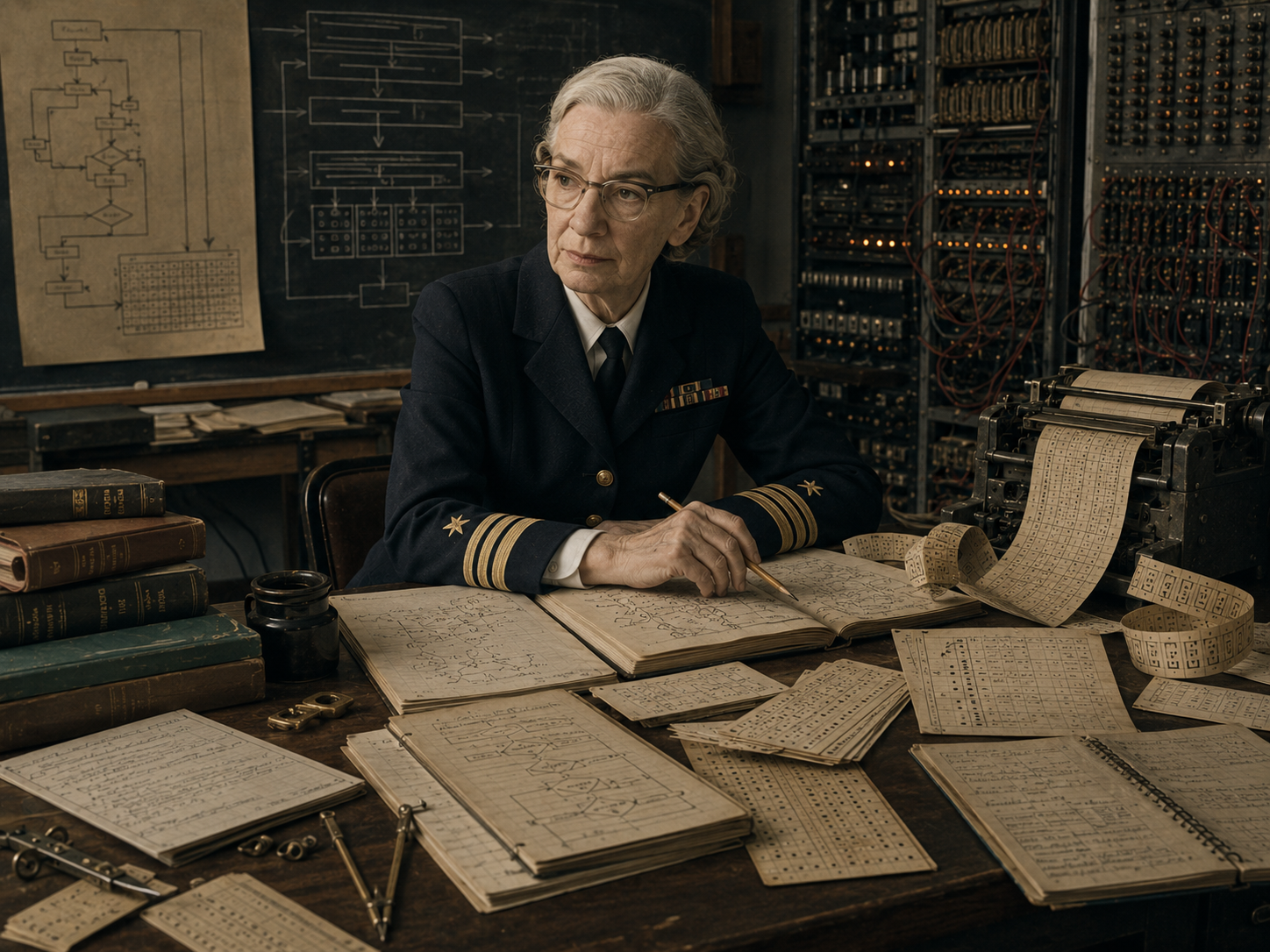
This article introduces Grace Hopper, compilers, automatic programming, A-0, A-2, UNIVAC, FLOW-MATIC, COBOL, machine-independent languages, high-level programming, English-like syntax, debugging, documentation, programming-language standards, compiler validation, business data processing, naval computing, software engineering, programming pedagogy, human-readable code, abstraction, translation, portability, institutional computing, and responsible computational reasoning. It argues that Hopper matters because she helped make programming a human practice: not merely machine instruction, but a mediated language between people, organizations, procedures, and computers.
Why Hopper Matters
Hopper matters because she helped make programming language-centered. Early electronic and electromechanical computers required deep knowledge of machine operation. Programming was close to hardware, wiring, addresses, numeric codes, and machine-specific procedure. Hopper’s compiler work helped move programming toward symbolic and human-readable systems.
This shift made modern software possible. Programmers could begin thinking in procedures, records, business operations, routines, and source language rather than only in machine instructions. The machine still required precise instructions, but the human did not always have to write those instructions at the lowest level.
| Dimension | Hopper’s relevance | Computational meaning |
|---|---|---|
| Compiler | Translates human-facing source into machine-executable form. | Language mediation. |
| Automatic programming | Automates routine parts of coding. | Abstraction and productivity. |
| English-like language | Brings code closer to institutional work. | Human-readable procedure. |
| Portability | Reduces dependence on one machine. | Machine independence. |
| Documentation | Makes systems teachable and maintainable. | Software culture. |
| Standards | Supports reliable use across institutions. | Governed software infrastructure. |
Hopper matters because she helped make programming a language practice, not only a machine practice.
From Machine Operation to Programming Language
The history of programming is partly a history of distance from the machine. Early programmers had to know exact operations, memory locations, switches, instruction formats, timing, and hardware constraints. That intimacy produced extraordinary technical work, but it limited who could program and how quickly programs could be written, maintained, and moved.
Programming languages changed this relationship. They created a symbolic layer between human intention and machine execution. That layer did not remove rigor. It relocated rigor into language design, compiler construction, syntax, semantics, testing, documentation, and standards.
| Programming layer | Human burden | Compiler/language contribution |
|---|---|---|
| Machine code | Write exact numeric instructions. | Direct execution. |
| Assembly | Use symbolic operation names and addresses. | Mnemonic abstraction. |
| Subroutine library | Reuse known routines. | Procedural reuse. |
| Compiler | Translate source expressions. | Automated translation. |
| High-level language | Write closer to problem domain. | Human-readable abstraction. |
| Standards | Move across institutions and machines. | Portability and reliability. |
Programming languages humanized computation by creating disciplined symbolic distance from hardware.
Harvard Mark I and Early Programming
Hopper began her computing career working with the Harvard Mark I, an electromechanical computer used during World War II. This work was practical, mathematical, procedural, and painstaking. Programs were not yet written in high-level languages. They were constructed through detailed understanding of machine operation and numerical procedure.
This early experience matters because Hopper’s later compiler vision came from direct contact with the difficulty of programming machines. She understood that human time, clarity, reuse, and reliability mattered. A machine could perform operations rapidly, but people still needed better ways to express the work.
| Early programming challenge | Problem | Later Hopper theme |
|---|---|---|
| Machine specificity | Programs tied closely to hardware. | Portability. |
| Long procedures | Programs difficult to inspect and maintain. | Documentation. |
| Manual operation | Human effort spent on routine translation. | Automatic programming. |
| Numerical codes | Hard for many users to read. | Human-readable language. |
| Limited reuse | Routines had to be reconstructed. | Subroutine libraries. |
| Debugging difficulty | Errors hard to locate and explain. | Software discipline. |
Hopper’s human-facing vision grew from the hard practical labor of early programming.
Automatic Programming
Automatic programming was an early term for what later became central to software development: using programs to help produce programs. A compiler is one form of automatic programming. It takes source instructions written in a higher-level form and translates them into machine-executable instructions.
The idea was controversial. Some engineers doubted that computers could translate human-facing instructions efficiently or reliably. Hopper’s work challenged that assumption. She argued, in effect, that machine time should be used to save human time, reduce routine work, and make computers more usable.
| Automatic programming idea | Human problem | Computational response |
|---|---|---|
| Reuse routines | Repeated coding of known procedures. | Subroutine libraries. |
| Symbolic calls | Hard-to-remember numeric references. | Named operations. |
| Source language | Machine code difficult to write. | Higher-level notation. |
| Translation | Manual conversion into machine instructions. | Compiler. |
| Validation | Need to trust generated code. | Testing and standards. |
| Maintenance | Programs persist over time. | Readable source and documentation. |
Automatic programming began as a radical claim: computers could help humans program computers.
The Compiler as Human-Machine Bridge
A compiler is a bridge between a source language and machine execution. It accepts a program in a language designed for human use, analyzes it, translates it, and produces code the machine can run. In doing so, it formalizes the relationship between human expression and mechanical procedure.
This bridge has two sides. On one side is human readability: names, statements, routines, records, procedures, and domain logic. On the other side is machine execution: instructions, memory, registers, control flow, and data representation. Compiler design is the disciplined construction of that bridge.
| Compiler layer | Purpose | Humanization effect |
|---|---|---|
| Lexical analysis | Recognize tokens. | Readable words and symbols become formal input. |
| Parsing | Analyze structure. | Human statements become grammatical forms. |
| Semantic analysis | Check meaning under language rules. | Errors become explainable. |
| Optimization | Improve generated code. | Machine efficiency without manual rewriting. |
| Code generation | Produce executable instructions. | Human source becomes machine action. |
| Diagnostics | Report problems. | Programming becomes teachable and correctable. |
The compiler is one of the most important human-machine interfaces in computing history.
A-0, A-2, and Subroutine Translation
Hopper’s A-0 system is often described as an early compiler or compiler-like system. It organized subroutines so that symbolic references could be translated into machine-usable routines. This was not yet a modern compiler in the full contemporary sense, but it was a major step toward automatic programming.
A-0 and related systems demonstrate a key principle: programming can be built from reusable components. If known routines can be named, stored, retrieved, and inserted, then programming becomes less about rewriting machine instructions and more about composing tested procedures.
| Compiler-like element | Role | Software significance |
|---|---|---|
| Subroutine | Reusable block of procedure. | Modularity. |
| Call number | Reference to a routine. | Symbolic selection. |
| Routine library | Collection of known procedures. | Reuse. |
| Translation | Map symbolic request to machine routine. | Automation. |
| Tape storage | Routines stored for retrieval. | Program infrastructure. |
| Automatic assembly | Build executable program from components. | Software construction. |
Hopper’s early compiler work helped make programming compositional.
FLOW-MATIC and English-Like Programming
FLOW-MATIC was one of Hopper’s most important contributions to English-like programming for business data processing. It reflected a crucial conviction: many users needed to express procedures in terms closer to their work. Business computing involved records, files, accounts, inventories, payrolls, transactions, and reports. A language for that world needed to be understandable to people who lived in that world.
This was a major shift. Programming language was no longer only a mathematical notation or machine instruction system. It could be a language of operations, records, movement, and institutional procedure.
| FLOW-MATIC principle | Human need | Programming-language effect |
|---|---|---|
| English-like statements | Readable procedure. | Accessible syntax. |
| Business vocabulary | Domain fit. | Problem-oriented language. |
| Data files | Organizational records. | File-processing logic. |
| Procedural clarity | Maintainable operations. | Structured expression. |
| Compilation | Machine execution from human-facing source. | Translation layer. |
| Institutional adoption | Shared language across organizations. | Standardization pathway. |
FLOW-MATIC helped demonstrate that programming languages could be organized around human work.
COBOL and Business Computation
COBOL extended Hopper’s vision into one of the most influential programming languages in business computing. It was designed for data processing, record handling, reports, and institutional procedure. Its English-like style was sometimes mocked, but that readability was part of its purpose.
COBOL matters because it helped bring computing into government, finance, insurance, payroll, administration, and commerce. It made programming legible to organizations that needed durable, auditable, record-oriented systems. It also shows that “humanization” often happens through bureaucracy: forms, records, standards, maintainability, and operational continuity.
| COBOL feature | Institutional role | Computational significance |
|---|---|---|
| English-like syntax | Readable by business users and maintainers. | Human-facing programming. |
| Record orientation | Matches administrative data. | Structured data processing. |
| File processing | Supports business workflows. | Operational computing. |
| Standardization | Used across machines and vendors. | Portability. |
| Long life | Programs survive for decades. | Maintenance culture. |
| Enterprise use | Supports institutional infrastructure. | Computing at organizational scale. |
COBOL’s history shows that programming languages are also infrastructures for institutions.
Machine Independence and Portability
One of Hopper’s most important ideas was machine independence. A program should not have to be rewritten from scratch for every machine. If a source language can be compiled for multiple systems, then programming becomes less dependent on a single hardware environment.
This idea underlies modern software. Portability, abstraction layers, compilers, interpreters, virtual machines, standard libraries, containers, and cross-platform frameworks all extend the principle that human-facing programs should not be unnecessarily trapped by hardware details.
| Portability issue | Human cost | Language/compiler response |
|---|---|---|
| Machine-specific code | Rewrite programs repeatedly. | Portable source language. |
| Vendor differences | Institutional lock-in. | Standards. |
| Instruction-set detail | Specialist knowledge required. | Compilation target abstraction. |
| Maintenance burden | Hard to update long-lived systems. | Readable source code. |
| Training burden | Programmers tied to machines. | Shared language education. |
| Institutional continuity | Systems must outlive hardware generations. | Language-level durability. |
Machine independence humanizes programming by letting people reason above the hardware layer when appropriate.
Documentation, Debugging, and Software Culture
Hopper’s legacy is also cultural. She wrote manuals, taught constantly, popularized vivid explanations, and helped shape the language of debugging. The famous moth found in the Harvard Mark II logbook was not the origin of the word “bug,” but it became a powerful artifact in computing culture. It made debugging memorable as a practice of finding and removing faults.
Documentation and debugging are part of the humanization of programming because they acknowledge that software is written, read, misunderstood, repaired, taught, and inherited. Programs are not only executed by machines. They are maintained by communities.
| Software culture practice | Human function | Computational value |
|---|---|---|
| Manuals | Teach use and operation. | Knowledge transfer. |
| Diagnostics | Explain failure. | Error correction. |
| Debugging | Locate and repair faults. | Reliability. |
| Examples | Show how to write programs. | Pedagogy. |
| Standards documents | Coordinate institutions. | Consistency. |
| Stories and metaphors | Make abstractions memorable. | Learning culture. |
Software becomes human when it can be explained, repaired, taught, and inherited.
Standards, Validation, and Institutional Computing
Hopper’s later career included work on programming-language standards, validation, and testing. This matters because human-facing programming is not just about writing nicer syntax. It is about trust. Institutions need to know whether compilers conform to specifications, whether programs behave predictably, and whether systems can be shared across vendors and agencies.
Standards make programming languages durable. Validation makes them governable. Compiler tests make language promises operational. This is a quieter but essential part of Hopper’s legacy.
| Institutional need | Software mechanism | Governance value |
|---|---|---|
| Consistency | Language standards. | Shared expectations. |
| Trust | Compiler validation. | Reliable translation. |
| Portability | Conformance testing. | Cross-system use. |
| Maintenance | Readable and standardized code. | Long-term operation. |
| Procurement | Vendor comparison. | Institutional accountability. |
| Auditability | Documented behavior. | Review and oversight. |
Hopper’s standards work shows that programming languages are governed infrastructures.
Humanization Without Simplification
It is tempting to say Hopper made programming “easy.” That is too simple. She made programming more human-facing, but not less rigorous. A compiler must still define syntax, check structure, translate reliably, handle errors, and preserve semantics. A high-level language must still be precise enough for machine execution.
Humanization means designing technical systems around human comprehension, work, maintenance, and collaboration. It means making the interface between people and machines clearer without pretending that computation is vague or informal.
| Humanization does not mean | Humanization does mean | Why it matters |
|---|---|---|
| No rigor. | Rigor expressed through usable language. | Programs must still be correct. |
| No machine constraints. | Machine constraints mediated by compilers. | Abstraction has limits. |
| No expertise. | Expertise distributed through tools and standards. | More people can participate. |
| Only natural language. | Formal languages closer to human domains. | Readable but precise. |
| Only convenience. | Maintainability, portability, and governance. | Software persists. |
| Magic translation. | Disciplined compiler construction. | Trust requires validation. |
Hopper’s legacy is not anti-technical. It is deeply technical human-centered computing.
Compilers and Abstraction
A compiler is an abstraction machine. It lets programmers express intent in one language while the system produces executable instructions in another. That does not eliminate lower layers. It hides them selectively and responsibly.
Abstraction is one of the main ways computational reasoning scales. People cannot reason productively about every voltage, register, instruction, memory address, library call, network packet, and operating-system detail at once. Programming languages create levels at which humans can think.
| Abstraction layer | What it hides | What it reveals |
|---|---|---|
| High-level statement | Machine instruction sequence. | Procedure. |
| Variable name | Memory address. | Meaningful role. |
| Data record | Storage layout. | Institutional object. |
| Function or routine | Internal steps. | Reusable behavior. |
| Compiler diagnostic | Machine failure mode. | Human-correctable error. |
| Standard language | Vendor-specific implementation. | Portable expression. |
Compilers make abstraction executable.
Programming Languages as Institutions
Programming languages are not only technical grammars. They are institutions: communities, standards bodies, vendors, textbooks, educators, maintainers, codebases, compilers, style conventions, libraries, and governance arrangements. COBOL’s longevity makes this visible.
A programming language persists when institutions keep it alive. Business systems, government agencies, banks, insurers, and payroll systems rely on languages, compilers, and maintainers. Hopper’s legacy therefore belongs not only to computer science but to institutional infrastructure.
| Language institution | Function | Example concern |
|---|---|---|
| Standard | Defines language expectations. | Conformance. |
| Compiler | Implements translation. | Correctness. |
| Community | Shares knowledge. | Training and maintenance. |
| Codebase | Embeds organizational history. | Legacy systems. |
| Vendor ecosystem | Provides tools. | Portability and lock-in. |
| Documentation | Preserves practice. | Institutional memory. |
A programming language becomes powerful when it becomes a shared institutional medium.
Hopper and Responsible Automation
Hopper’s work connects directly to responsible automation because compilers automate translation. They delegate part of programming to machines. That delegation is powerful, but it requires trust, validation, diagnostics, standards, and human review.
This matters for modern automation. The question is not whether machines should assist humans. They already do. The question is how assistance is structured: what is translated, what is checked, what is hidden, what is explained, who can inspect outputs, and who remains responsible.
| Automation question | Compiler-era version | Modern version |
|---|---|---|
| What is delegated? | Translation to machine code. | Code generation, model inference, workflow automation. |
| What is checked? | Syntax, structure, conformance. | Tests, audits, validation, evaluation. |
| What is hidden? | Machine instruction detail. | Infrastructure and model internals. |
| What is explained? | Compiler diagnostics. | Error reports and documentation. |
| Who is responsible? | Programmer, compiler writer, institution. | Developer, deployer, vendor, user. |
| What persists? | Source code and binaries. | Codebases, models, logs, decisions. |
Responsible automation begins with readable interfaces, reliable translation, and accountable use.
AI Code Generation and Hopper’s Legacy
AI code generation belongs to a long history of making programming more human-facing. Like compilers, AI tools translate from one form of expression into another. But the analogy has limits. A compiler translates according to formal language rules. AI code generation produces likely code based on statistical patterns. That code still requires review, testing, security analysis, licensing awareness, and human accountability.
Hopper’s legacy helps clarify the stakes. Human-facing programming tools are valuable when they make computation more understandable, maintainable, and reliable. They are dangerous when they hide too much, overpromise correctness, or encourage unreviewed automation.
| Tool | Translation model | Responsibility need |
|---|---|---|
| Compiler | Formal source language to target code. | Correct compiler and valid source. |
| Interpreter | Source executed through runtime. | Runtime behavior and environment. |
| Code generator | Templates or rules produce code. | Review generated artifacts. |
| AI coding assistant | Statistical generation from prompt and context. | Human review, tests, security checks. |
| Low-code system | Visual or form-based logic to executable workflow. | Audit hidden assumptions. |
| Automation platform | Human task description to workflow execution. | Govern effects and errors. |
Hopper’s lesson for AI is not “let machines program for us.” It is “build tools that make computation more accountable to human understanding.”
Examples of Hopper’s Programming Legacy
The examples below show how Hopper’s work reshaped software practice.
Compiler translation
Human-facing source language becomes machine-executable code through a formal translation system.
Automatic programming
Computers help perform routine parts of program construction.
Subroutine reuse
Known routines are named, stored, retrieved, and composed.
FLOW-MATIC
Business procedures move closer to English-like programming expression.
COBOL
Institutional data processing gains a readable, standardized programming language.
Debugging culture
Software work becomes a practice of diagnosis, repair, documentation, and learning.
Compiler validation
Translation systems become testable and governable.
AI coding caution
Modern code-generation tools extend the humanization problem while increasing accountability needs.
These examples show why Hopper belongs in the history of computational reasoning: she helped make formal machine behavior expressible through human-facing language systems.
Mathematics, Computation, and Modeling
A compiler can be modeled as a translation function:
Compiler(SourceProgram) = TargetProgram
\]
Interpretation: A compiler translates a source program into another representation suitable for execution or further processing.
A simplified compilation pipeline can be modeled as:
Source \rightarrow Tokens \rightarrow SyntaxTree \rightarrow CheckedProgram \rightarrow TargetCode
\]
Interpretation: Compilation proceeds through formal intermediate representations that make translation systematic.
Portability can be modeled as:
SourceProgram + Compiler_{Machine_i} \rightarrow Executable_{Machine_i}
\]
Interpretation: A shared source program can be translated for multiple machine environments when appropriate compilers exist.
Humanization can be modeled as a change in cognitive distance:
HumanWork \rightarrow SourceLanguage \rightarrow MachineExecution
\]
Interpretation: Programming languages mediate between human domains of work and machine-level procedure.
Compiler responsibility can be modeled as:
Trust = Specification + Translation + Testing + Diagnostics + Review
\]
Interpretation: Trust in programming tools depends on formal rules, reliable translation, testing, explainable errors, and human oversight.
These formulas are simplified teaching models. They clarify Hopper’s contribution without replacing compiler theory, programming-language semantics, software engineering, or institutional software governance.
Python Workflow: Compiler Humanization Map
The Python workflow below creates a dependency-light interpretive map of Hopper’s programming legacy. It scores themes by compiler centrality, human readability, portability, documentation, standards, debugging, business relevance, institutional scale, abstraction, and governance caution, then writes reproducible CSV and JSON outputs.
# grace_hopper_compiler_humanization_map.py
# Dependency-light workflow for mapping Hopper's compilers and humanization of programming.

from __future__ import annotations

from dataclasses import asdict, dataclass
from pathlib import Path
from statistics import mean
import csv
import json
from datetime import datetime, timezone

ARTICLE_ROOT = Path(__file__).resolve().parents[1]
TABLES = ARTICLE_ROOT / "outputs" / "tables"
JSON_DIR = ARTICLE_ROOT / "outputs" / "json"


@dataclass(frozen=True)
class HopperConfig:
    article: str = "grace_hopper_compilers_and_the_humanization_of_programming"
    core_threshold: float = 0.80
    high_compiler_threshold: float = 0.86


def timestamp_utc() -> str:
    return datetime.now(timezone.utc).isoformat()


def write_csv(path: Path, rows: list[dict[str, object]]) -> None:
    path.parent.mkdir(parents=True, exist_ok=True)
    if not rows:
        path.write_text("", encoding="utf-8")
        return
    fieldnames = sorted({key for row in rows for key in row.keys()})
    with path.open("w", newline="", encoding="utf-8") as handle:
        writer = csv.DictWriter(handle, fieldnames=fieldnames, extrasaction="ignore")
        writer.writeheader()
        writer.writerows(rows)


def write_json(path: Path, payload: object) -> None:
    path.parent.mkdir(parents=True, exist_ok=True)
    path.write_text(json.dumps(payload, indent=2, sort_keys=True), encoding="utf-8")


def hopper_themes() -> list[dict[str, object]]:
    return [
        {"theme_id": "compiler_as_bridge", "compiler_centrality": 0.98, "human_readability": 0.96, "portability": 0.92, "documentation": 0.90, "standards": 0.88, "debugging": 0.86, "business_relevance": 0.88, "institutional_scale": 0.92, "abstraction": 0.98, "governance_caution": 0.90},
        {"theme_id": "automatic_programming", "compiler_centrality": 0.96, "human_readability": 0.90, "portability": 0.90, "documentation": 0.84, "standards": 0.82, "debugging": 0.82, "business_relevance": 0.84, "institutional_scale": 0.88, "abstraction": 0.96, "governance_caution": 0.86},
        {"theme_id": "a0_a2_subroutine_translation", "compiler_centrality": 0.94, "human_readability": 0.84, "portability": 0.86, "documentation": 0.84, "standards": 0.78, "debugging": 0.80, "business_relevance": 0.82, "institutional_scale": 0.86, "abstraction": 0.92, "governance_caution": 0.84},
        {"theme_id": "flow_matic_english_like_programming", "compiler_centrality": 0.94, "human_readability": 0.98, "portability": 0.88, "documentation": 0.88, "standards": 0.86, "debugging": 0.84, "business_relevance": 0.98, "institutional_scale": 0.94, "abstraction": 0.94, "governance_caution": 0.88},
        {"theme_id": "cobol_business_computation", "compiler_centrality": 0.90, "human_readability": 0.98, "portability": 0.94, "documentation": 0.92, "standards": 0.98, "debugging": 0.88, "business_relevance": 0.98, "institutional_scale": 0.98, "abstraction": 0.92, "governance_caution": 0.92},
        {"theme_id": "documentation_debugging_culture", "compiler_centrality": 0.82, "human_readability": 0.92, "portability": 0.82, "documentation": 0.98, "standards": 0.90, "debugging": 0.98, "business_relevance": 0.86, "institutional_scale": 0.92, "abstraction": 0.86, "governance_caution": 0.92},
        {"theme_id": "standards_validation_institutional_computing", "compiler_centrality": 0.88, "human_readability": 0.88, "portability": 0.98, "documentation": 0.94, "standards": 0.98, "debugging": 0.90, "business_relevance": 0.94, "institutional_scale": 0.98, "abstraction": 0.90, "governance_caution": 0.98},
        {"theme_id": "ai_code_generation_caution", "compiler_centrality": 0.82, "human_readability": 0.94, "portability": 0.86, "documentation": 0.92, "standards": 0.88, "debugging": 0.94, "business_relevance": 0.88, "institutional_scale": 0.94, "abstraction": 0.96, "governance_caution": 0.98},
    ]


def score_theme(row: dict[str, object], config: HopperConfig) -> dict[str, object]:
    humanization_score = mean([
        float(row["compiler_centrality"]),
        float(row["human_readability"]),
        float(row["portability"]),
        float(row["documentation"]),
        float(row["standards"]),
        float(row["debugging"]),
        float(row["business_relevance"]),
        float(row["institutional_scale"]),
        float(row["abstraction"]),
        float(row["governance_caution"]),
    ])

    if humanization_score >= config.core_threshold and float(row["compiler_centrality"]) >= config.high_compiler_threshold:
        interpretive_status = "core_hopper_compiler_humanization_thread"
    elif humanization_score >= config.core_threshold:
        interpretive_status = "major_hopper_compiler_humanization_thread"
    else:
        interpretive_status = "supporting_hopper_compiler_humanization_thread"

    return {
        "theme_id": row["theme_id"],
        "compiler_centrality": round(float(row["compiler_centrality"]), 6),
        "human_readability": round(float(row["human_readability"]), 6),
        "portability": round(float(row["portability"]), 6),
        "documentation": round(float(row["documentation"]), 6),
        "standards": round(float(row["standards"]), 6),
        "debugging": round(float(row["debugging"]), 6),
        "business_relevance": round(float(row["business_relevance"]), 6),
        "institutional_scale": round(float(row["institutional_scale"]), 6),
        "abstraction": round(float(row["abstraction"]), 6),
        "governance_caution": round(float(row["governance_caution"]), 6),
        "humanization_score": round(humanization_score, 6),
        "interpretive_status": interpretive_status,
    }


def interpretation_cautions() -> list[dict[str, str]]:
    return [
        {"caution": "do_not_treat_humanization_as_lack_of_rigor", "meaning": "Human-facing programming still requires formal syntax, semantics, testing, and validation."},
        {"caution": "do_not_tell_a_single_inventor_story", "meaning": "COBOL and programming languages emerged through teams, standards committees, vendors, and institutions."},
        {"caution": "do_not_confuse_compilers_with_ai_code_generation", "meaning": "Compilers translate formal languages; AI coding tools generate statistically likely code that still requires review."},
        {"caution": "do_not_ignore_maintenance", "meaning": "Human-readable languages matter because code persists over decades."},
        {"caution": "do_not_hide_machine_constraints", "meaning": "Abstraction mediates hardware constraints; it does not abolish them."},
    ]


def main() -> None:
    config = HopperConfig()
    themes = hopper_themes()
    scored = [score_theme(row, config) for row in themes]
    cautions = interpretation_cautions()

    summary = {
        "article": config.article,
        "timestamp_utc": timestamp_utc(),
        "themes_reviewed": len(scored),
        "core_threads": sum(1 for row in scored if row["interpretive_status"] == "core_hopper_compiler_humanization_thread"),
        "major_threads": sum(1 for row in scored if row["interpretive_status"] == "major_hopper_compiler_humanization_thread"),
        "supporting_threads": sum(1 for row in scored if row["interpretive_status"] == "supporting_hopper_compiler_humanization_thread"),
        "mean_humanization_score": round(mean(float(row["humanization_score"]) for row in scored), 6),
        "cautions": len(cautions),
        "interpretation": "Hopper should be studied as a pioneer of compiler-mediated programming, human-readable source language, machine independence, standards, documentation, and accountable automation.",
    }

    write_csv(TABLES / "hopper_themes.csv", themes)
    write_csv(TABLES / "hopper_compiler_humanization_map.csv", scored)
    write_csv(TABLES / "interpretation_cautions.csv", cautions)
    write_csv(TABLES / "hopper_compiler_humanization_summary.csv", [summary])

    write_json(JSON_DIR / "hopper_config.json", asdict(config))
    write_json(JSON_DIR / "hopper_compiler_humanization_map.json", scored)
    write_json(JSON_DIR / "interpretation_cautions.json", cautions)
    write_json(JSON_DIR / "hopper_compiler_humanization_summary.json", summary)

    print("Hopper compiler humanization map complete.")
    print(TABLES / "hopper_compiler_humanization_summary.csv")


if __name__ == "__main__":
    main()
This workflow turns Hopper’s programming-language legacy into a reproducible interpretive artifact: compiler centrality, human readability, portability, documentation, standards, debugging, business relevance, institutional scale, abstraction, and governance caution are documented together.
R Workflow: Programming-Language Diagnostics
The R workflow reads the generated CSV outputs, summarizes Hopper themes, visualizes dimensions, and writes an additional diagnostic table.
# grace_hopper_compiler_humanization_summary.R
args <- commandArgs(trailingOnly = FALSE)
file_arg <- grep("^--file=", args, value = TRUE)

if (length(file_arg) > 0) {
  script_path <- normalizePath(sub("^--file=", "", file_arg[1]), mustWork = TRUE)
  article_root <- normalizePath(file.path(dirname(script_path), ".."), mustWork = TRUE)
} else {
  article_root <- getwd()
}

setwd(article_root)

tables_dir <- file.path(article_root, "outputs", "tables")
figures_dir <- file.path(article_root, "outputs", "figures")
dir.create(tables_dir, recursive = TRUE, showWarnings = FALSE)
dir.create(figures_dir, recursive = TRUE, showWarnings = FALSE)

map_path <- file.path(tables_dir, "hopper_compiler_humanization_map.csv")
summary_path <- file.path(tables_dir, "hopper_compiler_humanization_summary.csv")

if (!file.exists(map_path)) {
  stop(paste("Missing", map_path, "Run the Python workflow first."))
}

hopper_map <- read.csv(map_path, stringsAsFactors = FALSE)
summary <- read.csv(summary_path, stringsAsFactors = FALSE)

png(file.path(figures_dir, "hopper_compiler_humanization_dimensions.png"), width = 1200, height = 850)
score_matrix <- t(as.matrix(hopper_map[, c("compiler_centrality", "human_readability", "portability", "documentation", "standards", "debugging", "business_relevance", "institutional_scale", "abstraction", "governance_caution")]))
barplot(score_matrix,
        beside = TRUE,
        names.arg = hopper_map$theme_id,
        las = 2,
        ylim = c(0, 1),
        ylab = "Interpretive Score",
        main = "Grace Hopper, Compilers, and the Humanization of Programming")
legend("bottomright",
       legend = rownames(score_matrix),
       cex = 0.68,
       bty = "n")
grid()
dev.off()

png(file.path(figures_dir, "hopper_humanization_score_by_theme.png"), width = 1000, height = 750)
barplot(hopper_map$humanization_score,
        names.arg = hopper_map$theme_id,
        las = 2,
        ylab = "Programming Humanization Score",
        main = "Hopper Compiler Humanization Score by Theme")
grid()
dev.off()

r_summary <- data.frame(
  themes_reviewed = summary$themes_reviewed[1],
  core_threads = summary$core_threads[1],
  major_threads = summary$major_threads[1],
  supporting_threads = summary$supporting_threads[1],
  mean_humanization_score = summary$mean_humanization_score[1],
  cautions = summary$cautions[1],
  diagnostic_note = "Hopper should be studied as a pioneer of compiler-mediated programming, human-readable source language, machine independence, standards, documentation, and accountable automation."
)

write.csv(r_summary, file.path(tables_dir, "r_hopper_humanization_diagnostic_summary.csv"), row.names = FALSE)
print(r_summary)
The R layer makes the interpretive structure visible: compiler centrality, human readability, portability, documentation, standards, debugging, business relevance, institutional scale, abstraction, and governance caution can be compared across themes.
GitHub Repository
The companion repository contains reproducible workflows, synthetic interpretive data, outputs, calculators, documentation, and multilingual examples for this article.
Complete Code Repository
Companion article folder with Python, R, Julia, SQL, Haskell, C, C++, Fortran, Rust, Go, Java, TypeScript, Prolog, Racket, notebooks, documentation, synthetic teaching data, generated outputs, schemas, calculators, and Canvas-ready workflow artifacts for Grace Hopper, compilers, automatic programming, A-0, A-2, UNIVAC, FLOW-MATIC, COBOL, machine-independent languages, human-readable code, documentation, debugging, compiler validation, programming-language standards, institutional computing, AI code-generation caution, and responsible software automation.
A Practical Method for Studying Hopper
A careful study of Hopper asks how compilers, languages, documentation, standards, and institutions made programming more human-facing.
| Step | Historical action | Output |
|---|---|---|
| 1 | Begin with early machine-specific programming. | Machine burden map. |
| 2 | Study automatic programming as an attempt to save human effort. | Automation profile. |
| 3 | Analyze the compiler as a translation system. | Compiler pipeline. |
| 4 | Connect A-0 and A-2 to subroutine reuse. | Reuse model. |
| 5 | Study FLOW-MATIC as human-readable business programming. | Domain-language map. |
| 6 | Analyze COBOL as institutional infrastructure. | Language institution profile. |
| 7 | Trace documentation, debugging, standards, and validation. | Software culture map. |
| 8 | Compare compiler automation with AI code-generation tools. | Responsible automation review. |
This method keeps Hopper’s legacy technical, institutional, and human-centered at once.
Common Pitfalls
The first pitfall is treating humanization as lack of rigor. The second is telling a lone-inventor story. The third is confusing compilers with AI code generation. The fourth is ignoring maintenance. The fifth is pretending abstraction eliminates machine constraints.
| Pitfall | Why it matters | Better practice |
|---|---|---|
| Humanization as simplification | Understates compiler rigor. | Show syntax, semantics, testing, and validation. |
| Lone-inventor story | Erases teams, committees, and institutions. | Credit Hopper and collaborative language history. |
| COBOL nostalgia only | Misses institutional infrastructure. | Discuss standards, maintenance, and business systems. |
| Compiler equals AI generator | Misstates translation mechanisms. | Distinguish formal translation from probabilistic generation. |
| Readable means correct | Readable code can still fail. | Use tests, validation, and review. |
| Abstraction hides everything | Machine constraints still matter. | Teach abstraction boundaries. |
Hopper is most useful when human-facing programming is treated as rigorous, maintained, and governed.
Why Hopper Still Matters
Grace Hopper still matters because programming is a human-machine language problem. Computers execute formal instructions, but humans need ways to express, inspect, maintain, teach, and govern those instructions. Hopper’s compiler work helped create that bridge.
Her legacy is visible every time a programmer writes in a high-level language, reads a compiler error, reuses a library, relies on a standard, maintains a legacy system, or trusts a tool to translate source into execution. It is also visible in modern AI coding tools, where the dream of human-facing programming returns with new risks.
For computational reasoning, Hopper adds a crucial layer. Church gives functions. Turing gives machines. Von Neumann gives architecture. Shannon gives information. Wiener gives feedback. Hopper gives programming language as human mediation. She reminds us that the future of computation depends not only on what machines can do, but on how responsibly people can tell machines what to do. AI belongs in the toolkit, not in control.
Related Articles
- Norbert Wiener, Cybernetics, and Feedback in Computation
- Warren McCulloch, Walter Pitts, and Neural Logic
- Alan Turing, Computation, and the Machine Model of Reasoning
- Ada Lovelace, Programming, and the Imagination of Computation
- AI Agents, Tool Use, and Procedural Autonomy
Further Reading
- Yale University (n.d.) ‘Biography of Grace Murray Hopper’.
- Computer History Museum (n.d.) ‘Grace Murray Hopper’.
- Smithsonian National Museum of American History (n.d.) ‘Log Book With Computer Bug’.
- IEEE Engineering and Technology History Wiki (2024) ‘A-0 Compiler and Initial Development of Automatic Programming, 1951–1952’.
- ACM (n.d.) ‘A.M. Turing Award’.
- Beyer, K.W. (2009) Grace Hopper and the Invention of the Information Age. Cambridge, MA: MIT Press.
- Williams, K.B. (2004) Grace Hopper: Admiral of the Cyber Sea. Annapolis: Naval Institute Press.
- Ceruzzi, P.E. (2003) A History of Modern Computing. 2nd edn. Cambridge, MA: MIT Press.
References
- ACM (n.d.) ‘A.M. Turing Award’. Available at: https://awards.acm.org/turing.
- Beyer, K.W. (2009) Grace Hopper and the Invention of the Information Age. Cambridge, MA: MIT Press.
- Ceruzzi, P.E. (2003) A History of Modern Computing. 2nd edn. Cambridge, MA: MIT Press.
- Computer History Museum (n.d.) ‘Grace Murray Hopper’. Available at: https://computerhistory.org/profile/grace-murray-hopper/.
- IEEE Engineering and Technology History Wiki (2024) ‘A-0 Compiler and Initial Development of Automatic Programming, 1951–1952’. Available at: https://ethw.org/Milestones%3AA-0_Compiler_and_Initial_Development_of_Automatic_Programming%2C_1951-1952.
- Smithsonian National Museum of American History (n.d.) ‘Log Book With Computer Bug’. Available at: https://americanhistory.si.edu/collections/object/nmah_334663.
- Williams, K.B. (2004) Grace Hopper: Admiral of the Cyber Sea. Annapolis: Naval Institute Press.
- Yale University (n.d.) ‘Biography of Grace Murray Hopper’. Available at: https://president.yale.edu/biography-grace-murray-hopper.