
Last Updated June 23, 2026
The History of Programming Languages examines how human beings learned to express computational ideas in forms that machines could execute and people could understand. Programming languages are not only technical tools. They are intellectual frameworks. They shape what kinds of procedures are easy to express, what kinds of errors are likely, what kinds of abstractions feel natural, and what kinds of institutions can build, maintain, and govern software.
The history begins before modern software. Mathematical notation, mechanical control, symbolic logic, machine instructions, punched cards, and early automatic coding all contributed to the idea that a procedure could be written in a formal language. But modern programming-language history became recognizable when languages began to mediate between human reasoning and machine execution: assembly, Fortran, Lisp, ALGOL, COBOL, BASIC, Pascal, C, Smalltalk, Prolog, ML, SQL, Ada, C++, Python, Java, JavaScript, R, Haskell, Rust, Julia, TypeScript, and many others each carried different assumptions about computation.
This article treats programming languages as a history of expression. A language is not merely syntax. It is a model of computation, a memory of hardware constraints, a theory of abstraction, a pedagogy for beginners, a tool for institutions, a social contract for teams, and sometimes an ideology about how programs should be written. To understand programming languages historically is to understand how computation became a human practice.
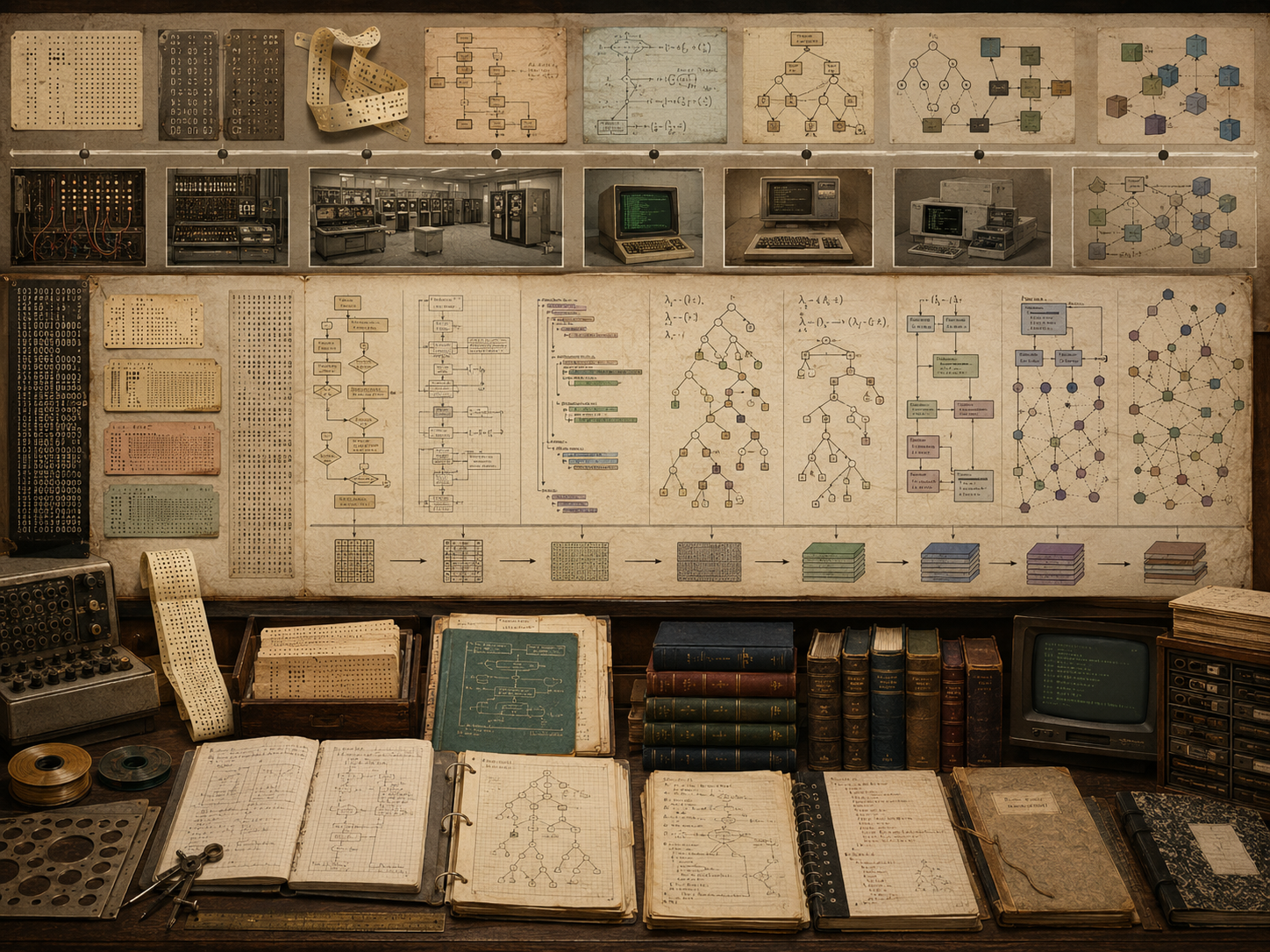
This article introduces the history of programming languages, assembly language, automatic coding, Fortran, Lisp, ALGOL, COBOL, BASIC, PL/I, Simula, Pascal, C, Smalltalk, Prolog, ML, SQL, Ada, C++, Objective-C, Perl, Python, Java, JavaScript, PHP, R, Ruby, Haskell, C#, Scala, Go, Rust, Swift, Julia, TypeScript, domain-specific languages, functional programming, logic programming, object-oriented programming, scripting, type systems, compilers, interpreters, virtual machines, runtime systems, language standards, package ecosystems, software governance, AI code generation, and responsible computational reasoning. It argues that programming-language history is not a simple march toward newer syntax. It is a layered history of abstraction, performance, portability, human readability, institutional need, and the continuing struggle to make computation expressible.
Why Programming-Language History Matters
Programming-language history matters because languages determine the practical grammar of computational thought. A language makes some ideas easy, others awkward, and others nearly invisible. It shapes how programmers describe data, control, state, functions, objects, relations, processes, types, errors, concurrency, and communication.
A programming language is also a social artifact. It has textbooks, compilers, standards, libraries, idioms, conferences, package managers, style guides, job markets, legacy systems, and communities. A language succeeds not only because of elegant design, but because it fits machines, institutions, users, economics, and time.
| Historical dimension | Programming-language question | Computational meaning |
|---|---|---|
| Expression | What can users say naturally? | Abstraction and readability. |
| Execution | How does language become machine action? | Compilation and interpretation. |
| Representation | How are data and structures modeled? | Memory and meaning. |
| Control | How is procedure organized? | Loops, recursion, events, concurrency. |
| Safety | What errors are prevented or exposed? | Types, checks, ownership, contracts. |
| Institution | Who uses the language and why? | Adoption and governance. |
Programming-language history is the history of how computation became writable by different communities.
Before Programming Languages
Programming languages emerged from older traditions of notation, procedure, and control. Mathematical notation allowed symbolic compression. Tables organized calculation. Mechanical devices encoded repeated action. Logic formalized inference. Punched cards made patterns machine-readable. Early computers required instructions that were close to hardware.
This prehistory matters because programming languages did not appear from nowhere. They inherited ideas from algebra, logic, calculation, textile control, office tabulation, engineering notation, and mathematical proof. The language of computation was built from many earlier forms of representation.
| Pre-language tradition | Contribution | Programming-language inheritance |
|---|---|---|
| Mathematical notation | Compact symbolic expression. | Variables, formulas, functions. |
| Algorithmic procedure | Stepwise rules. | Programs as formal instructions. |
| Mechanical control | Encoded repeated action. | Automation and sequencing. |
| Punched cards | Machine-readable patterns. | Input, storage, and batch workflows. |
| Symbolic logic | Formal inference. | Types, proofs, logic programming. |
| Machine architecture | Instructions and memory. | Assembly, registers, control flow. |
Programming languages formalized older dreams of symbolic procedure and mechanical execution.
Machine Code, Assembly, and Automatic Coding
Before high-level languages, programmers often worked directly with machine instructions or symbolic assembly languages. Assembly improved human readability by allowing names and mnemonics, but it remained closely tied to machine architecture. Memory addresses, registers, instructions, and control flow were still central.
Automatic coding systems and early assemblers began to shift work from human programmers into translators. This transition was crucial. Once programmers accepted that a program could be written in one form and translated into another, high-level languages became imaginable.
| Layer | Human benefit | Remaining limitation |
|---|---|---|
| Machine code | Direct execution. | Difficult for humans to write and maintain. |
| Assembly language | Symbolic names and mnemonics. | Machine-specific thinking. |
| Assembler | Symbolic translation. | Low-level control remains dominant. |
| Automatic coding | Some routine translation automated. | Limited abstraction. |
| Compiler | High-level language to machine code. | Requires trust in translation. |
| Runtime system | Support during execution. | Language and environment become linked. |
The move from machine code to language was also a move from manual instruction craft to mediated expression.
Fortran and Scientific Expression
Fortran made high-level scientific programming practical. It allowed mathematical formulas, variables, loops, arrays, and subroutines to be written in a form closer to scientific work. Its compiler translated those source programs into efficient machine instructions.
Fortran mattered because it solved a specific historical problem: scientists and engineers needed computing power without writing every detail in machine language. The language’s success depended on performance credibility. High-level expression had to be fast enough to be trusted in numerical work.
| Fortran feature | Scientific value | Historical significance |
|---|---|---|
| Formula translation | Mathematical notation becomes source code. | High-level scientific expression. |
| Arrays | Represent vectors, matrices, and grids. | Numerical computing. |
| Loops | Repeat calculations over data. | Simulation and iteration. |
| Subroutines | Reuse numerical procedures. | Library culture. |
| Compiler optimization | Preserve performance. | Trust in abstraction. |
| Portability | Source can outlive machines. | Scientific software continuity. |
Fortran proved that high-level programming could serve serious scientific computation.
Lisp and Symbolic Computation
Lisp introduced another vision of programming. Where Fortran emphasized numerical scientific calculation, Lisp emphasized symbolic computation, lists, recursion, functions, and programs as manipulable structures. It became central to artificial intelligence research, language theory, symbolic processing, and functional programming traditions.
Lisp is historically important because it blurred the boundary between data and program. Code could be represented as symbolic structures. This gave Lisp unusual expressive power for metaprogramming, interpreters, macros, symbolic reasoning, and experimental language design.
| Lisp idea | Computational meaning | Historical influence |
|---|---|---|
| Lists | Recursive symbolic data. | Symbolic processing. |
| Functions | Computation as application. | Functional programming. |
| Recursion | Self-referential procedure. | Tree and symbolic algorithms. |
| Code as data | Programs can be manipulated. | Macros and metaprogramming. |
| Interactive development | Programs evolve in dialogue. | Exploratory computing. |
| AI research | Symbolic reasoning and representation. | Knowledge systems. |
Lisp made programming languages a laboratory for symbolic thought.
ALGOL and Structured Language Design
ALGOL shaped the vocabulary of programming-language design. It influenced block structure, lexical scoping, formal language description, recursive procedures, and the notation used to describe programming languages. ALGOL was not as commercially dominant as some other languages, but its intellectual influence was immense.
ALGOL matters because it showed that language design could be a formal, international, and theoretical project. It influenced Pascal, C, many later imperative languages, and the use of formal grammar notations in language specification.
| ALGOL contribution | Language-design meaning | Later influence |
|---|---|---|
| Block structure | Programs organized into nested regions. | Structured programming. |
| Lexical scope | Names have controlled visibility. | Modern language semantics. |
| Recursive procedures | Procedures can call themselves. | Algorithmic expression. |
| Formal syntax description | Language can be specified precisely. | Compiler design and standards. |
| International design | Language as shared scientific project. | Formal language culture. |
| Influence over adoption | Ideas outlast market share. | Language lineage. |
ALGOL demonstrated that programming languages could be designed as formal intellectual systems.
COBOL and Institutional Data Processing
COBOL represents the institutional side of programming-language history. It was designed for business data processing, records, reports, files, payrolls, banking, insurance, government administration, and large organizational systems.
COBOL’s importance is often underestimated because its style differs from academic language traditions. But institutional computing is a major part of computing history. Organizations needed languages that supported records, decimal arithmetic, readable business logic, and long-term maintenance.
| COBOL concern | Institutional need | Historical meaning |
|---|---|---|
| Records | Structured business data. | Data-processing language. |
| Files | Persistent institutional storage. | Administrative computing. |
| Reports | Human-readable output. | Organizational communication. |
| Decimal arithmetic | Financial calculation. | Business correctness. |
| English-like syntax | Readability for institutions. | Maintenance culture. |
| Longevity | Systems persist for decades. | Software as infrastructure. |
COBOL reminds us that programming languages serve institutions, not only scientists and theorists.
BASIC and Programming for Beginners
BASIC made programming accessible to students, hobbyists, and non-specialists. It belongs to the history of computing education and personal computing. Its importance lies less in formal elegance and more in lowering the barrier to entry.
A language for beginners has a different mission from a language for systems programming or formal proof. It must make early success possible. It must support experimentation. It must make computation feel approachable. BASIC helped create generations of people who first encountered computing through direct interaction and small programs.
| BASIC dimension | Educational role | Computational effect |
|---|---|---|
| Simple syntax | Reduce entry barrier. | Beginner access. |
| Interactive use | Immediate feedback. | Exploration. |
| Small programs | Learn by doing. | Procedural literacy. |
| Personal computing | Bring programming to individuals. | Computer culture. |
| Educational adoption | Teach programming concepts. | Mass exposure. |
| Limitations | Can encourage poor structure. | Pedagogical tradeoff. |
BASIC made programming feel possible for people who were not already specialists.
Pascal, C, and Systems Programming
Pascal and C show two different paths out of structured programming. Pascal emphasized teaching, structure, and clarity. C emphasized systems programming, portability across machines, and close control over memory and hardware. Both shaped generations of programmers.
C became especially influential because it fit operating systems, compilers, embedded systems, libraries, and performance-critical software. It provided abstraction above assembly while preserving low-level power. This combination made it a foundation for Unix, C++, Objective-C, many runtime systems, and later language implementations.
| Language | Core emphasis | Historical influence |
|---|---|---|
| Pascal | Structured programming and teaching. | Educational discipline. |
| C | Systems programming and portability. | Operating systems and infrastructure. |
| Unix/C relationship | Language and operating system co-evolve. | Software platform culture. |
| Memory control | Programmers manage representation. | Power and risk. |
| Procedural abstraction | Functions and modules organize code. | Portable systems software. |
| Language descendants | C influences many later languages. | Syntax and semantics lineage. |
C showed that a high-level language could remain close enough to hardware to build the software world.
Simula, Smalltalk, and Object-Oriented Programming
Object-oriented programming emerged from simulation, modeling, and human-computer interaction as much as from software engineering. Simula introduced classes and objects in the context of simulation. Smalltalk made objects part of a broader vision of interactive personal computing and message-passing systems.
Object orientation changed how programmers thought about state and behavior. Instead of seeing programs only as procedures acting on data, object-oriented languages encouraged programmers to model interacting entities with internal state and methods.
| Object-oriented idea | Meaning | Historical role |
|---|---|---|
| Object | Entity with state and behavior. | Modeling and modularity. |
| Class | Template or category for objects. | Abstraction and reuse. |
| Message passing | Interaction among objects. | Dynamic systems thinking. |
| Inheritance | Reuse and specialization. | Design hierarchy. |
| Encapsulation | Hide internal state. | Software boundaries. |
| Simulation | Model interacting systems. | Systems representation. |
Object-oriented languages turned programming toward modeled worlds of interacting entities.
Prolog, ML, and Declarative Traditions
Declarative languages ask programmers to specify relationships, rules, types, constraints, or expressions rather than spelling out every control step. Prolog represents logic programming: computation as inference over facts and rules. ML represents strongly typed functional programming: computation through expressions, functions, and type inference.
These traditions matter because they show that imperative programming is not the only model. Programs can be written as logic, as equations, as transformations, as constraints, or as typed expressions. Each style changes how programmers think about correctness and control.
| Declarative tradition | Core idea | Computational value |
|---|---|---|
| Prolog | Facts, rules, and queries. | Logical inference. |
| ML | Typed functional expressions. | Type inference and abstraction. |
| Functional programming | Functions and immutability. | Compositional reasoning. |
| Logic programming | Relations rather than commands. | Constraint and symbolic reasoning. |
| Pattern matching | Decompose structured data. | Readable case analysis. |
| Type systems | Static reasoning about programs. | Error prevention. |
Declarative languages reveal alternative ways to express computation beyond step-by-step command.
SQL and Database Languages
SQL changed programming-language history by making data querying a mainstream language activity. It is declarative: users describe what data they want, while the database system decides how to retrieve it. This is a different form of abstraction from procedural programming.
Database languages matter because modern institutions depend on data. Records, transactions, joins, constraints, schemas, and queries form the backbone of business, government, science, logistics, health care, finance, and web platforms.
| SQL idea | Meaning | Institutional value |
|---|---|---|
| Relation | Data organized as tables. | Structured records. |
| Query | Specify desired results. | Declarative access. |
| Join | Combine related tables. | Institutional integration. |
| Constraint | Protect data integrity. | Governance and correctness. |
| Transaction | Reliable state change. | Operational trust. |
| Optimization | System chooses execution plan. | Performance abstraction. |
SQL made declarative data work central to modern computing.
C++, Java, and Managed Platforms
C++ extended C with object-oriented and generic programming while preserving systems-level control. Java emphasized portability through a virtual machine, managed memory, object-oriented design, and enterprise software development. These languages show how programming-language history moved from individual machines toward platforms.
A managed platform changes the meaning of programming. The programmer writes for a language runtime, virtual machine, standard library, and ecosystem. The language is no longer only syntax and compiler. It is a governed execution environment.
| Language/platform idea | Role | Historical meaning |
|---|---|---|
| C++ | Systems-level abstraction and performance. | Complex software engineering. |
| Templates | Generic programming. | Compile-time abstraction. |
| Java | Virtual-machine portability. | Managed platform computing. |
| Garbage collection | Automated memory management. | Safety and productivity tradeoff. |
| Standard libraries | Shared infrastructure. | Ecosystem power. |
| Enterprise adoption | Large institutional systems. | Software as organization. |
C++ and Java show programming languages becoming infrastructure for large software ecosystems.
Scripting, Web, and Glue Languages
Scripting languages changed the pace and style of programming. Perl, Python, Ruby, PHP, JavaScript, and shell languages made it easier to automate tasks, connect systems, process text, build websites, and glue software components together.
The web amplified this change. JavaScript became a universal browser language and later a server-side platform. PHP powered dynamic websites. Scripting languages supported rapid iteration, deployment, and integration. They also raised new questions about maintainability, testing, and scale.
| Scripting/web feature | Programming value | Historical effect |
|---|---|---|
| Interactive development | Fast feedback. | Rapid experimentation. |
| Text processing | Manipulate files and streams. | Automation culture. |
| Glue code | Connect tools and systems. | Integration workflows. |
| Web scripting | Dynamic pages and applications. | Internet software. |
| Package ecosystems | Reusable libraries. | Community scaling. |
| Maintainability pressure | Rapid code can grow complex. | Testing and architecture needs. |
Scripting languages made programming faster, more connective, and more widespread.
Python, R, Julia, and Computational Workflows
Python, R, and Julia are central to modern scientific, statistical, data, and AI workflows. Python became a general-purpose language with strong library ecosystems for data science, machine learning, automation, and web services. R became a statistical computing environment and language. Julia was designed to combine high-level numerical expression with high performance.
These languages reflect a major shift: programming is increasingly organized around workflows. A computational project may combine notebooks, packages, scripts, dataframes, visualizations, models, APIs, and reproducible outputs. Language history becomes workflow history.
| Language | Workflow role | Computational significance |
|---|---|---|
| Python | General-purpose glue, data, AI, automation. | Broad ecosystem. |
| R | Statistics, modeling, visualization. | Analytical language culture. |
| Julia | High-level numerical performance. | Scientific computing abstraction. |
| Notebooks | Interactive documents. | Code plus explanation. |
| Dataframes | Tabular analysis. | Data-centered programming. |
| Package ecosystems | Reusable workflows. | Community infrastructure. |
Modern programming languages increasingly organize research, analysis, modeling, and AI workflows.
Haskell, Rust, Types, and Safety
Haskell and Rust illustrate different ways that programming languages can use type systems to discipline programs. Haskell emphasizes pure functional programming, strong static types, type classes, laziness, and mathematical abstraction. Rust emphasizes memory safety, ownership, borrowing, systems programming, and concurrency safety without garbage collection.
These languages show that type systems are not merely error checkers. They are design tools. They let language designers encode assumptions about state, effects, memory, concurrency, abstraction, and correctness.
| Language/safety idea | Meaning | Historical significance |
|---|---|---|
| Haskell | Pure functional abstraction. | Mathematical programming culture. |
| Type classes | Ad hoc polymorphism. | Structured generic abstraction. |
| Rust | Ownership and borrowing. | Memory safety for systems code. |
| Static types | Check properties before execution. | Prevent classes of error. |
| Effect discipline | Control side effects. | Reasoning support. |
| Concurrency safety | Avoid data races and unsafe sharing. | Reliable systems. |
Type-rich languages make safety and reasoning part of language design.
Languages as Ecosystems
Programming languages survive through ecosystems. A language needs compilers or interpreters, documentation, package managers, libraries, tutorials, editors, build systems, testing tools, standards, style guides, communities, hiring markets, and institutional users.
This ecosystem view helps explain why technically elegant languages sometimes remain niche while imperfect languages become dominant. Adoption is not only design quality. It is timing, infrastructure, education, institutional fit, interoperability, and accumulated trust.
| Ecosystem layer | Function | Historical importance |
|---|---|---|
| Compiler/interpreter | Execute language. | Practical usability. |
| Standard library | Provide common tools. | Productivity. |
| Package manager | Share reusable code. | Community scaling. |
| Documentation | Teach use and norms. | Adoption. |
| Standards | Stabilize language behavior. | Governed continuity. |
| Institutions | Use language at scale. | Longevity. |
A programming language is not only a grammar. It is a living infrastructure for software work.
AI Code Generation and Language History
AI code generation adds a new layer to programming-language history. It does not eliminate languages. It changes who writes them, how code is generated, how explanations are produced, and how responsibility is assigned. Generated code still belongs to language ecosystems, compilers, interpreters, tests, libraries, and runtime assumptions.
The history of programming languages teaches caution. Every abstraction promises productivity. Every translation layer introduces trust questions. Fortran needed optimizing compilers. COBOL needed institutional readability. C needed discipline around memory. Java needed runtime trust. Python needs dependency governance. AI-generated code needs review, tests, explanation, and accountability.
| Historical language lesson | AI-code analogue | Responsible response |
|---|---|---|
| High-level source needs compiler trust. | Generated code needs review trust. | Test translation from intent to code. |
| Readable syntax does not guarantee correctness. | Plausible code may be wrong. | Require tests and reasoning. |
| Ecosystems shape reliability. | Dependencies can carry risk. | Audit packages and versions. |
| Language choice encodes assumptions. | Generated language choice matters. | Match tool to domain. |
| Legacy systems persist. | Generated code may become legacy. | Document and govern. |
| Abstraction can hide cost. | Prompts can hide constraints. | Make assumptions explicit. |
AI does not end programming-language history. It adds another translation layer that must be governed.
Examples of Programming-Language Lineages
The examples below show how programming languages carry different theories of computation.
Fortran
Scientific formulas, arrays, loops, and optimized numerical execution.
Lisp
Symbolic computation, recursion, lists, macros, and programs as data.
ALGOL
Block structure, formal syntax, lexical scope, and structured language design.
COBOL
Business records, files, reports, decimal arithmetic, and institutional data processing.
C
Portable systems programming, memory control, operating systems, and infrastructure.
Smalltalk
Objects, messages, interactive environments, and personal computing vision.
SQL
Declarative querying, relational data, joins, constraints, and database systems.
Rust
Ownership, borrowing, memory safety, concurrency discipline, and systems reliability.
These lineages show that programming-language history is not one path. It is a branching atlas of computational expression.
Mathematics, Computation, and Modeling
A simple translation model can be written as:
SourceLanguage \rightarrow Translator \rightarrow ExecutableBehavior
\]
Interpretation: Programming languages mediate between human-readable source and machine behavior.
A language ecosystem can be modeled as:
Language = Syntax + Semantics + Runtime + Libraries + Community + Standards
\]
Interpretation: A programming language is more than grammar; it includes execution, tooling, shared practice, and governance.
A paradigm model can be written as:
Paradigm \rightarrow \{Control,\ Data,\ Abstraction,\ Error,\ Reasoning\}
\]
Interpretation: A programming paradigm shapes how programs express control flow, data structure, abstraction, errors, and proof.
A safety model can be written as:
Safety = TypeChecks + RuntimeChecks + Tests + Review + OperationalConstraints
\]
Interpretation: Language-level safety is only one part of reliable software practice.
A model for AI-generated code can be written as:
Prompt \rightarrow GeneratedSource \rightarrow HumanReview \rightarrow GovernedSoftware
\]
Interpretation: AI-generated code should pass through review, testing, documentation, and governance before becoming trusted software.
These formulas are simplified teaching models. They clarify programming-language history without replacing compiler theory, language semantics, type theory, software engineering, or sociotechnical analysis.
Python Workflow: Programming-Language History Map
The Python workflow below creates a dependency-light interpretive map of programming-language history. It scores language traditions by abstraction, performance orientation, readability, formal specification, ecosystem depth, domain fit, safety orientation, institutional adoption, historical influence, and governance caution, then writes reproducible CSV and JSON outputs.
# programming_language_history_map.py
# Dependency-light workflow for mapping programming-language history.

from __future__ import annotations

from dataclasses import asdict, dataclass
from pathlib import Path
from statistics import mean
import csv
import json
from datetime import datetime, timezone

ARTICLE_ROOT = Path(__file__).resolve().parents[1]
TABLES = ARTICLE_ROOT / "outputs" / "tables"
JSON_DIR = ARTICLE_ROOT / "outputs" / "json"


@dataclass(frozen=True)
class LanguageHistoryConfig:
    article: str = "the_history_of_programming_languages"
    core_threshold: float = 0.80
    high_influence_threshold: float = 0.86


def timestamp_utc() -> str:
    return datetime.now(timezone.utc).isoformat()


def write_csv(path: Path, rows: list[dict[str, object]]) -> None:
    path.parent.mkdir(parents=True, exist_ok=True)
    if not rows:
        path.write_text("", encoding="utf-8")
        return
    fieldnames = sorted({key for row in rows for key in row.keys()})
    with path.open("w", newline="", encoding="utf-8") as handle:
        writer = csv.DictWriter(handle, fieldnames=fieldnames, extrasaction="ignore")
        writer.writeheader()
        writer.writerows(rows)


def write_json(path: Path, payload: object) -> None:
    path.parent.mkdir(parents=True, exist_ok=True)
    path.write_text(json.dumps(payload, indent=2, sort_keys=True), encoding="utf-8")


def language_traditions() -> list[dict[str, object]]:
    return [
        {"tradition_id": "machine_code_assembly", "abstraction": 0.30, "performance_orientation": 0.98, "readability": 0.35, "formal_specification": 0.70, "ecosystem_depth": 0.80, "domain_fit": 0.70, "safety_orientation": 0.30, "institutional_adoption": 0.90, "historical_influence": 0.98, "governance_caution": 0.96},
        {"tradition_id": "fortran_scientific_programming", "abstraction": 0.82, "performance_orientation": 0.96, "readability": 0.76, "formal_specification": 0.78, "ecosystem_depth": 0.92, "domain_fit": 0.98, "safety_orientation": 0.48, "institutional_adoption": 0.96, "historical_influence": 0.98, "governance_caution": 0.90},
        {"tradition_id": "lisp_symbolic_computation", "abstraction": 0.96, "performance_orientation": 0.62, "readability": 0.72, "formal_specification": 0.88, "ecosystem_depth": 0.84, "domain_fit": 0.92, "safety_orientation": 0.62, "institutional_adoption": 0.78, "historical_influence": 0.96, "governance_caution": 0.86},
        {"tradition_id": "algol_structured_design", "abstraction": 0.92, "performance_orientation": 0.72, "readability": 0.86, "formal_specification": 0.98, "ecosystem_depth": 0.72, "domain_fit": 0.80, "safety_orientation": 0.70, "institutional_adoption": 0.70, "historical_influence": 0.98, "governance_caution": 0.84},
        {"tradition_id": "cobol_institutional_data_processing", "abstraction": 0.78, "performance_orientation": 0.70, "readability": 0.84, "formal_specification": 0.82, "ecosystem_depth": 0.88, "domain_fit": 0.98, "safety_orientation": 0.62, "institutional_adoption": 0.98, "historical_influence": 0.90, "governance_caution": 0.94},
        {"tradition_id": "c_systems_programming", "abstraction": 0.72, "performance_orientation": 0.98, "readability": 0.70, "formal_specification": 0.84, "ecosystem_depth": 0.98, "domain_fit": 0.94, "safety_orientation": 0.36, "institutional_adoption": 0.98, "historical_influence": 0.98, "governance_caution": 0.98},
        {"tradition_id": "object_oriented_programming", "abstraction": 0.90, "performance_orientation": 0.74, "readability": 0.82, "formal_specification": 0.78, "ecosystem_depth": 0.94, "domain_fit": 0.88, "safety_orientation": 0.70, "institutional_adoption": 0.96, "historical_influence": 0.94, "governance_caution": 0.90},
        {"tradition_id": "declarative_logic_functional", "abstraction": 0.98, "performance_orientation": 0.66, "readability": 0.78, "formal_specification": 0.98, "ecosystem_depth": 0.82, "domain_fit": 0.86, "safety_orientation": 0.90, "institutional_adoption": 0.74, "historical_influence": 0.92, "governance_caution": 0.86},
        {"tradition_id": "sql_database_languages", "abstraction": 0.92, "performance_orientation": 0.84, "readability": 0.82, "formal_specification": 0.90, "ecosystem_depth": 0.98, "domain_fit": 0.98, "safety_orientation": 0.78, "institutional_adoption": 0.98, "historical_influence": 0.94, "governance_caution": 0.96},
        {"tradition_id": "scripting_web_languages", "abstraction": 0.88, "performance_orientation": 0.58, "readability": 0.86, "formal_specification": 0.72, "ecosystem_depth": 0.96, "domain_fit": 0.94, "safety_orientation": 0.56, "institutional_adoption": 0.96, "historical_influence": 0.92, "governance_caution": 0.94},
        {"tradition_id": "python_r_julia_workflows", "abstraction": 0.94, "performance_orientation": 0.78, "readability": 0.92, "formal_specification": 0.76, "ecosystem_depth": 0.98, "domain_fit": 0.98, "safety_orientation": 0.58, "institutional_adoption": 0.96, "historical_influence": 0.92, "governance_caution": 0.94},
        {"tradition_id": "haskell_rust_type_safety", "abstraction": 0.92, "performance_orientation": 0.84, "readability": 0.76, "formal_specification": 0.96, "ecosystem_depth": 0.84, "domain_fit": 0.86, "safety_orientation": 0.98, "institutional_adoption": 0.78, "historical_influence": 0.88, "governance_caution": 0.90},
        {"tradition_id": "ai_generated_code_layer", "abstraction": 0.96, "performance_orientation": 0.70, "readability": 0.72, "formal_specification": 0.68, "ecosystem_depth": 0.88, "domain_fit": 0.88, "safety_orientation": 0.58, "institutional_adoption": 0.92, "historical_influence": 0.88, "governance_caution": 0.98},
    ]


def score_tradition(row: dict[str, object], config: LanguageHistoryConfig) -> dict[str, object]:
    history_score = mean([
        float(row["abstraction"]),
        float(row["performance_orientation"]),
        float(row["readability"]),
        float(row["formal_specification"]),
        float(row["ecosystem_depth"]),
        float(row["domain_fit"]),
        float(row["safety_orientation"]),
        float(row["institutional_adoption"]),
        float(row["historical_influence"]),
        float(row["governance_caution"]),
    ])

    if history_score >= config.core_threshold and float(row["historical_influence"]) >= config.high_influence_threshold:
        interpretive_status = "core_programming_language_history_thread"
    elif history_score >= config.core_threshold:
        interpretive_status = "major_programming_language_history_thread"
    else:
        interpretive_status = "supporting_programming_language_history_thread"

    return {
        "tradition_id": row["tradition_id"],
        "abstraction": round(float(row["abstraction"]), 6),
        "performance_orientation": round(float(row["performance_orientation"]), 6),
        "readability": round(float(row["readability"]), 6),
        "formal_specification": round(float(row["formal_specification"]), 6),
        "ecosystem_depth": round(float(row["ecosystem_depth"]), 6),
        "domain_fit": round(float(row["domain_fit"]), 6),
        "safety_orientation": round(float(row["safety_orientation"]), 6),
        "institutional_adoption": round(float(row["institutional_adoption"]), 6),
        "historical_influence": round(float(row["historical_influence"]), 6),
        "governance_caution": round(float(row["governance_caution"]), 6),
        "history_score": round(history_score, 6),
        "interpretive_status": interpretive_status,
    }


def interpretation_cautions() -> list[dict[str, str]]:
    return [
        {"caution": "do_not_treat_language_history_as_progress_only", "meaning": "Newer languages do not simply replace older ones; they solve different problems under different constraints."},
        {"caution": "do_not_reduce_languages_to_syntax", "meaning": "A language includes semantics, runtime, libraries, tools, standards, and communities."},
        {"caution": "do_not_ignore_institutions", "meaning": "Business, science, government, education, and web platforms shape language adoption."},
        {"caution": "do_not_confuse_expressiveness_with_safety", "meaning": "Expressive languages still require tests, review, and operational constraints."},
        {"caution": "do_not_treat_ai_code_generation_as_the_end_of_languages", "meaning": "AI-generated code still depends on languages, ecosystems, runtimes, and governance."},
    ]


def main() -> None:
    config = LanguageHistoryConfig()
    traditions = language_traditions()
    scored = [score_tradition(row, config) for row in traditions]
    cautions = interpretation_cautions()

    summary = {
        "article": config.article,
        "timestamp_utc": timestamp_utc(),
        "traditions_reviewed": len(scored),
        "core_threads": sum(1 for row in scored if row["interpretive_status"] == "core_programming_language_history_thread"),
        "major_threads": sum(1 for row in scored if row["interpretive_status"] == "major_programming_language_history_thread"),
        "supporting_threads": sum(1 for row in scored if row["interpretive_status"] == "supporting_programming_language_history_thread"),
        "mean_history_score": round(mean(float(row["history_score"]) for row in scored), 6),
        "cautions": len(cautions),
        "interpretation": "Programming-language history should be studied as a layered history of expression, execution, abstraction, ecosystems, institutions, safety, and governance.",
    }

    write_csv(TABLES / "programming_language_traditions.csv", traditions)
    write_csv(TABLES / "programming_language_history_map.csv", scored)
    write_csv(TABLES / "interpretation_cautions.csv", cautions)
    write_csv(TABLES / "programming_language_history_summary.csv", [summary])

    write_json(JSON_DIR / "language_history_config.json", asdict(config))
    write_json(JSON_DIR / "programming_language_history_map.json", scored)
    write_json(JSON_DIR / "interpretation_cautions.json", cautions)
    write_json(JSON_DIR / "programming_language_history_summary.json", summary)

    print("Programming language history map complete.")
    print(TABLES / "programming_language_history_summary.csv")


if __name__ == "__main__":
    main()
This workflow turns programming-language history into a reproducible interpretive artifact: abstraction, performance orientation, readability, formal specification, ecosystem depth, domain fit, safety orientation, institutional adoption, historical influence, and governance caution are documented together.
R Workflow: Language-History Diagnostics
The R workflow reads the generated CSV outputs, summarizes programming-language traditions, visualizes dimensions, and writes an additional diagnostic table.
# programming_language_history_summary.R
args <- commandArgs(trailingOnly = FALSE)
file_arg <- grep("^--file=", args, value = TRUE)

if (length(file_arg) > 0) {
  script_path <- normalizePath(sub("^--file=", "", file_arg[1]), mustWork = TRUE)
  article_root <- normalizePath(file.path(dirname(script_path), ".."), mustWork = TRUE)
} else {
  article_root <- getwd()
}

setwd(article_root)

tables_dir <- file.path(article_root, "outputs", "tables")
figures_dir <- file.path(article_root, "outputs", "figures")
dir.create(tables_dir, recursive = TRUE, showWarnings = FALSE)
dir.create(figures_dir, recursive = TRUE, showWarnings = FALSE)

map_path <- file.path(tables_dir, "programming_language_history_map.csv")
summary_path <- file.path(tables_dir, "programming_language_history_summary.csv")

if (!file.exists(map_path)) {
  stop(paste("Missing", map_path, "Run the Python workflow first."))
}

language_map <- read.csv(map_path, stringsAsFactors = FALSE)
summary <- read.csv(summary_path, stringsAsFactors = FALSE)

png(file.path(figures_dir, "programming_language_history_dimensions.png"), width = 1200, height = 850)
score_matrix <- t(as.matrix(language_map[, c("abstraction", "performance_orientation", "readability", "formal_specification", "ecosystem_depth", "domain_fit", "safety_orientation", "institutional_adoption", "historical_influence", "governance_caution")]))
barplot(score_matrix,
        beside = TRUE,
        names.arg = language_map$tradition_id,
        las = 2,
        ylim = c(0, 1),
        ylab = "Interpretive Score",
        main = "The History of Programming Languages")
legend("bottomright",
       legend = rownames(score_matrix),
       cex = 0.68,
       bty = "n")
grid()
dev.off()

png(file.path(figures_dir, "programming_language_history_score_by_tradition.png"), width = 1000, height = 750)
barplot(language_map$history_score,
        names.arg = language_map$tradition_id,
        las = 2,
        ylab = "Programming-Language History Score",
        main = "Language-History Score by Tradition")
grid()
dev.off()

r_summary <- data.frame(
  traditions_reviewed = summary$traditions_reviewed[1],
  core_threads = summary$core_threads[1],
  major_threads = summary$major_threads[1],
  supporting_threads = summary$supporting_threads[1],
  mean_history_score = summary$mean_history_score[1],
  cautions = summary$cautions[1],
  diagnostic_note = "Programming-language history should be studied as a layered history of expression, execution, abstraction, ecosystems, institutions, safety, and governance."
)

write.csv(r_summary, file.path(tables_dir, "r_programming_language_history_diagnostic_summary.csv"), row.names = FALSE)
print(r_summary)
The R layer makes the interpretive structure visible: abstraction, performance orientation, readability, formal specification, ecosystem depth, domain fit, safety orientation, institutional adoption, historical influence, and governance caution can be compared across traditions.
GitHub Repository
The companion repository contains reproducible workflows, synthetic interpretive data, outputs, calculators, documentation, and multilingual examples for this article.
Complete Code Repository
Companion article folder with Python, R, Julia, SQL, Haskell, C, C++, Fortran, Rust, Go, Java, TypeScript, Prolog, Racket, notebooks, documentation, synthetic teaching data, generated outputs, schemas, calculators, and Canvas-ready workflow artifacts for the history of programming languages, assembly, Fortran, Lisp, ALGOL, COBOL, BASIC, Pascal, C, Smalltalk, Prolog, ML, SQL, C++, Java, JavaScript, Python, R, Haskell, Rust, Julia, TypeScript, language ecosystems, compilers, interpreters, runtimes, type systems, software governance, and AI code-generation review.
A Practical Method for Studying Programming Languages Historically
A careful study of programming-language history asks how languages express computation, serve communities, and shape systems.
| Step | Historical action | Output |
|---|---|---|
| 1 | Identify the language’s target users and problems. | Domain profile. |
| 2 | Study its model of computation and control. | Paradigm map. |
| 3 | Analyze data representation and memory assumptions. | Representation profile. |
| 4 | Examine compiler, interpreter, runtime, and tooling. | Execution model. |
| 5 | Trace libraries, standards, packages, and documentation. | Ecosystem map. |
| 6 | Compare safety, error, and maintainability mechanisms. | Reliability profile. |
| 7 | Study adoption by institutions and communities. | Social history. |
| 8 | Apply historical lessons to AI-generated code. | Governed-language checklist. |
This method keeps programming-language history focused on expression, execution, institutions, and responsibility.
Common Pitfalls
The first pitfall is treating language history as simple progress. The second is reducing languages to syntax. The third is ignoring institutions. The fourth is confusing expressiveness with safety. The fifth is treating AI code generation as the end of programming-language history.
| Pitfall | Why it matters | Better practice |
|---|---|---|
| Newer always means better. | Languages solve different problems. | Study constraints and domains. |
| Language equals syntax. | Ignores semantics, runtime, tools, and culture. | Analyze ecosystem. |
| Only academic languages matter. | Misses institutional computing. | Include business, web, data, and infrastructure languages. |
| Popularity proves quality. | Adoption reflects timing and ecosystem. | Separate design from diffusion. |
| Expressiveness guarantees correctness. | Power can increase risk. | Use tests, types, review, and governance. |
| AI replaces languages. | Generated code still uses languages and runtimes. | Govern generated source and dependencies. |
Programming-language history is most useful when it is studied as a plural history of computational expression.
Why Programming-Language History Still Matters
Programming-language history still matters because modern software is written in layers of inherited choices. Every system carries language decisions: how memory is represented, how errors appear, how dependencies are managed, how functions compose, how data are queried, how objects interact, how concurrency is controlled, how packages are trusted, and how humans read the result.
AI code generation does not erase this history. It makes the history more important. A generated program still belongs to a language. It still depends on syntax, semantics, libraries, runtimes, package ecosystems, compilers, interpreters, tests, style conventions, documentation, and governance. The question is no longer only “Can we write code?” It is “Can we understand, maintain, verify, and govern the code that gets written?”
For computational reasoning, programming languages are the expressive layer between formal procedure and institutional software. Backus gives high-level scientific programming. The history of programming languages shows how that breakthrough expanded into many paradigms, communities, and infrastructures. AI belongs in the toolkit, not in control.
Related Articles
- John Backus, Fortran, and the Birth of High-Level Scientific Programming
- The History of Data Structures and Algorithm Analysis
- Grace Hopper, Compilers, and the Humanization of Programming
- Edsger Dijkstra and the Discipline of Structured Programming
- Donald Knuth and the Art of Computer Programming
Further Reading
- ACM SIGPLAN (n.d.) ‘History of Programming Languages’.
- ACM Digital Library (1978) History of Programming Languages.
- Computer History Museum (n.d.) ‘Software & Languages: Timeline of Computer History’.
- IBM (n.d.) ‘Fortran’.
- Backus, J.W. et al. (1957) The FORTRAN Automatic Coding System for the IBM 704 EDPM: Programmer’s Reference Manual. IBM.
- McCarthy, J. (1960) ‘Recursive Functions of Symbolic Expressions and Their Computation by Machine, Part I’. Communications of the ACM, 3(4), pp. 184–195.
- Naur, P. et al. (1960) ‘Report on the Algorithmic Language ALGOL 60’. Communications of the ACM, 3(5), pp. 299–314.
- Wexelblat, R.L. (ed.) (1981) History of Programming Languages. New York: Academic Press.
References
- ACM Digital Library (1978) History of Programming Languages. Available at: https://dl.acm.org/doi/proceedings/10.1145/800025.
- ACM SIGPLAN (n.d.) ‘History of Programming Languages’. Available at: https://www.sigplan.org/Conferences/HOPL/.
- Backus, J.W. et al. (1957) The FORTRAN Automatic Coding System for the IBM 704 EDPM: Programmer’s Reference Manual. IBM.
- Computer History Museum (n.d.) ‘Software & Languages: Timeline of Computer History’. Available at: https://www.computerhistory.org/timeline/software-languages/.
- Dahl, O.-J., Myhrhaug, B. and Nygaard, K. (1970) SIMULA 67 Common Base Language. Oslo: Norwegian Computing Center.
- IBM (n.d.) ‘Fortran’. Available at: https://www.ibm.com/history/fortran.
- McCarthy, J. (1960) ‘Recursive Functions of Symbolic Expressions and Their Computation by Machine, Part I’. Communications of the ACM, 3(4), pp. 184–195.
- Naur, P. et al. (1960) ‘Report on the Algorithmic Language ALGOL 60’. Communications of the ACM, 3(5), pp. 299–314.
- Wexelblat, R.L. (ed.) (1981) History of Programming Languages. New York: Academic Press.