Embedded & Edge Systems

Embedded and edge systems examine how computational intelligence is integrated directly into physical devices, sensors, and distributed technological infrastructure. Unlike centralized computing systems that rely on remote servers or cloud environments, embedded and edge systems perform computation close to where data is generated, enabling faster response times, improved efficiency, and reduced reliance on centralized networks.

Embedded systems appear across a wide range of technologies, including microcontrollers, sensor networks, robotics platforms, industrial automation, environmental monitoring devices, and Internet of Things (IoT) infrastructure. These systems often operate under strict constraints related to power consumption, processing capacity, reliability, and real-time performance.

The study of embedded and edge systems therefore involves both hardware and software design. It includes firmware development, real-time operating systems, distributed computing architectures, and low-power processing strategies that enable intelligent devices to function reliably in complex environments. As technological infrastructure becomes increasingly decentralized, embedded and edge systems play a growing role in shaping how information is collected, processed, and acted upon across physical systems.

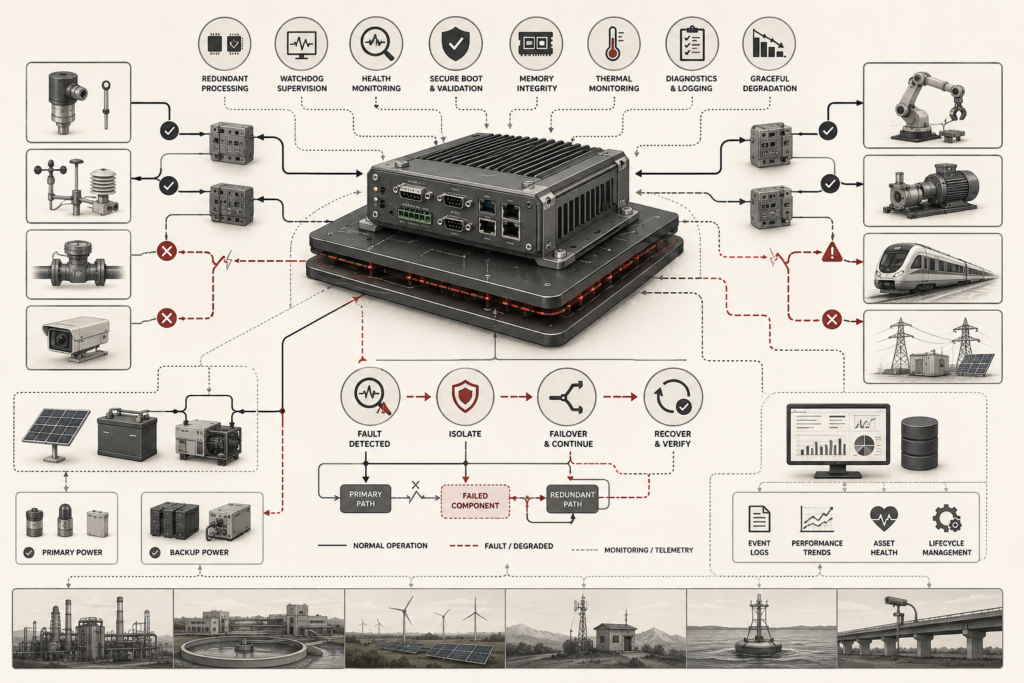
Institutional systems-research illustration of embedded device reliability, showing redundant paths, backup power, diagnostics, failover, recovery, and monitored physical infrastructure.

Reliability and Fault Tolerance in Embedded Devices

Reliability and fault tolerance in embedded devices define how systems continue operating correctly, safely, or acceptably when faults, degradation, and unexpected conditions occur. This article frames dependability as controlled failure: the disciplined architecture of detection, containment, recovery, redundancy, supervision, diagnostics, safe-state behavior, and graceful degradation. It explains the distinction between faults, errors, and failures, and shows why reliable embedded systems require more than high-quality components or nominal functional testing. The article examines watchdog timers, reset strategy, brownout recovery, persistent-state validation, redundant sensing, fault containment, software reliability, field observability, and lifecycle response. It also introduces mathematical models, Python and R workflows, systems-code scaffolding, and verification gates for designing embedded devices that remain interpretable, recoverable, and operationally trustworthy when real-world conditions become imperfect.
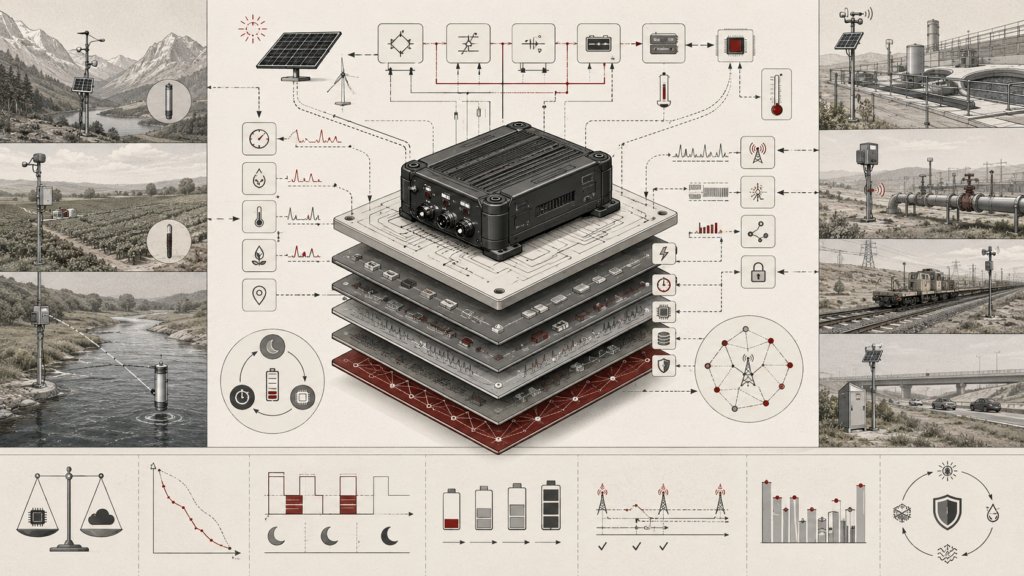
Institutional systems-research illustration of low-power embedded system design, showing a rugged edge device, energy harvesting, battery management, duty cycling, sensor nodes, and constrained field infrastructure.

Low-Power Embedded System Design for Embedded and Edge Devices

Low-power embedded system design defines how devices conserve energy while preserving responsiveness, measurement quality, reliability, and useful field behavior. This article frames low power as the architecture of selective activity: the discipline of waking only when meaningful work is required, retaining only necessary state, powering only required peripherals, and returning safely to lower-energy operation. It examines energy budgets, duty cycles, sleep states, wake latency, retention, clocking, peripheral gating, firmware scheduling, radio energy, sensing quality, battery derating, regulator losses, board-level leakage, brownout recovery, and fleet power observability. The article also introduces mathematical models, Python and R workflows, systems-code scaffolding, and verification gates for designing embedded devices that meet lifetime requirements without sacrificing valid measurement, safe recovery, diagnostics, or operational trust.

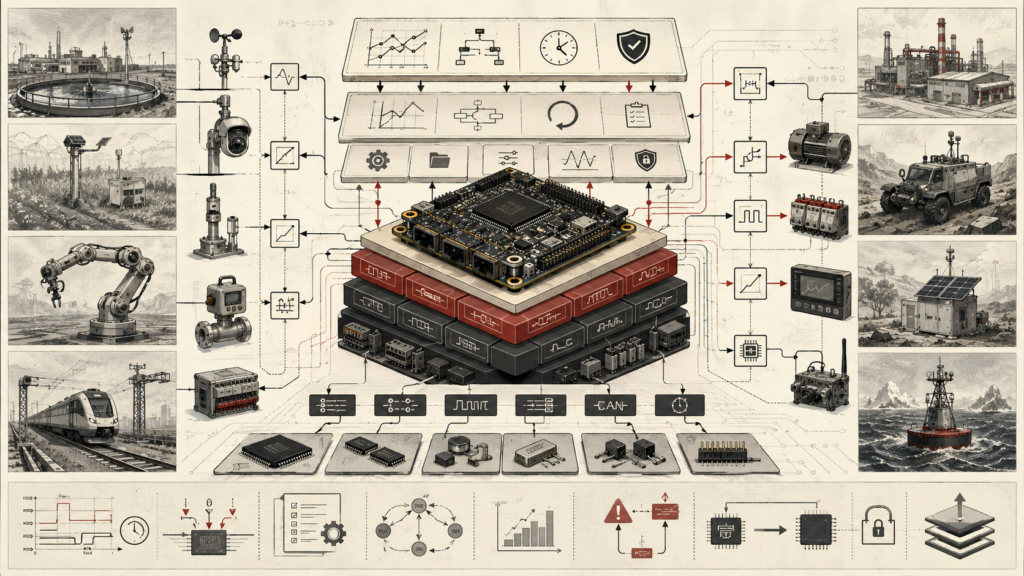
Institutional systems-research illustration of firmware and hardware abstraction in embedded systems, showing a layered control stack connecting a microcontroller board to sensors, buses, drivers, actuators, and field devices.

Firmware, Hardware Abstraction, and Device Control in Embedded Systems

Firmware, hardware abstraction, and device control define how embedded software turns physical hardware into reliable, testable, and maintainable system behavior. This article frames firmware as the operational substrate of embedded systems: the layer that initializes hardware, manages registers and peripherals, coordinates interrupts, controls power states, exposes driver interfaces, preserves diagnostic evidence, and governs device lifecycle transitions. It examines hardware abstraction layers, driver contracts, register access policy, blocking behavior, ISR safety, bus timeouts, suspend/resume behavior, update integrity, rollback, state ownership, concurrency, resource arbitration, and hardware-in-the-loop validation. The article also introduces mathematical models, Python and R workflows, systems-code scaffolding, and verification gates for designing firmware architectures that remain timing-aware, power-aware, diagnosable, portable where appropriate, and grounded in real hardware constraints.

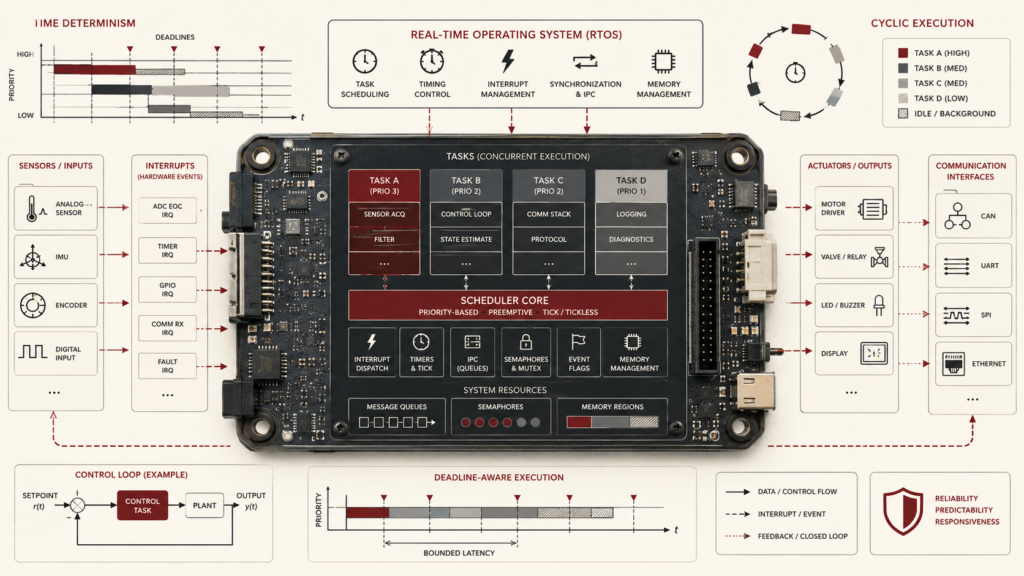
Technical systems illustration of a real-time operating system coordinating task scheduling, interrupts, timing control, memory management, sensors, actuators, and communication interfaces in an embedded controller.

Real-Time Operating Systems in Embedded Computing

Real-time operating systems structure embedded software so devices can coordinate tasks, interrupts, timing, synchronization, memory, and power behavior within defined temporal bounds. This article frames the RTOS as a temporal control architecture rather than a generic multitasking convenience. It examines task models, priorities, schedulability, worst-case execution time, response time, jitter, interrupt latency, deferred work, synchronization hazards, priority inversion, stack discipline, queue sizing, tickless idle, sleep coordination, runtime tracing, and field telemetry. The article also introduces mathematical models, Python and R workflows, systems-code scaffolding, and verification gates for designing embedded systems whose concurrency remains bounded, observable, power-aware, and testable under realistic operating conditions.

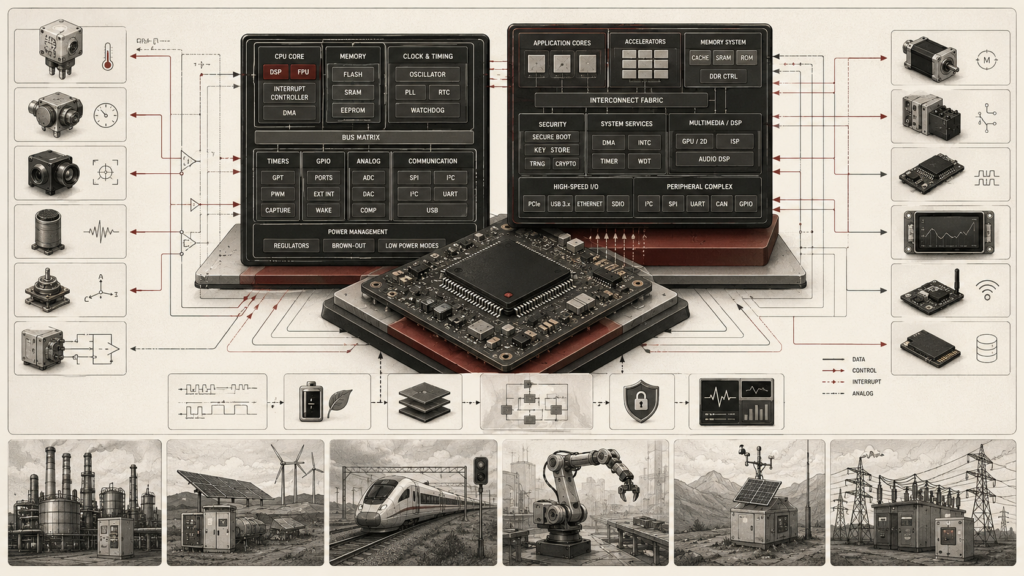
Institutional systems-research illustration of microcontroller and system-on-chip architecture, showing CPU cores, memory, timing, peripherals, communication interfaces, sensors, actuators, and embedded-system environments.

Microcontrollers and System-on-Chip Design for Embedded Systems

Microcontrollers and system-on-chip design define the silicon foundations of embedded and edge systems. This article frames MCUs and SoCs as integrated architectures that coordinate processing, memory, peripherals, timing resources, communication interfaces, power domains, security functions, and lifecycle control under strict physical constraints. It examines silicon-fit analysis, compute headroom, memory margin, peripheral coverage, pin and package conflicts, interrupt latency, DMA, bus contention, boot chains, power states, secure updates, debug control, heterogeneous compute, accelerators, and field diagnostics. The article also introduces mathematical models, Python and R workflows, systems-code scaffolding, and verification gates for selecting embedded platforms that meet real requirements for timing, energy, reliability, software maintainability, security, and long-term operational support.

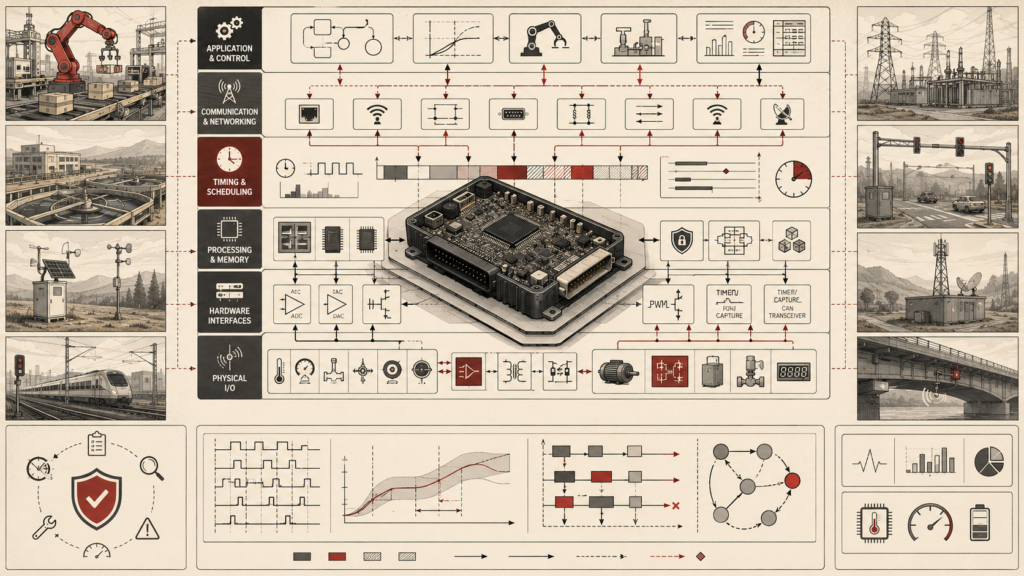
Institutional systems-research illustration of embedded systems architecture, showing a layered embedded control stack with physical I/O, hardware interfaces, processing, timing, communication, and real-time coordination across infrastructure environments.

Embedded Systems Architecture: Components, Design, and Real-Time Constraints

Embedded systems architecture defines how dedicated devices sense, compute, control, communicate, conserve power, recover from faults, and remain maintainable under real-world constraints. This article frames embedded architecture as a form of constraint governance: the disciplined coordination of processors, memory, firmware, timing, interrupts, peripherals, buses, power states, security controls, diagnostics, and lifecycle support. It examines hardware–software co-design, memory-mapped I/O, allocation strategy, interrupt latency, jitter, deterministic control, communication buses, boot and update trust, watchdog behavior, observability, and field telemetry. The article also introduces mathematical models, Python and R workflows, systems-code scaffolding, and verification gates for designing embedded systems whose timing, memory, power, fault behavior, security, and lifecycle assumptions are explicit, testable, and grounded in deployment reality.

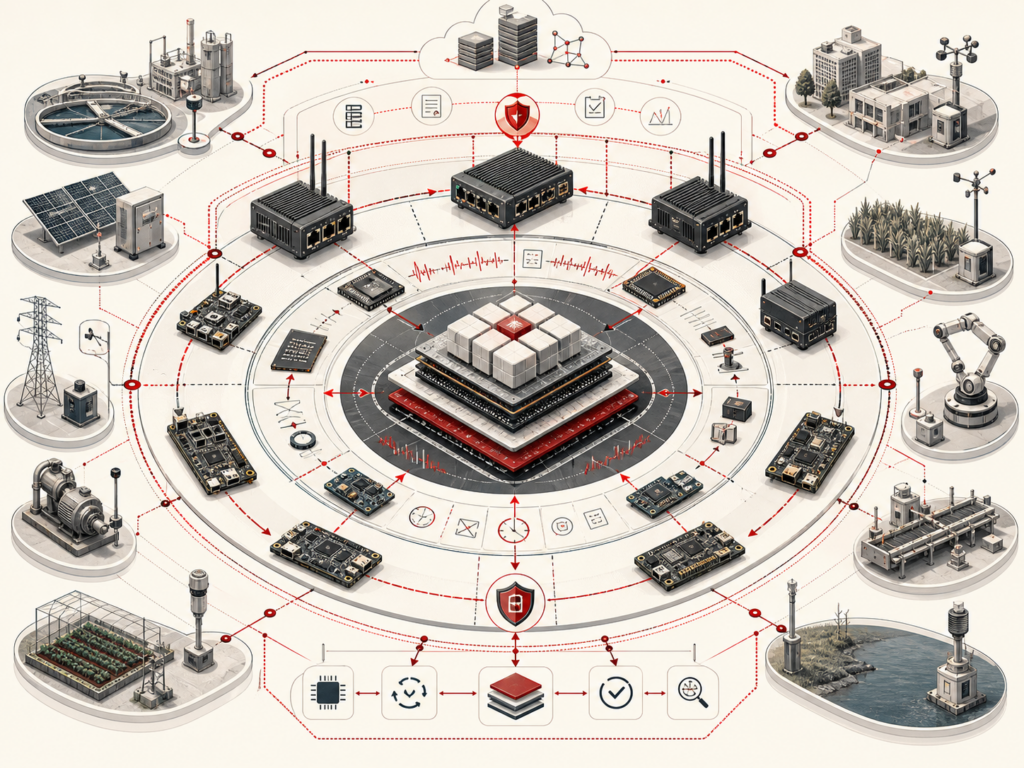
Editorial systems illustration showing sensors, embedded boards, edge gateways, local processing cores, telemetry pathways, security controls, cloud-edge coordination, and physical infrastructure connected through a distributed cyber-physical architecture.

Embedded and Edge Systems: Real-Time Computing in Devices, Sensors, and Infrastructure

Embedded and edge systems examine how computation moves into physical devices, sensors, machines, and infrastructure. This pillar explores microcontrollers, firmware, sensor networks, real-time operating systems, edge computing, TinyML, PYNQ, local analytics, cyber-physical control, security, and device lifecycle governance. It shows how physical signals become digital telemetry, how local processing can reduce latency and bandwidth dependence, and how embedded intelligence can support environmental monitoring, infrastructure resilience, health technology, industrial automation, robotics, and sustainable systems. The series emphasizes engineering constraints such as memory, energy, timing, signal quality, reliability, privacy, and field maintenance. By connecting Embedded C, SQL, Python, R, TinyML, and hardware-aware edge workflows, the pillar presents embedded and edge systems as the technical foundation for trustworthy, distributed, real-world intelligence.

Smart city skyline at night representing FPGA-accelerated edge AI and TinyML for scalable urban intelligence.

Edge Intelligence for Smart Cities: FPGA and TinyML Infrastructure

FPGA TinyML smart cities shift urban digital infrastructure from cloud-dependent data collection toward distributed edge intelligence. By combining embedded systems, TinyML, and FPGA acceleration, cities can process signals locally where latency, energy efficiency, privacy, and operational continuity matter most. This article examines how on-device inference and configurable hardware can support traffic systems, water monitoring, environmental sensors, transit infrastructure, grid diagnostics, and adaptive public services without transmitting every signal to centralized platforms. It argues that edge intelligence is not merely a performance upgrade; it is a resilience architecture. For smart-city systems to remain trustworthy, they must also be secure, auditable, version-controlled, maintainable, and governed across the full lifecycle of models, firmware, FPGA configurations, sensors, and public infrastructure decisions.

Scroll to Top