
Last Updated May 12, 2026
Microcontrollers and system-on-chip design examine how processing, memory, peripherals, communication interfaces, timing resources, security functions, and control logic are integrated into compact silicon platforms for embedded and edge systems. These architectures determine what devices can sense, compute, control, secure, and communicate within strict limits of power, space, cost, timing, reliability, and software complexity.
Embedded computing depends on silicon architectures that bring computation directly into physical devices. Whether the target is an environmental sensor, industrial controller, medical monitor, wearable, robotics platform, smart meter, motor-control node, field instrument, or edge gateway, the underlying architectural problem is the same: how much processing capability, memory, peripheral integration, communication support, and lifecycle control can be placed into a device while preserving efficiency, determinism, reliability, and affordability. Microcontrollers and system-on-chip designs are two of the most important answers to that problem.
Microcontrollers are typically optimized for dedicated control tasks in constrained environments. They often combine a processor core, on-chip nonvolatile memory, SRAM, timers, interrupt controllers, analog and digital interfaces, direct memory access, watchdogs, clock control, reset logic, and communication peripherals in a compact device that can support low-power, real-time operation. System-on-chip architectures extend this logic of integration further by combining multiple functional domains within one piece of silicon. Those domains may include CPUs, memory controllers, DMA engines, radios, security modules, graphics subsystems, DSP blocks, storage interfaces, interconnect fabrics, and increasingly domain-specific accelerators for signal processing or machine-learning inference.
The architectural significance of these platforms is not reducible to how many features can be packed onto a chip. Their internal organization shapes boot behavior, interrupt latency, memory access patterns, peripheral arbitration, clocking, power states, software complexity, security boundaries, update paths, diagnostic visibility, and the feasibility of local analytics or autonomous response. For that reason, microcontroller and SoC design sits near the center of embedded systems engineering. It defines not only what a device can do, but how dependably it can do it under real physical constraints.
A rigorous view of microcontroller and SoC design therefore treats silicon integration as systems architecture. The chip is not merely a component selected from a catalog. It is the hardware substrate that determines whether firmware can meet timing requirements, whether sensors can be sampled reliably, whether data can move without contention, whether power states can be used safely, whether updates can be trusted, and whether the device can remain maintainable across its operational life.
Main Library
Publications
Article Map
Embedded & Edge Systems
Related Topic
Data Systems & Analytics
Related Topic
Intelligent Infrastructure
Related Topic
Environmental Monitoring
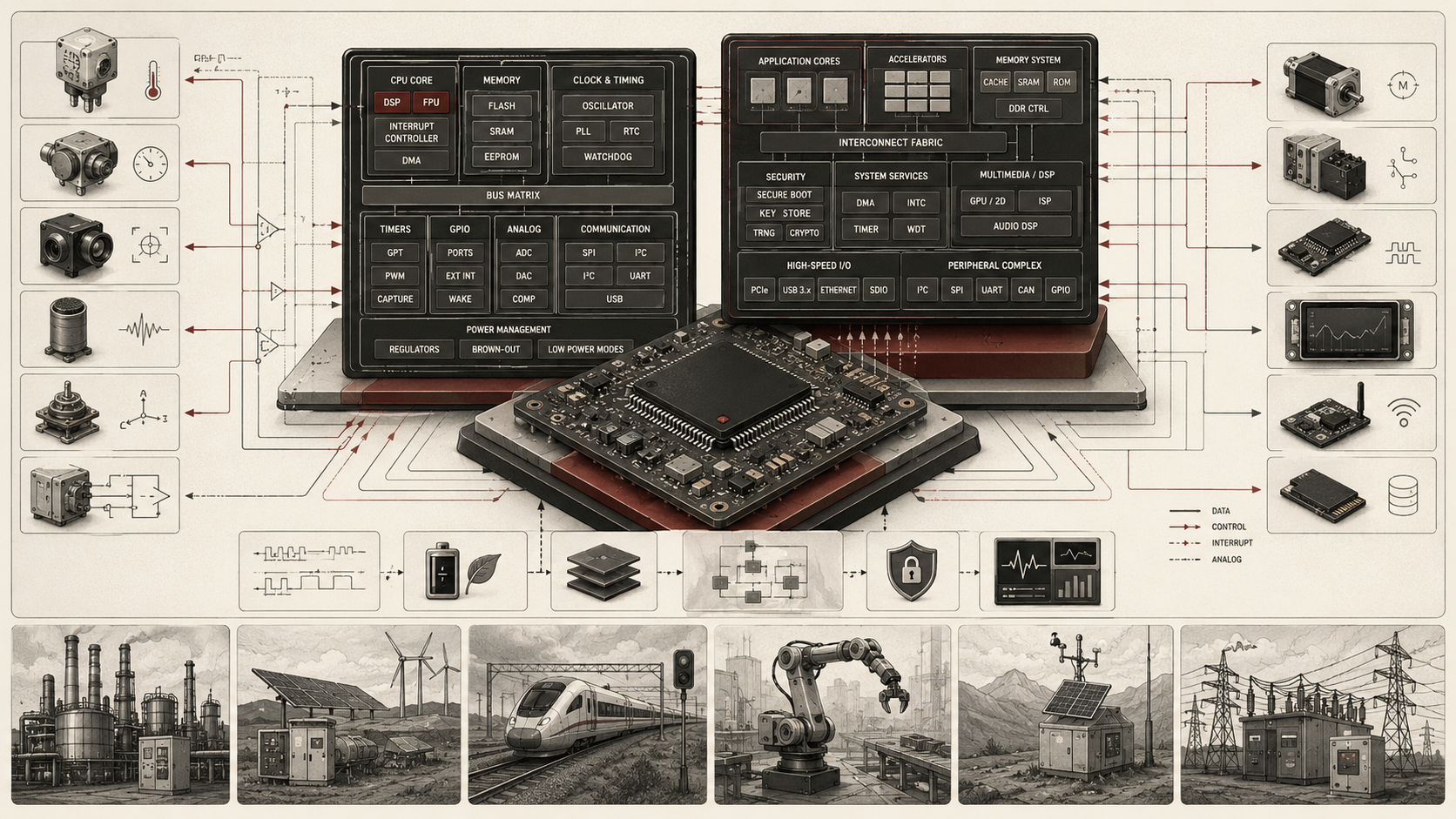
The engineering question is therefore not simply whether a device should use a “small MCU” or a “larger SoC.” It is how silicon architecture should match the device’s timing requirements, memory needs, sensing behavior, power budget, security model, software stack, field-maintenance expectations, and role within a larger embedded or edge system.
Engineering Problem
The engineering problem is how to choose and use an integrated silicon platform that can meet the device’s functional, temporal, energy, security, and lifecycle requirements without overbuilding the system or constraining it too tightly. Microcontrollers and SoCs are not interchangeable parts. They embody different assumptions about memory, timing, peripheral access, software complexity, power management, security, and field maintainability.
A weak silicon choice can create long-term architectural problems. A microcontroller may be too small for the required buffers, firmware updates, cryptographic stack, or communications workload. A larger SoC may provide abundant compute but introduce boot complexity, higher standby power, thermal limits, memory nondeterminism, and software-maintenance burden. A chip may have the right CPU but the wrong ADC characteristics, too few timers, insufficient DMA channels, inadequate wake sources, poor debug control, missing security primitives, or an I/O mix that forces board-level workarounds.
A rigorous design should be able to answer several questions. What work must the device perform locally? What timing deadlines must be met? What memory must be retained across power states? Which peripherals are central rather than optional? What interrupts, timers, DMA paths, and buses determine responsiveness? What power states are required for the operating life? What security properties are needed for boot, update, debug, and key storage? What software stack must run today, and what must remain possible later?
The central challenge is not selecting the most powerful chip. It is selecting the most proportionate silicon architecture: enough integration to support the device’s role, not so much complexity that power, reliability, timing, security, and maintenance become harder to control.
Reference Architecture
A practical microcontroller or SoC architecture can be understood as a coordinated set of compute resources, memory resources, I/O paths, timing mechanisms, security boundaries, power domains, and software-facing control surfaces.
| Layer | Engineering Role | Architectural Concern | Evidence Artifact |
|---|---|---|---|
| Device requirement layer | Defines sensing, control, communication, timing, security, and lifecycle requirements | Workload fit, deadlines, power budget, field-service interval, update needs | Requirements matrix, device-class profile, silicon-fit scorecard |
| Compute layer | Provides CPU cores, optional heterogeneous cores, DSP blocks, or accelerators | Instruction throughput, interrupt latency, deterministic behavior, compute headroom | Core profile, benchmark notes, WCET assumptions, accelerator map |
| Memory layer | Provides flash, ROM, SRAM, cache, TCM, external memory, or memory controllers | Code size, stack, buffers, boot storage, update slots, latency variance | Memory budget, linker map, stack report, update-partition plan |
| Interconnect layer | Moves data among CPUs, memory, DMA engines, peripherals, and accelerators | Bus contention, arbitration, DMA latency, coherency, bandwidth | Bus map, bandwidth model, DMA plan, contention review |
| Timing layer | Provides timers, counters, capture/compare units, PWM, RTC, and watchdogs | Control-loop timing, sampling cadence, event timestamping, reset supervision | Timer allocation table, watchdog policy, timing validation report |
| Peripheral layer | Provides ADC, DAC, GPIO, UART, SPI, I²C, CAN, USB, Ethernet, radio, storage, or sensor interfaces | I/O fit, signal quality, bus ownership, peripheral count, pin multiplexing | Peripheral manifest, pin map, bus allocation, sensor-interface matrix |
| Power layer | Provides clock trees, power domains, sleep states, voltage scaling, reset, and brownout behavior | Energy budget, wake latency, retained state, leakage, thermal margin | Power-state map, clock plan, current budget, wake-source table |
| Security layer | Provides secure boot, debug control, key storage, cryptographic engines, isolation, and update trust | Root of trust, update integrity, debug lockdown, memory protection, lifecycle state | Threat model, secure-boot chain, debug policy, key-storage notes |
| Software support layer | Connects silicon features to toolchains, SDKs, HALs, drivers, RTOSes, Linux, or vendor ecosystems | Maintainability, driver maturity, portability, trace support, long-term support | SDK review, BSP plan, driver-quality checklist, toolchain record |
| Lifecycle layer | Supports manufacturing, provisioning, updates, diagnostics, recovery, and field maintenance | Firmware update, rollback, versioning, telemetry, failure evidence | Lifecycle runbook, update manifest, diagnostic schema, fleet report |
This architecture makes the chip visible as a system design decision. A platform is not suitable merely because it has a fast CPU or a long peripheral list. It is suitable when compute, memory, timing, I/O, power, security, software support, and lifecycle behavior fit the device’s role together.
Implementation Pattern
A rigorous implementation begins with a silicon-fit model before board design and firmware architecture are locked in. The design should identify workload requirements, timing requirements, memory requirements, peripheral dependencies, power states, security needs, software stack assumptions, and long-term maintenance constraints.
| Artifact | Purpose | Typical Format |
|---|---|---|
| Silicon-fit matrix | Compares candidate MCUs and SoCs against workload, timing, memory, I/O, power, and security requirements | CSV, spreadsheet, Python model, design review table |
| Memory budget | Estimates code, stack, heap, buffers, update slots, logs, and retained state | Linker map, CSV, firmware sizing report |
| Peripheral manifest | Lists required ADC, DAC, timers, PWM, GPIO, buses, radios, storage, and debug interfaces | YAML, pin map, board manifest |
| Pin and package review | Tests whether the package exposes required pins without unsafe multiplexing conflicts | Pin map, schematic note, board-layout checklist |
| Clock and timing plan | Defines oscillator sources, PLLs, bus clocks, timers, RTC, and timing domains | Clock-tree diagram, timer allocation table, timing report |
| Power-state model | Defines active, idle, sleep, deep sleep, wake, brownout, and retained domains | Power-state table, current budget, wake-source plan |
| Security and lifecycle policy | Defines secure boot, updates, rollback, debug control, key storage, and device lifecycle states | Threat model, update manifest, provisioning runbook |
| Software-stack plan | Defines bare-metal, RTOS, embedded Linux, drivers, HAL, middleware, and observability tooling | Architecture note, SDK review, driver-dependency table |
| Bring-up and validation plan | Tests clocks, memory, boot, peripherals, interrupts, power states, security, and diagnostics | HIL plan, bench checklist, manufacturing test notes |
| Lifecycle evidence schema | Records firmware version, reset cause, boot status, peripheral faults, power events, and update results | SQL, JSON Schema, telemetry contract |
The implementation goal is to prevent silicon choice from becoming an unexamined constraint. Engineers should know why a chip was selected, what assumptions it satisfies, where its margins are thin, what software dependencies it introduces, and how it will be validated in the field.
Research-Grade Framing: Silicon Integration as Embedded Systems Architecture
Microcontroller and SoC design should be framed as silicon integration in service of embedded systems architecture. The question is not merely what a chip contains, but how its integrated subsystems shape the behavior of the device. Compute, memory, timing, peripherals, power, security, and software support all become coupled.
This framing matters because silicon integration can create hidden dependencies. A CPU may be powerful enough, but memory bandwidth may be insufficient. A peripheral may exist, but its pins may conflict with another required function. A sleep state may be available, but wake latency may violate the control requirement. A security module may support secure boot, but the update architecture may not support rollback. A camera interface may be integrated, but the memory system may be unable to sustain the processing pipeline. A hardware accelerator may exist, but software tooling may make it difficult to use reliably.
| Integration Dimension | Question | Required Evidence |
|---|---|---|
| Compute fit | Does the platform meet local processing needs with appropriate headroom? | Benchmark notes, WCET assumptions, utilization model, accelerator review |
| Memory fit | Can code, stacks, buffers, logs, update slots, and retained state fit safely? | Memory budget, linker map, stack report, update partition plan |
| I/O fit | Are required peripherals, pin mappings, signal paths, and bus counts available? | Peripheral manifest, pin map, bus allocation, schematic review |
| Timing fit | Do timers, interrupts, DMA, and bus behavior support required responsiveness? | Timing report, interrupt latency test, DMA/bus review |
| Power fit | Can active, idle, sleep, wake, and retained states meet the power budget? | Power model, current trace, wake-source plan, energy budget |
| Security fit | Does silicon support the required boot, update, debug, key, and isolation properties? | Threat model, secure-boot chain, debug policy, lifecycle plan |
| Software fit | Are SDKs, drivers, toolchains, trace tools, and long-term support adequate? | SDK review, BSP plan, toolchain record, support horizon |
| Lifecycle fit | Can the platform be provisioned, updated, diagnosed, and maintained over time? | Update manifest, diagnostics schema, field telemetry, recovery runbook |
In this framing, an MCU or SoC is not merely selected. It is justified. The platform must fit the work, the field environment, the development ecosystem, and the operational life of the device.
Formal Model: Compute, Memory, I/O, Timing, Power, and Integration Fit
A useful formal model treats silicon selection as a multi-constraint fit problem. Let \(C\) represent compute demand, \(M\) memory demand, \(I\) I/O demand, \(T\) timing demand, \(P\) power budget, \(S\) security requirements, and \(L\) lifecycle requirements. A platform is suitable only when each domain has adequate margin and when cross-domain interactions remain manageable.
F_{\mathrm{platform}} = f(C, M, I, T, P, S, L)
\]
Interpretation: Platform fit depends on compute, memory, I/O, timing, power, security, and lifecycle needs. No single metric, such as clock speed or core count, determines suitability.
U_{\mathrm{cpu}} = \sum_{i=1}^{n} \frac{C_i}{T_i}
\]
Interpretation: CPU utilization estimates how much processing time is consumed by periodic or bounded workloads. It should be interpreted alongside interrupt load, DMA behavior, bus contention, and software overhead.
M_{\mathrm{margin}} = M_{\mathrm{available}} – (M_{\mathrm{code}} + M_{\mathrm{stack}} + M_{\mathrm{heap}} + M_{\mathrm{buffers}} + M_{\mathrm{logs}} + M_{\mathrm{update}})
\]
Interpretation: Memory margin must include code, stacks, heap, buffers, logs, and firmware-update space. A platform that fits the first release may still fail lifecycle requirements if update and diagnostic space are ignored.
B_{\mathrm{required}} = B_{\mathrm{sensors}} + B_{\mathrm{storage}} + B_{\mathrm{network}} + B_{\mathrm{accelerators}} + B_{\mathrm{diagnostics}}
\]
Interpretation: Internal and external bandwidth must support sensor streams, storage, network traffic, accelerators, and diagnostics. SoC performance often depends on memory and interconnect behavior as much as CPU speed.
E_{\mathrm{day}} = E_{\mathrm{active}} + E_{\mathrm{sleep}} + E_{\mathrm{wake}} + E_{\mathrm{comm}} + E_{\mathrm{retention}}
\]
Interpretation: Daily energy includes active processing, sleep, wake overhead, communications, and retained domains. A chip with excellent active performance can still be a poor fit if standby or wake behavior violates the energy model.
These equations turn chip selection into a reviewable engineering process. The goal is not mathematical precision for its own sake. The goal is to make hidden assumptions explicit before silicon choice, board design, and firmware architecture become expensive to change.
What Are Microcontrollers and SoCs?
A microcontroller is a compact integrated computing platform designed for embedded control. It typically combines a CPU core, on-chip flash or ROM, SRAM, timers, GPIO, interrupt controllers, serial interfaces, and other peripherals needed to operate a device without extensive external support hardware. The defining logic of a microcontroller is integration in service of dedicated function. It is meant to sample inputs, execute bounded logic, and drive outputs with high efficiency and predictable timing.
A system on chip, by contrast, is a broader integration model in which many system components are implemented on one integrated circuit. Depending on the target system, an SoC may include one or more CPU cores, memory controllers, multimedia engines, wireless radios, DMA fabrics, hardware security blocks, DSP units, storage interfaces, or heterogeneous compute clusters. Some SoCs target consumer devices, others industrial equipment, automotive systems, communications hardware, or intelligent edge platforms. In embedded systems, the key architectural point is that the SoC consolidates what might once have required multiple chips into a tightly coordinated silicon system.
These categories overlap. Many modern microcontrollers are technically small SoCs, while many SoCs are engineered for embedded or edge workloads rather than for general-purpose computing. The distinction remains useful because it highlights different design priorities. Microcontrollers usually emphasize deterministic control, low power consumption, compact firmware, and direct peripheral interaction. Larger SoCs typically emphasize richer integration, broader memory systems, more complex software environments, and higher-performance or heterogeneous workloads.
The most important point is that neither term is enough by itself. The real question is what kind of device the silicon makes possible: a small deterministic controller, a connected sensor node, a gateway, a secure field device, a local inference platform, a real-time control node, or a hybrid architecture that combines several roles.
Microcontrollers as Embedded Control Platforms
Microcontrollers remain foundational to embedded computing because they are well suited to devices that must perform dedicated tasks with limited resources. Their architectural value lies in tight integration. Rather than depending on external memory, companion chips, or elaborate board-level support for basic operation, an MCU can often support sensing, timing, control, and communication directly from a single package.
This makes microcontrollers especially valuable in devices where timing, energy efficiency, and simplicity matter more than raw computational scale. A low-power environmental sensor, access-control node, portable instrument, smart meter, motor controller, or actuator-driven subsystem often benefits from an MCU that can wake quickly, respond to interrupts with low latency, coordinate timers precisely, and return to sleep efficiently. In such designs, architectural discipline often matters more than peak throughput. What the system needs is not maximal performance, but proportionate capability with bounded behavior.
Microcontrollers also shape software architecture. Because memory is limited and timing constraints are often strict, MCU software tends to remain close to hardware. Firmware commonly relies on direct register access, explicit buffer management, compact interrupt service routines, and carefully bounded execution paths. Even where an RTOS is used, the software environment remains far more constrained than in larger application-processor systems.
This is one reason microcontrollers continue to dominate the lower and middle layers of embedded control: they are architecturally well matched to devices that must be small, reliable, predictable, and power-aware. Their strength is not that they can do everything. Their strength is that they can do specific things with discipline.
System-on-Chip Design as Integrated System Architecture
System-on-chip design extends the integration logic of embedded computing by bringing multiple major subsystems onto one chip. At a minimum, this often means one or more processor cores plus memory and I/O infrastructure. In more capable designs it may also mean caches, bus fabrics, DMA engines, display and video pipelines, cryptographic engines, AI accelerators, radios, storage controllers, or domain-specific subsystems. What distinguishes the SoC is not simply that it contains “more.” It is that it internalizes system architecture inside the chip.
The architectural importance of the SoC lies in system coordination. Integrating multiple compute and I/O functions on one chip reduces board complexity, shortens communication paths, lowers latency between subsystems, and can improve power efficiency compared with fragmented multi-chip arrangements. For edge devices, this may create enough local capability to support computer vision, protocol translation, sensor fusion, local data filtering, or inference workloads that would exceed the practical capacity of a small microcontroller.
Yet the SoC also introduces architectural complexity. Once multiple processors, memory domains, accelerators, buses, and security regimes coexist on one die, the design problem becomes one of orchestration. Interconnect architecture, arbitration, memory hierarchy, cache behavior, interrupt routing, clock distribution, thermal constraints, and software initialization all become central. An SoC is not merely a richer MCU. It is an integrated system whose internal complexity must be managed with the same seriousness that earlier designers once applied to full boards.
In embedded and edge contexts, the strongest SoC designs are those that balance richer capability with controlled complexity. Local intelligence is valuable only when the platform can boot reliably, move data predictably, manage power, isolate trust boundaries, expose diagnostics, and remain maintainable in the field.
Boot Flow, Initialization, and Bring-Up
One of the clearest differences between small MCU designs and larger SoC platforms appears in boot flow. In a simple microcontroller, boot may be relatively direct: the device resets, vectors to startup code, initializes memory and clocks, configures required peripherals, and begins application execution. Even in this simpler case, the architecture of boot still matters. It determines how reset causes are handled, how memory sections are initialized, how watchdog or brownout recovery behaves, and whether firmware update paths are safe and recoverable.
In larger SoCs, bring-up is usually more layered. A boot ROM may establish a root sequence, validate the next stage, initialize essential hardware, and hand off to a secondary bootloader. Additional stages may configure DRAM, set up interconnects, enable peripheral domains, load trusted firmware, and finally bring up an operating system or richer runtime environment. This longer boot chain creates opportunities for flexibility and security, but it also increases architectural risk. Every stage introduces state assumptions, trust boundaries, and possible failure points.
Boot architecture therefore deserves more attention than it often receives in high-level summaries. A device’s boot process defines not only how it starts, but how it recovers, updates, authenticates code, and re-enters stable operation after interruption or corruption. In embedded systems intended for long deployment lifecycles, boot flow is part of the device’s reliability model and, increasingly, part of its governance model as well.
A rigorous bring-up plan should test reset causes, clock configuration, memory initialization, peripheral enumeration, secure-boot behavior, fallback boot paths, debug policy, and field-update recovery. Boot is not only the beginning of execution. It is the first test of whether the platform’s lifecycle architecture is sound.
Core Architectural Components
Microcontrollers and SoCs vary widely, but most combine recurring architectural elements whose relationships define the platform:
- CPU core or cores: optimized either for low-power control, general embedded processing, heterogeneous workloads, or application-class performance.
- Register and control architecture: the visible machine state through which software configures execution, exceptions, privileges, and peripheral behavior.
- Interrupt and exception system: essential for responsive coordination with timers, buses, sensors, peripherals, and fault conditions.
- Timers and counters: central to scheduling, pulse generation, measurement, capture/compare, timestamping, watchdog supervision, and control loops.
- Memory resources: flash, ROM, SRAM, tightly coupled memory, cache hierarchies, external memory controllers, or shared memory regions.
- Peripheral subsystem: GPIO, ADC, DAC, PWM, UART, SPI, I²C, CAN, USB, Ethernet, wireless interfaces, storage, and device-specific controllers.
- Interconnect fabric: internal buses or crossbars linking processors, memory, DMA engines, accelerators, and peripherals.
- DMA and data movement: hardware-supported movement of data between memory and peripherals without constant CPU intervention.
- Security blocks: secure boot support, cryptographic engines, debug protection, key storage, memory protection, or isolation mechanisms.
- Power and clock management: reset logic, oscillators, PLLs, domain gating, sleep modes, voltage scaling, and brownout handling.
- Accelerators: DSP, graphics, signal-processing, inference, media, compression, or cryptographic engines in more capable platforms.
These parts matter not only individually but relationally. A processor core without appropriate memory bandwidth, interrupt design, bus structure, and power control may be architecturally unbalanced. Similarly, a chip rich in peripherals may still be poorly suited to the workload if its memory system, clocking behavior, software tooling, or package constraints create instability. The practical value of a silicon platform emerges from coordination across the whole design.
Memory Hierarchy, Buses, and Peripheral Integration
Memory architecture is one of the most consequential differences across microcontrollers and SoCs. Smaller MCUs often rely on integrated flash for code storage and SRAM for active state, buffers, and stacks. This arrangement supports compact, direct execution with relatively predictable access characteristics. In many cases, software can be designed around known bounds for stack depth, buffer size, and execution footprint, which helps preserve determinism.
Larger SoCs usually introduce more elaborate memory hierarchies. These may include multiple levels of cache, tightly coupled memory, shared SRAM regions, external DRAM interfaces, and separate memory domains for processors or accelerators. Such structures allow more sophisticated workloads but also create new architectural questions: where should latency-sensitive code or data reside, how should shared access be arbitrated, which domains require coherency, and how can throughput be increased without sacrificing predictability?
Internal buses and interconnects are equally important. In smaller microcontrollers, bus architecture may be simple enough that peripheral access paths remain relatively transparent. In richer SoCs, interconnect fabrics become central to performance and stability. CPUs, DMA engines, radios, storage controllers, accelerators, and peripherals may all contend for memory or bus access. Once that happens, arbitration, bandwidth allocation, burst behavior, and latency variance cease to be low-level details and become central architectural concerns.
Peripheral integration also shapes the identity of the chip. A microcontroller intended for industrial control may privilege ADC precision, timers, PWM channels, and CAN interfaces. A communications-oriented SoC may privilege Ethernet, storage, packet processing, and cryptographic offload. A device intended for local analytics may allocate silicon budget to memory bandwidth, DSP functions, or inference engines. What the chip integrates is a direct statement of the problem it is meant to solve.
Timers, Interrupts, DMA, and Deterministic Control
Timing resources are central to microcontroller and SoC architecture. Timers, counters, capture/compare units, PWM channels, real-time clocks, watchdog timers, interrupt controllers, and DMA engines determine how precisely the device can observe, schedule, and control physical processes.
In microcontroller systems, timer and interrupt behavior often determines whether the platform is suitable for control. Motor control, pulse measurement, sensor sampling, power conversion, communications timing, and actuator coordination all depend on bounded latency and precise event handling. A CPU clock rate is not enough. The platform also needs the right timer channels, interrupt priorities, capture/compare features, peripheral triggers, and DMA paths.
DMA is especially important because it changes the relationship between data movement and CPU load. A system that samples an ADC, receives serial data, or streams sensor records may use DMA to move data into memory while the CPU performs other work or remains asleep. But DMA also introduces arbitration and memory-consistency concerns. In larger SoCs, DMA engines may compete with CPUs, accelerators, storage, and networking blocks for bus and memory bandwidth.
Deterministic control therefore depends on more than the processor core. It depends on how events become interrupts, how interrupts become software work, how data moves through memory, how timers remain stable across power states, and how bus contention affects latency. These are silicon-level design properties with software consequences.
Clocking, Power Domains, and Energy Management
Clocking and power architecture are often treated as implementation details, but in embedded design they are foundational. A device’s clock tree determines how processing and peripherals are synchronized, what latencies are possible, and how precisely time-dependent behavior can be controlled. Oscillators, PLLs, prescalers, clock gates, and timer domains collectively shape the device’s temporal behavior.
Power design is equally important. Many embedded systems must operate on limited batteries, in remote environments, or under tight thermal constraints. Microcontrollers therefore often provide sleep states, fast wake paths, peripheral gating, and low-power timer options so that the chip can remain dormant most of the time and only become active when needed. In such systems, the energy cost of waking memory, clocks, radios, analog blocks, or sensor interfaces can matter as much as the efficiency of the CPU itself.
More capable SoCs usually divide the chip into power domains so that selected subsystems can be disabled or clock-gated independently. This enables richer devices to balance local compute with energy limits, but it also adds state complexity. The architecture must account for which domains retain state, how wake dependencies are managed, how peripheral reinitialization occurs, and what happens when power transitions fail or become unsynchronized.
Power architecture is therefore not simply about saving energy. It is about making energy management compatible with reliable system behavior. A platform is power-fit only when its clocking, wake paths, retained domains, and software power-management model match the device’s operational rhythm.
Security, Isolation, and Lifecycle Implications
As embedded devices become more connected and more autonomous, microcontroller and SoC design increasingly includes security and isolation features at the silicon level. Secure boot, cryptographic engines, protected key storage, tamper resistance, debug lockdown, memory protection, privilege separation, and trusted execution environments all shape how trustworthy the platform can be over time. These are not merely optional add-ons. They are part of the architecture of deployment.
In smaller microcontroller systems, security may focus on authenticated updates, secure startup, debug protection, and protection of device identity or communication keys. In larger SoCs, the security model often becomes more layered. Multiple execution worlds, isolated memory regions, security controllers, trusted firmware stages, secure monitors, and protected peripherals may all be necessary. As platforms grow more capable, security architecture begins to resemble system governance within the chip itself: which code may execute, which subsystems may access which data, and how compromise in one domain can be prevented from spreading across the device.
Lifecycle management follows from this. Chips selected for long-lived infrastructure or field devices must support dependable updates, debug policy, fault recovery, and controlled evolution of the software stack. The right silicon choice is therefore not only a matter of present workload. It is a matter of whether the device can remain manageable, secure, and intelligible over its operational life.
Security should also be matched to field reality. A prototype may tolerate open debug ports and unsigned images. A deployed infrastructure node, medical-adjacent device, industrial controller, or public environmental sensor network may not. Silicon choice can either support that transition or make it difficult later.
Heterogeneous Compute, Accelerators, and Edge Intelligence
Modern embedded and edge platforms increasingly include heterogeneous compute resources. A device may combine a low-power microcontroller core, an application processor, a DSP, a neural processing unit, a graphics block, a security engine, a radio subsystem, and specialized sensor-processing logic. This can make local intelligence possible, but it also changes the architectural problem.
Heterogeneous compute is useful when different workloads have different computational shapes. Control loops may need predictable low-latency execution. Signal processing may benefit from DSP instructions or vector engines. Image processing may require high memory bandwidth. Cryptography may benefit from hardware acceleration. Local inference may require matrix operations or quantized neural-network support. A well-designed SoC assigns those workloads to resources that match them.
But acceleration is not free. Accelerators require software tooling, drivers, memory movement, scheduling, quantization support, power management, and validation. A hardware inference block may reduce CPU load but increase memory pressure. A DSP may accelerate signal processing but complicate the build system. A GPU or NPU may produce impressive throughput but require a software ecosystem that exceeds the maintainability budget of the device.
The question is therefore not whether a platform includes accelerators. It is whether the accelerators improve the total embedded system: latency, energy, memory use, reliability, software maintainability, and field diagnostics. Edge intelligence is valuable only when the platform can support it without making the device opaque or fragile.
Microcontrollers vs System-on-Chip Designs
The distinction between microcontrollers and SoCs is best treated as a difference in architectural emphasis rather than as a rigid binary.
- Microcontrollers usually prioritize deterministic control, compact memory models, rapid wake-up, low-power operation, direct peripheral interaction, and firmware simplicity.
- SoC platforms usually prioritize richer integration, larger memory systems, broader I/O, heterogeneous processing, stronger isolation regimes, and support for more complex software environments.
An MCU is often the right choice when the device’s job is bounded and timing-sensitive: periodic sampling, control loops, simple communications, actuator coordination, or energy-constrained monitoring. An SoC becomes attractive when the device must support more demanding compute tasks, larger software stacks, richer connectivity, domain-specific acceleration, or multiple processing classes within a unified chip.
The architectural question is not which platform is more advanced in the abstract. It is which integration model is proportionate to the device’s real role in a larger system. A small deterministic MCU may be the more sophisticated choice for a field sensor. A richer SoC may be necessary for a gateway or local-analytics node. A hybrid design may use both.
Choosing Between MCU and SoC Approaches
Choosing between a microcontroller-oriented design and a larger SoC platform requires judgment across several axes:
- How strict are the device’s timing and determinism requirements?
- How constrained is the power budget?
- How much local memory and compute are actually required?
- Will the software stack remain compact, or does it require an RTOS, substantial middleware, embedded Linux, or a fuller OS environment?
- How many peripherals, interfaces, timers, DMA channels, and analog resources must be integrated?
- Is local inference, multimedia processing, sensor fusion, or complex protocol handling required?
- What level of security, updateability, provisioning, and lifecycle control is necessary?
- How mature are the SDK, drivers, documentation, trace tools, and long-term support ecosystem?
- How much diagnostic evidence must the device provide after reset, failure, update, or field anomaly?
In many contemporary systems, the answer is hybrid rather than purely one or the other. Some designs combine MCU-style deterministic control with companion processors for richer workloads. Others integrate multiple processing domains onto one SoC so that time-critical and high-level functions can coexist. The most important architectural task is not selecting a fashionable chip category. It is partitioning responsibilities across sensing, control, communications, analytics, and lifecycle management in a way that remains dependable under constraint.
Mathematical Lens: Utilization, Memory Fit, Bandwidth, Energy, and Integration Risk
A mathematical lens helps connect silicon architecture to measurable design constraints. The point is not to reduce platform selection to a single score. The point is to expose the trade-offs that determine whether a microcontroller or SoC is proportionate to the device.
U_{\mathrm{cpu}} = \sum_{i=1}^{n} \frac{C_i}{T_i}
\]
Interpretation: CPU utilization estimates the fraction of processing capacity consumed by periodic or bounded work. It should leave margin for interrupts, communication bursts, diagnostics, and future firmware growth.
M_{\mathrm{margin}} = M_{\mathrm{available}} – M_{\mathrm{required}}
\]
Interpretation: Memory margin is the difference between available memory and required memory for code, stacks, heap, buffers, logs, update slots, and retained state. Low memory margin increases lifecycle and reliability risk.
B_{\mathrm{margin}} = B_{\mathrm{available}} – B_{\mathrm{required}}
\]
Interpretation: Bandwidth margin captures whether internal buses, memory systems, DMA paths, and external interfaces can support sensor streams, storage, networking, and accelerators without destabilizing timing.
E_{\mathrm{day}} = E_{\mathrm{active}} + E_{\mathrm{sleep}} + E_{\mathrm{wake}} + E_{\mathrm{comm}} + E_{\mathrm{retention}}
\]
Interpretation: Daily energy includes active work, sleep, wake transitions, communication, and retained domains. Platform power must be evaluated across the device’s real operating rhythm, not only peak or idle current.
R_{\mathrm{fit}} = w_C R_C + w_M R_M + w_I R_I + w_T R_T + w_P R_P + w_S R_S + w_L R_L
\]
Interpretation: A weighted fit score can compare candidate platforms across compute, memory, I/O, timing, power, security, and lifecycle dimensions. The weights should reflect the device’s actual mission rather than generic performance preferences.
These calculations are useful when they are grounded in design evidence: measurements, datasheets, prototypes, linker maps, timing traces, current traces, and field assumptions. They should guide review, not replace engineering judgment.
Python Workflow: Silicon-Fit, Power, Memory, and Peripheral-Constraint Modeling
The companion Python workflow models candidate microcontroller and SoC platforms against device requirements. It can compare CPU headroom, memory margin, peripheral fit, pin conflicts, bandwidth margin, energy estimates, security capabilities, software-stack assumptions, and lifecycle-readiness indicators.
The workflow is designed to answer practical engineering questions. Which candidate has enough SRAM after stacks, buffers, logs, and update requirements? Which platform has the right ADC, timer, DMA, bus, and communication resources? Which candidate meets active and sleep current requirements? Which SoC has enough bandwidth for sensor streams and local inference? Which chip has the strongest security and update support? Which candidate creates the most software-maintenance risk?
Useful outputs include a silicon-fit scorecard, candidate comparison table, memory-margin report, peripheral-coverage matrix, power-state estimate, security-capability review, and integration-risk ranking. In a production setting, this workflow could support early platform selection, design review, and evidence-based justification for MCU, SoC, or hybrid architecture choices.
The purpose is not to pretend that platform selection is purely quantitative. It is to make the trade-offs explicit enough that teams can argue about evidence rather than intuition.
R Workflow: Platform Portfolio and Device-Class Comparison
The companion R workflow treats chip selection as a portfolio and device-class comparison problem. It can summarize candidate platforms across memory, power, peripheral coverage, security capabilities, software support, cost, package constraints, and lifecycle readiness. It can also compare device classes such as sensor nodes, controllers, gateways, local-inference devices, and infrastructure monitors.
This matters because platform selection is rarely a one-device decision. A product line may include small battery nodes, midrange controllers, and edge gateways. A research platform may need one family of devices for deterministic sensing and another for local analytics. A sustainability-monitoring network may need both low-power microcontrollers and richer gateway SoCs. Treating platforms as a portfolio helps avoid one-size-fits-all decisions.
Useful R outputs include platform comparison plots, radar-style summaries, score distributions, candidate risk categories, device-class fit tables, and supply/ecosystem review summaries. These reports support architecture decisions, procurement review, lifecycle planning, and documentation of why particular silicon platforms were selected.
A mature embedded platform strategy is not only about the chip used in the first board. It is about how a family of devices can remain coherent, maintainable, and fit for purpose over time.
Systems Code: Platform Manifests, Register Models, Validation, Telemetry, PYNQ, HDL, and Bash
The companion systems stack demonstrates how microcontroller and SoC design concerns appear across implementation layers.
The C example focuses on platform capability contracts: CPU budget, memory budget, peripheral availability, interrupt resources, and low-power state support. The C++ example models a silicon-fit evaluator that compares candidate platforms against device requirements. The Rust example validates platform manifests and ensures that required fields—memory, CPU, peripherals, clocks, power states, security features, and lifecycle support—are present before design review. The Go example sketches a platform-portfolio telemetry and comparison utility.
MicroPython provides a prototype for board-level feature discovery and simple peripheral readiness checks. TinyML support can model whether a platform has enough memory, compute, and accelerator support for local inference, but it should not replace power, timing, and lifecycle review. PYNQ support can demonstrate SoC-oriented hardware/software co-design, hardware-assisted data movement, event counters, or accelerator integration. HDL examples can model register blocks, bus arbitration stubs, timer/counter logic, or platform capability indicators.
The Bash scripts tie the workflow together by validating manifests, running Python and R workflows, generating outputs, and checking repository structure. The goal is not to turn the article into a chip-design textbook. The goal is to provide an engineering scaffold that mirrors real platform-selection problems: compute, memory, I/O, timing, power, security, lifecycle, and maintainability.
Technical Verification Gates
Microcontroller and SoC platform decisions should pass explicit verification gates before the design becomes difficult to change.
| Gate | Verification Question | Evidence Required |
|---|---|---|
| Compute gate | Does the platform meet processing needs with adequate margin under realistic workload? | Utilization estimate, benchmark, WCET assumptions, prototype trace |
| Memory gate | Can code, stacks, buffers, logs, retained state, and firmware updates fit safely? | Memory budget, linker map, stack analysis, update partition plan |
| Peripheral gate | Are required ADCs, timers, buses, GPIOs, radios, storage, and debug interfaces available? | Peripheral manifest, pin map, bus allocation, schematic review |
| Timing gate | Do timers, interrupts, DMA, and bus behavior support required latency and determinism? | Latency test, timer allocation, DMA plan, bus-contention review |
| Power gate | Can the platform meet active, sleep, wake, retention, and thermal requirements? | Power-state table, current trace, wake-source test, energy model |
| Security gate | Does silicon support required secure boot, update, debug, key, and isolation behavior? | Threat model, secure-boot review, debug policy, key-storage plan |
| Software ecosystem gate | Are SDKs, drivers, toolchains, debugging, tracing, and long-term support sufficient? | SDK review, driver audit, toolchain test, support horizon |
| Lifecycle gate | Can the device be provisioned, updated, diagnosed, recovered, and maintained in the field? | Update manifest, diagnostic schema, provisioning plan, recovery runbook |
These gates reinforce the central principle: silicon choice is not validated by a successful prototype alone. It is validated when compute, memory, I/O, timing, power, security, software support, and lifecycle behavior are all shown to fit the device’s operating reality.
Common Failure Modes
Microcontroller and SoC failures often begin as platform-selection failures. A device may work in a demonstration but fail when firmware grows, buffers fill, updates require more flash, interrupts increase, or field power behavior diverges from assumptions. These failures can look like software bugs, but their roots may be architectural.
Common failure modes include choosing an MCU with too little SRAM for realistic queues and stacks, selecting a chip with insufficient flash for secure updates, ignoring pin multiplexing conflicts, underestimating ADC or timer requirements, assuming DMA removes all CPU load, relying on a security feature without designing the full boot/update chain, or selecting an SoC whose software stack is too complex for the team and product lifecycle.
Other failures include false headroom, where the CPU is fast enough in nominal tests but not under interrupt or communication bursts; false low power, where datasheet sleep modes are not usable with required wake sources; false integration, where peripherals exist but cannot be combined due to package, pin, clock, or bus conflicts; and false acceleration, where hardware accelerators exist but are impractical because of memory movement, software tooling, or validation burden.
A particularly important failure mode is lifecycle blindness. A chip may support the first firmware image but not future updates, logs, diagnostics, security requirements, or field recovery. Strong embedded architecture evaluates the platform across the full device life, not only the first board revision.
Applications in Embedded and Edge Systems
Microcontrollers and SoCs appear across environmental monitoring, industrial automation, connected health, robotics, mobility systems, smart infrastructure, communications equipment, energy systems, building systems, and intelligent edge platforms. Small MCUs remain essential in sensors, controllers, portable instruments, and actuator-driven devices where low power and deterministic behavior are central. More integrated SoCs support gateways, advanced HMIs, vision-enabled systems, networking nodes, and edge devices that require larger memory, richer security, or local analytics.
This makes microcontroller and SoC design foundational to the broader embedded-and-edge stack. These chips determine whether intelligence is mostly centralized, partially distributed, or substantially local. They shape not only the device itself, but also the system architecture around that device.
In environmental and infrastructure systems, for example, a low-power MCU may support long-lived sensing while a gateway SoC handles aggregation, protocol translation, local analytics, and secure connectivity. In robotics, an MCU may coordinate deterministic motor control while an SoC handles perception or planning. In industrial systems, MCUs may supervise field-level control while SoCs manage networking, visualization, and diagnostics. The architectural pattern is distributed responsibility across silicon platforms matched to different layers of the system.
Engineer Checklist
| Question | Why It Matters |
|---|---|
| Does the platform have enough compute headroom under realistic load? | Prevents nominal prototypes from hiding interrupt, communication, or analytics pressure. |
| Does the memory budget include updates, logs, buffers, stacks, and retained state? | Prevents first-release fit from becoming lifecycle failure. |
| Are required peripherals, pins, timers, DMA paths, and buses actually usable together? | Prevents false integration caused by multiplexing, package, or bus conflicts. |
| Do clocking, timers, interrupts, and DMA support required timing behavior? | Protects sampling, control, timestamping, and real-time responsiveness. |
| Can power states meet energy targets without breaking wake or retained-state requirements? | Protects battery life, field reliability, and low-power architecture. |
| Does the security model support boot, update, debug, key storage, and lifecycle needs? | Prevents security from being treated as a late add-on. |
| Is the software ecosystem mature enough for the product lifecycle? | Reduces driver, SDK, toolchain, and maintainability risk. |
| Can the device provide field diagnostics after reset, fault, update, or power event? | Supports root-cause analysis, maintenance, and long-term platform governance. |
GitHub Repository
This article is supported by a companion workflow that treats microcontroller and SoC selection as a structured embedded-platform architecture problem: silicon-fit matrices, memory budgets, peripheral manifests, power-state models, security capability reviews, platform comparison reports, SQL evidence schemas, systems-code examples, tests, manifests, and runbooks.
Complete Code Repository
The companion repository includes Python, R, SQL, C, C++, Rust, Go, MicroPython, TinyML, PYNQ, HDL, Bash, YAML/JSON configuration, notebooks, tests, docs, data, outputs, and article-specific engineering workflows for evaluating embedded silicon platforms.
View the Full GitHub Repository
Where This Fits in the Series
This article extends the foundation established in Embedded Systems Architecture by focusing on the silicon platforms that make embedded control and local computation possible. It sits before Real-Time Operating Systems in Embedded Computing because the execution model of embedded software depends heavily on the processing, memory, interrupt, peripheral, and timing resources provided by the chip.
It also prepares later work on Firmware, Hardware Abstraction, and Device Control, Data Acquisition and Embedded Sensor Interfaces, Low-Power Embedded System Design, Edge Computing Architectures, and Environmental Sensor Networks.
Related articles
- Embedded Systems Architecture
- Real-Time Operating Systems in Embedded Computing
- Firmware, Hardware Abstraction, and Device Control
- Data Acquisition and Embedded Sensor Interfaces
- Low-Power Embedded System Design
- Environmental Sensor Networks
- Edge Computing Architectures
Further reading
- Arm (n.d.) Cortex-M Processors. Available at: https://www.arm.com/products/silicon-ip-cpu/cortex-m.
- Arm (n.d.) Arm M-Profile Architectures. Available at: https://www.arm.com/architecture/cpu/m-profile.
- Hennessy, J.L. and Patterson, D.A. (2019) Computer Architecture: A Quantitative Approach. 6th edn. Cambridge, MA: Morgan Kaufmann.
- Lee, E.A. and Seshia, S.A. (2017) Introduction to Embedded Systems: A Cyber-Physical Systems Approach. 2nd edn. Cambridge, MA: MIT Press.
- RISC-V International (n.d.) Specifications. Available at: https://riscv.org/technical/specifications/.
- Valvano, J.W. (2017) Embedded Systems: Real-Time Interfacing to ARM Cortex-M Microcontrollers. 3rd edn. CreateSpace Independent Publishing Platform.
- Wolf, W. (2012) Computers as Components: Principles of Embedded Computing System Design. 3rd edn. Burlington, MA: Morgan Kaufmann.
- Yiu, J. (2015) The Definitive Guide to ARM Cortex-M3 and Cortex-M4 Processors. 3rd edn. Oxford: Newnes.
References
- Arm (n.d.) Cortex-M Processors. Available at: https://www.arm.com/products/silicon-ip-cpu/cortex-m.
- Arm (n.d.) Arm M-Profile Architectures. Available at: https://www.arm.com/architecture/cpu/m-profile.
- Hennessy, J.L. and Patterson, D.A. (2019) Computer Architecture: A Quantitative Approach. 6th edn. Cambridge, MA: Morgan Kaufmann.
- Lee, E.A. and Seshia, S.A. (2017) Introduction to Embedded Systems: A Cyber-Physical Systems Approach. 2nd edn. Cambridge, MA: MIT Press.
- RISC-V International (n.d.) Specifications. Available at: https://riscv.org/technical/specifications/.
- Valvano, J.W. (2017) Embedded Systems: Real-Time Interfacing to ARM Cortex-M Microcontrollers. 3rd edn. CreateSpace Independent Publishing Platform.
- Wolf, W. (2012) Computers as Components: Principles of Embedded Computing System Design. 3rd edn. Burlington, MA: Morgan Kaufmann.
- Yiu, J. (2015) The Definitive Guide to ARM Cortex-M3 and Cortex-M4 Processors. 3rd edn. Oxford: Newnes.