Sustainable Systems

Sustainable systems examine how social, economic, and environmental processes can be organized to support long-term stability and human well-being. Rather than treating environmental protection, economic development, and social equity as separate challenges, sustainable systems research emphasizes their deep interdependence.

The field integrates insights from sustainability science, systems theory, ecological economics, and public policy. Researchers analyze how resource use, technological development, governance structures, and social behavior interact within complex systems.

Designing sustainable systems requires understanding feedback loops, institutional incentives, and long-term environmental constraints. Effective systems must balance efficiency with resilience, innovation with stewardship, and economic opportunity with ecological limits.

By integrating interdisciplinary knowledge, sustainable systems approaches aim to create development pathways that maintain ecological integrity while supporting inclusive and resilient societies.

Editorial illustration showing recovery after disruption, adaptation to changing risk, and deeper transformation through resilient infrastructure, ecological restoration, and community planning.

Adaptation, Recovery, and Transformation

Adaptation, recovery, and transformation are distinct but connected pathways for responding to disruption and long-term change. Recovery restores essential functions after shocks; adaptation adjusts systems to altered conditions; transformation restructures systems when inherited arrangements become untenable, unjust, or ecologically unsustainable. This article explains why these differences matter for sustainable systems, where returning to normal can sometimes rebuild the same vulnerability that produced crisis. It shows how recovery can stabilize life-supporting services, how adaptation can reduce future harm, and how transformation becomes necessary when incremental adjustment no longer protects people, ecosystems, or institutions. The article argues that resilience requires choosing the right response pathway: restoring what must continue, adapting what can remain viable, and transforming what would otherwise reproduce risk, injustice, or ecological harm.
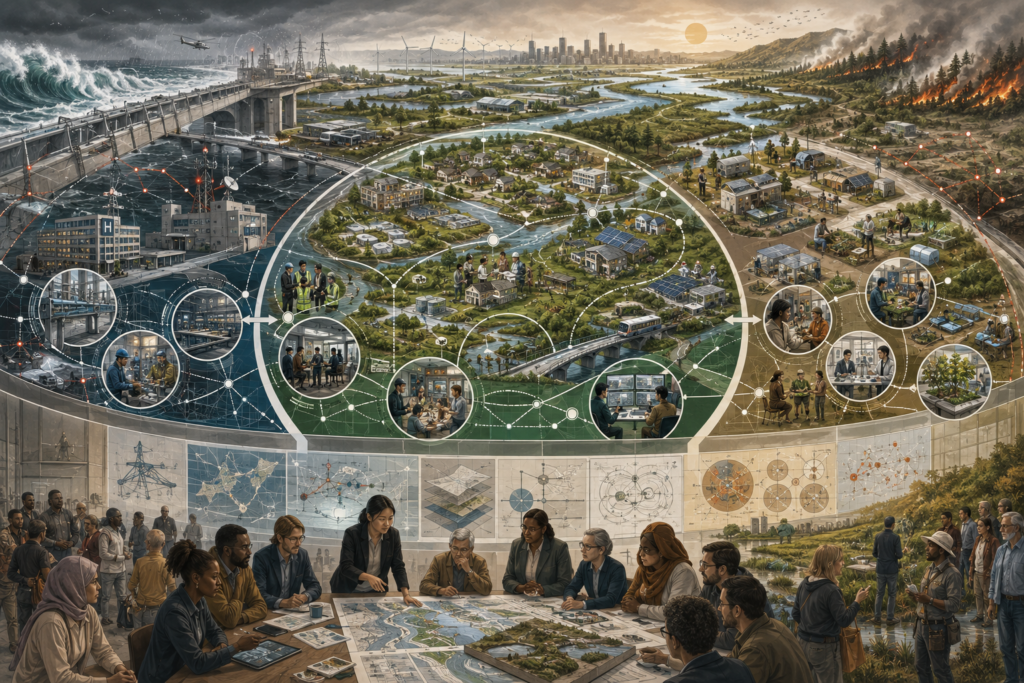

Editorial illustration showing three system-response modes under stress: robust infrastructure resisting disruption, resilient communities adapting and recovering, and bounded experimentation enabling learning without unacceptable harm.

Resilience, Robustness, and Antifragility

Resilience, robustness, and antifragility describe different ways systems respond to stress. Robust systems resist disruption; resilient systems absorb, adapt, recover, reorganize, and continue functioning; antifragile systems improve through bounded stress, variation, feedback, and learning. This article explains why these distinctions matter for sustainable systems, where critical infrastructure, ecosystems, institutions, communities, and technologies do not all need the same response strategy. It argues that robustness is essential for lifelines that must not fail, resilience is necessary for complex systems facing uncertainty, and antifragility is useful only where failure is contained, reversible, informative, and justly distributed. Sustainable resilience requires more than strength or adaptation alone. It requires matching response capacities to ethical stakes, ecological limits, public legitimacy, and the protection of vulnerable communities.

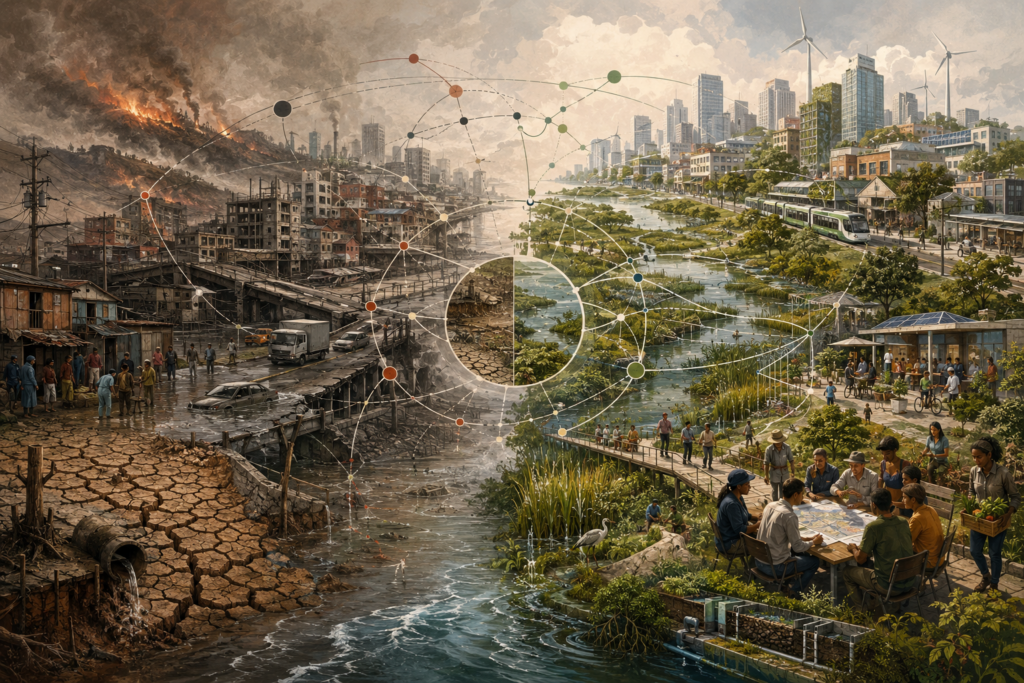
Editorial illustration showing coastal flooding, drought, wildfire, unequal infrastructure, community planning, and governance to explain vulnerability, exposure, and sensitivity in sustainable-systems risk.

Vulnerability, Exposure, and Sensitivity

Vulnerability, exposure, and sensitivity explain why hazards do not produce equal outcomes. Exposure identifies who or what is in harm’s way; sensitivity describes how strongly exposed systems respond to stress; vulnerability captures the broader susceptibility to harm created by social, infrastructural, ecological, institutional, and adaptive-capacity conditions. This article shows why risk cannot be understood through hazard severity alone. The same flood, heat wave, drought, wildfire, outage, or disease outbreak can produce radically different consequences depending on housing quality, public health, ecosystem condition, infrastructure maintenance, early warning, social protection, governance capacity, and inequality. Serious resilience planning must therefore reduce exposure where possible, lower sensitivity through better design and ecological buffers, and address vulnerability by strengthening institutions, public investment, justice, and adaptive capacity before hazards become disasters.

Editorial illustration showing interconnected cities, infrastructure, ecosystems, climate hazards, monitoring systems, and community governance under uncertainty and systemic risk.

Risk, Uncertainty, and Complexity

Risk, uncertainty, and complexity are inseparable in sustainable systems because real-world systems rarely operate in stable, isolated, or fully knowable conditions. This article explains how risk shifts from calculable probability toward systemic vulnerability when climate, infrastructure, ecosystems, institutions, technologies, finance, and social capacity interact through feedback loops, thresholds, delays, dependencies, and adaptive behavior. It distinguishes risk from uncertainty, shows why complexity makes prediction limited, and argues that governance must rely on more than probability, optimization, or control. Resilient systems need monitoring, redundancy, flexibility, institutional learning, adaptive governance, precaution, and public legitimacy. The article also connects conceptual analysis with computational workflows for modeling uncertainty-adjusted risk, complexity amplification, systemic risk, robust response capacity, and resilience gaps under changing conditions.

Editorial illustration contrasting systemic fragility and resilient adaptation, showing hazards, vulnerable infrastructure, ecological degradation, community planning, green infrastructure, and long-term resilience-building.

What Is Risk and Resilience in Sustainable Systems?

Risk and resilience are foundational to sustainable systems because they explain how societies, infrastructures, ecosystems, technologies, and institutions behave under disturbance. Risk is not simply an external hazard; it emerges through the interaction of hazard, exposure, vulnerability, dependency, ecological condition, institutional capacity, and social inequality. Resilience is not merely recovery after crisis; it is the capacity to resist, absorb, adapt, reorganize, recover, and sometimes transform while preserving essential functions and long-term viability. This article introduces risk and resilience as a systems framework for understanding why some arrangements fail under stress while others maintain function, protect vulnerable communities, and adapt without sacrificing justice, ecological integrity, or future possibility. It also connects conceptual analysis with computational workflows for modeling systemic risk, resilience gaps, and intervention scenarios.

Editorial illustration of risk and resilience shown as a layered systems map with a central resilience core, surrounding infrastructure networks, climate stress patterns, ecological pressures, human movement, and interconnected pathways of failure, adaptation, and recovery.

Risk & Resilience: Fragility, Adaptation, and Sustainable Systems

Risk and resilience explain how complex systems confront disturbance, uncertainty, cascading failure, and long-term structural change. This pillar examines hazards, exposure, vulnerability, adaptive capacity, infrastructure dependency, ecological stress, climate risk, governance failure, public-health resilience, financial fragility, digital dependency, and social inequality as interconnected systems problems. Rather than treating resilience as simple recovery, it asks how systems absorb disruption, maintain essential functions, reorganize under stress, and transform when existing structures become brittle, unjust, or unsustainable. The series connects systems theory, disaster risk reduction, climate adaptation, infrastructure planning, social-ecological resilience, decision science, and institutional governance to show why durable resilience depends on redundancy, monitoring, maintenance, public trust, local capacity, ecological buffers, and justice.

Editorial illustration showing Earth within planetary stewardship systems, with restoration, multilevel governance, ecological repair, justice, cities, communities, and future generations.

The Future of Planetary Stewardship

The future of planetary stewardship will be defined by whether human societies can learn to govern themselves as participants in, rather than masters of, a finite and interdependent Earth system. More than a narrow form of environmental management, planetary stewardship asks what kinds of institutions, values, responsibilities, and forms of coordination are needed to preserve the ecological conditions that make long-term collective flourishing possible. This article examines why stewardship is becoming a defining concept in an age of ecological limits, how it connects planetary boundaries to governance and justice, and why the future of stewardship depends on whether societies can turn ecological knowledge into credible forms of care, repair, restraint, and transformation.

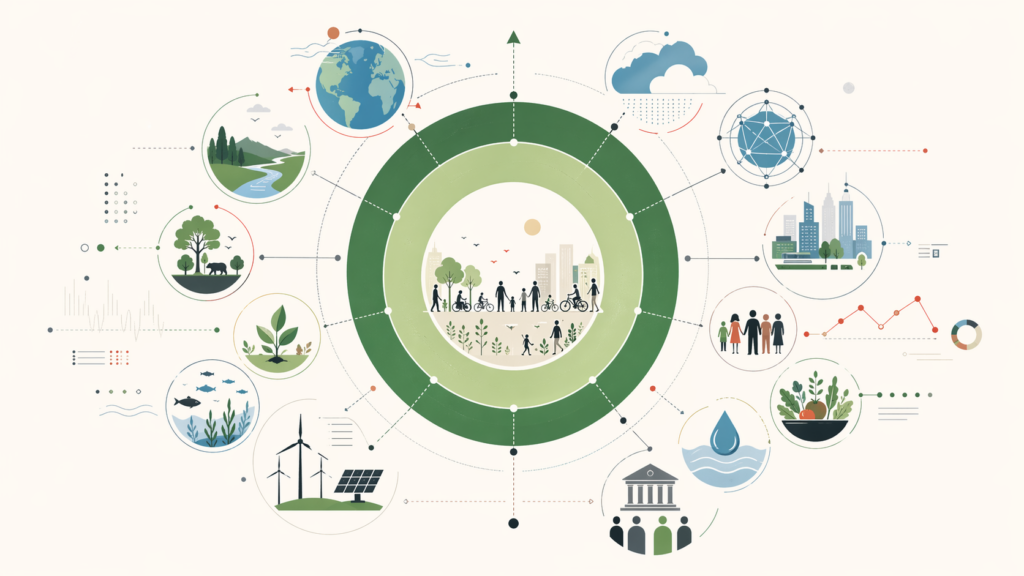
Editorial illustration showing a large green doughnut-shaped systems diagram with people, city life, ecosystems, water, food, energy, governance, climate, and biodiversity icons connected around a central safe and just space.

Planetary Boundaries and Doughnut Economics

Planetary boundaries and Doughnut Economics are best understood as complementary frameworks for thinking about sustainability, development, and human flourishing on a finite planet. The planetary boundaries framework identifies the ecological ceiling required to protect Earth system stability and resilience, while Doughnut Economics adds a social foundation below which no one should fall. This article examines how Doughnut Economics extends the logic of planetary boundaries, why the safe and just space for humanity has become such an influential idea, and how the synthesis of ecological limits and social wellbeing is reshaping debates over development, governance, and economic redesign.

Editorial illustration showing Earth within planetary-boundary bands, surrounded by debates over technocracy, justice, democracy, political economy, local translation, and responsible governance.

Critiques of the Planetary Boundaries Framework

Critiques of the Planetary Boundaries Framework examines why one of sustainability science’s most influential models has also become the subject of serious scholarly debate. The article argues that the major critiques do not reject ecological limits; they challenge how those limits are framed, governed, measured, downscaled, and distributed across unequal societies. It explores technocracy, democratic legitimacy, justice, political economy, scale, anthropocentrism, operationalization, and the safe-versus-just boundaries debate. The article also adds a mathematical lens for modeling critique-aware governance risk, along with Python and R workflows for scoring biophysical, justice, legitimacy, political-economy, and operationalization risks. The result is a more reflective framework for using planetary boundaries critically, transparently, and responsibly.

Scroll to Top