Psychology

Psychology explores the cognitive, emotional, and social processes that shape human behavior. The discipline examines how individuals perceive information, form beliefs, make decisions, interact with others, and respond to complex environments.

Modern psychological research spans multiple domains, including cognitive psychology, behavioral economics, social psychology, and positive psychology. Together, these fields provide insights into decision-making, motivation, learning, and the social dynamics that influence collective behavior.

Understanding psychological processes is essential for designing effective institutions, policies, and communication strategies. Behavioral insights help explain why individuals and groups respond to incentives, social norms, and institutional structures in ways that often diverge from purely rational models.

Psychology therefore plays an important role in fields ranging from public policy and organizational leadership to sustainability governance and technological design.

Editorial scientific illustration of organizational psychology as an institutional behavior systems architecture, showing leadership structures, team networks, communication pathways, trust systems, psychological safety, decision corridors, burnout pressure, and organizational resilience.

Organizational Psychology: How Human Behavior Shapes Work, Leadership, and Institutions

Organizational psychology examines how human behavior shapes work, leadership, teams, culture, decision-making, motivation, conflict, and institutional performance. It studies organizations not simply as charts, roles, or management structures, but as living behavioral systems shaped by perception, incentives, identity, trust, authority, communication, power, and shared meaning. This article introduces organizational psychology as a field for understanding why people cooperate, resist, lead, disengage, innovate, conform, burn out, or adapt inside formal institutions. It connects individual psychology with group dynamics, organizational design, leadership practice, and institutional outcomes, showing how workplaces become sites of both human possibility and structural constraint. A serious account of organizational psychology must therefore examine performance and productivity alongside dignity, fairness, psychological safety, accountability, and the unequal distribution of voice and power across organizational life.

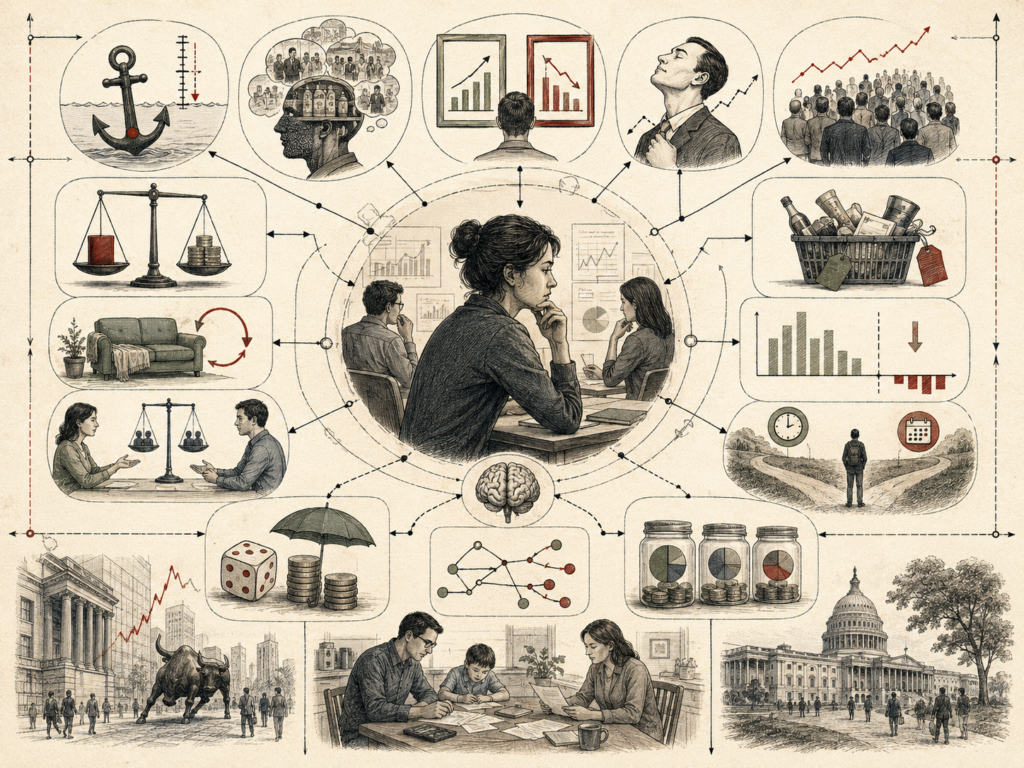
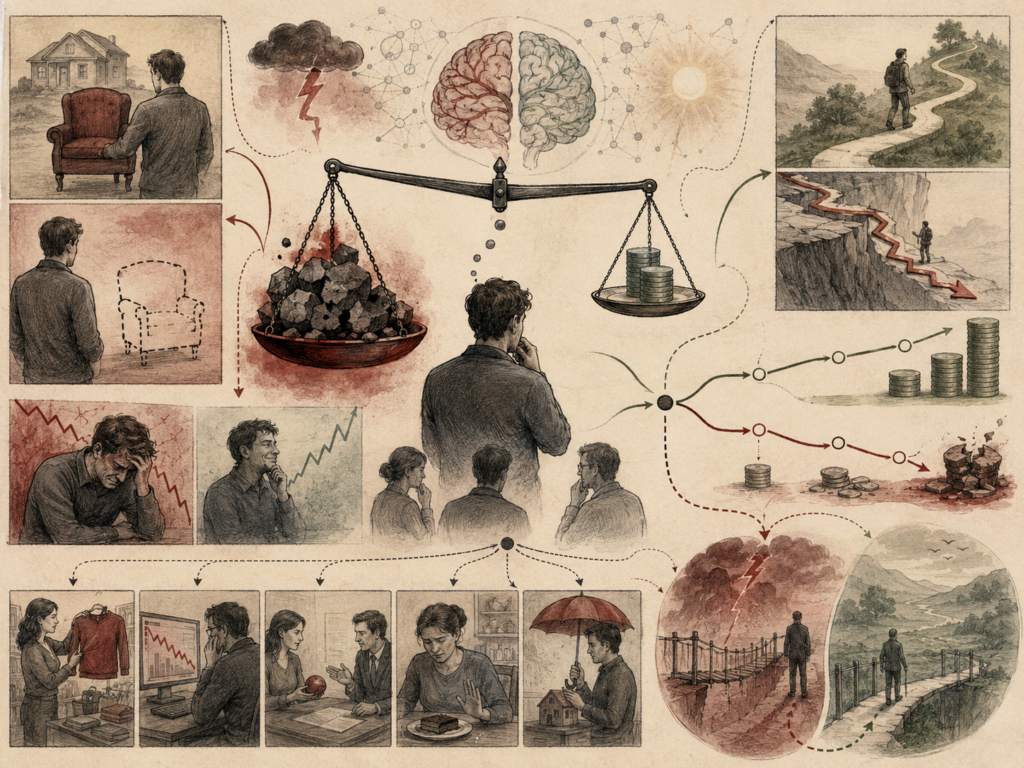
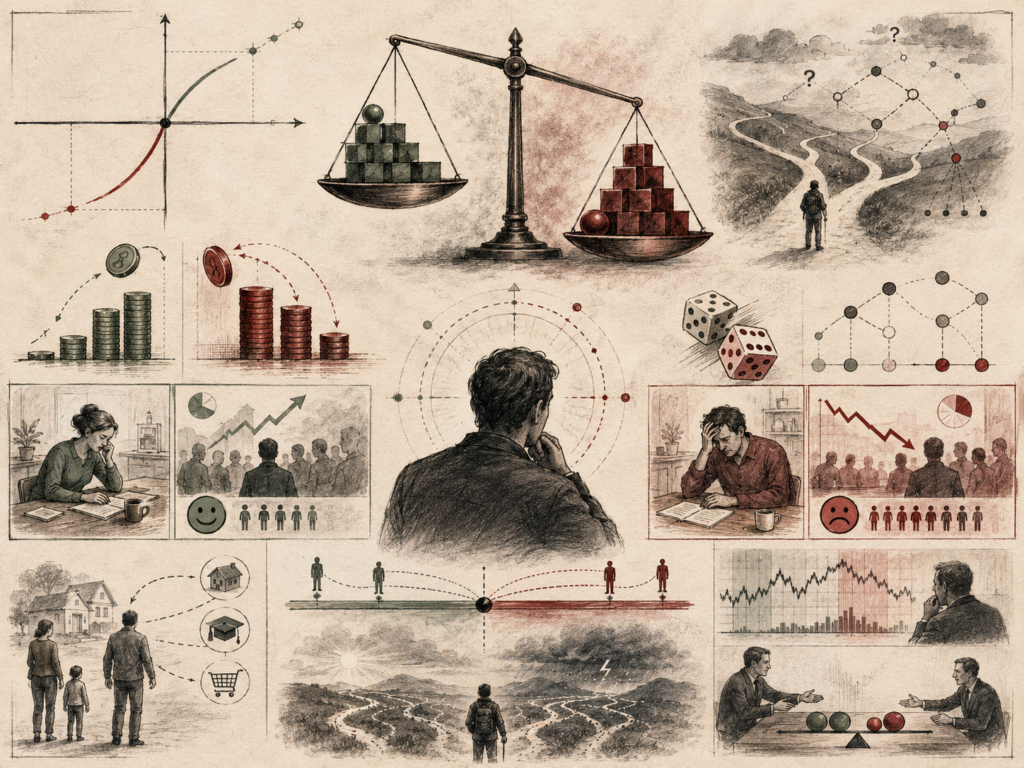
Editorial scientific illustration of behavioral economics as a decision systems architecture, showing bounded rationality, incentives, risk perception, framing effects, loss aversion, heuristics, time discounting, social influence, choice architecture, markets, policy systems, and sustainability pathways.

Behavioral Economics: How Psychology Shapes Economic Decision-Making

Behavioral economics studies how psychological processes shape economic decision-making under risk, incentives, and uncertainty, explaining why real human behavior often departs from the assumptions of perfect rationality. This article introduces the field as an interdisciplinary framework linking psychology, economics, decision science, and institutional analysis, while tracing its intellectual emergence through bounded rationality, prospect theory, heuristics, loss aversion, choice architecture, behavioral finance, and social preferences. It also maps the full article series across decision theory, bias, intertemporal choice, finance, policy, digital systems, and sustainability, and develops a formal analytical framework with substantial R and Python sections using fully commented code. The broader argument is that behavioral economics is not simply a critique of classical theory, but a more realistic account of how incentives, cognition, context, and institutions combine to shape actual economic behavior.

Research-grade cognitive psychology diagram showing cognitive load and working memory limits through input, attention, selective filtering, limited-capacity working memory, rehearsal, chunking, overload, symptoms, performance decline, and feedback.

Cognitive Load and Information Processing: Limits of Human Working Memory

Cognitive load refers to the mental effort required to process information within the limits of working memory, and for that reason it is one of the clearest ways of understanding cognition under constraint. Human beings do not think in an unlimited space. Attention can only select a fraction of what is available, working memory can only maintain a small amount of novel information at once, and learning depends on whether that limited workspace is being used productively or overwhelmed by unnecessary demands. Cognitive load theory emerged from this basic architecture and asks a deceptively simple question: how much of the mind’s limited capacity is being consumed, and by what? The answer helps explain why some forms of instruction, design, and problem presentation support understanding while others produce confusion, fatigue, and error. Not all mental effort is the same. Some effort is inherent to the complexity of the material itself, some is wasted through poor presentation, and some contributes directly to meaningful learning.

Restrained institutional research illustration showing heuristics as mental shortcuts that filter information through attention, uncertainty, limited time, cognitive capacity, availability, representativeness, anchoring, affect, recognition, fluency, judgment, choice, bias risk, speed-accuracy tradeoffs, and feedback.

Heuristics in Cognitive Psychology: Mental Shortcuts in Human Judgment

Heuristics are the mental shortcuts that allow people to make judgments quickly when time, attention, information, or certainty is limited. In cognitive psychology, heuristics are not simply errors or signs of irrationality; they are adaptive tools for navigating complexity with bounded cognitive resources. Availability, representativeness, anchoring, affect, recognition, and fluency all help simplify judgment by reducing the amount of information that must be processed. Yet these same shortcuts can also distort reasoning, especially when vivid examples, emotional reactions, familiar patterns, initial anchors, or easy-to-process information are mistaken for reliable evidence. Understanding heuristics reveals how human judgment balances efficiency and accuracy, why bias emerges under uncertainty, and how better feedback, reflection, and decision environments can improve reasoning.

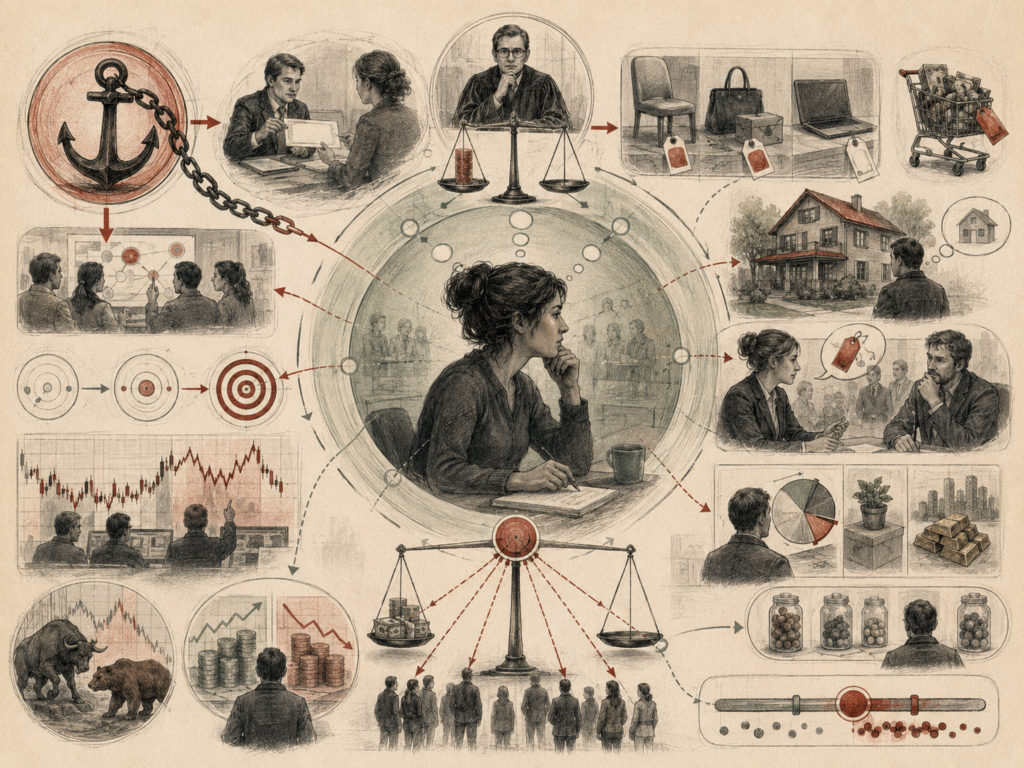
Research-grade cognitive psychology diagram showing how objective evidence becomes filtered by attention, uncertainty, emotion, memory, and common cognitive biases, leading human judgment away from an ideal rational pathway.

Cognitive Biases in Decision Making: Why Human Judgment Deviates from Rationality

Cognitive biases are systematic patterns of deviation from formal standards of reasoning that arise from the ordinary structure and limits of human cognition. In cognitive psychology, they are not treated as random mistakes or isolated lapses in judgment, but as predictable outcomes of the same mechanisms that make thought efficient under uncertainty. Attention filters what is noticed, memory reconstructs and prioritizes experience, working memory limits how much can be processed at once, and decision systems rely on heuristics to act without exhaustive computation. Because cognition must operate under pressure, ambiguity, and incomplete information, it often favors speed, tractability, and usable approximation over perfect accuracy. Biases therefore reveal something fundamental about how the mind works: they are not external to intelligence but emerge from the adaptive strategies that make intelligence possible in complex environments. This is why the study of cognitive bias became so influential across psychology, behavioral economics, neuroscience, and public policy. It shows that judgment is systematically shaped by the architecture of cognition itself, and that understanding those distortions is essential for understanding how people interpret information, evaluate risk, and make decisions in the real world.

Restrained institutional research illustration showing decision making as a cognitive process in which attention filters inputs, options are compared, uncertainty and tradeoffs are evaluated, values are judged, and a final choice is made with feedback.

Decision Making in Cognitive Psychology: How the Mind Evaluates Choices

Decision making in cognitive psychology refers to the processes through which individuals evaluate options, interpret uncertainty, and select actions under conditions of limited information, limited time, and cognitive constraint. Rather than unfolding as a purely rational calculation of costs and benefits, decision making emerges from the interaction of attention, memory, working memory, perception, and judgment, each of which shapes what information is noticed, retained, compared, and acted upon. This makes decision making one of the clearest windows into cognition as a whole, because it reveals how thought is organized when the mind must move from interpretation to action. In real environments, people rarely optimize across every possible alternative. They simplify, rely on heuristics, use prior knowledge, frame problems through mental models, and make choices under uncertainty with only partial representations of the situation. For that reason, decision making is not just a topic within cognitive psychology but one of its central organizing problems. It helps explain how the mind balances speed against accuracy, risk against reward, and constraint against action, while also showing why judgment is so often shaped by bias, framing, and bounded rationality in the real world.

Restrained institutional research illustration showing working memory as a limited-capacity cognitive system that filters input through attention, temporarily holds information, chunks patterns, updates contents, compares alternatives, supports reasoning, and uses feedback.

Working Memory in Cognitive Psychology: The System That Supports Thinking and Reasoning

Working memory is the cognitive system that allows the mind to hold, manipulate, and organize information over short periods of time while thought is still unfolding. It is one of the central mechanisms of cognition because it makes reasoning, comprehension, decision making, and problem solving possible in real time. Rather than serving as a passive storage space, working memory functions as an active mental workspace in which information can be updated, compared, combined, and directed toward immediate goals. Its importance lies not only in what it can hold, but in the severe limits under which it operates. Because only a small amount of information can be actively maintained at once, working memory helps explain why complex tasks become effortful, why attention is easily overloaded, and why the structure of information matters so much for learning and performance. In cognitive psychology, working memory therefore stands at the center of the mind’s capacity to think under constraint, linking perception, attention, memory, and action into a temporary system of control that allows intelligence to function moment by moment.

Restrained institutional research illustration showing memory as a cognitive system involving attention, encoding, working memory, long-term memory, consolidation, retrieval cues, recall, recognition, rehearsal, and feedback updating.

Memory in Cognitive Psychology: How the Mind Encodes, Stores, and Retrieves Information

Memory in cognitive psychology refers to the processes through which information is encoded, stored, and retrieved across time, allowing experience to become available for later thought, judgment, and action. It is one of the central systems of cognition because it makes learning, recognition, language, reasoning, and identity possible by preserving knowledge beyond the immediate present. Memory is not a single container in which information is simply deposited and later recovered unchanged. It is a dynamic system composed of interacting processes and forms, including the short-term maintenance of information, the long-term organization of knowledge, and the reconstruction of past experience in light of current context. For that reason, memory helps explain both the power and the fragility of human cognition. It allows the mind to build continuity, accumulate knowledge, and act intelligently in complex environments, but it also reveals how remembering is shaped by attention, interpretation, and constraint. In cognitive psychology, memory therefore stands at the center of how the mind connects past experience to present understanding and future action.

Restrained institutional research illustration showing perception as a cognitive process that filters sensory input through attention, feature detection, pattern recognition, figure-ground organization, depth and form interpretation, context, recognition, and perceptual judgment.

Perception in Cognitive Psychology: How the Mind Interprets Sensory Information

Perception is the process through which the mind organizes, interprets, and stabilizes sensory information into a usable world. Sensory systems register light, sound, motion, pressure, and other forms of stimulation, but perception is what transforms those unstable signals into objects, surfaces, voices, events, and environments that can be meaningfully navigated. In cognitive psychology, perception is therefore not treated as a passive recording of reality. It is understood as an active process of organization, inference, prediction, and context-sensitive interpretation. Because raw sensory input is incomplete, noisy, and often ambiguous, the mind must construct relatively stable experience from uncertain evidence, drawing not only on incoming stimulation but also on attention, memory, working memory, prior knowledge, and expectation. This gives perception a foundational place within cognition as a whole, since reasoning, learning, judgment, and action all depend on what is first perceived and how it is organized. To understand cognition more broadly, one must first understand how the mind constructs the world it takes itself to be encountering.

Scroll to Top