
Last Updated May 26, 2026
Bounded rationality describes the idea that human decision-making is constrained by limited attention, incomplete information, finite time, cognitive capacity, search costs, institutional context, and uncertainty. Rather than optimizing perfectly across all available alternatives, people usually make decisions through simplified rules, routines, thresholds, habits, procedures, and satisficing strategies that are workable under real-world constraints. The concept fundamentally reshaped economics by showing that actual economic behavior cannot be understood only through incentives and preferences. It must also be understood through the cognitive and institutional limits inside which choices are made.
Bounded rationality matters because the world is too complex for complete optimization. Consumers do not compare every product. Workers do not evaluate every possible job. Investors do not process every signal. Organizations do not calculate every possible strategy. Governments do not possess complete knowledge of policy consequences. Households do not fully model retirement, insurance, housing, health care, credit, education, or climate risk. Instead, decision-makers search, simplify, categorize, imitate, anchor, stop early, defer to defaults, rely on trusted institutions, and often choose an option that is “good enough” rather than globally optimal.
Main Library
Publications
Article Map
Behavioral Economics
Related Topic
Economic Systems
Related Topic
Cognitive Psychology
Related Topic
Institutions & Governance
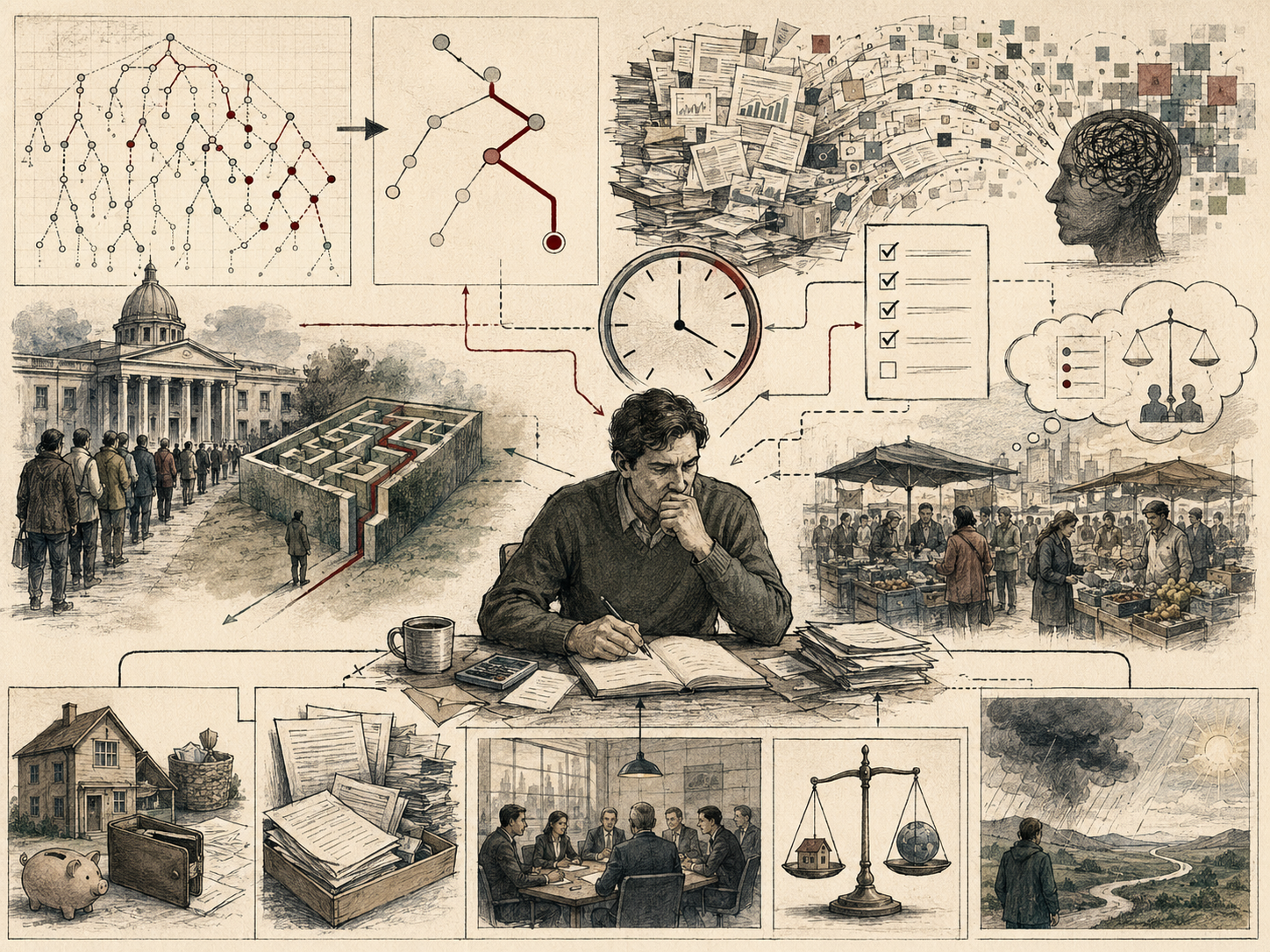
Classical economic models often begin with the image of a rational actor who possesses clear preferences, evaluates available information, calculates expected outcomes, and chooses the option that maximizes utility. Bounded rationality begins somewhere else: with the human being inside a complex decision environment. Real people face uncertainty, limited attention, search costs, emotional pressure, social influence, administrative burden, institutional complexity, and time constraints. Under these conditions, full optimization may be impossible, inefficient, or even irrational because the cost of searching for the best option may exceed the benefit of finding it.
This article connects bounded rationality to Expected Utility Theory and Rational Choice, Prospect Theory and the Psychology of Risk, Loss Aversion, Heuristics and Biases in Economic Decision-Making, Framing Effects in Consumer Choice, Choice Architecture and Decision Environments, Nudge Theory and Behavioral Public Policy, and Behavioral Economics in Organizational Decision-Making. The central argument is that bounded rationality is not a minor correction to rational-choice theory. It is one of the foundational ideas that made behavioral economics, organizational decision theory, administrative science, and realistic policy design possible.
The Concept of Bounded Rationality
Bounded rationality is the idea that decision-making is rational only within limits. Human beings try to make sensible choices, but they do so with limited attention, limited memory, limited computational capacity, limited information, limited time, and limited ability to forecast the consequences of complex systems. The result is not irrational chaos. It is practical reasoning under constraint.
The concept shifts attention from what an ideal decision-maker would choose under perfect information to how real decision-makers actually reason in imperfect environments. A consumer shopping for insurance may not compare every plan. A patient choosing a treatment may not understand every probability. A household planning retirement may not solve an intertemporal optimization problem. A public agency designing a program may not know every consequence of its rules. A firm facing uncertain markets may rely on routines, benchmarks, or managerial judgment. These behaviors are not exceptions to economic life. They are economic life.
Bounded rationality therefore challenges the assumption that economic actors are fully optimizing agents. It does not deny that people have goals. It does not deny that people respond to incentives. It does not deny that reasoning matters. Instead, it argues that goals and incentives are filtered through attention, cognition, institutional structure, search processes, social context, and available information.
This makes bounded rationality especially important for behavioral economics. Many later concepts—heuristics, framing effects, default effects, limited attention, information overload, present bias, decision fatigue, administrative burden, choice architecture, and institutional design—depend on the recognition that human cognition is finite. Once this is acknowledged, the structure of decision environments becomes central. A badly designed system can overwhelm people. A well-designed system can help people make better choices without requiring impossible levels of calculation.
Bounded rationality also has a democratic and ethical dimension. If institutions are built for imaginary fully rational actors, they may fail real people. Complex benefit applications, opaque financial products, confusing health plans, misleading interfaces, and overloaded regulatory disclosures may formally preserve choice while practically denying meaningful agency. Bounded rationality shows why simplicity, transparency, defaults, trusted intermediaries, and institutional accountability are not decorative. They are part of what makes choice real.
The Origins of Bounded Rationality
The concept of bounded rationality emerged as a critique of the idealized rational actor at the center of much neoclassical economics. In traditional models, decision-makers are often assumed to possess stable preferences, access relevant information, evaluate alternatives consistently, and choose the option that maximizes expected utility. This abstraction can be useful, but it can also obscure the actual conditions under which decisions are made.
Bounded rationality arose from the observation that decision-makers rarely face clean choice sets. Real options may be unknown, uncertain, ambiguous, costly to discover, difficult to compare, changing over time, or embedded in institutional constraints. Even when information exists, it may be too complex, too voluminous, too technical, or too costly to process. A person may have a theoretical right to choose, but not the practical capacity to evaluate all choices meaningfully.
The intellectual roots of bounded rationality sit at the intersection of economics, psychology, public administration, political science, management science, and organizational theory. The concept was not only about individual cognition. It was also about how organizations and institutions process information. Firms, governments, universities, hospitals, courts, platforms, and public agencies all face bounded rationality because they must decide under uncertainty, limited knowledge, and organizational constraints.
This broader institutional dimension is one reason bounded rationality became so influential. It helped explain why organizations rely on rules, routines, standard operating procedures, committees, reporting systems, bureaucratic categories, professional norms, and delegated authority. These are not simply inefficiencies. They are ways of coping with complexity. The problem is that these coping systems can also become rigid, biased, exclusionary, or poorly adapted to changing conditions.
Bounded rationality therefore changed the question. Instead of asking only what a rational actor would choose, it asks how decision systems can be designed so that limited actors can make better decisions in complex environments. That question remains central to behavioral economics, governance, organizational design, digital systems, consumer protection, and sustainability policy.
Herbert Simon and the Behavioral Model of Rational Choice
Herbert A. Simon is the central figure in the development of bounded rationality. His work across economics, psychology, political science, public administration, artificial intelligence, and organizational theory challenged the idea that rationality should be understood as unlimited optimization. Simon argued that real decision-makers operate under constraints of knowledge, computation, attention, and time. Rationality is therefore bounded by the structure of the decision environment and by the capacities of the decision-maker.
In his 1955 article “A Behavioral Model of Rational Choice,” Simon criticized models that assumed actors could evaluate all possible alternatives and consequences. He argued that this assumption was psychologically unrealistic and institutionally inadequate. People do not normally optimize across the full space of possibilities. They search until they find an alternative that meets an aspiration level. This process became known as satisficing.
Satisficing was a profound idea because it reframed decision-making as sequential search under constraint. An agent does not need to know every option. The agent needs a rule for deciding when to stop searching. That stopping rule depends on aspiration level, search cost, time pressure, experience, available information, and perceived risk. A decision may be rational within the bounds of the situation even if it does not identify the theoretical optimum.
Simon extended these ideas in Administrative Behavior and Models of Man. He showed that organizations exist partly because individuals cannot handle complex decision environments alone. Organizations structure attention, distribute information, create routines, define roles, set procedures, and narrow the decision space. In that sense, institutions are not only incentive systems. They are cognitive systems.
This is one of Simon’s lasting contributions. He moved economics away from the isolated, perfectly calculating actor and toward a theory of decision-making embedded in organizations, routines, information systems, and practical constraints. That shift shaped behavioral economics, organizational economics, management science, artificial intelligence, public administration, and modern policy design.
Simon’s work also carries a warning. If rationality is bounded, then systems can either support or exploit those bounds. Institutions can simplify genuinely, or they can obscure. They can reduce cognitive burden, or they can shift it onto vulnerable people. They can create useful routines, or they can trap decision-makers in outdated categories. Bounded rationality therefore becomes both a descriptive theory and a design responsibility.
Optimization, Search, and the Cost of Calculation
Classical optimization assumes that a decision-maker can compare all relevant alternatives and select the one with the greatest value. This is a powerful mathematical framework. It supports microeconomic theory, welfare analysis, finance, operations research, game theory, and many models of public policy. But bounded rationality asks whether optimization is feasible when search and calculation are themselves costly.
In real environments, optimization requires discovering options, gathering information, interpreting evidence, comparing outcomes, estimating probabilities, forecasting consequences, and updating beliefs. Each of these steps has a cost. A consumer comparing health plans must understand premiums, deductibles, networks, formularies, out-of-pocket limits, and uncertain medical needs. A firm evaluating suppliers must assess price, quality, reliability, logistics, political risk, and long-term resilience. A government evaluating climate policy must model technology, emissions, political feasibility, distributional effects, ecological thresholds, and uncertain future damages.
The cost of calculation can make full optimization self-defeating. If the time and effort required to identify the best option exceed the benefit of the improvement, then a bounded decision rule may be more reasonable than exhaustive search. This is not laziness. It is a recognition that decision-making itself consumes resources.
Search costs are especially important in markets. Consumers often choose from the first acceptable options they encounter. Job seekers stop searching when an offer meets their threshold. Firms rely on preferred vendors. Investors use screening rules. Organizations follow routines. Households repeat familiar purchases. These behaviors may appear suboptimal if compared with a perfect-information benchmark, but they may be efficient responses to search costs.
Optimization also assumes that the value of alternatives can be known or estimated reliably. Many real decisions involve ambiguity, not just risk. Probabilities may be unknown. Outcomes may be contested. Values may be multidimensional. The best option may depend on future conditions that cannot be forecast. Under such conditions, “optimization” can become an illusion of precision.
Bounded rationality therefore encourages a more realistic view: decision-makers often use adaptive search. They look for acceptable options, stop when search becomes too costly, update aspiration levels, rely on trusted sources, and use institutional rules to simplify complexity. The quality of the decision depends not only on the individual but on the environment that shapes search.
Satisficing Versus Maximizing
Satisficing is the decision rule most closely associated with bounded rationality. Instead of searching for the best possible option, a satisficing agent searches until an option meets an acceptable aspiration threshold. The threshold may be based on need, experience, social norms, expectations, institutional rules, prior outcomes, or available time. Once the threshold is met, search stops.
Maximizing asks, “What is the best possible option?” Satisficing asks, “Is this option good enough given my constraints?” The difference matters because the second question is often the one real decision-makers can answer. A household looking for an apartment may not find the mathematically optimal housing option. It may search until it finds a place that is affordable, safe enough, close enough, and available. A manager hiring under time pressure may not find the best possible candidate. The manager may choose the first candidate who meets key requirements. A patient choosing among treatment plans may not optimize across all clinical probabilities. The patient may choose an option that is understandable, trusted, and acceptable.
Satisficing can be adaptive. In environments where search is costly and options are uncertain, stopping early can preserve time, attention, and emotional energy. A decision that is slightly below the theoretical optimum may be better overall once search costs are included. This is especially true when the difference between the best and acceptable options is small, but the cost of finding the best option is high.
However, satisficing can also produce unequal outcomes. People with fewer resources, less time, less institutional knowledge, lower digital access, or greater stress may set lower aspiration thresholds or stop searching sooner. A low-income consumer may accept worse credit terms. A worker under pressure may accept worse employment conditions. A patient with limited support may accept confusing or inadequate care. A small business may accept less favorable contracts because it lacks legal or analytical capacity.
This is why bounded rationality is not merely cognitive. It is social and institutional. The ability to search depends on resources, education, time, trust, infrastructure, and power. Satisficing can be rational under constraint, but the constraints themselves may be unjust.
Policy design should therefore ask two questions. First, are people given decision environments in which satisficing leads to acceptable outcomes? Second, are some groups forced to satisfice under worse constraints than others? A well-designed institution should make good-enough choices genuinely good, especially for people with the least time, power, and administrative capacity.
Decision-Making Under Cognitive Limits
Bounded rationality begins from the reality that cognition is limited. People cannot attend to everything, remember everything, compare everything, calculate everything, or forecast every consequence. Attention is scarce. Working memory is limited. Complex information must be simplified. Emotional stress changes processing. Time pressure narrows attention. Fatigue reduces decision quality. These limits shape economic behavior as much as prices and incentives do.
One important limit is attention. A decision-maker may ignore information not because it is irrelevant, but because it is not salient. Fees hidden in fine print, delayed consequences, low-probability risks, long-term climate damages, compound interest, or future health costs may receive too little attention. Conversely, vivid or emotionally salient information may receive too much attention.
A second limit is working memory. People can hold only a limited amount of information in mind at once. This makes complex comparisons difficult. Health insurance menus, retirement plans, tax forms, loan disclosures, privacy policies, benefit applications, and digital-platform settings often exceed practical cognitive capacity. When choice architecture overwhelms working memory, people rely on defaults, shortcuts, or avoidance.
A third limit is computational capacity. Many decisions require probabilistic reasoning, tradeoff analysis, intertemporal calculation, and scenario comparison. Even highly educated decision-makers may struggle with compound probabilities, uncertain risks, actuarial values, or dynamic feedback systems. Economic models may assume these calculations are available, but real people often use approximations.
A fourth limit is time. Decisions are rarely made in ideal analytical conditions. A worker may need to accept a job quickly. A tenant may need housing immediately. A consumer may choose a loan under pressure. A public agency may respond to crisis conditions. Time pressure reduces search and increases reliance on rules of thumb.
A fifth limit is stress. Scarcity, insecurity, crisis, and administrative burden consume cognitive resources. A person under financial pressure may focus on immediate threats, not because they lack long-term concern, but because urgent needs dominate attention. Bounded rationality therefore intersects with inequality. Poverty, instability, and insecurity can narrow the decision space.
These cognitive limits make the design of decision environments ethically important. Systems should not require impossible cognition as the price of good outcomes. When institutions create complexity and then blame people for poor decisions, they misuse the language of choice.
Incomplete Information, Uncertainty, and Ambiguity
Bounded rationality is not only about limited cognition. It is also about incomplete information. Real decision-makers rarely know all possible options, outcomes, probabilities, or consequences. Information may be missing, expensive, technical, misleading, strategically withheld, rapidly changing, or distributed unevenly across actors.
In many markets, information asymmetry is central. Sellers may know more than buyers. Employers may know more about job conditions than applicants. Lenders may understand terms better than borrowers. Platforms may know more about user behavior than users know about platform incentives. Insurers may know more about product exclusions than policyholders. These asymmetries make bounded rationality more consequential because limited cognition interacts with unequal information.
Uncertainty also matters. Some decisions involve known probabilities, such as a simplified lottery. Many real decisions do not. A household choosing a mortgage does not know future income, interest rates, housing prices, health shocks, or job stability. A government choosing climate policy does not know the exact timing of tipping points, technological development, political response, or future adaptation capacity. A firm making supply-chain decisions does not know future disruptions, regulations, geopolitics, or environmental risks.
Ambiguity goes further. In ambiguous situations, probabilities themselves are uncertain. People may not know which model applies. Climate risk, financial crises, pandemics, war, artificial intelligence, ecosystem thresholds, and technological disruption involve ambiguity as well as risk. Optimization becomes difficult because the relevant probability distribution is not stable or agreed upon.
Bounded rationality under incomplete information often produces reliance on trust. People use experts, institutions, brands, advisors, community networks, professional norms, ratings, recommendations, and public agencies as substitutes for direct evaluation. Trust can reduce cognitive burden, but it also creates vulnerability. If trusted intermediaries are captured, biased, opaque, or misaligned, bounded rationality can be exploited.
Good institutional design should therefore address both information quality and cognitive usability. Information should be accurate, accessible, comparable, timely, and meaningful. Disclosure alone is not enough. A twenty-page legal document may technically provide information while practically overwhelming the user. Bounded rationality requires usable transparency, not merely formal disclosure.
Heuristics, Rules of Thumb, and Judgment Shortcuts
Heuristics are simplified decision strategies used under bounded rationality. They reduce cognitive burden by allowing people to make judgments without exhaustive analysis. A person may choose a familiar brand, follow a default, rely on a recommendation, compare only a few salient features, avoid options that feel risky, copy peers, choose the middle option, or stop searching when an acceptable alternative appears.
Heuristics are not inherently irrational. In many environments, they are adaptive. A rule of thumb can be faster, cheaper, and more reliable than complex calculation when information is limited and time is scarce. A doctor may use triage rules. A consumer may use trusted labels. A manager may use screening criteria. A regulator may use risk thresholds. A household may use budgeting categories. These shortcuts help decision-makers function.
But heuristics can also produce systematic bias. Availability bias can make vivid events seem more common than they are. Anchoring can make initial numbers overly influential. Representativeness can lead people to ignore base rates. Framing can change preferences across equivalent descriptions. Status quo bias can preserve existing arrangements. Present bias can privilege immediate rewards over future welfare. These patterns are central to behavioral economics because they show how bounded rationality can generate predictable departures from idealized rational choice.
The quality of a heuristic depends on the environment. A heuristic that works well in one setting may fail in another. Experience can improve judgment when feedback is frequent, clear, and reliable. But many economic decisions provide poor feedback. People do not repeatedly choose mortgages, retirement plans, medical treatments, disaster insurance, or climate policies under identical conditions. Learning is difficult when outcomes are delayed, noisy, rare, or irreversible.
Institutional design should therefore distinguish helpful heuristics from harmful ones. Labels, defaults, checklists, comparison tables, calculators, warnings, and simplified categories can support better heuristics. But misleading reference prices, dark patterns, manipulative urgency cues, fake scarcity, and confusing disclosures exploit bounded rationality.
Heuristics are the practical language of bounded rationality. They show how people bridge the gap between overwhelming complexity and actionable decision-making. The question is whether environments are designed so that shortcuts lead toward welfare, dignity, and informed agency—or toward exploitation.
Bounded Rationality in Organizations
Organizations are bounded-rationality systems. They exist partly because complex tasks exceed the capacity of isolated individuals. An organization can divide labor, specialize knowledge, create routines, delegate authority, standardize procedures, preserve memory, coordinate action, and structure information flows. These features help people act under conditions they could not manage alone.
Herbert Simon’s work emphasized that organizations are decision systems. They do not merely implement choices made elsewhere. They shape what information is noticed, which alternatives are considered, who has authority, how problems are categorized, and when search stops. A budget process, hiring process, procurement rule, compliance checklist, data dashboard, committee agenda, or reporting hierarchy all influences organizational rationality.
Routines are especially important. They reduce the need for constant calculation. A firm does not rethink every process every day. A hospital uses protocols. A public agency uses eligibility rules. A university uses committees. A court uses procedures. Routines create stability and reduce cognitive burden. But they can also create rigidity, blind spots, and path dependence.
Organizations also filter attention. Leaders cannot attend to every signal. Metrics, dashboards, reports, and key performance indicators determine what becomes visible. If the wrong metrics are selected, the organization may optimize what is measurable while ignoring what matters. A platform may optimize engagement while ignoring user welfare. A hospital may optimize throughput while ignoring dignity. A public agency may optimize processing time while ignoring accessibility. A firm may optimize short-term cost while ignoring resilience.
Bounded rationality also explains why organizations rely on standard operating procedures during uncertainty. Procedures can preserve quality and fairness, but they may also fail when novel conditions arise. Crises such as pandemics, climate disasters, financial shocks, supply-chain disruptions, and technological change reveal whether organizational routines are adaptive or brittle.
Good organizational design should therefore support learning. It should create feedback loops, encourage error reporting, preserve institutional memory, allow revision of routines, include frontline knowledge, and avoid punishing people for revealing inconvenient information. Bounded rationality cannot be eliminated, but it can be organized intelligently.
Institutions as Bounded-Rationality Systems
Institutions help societies manage bounded rationality at scale. Laws, regulations, professional standards, public agencies, markets, courts, accounting systems, scientific institutions, educational systems, and civic procedures all reduce complexity by creating rules and expectations. They structure decision-making so individuals do not need to calculate everything from scratch.
A contract reduces uncertainty. A standard label reduces search costs. A licensing regime signals competence. A court system creates dispute procedures. A public-health agency aggregates expertise. A central bank provides monetary signals. A building code embeds safety knowledge. A food-safety rule reduces the need for consumers to inspect every production process. Institutions are cognitive infrastructure.
But institutions can also fail bounded decision-makers. They may become too complex, opaque, inaccessible, captured, discriminatory, outdated, or misaligned. A benefit system may require excessive paperwork. A legal system may be formally open but practically inaccessible. A financial disclosure may be technically complete but unreadable. A regulatory system may rely on consumer vigilance when firms have far greater information and resources.
Institutional design must therefore account for real users. A system that works only for highly literate, digitally connected, time-rich, legally sophisticated users is not broadly accessible. Complexity can become a form of exclusion. Administrative burden can function as a hidden barrier. In this sense, bounded rationality is deeply connected to justice.
Institutions also shape aspiration levels. They define what people consider normal, possible, fair, or worth pursuing. If institutions repeatedly deny access, people may lower expectations. If systems are confusing, people may stop applying. If complaints are ignored, people may stop reporting harm. Bounded rationality interacts with institutional trust.
Effective institutions reduce unnecessary complexity, provide usable information, create fair defaults, protect people from exploitation, and make consequential choices understandable. They do not eliminate bounded rationality. They respect it.
Markets, Consumers, and Search Frictions
Markets are often described as mechanisms for aggregating information and coordinating choice. But markets also impose search, comparison, interpretation, and trust burdens on consumers. Bounded rationality is therefore central to consumer behavior. People must navigate prices, quality, contracts, warranties, reviews, fees, privacy terms, financing options, subscriptions, risks, and long-term consequences under limited time and attention.
Search frictions are everywhere. A consumer buying a laptop may compare only a few models. A family choosing health insurance may rely on defaults. A borrower may focus on monthly payment rather than total cost. A renter may accept the first available unit that meets basic needs. A worker may use salary as a proxy for overall job quality. A household may renew a subscription because cancellation requires attention.
Firms understand bounded rationality. Some reduce cognitive burden through clear design, honest comparison, and trustworthy service. Others exploit it through hidden fees, complex pricing, confusing contracts, misleading reference prices, subscription traps, dark patterns, fake scarcity, and strategically designed friction. The difference matters. A market that depends on consumer confusion is not simply efficient competition.
Bounded rationality also explains why more choice is not always better. A large menu can improve welfare when options are clear and comparable. But too many options can overload attention, increase regret, delay decision-making, and push people toward defaults. Choice quality depends on structure, not quantity alone.
Consumer protection should therefore move beyond the idea that disclosure automatically solves market problems. A disclosure that no one can understand does not create informed choice. A fee revealed only after several steps exploits attention limits. A cancellation flow that makes exit confusing abuses friction. A comparison table designed to highlight irrelevant features may distort judgment.
Markets work better when decision environments are honest, comparable, and navigable. Bounded rationality makes this a core economic issue, not a peripheral design concern.
Bounded Rationality in Finance and Investment
Financial decisions are especially vulnerable to bounded rationality because they involve uncertainty, probability, time, compounding, risk, taxes, fees, inflation, diversification, liquidity, and psychological pressure. Even sophisticated investors face limits. Ordinary households often face financial choices that exceed practical cognitive capacity.
Retirement planning is a clear example. A fully optimizing household would project future income, inflation, lifespan, health costs, asset returns, tax rules, risk tolerance, Social Security benefits, housing needs, family obligations, and uncertain shocks. In reality, households often rely on defaults, employer plans, rules of thumb, peer behavior, financial advisors, or avoidance. These strategies may be reasonable, but they are shaped by institutional design.
Investment decisions also involve bounded rationality. Investors may focus on recent returns, salient losses, familiar companies, simple narratives, or platform-provided rankings. They may under-diversify because evaluating portfolios is complex. They may trade too often because dashboards make short-term fluctuations salient. They may avoid beneficial investments because risk is emotionally vivid. They may chase speculative assets because low-probability upside is easy to imagine.
Fees and compounding are particularly difficult. Small annual fees can have large long-term effects, but those effects are not intuitive. Loan terms, credit-card interest, adjustable rates, insurance exclusions, and investment expenses often require calculations that many users cannot perform under ordinary decision conditions. This is not an individual moral failure. It is a design and governance problem.
Financial institutions can support bounded decision-makers through clear defaults, fiduciary standards, simplified fee disclosure, diversified default portfolios, risk-appropriate guidance, cooling-off periods, and honest communication. They can also exploit bounded rationality through complexity, urgency, gamification, hidden fees, and misleading performance displays.
Bounded rationality therefore belongs at the center of financial regulation and behavioral finance. The key question is not whether people should be responsible for their choices. The question is whether financial systems are designed so that responsibility is meaningful rather than performative.
Digital Platforms, Algorithms, and Cognitive Burden
Digital platforms intensify bounded rationality because they mediate choice through interfaces, rankings, defaults, notifications, feeds, recommendations, personalization, and algorithmic estimates. A user rarely sees the full choice environment. The platform structures what becomes visible, what is hidden, what is easy, what is hard, what appears popular, what appears urgent, and what feels normal.
Algorithms can reduce cognitive burden by filtering information and recommending relevant options. A good recommendation system can help users navigate complexity. But algorithms can also exploit bounded rationality by optimizing for engagement, conversion, retention, or revenue rather than user welfare. The user’s limited attention becomes the platform’s resource.
Digital choice environments often rely on friction asymmetry. Signing up is easy; cancellation is hard. Accepting defaults is easy; changing privacy settings is hard. Continuing a subscription is automatic; leaving requires effort. Consuming recommended content is effortless; searching independently takes work. These designs shape behavior by exploiting attention and effort limits.
Personalization adds another layer. Platforms can learn which users respond to urgency, social proof, scarcity cues, loss frames, price anchors, or emotional content. They can adapt interfaces to cognitive vulnerabilities. This makes bounded rationality not merely a general condition but a target of optimization.
Algorithmic systems also create new reference points. Suggested prices, risk scores, predicted delivery dates, performance benchmarks, recommended contributions, popularity labels, and ranking positions can anchor judgment. Users may treat these outputs as neutral information even when they reflect platform incentives.
Responsible digital governance should require transparency, contestability, easy exit, honest defaults, meaningful privacy control, accessible explanations, and limits on manipulative design. Bounded rationality shows why “the user could have chosen differently” is not always an adequate defense. The architecture of choice matters.
Implications for Policy and System Design
Bounded rationality has major implications for public policy. If people have limited attention, time, and processing capacity, then policy effectiveness depends not only on incentives but on administrative design, communication, defaults, accessibility, trust, and institutional simplicity. A policy can be formally available and practically unusable at the same time.
Many public programs fail not because eligible people do not value them, but because applying is difficult, documentation is burdensome, rules are confusing, deadlines are unclear, digital access is uneven, or people distrust the system. Under bounded rationality, friction is not neutral. It changes outcomes. It can exclude people, reduce take-up, and shift benefits toward those with more resources and administrative capacity.
Choice architecture matters because people rely on defaults and simplified cues. A retirement savings default can increase participation. A simplified tax credit application can increase access. Automatic enrollment can reduce administrative barriers. Clear energy labels can support sustainable consumption. Plain-language health communication can improve decision quality. Well-designed reminders can help people act on intentions.
But behavioral policy must be ethically careful. Nudges, defaults, reminders, and simplifications can support agency, but they can also manipulate. A default that helps people enroll in a beneficial program differs from a default that traps them in an unwanted subscription. A reminder that supports an important action differs from a fear-based message that exploits anxiety. Public institutions should use bounded-rationality insights transparently and accountably.
Policy design should therefore evaluate more than behavioral uptake. It should evaluate comprehension, dignity, distribution, administrative burden, trust, error rates, appeal rights, and long-term welfare. A system that increases compliance by confusing people is not a good bounded-rationality design. A system that reduces complexity while preserving meaningful choice is.
Bounded rationality shifts the design standard. Good policy should not assume heroic cognition. It should make the right action understandable, accessible, and practically possible.
Administrative Burden and Public Access
Administrative burden is one of the most important policy implications of bounded rationality. Burden includes the learning costs, compliance costs, and psychological costs people face when trying to access public services, rights, benefits, or legal protections. These burdens are often treated as procedural details, but they can determine who actually receives support.
Learning costs arise when people must discover that a program exists, determine eligibility, understand rules, compare options, or interpret technical language. Compliance costs arise when people must gather documents, complete forms, attend appointments, wait in lines, navigate websites, verify identity, or respond to repeated requests. Psychological costs arise from stigma, frustration, fear of denial, distrust, shame, or stress.
Bounded rationality makes administrative burden especially consequential. A person may be eligible for a benefit but fail to claim it because the process is confusing, time-consuming, or intimidating. A worker may have rights but not enforce them because the complaint process is difficult. A tenant may be protected by law but unable to navigate court procedures. A patient may have coverage but fail to use it because the system is opaque.
Administrative burden is not distributed evenly. People with less time, less money, lower literacy, limited internet access, disabilities, language barriers, unstable housing, caregiving responsibilities, or prior negative experiences with institutions face greater burdens. Complexity can therefore reproduce inequality while appearing formally neutral.
Reducing administrative burden is not merely customer service. It is a democratic and justice issue. Automatic enrollment, prefilled forms, plain-language communication, multilingual access, mobile-friendly systems, human support, appeal rights, and proactive outreach can make rights and benefits real.
Bounded rationality helps explain why procedural design is substantive policy. A right hidden behind impossible paperwork is not fully accessible. A benefit that only the administratively skilled can claim is not equitably delivered.
Bounded Rationality and Sustainable Decision Systems
Sustainability governance is one of the clearest domains where bounded rationality matters. Climate change, biodiversity loss, water scarcity, energy transition, pollution, land-use change, and infrastructure resilience involve long time horizons, complex feedback loops, uncertain probabilities, distributed consequences, and collective-action problems. These are precisely the kinds of issues that exceed ordinary individual cognition.
People may care about long-term sustainability and still struggle to act. The consequences are delayed. The causal chains are complex. Individual actions feel small. Costs may be immediate while benefits are diffuse. Scientific uncertainty may be misunderstood. Political misinformation may distort perception. Daily pressures may crowd out long-term planning. Under bounded rationality, inaction is not always indifference. It may reflect cognitive and institutional mismatch.
This means sustainability policy cannot rely only on information campaigns. More information can help when it is clear, trusted, and actionable. But too much complex information can overwhelm. People need decision environments that make sustainable choices feasible: energy-efficiency defaults, simple rebates, reliable public transit, transparent labeling, infrastructure investment, building standards, clean-energy access, trusted local institutions, and fair transition support.
Bounded rationality also matters for institutions managing sustainability risk. Governments, firms, utilities, insurers, and communities must make decisions under deep uncertainty. They cannot optimize perfectly over future climate scenarios. They need robust decision-making, adaptive governance, scenario planning, early-warning systems, institutional learning, and feedback loops.
Environmental degradation also creates hidden cognitive problems. Slow losses may become normalized. Each generation may accept degraded baselines as ordinary. This “shifting baseline” problem is a form of bounded perception. People may fail to experience ecological loss because the reference point has already moved.
Sustainable decision systems should therefore reduce cognitive burden, make long-term risks visible, support collective action, protect vulnerable groups, and create institutional structures that can act before crisis becomes obvious. Bounded rationality does not weaken the case for sustainability. It explains why sustainability requires better systems, not simply better individual choices.
Ethical Questions: Simplification, Defaults, and Power
Bounded rationality creates ethical questions because anyone who designs a decision environment can influence behavior. Defaults, forms, rankings, labels, disclosures, warnings, friction, deadlines, and interface sequences all shape choices. This influence is unavoidable. The ethical question is whether it is used to support informed agency or to exploit cognitive limits.
Simplification can be ethical. A plain-language form, clear comparison table, automatic enrollment option, transparent fee disclosure, or well-designed default can help people act on their own interests. But simplification can also hide relevant tradeoffs. A platform can make a harmful option look easy. A lender can simplify monthly payments while obscuring total cost. A government can simplify compliance while limiting appeal. A firm can reduce friction for purchase and increase friction for cancellation.
Defaults are especially powerful. Because people often accept defaults, default design carries responsibility. A retirement savings default may support long-term welfare. A privacy-invasive default may exploit inattention. A subscription auto-renewal default may be convenient or manipulative depending on transparency, reminders, cancellation ease, and user expectations.
Power matters because decision environments are rarely designed by neutral actors. Firms design markets to increase revenue. Platforms design interfaces to optimize engagement. Governments design procedures that may include or exclude. Employers design benefit systems. Insurers design plan menus. Financial institutions design disclosures. People subject to these systems often have less information and less design power.
Ethical bounded-rationality design should meet several standards. It should be transparent, truthful, accessible, contestable, proportionate, and welfare-supporting. It should reduce unnecessary burden. It should not hide material costs. It should preserve meaningful exit. It should consider vulnerable users. It should distinguish helpful simplification from manipulation.
Bounded rationality does not mean people should be controlled because they are limited. It means systems should be accountable because people are limited. Respecting human agency requires designing environments where real human beings—not imaginary perfect optimizers—can understand, compare, refuse, appeal, and choose.
Empirical and Policy-Evaluation Lens
A professional economist-facing treatment of bounded rationality should ask what can be measured, estimated, and evaluated. Bounded rationality is not only a philosophical critique. It can be studied empirically through search behavior, response times, take-up rates, default effects, menu complexity, administrative burden, attention measures, information acquisition, decision quality, and welfare outcomes.
One empirical approach is to compare optimizing benchmarks with observed decisions. A researcher can model what a full-information choice would look like, then examine how search costs, time pressure, complexity, literacy, numeracy, or cognitive load change behavior. But this comparison must be careful. A deviation from the model is not automatically a mistake. The benchmark may omit real constraints, preferences, distrust, or context.
Another approach is to experimentally vary decision complexity. Researchers can change the number of options, format of information, default settings, deadlines, reminders, disclosure design, form length, or required steps. Outcomes may include take-up, error rates, completion time, choice quality, satisfaction, comprehension, persistence, and downstream welfare.
Administrative data can also reveal bounded rationality. Drop-off points in applications, missed deadlines, incomplete forms, plan inertia, renewal behavior, underclaiming of benefits, failure to appeal, and sensitivity to reminders all provide evidence about cognitive and procedural constraints. These patterns often show that behavior is shaped by system design, not only preference.
Heterogeneity is essential. Bounded-rationality effects may vary by income, education, age, language, disability, digital access, stress, institutional trust, time scarcity, and prior experience. A simplification that helps one group may be insufficient for another. A digital default may help connected users but exclude others. A policy that improves average take-up may leave the most burdened still excluded.
Policy evaluation should therefore measure both behavior and welfare. Increasing enrollment may be good if the program benefits participants. But increasing uptake of a costly product through simplified manipulation is not welfare improvement. Reducing search may help when options are high quality; it may harm when it channels people into bad defaults. Bounded-rationality analysis must always ask who benefits from simplification and who controls the design.
A rigorous workflow should include search-cost measures, decision-quality metrics, heterogeneity analysis, robustness checks, welfare proxies, and qualitative insight into how people understand the choice environment. Bounded rationality is best studied through both models and lived decision processes.
An Analytical Framework for Bounded Rationality
A simple way to formalize bounded rationality is to compare full optimization with constrained search. Suppose an agent faces a set of alternatives \(X = \{x_1, x_2, \dots, x_n\}\), each with value \(V(x_i)\). Under full optimization, the agent chooses:
x^{*} = \arg\max_{x_i \in X} V(x_i)
\]
Interpretation: The optimizing agent evaluates the full option set and selects the alternative with the highest value.
This rule requires full search, accurate comparison, and sufficient computational capacity. Under bounded rationality, the agent may instead use an aspiration threshold \(a\). A satisficing rule chooses the first option that meets or exceeds the threshold:
\text{Choose } x_i \text{ when } V(x_i) \geq a
\]
Interpretation: The agent stops searching when an acceptable option is found rather than searching for the global maximum.
Search costs can be added directly. Let \(c\) be the cost of evaluating one additional option, and let \(s_i\) be the number of options inspected before choosing \(x_i\). The net value of the choice can be written as:
U(x_i) = V(x_i) – c s_i
\]
Interpretation: An option with a high objective value may have lower net value if it requires too much costly search.
If the agent faces a time constraint \(T\), and each search step requires time \(\tau\), the feasible number of options is limited:
s_i \tau \leq T
\]
Interpretation: Time pressure restricts the search space and can prevent full optimization.
Cognitive capacity can also be represented as a constraint. Let \(K\) be the maximum amount of information the agent can process, and let \(k_i\) be the cognitive load required to evaluate option \(x_i\). Feasible evaluation requires:
\sum_{i=1}^{s} k_i \leq K
\]
Interpretation: Information overload occurs when the cognitive burden of evaluation exceeds processing capacity.
An aspiration level may adapt over time. If no acceptable option is found, the agent may lower the threshold. If many acceptable options appear quickly, the agent may raise it. A simple adaptive rule can be written as:
a_{t+1} = a_t + \eta (V(x_t)-a_t)
\]
Interpretation: The aspiration level adjusts in response to the quality of encountered options, with \(\eta\) representing the adjustment rate.
For institutional design, the decision environment can be represented as a structure \(E\) that affects search cost, information quality, cognitive load, and default behavior:
Y_i = f(V_i, c_i(E), K_i, T_i, D(E), I(E))
\]
Interpretation: Outcomes depend not only on values and preferences, but on environment-shaped search costs, cognitive capacity, time constraints, defaults, and information design.
This analytical framework clarifies the core insight of bounded rationality: rationality is not absent. It is constrained. People make decisions through feasible procedures under limits. The quality of those decisions depends on both human capacities and the systems that shape choice.
R Workflow: Simulating Search, Satisficing, and Decision Costs
The following R workflow simulates agents who face sequential search, aspiration thresholds, search costs, time constraints, and cognitive-load constraints. The workflow compares a full-optimization benchmark with a satisficing rule and estimates how decision quality changes across constraint regimes.
# Bounded Rationality: Cognitive Limits and Economic Decision-Making
# R workflow: search, satisficing, time pressure, and cognitive constraints
# Synthetic data only. Economist-facing research scaffold.

set.seed(2626)

n_agents <- 3000
n_options <- 30

agents <- data.frame(
  agent_id = 1:n_agents,
  aspiration = runif(n_agents, 0.55, 0.85),
  search_cost = runif(n_agents, 0.003, 0.035),
  time_budget = runif(n_agents, 8, 30),
  cognitive_capacity = runif(n_agents, 6, 25),
  numeracy = runif(n_agents, 0.20, 1.00),
  stress = runif(n_agents, 0.00, 0.70)
)

simulate_agent <- function(agent_row, regime) {
  option_values <- runif(n_options, 0, 1)
  option_loads <- runif(n_options, 0.50, 2.00)
  option_times <- runif(n_options, 0.50, 1.50)

  if (regime == "low_constraint") {
    search_multiplier <- 0.75
    load_multiplier <- 0.75
  } else if (regime == "medium_constraint") {
    search_multiplier <- 1.00
    load_multiplier <- 1.00
  } else {
    search_multiplier <- 1.35
    load_multiplier <- 1.35
  }

  adjusted_search_cost <- agent_row$search_cost * search_multiplier * (1 + agent_row$stress)
  adjusted_capacity <- agent_row$cognitive_capacity / load_multiplier
  adjusted_time_budget <- agent_row$time_budget / search_multiplier

  optimal_value <- max(option_values)

  chosen_index <- NA
  chosen_value <- NA
  cumulative_time <- 0
  cumulative_load <- 0

  for (j in 1:n_options) {
    cumulative_time <- cumulative_time + option_times[j]
    cumulative_load <- cumulative_load + option_loads[j]

    if (cumulative_time > adjusted_time_budget || cumulative_load > adjusted_capacity) {
      chosen_index <- max(1, j - 1)
      chosen_value <- option_values[chosen_index]
      break
    }

    if (option_values[j] >= agent_row$aspiration) {
      chosen_index <- j
      chosen_value <- option_values[j]
      break
    }
  }

  if (is.na(chosen_index)) {
    chosen_index <- n_options
    chosen_value <- option_values[n_options]
    cumulative_time <- sum(option_times)
    cumulative_load <- sum(option_loads)
  }

  net_value <- chosen_value - adjusted_search_cost * chosen_index
  optimization_gap <- optimal_value - chosen_value

  data.frame(
    regime = regime,
    agent_id = agent_row$agent_id,
    aspiration = agent_row$aspiration,
    search_cost = agent_row$search_cost,
    time_budget = agent_row$time_budget,
    cognitive_capacity = agent_row$cognitive_capacity,
    numeracy = agent_row$numeracy,
    stress = agent_row$stress,
    chosen_index = chosen_index,
    chosen_value = chosen_value,
    optimal_value = optimal_value,
    net_value = net_value,
    optimization_gap = optimization_gap,
    cumulative_time = cumulative_time,
    cumulative_load = cumulative_load
  )
}

regimes <- c("low_constraint", "medium_constraint", "high_constraint")
rows <- list()

counter <- 1
for (regime in regimes) {
  for (i in 1:n_agents) {
    rows[[counter]] <- simulate_agent(agents[i, ], regime)
    counter <- counter + 1
  }
}

panel <- do.call(rbind, rows)

regime_summary <- aggregate(
  cbind(chosen_value, optimal_value, net_value, optimization_gap, chosen_index) ~ regime,
  data = panel,
  FUN = mean
)

panel$aspiration_quartile <- cut(
  panel$aspiration,
  breaks = quantile(panel$aspiration, probs = seq(0, 1, 0.25)),
  include.lowest = TRUE,
  labels = paste0("Q", 1:4)
)

panel$stress_quartile <- cut(
  panel$stress,
  breaks = quantile(panel$stress, probs = seq(0, 1, 0.25)),
  include.lowest = TRUE,
  labels = paste0("Q", 1:4)
)

aspiration_summary <- aggregate(
  cbind(chosen_value, net_value, optimization_gap, chosen_index) ~ regime + aspiration_quartile,
  data = panel,
  FUN = mean
)

stress_summary <- aggregate(
  cbind(chosen_value, net_value, optimization_gap, chosen_index) ~ regime + stress_quartile,
  data = panel,
  FUN = mean
)

print(regime_summary)
print(aspiration_summary)
print(stress_summary)

dir.create("outputs/tables", recursive = TRUE, showWarnings = FALSE)

write.csv(panel, "outputs/tables/r_bounded_rationality_panel.csv", row.names = FALSE)
write.csv(regime_summary, "outputs/tables/r_bounded_rationality_regime_summary.csv", row.names = FALSE)
write.csv(aspiration_summary, "outputs/tables/r_bounded_rationality_aspiration_heterogeneity.csv", row.names = FALSE)
write.csv(stress_summary, "outputs/tables/r_bounded_rationality_stress_heterogeneity.csv", row.names = FALSE)
This workflow shows why satisficing should not be treated as simple failure. Under costly search, limited time, and cognitive load, the globally best option may be inaccessible or too expensive to discover. The policy question is how to design environments where bounded search still leads to good outcomes.
Python Workflow: Comparing Optimization and Satisficing Under Cognitive Constraints
The following Python workflow compares full optimization with satisficing across low-, medium-, and high-constraint environments. It produces synthetic decision data, regime summaries, treatment-effect-style estimates, and heterogeneity tables by aspiration, stress, numeracy, search cost, and cognitive capacity.
# Bounded Rationality: Cognitive Limits and Economic Decision-Making
# Python workflow: optimization, satisficing, search costs, and cognitive constraints
# Synthetic data only. Economist-facing research scaffold.

from __future__ import annotations

from pathlib import Path

import numpy as np
import pandas as pd

rng = np.random.default_rng(2626)

n_agents = 3000
n_options = 30

agents = pd.DataFrame({
    "agent_id": np.arange(1, n_agents + 1),
    "aspiration": rng.uniform(0.55, 0.85, n_agents),
    "search_cost": rng.uniform(0.003, 0.035, n_agents),
    "time_budget": rng.uniform(8, 30, n_agents),
    "cognitive_capacity": rng.uniform(6, 25, n_agents),
    "numeracy": rng.uniform(0.20, 1.00, n_agents),
    "stress": rng.uniform(0.00, 0.70, n_agents),
    "institutional_trust": rng.uniform(0.20, 1.00, n_agents),
})

def simulate_agent(agent: pd.Series, regime: str) -> dict:
    """Simulate sequential search with aspiration, search cost, time, and cognitive-load constraints."""
    option_values = rng.uniform(0, 1, n_options)
    option_loads = rng.uniform(0.50, 2.00, n_options)
    option_times = rng.uniform(0.50, 1.50, n_options)

    if regime == "low_constraint":
        search_multiplier = 0.75
        load_multiplier = 0.75
    elif regime == "medium_constraint":
        search_multiplier = 1.00
        load_multiplier = 1.00
    elif regime == "high_constraint":
        search_multiplier = 1.35
        load_multiplier = 1.35
    else:
        raise ValueError(f"Unknown regime: {regime}")

    adjusted_search_cost = agent["search_cost"] * search_multiplier * (1 + agent["stress"])
    adjusted_capacity = agent["cognitive_capacity"] / load_multiplier
    adjusted_time_budget = agent["time_budget"] / search_multiplier

    optimal_value = float(option_values.max())

    chosen_index = None
    chosen_value = None
    cumulative_time = 0.0
    cumulative_load = 0.0

    for idx, value in enumerate(option_values, start=1):
        cumulative_time += option_times[idx - 1]
        cumulative_load += option_loads[idx - 1]

        if cumulative_time > adjusted_time_budget or cumulative_load > adjusted_capacity:
            chosen_index = max(1, idx - 1)
            chosen_value = float(option_values[chosen_index - 1])
            break

        if value >= agent["aspiration"]:
            chosen_index = idx
            chosen_value = float(value)
            break

    if chosen_index is None:
        chosen_index = n_options
        chosen_value = float(option_values[-1])
        cumulative_time = float(option_times.sum())
        cumulative_load = float(option_loads.sum())

    net_value = chosen_value - adjusted_search_cost * chosen_index
    optimization_gap = optimal_value - chosen_value

    return {
        "regime": regime,
        "agent_id": int(agent["agent_id"]),
        "aspiration": agent["aspiration"],
        "search_cost": agent["search_cost"],
        "time_budget": agent["time_budget"],
        "cognitive_capacity": agent["cognitive_capacity"],
        "numeracy": agent["numeracy"],
        "stress": agent["stress"],
        "institutional_trust": agent["institutional_trust"],
        "chosen_index": chosen_index,
        "chosen_value": chosen_value,
        "optimal_value": optimal_value,
        "net_value": net_value,
        "optimization_gap": optimization_gap,
        "cumulative_time": cumulative_time,
        "cumulative_load": cumulative_load,
    }

rows = []
for regime in ["low_constraint", "medium_constraint", "high_constraint"]:
    for _, agent in agents.iterrows():
        rows.append(simulate_agent(agent, regime))

panel = pd.DataFrame(rows)

panel["medium_constraint_treat"] = (panel["regime"] == "medium_constraint").astype(int)
panel["high_constraint_treat"] = (panel["regime"] == "high_constraint").astype(int)

summary = panel.groupby("regime").agg(
    agents=("agent_id", "count"),
    mean_chosen_value=("chosen_value", "mean"),
    mean_optimal_value=("optimal_value", "mean"),
    mean_net_value=("net_value", "mean"),
    mean_optimization_gap=("optimization_gap", "mean"),
    mean_search_depth=("chosen_index", "mean"),
    mean_time_used=("cumulative_time", "mean"),
    mean_cognitive_load=("cumulative_load", "mean"),
).reset_index()

print(summary.sort_values("mean_net_value", ascending=False))

try:
    import statsmodels.api as sm

    outcomes = [
        "chosen_value",
        "net_value",
        "optimization_gap",
        "chosen_index",
    ]

    controls = [
        "medium_constraint_treat",
        "high_constraint_treat",
        "aspiration",
        "search_cost",
        "time_budget",
        "cognitive_capacity",
        "numeracy",
        "stress",
        "institutional_trust",
    ]

    for outcome in outcomes:
        X = sm.add_constant(panel[controls])
        model = sm.OLS(panel[outcome], X).fit(cov_type="HC1")
        print(f"\nOutcome: {outcome}")
        print(model.summary().tables[1])

except ImportError:
    print("statsmodels is not installed; skipping regression output.")

panel["aspiration_quartile"] = pd.qcut(
    panel["aspiration"],
    4,
    labels=["Q1", "Q2", "Q3", "Q4"]
)

panel["stress_quartile"] = pd.qcut(
    panel["stress"],
    4,
    labels=["Q1", "Q2", "Q3", "Q4"]
)

panel["capacity_quartile"] = pd.qcut(
    panel["cognitive_capacity"],
    4,
    labels=["Q1", "Q2", "Q3", "Q4"]
)

aspiration_heterogeneity = panel.groupby(
    ["regime", "aspiration_quartile"],
    observed=False
).agg(
    mean_chosen_value=("chosen_value", "mean"),
    mean_net_value=("net_value", "mean"),
    mean_optimization_gap=("optimization_gap", "mean"),
    mean_search_depth=("chosen_index", "mean"),
).reset_index()

stress_heterogeneity = panel.groupby(
    ["regime", "stress_quartile"],
    observed=False
).agg(
    mean_chosen_value=("chosen_value", "mean"),
    mean_net_value=("net_value", "mean"),
    mean_optimization_gap=("optimization_gap", "mean"),
    mean_search_depth=("chosen_index", "mean"),
).reset_index()

capacity_heterogeneity = panel.groupby(
    ["regime", "capacity_quartile"],
    observed=False
).agg(
    mean_chosen_value=("chosen_value", "mean"),
    mean_net_value=("net_value", "mean"),
    mean_optimization_gap=("optimization_gap", "mean"),
    mean_search_depth=("chosen_index", "mean"),
).reset_index()

output_dir = Path("outputs/tables")
output_dir.mkdir(parents=True, exist_ok=True)

panel.to_csv(output_dir / "synthetic_bounded_rationality_panel.csv", index=False)
summary.to_csv(output_dir / "bounded_rationality_regime_summary.csv", index=False)
aspiration_heterogeneity.to_csv(output_dir / "bounded_rationality_aspiration_heterogeneity.csv", index=False)
stress_heterogeneity.to_csv(output_dir / "bounded_rationality_stress_heterogeneity.csv", index=False)
capacity_heterogeneity.to_csv(output_dir / "bounded_rationality_capacity_heterogeneity.csv", index=False)
This workflow is useful because it treats bounded rationality as an empirically analyzable decision process. Analysts can compare objective choice quality, net value after search costs, search depth, and optimization gaps across environments. That makes the article-level repository useful for behavioral economics, public policy, organizational design, consumer protection, and sustainability decision systems.
Stata Replication Note: Bounded Rationality, Search, and Satisficing
For an economist-facing repository, the companion code should support Stata as well as R and Python. The article-level GitHub folder should include a Stata workflow that imports the synthetic bounded-rationality dataset, estimates the effect of constraint regimes on decision quality, reports robust standard errors, and exports heterogeneity tables by aspiration, stress, and cognitive-capacity quartiles.
clear all
set more off

* Bounded Rationality: Cognitive Limits and Economic Decision-Making
* Stata search, satisficing, and cognitive-constraint workflow using synthetic data.

global ROOT "`c(pwd)'"
global TABLES "$ROOT/outputs/tables"
global REG "$ROOT/outputs/regression_tables"

capture mkdir "$REG"

import delimited "$TABLES/synthetic_bounded_rationality_panel.csv", clear varnames(1)

label variable chosen_value "Value of satisficing choice"
label variable optimal_value "Full-search optimal value"
label variable net_value "Chosen value net of search cost"
label variable optimization_gap "Full-search optimum minus chosen value"
label variable chosen_index "Sequential search depth"
label variable aspiration "Aspiration threshold"
label variable search_cost "Search cost"
label variable time_budget "Time budget"
label variable cognitive_capacity "Cognitive capacity"
label variable stress "Stress proxy"
label variable institutional_trust "Institutional trust proxy"
label variable medium_constraint_treat "Medium-constraint environment"
label variable high_constraint_treat "High-constraint environment"

local controls medium_constraint_treat high_constraint_treat aspiration search_cost time_budget cognitive_capacity numeracy stress institutional_trust
local outcomes chosen_value net_value optimization_gap chosen_index

tempname handle
postfile `handle' str55 outcome str55 term double estimate double std_error double p_value double n using "$REG/stata_bounded_rationality_estimates.dta", replace

foreach y of local outcomes {
    regress `y' `controls', vce(robust)

    foreach x in medium_constraint_treat high_constraint_treat aspiration search_cost time_budget cognitive_capacity numeracy stress institutional_trust {
        local b = _b[`x']
        local se = _se[`x']
        local p = 2 * ttail(e(df_r), abs(_b[`x'] / _se[`x']))
        local n = e(N)
        post `handle' ("`y'") ("`x'") (`b') (`se') (`p') (`n')
    }
}

postclose `handle'

use "$REG/stata_bounded_rationality_estimates.dta", clear
export delimited using "$REG/stata_bounded_rationality_estimates.csv", replace

* Heterogeneity by aspiration, stress, and cognitive capacity.
import delimited "$TABLES/synthetic_bounded_rationality_panel.csv", clear varnames(1)

xtile aspiration_quartile = aspiration, nq(4)
xtile stress_quartile = stress, nq(4)
xtile capacity_quartile = cognitive_capacity, nq(4)

tempname h
postfile `h' str35 group str30 regime double mean_chosen_value double mean_net_value double mean_optimization_gap double mean_search_depth double n using "$REG/stata_bounded_rationality_heterogeneity.dta", replace

levelsof regime, local(regimes)

forvalues q = 1/4 {
    foreach r of local regimes {
        summarize chosen_value if aspiration_quartile == `q' & regime == "`r'"
        local chosen = r(mean)
        local n = r(N)

        summarize net_value if aspiration_quartile == `q' & regime == "`r'"
        local net = r(mean)

        summarize optimization_gap if aspiration_quartile == `q' & regime == "`r'"
        local gap = r(mean)

        summarize chosen_index if aspiration_quartile == `q' & regime == "`r'"
        local depth = r(mean)

        post `h' ("aspiration_q`q'") ("`r'") (`chosen') (`net') (`gap') (`depth') (`n')

        summarize chosen_value if stress_quartile == `q' & regime == "`r'"
        local chosen_s = r(mean)
        local n_s = r(N)

        summarize net_value if stress_quartile == `q' & regime == "`r'"
        local net_s = r(mean)

        summarize optimization_gap if stress_quartile == `q' & regime == "`r'"
        local gap_s = r(mean)

        summarize chosen_index if stress_quartile == `q' & regime == "`r'"
        local depth_s = r(mean)

        post `h' ("stress_q`q'") ("`r'") (`chosen_s') (`net_s') (`gap_s') (`depth_s') (`n_s')

        summarize chosen_value if capacity_quartile == `q' & regime == "`r'"
        local chosen_c = r(mean)
        local n_c = r(N)

        summarize net_value if capacity_quartile == `q' & regime == "`r'"
        local net_c = r(mean)

        summarize optimization_gap if capacity_quartile == `q' & regime == "`r'"
        local gap_c = r(mean)

        summarize chosen_index if capacity_quartile == `q' & regime == "`r'"
        local depth_c = r(mean)

        post `h' ("capacity_q`q'") ("`r'") (`chosen_c') (`net_c') (`gap_c') (`depth_c') (`n_c')
    }
}

postclose `h'

use "$REG/stata_bounded_rationality_heterogeneity.dta", clear
export delimited using "$REG/stata_bounded_rationality_heterogeneity.csv", replace

display "Stata bounded-rationality workflow complete."
The purpose of including Stata is to make the repository useful to economists, public-policy researchers, organizational scholars, consumer-protection analysts, sustainability-policy analysts, and applied researchers who work across Stata, R, and Python. The full repository scaffold should include identification notes, robustness plans, replication instructions, synthetic bounded-rationality panels, search-cost simulations, administrative-burden examples, organizational decision routines, policy-simplification workflows, and decision-quality sensitivity analysis.
GitHub Repository
The companion repository provides reproducible scaffolding for the computational side of this article, including synthetic bounded-rationality datasets, search-cost simulations, satisficing models, aspiration-threshold workflows, optimization-gap analysis, administrative-burden examples, organizational decision-system scaffolds, policy-simplification workflows, robustness checks, Stata/R/Python workflows, SQL metadata structures, and scientific-computing examples for behavioral economics research.
Complete Code Repository
This article is supported by an article-level folder in the Behavioral Economics computational repository, with synthetic bounded-rationality datasets, causal-inference workflows, sequential-search simulations, aspiration-threshold models, satisficing versus optimization comparisons, cognitive-load and time-pressure examples, administrative-burden scaffolds, organizational decision-routine workflows, policy-simplification examples, sustainability decision-system simulations, econometric identification notes, robustness and sensitivity checks, Stata/R/Python workflows, SQL metadata structures, and scientific-computing examples for studying bounded rationality, search costs, decision quality, institutional design, consumer protection, public policy, sustainability governance, and organizational behavior.
Interpretive Limits and Cautions
Bounded rationality is powerful, but it should not be used to trivialize people’s decisions or explain away structural injustice. A person who chooses a costly loan, fails to claim a benefit, accepts a poor job, or remains in a bad plan may be acting under constraint. The problem may not be cognitive weakness. It may be poverty, time scarcity, discrimination, institutional distrust, administrative burden, lack of alternatives, or exploitative design.
It is also important not to treat optimization as always superior. In many environments, full optimization is impossible or wasteful. Satisficing can be sensible when search costs are high, feedback is noisy, options are similar, or decisions must be made quickly. The goal is not to replace every heuristic with calculation. The goal is to understand when simplified decision rules work and when they fail.
Analysts should also avoid assuming that the modeler’s definition of the “best” option is the decision-maker’s actual goal. People may value dignity, familiarity, trust, identity, fairness, safety, flexibility, or moral commitments in ways that are not captured by narrow utility metrics. A choice that appears suboptimal may reflect values omitted from the model.
Bounded rationality can also be misused by institutions. Firms may use it to justify paternalism while preserving exploitative design. Governments may use it to justify nudges without accountability. Platforms may use it to claim users are irrational while manipulating attention. A serious bounded-rationality framework must include power, transparency, and contestability.
Finally, bounded rationality is not a complete theory of behavior. It interacts with loss aversion, prospect theory, heuristics and biases, present bias, social preferences, norms, culture, institutions, and political economy. It is best understood as a foundational constraint that shapes how these other mechanisms operate.
The most responsible use of bounded-rationality analysis is to design better systems: systems that reduce unnecessary burden, make choices intelligible, protect vulnerable users, support learning, and respect human agency under real-world limits.
Conclusion
Bounded rationality reshaped economic thought by showing that decision-making occurs under limits. People do not usually optimize across all possible alternatives with perfect information and unlimited calculation. They search, simplify, rely on rules, follow routines, accept defaults, use heuristics, and stop when an option is good enough. These behaviors are not peripheral to economic life. They are central to it.
The concept matters because it connects cognition to institutions. If people are boundedly rational, then decision environments matter. Markets, platforms, firms, public agencies, legal systems, benefit programs, financial products, and sustainability policies all shape what people can understand, compare, and choose. A system that assumes perfect rationality may fail real people. A system designed around real cognition can improve access, welfare, trust, and accountability.
Bounded rationality is also morally serious. It shows why complexity is not neutral, why administrative burden excludes, why consumer confusion can be profitable, why defaults carry responsibility, and why policy design must account for attention, time, trust, and cognitive load. It does not deny personal responsibility. It makes responsibility meaningful by asking whether people are given systems in which informed choice is actually possible.
For behavioral economics, bounded rationality is foundational. It explains why heuristics matter, why framing matters, why defaults matter, why institutions matter, and why the rational actor must be replaced by a more realistic account of human beings choosing under constraint. Economic systems are not built for abstract optimizers. They are built for people. Bounded rationality tells us to design accordingly.
Related Articles
- Behavioral Economics
- Expected Utility Theory and Rational Choice
- Prospect Theory and the Psychology of Risk
- Loss Aversion: Why Losses Matter More Than Gains
- Heuristics and Biases in Economic Decision-Making
- Framing Effects in Consumer Choice
- Availability Bias and Economic Perception
- Anchoring Bias in Economic Judgment
- Choice Architecture and Decision Environments
- Nudge Theory and Behavioral Public Policy
- Behavioral Economics in Organizational Decision-Making
- Behavioral Regulation and Institutional Design
- Behavioral Insights in Environmental Policy
- Behavioral Economics and Sustainable Consumption
Further Reading
- Britannica (n.d.) ‘Bounded rationality’. Available at: https://www.britannica.com/topic/bounded-rationality.
- Gigerenzer, G. and Selten, R. (eds) (2001) Bounded Rationality: The Adaptive Toolbox. Cambridge, MA: MIT Press. Available at: https://mitpress.mit.edu/9780262571647/bounded-rationality/.
- Kahneman, D. (2011) Thinking, Fast and Slow. New York: Farrar, Straus and Giroux. Available at: https://us.macmillan.com/books/9780374533557/thinkingfastandslow.
- Nobel Prize Outreach AB (n.d.) ‘Herbert A. Simon – Facts’. Available at: https://www.nobelprize.org/prizes/economic-sciences/1978/simon/facts/.
- Simon, H.A. (1947) Administrative Behavior: A Study of Decision-Making Processes in Administrative Organization. New York: Macmillan.
- Simon, H.A. (1955) ‘A behavioral model of rational choice’, The Quarterly Journal of Economics, 69(1), pp. 99–118. Available at: https://www.jstor.org/stable/1884852.
- Simon, H.A. (1957) Models of Man: Social and Rational. New York: Wiley.
- Simon, H.A. (1972) ‘Theories of bounded rationality’, in McGuire, C.B. and Radner, R. (eds) Decision and Organization. Amsterdam: North-Holland, pp. 161–176.
- Steele, K. (2015) ‘Decision theory’, The Stanford Encyclopedia of Philosophy. Available at: https://plato.stanford.edu/entries/decision-theory/.
- Thaler, R.H. (2015) Misbehaving: The Making of Behavioral Economics. New York: W.W. Norton. Available at: https://wwnorton.com/books/misbehaving/.
- Wheeler, G. (2018) ‘Bounded rationality’, The Stanford Encyclopedia of Philosophy. Available at: https://plato.stanford.edu/entries/bounded-rationality/.
References
- Britannica (n.d.) ‘Bounded rationality’. Available at: https://www.britannica.com/topic/bounded-rationality.
- Gigerenzer, G. and Selten, R. (eds) (2001) Bounded Rationality: The Adaptive Toolbox. Cambridge, MA: MIT Press. Available at: https://mitpress.mit.edu/9780262571647/bounded-rationality/.
- Kahneman, D. (2011) Thinking, Fast and Slow. New York: Farrar, Straus and Giroux. Available at: https://us.macmillan.com/books/9780374533557/thinkingfastandslow.
- Kahneman, D. and Tversky, A. (1979) ‘Prospect theory: An analysis of decision under risk’, Econometrica, 47(2), pp. 263–291. Available at: https://www.jstor.org/stable/1914185.
- Nobel Prize Outreach AB (n.d.) ‘Herbert A. Simon – Facts’. Available at: https://www.nobelprize.org/prizes/economic-sciences/1978/simon/facts/.
- Simon, H.A. (1947) Administrative Behavior: A Study of Decision-Making Processes in Administrative Organization. New York: Macmillan.
- Simon, H.A. (1955) ‘A behavioral model of rational choice’, The Quarterly Journal of Economics, 69(1), pp. 99–118. Available at: https://www.jstor.org/stable/1884852.
- Simon, H.A. (1956) ‘Rational choice and the structure of the environment’, Psychological Review, 63(2), pp. 129–138. Available at: https://doi.org/10.1037/h0042769.
- Simon, H.A. (1957) Models of Man: Social and Rational. New York: Wiley.
- Simon, H.A. (1972) ‘Theories of bounded rationality’, in McGuire, C.B. and Radner, R. (eds) Decision and Organization. Amsterdam: North-Holland, pp. 161–176.
- Steele, K. (2015) ‘Decision theory’, The Stanford Encyclopedia of Philosophy. Available at: https://plato.stanford.edu/entries/decision-theory/.
- Thaler, R.H. (2015) Misbehaving: The Making of Behavioral Economics. New York: W.W. Norton. Available at: https://wwnorton.com/books/misbehaving/.
- Wheeler, G. (2018) ‘Bounded rationality’, The Stanford Encyclopedia of Philosophy. Available at: https://plato.stanford.edu/entries/bounded-rationality/.