Psychology

Psychology explores the cognitive, emotional, and social processes that shape human behavior. The discipline examines how individuals perceive information, form beliefs, make decisions, interact with others, and respond to complex environments.

Modern psychological research spans multiple domains, including cognitive psychology, behavioral economics, social psychology, and positive psychology. Together, these fields provide insights into decision-making, motivation, learning, and the social dynamics that influence collective behavior.

Understanding psychological processes is essential for designing effective institutions, policies, and communication strategies. Behavioral insights help explain why individuals and groups respond to incentives, social norms, and institutional structures in ways that often diverge from purely rational models.

Psychology therefore plays an important role in fields ranging from public policy and organizational leadership to sustainability governance and technological design.

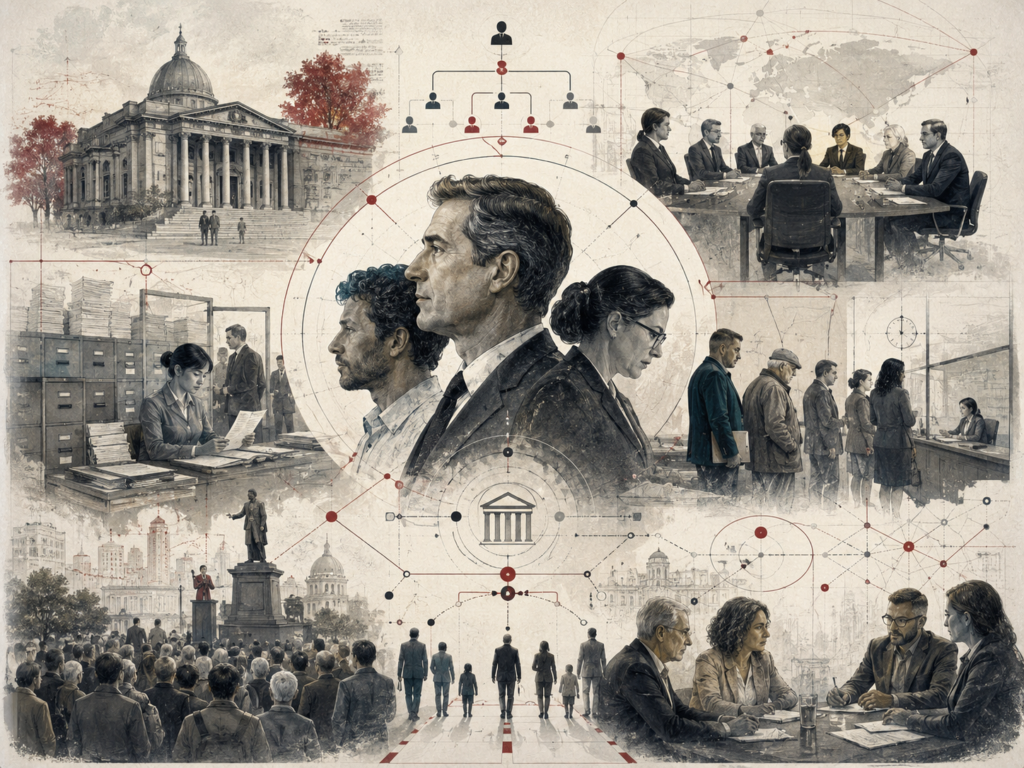
Research-grade illustration of personality, work, and leadership, showing organizational decision-making, team collaboration, leadership roles, workplace relationships, social networks, institutional structures, and individual differences.

Personality, Work, and Leadership

Personality, work, and leadership belong together because institutions are shaped not only by rules and incentives, but by recurring human styles of effort, judgment, cooperation, conflict, and influence. This article examines how personality affects job performance, teamwork, leadership emergence, leadership effectiveness, and derailment risk, with particular attention to conscientiousness, emotional stability, extraversion, and dark traits in positions of authority. It argues that leadership is not merely a role title but a morally consequential pattern of social influence shaped by both personality and institutional context. The result is a more serious account of work and leadership as major arenas in which personality becomes visible, socially consequential, and ethically tested through performance, power, trust, and the organization of collective life.

Research-grade illustration of personality and social functioning, showing interpersonal relationships, family interaction, friendship, conflict, support, communication, social networks, and emotional connection.

Personality, Relationships, and Social Functioning

Personality, relationships, and social functioning belong together because enduring individual differences shape not only what people think and feel, but how they love, cooperate, argue, repair, trust, and sustain life with others. This article examines how personality enters romantic relationships, friendship, reputation, reciprocity, and broader social functioning, showing that traits become socially meaningful when they are enacted in real relationships rather than abstractly described. It explores the Big Five, conflict and satisfaction, interpersonal goals, empathy, regulation, and person–environment fit while arguing that social life is one of the main places where personality becomes visible. The result is a more serious account of personality as relational structure—revealed not only in inner pattern, but in the shared worlds people create with and for others.

Research-grade illustration of personality and physical health across the lifespan, showing children, adults, and older adults alongside motifs of brain-body connection, cardiovascular health, sleep, movement, stress, care, and social support.

Personality and Physical Health Across the Lifespan

Personality and physical health are linked across the lifespan because enduring traits shape not only how people think and feel, but how they sleep, cope, adhere to treatment, respond to stress, sustain health habits, and age over time. This article examines how personality becomes embodied through behavior, physiology, stress reactivity, and long-term health trajectories, with particular attention to conscientiousness, neuroticism, mortality risk, and healthy ageing. It shows why personality matters for physical health without reducing health to disposition alone, and why the strongest explanations are developmental, behavioral, and contextual rather than simplistic. The result is a more serious account of physical health as something partly patterned by personality, yet always lived within unequal environments, biological constraints, and changing conditions across the life course.

Research-grade illustration of personality, wellbeing, and mental health, showing reflective figures, emotional support, therapy, solitude, stress, resilience, brain-body regulation, and social connection.

Personality, Wellbeing, and Mental Health

Personality, wellbeing, and mental health belong together because enduring individual differences shape not only how people behave, but how they cope, suffer, recover, and flourish. This article examines how personality traits influence distress, self-regulation, relationships, health behavior, and the broader architecture of mental wellbeing. It distinguishes wellbeing from the mere absence of symptoms, and mental health from disorder reduction alone, showing why flourishing, meaning, and functioning must be kept in view alongside anxiety and depression. Drawing on major personality and wellbeing research, it argues that traits such as neuroticism, extraversion, and conscientiousness matter not as destiny but as recurring patterns through which vulnerability and resilience are organized. The result is a more serious account of mental health as lived through personality rather than apart from it.

Research-grade illustration of personality disorders and dimensional diagnosis, showing reflective human figures, brain-network diagrams, clinical conversations, emotional distress, social functioning, and dimensional trait distributions.

Personality Disorders and Dimensional Diagnosis

Personality disorders and dimensional diagnosis sit at the center of one of the most important transformations in contemporary personality science. This article examines how personality pathology is increasingly understood not through rigid diagnostic categories alone, but through severity, maladaptive trait structure, and impairments in self and interpersonal functioning. It explains the limitations of older categorical systems, the logic of the DSM-5 Alternative Model for Personality Disorders and ICD-11, and the growing view that pathology is better described as graded and structured rather than boxed into discrete types. The result is a more serious account of personality disorder as disturbed personality organization—continuous with broader personality science, yet clinically distinct where severity, rigidity, and dysfunction converge.

Abstract institutional illustration of a human silhouette divided between calm organic landscape forms and darker fractured architectural shapes, representing maladaptive personality as a continuum between normal variation and clinical impairment.

Maladaptive Personality and the Border Between Normal and Clinical Structure

Maladaptive personality sits at one of the most important borders in personality psychology: the point where ordinary individual differences become so rigid, extreme, and impairing that they take on clinical significance. This article examines how current dimensional models reinterpret the relation between normal personality and personality disorder, showing why the border is better understood through severity, self and interpersonal dysfunction, rigidity, and maladaptive trait structure than through older categorical distinctions alone. It explores the DSM-5 Alternative Model for Personality Disorders, ICD-11, trait continua, and the role of personality functioning in defining pathology. The result is a more serious account of maladaptive personality as neither wholly separate from normal variation nor reducible to it, but as a clinically consequential form of personality structure.

Institutional-style illustration of a central human figure divided between dark fractured geometric forms and lighter balanced symbolic forms, representing the tension between dark personality traits and virtue.

Dark Traits, Virtue, and the Moral Structure of Personality

Dark traits and virtue bring personality psychology to one of its sharpest moral questions: how should stable tendencies toward exploitation, callousness, grandiosity, cruelty, honesty, fairness, and humility be understood within one account of personality? This article examines the Dark Triad and Dark Tetrad alongside virtue research and contemporary work on moral character, arguing that the moral structure of personality cannot be reduced either to vice alone or to the absence of vice. It explores Honesty-Humility, moral evaluation, character strengths, and the social conditions under which dark tendencies are expressed or rewarded. The result is a more serious account of personality as ethically consequential structure—shaped by enduring dispositions, motives, judgment, and the moral worlds in which persons act.

Restrained institutional illustration of a contemplative human profile surrounded by symbolic trait patterns, moral scales, branching paths, and ordered geometric forms representing character and moral evaluation.

Traits, Character, and Moral Evaluation

Traits and character are often treated as if they were the same, but they name different levels of analysis. Traits describe relatively enduring patterns in thought, feeling, and behavior. Character usually adds moral evaluation, asking what those patterns mean in relation to honesty, fairness, courage, integrity, vice, and responsibility. This article examines how descriptive personality science relates to the older normative language of character, showing why the distinction matters for moral psychology, virtue ethics, and contemporary personality research. It argues that personality traits can inform the study of character without exhausting it, because character involves not only stable tendencies but the ethical interpretation of those tendencies under standards of virtue, vice, trustworthiness, and human flourishing.
Image Alt Text: Conceptual editorial illustration representing the relationship between descriptive personality traits, character structure, and moral evaluation

Scroll to Top