
Last Updated May 29, 2026
Analytical psychology did not emerge as an abstract theory detached from history. It was formed through clinical work, psychiatric research, intellectual conflict, comparative inquiry, personal crisis, and Jung’s attempt to build a psychology large enough to account for symbolism, religion, imagination, psychic conflict, and the developmental problem of becoming a self. To understand analytical psychology seriously, one must understand how Jung arrived at it. His ideas did not appear all at once, and they were not simply a rejection of Freud followed by a private mythology of archetypes. They emerged from psychiatry, word-association research, dream interpretation, encounters with psychosis, comparative study of myth and religion, and a long struggle to explain forms of psychic life that could not easily be reduced to repression, instinct, or conscious intention alone.
Jung’s formation as a thinker belongs to the wider history of modern psychology, but it also exceeds its usual boundaries. He was shaped by medicine, psychiatry, late nineteenth-century debates about consciousness and hysteria, early psychoanalysis, and the symbolic crises of modernity. At the same time, he became one of the few major psychologists whose work moved deeply into myth, alchemy, comparative religion, ritual imagery, art, and the interpretation of symbolic forms. This breadth made his work unusually generative and unusually controversial. Admirers saw in him a psychology capable of addressing the hidden architecture of mind and culture. Critics saw an unstable mixture of clinical insight, speculative metaphysics, sweeping comparison, and insufficient historical discipline.
This article examines how Jung’s life, training, disputes, inner work, and intellectual development contributed to the formation of analytical psychology. It traces his early psychiatric and experimental work, his collaboration and break with Freud, the crisis and reconstruction of his middle period, and the gradual emergence of a distinctive psychology of the unconscious grounded in symbolic process rather than reduction alone. It also situates Jung within the broader history of depth psychology and assesses both the power and the limits of the tradition he founded.
Main Library
Publications
Article Map
Analytical Psychology
Related Topic
Personality Psychology
Related Topic
Cognitive Psychology
Related Topic
Developmental Psychology
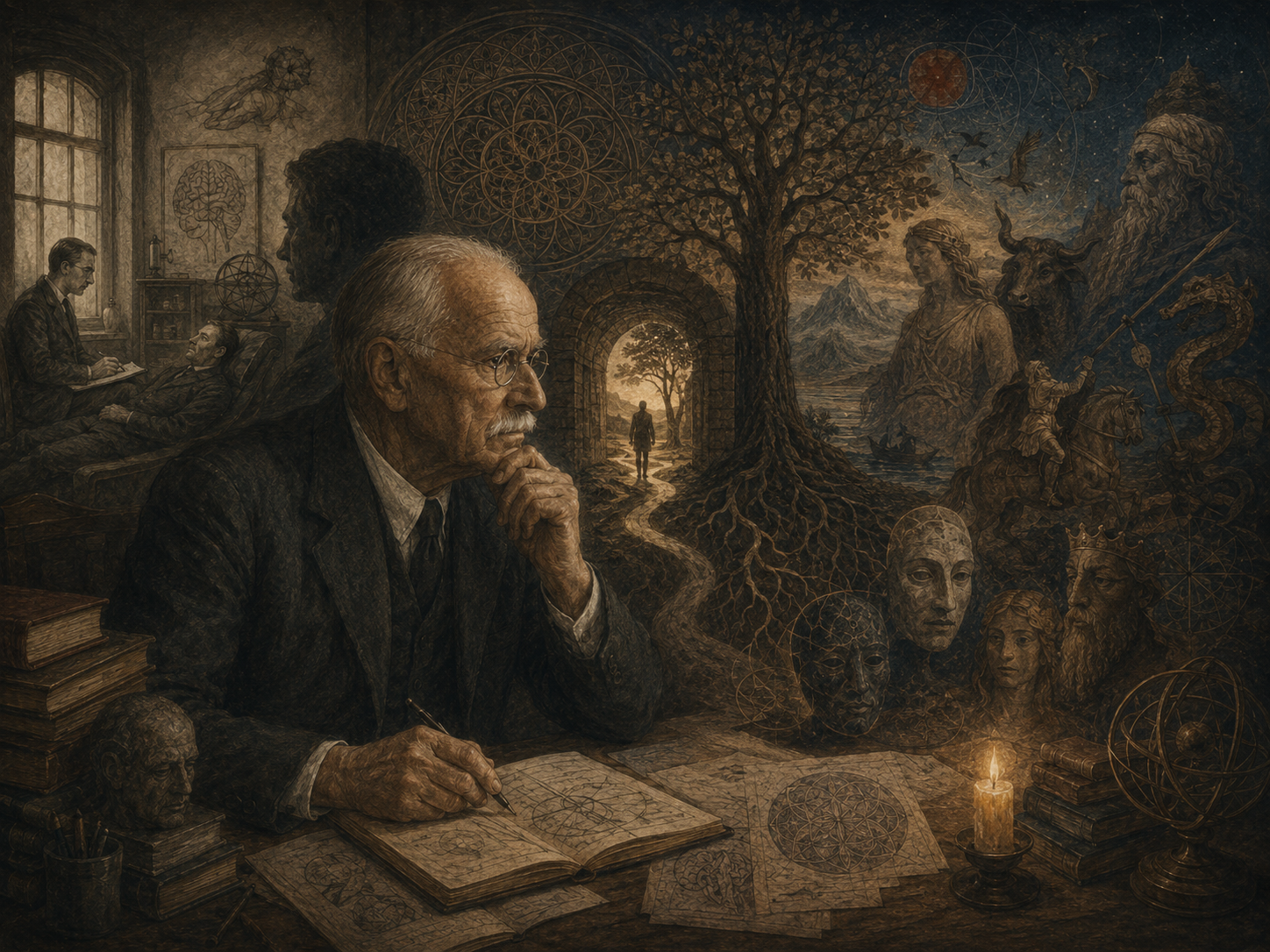
What makes Jung historically important is not that every concept he proposed has held up unchanged. It is that he helped define a field in which the psyche could be understood as layered, conflictual, symbolic, developmental, relational, and only partially accessible to consciousness. He gave modern psychology a vocabulary for complexes, archetypal patterning, psychic compensation, individuation, shadow, projection, symbolic transformation, and the developmental tension between ego and Self. Even where his formulations demand revision, the problems he named remain foundational for any serious inquiry into depth, selfhood, imagination, dream life, mythic form, and the meanings carried by unconscious process.
Jung also matters because his intellectual formation dramatizes a central dilemma in the history of psychology: how can the study of mind remain scientifically responsible while taking symbolic life seriously? A narrow psychology can measure behavior but miss meaning. A loose symbolic psychology can generate insight but lose evidentiary discipline. Jung’s work stands at that difficult boundary. His best work refuses to reduce the psyche to surface behavior, but his weakest work sometimes overextends symbolic interpretation beyond the evidence. A serious contemporary reading must therefore hold two commitments together: preserve the depth of the questions Jung opened, and revise his answers where history, ethics, culture, gender, evidence, or clinical practice require it.
Why Jung Matters
Carl Jung matters because he helped create one of the few modern psychologies that treated symbolism as central rather than secondary. In Jung’s work, dreams are not mere mental debris, myth is not an obsolete curiosity, and inward conflict is not exhausted by symptom mechanics alone. The psyche appears as an internally differentiated reality whose contents exceed consciousness and whose hidden processes often announce themselves through image, fantasy, projection, affect, bodily disturbance, dream sequence, religious symbol, and symbolic compensation.
That vision gave analytical psychology an unusual reach. It could speak not only to clinical life, but also to literature, religion, ritual, art, moral struggle, cultural crisis, identity, aging, creativity, and the long work of becoming a person. It also made Jung’s work vulnerable to overreach, because a psychology with such interpretive scope can easily drift into loose analogy, mystical suggestion, or universalist simplification. The importance of Jung, then, lies not in unquestioned authority, but in the scale of the questions he forced psychology to confront.
Jung matters because he challenged the ego-centered view of the person. Modern consciousness often assumes that the self is what it can explain, intend, perform, narrate, and control. Jung insisted that this is only a surface position. The ego is necessary, but it is not the whole psyche. Beneath and around it are memories, complexes, affects, disowned traits, symbolic figures, unintegrated potentials, and organizing patterns that shape experience before conscious reflection can command them. This claim remains psychologically powerful even when one revises Jung’s more speculative language.
He also matters because he refused to dismiss religious and mythic experience as mere error. Jung did not simply defend religion in a doctrinal sense. He asked why religious symbols endure psychologically, why myths continue to organize imagination, why modern people remain haunted by symbolic forms even after formal belief weakens, and why dreams often produce images that resemble ritual, mythology, and sacred narrative. This makes Jung indispensable for any psychology that wants to understand secular modernity without assuming that symbolic hunger has disappeared.
| Why Jung matters | Problem he addressed | Continuing relevance |
|---|---|---|
| Depth of the psyche | Consciousness does not fully know what moves it | Connects psychology to unconscious process, affect, dream, projection, and symbolic life |
| Theory of complexes | Emotionally charged clusters interrupt conscious intention | Anticipates later concerns with schemas, triggers, implicit memory, and affective networks |
| Symbolic interpretation | Dreams, myths, and images carry psychological meaning | Supports serious interpretation of imagination, religion, literature, and ritual |
| Individuation | Development involves more than social adaptation | Offers a model of selfhood as integration, differentiation, and moral encounter |
| Shadow and projection | People externalize what they cannot recognize in themselves | Remains useful for moral psychology, conflict, identity, and relational life |
| Historical controversy | Symbolic breadth can become overgeneralization | Requires contemporary revision, ethical critique, and methodological discipline |
Jung matters most where psychology becomes too narrow. His work reminds us that human beings suffer, imagine, defend, desire, dream, mythologize, project, repeat, and seek meaning. A psychology that cannot speak to those dimensions may be precise, but it will be incomplete.
Early Life and Intellectual Background
Jung was born in 1875 in Kesswil, Switzerland, and came of age in a Europe marked by scientific confidence, religious strain, psychiatric experimentation, colonial expansion, and cultural transition. His family background exposed him early to theological questions, spiritual unease, and the tension between institutional religion and inward experience. These tensions would remain with him. Much of Jung’s later work can be read as an effort to understand how symbolic and religious forms persist within the psyche even where formal belief weakens.
Jung’s early context matters because analytical psychology was shaped by a world in which older religious certainties were losing public authority while scientific medicine was expanding its reach. This created both opportunity and crisis. Psychology could emerge as a new science of mind, but it also risked reducing meaning to mechanism. Jung was drawn to this fault line. He wanted a psychology that could remain attentive to empirical disturbance while still accounting for symbolic experience, spiritual conflict, mythic imagination, and the inner life of modern people no longer fully contained by inherited religious forms.
His education in medicine and psychiatry placed him within the emerging scientific study of mental illness, but he was never satisfied with a psychology limited to physiology or observable disturbance alone. He was drawn to the border zones where pathology, imagination, symbolism, and religious feeling seemed to overlap. This made him unusually receptive to questions that mainstream psychology would often bracket: the meaning of visions, the structure of myths, the recurrence of symbolic images, and the psychic significance of spiritual crisis.
Jung’s intellectual formation also occurred amid nineteenth-century and early twentieth-century debates over hypnosis, dissociation, hysteria, spiritualism, psychical research, dream life, and the fragmentation of consciousness. These fields were uneven in quality, but they opened questions that would become central to depth psychology: Is consciousness unified? Can psychic processes operate outside awareness? Can the personality split? What is the relation between symptom, symbol, memory, and affect? Jung’s later work cannot be separated from this broader intellectual environment.
| Formative influence | Historical significance | Later Jungian development |
|---|---|---|
| Swiss Protestant and theological background | Exposed Jung to religious symbolism, doubt, and inward spiritual conflict | Later concern with religion as psychological reality |
| Medical and psychiatric training | Grounded Jung in clinical observation and institutional psychiatry | Early work on psychosis, dissociation, association, and complexes |
| Debates about consciousness | Raised questions about dissociation, hysteria, automatism, and unconscious process | Model of a layered psyche exceeding ego-consciousness |
| Modern crisis of belief | Made religious symbols psychologically urgent even when dogma weakened | Interest in myth, ritual, archetype, and symbolic compensation |
| Comparative intellectual culture | Encouraged wide reading across religion, myth, literature, and anthropology | Comparative symbolic method and theory of archetypes |
Jung’s early life and intellectual background did not determine his later psychology mechanically, but they shaped its central tension: the effort to build a psychology that could speak both to clinical disturbance and to the symbolic depth of human experience.
Psychiatry, Burghölzli, and the Study of Complexes
Jung’s early professional formation at the Burghölzli psychiatric hospital in Zurich was decisive. Under Eugen Bleuler, he worked in one of Europe’s leading psychiatric institutions, where he encountered psychosis, dissociation, and severe mental disturbance firsthand. This experience shaped his conviction that psychic life could not be understood merely through conscious report. Mental life was clearly capable of fragmentation, autonomous patterning, symbolic expression, and forms of disturbance not governed by rational intention.
It was during this period that Jung conducted his influential word-association experiments. Participants responded to stimulus words while Jung and his collaborators observed reaction times, hesitations, repetitions, forgotten words, emotional disturbances, unusual responses, and bodily signs. These experiments suggested that certain words triggered disturbances in response that could not be explained by chance alone. The disturbance appeared to cluster around emotionally charged themes. From this work emerged the concept of the complex: a cluster of affect, memory, and associative material organized around conflict-laden themes.
The concept of the complex gave Jung an early bridge between experiment and depth psychology. It showed that the psyche contained semi-autonomous organizations capable of affecting thought and behavior without full conscious control. A person might believe they are responding freely, but the response pattern may reveal interference from affectively charged material. This was one of Jung’s most important empirical and clinical insights: the unconscious is not merely a hidden storehouse; it can interrupt language, distort attention, and reorganize reaction.
This early phase is crucial because it reveals that Jung did not begin as a mystic of archetypes. He began as a psychiatrist and investigator of dissociation, affect, and unconscious interference. Analytical psychology grew out of that clinical and experimental ground before expanding into broader symbolic terrain. The later Jungian vocabulary of archetype, shadow, Self, and individuation should not obscure the fact that one of Jung’s first major discoveries concerned affective disturbance in ordinary associative response.
| Burghölzli contribution | What Jung observed | Later significance |
|---|---|---|
| Psychiatric clinical work | Severe disturbance revealed fragmentation, symbolic expression, and autonomous psychic processes | Supported a layered model of the psyche beyond conscious intention |
| Word-association experiments | Emotionally charged words disrupted reaction time and associative flow | Led to the theory of complexes |
| Attention to affect | Disturbance was organized around emotional charge | Complexes became affective organizations, not merely ideas |
| Dissociation and autonomy | Psychic contents could act with partial independence | Prepared Jung’s later language of semi-autonomous complexes |
| Clinical-experimental bridge | Unconscious material could be inferred from observable disturbance | Gave analytical psychology an empirical foothold before symbolic expansion |
The Burghölzli years established the first durable foundation of Jung’s psychology: the psyche is internally organized by affective formations that can operate outside conscious control. This insight remained central even when Jung’s later work moved toward myth, religion, symbol, and archetypal patterning.
Jung’s Engagement with Freud
Jung’s encounter with Freud transformed his trajectory. Freud’s model of unconscious conflict, repression, dream interpretation, and symptom formation offered a powerful framework for explaining dimensions of mind that academic psychology often ignored. Jung recognized immediately that psychoanalysis addressed something essential: human beings are not fully conscious of what moves them, and hidden psychic processes shape thought, desire, fantasy, symptom, and suffering.
For a period, Jung became one of Freud’s most important collaborators and was widely seen as a likely successor in the psychoanalytic movement. Freud, who sought to broaden the movement beyond its largely Jewish Viennese milieu, valued Jung’s intellectual stature, psychiatric credentials, and institutional legitimacy. Jung, for his part, saw in psychoanalysis a crucial breakthrough, but he never fully accepted the narrower metapsychological boundaries within which Freud wanted to keep it.
Their collaboration was productive but unstable from the start. Jung agreed with Freud that dreams and symptoms required interpretation and that unconscious life mattered profoundly. He also accepted that repression, sexuality, childhood, and conflict played major roles in psychological suffering. But Jung increasingly resisted the idea that symbolic life could be explained primarily as disguised wish fulfillment or as derivative of sexual instinct. He believed the unconscious also contained prospective, religious, symbolic, developmental, and compensatory functions.
The Freud-Jung relationship therefore became the historical crucible in which analytical psychology was differentiated. Jung did not simply abandon psychoanalysis. He carried forward several of its central insights while changing their meaning. The unconscious remained fundamental, but it became larger than repression. Dreams remained meaningful, but they became prospective and compensatory as well as retrospective. Libido remained important, but it was reconceived as broader psychic energy rather than narrowly sexual drive. Symbol remained central, but it became creative and transformative rather than merely disguising forbidden content.
| Shared psychoanalytic ground | Freudian emphasis | Jungian transformation |
|---|---|---|
| Unconscious process | Repression, wish, conflict, symptom formation | Layered psyche including personal complexes and broader symbolic structures |
| Dream interpretation | Dream as disguised wish fulfillment and compromise formation | Dream as symbolic, compensatory, prospective, and self-regulating |
| Libido | Primarily sexual drive energy | General psychic energy capable of symbolic and developmental transformation |
| Symptoms | Expressions of conflict and repression | Expressions of conflict, compensation, symbolic imbalance, and developmental pressure |
| Transference | Repetition of unconscious relational patterns | Relational field shaped by complexes, projection, symbol, and individuation |
Jung’s engagement with Freud gave analytical psychology its first major contrast. Jung’s later work cannot be understood without Freud, but it also cannot be reduced to Freud. Analytical psychology formed through both inheritance and dissent.
The Break with Freud and the Problem of Reduction
The break with Freud was not merely personal, though it certainly became personally painful. It was theoretical. Freud’s framework treated many symbolic forms as transformations, disguises, or derivatives of instinctual and especially sexual conflict. Jung came to believe this model was too reductive. He did not deny desire, repression, or developmental conflict, but he argued that psychic life included symbolic and prospective dimensions that could not be adequately understood as derivatives of repressed libido alone.
For Jung, symbols did not simply conceal forbidden wishes. They could also reveal unrealized possibilities, compensate for conscious one-sidedness, and orient the psyche toward development. This was a decisive shift. Where Freud often interpreted symbolic material by tracing it back to prior conflict, Jung increasingly interpreted it as both retrospective and prospective. The psyche was not only a repository of the past. It was also a dynamic system pressing toward reorganization and greater wholeness.
The disagreement over reduction was therefore the disagreement over the meaning of symbol. A reductive interpretation asks what earlier cause produced the symbol. A constructive or synthetic interpretation asks what the symbol is doing now and what future psychic development it may be attempting to mediate. Jung believed that both questions mattered. A dream could contain personal memory and conflict, but it could also express compensation for conscious imbalance or orient the person toward a new psychological attitude.
This disagreement made the split inevitable. Jung’s eventual account of libido broadened psychic energy beyond narrowly sexual terms, while his growing attention to myth, religion, and symbolic patterning pushed him further from orthodox psychoanalysis. The separation opened the path toward analytical psychology as a distinct school. But it also left analytical psychology with a permanent problem: how to avoid Freud’s reductionism without drifting into ungrounded symbolic overextension.
| Issue | Freudian reduction Jung resisted | Jungian alternative | Risk in Jung’s alternative |
|---|---|---|---|
| Symbol | Symbol as disguise of repressed wish | Symbol as living expression of psychic transformation | Loose or inflated interpretation |
| Libido | Sexual drive as primary explanatory force | General psychic energy with symbolic and developmental expression | Conceptual vagueness |
| Dream | Dream as wish fulfillment or compromise formation | Dream as compensation, orientation, and symbolic self-regulation | Overreading purpose into dream material |
| Religion | Religious imagery as derivative of infantile wishes or defenses | Religious imagery as psychologically real symbolic form | Blurring psychology and metaphysics |
| Development | Emphasis on early conflict and repression | Lifelong individuation and symbolic integration | Romanticizing development as destiny |
The break with Freud gave Jungian psychology its independence, but it also defined its central tension. Analytical psychology would be strongest when it preserved Freud’s suspicion and discipline while expanding the field of meaning. It would be weakest when symbolic expansion became an escape from evidence.
The Confrontation with the Unconscious
After the break with Freud, Jung entered a period of intense inner exploration often described as his “confrontation with the unconscious.” This phase, documented in manuscripts and visionary writings later associated with The Red Book, became foundational for his mature thought. Jung deliberately engaged fantasies, dreams, images, dialogues, and imaginal encounters rather than suppressing them or treating them simply as pathology.
This period has sometimes been romanticized, but its significance lies in method as much as drama. Jung came to believe that the psyche could be approached through sustained attention to its symbolic productions and that inward images were not always reducible to noise or delusion. From this process emerged practices later connected to active imagination, symbolic amplification, and the interpretive treatment of dream material as expressions of a psyche larger than the ego.
The confrontation also intensified Jung’s conviction that the unconscious is not merely personal. The images that emerged seemed to him too structured, archaic, and mythic to be explained only by personal memory. This conviction would eventually become the basis for his theory of the collective unconscious and archetypes, though those concepts remain among the most disputed parts of his work.
It is important to approach this period carefully. Jung’s inner work should not be treated as a clinical model to imitate casually, nor should it be romanticized as visionary authority beyond criticism. It involved risk, isolation, symbolic intensity, and a deliberate engagement with fantasy material that would not be appropriate for everyone. Its historical importance lies in how it shaped Jung’s method: the unconscious could be engaged through images, dialogue, symbol, and sustained attention, but it also required containment, differentiation, and ethical judgment.
| Element of the confrontation | Psychological significance | Later Jungian development |
|---|---|---|
| Fantasy dialogues | Inner figures were approached as meaningful psychic presences | Development of active imagination |
| Symbolic images | Images were treated as expressions of unconscious organization | Dream interpretation and symbolic amplification |
| Mythic atmosphere | Personal material appeared in forms larger than biography | Archetype and collective unconscious theory |
| Crisis and reconstruction | Breakdown of prior intellectual identity forced new synthesis | Formation of analytical psychology as distinct from psychoanalysis |
| Need for containment | Unconscious material could be overwhelming or destabilizing | Later emphasis on ego, symbolic relation, and individuation |
The confrontation with the unconscious was not simply a private episode. It became one of the methodological sources of analytical psychology. Jung learned to treat symbolic material as psychologically serious, but he also left later readers with the difficult task of distinguishing disciplined symbolic engagement from inflation.
From Depth Conflict to Symbolic Psychology
As Jung’s thought matured, analytical psychology moved beyond a psychology of repression into a psychology of symbolic process. Conflict remained central, but conflict was no longer understood only as the return of forbidden wishes. It became a wider drama involving adaptation, psychic division, projection, moral tension, compensation, symbolic expression, and the encounter between conscious identity and deeper organizing structures.
In this framework, symbolic life is not ornamental. It is one of the psyche’s principal modes of self-presentation. Dreams, myths, rituals, religious images, artistic forms, and recurring narrative patterns become legible as expressions of psychic organization. Jung’s enduring contribution was to treat these symbolic productions as psychologically serious without collapsing them into literal doctrine or trivial superstition.
The shift from conflict to symbol also changed the meaning of psychological development. Jung was not interested only in symptom relief, although clinical suffering mattered. He became increasingly concerned with the problem of wholeness: how the person might become more complete by confronting shadow, withdrawing projection, integrating neglected potentials, differentiating ego from persona, relating consciously to inner figures, and discovering a deeper organizing center beyond ego-control. This process became the theory of individuation.
Symbolic psychology also allowed Jung to address cultural and religious forms in ways that psychoanalysis often found difficult. A myth, ritual, or religious image could be understood as more than primitive error or disguised wish. It could be a symbolic structure through which psychic life organizes conflict, loss, transformation, and relation to the unknown. This insight remains valuable, but it also requires discipline. A symbol must be interpreted within historical, religious, cultural, and personal context. It cannot be treated as a universal psychological token detached from its world.
| Shift in Jung’s psychology | Earlier emphasis | Mature Jungian emphasis |
|---|---|---|
| From symptom to symbol | Symptoms as expressions of conflict | Symbols as expressions of conflict, compensation, and transformation |
| From repression to compensation | The unconscious returns what is repressed | The unconscious also compensates one-sided consciousness |
| From cause to direction | Interpretation traces material back to earlier causes | Interpretation also asks what development the image may serve |
| From ego to psyche | Conscious identity is the main organizing point | The ego is one center within a larger psychic totality |
| From private conflict to symbolic field | Psychic material belongs mainly to biography | Personal material may intersect with cultural, mythic, and archetypal forms |
Analytical psychology became distinctive when it moved from unconscious conflict alone to symbolic process. Jung’s achievement was to insist that the psyche does not merely hide. It images, compensates, dramatizes, warns, repairs, organizes, and transforms through symbols.
The Emergence of Key Jungian Concepts
Several of Jung’s central concepts emerged gradually rather than appearing as a finished system. The ego named the center of conscious identity, but it was never the whole psyche. The personal unconscious referred to forgotten, repressed, and conflict-laden material organized partly through complexes. The collective unconscious extended this model toward recurrent structural potentials of imagery and relation not reducible to personal experience alone.
From there came the concepts that would define Jungian thought for later generations: archetypes as recurrent forms of psychic organization; the persona as social mask and adaptive identity; the shadow as disowned or unintegrated psychic material; anima and animus as relational-symbolic figures that Jung linked to inner contrasexual patterning; and the Self as the broader totality and ordering principle of the psyche. These ideas converged in the developmental process Jung called individuation, the long effort to integrate rather than deny psychic plurality.
The emergence of these concepts reflects Jung’s attempt to build a map of psychic life larger than ego-adaptation. The ego must adapt to the world, but it must also relate to unconscious contents. The persona helps the person function socially, but it can become rigid and false. The shadow contains what conscious identity refuses, but it may also contain vitality and truth. Anima and animus were historically framed in gendered terms that now require revision, but they still point toward the psychic importance of inner relational figures. The Self names a totality the ego can approach but never fully possess.
Some of these concepts continue to be fruitful. Others require significant revision, especially where gender essentialism, civilizational abstraction, or overextended universality enters the picture. But taken together, they formed the conceptual scaffold of analytical psychology. They gave later clinicians, artists, scholars, and readers a language for psychic multiplicity, symbolic recurrence, projection, identity, moral conflict, and development beyond simple adjustment.
| Concept | Core meaning | Continuing value | Needed caution |
|---|---|---|---|
| Ego | Center of conscious identity and reflection | Clarifies that consciousness is necessary but limited | Do not confuse ego with the whole psyche |
| Complex | Affectively charged cluster of memory, image, and expectation | Links Jung to modern schema, trauma, and affective-network theory | Do not diagnose or label casually |
| Persona | Social identity, role, mask, and adaptation | Explains the tension between social function and inner truth | Do not treat all adaptation as false |
| Shadow | Disowned, rejected, or unintegrated psychic material | Useful for moral psychology, projection, and self-deception | Do not reduce real social conflict to projection alone |
| Archetype | Recurrent structuring pattern inferred from symbolic images | Explains recurring symbolic forms across dream, myth, and culture | Do not flatten cultural difference into universal shorthand |
| Self | Totality and ordering principle of the psyche | Gives individuation a symbolic center beyond ego-control | Do not inflate ego-identification with totality |
| Individuation | Process of becoming more integrated and differentiated | Frames development as lifelong psychological work | Do not romanticize suffering or isolation as necessary destiny |
The key Jungian concepts emerged from the tension between clinical observation and symbolic expansion. They are most useful when treated as interpretive tools, not as rigid doctrines or universal labels imposed on every psychic event.
Jung and the Comparative Study of Symbols
Jung’s work became increasingly comparative. He drew from mythology, religious traditions, alchemy, folklore, ritual, dreams, literature, and symbolic art in order to interpret recurrent psychic forms. This interdisciplinary reach is one reason analytical psychology has remained influential far beyond clinical analysis. It offered scholars and readers a vocabulary for thinking about recurring images of descent, rebirth, shadow, sacrifice, transformation, sacred centers, doubles, tricksters, devouring figures, divine children, mandalas, and psychic integration across diverse cultural materials.
Jung’s comparative method grew from his conviction that symbolic recurrence required explanation. If similar motifs appeared in dreams, myths, religious images, and alchemical texts, he believed they might point toward recurrent structures of the psyche. This claim gave analytical psychology enormous interpretive power. It also produced some of its greatest dangers. Symbolic resemblance can be fascinating, but resemblance is not identity. A serpent, tree, mother, flood, cave, or circle may carry radically different meanings across traditions, languages, rituals, theological systems, and historical situations.
This comparative method is therefore where Jung’s work requires the most caution. Too often, symbolic resemblance was treated as evidence of deep equivalence. Historical specificity, political context, cultural difference, and doctrinal meaning can disappear when everything is placed under an archetypal frame. Contemporary readers do best when they preserve Jung’s sensitivity to recurring symbolic structures while rejecting any flattening of distinct traditions into universal psychological shorthand.
A responsible comparative Jungian method should ask layered questions. What does the symbol mean in its own tradition? How is it used ritually, textually, politically, or theologically? Does the resemblance arise from historical borrowing, cultural transmission, shared ecology, genre convention, colonial contact, translation, or common human embodiment? Only after these questions are taken seriously should archetypal interpretation be considered. Jung’s comparative ambition remains valuable, but only when disciplined by historical and cultural humility.
| Symbolic domain | Why Jung studied it | Contemporary caution |
|---|---|---|
| Myth | Myths preserve recurring narratives of origin, ordeal, descent, death, and renewal | Do not treat mythic similarity as universal sameness |
| Religion | Religious symbols carry extraordinary psychic and communal force | Do not reduce theology, ritual, or faith to psychology alone |
| Alchemy | Alchemical imagery offered Jung a symbolic language of transformation | Distinguish historical alchemy from psychological reinterpretation |
| Dreams | Dreams show symbolic production within individual psychic life | Begin with personal association before amplification |
| Folklore | Folk motifs show recurring patterns of danger, trickery, transformation, and survival | Respect local storytelling contexts and transmission histories |
| Art and literature | Creative works externalize psychic conflicts and symbolic forms | Do not reduce artistic craft to archetypal formula |
Jung’s comparative study of symbols remains one of his most generative legacies, but also one of his most contested. It teaches psychology to take symbolic recurrence seriously. It also teaches contemporary readers why recurrence must be interpreted with discipline, context, and respect.
Analytical Psychology as a School
Analytical psychology became more than Jung’s personal thought. It developed into a school of psychotherapy, symbolic interpretation, cultural analysis, and post-Jungian theory. Later Jungians and post-Jungians expanded, revised, and criticized the tradition in multiple directions. Some moved toward developmental and clinical refinement. Others brought Jung into dialogue with anthropology, feminism, literary theory, trauma studies, religious studies, attachment research, cultural criticism, queer theory, ecological thought, and political psychology.
This afterlife matters because it prevents analytical psychology from being frozen at the level of Jung’s original formulations. The tradition has survived not by preserving every claim unchanged, but by reworking the field’s central intuitions: that the psyche is layered, that symbolic life matters, that imagination and dream life belong to psychology, that unconscious patterns shape relationship, and that becoming a self involves more than adaptation to external norms.
As a school, analytical psychology has also diversified. Classical Jungian approaches often preserve closer continuity with Jung’s own concepts and symbolic method. Developmental Jungians have emphasized early relational life, trauma, attachment, and the formation of psychic structure. Archetypal psychology reimagined Jung through image, metaphor, and polytheistic imagination. Cultural and political Jungian approaches have examined shadow, projection, myth, nationalism, gender, race, ecological crisis, and collective fantasy. These directions do not always agree, but they show that Jung’s work became a field rather than a closed system.
The school’s clinical significance lies in its attention to symbolic life, transference, dream, complex, projection, and the gradual movement toward integration. Its broader cultural significance lies in its capacity to interpret images, myths, public fantasies, religious forms, and cultural symptoms. But the same breadth requires rigorous boundaries. Analytical psychology is strongest when it remains clinically careful, historically informed, culturally humble, and ethically serious.
| Post-Jungian direction | Primary emphasis | Contribution | Risk |
|---|---|---|---|
| Classical Jungian analysis | Dreams, complexes, archetypes, Self, individuation | Preserves the symbolic and clinical core of Jung’s system | May preserve outdated assumptions too uncritically |
| Developmental Jungian work | Attachment, trauma, early relationship, psychic formation | Strengthens Jungian theory through developmental psychology | May underemphasize symbolic and archetypal dimensions |
| Archetypal psychology | Image, metaphor, myth, polycentric psyche | Protects imagination from reductive explanation | May drift away from clinical and empirical grounding |
| Cultural Jungian studies | Myth, politics, collective fantasy, public symbols | Extends Jungian analysis into social and cultural life | May over-symbolize material and institutional realities |
| Feminist and gender-critical Jungian work | Revision of anima/animus, gender symbolism, power | Corrects essentialist and patriarchal assumptions | Must avoid replacing old binaries with new simplifications |
| Trauma-informed Jungian work | Affect, body, dissociation, relational safety | Grounds symbolic work in stabilization and clinical care | Must avoid reducing all symbolism to trauma |
Analytical psychology as a school is best understood as a living tradition of revision. Jung founded the field, but the field is not identical with Jung. Its future depends on preserving depth while strengthening evidence, ethics, historical awareness, and cultural responsibility.
Strengths, Limits, and Historical Problems
Jung’s strengths are substantial. He gave psychology a durable account of complexes, a rich framework for symbolic interpretation, a language for projection and shadow, and a developmental vision of psychic integration that still speaks to identity, creativity, and moral conflict. He took religious and mythic life seriously without reducing them to error or pretending they could be ignored in the study of mind. He also gave clinicians and readers a vocabulary for experiences that are psychologically real but difficult to capture in narrowly behavioral language: being possessed by an affect, encountering the shadow, dreaming compensatory images, living through symbolic crisis, or feeling called toward a deeper form of selfhood.
His limits are equally serious. Many Jungian claims are difficult to operationalize within conventional empirical research. His treatment of culture was sometimes insufficiently historical and overly synthetic. His formulations regarding gender and symbolic polarity often reflect assumptions contemporary scholarship has rightly criticized. There are also significant historical questions surrounding aspects of Jung’s public life, rhetoric, and institutional positioning during politically fraught periods of twentieth-century Europe. A serious contemporary use of Jung therefore requires both gratitude and discipline: gratitude for the depth of the questions he opened, and discipline in refusing to treat his vocabulary as beyond revision.
Jung’s comparative method also needs correction. It can illuminate symbolic recurrence, but it can also erase the specificity of traditions. A mandala, cross, serpent, mother image, tree, flood, or descent motif cannot be interpreted responsibly without attention to language, ritual, theology, historical transmission, social function, and power. A contemporary Jungian method must not extract symbols from living traditions as if they were anonymous evidence for archetypes.
Jung’s gender symbolism requires particular care. Classical Jungian language around anima and animus was often organized through binaries that do not adequately account for the complexity of gender, embodiment, sexuality, culture, and identity. The deeper question behind those concepts—the way the psyche encounters otherness, relation, desire, projection, and symbolic complementarity—remains worth studying. But the inherited gender framing must be revised rather than repeated mechanically.
| Strength or problem | What remains valuable | What requires revision |
|---|---|---|
| Complex theory | Strong account of affective clusters and unconscious interference | Needs integration with trauma, attachment, cognitive science, and social context |
| Symbolic interpretation | Takes dreams, myths, images, and religion seriously | Needs stronger historical and cultural discipline |
| Archetype theory | Names recurrent symbolic forms and psychic patterning | Must avoid universalism and cultural flattening |
| Individuation | Frames development as integration beyond social adaptation | Must avoid individualism detached from community and material conditions |
| Gender symbolism | Explores inner relational figures and projection | Requires major revision beyond essentialist binaries |
| Political and historical ambiguity | Forces serious inquiry into psychology’s relation to culture and power | Requires honest historical scholarship, not defensive idealization |
The responsible position is neither uncritical celebration nor easy dismissal. Jung’s work remains powerful because it names real dimensions of psychic life. It remains problematic because some of its inherited language and methods are too broad, too gendered, too culturally synthetic, or too difficult to test. The task is disciplined inheritance: preserving what remains illuminating while revising what no longer withstands scrutiny.
Jung’s Place in the History of Psychology
Jung occupies a singular place in the history of psychology. He is too psychologically serious to be dismissed as mere mysticism and too symbolically ambitious to fit comfortably within narrowly experimental models of the field. He belongs with the great depth psychologists, but he also exceeds them, because his work extends into philosophy of religion, cultural interpretation, symbolic anthropology, literature, and the history of imagination.
His most durable legacy may be this: he insisted that the psyche is not exhausted by what can be directly measured, narrated, or consciously intended. Human beings live partly through images they do not invent, conflicts they do not fully understand, projections they do not recognize, and symbolic forms that mediate between history, imagination, body, culture, and selfhood. Whether one accepts Jung’s strongest claims or not, modern psychology is poorer when it forgets those dimensions of mind.
Jung also occupies a strange position because his influence often travels outside formal psychology. Writers, artists, theologians, religious studies scholars, literary critics, mythologists, filmmakers, and ordinary readers have often found Jung more useful than academic psychologists have. This uneven reception tells us something important. Jung’s work is not easily contained by disciplinary boundaries. It is a psychology of depth, but also a theory of symbol, a method of reading images, and a language for modern spiritual and cultural crisis.
At the same time, Jung’s marginality within mainstream empirical psychology should not be ignored. Some of his claims are too speculative, too difficult to operationalize, or too historically broad to fit the standards of contemporary research. The best future for Jungian thought is therefore not a return to authority, but a more careful interdisciplinary reconstruction: one that links complex theory to affective neuroscience and trauma studies, dream work to cognitive and narrative research, archetypal claims to cultural history and comparative method, and individuation to developmental, relational, and moral psychology.
| Historical role | What Jung contributed | Why his position remains contested |
|---|---|---|
| Depth psychologist | Expanded the study of unconscious life beyond conscious intention | His symbolic scope exceeds conventional empirical methods |
| Clinical theorist | Developed the theory of complexes, projection, and symbolic compensation | Some concepts require clearer operationalization |
| Interpreter of religion | Treated religious symbols as psychologically serious | Risk of reducing theology to psychology |
| Comparative symbolist | Tracked recurrent motifs across dream, myth, ritual, and art | Risk of cultural flattening and historical overreach |
| Developmental thinker | Framed selfhood as individuation and integration | Risk of individualism or spiritualized abstraction |
| Cultural critic | Analyzed modernity’s symbolic and spiritual crisis | Needs stronger attention to politics, institutions, and material conditions |
Jung’s place in psychology is therefore paradoxical. He is indispensable for understanding depth, symbol, and psychic plurality, yet he must be read critically. His work belongs neither to unquestioned doctrine nor to the discard pile. It belongs to a demanding form of intellectual inheritance.
Mathematical Lens
Jung’s intellectual development can be represented formally as a transition from a primarily clinical-experimental framework to a broader symbolic-dynamic system. Let \(J(t)\) represent Jung’s evolving theoretical position over time. A simplified model can represent that position as a weighted combination of several intellectual inputs:
J(t) = \alpha P(t) + \beta F(t) + \gamma C(t) + \delta S(t) + \eta R(t)
\]
Interpretation: \(P(t)\) represents psychiatric-clinical experience, \(F(t)\) Freudian influence, \(C(t)\) complex research, \(S(t)\) comparative symbolic inquiry, and \(R(t)\) reflective inward exploration. In Jung’s early period, psychiatric and Freudian weights are relatively high. Over time, symbolic inquiry and inward exploration increase, while Freudian reduction declines.
Analytical psychology can also be modeled as a conceptual network. Let each major concept be a node: complex, ego, unconscious, symbol, archetype, Self, individuation, shadow, projection, persona, anima, animus, and dream. The adjacency matrix \(A\) records the strength of conceptual relations:
A_{ij} =
\begin{cases}
w_{ij}, & \text{if concept } i \text{ is linked to concept } j \\
0, & \text{otherwise}
\end{cases}
\]
Interpretation: Higher values of \(w_{ij}\) indicate stronger conceptual linkage. Over time, network density can increase as Jung’s ideas become more integrated. Concepts such as symbol, complex, unconscious, Self, and individuation may function as high-centrality bridge nodes.
One can also represent conceptual transition across historical phases:
\Delta K = K_{\text{late}} – K_{\text{early}}
\]
Interpretation: \(K_{\text{early}}\) represents the conceptual structure of Jung’s early psychiatric and psychoanalytic period, while \(K_{\text{late}}\) represents the structure of mature analytical psychology. \(\Delta K\) captures the shift from experimental complex theory and psychoanalytic conflict toward symbol, archetype, Self, individuation, and comparative religion.
A diffusion model can represent how concepts spread through Jungian and post-Jungian thought:
x_{t+1} = \sigma(Wx_t + b)
\]
Interpretation: \(x_t\) is the activation vector of concepts at time \(t\), \(W\) is the matrix of conceptual influence, \(b\) is contextual pressure from historical events, publications, institutions, and interpretive communities, and \(\sigma\) is an activation function. The model clarifies how concepts such as complex, archetype, Self, and individuation can become more or less central over time.
This mathematical lens does not reduce Jung to a formula. It clarifies that theories develop historically through changing relations among concepts, influences, methods, institutions, and interpretive commitments. Analytical psychology was not born complete. It formed through a nonlinear process of divergence, integration, crisis, symbolic expansion, and post-Jungian reconstruction.
R Workflow: Mapping Jung’s Conceptual Development as a Symbolic Network
The following R workflow treats Jung’s major concepts as a network that can be analyzed for density, centrality, and structural change. This is useful for scholars who want to study how analytical psychology formed across texts, lectures, or publication periods rather than treating it as a single static doctrine. The example uses synthetic conceptual relations and should be understood as a reproducible modeling scaffold, not a definitive map of Jung’s corpus.
# ============================================================
# Carl Jung and the Formation of Analytical Psychology
# R Workflow: Mapping Jung's conceptual development
# ============================================================
#
# Synthetic-data demonstration only.
# This workflow does not prove historical influence or interpretive priority.
# It provides a reproducible scaffold for conceptual network analysis.

library(tidyverse)
library(tidygraph)
library(ggraph)
library(igraph)

set.seed(2026)

# ------------------------------------------------------------
# 1. Define simplified concept-period metadata
# ------------------------------------------------------------

jung_concepts <- tibble(
  concept = c(
    "complex", "association", "affect", "ego", "persona",
    "shadow", "projection", "symbol", "dream", "archetype",
    "collective_unconscious", "Self", "individuation",
    "active_imagination", "religion", "myth", "alchemy"
  ),
  period = c(
    "early", "early", "early", "middle", "middle",
    "middle", "middle", "middle", "early", "middle",
    "middle", "late", "late",
    "middle", "late", "middle", "late"
  ),
  domain = c(
    "clinical", "experimental", "clinical", "structural", "social",
    "moral", "relational", "symbolic", "clinical", "symbolic",
    "symbolic", "developmental", "developmental",
    "method", "religion", "comparative", "comparative"
  )
)

# ------------------------------------------------------------
# 2. Create simplified edge list representing conceptual relations
# ------------------------------------------------------------

jung_edges <- tibble(
  from = c(
    "association", "association", "complex", "complex", "complex",
    "affect", "ego", "ego", "persona", "shadow",
    "shadow", "projection", "symbol", "symbol", "symbol",
    "dream", "dream", "archetype", "archetype",
    "collective_unconscious", "Self", "Self", "individuation",
    "active_imagination", "religion", "myth", "alchemy"
  ),
  to = c(
    "complex", "affect", "unconscious", "affect", "projection",
    "dream", "persona", "shadow", "social_adaptation", "projection",
    "moral_conflict", "relationship", "dream", "archetype", "religion",
    "compensation", "symbol", "collective_unconscious", "myth",
    "symbol", "individuation", "symbol", "shadow",
    "symbol", "symbol", "archetype", "transformation"
  ),
  weight = c(
    5, 4, 5, 5, 4,
    4, 4, 5, 4, 5,
    3, 5, 5, 5, 4,
    5, 5, 5, 4,
    5, 5, 5, 5,
    4, 4, 5, 4
  )
)

# ------------------------------------------------------------
# 3. Build conceptual network
# ------------------------------------------------------------

jung_graph <- tbl_graph(
  nodes = jung_concepts,
  edges = jung_edges,
  directed = FALSE
)

jung_graph <- jung_graph |>
  activate(nodes) |>
  mutate(
    degree = centrality_degree(),
    betweenness = centrality_betweenness(),
    eigen = centrality_eigen(),
    page_rank = centrality_pagerank()
  )

node_metrics <- jung_graph |>
  activate(nodes) |>
  as_tibble() |>
  arrange(desc(betweenness), desc(degree))

edge_metrics <- jung_graph |>
  activate(edges) |>
  as_tibble() |>
  arrange(desc(weight))

print(node_metrics)
print(edge_metrics)

# ------------------------------------------------------------
# 4. Summarize centrality by conceptual domain
# ------------------------------------------------------------

domain_summary <- node_metrics |>
  group_by(domain) |>
  summarize(
    concept_count = n(),
    mean_degree = mean(degree, na.rm = TRUE),
    mean_betweenness = mean(betweenness, na.rm = TRUE),
    mean_eigen = mean(eigen, na.rm = TRUE),
    .groups = "drop"
  ) |>
  arrange(desc(mean_betweenness))

print(domain_summary)

# ------------------------------------------------------------
# 5. Plot network
# ------------------------------------------------------------

network_plot <- ggraph(jung_graph, layout = "fr") +
  geom_edge_link(aes(width = weight), alpha = 0.25) +
  geom_node_point(aes(size = degree)) +
  geom_node_text(aes(label = name), repel = TRUE, size = 3) +
  scale_edge_width(range = c(0.4, 2.5)) +
  labs(
    title = "Conceptual Network in the Formation of Analytical Psychology",
    subtitle = "Synthetic mapping of major Jungian concepts and relations"
  ) +
  theme_void()

print(network_plot)

# ------------------------------------------------------------
# 6. Export reproducible outputs
# ------------------------------------------------------------

dir.create("outputs/tables", recursive = TRUE, showWarnings = FALSE)
dir.create("outputs/figures", recursive = TRUE, showWarnings = FALSE)

write_csv(node_metrics, "outputs/tables/jung_concept_node_metrics.csv")
write_csv(edge_metrics, "outputs/tables/jung_concept_edge_metrics.csv")
write_csv(domain_summary, "outputs/tables/jung_concept_domain_summary.csv")

ggsave(
  filename = "outputs/figures/jung_conceptual_network.png",
  plot = network_plot,
  width = 11,
  height = 8,
  dpi = 300
)

# ------------------------------------------------------------
# Possible extensions
# ------------------------------------------------------------

# 1. Code concepts directly from Jung's texts by publication year.
# 2. Build separate early, middle, and late networks.
# 3. Compare Jung's network with Freud's concept network.
# 4. Model post-Jungian revisions as changes in node centrality.
# 5. Add gender-critical and cultural-critical revision layers.
# 6. Link concepts to clinical, religious, literary, and cultural domains.
# 7. Track whether "complex," "symbol," or "Self" becomes more central over time.
A more advanced version could construct separate networks for early psychiatric work, Freudian correspondence, the middle symbolic phase, and the later mature writings. That would allow a researcher to observe whether concepts such as complex give way to more integrated symbolic nodes like archetype and Self, or whether they remain latent structural anchors throughout the whole tradition.
Python Workflow: Modeling Intellectual Formation and Concept Diffusion in Jungian Thought
The following Python workflow models Jung’s conceptual formation as a temporal diffusion problem. It can be adapted to analyze text corpora from Jung’s writings, correspondence, or post-Jungian scholarship in order to examine how key concepts spread, cluster, and stabilize across time. The example uses synthetic concept relations and is intended as a reproducible research scaffold rather than a definitive historical claim.
# ============================================================
# Carl Jung and the Formation of Analytical Psychology
# Python Workflow: Concept diffusion in Jungian thought
# ============================================================
#
# Synthetic-data demonstration only.
# This workflow does not prove historical influence, authorship priority,
# or interpretive authority. It provides a scaffold for reproducible
# conceptual-network analysis.

from pathlib import Path
import numpy as np
import pandas as pd
import networkx as nx

np.random.seed(2026)

OUTPUT_DIR = Path("outputs/tables")
OUTPUT_DIR.mkdir(parents=True, exist_ok=True)

# ------------------------------------------------------------
# 1. Define simplified concept metadata
# ------------------------------------------------------------

concepts = pd.DataFrame(
    {
        "concept": [
            "complex",
            "association",
            "affect",
            "ego",
            "persona",
            "shadow",
            "projection",
            "symbol",
            "dream",
            "archetype",
            "collective_unconscious",
            "Self",
            "individuation",
            "active_imagination",
            "religion",
            "myth",
            "alchemy",
        ],
        "period": [
            "early",
            "early",
            "early",
            "middle",
            "middle",
            "middle",
            "middle",
            "middle",
            "early",
            "middle",
            "middle",
            "late",
            "late",
            "middle",
            "late",
            "middle",
            "late",
        ],
        "domain": [
            "clinical",
            "experimental",
            "clinical",
            "structural",
            "social",
            "moral",
            "relational",
            "symbolic",
            "clinical",
            "symbolic",
            "symbolic",
            "developmental",
            "developmental",
            "method",
            "religion",
            "comparative",
            "comparative",
        ],
    }
)

# ------------------------------------------------------------
# 2. Define conceptual relations
# ------------------------------------------------------------

edges = [
    ("association", "complex", 5),
    ("association", "affect", 4),
    ("complex", "unconscious", 5),
    ("complex", "affect", 5),
    ("complex", "projection", 4),
    ("affect", "dream", 4),
    ("ego", "persona", 4),
    ("ego", "shadow", 5),
    ("persona", "social_adaptation", 4),
    ("shadow", "projection", 5),
    ("shadow", "moral_conflict", 3),
    ("projection", "relationship", 5),
    ("symbol", "dream", 5),
    ("symbol", "archetype", 5),
    ("symbol", "religion", 4),
    ("dream", "compensation", 5),
    ("dream", "symbol", 5),
    ("archetype", "collective_unconscious", 5),
    ("archetype", "myth", 4),
    ("collective_unconscious", "symbol", 5),
    ("Self", "individuation", 5),
    ("Self", "symbol", 5),
    ("individuation", "shadow", 5),
    ("active_imagination", "symbol", 4),
    ("religion", "symbol", 4),
    ("myth", "archetype", 5),
    ("alchemy", "transformation", 4),
]

# ------------------------------------------------------------
# 3. Build graph
# ------------------------------------------------------------

G = nx.Graph()

for _, row in concepts.iterrows():
    G.add_node(row["concept"], period=row["period"], domain=row["domain"])

for source, target, weight in edges:
    if source not in G:
        G.add_node(source, period="auxiliary", domain="auxiliary")
    if target not in G:
        G.add_node(target, period="auxiliary", domain="auxiliary")
    G.add_edge(source, target, weight=weight)

# ------------------------------------------------------------
# 4. Compute centrality metrics
# ------------------------------------------------------------

degree_centrality = nx.degree_centrality(G)
betweenness_centrality = nx.betweenness_centrality(G, weight="weight")
eigenvector_centrality = nx.eigenvector_centrality_numpy(G, weight="weight")
pagerank = nx.pagerank(G, weight="weight")

metrics = pd.DataFrame(
    {
        "node": list(G.nodes()),
        "period": [G.nodes[n].get("period", "unknown") for n in G.nodes()],
        "domain": [G.nodes[n].get("domain", "unknown") for n in G.nodes()],
        "degree_centrality": [degree_centrality[n] for n in G.nodes()],
        "betweenness_centrality": [betweenness_centrality[n] for n in G.nodes()],
        "eigenvector_centrality": [eigenvector_centrality[n] for n in G.nodes()],
        "pagerank": [pagerank[n] for n in G.nodes()],
    }
).sort_values(["betweenness_centrality", "degree_centrality"], ascending=[False, False])

# ------------------------------------------------------------
# 5. Model phase-weighted concept activation
# ------------------------------------------------------------

period_weights = {
    "early": {"clinical": 0.90, "experimental": 0.85, "symbolic": 0.30, "developmental": 0.20},
    "middle": {"clinical": 0.65, "experimental": 0.45, "symbolic": 0.85, "developmental": 0.55},
    "late": {"clinical": 0.45, "experimental": 0.25, "symbolic": 0.78, "developmental": 0.88},
}

activation_rows = []

for phase, weights in period_weights.items():
    for node in G.nodes():
        domain = G.nodes[node].get("domain", "auxiliary")
        base = weights.get(domain, 0.35)
        centrality_boost = 0.60 * degree_centrality[node] + 0.40 * pagerank[node]
        activation = base + centrality_boost

        activation_rows.append(
            {
                "phase": phase,
                "node": node,
                "domain": domain,
                "activation": activation,
            }
        )

activation_df = pd.DataFrame(activation_rows)

phase_summary = (
    activation_df.groupby(["phase", "domain"], as_index=False)
    .agg(
        mean_activation=("activation", "mean"),
        max_activation=("activation", "max"),
        concept_count=("node", "count"),
    )
    .sort_values(["phase", "mean_activation"], ascending=[True, False])
)

# ------------------------------------------------------------
# 6. Export outputs
# ------------------------------------------------------------

edges_df = nx.to_pandas_edgelist(G)

metrics.to_csv(OUTPUT_DIR / "jung_concept_network_metrics.csv", index=False)
edges_df.to_csv(OUTPUT_DIR / "jung_concept_network_edges.csv", index=False)
activation_df.to_csv(OUTPUT_DIR / "jung_concept_phase_activation.csv", index=False)
phase_summary.to_csv(OUTPUT_DIR / "jung_concept_phase_summary.csv", index=False)

print("\nConcept network metrics")
print(metrics)

print("\nPhase activation summary")
print(phase_summary)

print("\nInterpretive guardrails:")
print("- Concept centrality is not proof of historical importance.")
print("- Synthetic networks clarify assumptions; they do not replace close reading.")
print("- Historical formation requires textual, institutional, biographical, and cultural evidence.")
print("- Jungian concepts should be studied with attention to revision, critique, and context.")

# ------------------------------------------------------------
# Possible extensions
# ------------------------------------------------------------

# 1. Import Jung's texts by publication date.
# 2. Extract concept co-occurrences by paragraph or chapter.
# 3. Build dynamic networks by publication period.
# 4. Compare Jung's network with Freud's drive-centered concept network.
# 5. Add post-Jungian authors and track revisions.
# 6. Compare classical, developmental, archetypal, feminist, and cultural Jungian schools.
# 7. Model how gender-critical revisions alter anima/animus centrality.
This approach is especially useful when combined with full-text analysis. One could track how often concepts cluster in early psychiatric writings versus later symbolic works, measure the changing importance of ideas like complex, archetype, or Self, and compare Jung’s conceptual network with Freud’s more drive-centered architecture. Such work does not replace interpretation, but it can make intellectual formation more reproducible and historically legible.
GitHub Repository
The companion repository extends this article’s argument into reproducible, multi-language research scaffolding. It supports synthetic concept-history data, network analysis of Jungian terminology, temporal concept-diffusion workflows, intellectual-formation modeling, SQL schemas, responsible-use documentation, and reusable methods for studying analytical psychology as a historically developing conceptual system rather than a fixed doctrine.
| Repository area | Purpose | Use in this article context |
|---|---|---|
python |
Concept-network modeling and temporal diffusion analysis | Models Jungian concepts as nodes whose centrality and activation change across early, middle, and late phases |
r |
Network analysis, visualization, and concept-domain summaries | Maps the formation of analytical psychology as an evolving symbolic and clinical concept network |
sql |
Structured schema and query examples | Stores concepts, periods, domains, edges, publications, interpretive notes, and responsible-use documentation |
julia |
Numerical modeling and dynamic-system simulation | Can extend concept formation into matrix transitions and phase-weighted influence modeling |
c, cpp, fortran, go, rust |
Compiled-language examples and computational scaffolds | Provide simple reproducibility and systems-modeling examples for concept weighting, transition scores, and network summaries |
data, notebooks, outputs, docs |
Inputs, notebooks, generated figures/tables, and documentation | Keep synthetic data, exploratory notebooks, outputs, method notes, validation plans, and responsible-use documentation organized |
These materials are for synthetic-data research, methods demonstration, intellectual-history modeling, conceptual-network analysis, institutional learning, and reproducible workflows. They are not intended for diagnosis, therapy, psychological assessment, clinical decision-making, mental-health evaluation, employment screening, workplace surveillance, individual performance management, or individual evaluation.
Complete Code Repository
Access the full companion repository for this article, including reproducible analysis materials, synthetic concept-history data, Jungian concept-network workflows, temporal diffusion models, SQL schemas, responsible-use documentation, and multi-language code scaffolding for analytical psychology research.
Conclusion
The formation of analytical psychology was neither a simple extension of Freud nor an isolated act of speculative invention. It emerged from psychiatry, experimental inquiry, clinical disturbance, inner crisis, comparative study, and the effort to build a psychology capable of speaking to symbolic life without reducing it away. Jung’s distinctive achievement was to insist that human beings live not only through drives and symptoms, but through images, myths, projections, conflicts of selfhood, moral tensions, and the difficult developmental labor of psychic integration.
That achievement remains unfinished and contested. Analytical psychology continues to require criticism, refinement, historical discipline, and ethical revision. Its concepts are not immune from critique. Its symbolic breadth can become excessive. Its gender language often requires reconstruction. Its comparative method must be disciplined by cultural specificity. Its clinical claims must remain attentive to trauma, embodiment, social reality, and empirical humility. Yet its central insight endures: the psyche is larger than the ego, symbolic life is psychologically real, and the struggle to become a person cannot be understood adequately at the surface alone.
Jung’s formation of analytical psychology therefore remains one of the major episodes in the intellectual history of mind. It shows how psychology can become broader without abandoning the question of suffering, and deeper without losing the problem of evidence. The tradition he founded is strongest when it remembers both sides of that inheritance: the courage to study depth and the discipline to revise inherited concepts in light of history, culture, ethics, and experience.
To read Jung seriously today is not to become a disciple. It is to enter a field of questions that remain alive: What is the unconscious? How do symbols think through us? Why do dreams speak in images? How does the past repeat itself in the present? What does it mean to confront the shadow? How does a person become more whole without becoming inflated? How can psychology respect religion and myth without reducing them? How can symbolic interpretation remain rigorous? Those questions are why Jung still matters.
Related articles
- What Is Analytical Psychology?
- The Personal Unconscious and the Theory of Complexes
- Complexes, Affect, and Repetition in Analytical Psychology
- The Collective Unconscious: Meaning, Scope, and Controversy
- What Is an Archetype? Pattern, Image, and Psychic Structure
- Ego, Consciousness, and Psychic Differentiation
- Persona and Social Adaptation in Analytical Psychology
- The Shadow and the Psychology of Disowned Selfhood
- Anima, Animus, and the Problem of Gendered Symbolism
- The Self in Jungian Thought: Totality, Center, and Symbol
- Individuation and the Development of the Depth Self
- Dream Interpretation in Analytical Psychology
- Active Imagination and the Practice of Symbolic Dialogue
- Myth, Symbol, and the Archetypal Imagination
- Analytical Psychology, Symbolism & the Depth Mind
Further reading
- Bair, D. (2003) Jung: A Biography. New York: Little, Brown. Available via Hachette Book Group.
- Jung, C.G. (1960) The Structure and Dynamics of the Psyche, trans. R.F.C. Hull. 2nd edn. Princeton, NJ: Princeton University Press. Available at: https://press.princeton.edu/books/hardcover/9780691098005/the-structure-and-dynamics-of-the-psyche.
- Jung, C.G. (1966) Two Essays on Analytical Psychology, trans. R.F.C. Hull. 2nd edn. Princeton, NJ: Princeton University Press. Available at: https://press.princeton.edu/books/paperback/9780691018263/two-essays-on-analytical-psychology.
- Jung, C.G. (1969) Experimental Researches, trans. L. Stein and D. Riviere. Princeton, NJ: Princeton University Press. Available at: https://press.princeton.edu/books/hardcover/9780691097633/experimental-researches.
- Jung, C.G. (2009) The Red Book: Liber Novus, ed. S. Shamdasani. New York: W.W. Norton. Available via W.W. Norton.
- McGuire, W. (ed.) (1974) The Freud/Jung Letters. Princeton, NJ: Princeton University Press. Available via Princeton University Press.
- Samuels, A. (1985) Jung and the Post-Jungians. London: Routledge. Available via Routledge.
- Shamdasani, S. (2003) Jung and the Making of Modern Psychology: The Dream of a Science. Cambridge: Cambridge University Press. Available via Cambridge University Press.
- Stein, M. (1998) Jung’s Map of the Soul: An Introduction. Chicago, IL: Open Court. Available at: https://opencourtbooks.com/products/jungs-map-of-the-soul.
- Young-Eisendrath, P. and Dawson, T. (eds.) (2008) The Cambridge Companion to Jung. 2nd edn. Cambridge: Cambridge University Press. Available at: https://www.cambridge.org/core/books/cambridge-companion-to-jung/DCC16E7952C1749A08BAC3F5C7181EC6.
References
- Bair, D. (2003) Jung: A Biography. New York: Little, Brown. Available via Hachette Book Group.
- Jung, C.G. (1960) The Structure and Dynamics of the Psyche, trans. R.F.C. Hull. 2nd edn. Princeton, NJ: Princeton University Press. Available at: https://press.princeton.edu/books/hardcover/9780691098005/the-structure-and-dynamics-of-the-psyche.
- Jung, C.G. (1966) Two Essays on Analytical Psychology, trans. R.F.C. Hull. 2nd edn. Princeton, NJ: Princeton University Press. Available at: https://press.princeton.edu/books/paperback/9780691018263/two-essays-on-analytical-psychology.
- Jung, C.G. (1968) The Archetypes and the Collective Unconscious, trans. R.F.C. Hull. 2nd edn. Princeton, NJ: Princeton University Press. Available at: https://press.princeton.edu/books/hardcover/9780691097565/the-archetypes-and-the-collective-unconscious.
- Jung, C.G. (1969) Experimental Researches, trans. L. Stein and D. Riviere. Princeton, NJ: Princeton University Press. Available at: https://press.princeton.edu/books/hardcover/9780691097633/experimental-researches.
- Jung, C.G. (1971) Psychological Types, trans. R.F.C. Hull. Princeton, NJ: Princeton University Press. Available at: https://press.princeton.edu/books/hardcover/9780691018133/psychological-types.
- Jung, C.G. (2009) The Red Book: Liber Novus, ed. S. Shamdasani. New York: W.W. Norton. Available via W.W. Norton.
- McGuire, W. (ed.) (1974) The Freud/Jung Letters. Princeton, NJ: Princeton University Press. Available via Princeton University Press.
- Samuels, A. (1985) Jung and the Post-Jungians. London: Routledge. Available via Routledge.
- Samuels, A., Shorter, B. and Plaut, F. (1986) A Critical Dictionary of Jungian Analysis. London: Routledge. Available at: https://www.routledge.com/A-Critical-Dictionary-of-Jungian-Analysis/Samuels-Shorter-Plaut/p/book/9780415059107.
- Shamdasani, S. (2003) Jung and the Making of Modern Psychology: The Dream of a Science. Cambridge: Cambridge University Press. Available via Cambridge University Press.
- Sonu, S. (2017) ‘Carl Jung’s encounters with Freud: the genesis of analytical psychology’, The International Journal of Psychoanalysis, 98(4), pp. 1119–1142. Available via PEP-Web.
- Stein, M. (1992) The Life of Jung. Boston, MA: Shambhala. Available via Shambhala.
- Stein, M. (1998) Jung’s Map of the Soul: An Introduction. Chicago, IL: Open Court. Available at: https://opencourtbooks.com/products/jungs-map-of-the-soul.
- Young-Eisendrath, P. and Dawson, T. (eds.) (2008) The Cambridge Companion to Jung. 2nd edn. Cambridge: Cambridge University Press. Available at: https://www.cambridge.org/core/books/cambridge-companion-to-jung/DCC16E7952C1749A08BAC3F5C7181EC6.