
Last Updated May 29, 2026
The theory of the collective unconscious is one of the most famous, ambitious, and controversial ideas in analytical psychology because it extends the study of the psyche beyond personal biography and into recurrent structures of symbolic life. In Jung’s account, not everything active in the mind can be explained by individual memory, private repression, family history, or personal experience alone. Human beings inherit not specific images, finished myths, or ready-made religious symbols, but structural potentials for image, relation, conflict, affect, and narrative form. These potentials become visible through dreams, fantasies, myths, religions, artistic productions, ritual systems, and recurring symbolic patterns that appear across times and cultures with enough regularity to demand explanation. The collective unconscious is Jung’s name for that deeper level of psychic organization.
The concept has always stood at the edge of what psychology can responsibly claim. For admirers, it explains why certain symbols and figures recur so powerfully across human life, why individual dreams can feel larger than private memory, and why mythic or religious forms often resonate with striking psychological force. For critics, it risks overgeneralization, historical flattening, metaphysical inflation, gender essentialism, and the importation of speculative universals into a field that ought to remain empirically disciplined. Much depends on how the concept is defined. If it is treated crudely as a warehouse of inherited mythic pictures, it quickly becomes untenable. If it is treated more carefully as a hypothesis about recurrent structuring tendencies in symbolic and imaginal life, it becomes more intellectually defensible, though still far from uncontroversial.
Main Library
Publications
Article Map
Analytical Psychology
Related Topic
Personality Psychology
Related Topic
Cognitive Psychology
Related Topic
Developmental Psychology
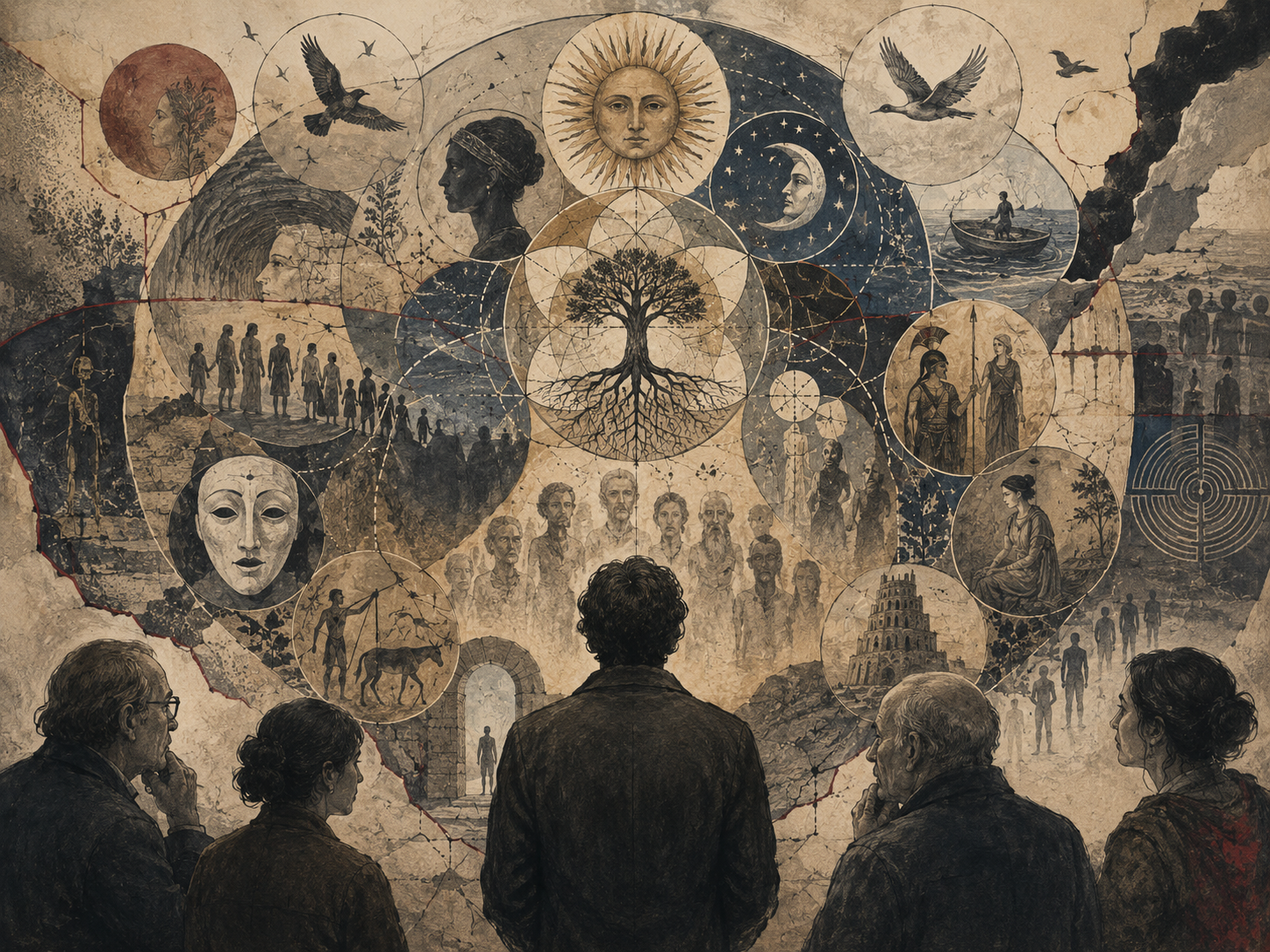
The question, then, is not merely whether one “believes” in the collective unconscious. The more serious question is what explanatory work the idea is trying to do. Jung introduced it in order to account for psychic contents that seemed irreducible to personal history alone. Certain dream motifs, religious symbols, alchemical images, mandalas, primordial animals, shadow figures, divine children, world trees, floods, descents, and narrative forms appeared to him with a force and recurrence that exceeded biography. He concluded that the psyche contains a transpersonal layer, a level of patterning deeper than individual memory yet still psychologically active in the life of the person.
This does not mean that culture, history, language, ritual, family, theology, literature, or political power become irrelevant. On the contrary, any responsible contemporary account must insist that the collective unconscious, if the concept remains useful at all, can only be studied through concrete symbolic forms shaped by history. A flood myth, a dream flood, a ritual washing, and a literary deluge may share structural features, but they do not mean the same thing everywhere. The danger of the concept is that it can flatten difference; the value of the concept is that it asks why difference so often appears through recurring symbolic forms.
This article examines what Jung meant by the collective unconscious, how it differs from the personal unconscious, what role it plays in the theory of archetypes, why Jung turned to myth and religion, how dreams and fantasies may produce transpersonal imagery, why the concept became influential, why it remains contested, and how it can be responsibly reinterpreted today. It treats the collective unconscious neither as a mystical truth to be accepted uncritically nor as an embarrassment to be dismissed without argument. Instead, it approaches the concept as one of the major intellectual proposals in the history of depth psychology: bold, suggestive, difficult, and in need of disciplined interpretation.
Why the Collective Unconscious Matters
The collective unconscious matters because it names a problem that does not disappear simply because one rejects Jung’s answer to it. Human symbolic life shows recurrence. Images of descent, rebirth, shadow, sacred center, wise guide, devouring mother, heroic struggle, sacrificial death, world tree, flood, trickster, psychic doubling, and hidden child appear with striking persistence across literature, religion, dream life, ritual, myth, folklore, and visionary experience. The question is how such recurrence should be understood. Are these similarities merely superficial? Are they products of historical borrowing and cultural transmission alone? Do they reflect common human developmental pressures? Or do they point to deeper structuring tendencies in the psyche itself?
Jung’s theory is one major attempt to answer that question. It matters not because it settles the issue, but because it refuses the easy reduction of symbolic recurrence to accident. It insists that some aspects of mind may be patterned at a level deeper than individual biography. Whether one ultimately endorses that claim, revises it, or rejects it, the explanatory challenge remains serious.
The concept also matters because it challenges the modern assumption that psychic life is entirely private. Dreams and fantasies often arise in intensely personal situations, yet their imagery may feel archaic, mythic, ritualized, or transpersonal. A person may dream of descent into a cave without consciously studying underworld mythology. Another may dream of a child, tree, flood, mandala, dark animal, or luminous guide during a major transition. Analytical psychology asks whether such imagery may express more than personal memory. It asks whether the psyche has symbolic forms through which universal human pressures become imaginatively organized.
This does not require romantic exaggeration. The recurrence of symbolic forms does not prove that all cultures secretly share the same myth. It does not prove that every dream image is archetypal. It does not erase borrowing, colonization, translation, literary inheritance, religious education, mass media, or shared ecological experience. But it does invite a disciplined study of recurrence. The collective unconscious matters because it keeps open the question of deep symbolic patterning without reducing imagination to either private biography or external culture alone.
| Why the concept matters | Psychological problem | Interpretive caution |
|---|---|---|
| Symbolic recurrence | Similar motifs appear across dreams, myths, rituals, and narratives | Similarity is not sameness |
| Transpersonal imagery | Some images feel larger than private memory | Intensity does not prove inheritance |
| Archetypal patterning | Images may organize experience into recurrent structures | Patterns must be tested against context |
| Depth of imagination | The psyche may generate forms not fully controlled by the ego | Depth language can become inflated |
| Interdisciplinary relevance | The concept touches psychology, religion, myth, literature, anthropology, and cognitive science | No single discipline should dominate the evidence |
The collective unconscious matters, then, because it names a field of inquiry: the relation between personal psyche and recurrent symbolic form. It is not a shortcut around evidence. It is an invitation to explain why certain symbolic patterns keep returning.
What Jung Meant by the Collective Unconscious
Jung did not mean by the collective unconscious a hidden archive of fully formed inherited stories. He did not mean that every person is born with complete myths stored somewhere in the brain. More carefully understood, the collective unconscious refers to a transpersonal layer of psychic organization composed of recurrent structural potentials. These are predispositions toward certain kinds of symbolic formation, relation, conflict, affective intensity, and imaginative patterning. They become visible only through concrete expressions such as dreams, myths, religious imagery, fantasies, rituals, visionary experiences, and symbolic narratives.
The collective unconscious is therefore “collective” not because it is socially shared in the everyday sense of public culture, but because it is not unique to one individual biography. It is “unconscious” because it is not ordinarily available to direct introspection and because it manifests indirectly through images, affects, symbolic forms, and recurring psychic motifs. In Jung’s view, these recurrent patterns cannot be explained adequately by personal experience alone.
Jung’s claim is structural rather than pictorial. The collective unconscious is not a library of inherited content. It is closer to a generative grammar of symbolic possibility. Just as language users do not inherit finished sentences but acquire capacities for sentence formation, the psyche, in Jung’s view, carries formal tendencies that can generate symbolic images under particular conditions. The content of those images depends on culture, language, religion, family, body, history, and personal experience. But the recurrence of form suggests an underlying patterning capacity.
This is why Jung repeatedly distinguished archetype from archetypal image. The archetype itself is not directly observable. What appears is the image: mother, child, snake, flood, shadow, guide, mandala, tower, cave, forest, divine figure, or wounded animal. The collective unconscious is inferred from the recurrence, force, and structural similarity of such images across persons and traditions. It is not directly seen; it is hypothesized from symbolic manifestation.
The concept is also dynamic. The collective unconscious is not simply a static background. It becomes active when archetypal material is constellated: in crisis, transition, illness, religious experience, artistic creation, dream sequences, psychosis, grief, initiation, social upheaval, or major psychic transformation. At such moments, the person may encounter images that feel both intimate and impersonal. They arise from within, yet do not feel merely personal.
| Term | Careful meaning | Misreading to avoid |
|---|---|---|
| Collective unconscious | A transpersonal layer of recurrent symbolic and psychic structuring potentials | A warehouse of inherited myths or finished images |
| Archetype | A latent organizing pattern inferred from recurring symbolic manifestations | A stock character or universal stereotype |
| Archetypal image | A concrete image through which an archetypal pattern becomes visible | The archetype itself in pure form |
| Symbolic recurrence | Repetition of motifs, structures, or dramas across contexts | Proof of identical meaning everywhere |
| Transpersonal imagery | Imagery that exceeds the apparent scale of personal memory | Evidence that culture and history do not matter |
What Jung meant, then, was not that people inherit finished myths. He meant that the psyche contains formal tendencies through which symbolic life repeatedly takes shape. That claim remains difficult, but it is more precise than the caricature often associated with the phrase “collective unconscious.”
How It Differs from the Personal Unconscious
The distinction between the personal unconscious and the collective unconscious is crucial. The personal unconscious consists of forgotten memories, repressed material, unresolved conflicts, latent potentials, and affectively charged formations such as complexes that belong to the individual’s own life history. It is biographical, local, and historically specific to the person. It includes what the person has experienced, lost, feared, denied, forgotten, defended against, or failed to integrate.
The collective unconscious, by contrast, is not composed primarily of personal memory. It refers to deeper recurrent structures that shape how symbolic life can form across persons and cultures. A dream about a dark forest, a devouring beast, a great flood, a hidden child, or a luminous guide may have intensely personal meaning in one case, yet its form may also participate in a broader symbolic grammar that exceeds the dreamer’s individual history. Jung’s claim is that both levels can be active at once: the personal and the transpersonal, the biographical and the archetypal.
This layered model is one of Jung’s most important contributions. It prevents dream interpretation from being reduced either to personal biography alone or to abstract archetypal symbolism alone. A mother image in a dream may refer to the dreamer’s actual mother, a mother complex, cultural expectations of motherhood, religious mother imagery, bodily memory, dependency, nourishment, danger, or an archetypal pattern of origin and containment. Interpretation becomes responsible only when these layers are differentiated rather than collapsed.
The personal unconscious is often accessible through association: what does the image remind the dreamer of? What memories, relationships, feelings, conflicts, and experiences does it evoke? The collective unconscious becomes relevant when the image’s form, affective charge, or recurrence suggests a pattern larger than the immediate association. But the archetypal layer should never be used to bypass the personal layer. Jungian interpretation becomes weak when it names an archetype before listening to the person.
| Dimension | Personal unconscious | Collective unconscious |
|---|---|---|
| Primary source | Individual biography, repression, forgetting, complexes, personal conflict | Recurrent symbolic structuring potentials not reducible to individual life history |
| Typical manifestation | Personal memories, emotional patterns, relational triggers, symptoms, complexes | Archetypal images, mythic motifs, transpersonal dreams, symbolic dramas |
| Interpretive method | Personal association, developmental history, affective complex analysis | Amplification, symbolic comparison, motif analysis, mythic and religious context |
| Main danger | Reducing everything to private history | Inflating everything into universal myth |
| Responsible integration | Ask how the image belongs to the person’s life | Ask how the image also participates in recurrent symbolic form |
The difference between the personal and collective unconscious should therefore be treated as a difference of layer, not a competition. The same image may be personal, cultural, and archetypal at once. The interpretive task is to hold those layers together without forcing one to erase the others.
Archetypes and Structural Patterns
The collective unconscious is inseparable from Jung’s theory of archetypes. Archetypes are not fixed mythic characters but recurrent organizing patterns of image, relation, and narrative possibility. They are tendencies toward certain symbolic configurations: mother and child, hero and adversary, descent and return, shadow and double, center and circle, death and rebirth, wise elder, trickster, threshold, sacrifice, and transformation.
These patterns do not appear in identical form everywhere, nor do they erase cultural difference. They become real only in their concrete instantiations, which vary historically, linguistically, ritually, aesthetically, politically, and theologically. The archetypal dimension, on Jung’s view, refers to recurrence at the level of psychic structure, not sameness at the level of content. That distinction is essential. Without it, archetypal theory collapses into a simplistic universalism that deserves criticism.
Archetypes function as structural patterns rather than fixed contents. The child archetype, for example, does not mean the same child image everywhere. It may appear as divine child, abandoned child, hidden child, future child, wounded child, miraculous infant, small animal, seed, or vulnerable new life. The recurrence lies not in a single picture but in a pattern of emergence, fragility, futurity, and unrealized possibility. The same is true of the shadow, the trickster, the mother, the guide, the hero, and the Self.
The relation between archetype and collective unconscious is therefore reciprocal. The collective unconscious is the field of archetypal potential; archetypes are the structuring patterns through which that field becomes symbolically manifest. When an archetypal image appears, it is not merely a private invention. It may connect the individual psyche to a wider symbolic pattern. But that connection must be interpreted with restraint, because archetypal language can easily overrun the evidence.
| Archetypal pattern | Structural drama | Possible images | Caution |
|---|---|---|---|
| Shadow | Disowned selfhood, projection, moral ambiguity | Double, dark figure, enemy, intruder, monster, animal | Do not reduce real others to projections |
| Child | Emergence, vulnerability, futurity, unrealized wholeness | Infant, seed, small animal, hidden child, divine child | Do not sentimentalize vulnerability |
| Mother | Origin, containment, nourishment, engulfment, danger | Mother, cave, vessel, sea, earth, garden, devouring figure | Do not reduce actual women to symbolic function |
| Hero | Separation, ordeal, struggle, differentiation, return | Warrior, traveler, pilgrim, dragon-slayer, initiand | Do not turn every conflict into heroic destiny |
| Trickster | Disruption, inversion, boundary crossing, creative disorder | Fool, thief, animal, shapeshifter, clown, deceiver | Do not romanticize deceit or harm |
| Self | Totality, center, ordering, integration | Mandala, circle, stone, tree, city, deity, radiant center | Do not identify ego with totality |
Archetypes and structural patterns are the practical language of the collective unconscious. They give the theory its interpretive power and also its greatest risk. If handled carefully, they help identify recurring symbolic organization. If handled carelessly, they become universalizing labels imposed on living material.
Myth, Religion, and Symbolic Recurrence
Jung turned repeatedly to myth and religion because he believed they preserved symbolic patterns that modern consciousness often forgets yet never fully escapes. Myths and sacred narratives externalize psychic dramas: conflict, initiation, sacrifice, temptation, descent, fragmentation, renewal, judgment, reconciliation, exile, return, death, and rebirth. Religious imagery, in this frame, is not merely doctrinal statement. It is also symbolic expression of deep psychic forms.
This helps explain why Jung’s work has attracted readers in literature, theology, comparative religion, anthropology, and the arts. He offered a framework in which symbolic recurrence across civilizations could be interpreted psychologically rather than only historically or theologically. The strength of this approach lies in its sensitivity to form and resonance. Its danger lies in flattening distinct traditions into interchangeable evidence for a pre-existing theory.
Mythic recurrence should therefore be understood as a problem, not as proof. A flood narrative in one tradition may concern divine judgment; in another, primordial chaos; in another, ecological memory; in another, ritual cleansing; in another, political renewal; in another, trauma. A descent narrative may concern death, initiation, depression, shamanic passage, underworld cosmology, mourning, or spiritual transformation. The recurrence of form does not authorize the erasure of difference.
Religion raises the stakes further. Religious symbols do not belong only to psychology. They belong to communities, scriptures, rituals, laws, liturgies, languages, ethics, authorities, and histories of interpretation. Jungian analysis may illuminate symbolic form, but it must not reduce religious life to archetypal psychology. A responsible approach asks what psychological resonance a symbol may carry while respecting its theological and communal meaning.
This is especially important when studying marginalized, colonized, Indigenous, minority, or non-Western traditions. Archetypal interpretation can become extractive when it takes symbols from living communities and uses them merely as evidence for a universal theory. A more responsible comparative method treats traditions as interpretive worlds, not symbolic raw material.
| Domain | Why Jung found it important | Responsible caution |
|---|---|---|
| Myth | Myths preserve recurrent symbolic dramas of origin, conflict, death, and renewal | Do not treat similar motifs as identical meanings |
| Religion | Religious images often carry powerful archetypal resonance | Do not reduce theology, ritual, or faith to psychology alone |
| Ritual | Ritual embodies transition, sacrifice, cleansing, initiation, and return | Interpret through social and religious function, not only symbolism |
| Alchemy | Alchemical imagery gave Jung a symbolic language of transformation | Distinguish historical alchemy from modern psychological projection onto it |
| Folklore | Folk narratives preserve recurring motifs of danger, transformation, trickery, and survival | Respect local storytelling traditions and historical transmission |
Myth, religion, and symbolic recurrence demonstrate why the collective unconscious remains both compelling and dangerous. It helps explain the resonance of symbolic patterns, but only if it does not erase the worlds in which symbols live.
Dreams, Fantasies, and Transpersonal Imagery
For Jung, the collective unconscious becomes most palpable when dreams or fantasies produce material that seems disproportionate to the dreamer’s personal life. Some images appear with a mythic or cosmological scale that exceeds ordinary memory. Mandalas, sacred centers, apocalyptic scenes, primordial animals, doubled figures, world trees, radiant children, catastrophic floods, initiatory descents, and guiding elders may appear in dreams of individuals with no conscious scholarly knowledge of their wider symbolic analogues.
Jung interpreted such material as evidence that the psyche can generate transpersonal imagery from its own depths. Critics have often responded that this conclusion moves too quickly from recurrence to inheritance. Similar images may arise from common embodied experience, common social structures, shared developmental pressures, broad diffusion of motifs, or indirect exposure through culture. That criticism is serious. Still, Jung’s proposal remains provocative because it suggests that the psyche does not merely copy culture from the outside but may also participate in recurrent symbolic formation from within.
Dreams are important because they often dramatize psychic problems rather than explaining them discursively. A person confronting loss may dream of burial, winter, dark water, descent, or a ruined house. A person facing moral self-deception may dream of a double, shadowy pursuer, trial, monster, or concealed room. A person undergoing transformation may dream of fire, child, tree, threshold, vessel, or rebirth. Such images do not automatically prove the collective unconscious, but they show why Jung needed a theory of symbolic patterning.
Fantasy material can function similarly. Active imagination, artistic vision, psychotic imagery, religious vision, and mythopoetic creativity may produce symbolic structures that feel larger than ego intention. Jung was especially interested in such material because it seemed to reveal psychic forms not controlled by conscious will. Yet this is also why interpretive caution is necessary. Transpersonal imagery can be stabilizing, meaningful, and transformative, but it can also be overwhelming, grandiose, or clinically destabilizing.
| Imaginal form | Possible collective-unconscious relevance | Clinical or interpretive caution |
|---|---|---|
| Mandalas and sacred centers | May express ordering, centering, totality, or Self imagery | Do not assume every circular image indicates integration |
| Floods, seas, and dark water | May express overwhelming affect, dissolution, chaos, cleansing, or unconscious depth | Consider trauma, grief, mood, and context before archetypal amplification |
| Shadow figures and doubles | May express disowned selfhood, projection, or psychic conflict | Do not reduce actual others to inner figures |
| Guides and elders | May express orientation, symbolic mediation, or wisdom figures | Do not surrender judgment to inner authority images |
| Children and seeds | May express emergence, futurity, vulnerability, or latent possibility | Do not sentimentalize or overpromise transformation |
| Descent and return | May express crisis, initiation, depression, mourning, or transformation | Do not romanticize suffering or bypass clinical care |
Dreams, fantasies, and transpersonal imagery remain central to the collective unconscious because they show the psyche’s tendency to organize itself symbolically. The question is not whether every such image proves Jung right. The question is why symbolic form appears with such force when the psyche is under pressure.
Scope of the Claim
The scope of the claim must be stated carefully. Jung was not simply saying that people from many cultures tell stories. He was making a stronger argument: that the mind has recurrent structural tendencies that organize symbolic production in patterned ways. This is a large claim, and its plausibility depends on how strongly one interprets it.
In its strongest form, the claim risks becoming biologically or metaphysically inflated, as if archetypal contents were prepackaged, universally legible, and separable from history. In a weaker and more defensible form, the claim says that human beings share recurrent existential, developmental, relational, embodied, and imaginal pressures, and that these pressures generate recurring symbolic structures. The weaker form remains closer to contemporary interdisciplinary dialogue, though it also moves somewhat away from the strongest classical Jungian language.
A responsible account should distinguish at least four levels of claim. The first is descriptive: symbolic recurrence exists. The second is interpretive: some recurrence may reflect shared psychological patterning. The third is theoretical: Jung called this deeper patterning the collective unconscious. The fourth is metaphysical or biological: such patterns are inherited psychic structures. Each level requires a different kind of evidence. The more ambitious the claim, the stronger the evidentiary burden.
The concept’s scope should also be limited by context. The collective unconscious should not be used to explain everything symbolic. Some recurrence is obviously due to direct cultural transmission. Some is due to genre convention. Some is due to religious education, colonial contact, translation, trade, migration, media, imitation, or shared ecological experience. Archetypal explanation becomes plausible only after these alternatives have been considered, not before.
| Level of claim | What it says | Evidence needed |
|---|---|---|
| Descriptive recurrence | Similar symbolic motifs appear across multiple contexts | Documented motif comparison |
| Psychological patterning | Some recurrence reflects shared psychic or developmental pressures | Contextual, clinical, developmental, and comparative analysis |
| Jungian collective unconscious | Recurrent motifs reflect a transpersonal layer of psychic structure | Argument beyond biography, diffusion, genre, and cultural borrowing |
| Strong inheritance claim | Archetypal structures are inherited psychic forms | Very high burden: interdisciplinary, empirical, theoretical, and philosophical support |
| Responsible contemporary reinterpretation | Symbolic recurrence may arise from shared embodiment, development, culture, and deep patterning | Comparative methods, humility, and rival explanations |
The scope of the collective unconscious should therefore be neither inflated nor prematurely dismissed. It is strongest when framed as a serious hypothesis about symbolic recurrence and weakest when used as an all-purpose explanation for anything that feels mythic.
Why the Idea Became Influential
The idea of the collective unconscious became influential because it provided a powerful vocabulary for experiences many people felt were psychologically real but difficult to name. It explained why myths could feel inwardly alive, why dreams could seem larger than personal memory, why certain symbolic figures recur in art and literature, and why human beings repeatedly construct similar stories of loss, ordeal, initiation, and transformation.
It also offered a bridge across disciplines. For scholars of religion, it suggested that symbolic forms had psychological depth. For literary critics, it provided a theory of recurring motifs. For psychotherapists, it offered a way to understand dreams and fantasies whose significance exceeded the immediate personal situation. For artists and writers, it validated the sense that imagination draws from layers deeper than conscious design alone.
The concept also became influential because modernity often produces symbolic hunger. In secular or rationalized contexts, many people experience myth, religion, dream, and ritual as either discredited or privately compelling. Jung offered a way to take symbolic life seriously without requiring literal belief in every traditional doctrine. This made his work attractive to readers seeking meaning beyond reductionist psychology but wary of institutional dogma.
The collective unconscious also gave depth psychology a broader cultural reach. Freud’s theory of the unconscious emphasized repression, sexuality, family romance, conflict, and symptom formation. Jung’s theory expanded unconscious life into mythology, religion, alchemy, fairy tale, visionary art, and cultural imagination. Whether one sees that expansion as brilliant or excessive, it helped make analytical psychology a major language for interpreting symbolic culture.
| Field influenced | Why the concept appealed | Risk of misuse |
|---|---|---|
| Psychotherapy | Provided language for dreams and symbolic imagery beyond personal memory | Premature amplification or archetypal labeling |
| Literature and art | Explained recurring motifs and mythic structures | Reducing literary craft to archetypal formula |
| Religious studies and theology | Recognized psychological depth in sacred symbols | Reducing religion to psychology |
| Popular culture | Made mythic patterns accessible to broad audiences | Simplifying archetypes into tropes or personality types |
| Creative practice | Encouraged artists to trust symbolic imagination | Inflating personal creativity into mythic destiny |
The idea became influential because it spoke to something real: the persistence and force of symbolic life. Its influence, however, must be separated from its proof. A concept can be culturally powerful and still require critique.
Major Criticisms
The major criticisms of the collective unconscious are substantial and must be taken seriously. First, the concept is difficult to operationalize in strict empirical terms. It is not easy to distinguish inherited psychic structure from common developmental pressures, cultural transmission, selective interpretation, genre convention, religious education, or broad exposure to shared motifs. If every recurrence can be counted as evidence, the theory becomes unfalsifiable.
Second, Jung and some later Jungians often moved too quickly across cultural materials, treating symbolic resemblance as evidence of deep equivalence while neglecting historical specificity, linguistic difference, ritual practice, theological meaning, political context, and colonial power. This is one of the most serious criticisms. Similar symbols do not always do the same work. A serpent, tree, flood, mother, child, or sacred center may carry radically different meanings across traditions.
Third, the concept can invite interpretive inflation. Every recurring image becomes archetypal, every strong dream becomes transpersonal, every personal crisis becomes initiation, every ordinary conflict becomes mythic battle, and every symbol becomes evidence of universal depth. This inflation can feel profound while actually reducing interpretive precision.
Fourth, archetypal claims have sometimes been entangled with essentialist assumptions about gender, civilization, culture, and hierarchy. Classical Jungian language sometimes associates symbolic categories with masculine and feminine essences, or treats certain traditions as earlier expressions of psychic development. Contemporary work must revise these assumptions rather than repeat them.
Fifth, the collective unconscious can become politically evasive. If social conflict is interpreted too quickly as symbolic projection, material injustice can disappear from view. Racism, colonialism, class domination, patriarchy, ecological destruction, and institutional violence cannot be reduced to archetypal drama. Symbolic analysis must never become a substitute for historical and structural analysis.
| Criticism | Why it matters | Responsible response |
|---|---|---|
| Empirical difficulty | The concept can be hard to test or falsify | Treat it as an interpretive hypothesis and compare alternatives |
| Cultural flattening | Symbolic resemblance may erase historical and ritual difference | Interpret symbols within living traditions and contexts |
| Interpretive inflation | Everything becomes archetypal regardless of evidence | Use proportion, context, and methodological restraint |
| Gender essentialism | Symbolic categories may reproduce outdated binaries | Separate symbolic coding from claims about gender essence |
| Political evasion | Material harm may be psychologized away | Combine symbolic analysis with historical, legal, social, and institutional analysis |
| Confirmation bias | The interpreter finds the patterns they expect | Include counterexamples, rival explanations, and transparent criteria |
These criticisms do not require abandoning the concept outright, but they do require narrowing and disciplining it. The collective unconscious remains useful only when it can survive contact with history, culture, evidence, and ethical critique.
Responsible Reinterpretations
A responsible reinterpretation of the collective unconscious keeps Jung’s central insight while narrowing its claims. One may preserve the idea that symbolic life exhibits recurrent structures without pretending those structures float free of history, embodiment, language, and power. One may also treat archetypes as recurrent possibilities of symbolic organization rather than universal meanings with fixed content.
On this reading, the collective unconscious becomes less a doctrine of inherited mythic pictures and more a hypothesis about deep symbolic patterning under shared human conditions. Such a reinterpretation is less grandiose, but also more intellectually sustainable. It invites dialogue with developmental psychology, anthropology, narrative theory, cognitive science, religious studies, comparative literature, evolutionary psychology, trauma theory, and cultural memory studies without requiring that all symbolic recurrence be explained in strictly Jungian terms.
A responsible reinterpretation should begin with methodological humility. The collective unconscious should be proposed only when personal biography, direct transmission, genre convention, historical borrowing, religious education, and cultural context do not fully explain the recurrence or intensity of symbolic form. Even then, the claim should remain provisional. Archetypal patterning may be one explanatory layer among several, not the master explanation.
Responsible reinterpretation also requires cultural humility. Symbols belong to communities, languages, ritual systems, and histories. They are not merely illustrations for depth psychology. Comparative work should ask not only whether motifs resemble one another, but how they function differently. It should also foreground whose symbols are being interpreted, who benefits from the interpretation, and whether the analysis respects the tradition from which the symbol comes.
Finally, responsible reinterpretation should distinguish psychic recurrence from moral truth. An image may be archetypally powerful and still ethically dangerous. A collective myth may organize meaning and still justify domination. A symbolic pattern may be psychologically real and politically harmful. The collective unconscious should never be treated as a source of automatic wisdom. It is a source of psychic form, and psychic form still requires ethical judgment.
| Responsible reinterpretation | What it preserves | What it avoids |
|---|---|---|
| Archetypes as patterning tendencies | The recurrence of symbolic form | Inherited picture theory |
| Layered explanation | Personal, cultural, historical, and archetypal dimensions | Single-cause interpretation |
| Context-first comparison | Respect for symbolic specificity | Universalizing flattening |
| Interdisciplinary dialogue | Connection to cognitive science, development, anthropology, religion, and literature | Closed Jungian doctrine |
| Ethical realism | Attention to power, harm, and accountability | Using myth to bypass justice |
Responsible reinterpretation does not make the collective unconscious easy. It makes it more disciplined. It keeps the question of symbolic recurrence alive while refusing to let recurrence become an excuse for overstatement.
The Collective Unconscious and Contemporary Thought
Contemporary thought tends not to accept the collective unconscious in Jung’s strongest classical form, yet many adjacent fields continue to circle related questions. Cognitive science studies recurring narrative templates and conceptual metaphors. Developmental psychology examines common human situations of dependency, separation, threat, attachment, grief, and maturation. Anthropology explores symbolic structures and ritual forms. Comparative literature tracks archetypal motifs while also stressing historical mediation. Trauma theory and cultural memory studies examine how collective experience shapes symbolic repertoires across generations.
None of these fields simply reproduces Jung. But together they show that the problem he addressed has not disappeared. There remain serious questions about why symbolic life recurs the way it does, why certain images carry unusual force, and how personal imagination intersects with larger inherited cultural and psychic forms.
Cognitive linguistics is especially relevant because it shows how human thought is structured through recurring embodied schemas: container, path, center, threshold, up and down, light and dark, journey, balance, source, goal, force, and transformation. These do not prove Jung’s collective unconscious, but they offer a contemporary way to understand why symbolic forms recur without requiring inherited mythic pictures.
Developmental psychology also matters. Human beings share conditions of birth, dependency, separation, fear, care, rivalry, authority, vulnerability, maturation, sexuality, aging, and death. These shared conditions may generate recurring symbolic patterns. The child, mother, father, stranger, monster, guide, shadow, threshold, and center may recur partly because human development repeatedly confronts similar psychic pressures.
Cultural memory and trauma studies complicate the question further. Some “collective” imagery may arise not from universal psychic structures but from transmitted historical experience: war, displacement, slavery, colonization, migration, ecological disaster, religious persecution, or institutional violence. Such imagery may be collective, but not necessarily in Jung’s sense. It may be historical, intergenerational, and politically specific.
| Field | Related question | Contribution to rethinking the collective unconscious |
|---|---|---|
| Cognitive science | Why do certain schemas and metaphors recur? | Offers embodied and cognitive accounts of recurrent symbolic form |
| Developmental psychology | How do shared human developmental pressures shape imagination? | Connects recurrence to care, dependency, separation, fear, and maturation |
| Anthropology | How do ritual and symbolic systems organize collective life? | Protects against abstract universalism |
| Comparative literature | How do motifs travel, transform, and recur across texts? | Distinguishes archetypal recurrence from genre and transmission |
| Religious studies | How do sacred symbols function within traditions? | Prevents reduction of religion to psychology alone |
| Cultural memory studies | How do communities transmit symbolic repertoires across generations? | Distinguishes historical collectivity from Jungian transpersonal structure |
| Network and corpus analysis | Can recurrence be mapped systematically? | Makes symbolic patterning more explicit and comparable |
The collective unconscious and contemporary thought meet most fruitfully when Jung’s concept is neither repeated dogmatically nor dismissed prematurely. The strongest path forward is comparative, interdisciplinary, historically careful, and methodologically humble.
Mathematical Lens
The collective unconscious can be formalized, cautiously, as a latent structural layer generating recurrent symbolic outputs across individuals and cultures. Let \(S_{ij}\) represent the symbolic expression of individual \(i\) in context \(j\). A stylized model might be written as:
S_{ij} = \alpha + \beta P_i + \gamma C_j + \delta L + \varepsilon_{ij}
\]
Interpretation: \(P_i\) represents personal biography, \(C_j\) cultural context, and \(L\) a latent structural term corresponding to transpersonal patterning. In Jungian language, \(L\) approximates the collective unconscious, though in practice it would be inferred only indirectly through recurrent symbolic forms not exhausted by personal or local explanatory variables.
A more cautious model would treat symbolic recurrence as a competition among explanations:
P(H_k \mid D) \propto P(D \mid H_k)P(H_k)
\]
Interpretation: \(H_k\) represents competing hypotheses: archetypal structure, cultural transmission, genre convention, shared development, embodied cognition, religious education, or historical memory. Evidence \(D\) should be evaluated against rival explanations rather than automatically assigned to the collective unconscious.
A network representation may be even more useful. Suppose myths, dream images, and symbolic motifs form a graph in which nodes are motifs and edges represent co-occurrence across corpora:
G = (V,E), \quad R_c = f(S_c, W_c, X_c, A_c)
\]
Interpretation: \(G\) is a symbolic motif network, \(S_c\) is cluster stability, \(W_c\) is weighted co-occurrence strength, \(X_c\) is cross-context recurrence, and \(A_c\) is alternative-explanation strength. \(R_c\) represents the recurrence strength of a symbolic cluster after accounting for rival explanations.
To avoid overstatement, cultural specificity can be modeled explicitly:
M_{m,c} = \theta_m + \phi_c + \psi_{m,c} + \eta_{m,c}
\]
Interpretation: \(M_{m,c}\) is motif \(m\) in context \(c\), \(\theta_m\) is the motif’s recurring formal tendency, \(\phi_c\) is cultural or historical context, and \(\psi_{m,c}\) is the interaction between motif and context. This prevents recurrence from being mistaken for sameness.
The key point is methodological humility. Mathematical models can clarify the problem of recurrence, but they cannot decide by themselves whether recurrence reflects archetypal structure, common development, shared embodiment, cultural transmission, genre convention, historical memory, or some combination of all of these. They help specify the explanatory alternatives rather than magically resolve them.
R Workflow: Modeling Symbolic Recurrence Across Textual Corpora
The following R workflow sketches how one might study recurrent symbolic patterning across multiple corpora without presuming the answer in advance. It treats symbolic recurrence as an empirical pattern to be mapped, compared, and interpreted cautiously rather than as proof of a doctrine. The workflow uses a synthetic fallback corpus if no file is present.
# ============================================================
# The Collective Unconscious: Meaning, Scope, and Controversy
# R Workflow: Symbolic recurrence across textual corpora
# ============================================================
#
# Responsible-use note:
# This workflow is for synthetic-data demonstration and symbolic-pattern
# research methods. It does not prove the collective unconscious, diagnose
# people, interpret private dreams, or replace cultural, historical, clinical,
# or religious scholarship.

library(tidyverse)
library(tidytext)
library(igraph)
library(ggraph)

set.seed(2026)

# ------------------------------------------------------------
# 1. Load or create a symbolic corpus
# ------------------------------------------------------------

corpus_path <- "data/raw/symbolic_corpora.csv"

if (file.exists(corpus_path)) {
  texts <- read_csv(corpus_path, show_col_types = FALSE)
} else {
  texts <- tibble(
    doc_id = paste0("doc_", 1:16),
    source_type = rep(c("dream", "myth", "religious", "literary"), each = 4),
    culture_group = rep(c("synthetic_a", "synthetic_b", "synthetic_c", "synthetic_d"), times = 4),
    text = c(
      "A child crossed a threshold and found a tree beside dark water.",
      "A shadow followed the traveler into a cave below the city.",
      "A guide appeared with fire and led the dreamer toward rebirth.",
      "A circle of stones opened at the center of the dream.",
      "The king lost his crown after a flood covered the old road.",
      "A snake circled the tree while the mother searched for the child.",
      "The hero descended into a cave and returned with a broken stone.",
      "A trickster stole fire from the king and opened the gate.",
      "The vessel was washed with water before the initiate crossed the threshold.",
      "The mother placed a seed in darkness beneath the moon.",
      "A sacred center appeared after sacrifice and return.",
      "The world tree rose between sun, moon, and water.",
      "A double walked through the city carrying a dark mirror.",
      "At the threshold, a masked figure offered moonlight and fire.",
      "A lonely child met an elder guide under the sun and tree.",
      "The traveler entered the underworld and returned with a new name."
    )
  )

  dir.create("data/raw", recursive = TRUE, showWarnings = FALSE)
  write_csv(texts, corpus_path)
}

# ------------------------------------------------------------
# 2. Tokenize and clean
# ------------------------------------------------------------

tokens_clean <- texts |>
  unnest_tokens(word, text) |>
  anti_join(stop_words, by = "word")

motif_terms <- c(
  "mother", "child", "shadow", "flood", "tree", "king",
  "snake", "fire", "cave", "sun", "moon", "journey",
  "threshold", "rebirth", "death", "guide", "circle",
  "stone", "center", "water", "double", "mirror", "trickster",
  "hero", "gate", "vessel", "seed", "underworld", "return"
)

motif_counts <- tokens_clean |>
  filter(word %in% motif_terms) |>
  count(doc_id, source_type, culture_group, word, name = "count")

# ------------------------------------------------------------
# 3. Compare motif prevalence by source and context
# ------------------------------------------------------------

motif_summary <- motif_counts |>
  group_by(source_type, culture_group, word) |>
  summarize(total = sum(count), .groups = "drop") |>
  arrange(desc(total), source_type, culture_group)

print(motif_summary)

# ------------------------------------------------------------
# 4. Build motif co-occurrence network by document
# ------------------------------------------------------------

doc_motifs <- motif_counts |>
  group_by(doc_id) |>
  summarize(motifs = list(unique(word)), .groups = "drop")

cooc_edges <- doc_motifs |>
  mutate(pairs = map(motifs, ~ {
    if (length(.x) < 2) {
      tibble(from = character(), to = character())
    } else {
      as_tibble(t(combn(sort(.x), 2)), .name_repair = "minimal") |>
        rename(from = V1, to = V2)
    }
  })) |>
  select(doc_id, pairs) |>
  unnest(pairs) |>
  count(from, to, name = "weight") |>
  filter(weight >= 1)

nodes <- tibble(name = unique(c(cooc_edges$from, cooc_edges$to)))

motif_graph <- graph_from_data_frame(
  d = cooc_edges,
  vertices = nodes,
  directed = FALSE
)

# ------------------------------------------------------------
# 5. Network metrics and clusters
# ------------------------------------------------------------

metrics <- tibble(
  motif = V(motif_graph)$name,
  degree = degree(motif_graph),
  strength = strength(motif_graph, weights = E(motif_graph)$weight),
  betweenness = betweenness(motif_graph, weights = 1 / E(motif_graph)$weight)
) |>
  arrange(desc(betweenness), desc(strength))

communities <- cluster_louvain(motif_graph, weights = E(motif_graph)$weight)

cluster_table <- tibble(
  motif = V(motif_graph)$name,
  cluster = membership(communities)
) |>
  arrange(cluster, motif)

print(metrics)
print(cluster_table)

# ------------------------------------------------------------
# 6. Visualization and export
# ------------------------------------------------------------

dir.create("outputs/figures", recursive = TRUE, showWarnings = FALSE)
dir.create("outputs/tables", recursive = TRUE, showWarnings = FALSE)

plot_obj <- ggraph(motif_graph, layout = "fr") +
  geom_edge_link(aes(width = weight), alpha = 0.25) +
  geom_node_point(size = 4) +
  geom_node_text(aes(label = name), repel = TRUE, size = 3) +
  scale_edge_width(range = c(0.3, 2.5)) +
  labs(
    title = "Synthetic Symbolic Motif Co-Occurrence Network",
    subtitle = "Recurring symbolic motifs can be mapped, but recurrence requires contextual interpretation"
  ) +
  theme_void()

ggsave(
  filename = "outputs/figures/collective_unconscious_motif_network.png",
  plot = plot_obj,
  width = 10,
  height = 7,
  dpi = 300
)

write_csv(motif_summary, "outputs/tables/motif_summary_by_context.csv")
write_csv(metrics, "outputs/tables/motif_network_metrics.csv")
write_csv(cluster_table, "outputs/tables/motif_clusters.csv")
write_csv(cooc_edges, "outputs/tables/motif_cooccurrence_edges.csv")

cat("\nInterpretive guardrails:\n")
cat("- Co-occurrence is not proof of the collective unconscious.\n")
cat("- Motif recurrence must be compared against genre, transmission, culture, and context.\n")
cat("- Network clusters support interpretation; they do not replace it.\n")
cat("- Similar motifs may perform different symbolic functions in different traditions.\n")
This workflow does not prove the collective unconscious. What it does is make recurrence visible at scale. It allows the researcher to ask whether symbolic motifs cluster in consistent ways across otherwise distinct corpora and whether those clusters are better explained by genre, tradition, diffusion, shared embodiment, developmental pressure, or deeper structural regularity.
Python Workflow: Mapping Archetypal Patterning as a Semantic Network
The following Python workflow models symbolic recurrence as a semantic network across texts. This approach is useful for exploring whether certain motifs repeatedly appear as bridge nodes within broader symbolic systems and whether those systems remain stable across different corpora. The workflow uses a synthetic fallback corpus if no source file is available.
# ============================================================
# The Collective Unconscious: Meaning, Scope, and Controversy
# Python Workflow: Archetypal patterning as a semantic network
# ============================================================
#
# Responsible-use note:
# This workflow is for synthetic-data demonstration and symbolic-pattern
# research methods. It does not prove the collective unconscious, diagnose
# people, interpret private dreams, or replace cultural, historical, clinical,
# or religious scholarship.

from pathlib import Path
from collections import Counter
from itertools import combinations
import re

import pandas as pd
import networkx as nx

ARTICLE_DIR = Path("articles/the-collective-unconscious-meaning-scope-and-controversy")
DATA_DIR = ARTICLE_DIR / "data/raw"
OUTPUT_TABLES = ARTICLE_DIR / "outputs/tables"
DATA_DIR.mkdir(parents=True, exist_ok=True)
OUTPUT_TABLES.mkdir(parents=True, exist_ok=True)

corpus_path = DATA_DIR / "symbolic_corpora.csv"

# ------------------------------------------------------------
# 1. Load or create synthetic corpus
# ------------------------------------------------------------

if corpus_path.exists():
    df = pd.read_csv(corpus_path)
else:
    df = pd.DataFrame(
        [
            {"doc_id": "doc_1", "source_type": "dream", "culture_group": "synthetic_a", "text": "A child crossed a threshold and found a tree beside dark water."},
            {"doc_id": "doc_2", "source_type": "dream", "culture_group": "synthetic_a", "text": "A shadow followed the traveler into a cave below the city."},
            {"doc_id": "doc_3", "source_type": "dream", "culture_group": "synthetic_b", "text": "A guide appeared with fire and led the dreamer toward rebirth."},
            {"doc_id": "doc_4", "source_type": "dream", "culture_group": "synthetic_b", "text": "A circle of stones opened at the center of the dream."},
            {"doc_id": "doc_5", "source_type": "myth", "culture_group": "synthetic_c", "text": "The king lost his crown after a flood covered the old road."},
            {"doc_id": "doc_6", "source_type": "myth", "culture_group": "synthetic_c", "text": "A snake circled the tree while the mother searched for the child."},
            {"doc_id": "doc_7", "source_type": "myth", "culture_group": "synthetic_d", "text": "The hero descended into a cave and returned with a broken stone."},
            {"doc_id": "doc_8", "source_type": "myth", "culture_group": "synthetic_d", "text": "A trickster stole fire from the king and opened the gate."},
            {"doc_id": "doc_9", "source_type": "religious", "culture_group": "synthetic_a", "text": "The vessel was washed with water before the initiate crossed the threshold."},
            {"doc_id": "doc_10", "source_type": "religious", "culture_group": "synthetic_b", "text": "The mother placed a seed in darkness beneath the moon."},
            {"doc_id": "doc_11", "source_type": "religious", "culture_group": "synthetic_c", "text": "A sacred center appeared after sacrifice and return."},
            {"doc_id": "doc_12", "source_type": "religious", "culture_group": "synthetic_d", "text": "The world tree rose between sun moon and water."},
            {"doc_id": "doc_13", "source_type": "literary", "culture_group": "synthetic_a", "text": "A double walked through the city carrying a dark mirror."},
            {"doc_id": "doc_14", "source_type": "literary", "culture_group": "synthetic_b", "text": "At the threshold a masked figure offered moonlight and fire."},
            {"doc_id": "doc_15", "source_type": "literary", "culture_group": "synthetic_c", "text": "A lonely child met an elder guide under the sun and tree."},
            {"doc_id": "doc_16", "source_type": "literary", "culture_group": "synthetic_d", "text": "The traveler entered the underworld and returned with a new name."},
        ]
    )
    df.to_csv(corpus_path, index=False)

motif_terms = {
    "mother", "child", "shadow", "flood", "tree", "king",
    "snake", "fire", "cave", "sun", "moon", "journey",
    "threshold", "rebirth", "death", "guide", "circle",
    "stone", "center", "water", "double", "mirror", "trickster",
    "hero", "gate", "vessel", "seed", "underworld", "return",
}

def tokenize(text: str) -> list[str]:
    """Lowercase and tokenize text using a simple alphabetic regex."""
    return re.findall(r"[a-z]+", str(text).lower())

# ------------------------------------------------------------
# 2. Document-level motif extraction
# ------------------------------------------------------------

doc_rows = []

for _, row in df.iterrows():
    tokens = tokenize(row["text"])
    motif_counts = Counter(token for token in tokens if token in motif_terms)

    for motif, count in motif_counts.items():
        doc_rows.append(
            {
                "doc_id": row["doc_id"],
                "source_type": row["source_type"],
                "culture_group": row["culture_group"],
                "motif": motif,
                "count": count,
            }
        )

motif_df = pd.DataFrame(doc_rows)

if motif_df.empty:
    raise ValueError("No motif terms were found in the corpus.")

motif_df.to_csv(OUTPUT_TABLES / "motif_document_counts.csv", index=False)

# ------------------------------------------------------------
# 3. Frequency by source and context
# ------------------------------------------------------------

summary_df = (
    motif_df.groupby(["source_type", "culture_group", "motif"], as_index=False)["count"]
    .sum()
    .sort_values(["count", "source_type", "culture_group"], ascending=[False, True, True])
)

summary_df.to_csv(OUTPUT_TABLES / "motif_summary_by_context.csv", index=False)

# ------------------------------------------------------------
# 4. Build co-occurrence graph
# ------------------------------------------------------------

G = nx.Graph()

for _, row in df.iterrows():
    tokens = tokenize(row["text"])
    present_terms = sorted(set(token for token in tokens if token in motif_terms))

    for motif in present_terms:
        if not G.has_node(motif):
            G.add_node(motif)

    for source, target in combinations(present_terms, 2):
        if G.has_edge(source, target):
            G[source][target]["weight"] += 1
        else:
            G.add_edge(source, target, weight=1)

# ------------------------------------------------------------
# 5. Compute graph metrics
# ------------------------------------------------------------

degree_centrality = nx.degree_centrality(G)
betweenness_centrality = nx.betweenness_centrality(G, weight="weight")
weighted_degree = dict(G.degree(weight="weight"))

metrics_df = pd.DataFrame(
    {
        "motif": list(G.nodes()),
        "degree_centrality": [degree_centrality[m] for m in G.nodes()],
        "betweenness_centrality": [betweenness_centrality[m] for m in G.nodes()],
        "weighted_degree": [weighted_degree[m] for m in G.nodes()],
    }
).sort_values(
    ["betweenness_centrality", "weighted_degree"],
    ascending=[False, False],
)

metrics_df.to_csv(OUTPUT_TABLES / "motif_network_metrics.csv", index=False)

# ------------------------------------------------------------
# 6. Components and edge export
# ------------------------------------------------------------

component_rows = []

for component_id, component in enumerate(nx.connected_components(G), start=1):
    for motif in sorted(component):
        component_rows.append({"component_id": component_id, "motif": motif})

components_df = pd.DataFrame(component_rows)
components_df.to_csv(OUTPUT_TABLES / "motif_components.csv", index=False)

edges_df = nx.to_pandas_edgelist(G)
edges_df.to_csv(OUTPUT_TABLES / "motif_network_edges.csv", index=False)

context_matrix = (
    motif_df.pivot_table(
        index="motif",
        columns="source_type",
        values="count",
        aggfunc="sum",
        fill_value=0,
    )
    .reset_index()
)

context_matrix.to_csv(OUTPUT_TABLES / "motif_by_source_matrix.csv", index=False)

print("\nMotif metrics")
print(metrics_df)

print("\nMotif summary by context")
print(summary_df)

print("\nConnected motif components")
print(components_df)

print("\nInterpretive guardrails:")
print("- Co-occurrence is not proof of the collective unconscious.")
print("- Motif recurrence must be compared against genre, transmission, culture, and context.")
print("- Network clusters support interpretation; they do not replace it.")
print("- Similar motifs may perform different symbolic functions in different traditions.")
In a richer version, one could combine semantic embeddings, topic models, and graph comparison methods to determine whether recurring symbolic neighborhoods persist across different traditions even when the exact lexical surface changes. Again, that would not settle Jung’s theory outright, but it would sharpen the question by distinguishing loose interpretive analogy from measurable recurrence.
GitHub Repository
The companion repository extends this article’s argument into reproducible, multi-language research scaffolding. It supports synthetic symbolic-corpus data, motif-frequency analysis, archetypal recurrence modeling, semantic co-occurrence networks, symbolic-cluster workflows, latent-structure documentation, SQL schemas, responsible-use notes, and reusable methods for studying symbolic recurrence without treating recurrence as proof of universal psychic inheritance.
| Repository area | Purpose | Use in this article context |
|---|---|---|
python |
Semantic network modeling and motif co-occurrence analysis | Maps recurring symbolic motifs as network structures across synthetic dream, myth, religious, and literary corpora |
r |
Corpus workflow, motif detection, visualization, and cluster analysis | Models recurrence while preserving methodological humility and interpretive guardrails |
sql |
Structured schema and query examples | Stores documents, motifs, counts, co-occurrence edges, and responsible-use notes |
julia |
Numerical recurrence and matrix analysis | Can extend symbolic recurrence modeling into similarity matrices and cluster stability measures |
c, cpp, fortran, go, rust |
Compiled-language examples and computational scaffolds | Provide simple reproducibility and systems-modeling examples for recurrence strength and motif co-occurrence |
data, notebooks, outputs, docs |
Inputs, notebooks, generated figures/tables, and documentation | Keep synthetic corpora, exploratory notebooks, outputs, method notes, validation plans, and responsible-use documentation organized |
These materials are for synthetic-data research, methods demonstration, conceptual modeling, symbolic-process analysis, corpus exploration, institutional learning, and reproducible workflows. They are not intended for diagnosis, therapy, psychological assessment, private dream interpretation, religious reductionism, cultural extraction, employment screening, workplace surveillance, individual performance management, or individual evaluation.
Complete Code Repository
Access the full companion repository for this article, including reproducible analysis materials, synthetic symbolic-corpus data, motif recurrence workflows, semantic network models, symbolic cluster examples, SQL schemas, responsible-use documentation, and multi-language code scaffolding for analytical psychology research.
Conclusion
The collective unconscious remains one of Jung’s most provocative contributions because it tries to explain why symbolic life recurs beyond the scale of individual biography. At its best, the concept directs attention to real problems of recurrence, resonance, transpersonal imagery, mythic structure, and symbolic patterning in religion, dream life, art, ritual, and imagination. At its worst, it encourages overstatement, cultural flattening, gender essentialism, metaphysical inflation, and speculative universalism insufficiently disciplined by history and evidence.
A serious contemporary reading should therefore do two things at once. It should preserve Jung’s insight that symbolic life cannot always be explained by personal history alone, and it should resist any lazy assumption that recurrence automatically proves universal psychic inheritance. Between dismissal and dogma lies the more fruitful path: treating the collective unconscious as a major, difficult hypothesis about mind, symbolic form, and the deep structures through which human beings imagine themselves and their world.
The value of the concept lies not in its ability to close interpretation, but in its ability to open the right questions. Why do certain motifs return? Why do some images feel charged beyond personal memory? How do dreams draw from forms that also appear in myth? How do religious symbols organize psychic life without being reducible to psychology? How do shared human conditions, cultural transmission, historical trauma, embodiment, and archetypal patterning interact?
The collective unconscious should not be treated as a final answer to these questions. It should be treated as a powerful and contested framework for asking them. Used responsibly, it helps keep symbolic life from being reduced to accident, private memory, or external culture alone. Used irresponsibly, it turns complexity into mythic shorthand. The task, then, is not to accept or reject the concept too quickly, but to make it answer to history, evidence, culture, ethics, and the living specificity of symbolic forms.
Related articles
- What Is Analytical Psychology?
- Carl Jung and the Formation of Analytical Psychology
- The Personal Unconscious and the Theory of Complexes
- Complexes, Affect, and Repetition in Analytical Psychology
- What Is an Archetype? Pattern, Image, and Psychic Structure
- The Shadow and the Psychology of Disowned Selfhood
- Anima, Animus, and the Problem of Gendered Symbolism
- The Self in Jungian Thought: Totality, Center, and Symbol
- Individuation and the Development of the Depth Self
- Dream Interpretation in Analytical Psychology
- Active Imagination and the Practice of Symbolic Dialogue
- Myth, Symbol, and the Archetypal Imagination
- Analytical Psychology, Symbolism & the Depth Mind
Further reading
- Henderson, J.L. (1964) ‘Ancient myths and modern man’, in Jung, C.G. (ed.) Man and His Symbols. London: Aldus Books. Available via W.W. Norton.
- Hillman, J. (1975) Re-Visioning Psychology. New York: Harper & Row. Available via HarperCollins.
- Jung, C.G. (1968) The Archetypes and the Collective Unconscious, trans. R.F.C. Hull. 2nd edn. Princeton, NJ: Princeton University Press. Available at: https://press.princeton.edu/books/hardcover/9780691097565/the-archetypes-and-the-collective-unconscious.
- Jung, C.G. (1969) Symbols of Transformation, trans. R.F.C. Hull. 2nd edn. Princeton, NJ: Princeton University Press. Available at: https://press.princeton.edu/books/hardcover/9780691097756/symbols-of-transformation.
- Knox, J. (2003) Archetype, Attachment, Analysis: Jungian Psychology and the Emergent Mind. Hove: Brunner-Routledge. Available via Routledge.
- Nagy, M. (1991) Philosophical Issues in the Psychology of C.G. Jung. Albany, NY: State University of New York Press. Available via SUNY Press.
- Samuels, A. (1985) Jung and the Post-Jungians. London: Routledge. Available via Routledge.
- Shamdasani, S. (2003) Jung and the Making of Modern Psychology: The Dream of a Science. Cambridge: Cambridge University Press. Available via Cambridge University Press.
- Stein, M. (1998) Jung’s Map of the Soul: An Introduction. Chicago, IL: Open Court. Available at: https://opencourtbooks.com/products/jungs-map-of-the-soul.
- Young-Eisendrath, P. and Dawson, T. (eds.) (2008) The Cambridge Companion to Jung. 2nd edn. Cambridge: Cambridge University Press. Available at: https://www.cambridge.org/core/books/cambridge-companion-to-jung/DCC16E7952C1749A08BAC3F5C7181EC6.
References
- Henderson, J.L. (1964) ‘Ancient myths and modern man’, in Jung, C.G. (ed.) Man and His Symbols. London: Aldus Books. Available via W.W. Norton.
- Hillman, J. (1975) Re-Visioning Psychology. New York: Harper & Row. Available via HarperCollins.
- Jung, C.G. (1960) The Structure and Dynamics of the Psyche, trans. R.F.C. Hull. 2nd edn. Princeton, NJ: Princeton University Press. Available at: https://press.princeton.edu/books/hardcover/9780691098005/the-structure-and-dynamics-of-the-psyche.
- Jung, C.G. (1968) The Archetypes and the Collective Unconscious, trans. R.F.C. Hull. 2nd edn. Princeton, NJ: Princeton University Press. Available at: https://press.princeton.edu/books/hardcover/9780691097565/the-archetypes-and-the-collective-unconscious.
- Jung, C.G. (1969) Symbols of Transformation, trans. R.F.C. Hull. 2nd edn. Princeton, NJ: Princeton University Press. Available at: https://press.princeton.edu/books/hardcover/9780691097756/symbols-of-transformation.
- Jung, C.G. (1971) Psychological Types, trans. R.F.C. Hull. Princeton, NJ: Princeton University Press. Available at: https://press.princeton.edu/books/hardcover/9780691018133/psychological-types.
- Jung, C.G. (1989) The Symbolic Life: Miscellaneous Writings, trans. R.F.C. Hull. Princeton, NJ: Princeton University Press. Available at: https://press.princeton.edu/books/hardcover/9780691097725/the-symbolic-life.
- Knox, J. (2003) Archetype, Attachment, Analysis: Jungian Psychology and the Emergent Mind. Hove: Brunner-Routledge. Available via Routledge.
- Nagy, M. (1991) Philosophical Issues in the Psychology of C.G. Jung. Albany, NY: State University of New York Press. Available via SUNY Press.
- Samuels, A. (1985) Jung and the Post-Jungians. London: Routledge. Available via Routledge.
- Samuels, A., Shorter, B. and Plaut, F. (1986) A Critical Dictionary of Jungian Analysis. London: Routledge. Available at: https://www.routledge.com/A-Critical-Dictionary-of-Jungian-Analysis/Samuels-Shorter-Plaut/p/book/9780415059107.
- Shamdasani, S. (2003) Jung and the Making of Modern Psychology: The Dream of a Science. Cambridge: Cambridge University Press. Available via Cambridge University Press.
- Stein, M. (1998) Jung’s Map of the Soul: An Introduction. Chicago, IL: Open Court. Available at: https://opencourtbooks.com/products/jungs-map-of-the-soul.
- Young-Eisendrath, P. and Hall, J.A. (eds.) (1991) Jung’s Self Psychology: A Constructivist Perspective. New York: Guilford Press. Available via Guilford Press.
- Young-Eisendrath, P. and Dawson, T. (eds.) (2008) The Cambridge Companion to Jung. 2nd edn. Cambridge: Cambridge University Press. Available at: https://www.cambridge.org/core/books/cambridge-companion-to-jung/DCC16E7952C1749A08BAC3F5C7181EC6.