
Organizational Psychology

Organizational psychology studies how individuals and groups behave within organizational settings. The discipline focuses on how workplace environments, leadership structures, institutional culture, and interpersonal dynamics influence performance, motivation, and decision-making.

Research in organizational psychology examines topics such as leadership styles, team dynamics, employee engagement, organizational culture, and workplace well-being. The field integrates insights from social psychology, behavioral science, and management research to understand how institutions can design environments that support collaboration, creativity, and sustained productivity.

Organizational psychologists often apply empirical methods—including surveys, experiments, and longitudinal studies—to analyze how organizational structures influence behavior over time. The discipline plays an important role in leadership development, organizational change management, talent development, and institutional design.

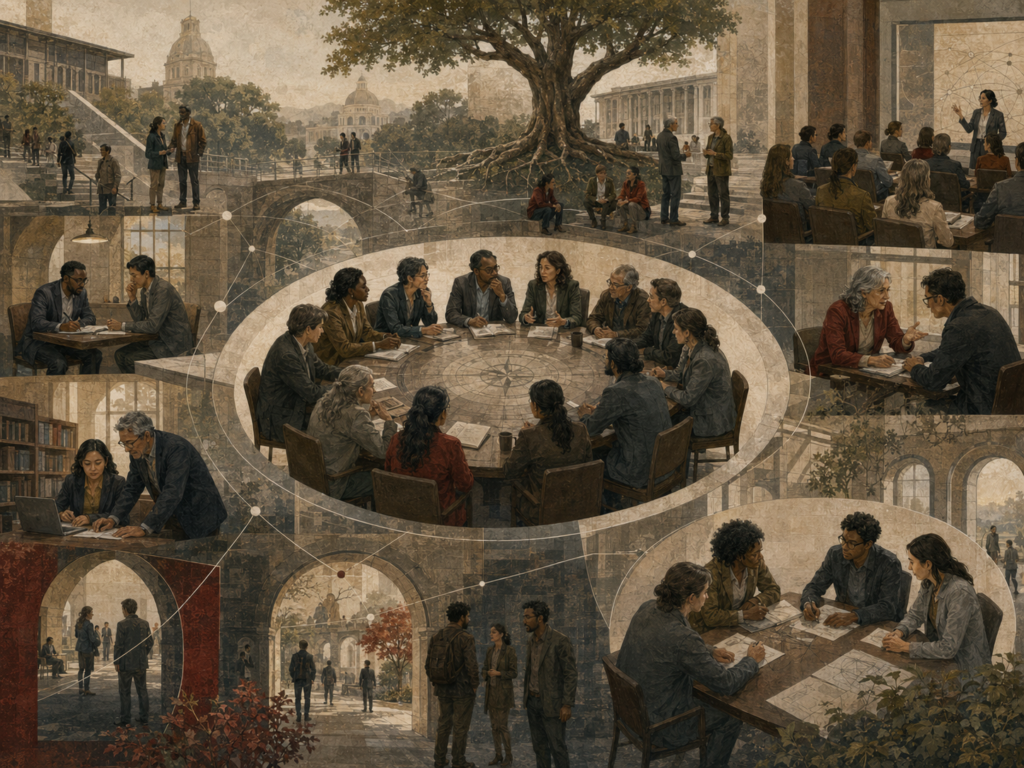
Restrained institutional illustration of leaders and teams deliberating across layered civic spaces, meeting rooms, bridges, archives, and shared organizational pathways.

Leadership in Organizational Psychology: How Influence Shapes Institutions

Leadership in organizational psychology examines how influence operates within institutions to shape interpretation, coordination, motivation, legitimacy, and collective performance. This article treats leadership not as a matter of personality alone, but as a multilevel social process through which goals are defined, norms are reinforced, uncertainty is interpreted, and coordinated action becomes possible. It surveys major theoretical traditions in leadership research, examines leadership as a process of social influence, compares transformational and transactional models, and analyzes how leadership affects engagement, culture, legitimacy, and organizational outcomes. A semi-formal model clarifies the institutional conditions that strengthen leadership capacity, while substantial R and Python sections provide practical starting points for analyzing trust, clarity, fragmentation, and organizational stability.
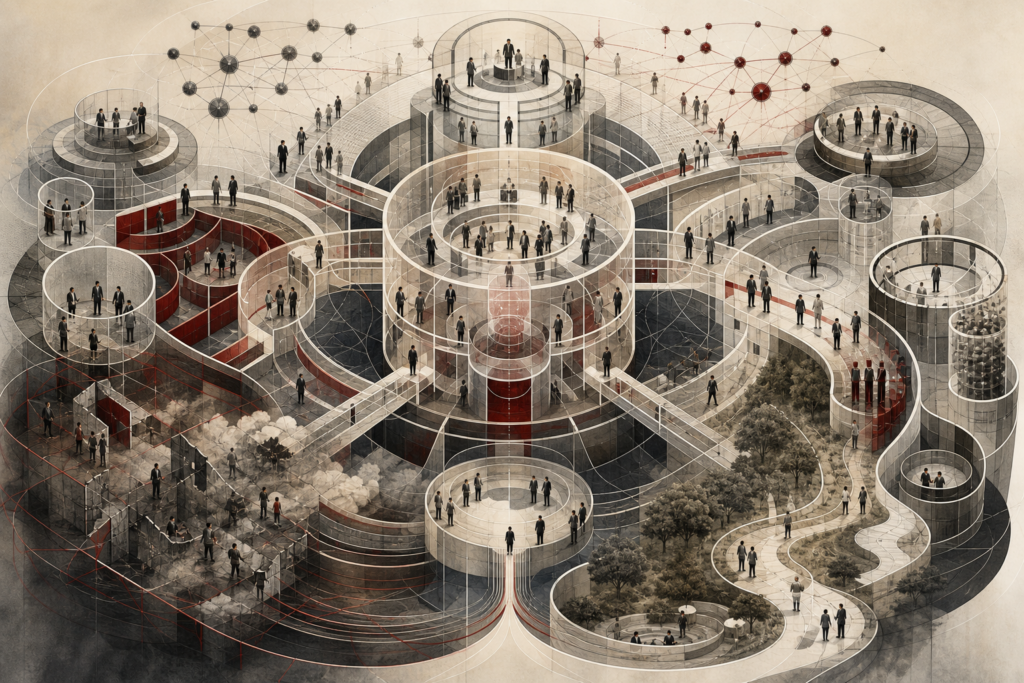
Editorial scientific illustration of organizational psychology as an institutional behavior systems architecture, showing leadership structures, team networks, communication pathways, trust systems, psychological safety, decision corridors, burnout pressure, and organizational resilience.

Organizational Psychology: How Human Behavior Shapes Work, Leadership, and Institutions

Organizational psychology examines how human behavior shapes work, leadership, teams, culture, decision-making, motivation, conflict, and institutional performance. It studies organizations not simply as charts, roles, or management structures, but as living behavioral systems shaped by perception, incentives, identity, trust, authority, communication, power, and shared meaning. This article introduces organizational psychology as a field for understanding why people cooperate, resist, lead, disengage, innovate, conform, burn out, or adapt inside formal institutions. It connects individual psychology with group dynamics, organizational design, leadership practice, and institutional outcomes, showing how workplaces become sites of both human possibility and structural constraint. A serious account of organizational psychology must therefore examine performance and productivity alongside dignity, fairness, psychological safety, accountability, and the unequal distribution of voice and power across organizational life.

Scroll to Top