Organizational Psychology

Organizational psychology studies how individuals and groups behave within organizational settings. The discipline focuses on how workplace environments, leadership structures, institutional culture, and interpersonal dynamics influence performance, motivation, and decision-making.

Research in organizational psychology examines topics such as leadership styles, team dynamics, employee engagement, organizational culture, and workplace well-being. The field integrates insights from social psychology, behavioral science, and management research to understand how institutions can design environments that support collaboration, creativity, and sustained productivity.

Organizational psychologists often apply empirical methods—including surveys, experiments, and longitudinal studies—to analyze how organizational structures influence behavior over time. The discipline plays an important role in leadership development, organizational change management, talent development, and institutional design.

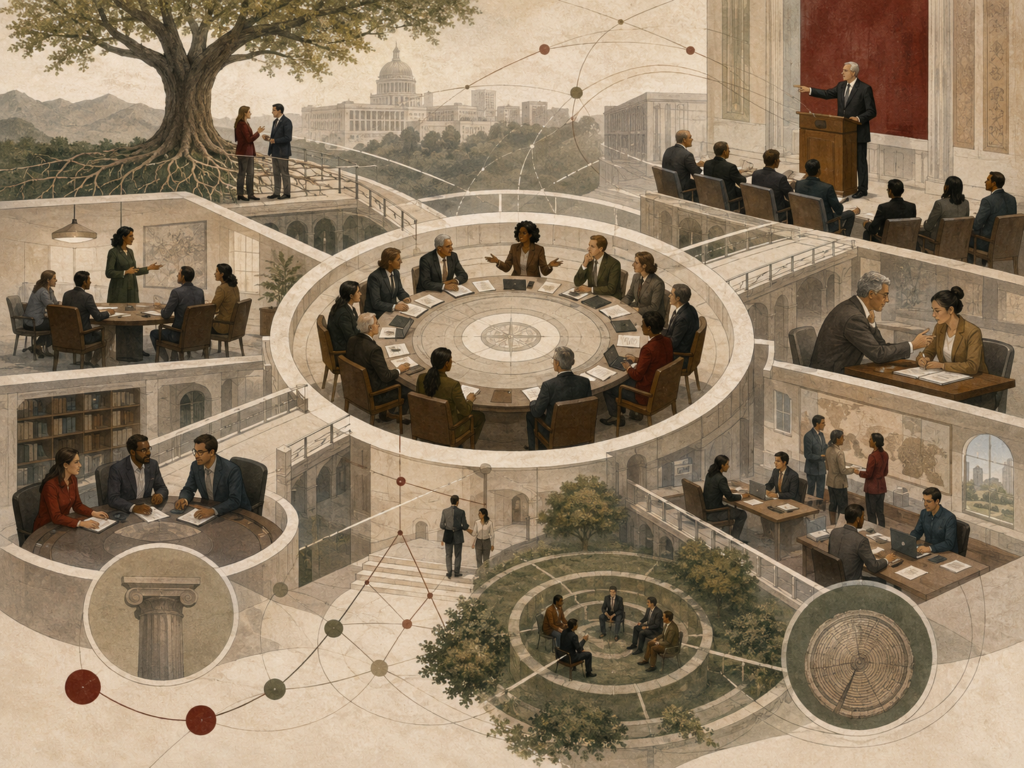
Restrained institutional illustration of workplace teams collaborating across open meeting spaces, shared tables, bridges, gardens, and connected rooms.

Trust and Cooperation in Workplace Teams: The Foundations of Collaborative Performance

Trust and cooperation are foundational relational conditions through which organizations coordinate effort, integrate expertise, and sustain collaborative performance under uncertainty. This article examines trust not as a vague interpersonal virtue, but as a structured judgment about competence, integrity, benevolence, and institutional reliability. It explores how trust supports cooperation, knowledge sharing, leadership credibility, institutional legitimacy, and team performance across complex organizations. It also considers the special challenges of maintaining trust in distributed and digitally mediated teams. A semi-formal model clarifies the determinants of cooperative capacity, while substantial R and Python sections provide practical starting points for analyzing reciprocity, opportunism risk, communication reliability, and collaborative outcomes across teams and institutions.


Restrained institutional illustration of teams collaborating across a layered organizational courtyard, with circular discussion spaces, shared worktables, bridges, archives, and open meeting rooms.

Team Dynamics in Organizations: The Psychology of Collaboration and Collective Performance

Team dynamics are the patterned processes through which individuals working interdependently become capable of coordinated collective performance. This article examines team dynamics not as simple interpersonal chemistry, but as a structured organizational phenomenon shaped by communication, trust, leadership, role clarity, psychological safety, conflict management, and shared norms of accountability. It explores how teams develop over time, how diversity and difference affect collaboration, and why effective group process is essential for integrating distributed expertise in modern institutions. A semi-formal model clarifies the conditions that support team effectiveness, while substantial R and Python sections provide practical starting points for analyzing communication quality, trust, ambiguity, and collective performance across work units.

Restrained institutional illustration of employees collaborating across a warm organizational courtyard with meeting spaces, libraries, shared tables, bridges, and a central tree.

Job Satisfaction and Organizational Commitment: Psychological Foundations of Employee Retention

Job satisfaction and organizational commitment are central concepts in organizational psychology because they explain how employees evaluate their work, how they form attachments to institutions, and why they remain engaged across longer organizational horizons. This article examines job satisfaction as a structured assessment of work experience and organizational commitment as a multidimensional bond involving affective, continuance, and normative attachment. It explores how these constructs relate to leadership, culture, fairness, trust, development, retention, and long-term organizational performance. A semi-formal model clarifies the institutional conditions that strengthen durable employee attachment, while substantial R and Python sections provide practical starting points for analyzing satisfaction, commitment, and retention risk across organizational units.

Restrained institutional illustration of teams gathered around circular planning tables, shared documents, target diagrams, workspaces, bridges, and organizational pathways.

Goal Setting and Performance Systems: The Psychology of Organizational Performance

Goal setting is one of the central mechanisms through which organizations translate strategic priorities into coordinated action, align effort, and shape how performance is interpreted. This article examines goal systems not simply as management tools, but as psychological and organizational infrastructures that govern attention, persistence, feedback, and accountability. It explores Locke and Latham’s goal-setting theory, the relationship between goals and motivation, the role of feedback and monitoring, the strategic function of cascading objectives, and the risks of metric distortion in rigid performance systems. A semi-formal model clarifies the conditions that strengthen goal system effectiveness, while substantial R and Python sections provide practical starting points for analyzing clarity, challenge, alignment, overload, and performance risk across organizational units.

Restrained institutional illustration of teams working across circular planning spaces, target diagrams, shared documents, feedback pathways, and organizational courtyards.

Incentives and Workplace Behavior: How Rewards Shape Organizational Performance

Incentives are among the most powerful institutional mechanisms organizations use to influence behavior because they shape how effort is rewarded, how performance is interpreted, and what priorities employees believe truly matter. This article examines incentives not simply as economic rewards, but as psychological and organizational systems that signal value, reinforce norms, and connect individual motivation with institutional strategy. It explores financial, social, career, and intrinsic incentives; the role of behavioral economics and self-determination theory; the risks of distortion and ethical slippage in poorly designed reward systems; and the cultural and trust-based conditions that make incentives credible. A semi-formal model clarifies the conditions that strengthen incentive effectiveness, while substantial R and Python sections provide practical starting points for analyzing fairness, expectancy, distortion risk, and behavioral performance across organizational units.

Restrained institutional illustration of employees collaborating across a layered organizational courtyard with meeting spaces, shared work areas, a central rooted tree, and subtle network pathways.

Employee Motivation in Organizations: Psychological Foundations of Work Behavior

Employee motivation refers to the psychological processes that shape the direction, intensity, quality, and persistence of effort within organizational settings. This article examines motivation not as a peripheral matter of morale, but as a central institutional mechanism through which organizations translate leadership, incentives, fairness, autonomy, and culture into actual performance. It explores major theories of motivation, including Maslow, Herzberg, expectancy theory, and self-determination theory, and shows how motivation interacts with trust, meaning, recognition, and organizational design. A semi-formal model clarifies the institutional conditions that support high-quality motivation, while substantial R and Python sections provide practical starting points for analyzing autonomy, strain, trust, and adaptive performance across organizational units.

Restrained institutional illustration of leaders, deliberation councils, civic architecture, archives, rooted trees, and advisory spaces representing authority, power, and institutional legitimacy.

Authority, Power, and Institutional Leadership: How Organizations Legitimize Influence

Authority and power are foundational concepts in organizational psychology because they explain how leadership becomes legitimate, how governance operates in practice, and why formal structure alone rarely determines institutional outcomes. This article examines authority as the legitimate right to direct behavior and power as the broader capacity to shape outcomes through expertise, information, networks, and interpretation. It explores Weber’s theory of legitimate authority, the multiple sources of informal power in organizations, the relationship between legitimacy and governance, the ethical risks of unaccountable power, and the challenges of authority in complex institutions. A semi-formal model clarifies how legitimacy, fairness, influence, and distrust interact, while substantial R and Python sections provide practical starting points for analyzing governance risk, informal power concentration, and institutional stability.

Restrained institutional illustration of leaders and teams working across council rooms, advisory spaces, civic architecture, bridges, rooted trees, and network pathways.

Leadership Styles and Organizational Performance: How Leadership Behavior Shapes Institutional Outcomes

Leadership styles are the recurring behavioral patterns through which leaders guide teams, distribute authority, structure decision-making, and shape the social climate of organizational life. This article examines leadership style not as a superficial matter of personality, but as a central organizational mechanism through which institutions translate formal authority into motivation, trust, communication, and performance. It explores major leadership styles, including authoritarian, democratic, transformational, transactional, and laissez-faire approaches, and analyzes how they affect employee motivation, organizational culture, and adaptive performance in complex institutions. A semi-formal model clarifies the institutional conditions that strengthen leadership effectiveness, while substantial R and Python sections provide practical starting points for analyzing trust, communication, control pressure, and performance risk across organizational units.

Restrained institutional illustration of leaders and teams planning transformation amid restored civic structures, scaffolding, archives, bridges, shared documents, and network pathways.

Transformational Leadership and Organizational Change: How Visionary Leaders Drive Institutional Transformation

Transformational leadership is one of the most influential concepts in modern organizational psychology because it explains how leaders mobilize individuals and institutions toward significant change by aligning motivation with shared purpose, supporting learning, and making institutional transformation psychologically credible. This article examines transformational leadership not simply as inspirational behavior, but as a broader framework for understanding how leaders reshape meaning, commitment, innovation, and adaptive performance under conditions of uncertainty. It explores the theory’s foundations in Burns and Bass, the four core dimensions of transformational leadership, its relationship to organizational change and learning, and its effects on engagement, commitment, and performance. A semi-formal model clarifies the institutional conditions that strengthen transformational leadership capacity, while substantial R and Python sections provide practical starting points for analyzing vision credibility, trust, change fatigue, and adaptive performance.

Scroll to Top