Developmental Psychology

Developmental Psychology examines the psychological traditions through which scholars have sought to understand human growth, change, and adaptation across the lifespan. In the history of psychology, the field has linked cognition, attachment, language, emotional regulation, moral development, identity formation, adulthood, aging, and developmental systems in ways that illuminate how human beings become who they are over time.

This category explores the major theories, methods, and debates of developmental psychology, including stage theories, lifespan development, developmental systems, attachment, cognitive and language development, adolescence, adult development, aging, and the interaction of genes, environment, family, culture, and institutions in shaping human growth. It considers how development is studied scientifically, how change unfolds across the life course, and how developmental inquiry contributes to wider reflection on care, plasticity, dependency, identity, and the temporal structure of human life.

Developmental psychology plays an important role in psychological and interdisciplinary inquiry because it provides one of the strongest frameworks for understanding the person as a being formed through time rather than fixed at any single moment. By engaging the field seriously, this category deepens understanding of childhood, adolescence, adulthood, aging, and the complex processes through which human capacities emerge, reorganize, and endure across the course of life.

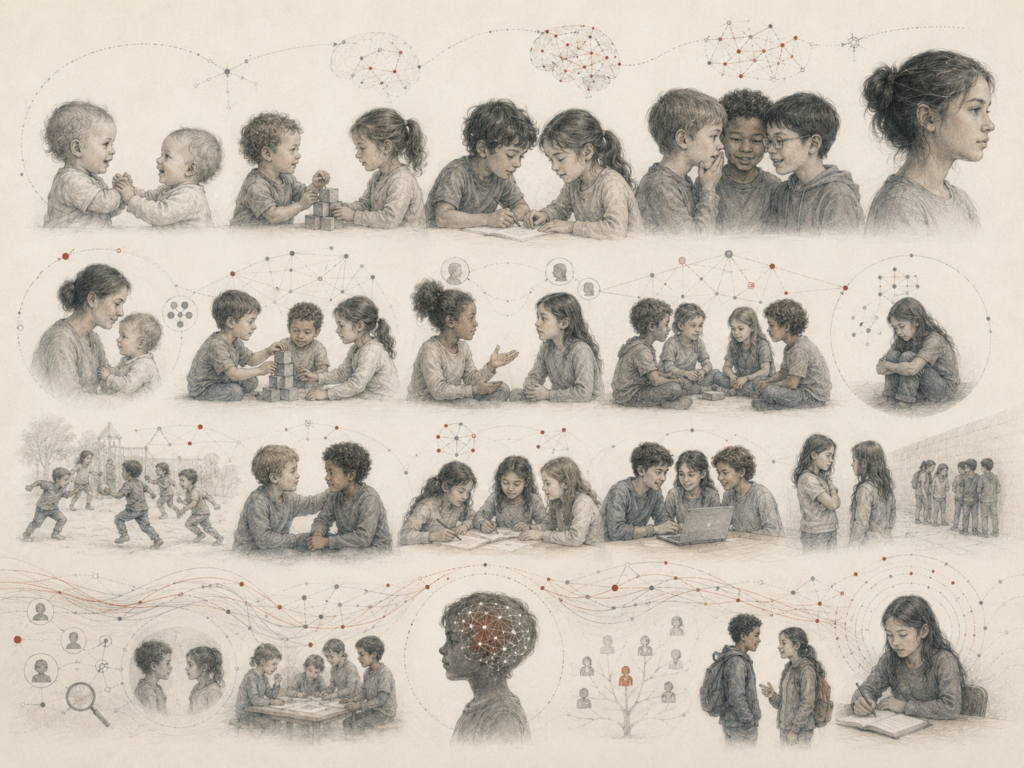
Research-grade illustration of social development across childhood and adolescence, showing peer interaction, cooperation, friendship, conflict, belonging, exclusion, and the formation of selfhood through social relationships.

Social Development, Peer Relations, and the Formation of the Self

Social development is the process through which children and adolescents learn to live with others, interpret others, belong to groups, manage conflict, form friendships, and gradually construct a sense of self through relationship and social reflection. This article examines peer relations, friendship, exclusion, school connectedness, belonging, inequality, and the formation of selfhood as parts of one developmental system. It argues that the self is not formed in isolation and then brought into social life, but shaped through recurring experiences of recognition, comparison, conflict, support, and exclusion. In that sense, social development reveals how identity, well-being, and adaptation are formed through the relational worlds children and adolescents inhabit.
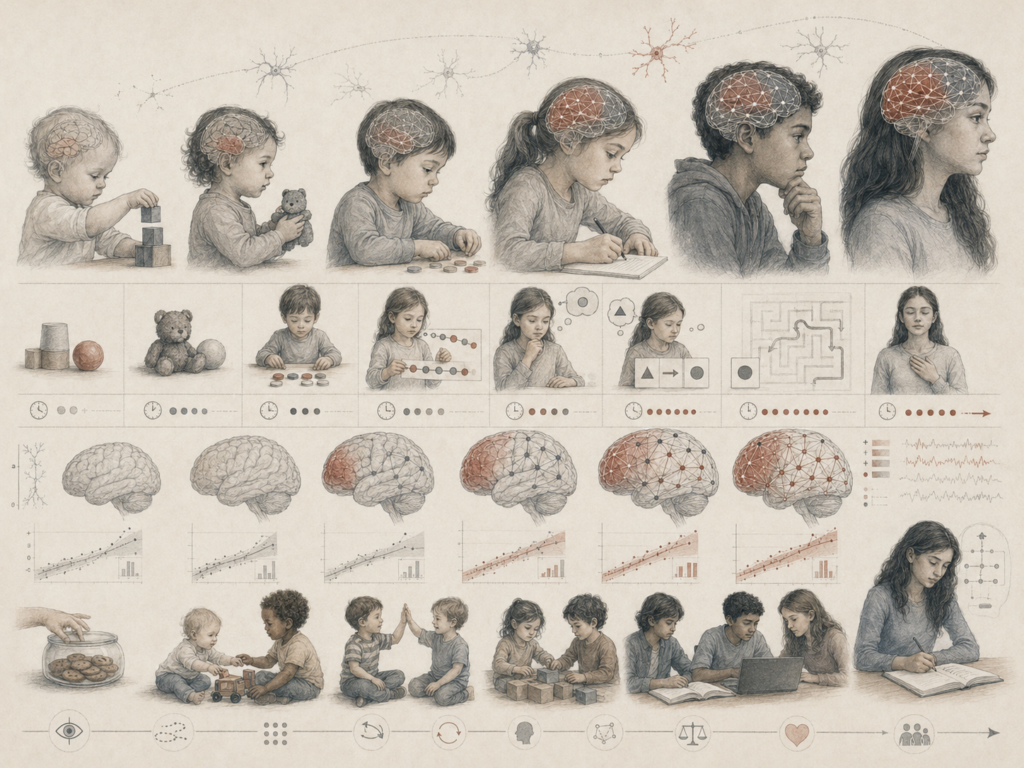
Research-grade illustration showing the development of self-regulation and executive function from early childhood through adolescence, with children at different ages, brain maturation, attention, inhibition, planning, problem-solving, and emotional regulation.

Self-Regulation and Executive Function Across Development

Self-regulation and executive function are among the most consequential developmental capacities because they shape how children and adolescents direct attention, inhibit impulses, manage emotion, hold information in mind, and act in relation to goals rather than only immediate reaction. This article examines inhibition, working memory, cognitive flexibility, co-regulation, stress, schooling, inequality, and developmental difference as parts of one developmental system. It argues that regulation is neither simple willpower nor a moral trait, but a growing capacity formed through brain development, caregiving, physiological stress, practice, and institutional context. In that sense, self-regulation reveals how children gradually become capable of governing thought, feeling, and behavior through developmental processes that are relational, cognitive, and unequal at once.

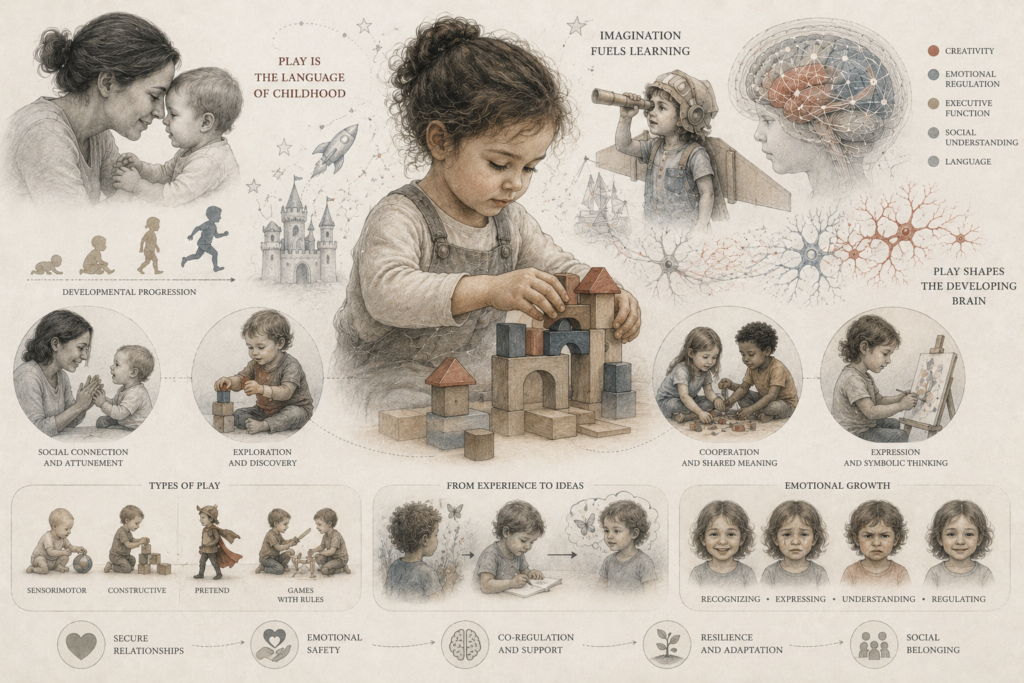
Research-grade illustration of childhood play and imagination, showing children building, pretending, exploring, creating, and interacting, with developmental brain networks and emotional, social, and cognitive growth motifs.

Play, Imagination, and Development

Play is one of the most serious forms of development because it is one of the primary ways children explore objects, roles, symbols, rules, relationships, and imagined worlds. This article examines play as a developmental mode through which cognition, emotion, language, social negotiation, and symbolic thinking grow together. Moving beyond the idea that play is merely recreation, it argues that play is a central medium of learning, regulation, and cultural participation. It also considers pretend play, peer interaction, inequality, disability, and institutional constraints, showing that play is shaped by context as well as by imagination. In that sense, play reveals how development often advances most powerfully where freedom, experimentation, and social world-making meet.

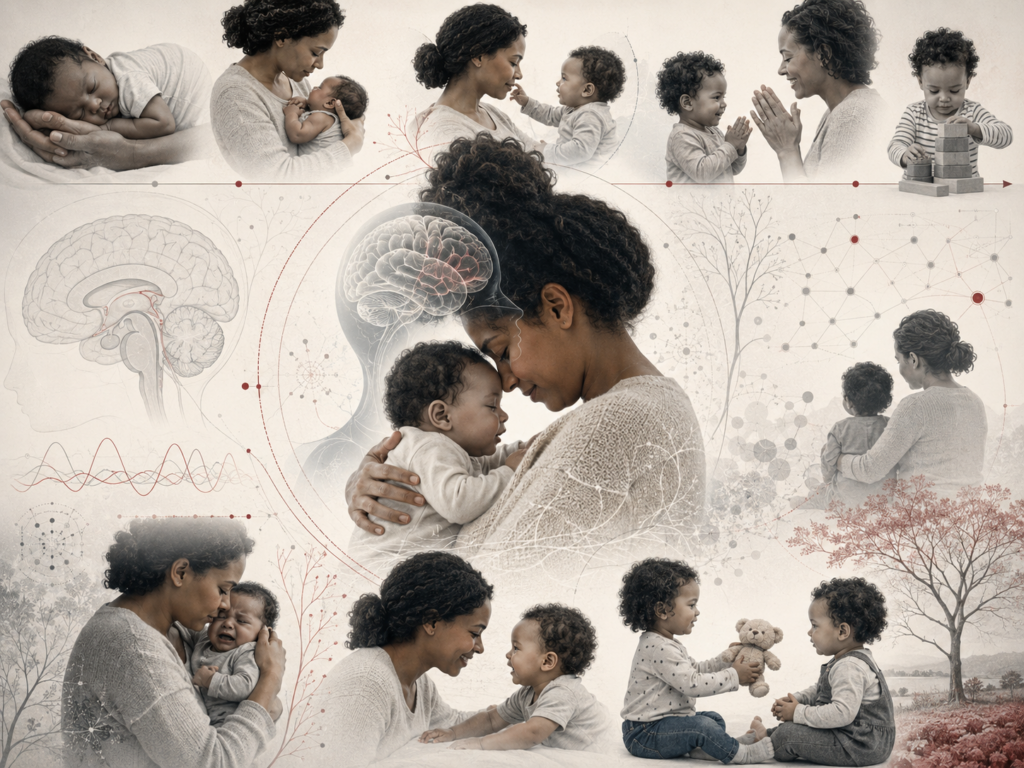
Research-grade illustration of early attachment and caregiving, showing a caregiver and infant in close contact, emotional attunement, developmental stages, neural regulation, and social bonds across early childhood.

Attachment, Caregiving, and Early Emotional Development

Attachment, caregiving, and early emotional development form a single developmental field through which infants first learn safety, distress, comfort, separation, regulation, and trust. This article examines Bowlby and Ainsworth, co-regulation, security and exploration, emotional development, cultural variation, inequality, and developmental risk as parts of one relational system. It argues that attachment is not a sentimental ideal or a total explanation of personality, but a powerful developmental process through which early emotional life is organized under conditions of dependence. In that sense, attachment reveals how human development begins in relationship and how caregiving becomes part of the architecture of mind, behavior, and feeling.

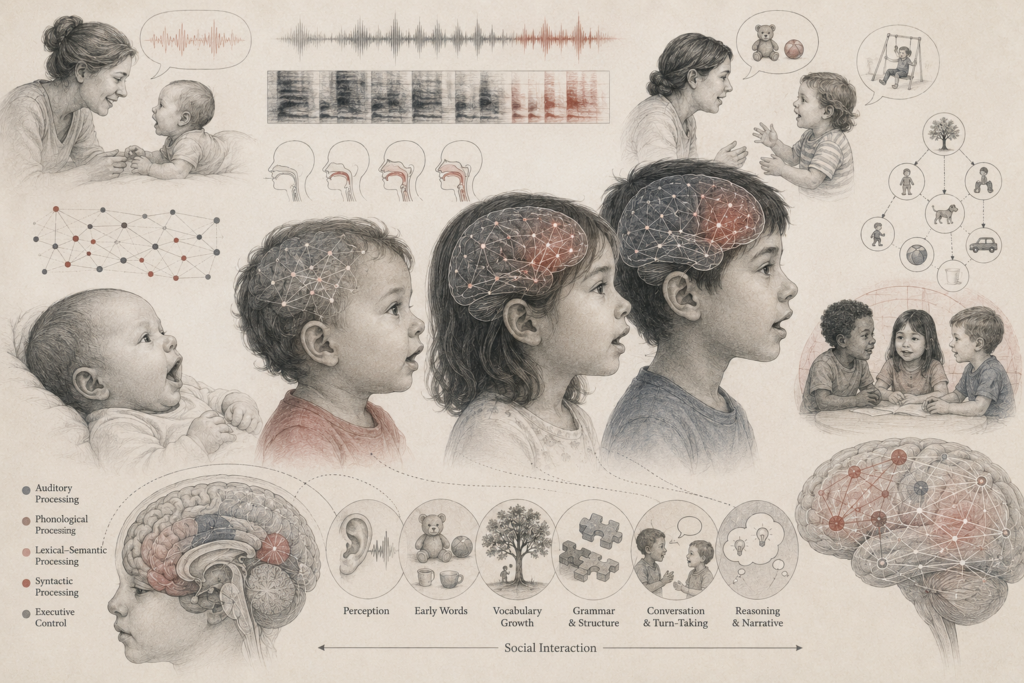
Research-grade illustration of language development showing children at different stages of speech growth, neural language networks, auditory processing, caregiver interaction, vocabulary learning, grammar, conversation, and social communication.

Language Development and the Social Formation of Speech

Language development is the social formation of speech through which children move from sound and gesture into shared meaning, conversation, memory, learning, and cultural participation. This article examines early vocalization, joint attention, caregiver turn-taking, vocabulary growth, grammar, late talking, hearing, cultural variation, and inequality as parts of one developmental process. It argues that language is not simply a skill added onto cognition, but one of the central ways mind becomes social and social life becomes thinkable. In that sense, language development reveals how speech is formed through relation, embodiment, support, hearing, and the unequal communicative worlds in which children grow.

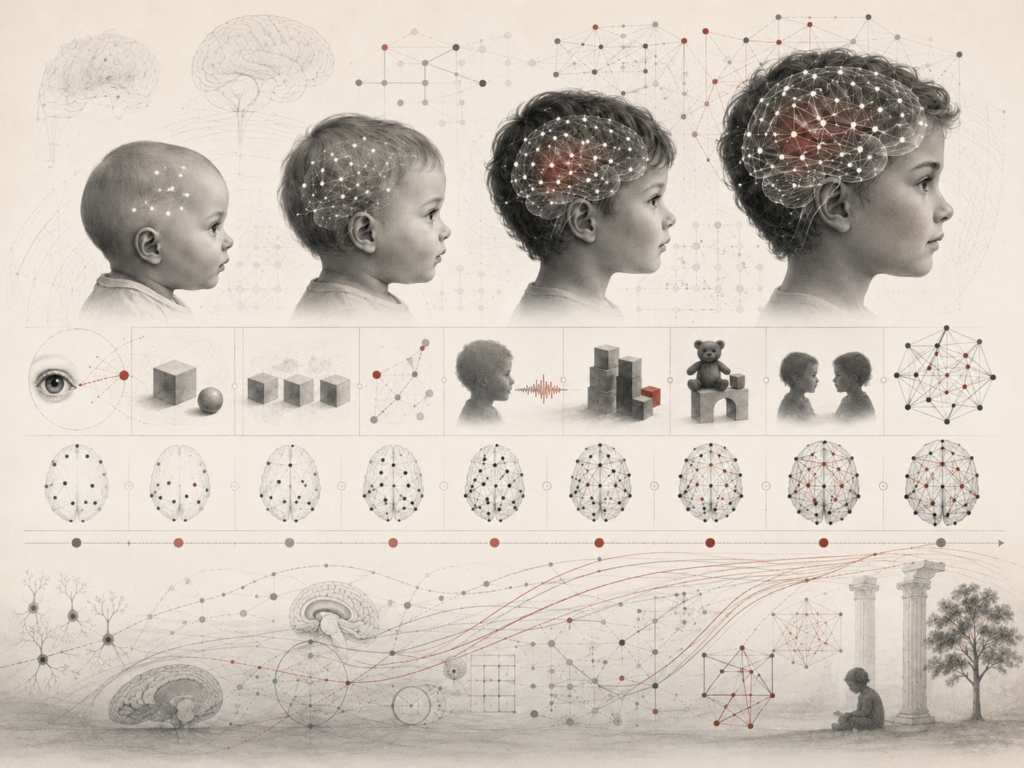
Research-grade illustration showing stages of cognitive development from infancy to childhood, with profiles of children, expanding brain networks, and visual motifs of perception, learning, language, reasoning, and social understanding.

Cognitive Development and the Growth of Mind

Cognitive development is the growth of mind as an organized human capacity: the emergence of attention, perception, memory, language, reasoning, symbolic thought, and self-regulation across development. This article examines classical theories of cognitive development, the movement from perception to representation, the roles of language and executive function, and the effects of schooling, culture, inequality, disability, and stress on cognitive pathways. It argues that cognition is not simply the accumulation of knowledge or school performance, but the development of mind itself through biological maturation, social interaction, cultural mediation, and institutional context. In that sense, cognitive development stands at the center of developmental psychology’s effort to understand how human beings come to know, think, and understand.

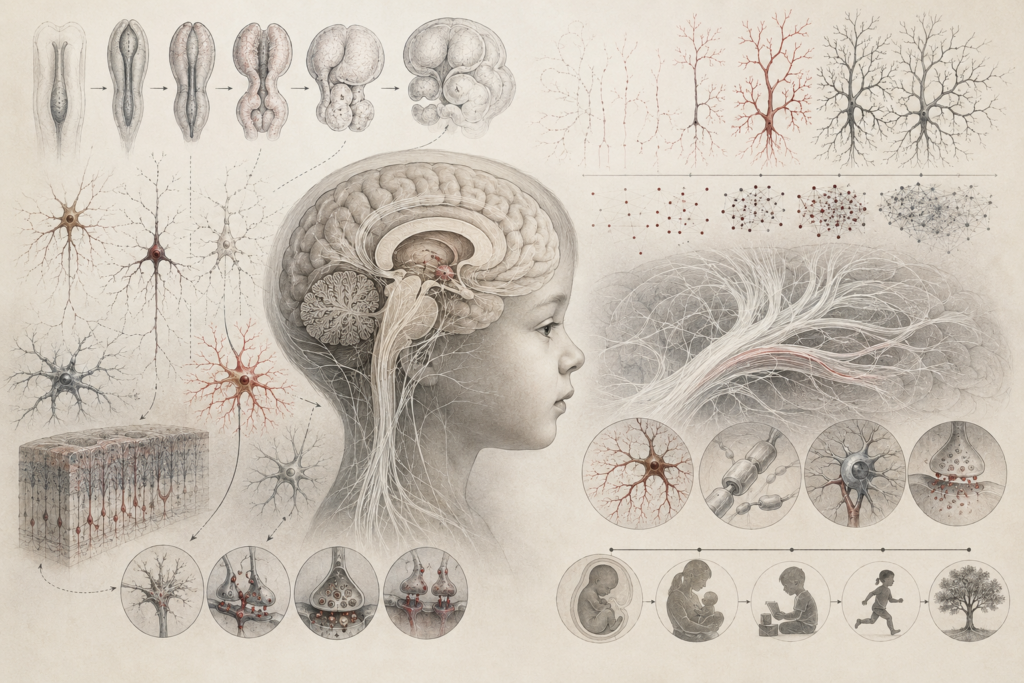
Research-grade illustration of brain development showing a child’s profile with transparent brain anatomy, embryonic neural stages, branching neurons, synaptic connections, and developmental patterns of neural plasticity.

Brain Development, Plasticity, and the Developing Nervous System

Brain development is central to developmental psychology because perception, movement, attention, learning, emotion, language, and self-regulation all emerge through a nervous system that is still developing. This article examines early brain development, neural plasticity, sensitive timing, caregiving, stress, learning, adolescence, and inequality as parts of one developmental process rather than separate biological and social stories. It argues that the developing nervous system is neither fixed destiny nor infinitely malleable. Instead, it is a plastic, structured, and context-sensitive system shaped by growth, experience, support, and adversity across time. In that sense, brain development is one of the clearest places where biology, care, environment, and developmental psychology meet.

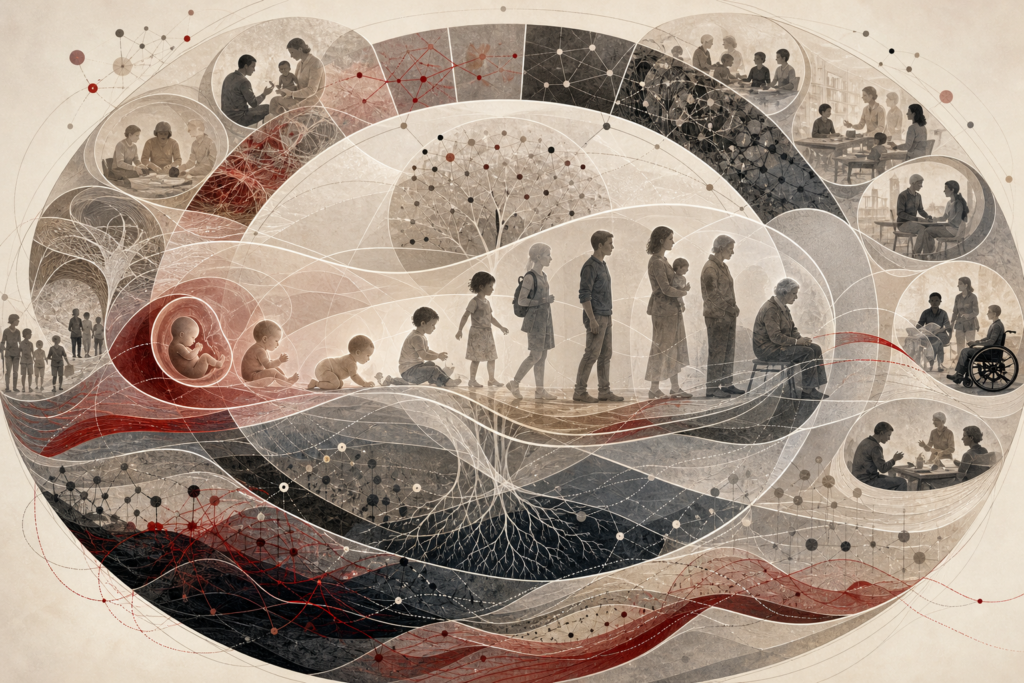
Editorial scientific illustration of developmental psychology as a lifespan systems architecture, showing prenatal life, infancy, childhood, adolescence, adulthood, aging, caregiving, education, disability inclusion, family systems, resilience pathways, and life-course development.

Developmental Psychology: Growth, Change, and Human Development Across the Lifespan

Developmental psychology examines how human beings grow, change, adapt, and age across the lifespan. This expanded pillar strengthens the field in the strongest sense by integrating prenatal development, temperament, brain development, attachment, schooling, psychopathology, culture, inequality, disability, neurodivergence, adulthood, aging, and developmental methods into a single lifespan framework. It also upgrades the page with a mathematical lens, a semi-formal conceptual model, and substantial R and Python sections for readers interested in modeling developmental context, cumulative risk, adaptation, and life-course divergence. The result is a broader, more research-driven map of development as the socially and historically situated formation of human capacities across time.

Scroll to Top