
Last Updated May 21, 2026
Social development is the developmental process through which human beings learn to live with others, become legible to others, interpret others, and gradually form a sense of self through relationship, recognition, conflict, comparison, belonging, exclusion, and participation in shared worlds. It is not a secondary layer added after cognition, language, attachment, or emotional life. It is one of the central conditions through which those capacities become organized. Infants begin life in radical dependence on caregivers. Children move into peer worlds structured by play, cooperation, rivalry, imitation, fairness, humor, and conflict. Adolescents confront intensified questions of status, intimacy, identity, visibility, reputation, sexuality, and social meaning. Across the life course, the self is not simply discovered inside the individual. It is formed through relation.
Developmental psychology has often studied social development through attachment, peer interaction, friendship, aggression, bullying, school connectedness, social cognition, identity, and prosocial behavior. Yet these topics all point toward a deeper claim: human development is relational at its core. A child does not first become an individual and then enter society. The child becomes an individual through repeated encounters with caregivers, siblings, peers, teachers, neighbors, institutions, digital publics, cultural expectations, and histories of inclusion or exclusion. Social development is therefore a theory of human becoming, not just a list of interpersonal skills.
Main Library
Publications
Article Map
Developmental Psychology
Related Topic
Social Psychology
Related Topic
Cognitive Psychology
Related Topic
Risk & Resilience
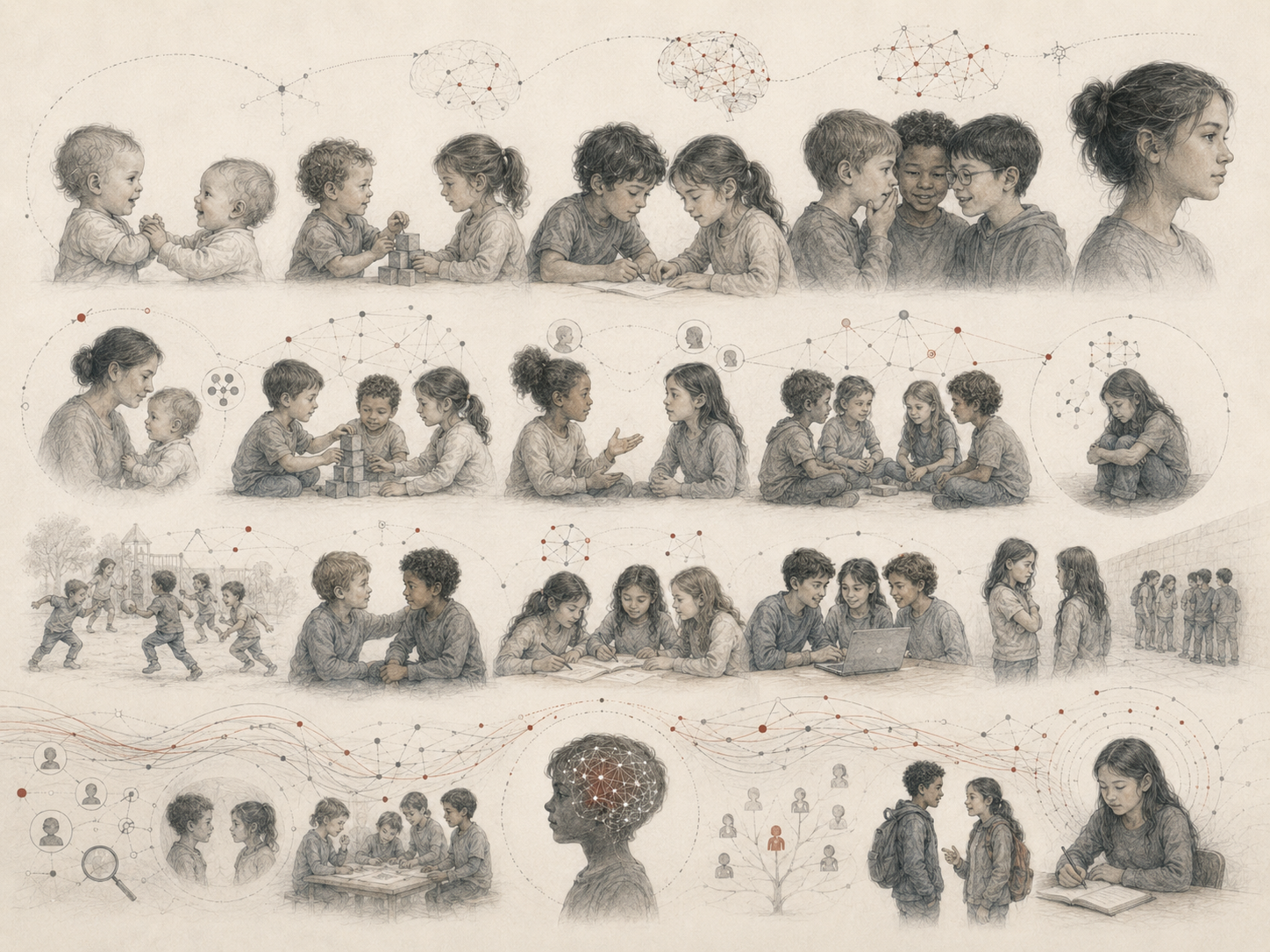
Peer relations occupy a special place in this process because peers are not simply smaller versions of caregivers, teachers, or authority figures. Peer worlds create distinct developmental conditions. Among peers, children negotiate friendship, conflict, humor, reciprocity, competition, popularity, rejection, group belonging, and social comparison. These experiences shape not only social skill but selfhood. A child comes to understand who they are partly through the reflected responses of others: whether they are welcomed, ignored, admired, teased, copied, excluded, trusted, feared, protected, or loved.
This article treats social development as a developmental systems problem: a process formed through the interaction of caregiving, peer relations, school culture, social cognition, belonging, exclusion, cultural norms, digital visibility, disability access, inequality, and institutional design. It asks how children and adolescents learn to participate in social worlds, how peer relations shape identity, how belonging protects development, how exclusion can become developmental harm, and how the self emerges through repeated social recognition and misrecognition.
Why Social Development Matters
Social development matters because human flourishing depends on more than private cognition, temperament, language, or individual achievement. Children develop in relation to families, peers, schools, neighborhoods, communities, cultures, and institutions that teach them what interaction feels like and what kinds of selves are possible. A child does not merely learn facts and motor skills. The child also learns turn-taking, imitation, empathy, rivalry, secrecy, loyalty, shame, humor, trust, competition, role expectation, and the emotional reality of being recognized by others.
Social development is central because the human self is relationally formed. People learn who they are through care, mirroring, comparison, conflict, praise, exclusion, intimacy, authority, and participation. A young child may first understand the self as someone who is comforted, called by name, corrected, watched, smiled at, or refused. Later, the child begins to understand the self through friendships, group roles, school classifications, peer reputation, family expectations, language, gendered norms, cultural belonging, and social comparison. The “I” develops in a world of “we,” “you,” and “they.”
This is why peer relations deserve sustained attention. Family relationships remain foundational, but peer life introduces new developmental pressures and possibilities. Peers are often less forgiving than caregivers, less formally structured than teachers, and more consequential than adults sometimes assume. Through peer interaction, children learn not only how to cooperate or compete, but also what kinds of personhood are rewarded, ignored, mocked, admired, or stigmatized in their social world.
Social development also matters because belonging is developmental infrastructure. Children who feel socially connected are often better able to take learning risks, recover from stress, participate in school, regulate emotion, and imagine themselves as valued. Children who experience chronic exclusion, humiliation, or rejection may develop vigilance, shame, withdrawal, aggression, distrust, or an unstable sense of self. Social experience is not merely emotional background. It can become developmental direction.
The field also matters ethically. If the self is formed through social recognition, then exclusion and humiliation are not trivial childhood events. They can shape identity, confidence, trust, moral development, school engagement, and mental health. Social development forces developmental psychology to ask not only whether a child has social skills, but whether the child lives in social worlds that make dignity, belonging, and participation possible.
What Social Development Is
Social development refers to the growth of capacities involved in interacting with others and participating in shared social life. It includes attachment, imitation, joint attention, emotional reciprocity, social communication, perspective-taking, empathy, friendship, cooperation, conflict management, group belonging, moral relation, and the ability to interpret rules, roles, expectations, and intentions. It also includes how individuals learn to position themselves within a social field: how they understand status, intimacy, fairness, reputation, similarity, difference, and identity in relation to others.
This broader framing matters because social development is often reduced to simple sociability or friendliness. A quiet child is not necessarily socially underdeveloped, and an outgoing child is not automatically socially competent. Social development concerns the structure and quality of relation, not just frequency of interaction. It includes how children manage closeness and distance, how they respond to rejection, how they interpret others’ intentions, how they repair conflict, how they read power, and how they learn to belong without losing individuality.
Social development also involves the ability to interpret social meaning. Children gradually learn that behavior has different meanings depending on context: a joke can be playful or cruel; silence can signal shyness, anger, exclusion, respect, or fear; sharing can be generous, strategic, coerced, or expected; imitation can be admiration or mockery; a rule can be fair, arbitrary, protective, or humiliating. Social development therefore requires interpretation, not just interaction.
The field includes both prosocial and conflictual experience. Cooperation, helping, empathy, friendship, and care are central. But so are rivalry, anger, jealousy, exclusion, betrayal, status competition, group loyalty, and repair after harm. A developmental psychology that studies only positive social behavior misses the full complexity of how children become social beings. Conflict is often one of the contexts in which social understanding becomes more sophisticated.
Social development is also inseparable from power. Children do not enter neutral peer worlds. They enter groups shaped by language, appearance, ability, race, class, gender norms, disability, migration status, body size, religion, sexuality, and institutional rules. Who is included, protected, mocked, followed, feared, or ignored is often shaped by larger hierarchies. Developmental psychology must therefore treat social development as both interpersonal and structural.
From Attachment to Peer Worlds
Early social development begins in relationship with caregivers. Infants first encounter social life through dependence, regulation, touch, voice, gaze, rhythm, feeding, soothing, and response. Attachment and caregiving shape the earliest expectations of comfort, safety, emotional reciprocity, and social predictability. Long before children can explain relationships, they learn whether distress is answered, whether exploration is supported, whether others are available, and whether the self can rely on care.
Yet development does not remain in the caregiver-child dyad. As children grow, they move outward into sibling relations, extended family networks, playgroups, childcare settings, classrooms, neighborhoods, religious communities, recreational spaces, and digital environments. These expanding social worlds require new forms of participation. The child who once relied primarily on adult regulation must learn how to enter play, share attention, negotiate rules, read peer cues, tolerate disappointment, and recover from social mistakes.
This transition matters because peer relations are not simply secondary copies of caregiver relations. Peer worlds involve more symmetry, more social comparison, more instability, and more active negotiation. Caregivers usually have obligations to the child. Peers do not relate under the same obligation. A caregiver may comfort repeatedly; a peer may walk away. A teacher may assign groups; children still determine who is truly welcomed. A parent may insist that everyone be included; a peer group can enforce belonging through subtle signals of acceptance or rejection.
Attachment still matters in peer life, but it does not determine it mechanically. A child with secure early relationships may enter peer worlds with confidence, but peer rejection can still harm. A child with early relational adversity may still find friendship, mentorship, group belonging, or school connectedness that redirects social development. Developmental pathways are probabilistic, not fixed.
The movement from attachment to peer worlds is therefore not a replacement of one social system by another. It is an expansion. Early care provides one relational foundation; peer life adds new demands of reciprocity, negotiation, fairness, reputation, conflict, belonging, and self-presentation. Social development grows through this widening ecology of relation.
Peer Relations as a Developmental System
Peer relations are developmental because they create recurring conditions under which children practice, fail, revise, and expand social capacities. Peers are co-learners in cooperation, conflict, language, norm enforcement, role experimentation, humor, group identification, and mutual influence. Friendship, rivalry, imitation, admiration, teasing, loyalty, and exclusion are not incidental by-products of childhood. They are developmental processes through which children learn how other people matter and how the self appears in a shared social field.
Peer systems have their own norms. A classroom, playground, sports team, online group, neighborhood cluster, or adolescent friend circle may reward humor, athleticism, toughness, kindness, academic skill, style, rebellion, conformity, creativity, risk-taking, or loyalty. Children quickly learn what is valued and what is dangerous in a group. They may adjust speech, clothing, interests, posture, emotional expression, or behavior to fit the group’s expectations. This adaptation can support belonging, but it can also narrow the self.
Peer relations also influence how children function at home and in school. A child who feels socially secure may take more risks in learning, recover more quickly from stress, and develop stronger self-confidence. A child who experiences chronic rejection, humiliation, or instability in peer life may become more vigilant, withdrawn, aggressive, or ashamed. Peer experience therefore belongs not only to social psychology in the narrow sense, but to developmental psychology as a key pathway through which adaptation and maladaptation unfold over time.
Peer groups can also serve as moral communities. Children learn fairness, loyalty, betrayal, apology, restitution, and courage in relation to peers. They learn whether to defend someone who is excluded, whether to join a joke that becomes cruel, whether to confess wrongdoing, whether to keep a friend’s secret, whether to resist group pressure, and whether friendship requires honesty or compliance. Peer relations are thus tied to moral development, identity, self-regulation, and social cognition.
Peer worlds are developmental systems because they involve repeated feedback. A child who is included may become more confident, which increases participation, which leads to more inclusion. A child who is rejected may withdraw, become anxious, or act aggressively, which may intensify rejection. These loops are not inevitable, but they show why peer experience can become cumulative. Social development is not a series of isolated interactions. It is a patterned history of recognition, misrecognition, participation, and feedback.
Friendship, Conflict, Belonging, and Exclusion
Friendship is one of the most developmentally significant forms of peer relation because it introduces repeated, emotionally meaningful, and partly chosen ties outside the family. Through friendship, children learn trust, loyalty, shared attention, disclosure, reciprocity, humor, repair, and the pleasure of being known. Friends can buffer stress, support exploration, protect against loneliness, and help stabilize the social self.
Friendship also creates new developmental risks. Jealousy, betrayal, imbalance, dependency, status conflict, secrecy, and fear of replacement can all appear within friendship. These experiences are not signs that friendship has failed. They are part of why friendship is developmentally powerful. Children learn that close relationships involve vulnerability. They learn that trust can be broken and repaired, that loyalty can conflict with fairness, that closeness can coexist with anger, and that the same person can be a source of comfort and hurt.
Conflict is not evidence that social development has failed. Conflict can be one of its main engines. Through disagreement and repair, children learn negotiation, perspective-taking, rule coordination, emotional restraint, apology, and the difference between transient frustration and relational rupture. A child who never experiences conflict may have fewer opportunities to learn repair. The developmental question is not whether conflict occurs, but whether children have the support and social context to interpret and resolve it.
Belonging is different from mere presence. A child can be physically included in a classroom or group but still feel socially peripheral. Belonging means being recognized as a legitimate participant. It involves being expected, missed, called on, invited, trusted, and allowed to matter. Belonging can protect development because it gives children a social base from which to explore, learn, and take risks.
Exclusion, however, can become developmental harm when it is chronic, humiliating, or identity-based. Repeated rejection can reorganize self-understanding. A child may begin to believe that they are unwanted, strange, defective, annoying, unlovable, or unsafe among others. Exclusion can also produce anger, vigilance, shame, or distrust. Developmental psychology must therefore distinguish ordinary disappointment from patterned social injury. Belonging and exclusion are not just feelings. They are developmental experiences that can shape the emerging self’s sense of worth, competence, and social safety.
Social Cognition, Perspective-Taking, and the Interpretation of Others
Social development depends on the ability to interpret others. Children gradually learn that other people have thoughts, feelings, intentions, beliefs, desires, fears, secrets, misunderstandings, and perspectives that may differ from their own. This growth in social cognition transforms peer relations. A child who can imagine another person’s perspective can cooperate more effectively, comfort more intentionally, negotiate more flexibly, and understand conflict more deeply.
Perspective-taking is not only cognitive. It is relational and emotional. A child may know that another person has a different belief but still fail to care. Another child may feel another’s distress before being able to explain it. Mature social development requires a coordination of interpretation and concern: understanding what another person might think or feel, and recognizing that this matters for action.
Children also learn to interpret ambiguity. Was a shove accidental or hostile? Was laughter friendly or mocking? Was silence rejection or distraction? Was exclusion intentional or circumstantial? These interpretations matter because they guide response. A child who habitually interprets ambiguous cues as hostile may respond aggressively. A child who habitually blames themselves may withdraw. A child who can pause, ask, clarify, and repair has more social options.
Social cognition also develops through error. Children misread others often. They assume motives, miss cues, overgeneralize, or project their own feelings. Peer life gives repeated feedback on these interpretations. A friend may say, “I wasn’t mad,” “That hurt,” “I was joking,” or “I didn’t mean it.” These corrections help refine social understanding when they happen in contexts where repair is possible.
Yet perspective-taking is not equally supported for all children. Neurodivergent children, multilingual children, children with communication differences, disabled children, traumatized children, and children from marginalized cultural groups may be misread by peers and adults. Social cognition is not only a capacity inside the child. It is also a reciprocal process: children interpret others, and others interpret them. A developmental psychology of social cognition must therefore include misrecognition as well as recognition.
The Formation of the Self Through Social Life
The self is formed socially because people come to know themselves partly through being known, misrecognized, included, corrected, praised, mocked, mirrored, and resisted by others. Developmental psychology often speaks of self-concept, self-esteem, identity, and self-regulation, but these are not produced in isolation. They are organized through repeated social encounters. A child discovers what kinds of speech, emotion, behavior, appearance, intelligence, humor, ability, or vulnerability are legible and valued within particular groups.
This means the self is both personal and relational. It is not merely imposed from outside, but neither is it an inner essence untouched by relation. The child who is consistently treated as competent, kind, funny, strange, annoying, gifted, immature, threatening, helpless, disruptive, or invisible may gradually organize some version of selfhood around those social responses. Peer life therefore participates in identity formation long before adolescence makes identity an explicit developmental theme.
The social formation of the self includes both recognition and resistance. Children do not simply absorb labels. They may reject, reinterpret, or contest how others see them. A child labeled shy may find voice in a trusted friendship. A child labeled difficult may become cooperative in a different classroom. A child excluded in one peer group may become valued in another. A child underestimated because of disability, language, or race may develop a strong counter-identity. Social development includes the struggle over who one is allowed to be.
Selfhood also develops through role experimentation. Children try out identities in play, friendship, schoolwork, humor, clothing, language, group affiliation, moral action, and imagination. They learn what it feels like to lead, follow, care, compete, apologize, perform, hide, defend, resist, and belong. These roles are not superficial masks. They are developmental experiments through which children discover possible selves.
The social world does not only surround the self. It helps constitute it. This is why peer relations, school culture, family recognition, and institutional treatment are central to developmental psychology. To understand a person developmentally, one must ask not only what traits they possess, but what social mirrors have reflected them back to themselves.
School, Culture, and Institutional Social Development
Schools are among the most important institutional settings for social development because they structure peer contact, rule systems, authority relations, competition, recognition, discipline, and belonging. Children do not merely acquire academic content there. They also learn how groups work, how adults classify them, how peers sort one another, and how institutional cultures reward or punish different forms of behavior. School is a social world before it is only an instructional site.
School connectedness matters because students who feel connected to school are more likely to experience school as a place of recognition rather than exposure. Connectedness can arise through trusted teachers, stable friendships, meaningful participation, fair discipline, extracurricular belonging, cultural recognition, disability accommodation, and protection from harassment. It is not merely a student attitude. It reflects institutional design.
School culture teaches children what kinds of social behavior are valued. Some schools reward competition and individual performance. Others foreground cooperation, restorative practice, civic participation, or collective care. Some tolerate bullying as a normal rite of passage. Others treat exclusion as a serious developmental harm. Some schools protect vulnerable students. Others make vulnerability visible without support. These institutional patterns shape social development by shaping what children can expect from groups and authority.
Schools also classify children. Labels such as advanced, behind, disruptive, popular, shy, gifted, disabled, English learner, athlete, troublemaker, leader, or outsider can become socially consequential. Some classifications provide needed support. Others become stigmatizing identities. Developmental psychology must therefore examine how institutional categories interact with peer worlds. A label given by adults can become a social identity among children.
Culture matters just as deeply. Social competence is not a universal script detached from context. Different communities vary in how they value assertiveness, deference, emotional display, independence, group loyalty, humor, competition, intimacy, restraint, and respect. A child’s peer style may be interpreted differently across settings. Developmental psychology must resist treating one dominant social style as the neutral endpoint of healthy development. Social development always takes place within culturally shaped norms of relation and recognition.
Inequality, Bullying, Rejection, and Social Risk
Peer life is not separate from inequality. Class, race, disability, gender norms, language background, body size, migration status, religion, sexuality, and institutional bias affect who is protected, who is targeted, who is read as socially acceptable, and who is treated as deviant or disposable. Bullying, ostracism, and chronic rejection are not just interpersonal problems between children. They often reflect larger social hierarchies and institutional failures.
Developmental risk here is not simply that a child feels bad. Sustained exclusion or humiliation can reorganize trust, self-worth, and participation in schooling and community life. A child who is bullied may become less willing to speak, less willing to try, less willing to trust adults, or less able to imagine school as a safe place. A child who is repeatedly targeted for disability, race, language, gender expression, body size, poverty, or religion may learn that social life is structured by danger rather than possibility.
Bullying also teaches bystanders. Children who watch cruelty without intervention learn something about power, fear, and belonging. They may learn that safety depends on silence, that group membership requires complicity, or that adults will not protect the vulnerable. Bullying is therefore not only a relationship between aggressor and target. It is a group and institutional event that shapes the moral and social climate for everyone present.
Rejection can also produce developmental feedback loops. A child who is excluded may withdraw or become defensive. Withdrawal may make it harder to form new friendships. Defensive behavior may be interpreted as aggression. Aggression may lead to further rejection. These loops can be interrupted, but they show why social risk becomes developmental. Peer experience can accumulate into a pattern.
At the same time, connectedness can buffer risk. Feeling connected to family, school, peers, and community can protect against some adverse outcomes. This does not erase material inequality, but it shows that social ties can function as developmental resources. Developmental psychology is strongest when it studies both sides of the equation: the harms of exclusion and the protective force of meaningful belonging.
Disability, Neurodivergence, and Social Development
Disability and neurodivergence must be central to any serious account of social development. Too often, social development is measured against narrow expectations of eye contact, conversational timing, facial expressiveness, group participation, body stillness, verbal fluency, or peer conformity. These expectations can misread disabled and neurodivergent children by treating difference as social failure. A child may communicate differently, regulate differently, play differently, or seek connection differently without lacking social meaning.
Autistic children, children with ADHD, children with language disabilities, children with intellectual disabilities, children with sensory processing differences, children with mobility disabilities, and children with chronic illness may all experience peer worlds differently. Some may be excluded because their communication style is misunderstood. Some may be overwhelmed by noise, touch, crowding, or unpredictable group behavior. Some may require assistive technology, accessible play structures, communication support, or adult facilitation to participate fully. These are not peripheral accommodations. They are conditions of social development.
Social development is reciprocal. It is not only the disabled or neurodivergent child who must learn social norms. Peers and institutions must learn how to include, interpret, and adapt. When a classroom treats one child’s difference as a problem for that child alone, it misses the developmental task facing the whole social group. Inclusion is not merely placement in the same room. It is the creation of conditions where participation is possible and dignity is protected.
Neurodivergent social development may also include distinctive strengths: intense loyalty, honesty, deep focus, strong justice sensitivity, original forms of play, careful observation, or nonstandard but meaningful modes of connection. These strengths can be obscured when social competence is defined too narrowly. A serious developmental psychology should distinguish between support needs, social difference, and institutional failure.
Disability and neurodivergence also reveal the limits of simplistic peer-skills models. Teaching a child how to act more typically is not the same as creating a social world in which the child can belong. Social development requires mutual adaptation. It asks how children learn to recognize difference, share space, communicate across variation, protect one another from ridicule, and build forms of belonging that do not depend on sameness.
Culture, Language, and Social Competence
Social competence is culturally organized. Children do not learn one universal way of being social. They learn ways of greeting, listening, interrupting, joking, disagreeing, helping, apologizing, respecting elders, managing eye contact, expressing emotion, sharing space, and participating in groups within particular cultural and linguistic worlds. What one setting reads as confidence, another may read as disrespect. What one setting reads as shyness, another may read as restraint or respect.
Language is central to this process, but social development is not limited to verbal fluency. Children learn pragmatic language: when to speak, how to take turns, how to repair misunderstanding, how to signal joking, how to refuse, how to apologize, how to request help, and how to shift register across home, school, peer, and public settings. Multilingual children may move between social worlds with different rules of politeness, humor, intimacy, and authority. Their social competence may be broader than a monolingual school measure can capture.
Cultural variation also shapes peer relations. Some children are socialized toward independence and self-expression; others toward interdependence, respect, and group responsibility. Some groups value public verbal performance; others value observation and gradual participation. Some children learn through adult-directed interaction; others learn through sibling care, mixed-age play, religious community, work contribution, or neighborhood networks. Developmental psychology must avoid treating one social style as the standard against which all others are measured.
Misrecognition occurs when institutions interpret cultural difference as deficiency. A child who does not challenge an adult may be seen as passive. A child who speaks directly may be seen as rude. A child who translates for family members may be seen only as burdened rather than also socially skilled. A child who moves between home language and school language may be underestimated because competence is divided across contexts. Social development must therefore be assessed with cultural humility.
A rigorous account of social development asks not only whether children can participate, but where, with whom, under what language conditions, and according to whose norms. Social competence is not a neutral endpoint. It is always shaped by the worlds in which participation is expected and recognized.
Adolescence, Identity, Status, and Social Reflection
Adolescence intensifies social development because peer evaluation, status, intimacy, and identity become more salient. The adolescent does not merely have more peers than the young child. Peer worlds become more interpretively powerful. Friendship becomes more emotionally dense, group belonging can become more consequential, and public image or social comparison may become more central to self-understanding. This is one reason social development and identity development are so tightly linked in adolescence.
Status also matters more visibly. Popularity, exclusion, attraction, subcultural belonging, athletic recognition, academic reputation, style, humor, and digital visibility can all shape how adolescents interpret themselves and others. Status can create confidence, opportunity, and belonging, but it can also create anxiety, conformity, cruelty, and fear of social loss. Adolescents may become more self-conscious not because they are shallow, but because the social world increasingly reflects the self back through reputation and comparison.
Friendship in adolescence often becomes more intimate and identity-forming. Adolescents may disclose fears, desires, beliefs, family struggles, sexuality, moral commitments, and future dreams to friends before they can speak them elsewhere. Friendships can become spaces of recognition where adolescents test possible selves. They can also become spaces of surveillance, jealousy, dependency, or pressure. The same closeness that supports identity can intensify vulnerability.
Adolescence also brings stronger capacity for social reflection. Young people become more able to think about group norms, injustice, hypocrisy, status hierarchies, and the difference between belonging and conformity. They may ask whether a group accepts them as they are or only as they perform. They may begin to resist peer cruelty, defend marginalized classmates, reject inherited prejudices, or seek communities organized around shared values rather than proximity alone.
A full developmental account must therefore avoid treating adolescent peer life as merely dangerous or superficial. It is a major domain in which selves are revised, defended, expanded, and tested. Adolescence is socially intense because identity is being reorganized in public and semi-public worlds where recognition matters deeply.
Digital Peer Worlds and Networked Selfhood
Digital environments have become major sites of social development. Children and adolescents now negotiate belonging, exclusion, friendship, reputation, humor, conflict, social comparison, visibility, privacy, and identity through group chats, games, social platforms, video communities, messaging apps, and algorithmic feeds. Digital life is not separate from “real” peer life. It is one of the environments in which peer life now unfolds.
Digital peer worlds can support connection. They can help isolated young people find communities of interest, disability affinity, cultural belonging, creative expression, identity exploration, and social support. A child who feels peripheral in one local peer world may find recognition in another networked space. Adolescents may use digital communication to sustain friendships, coordinate care, explore identity, or find language for experiences that are difficult to name offline.
But digital environments can also intensify social risk. Exclusion can be visible and persistent. A joke can spread beyond its original context. A humiliating image can circulate without consent. Popularity can become quantified through likes, views, followers, comments, and response speed. Social comparison can become constant. Bystander behavior can become diffuse because responsibility is spread across a network. Peer aggression can follow the child home through the device.
Digital visibility changes self-formation. Adolescents may increasingly experience the self as something performed, curated, watched, compared, and archived. This does not mean digital selfhood is fake. It means identity develops under new conditions of audience and persistence. A young person may try out selves online, but may also feel trapped by public traces of earlier performances. Networked selfhood can expand possibility while intensifying vulnerability.
Developmental psychology must therefore treat digital peer worlds as developmental environments. The question is not simply whether screen time is good or bad. The better question is what forms of relation, comparison, recognition, exclusion, agency, privacy, and repair digital spaces make possible. Social development now includes learning how to belong, disagree, apologize, protect privacy, resist cruelty, and maintain selfhood in networked environments.
What Social Development Can and Cannot Explain
Social development can explain how children and adolescents learn to cooperate, form friendships, interpret others, manage conflict, understand group life, and build a sense of self through recognition and participation. It helps explain why peer relations matter for school engagement, mental health, identity, moral development, and resilience. It shows that belonging is not a luxury, but a developmental condition.
It can also explain why behavior should not be interpreted outside context. A child who withdraws may be shy, but may also be protecting themselves after repeated rejection. A child who acts aggressively may be hostile, but may also be responding to exclusion, trauma, humiliation, or a peer world where power is the main route to safety. A child who seems socially skilled may still be anxious or performing under pressure. A child who communicates differently may be socially meaningful in ways adults fail to recognize.
But social development cannot explain everything as peer influence or social context alone. Temperament, neurodevelopment, disability, family history, trauma, language, culture, mental health, and institutional structure all matter. Social behavior is multi-determined. A serious developmental account does not replace one simplification with another. It asks how multiple systems interact over time.
The field also cannot treat social integration as the only developmental good. Belonging matters, but not all belonging is healthy. Children can belong to cruel groups, exclusionary cliques, coercive friendships, or peer cultures organized around risk, humiliation, prejudice, or domination. Social development must therefore distinguish belonging from conformity and connectedness from dependency.
Finally, social development cannot be studied responsibly without attention to power. Peer relations are shaped by inequality, adult institutions, cultural norms, disability access, racism, class hierarchy, gender norms, language status, and digital architecture. To study peer relations as if children simply choose inclusion or exclusion among equals is to miss the developmental importance of structure. The self is formed in relation, but those relations are never outside history.
An Analytical Framework for Social Development and Peer Relations
A stylized social-development outcome \(S_{it}\) for individual \(i\) at time \(t\) can be modeled as:
S_{it} = \alpha_i + \beta_i t + \gamma P_{it} + \delta F_{it} – \lambda X_{it} + \varepsilon_{it}
\]
Interpretation: \( \alpha_i \) is initial social capacity, \( \beta_i \) is the growth rate, \( P_{it} \) represents peer connectedness or peer support, \( F_{it} \) represents family or caregiver support, and \( X_{it} \) represents exclusion, bullying, or chronic social stress. This captures the basic developmental idea that social growth depends on both supportive and damaging relational conditions.
Because prior self-understanding conditions later social experience, we can add state dependence:
S_{it} = \rho S_{i,t-1} + \beta_i t + \gamma P_{it} + \delta F_{it} – \lambda X_{it} + \varepsilon_{it}
\]
Interpretation: A large value of \( \rho \) reflects continuity: earlier social adaptation shapes later social adaptation. This is common in development because confidence, anxiety, belonging, and withdrawal can become self-reinforcing through repeated social feedback.
To represent formation of the self more explicitly, let self-concept \(C_{it}\) be jointly shaped by peer experience and connectedness:
C_{it} = \alpha_i + \theta_1 P_{it} – \theta_2 X_{it} + \theta_3 B_{it} + \varepsilon_{it}
\]
Interpretation: \(B_{it}\) is belonging or school connectedness. This captures the idea that selfhood is partly formed through social reflection, recognition, and inclusion.
Because peer relations unfold within classrooms, schools, and communities, a multilevel form is often more realistic:
S_{ijt} = \alpha + u_j + \beta t + \gamma P_{ijt} – \lambda X_{ijt} + \varepsilon_{ijt}
\]
Interpretation: \(u_j\) captures contextual effects at the level of school, classroom, neighborhood, or community. This matters because social development is never only a matter of individual skill. It is also shaped by institutional climate and broader social structure.
To include digital social life, the framework can be extended:
S_{it} = \rho S_{i,t-1} + \gamma P_{it} + \delta F_{it} + \kappa D_{it} – \lambda X_{it} – \mu V_{it} + \varepsilon_{it}
\]
Interpretation: \(D_{it}\) represents supportive digital connectedness, while \(V_{it}\) represents harmful digital visibility, online exclusion, harassment, or intensified social comparison. Digital life can support social belonging or amplify vulnerability depending on how relation, audience, and power are organized.
The point of this framework is not to reduce social life to equations. It is to clarify that peer relations, belonging, exclusion, digital visibility, and self-formation are developmental processes shaped through time and context.
R: Simulating Peer Relations, Connectedness, and Developmental Outcomes
The following R example simulates children observed across eight waves. It includes peer support, friendship quality, family support, school connectedness, teacher support, chronic exclusion, bullying exposure, digital comparison, and a social-development outcome that can be interpreted as a social adaptation or self-confidence composite. The data are synthetic and intended for methodological demonstration.
# Simulating peer relations, connectedness, and developmental outcomes
# -------------------------------------------------------------------
# This synthetic example models social development as a longitudinal
# process shaped by peer support, friendship quality, family support,
# school connectedness, teacher support, exclusion, bullying exposure,
# digital comparison, and prior social-self organization.

suppressPackageStartupMessages({
  library(dplyr)
  library(tidyr)
  library(lme4)
  library(ggplot2)
})

set.seed(2026)

n_children <- 900
n_waves <- 8
n_schools <- 36

children <- data.frame(
  child_id = 1:n_children,
  school_id = sample(1:n_schools, n_children, replace = TRUE),
  baseline_social = rnorm(n_children, mean = 50, sd = 8),
  peer_support_base = rnorm(n_children, mean = 0, sd = 1),
  friendship_quality_base = rnorm(n_children, mean = 0, sd = 1),
  family_support_base = rnorm(n_children, mean = 0, sd = 1),
  social_interpretation_skill = rnorm(n_children, mean = 0, sd = 1),
  chronic_exclusion = rbinom(n_children, size = 1, prob = 0.22)
)

schools <- data.frame(
  school_id = 1:n_schools,
  school_connectedness = rnorm(n_schools, mean = 0, sd = 0.6),
  teacher_support = rnorm(n_schools, mean = 0, sd = 0.6),
  anti_bullying_climate = rnorm(n_schools, mean = 0, sd = 0.6),
  inclusion_climate = rnorm(n_schools, mean = 0, sd = 0.6),
  restorative_practice_access = rnorm(n_schools, mean = 0, sd = 0.5)
)

panel_data <- children |>
  slice(rep(1:n(), each = n_waves)) |>
  group_by(child_id) |>
  mutate(
    wave = 0:(n_waves - 1),
    current_peer_support = rnorm(n_waves, mean = peer_support_base, sd = 0.6),
    current_friendship_quality = rnorm(n_waves, mean = friendship_quality_base, sd = 0.6),
    current_family_support = rnorm(n_waves, mean = family_support_base, sd = 0.6),
    current_social_interpretation = rnorm(n_waves, mean = social_interpretation_skill, sd = 0.5)
  ) |>
  ungroup() |>
  left_join(schools, by = "school_id") |>
  mutate(
    current_exclusion = rnorm(
      n(),
      mean = 0.45 * chronic_exclusion - 0.25 * anti_bullying_climate - 0.20 * inclusion_climate,
      sd = 0.7
    ),
    bullying_exposure = rnorm(
      n(),
      mean = 0.35 * chronic_exclusion + 0.25 * current_exclusion - 0.30 * anti_bullying_climate,
      sd = 0.7
    ),
    digital_comparison_stress = rnorm(
      n(),
      mean = 0.25 * current_exclusion - 0.15 * current_friendship_quality,
      sd = 0.7
    ),
    social_support_context =
      current_peer_support +
      current_friendship_quality +
      current_family_support +
      current_social_interpretation +
      school_connectedness +
      teacher_support +
      anti_bullying_climate +
      inclusion_climate +
      restorative_practice_access
  )

panel_data <- panel_data |>
  mutate(
    social_self_score =
      baseline_social +
      1.2 * wave +
      1.20 * current_peer_support +
      1.10 * current_friendship_quality +
      1.00 * current_family_support +
      0.90 * current_social_interpretation +
      0.90 * school_connectedness +
      0.80 * teacher_support +
      0.85 * anti_bullying_climate +
      0.80 * inclusion_climate +
      0.65 * restorative_practice_access -
      1.25 * current_exclusion -
      1.15 * bullying_exposure -
      0.75 * digital_comparison_stress -
      0.85 * chronic_exclusion +
      0.25 * social_support_context +
      rnorm(n(), mean = 0, sd = 2.7)
  )

model <- lmer(
  social_self_score ~ wave + current_peer_support +
    current_friendship_quality + current_family_support +
    current_social_interpretation + school_connectedness +
    teacher_support + anti_bullying_climate + inclusion_climate +
    restorative_practice_access + current_exclusion +
    bullying_exposure + digital_comparison_stress +
    chronic_exclusion + social_support_context +
    (1 + wave | school_id/child_id),
  data = panel_data
)

summary(model)

trajectory_summary <- panel_data |>
  group_by(wave, chronic_exclusion) |>
  summarize(
    mean_social = mean(social_self_score),
    standard_error = sd(social_self_score) / sqrt(n()),
    .groups = "drop"
  ) |>
  mutate(
    lower = mean_social - 1.96 * standard_error,
    upper = mean_social + 1.96 * standard_error,
    exclusion_group = ifelse(chronic_exclusion == 1, "Higher exclusion risk", "Lower exclusion risk")
  )

ggplot(trajectory_summary, aes(x = wave, y = mean_social, linetype = exclusion_group)) +
  geom_line(linewidth = 1) +
  geom_ribbon(aes(ymin = lower, ymax = upper, group = exclusion_group), alpha = 0.12) +
  labs(
    title = "Simulated Social Development and Peer Relations Across Time",
    x = "Wave",
    y = "Social-self score",
    linetype = "Group"
  ) +
  theme_minimal()

context_summary <- panel_data |>
  group_by(wave) |>
  summarize(
    average_peer_support = mean(current_peer_support),
    average_friendship_quality = mean(current_friendship_quality),
    average_family_support = mean(current_family_support),
    average_connectedness = mean(school_connectedness),
    average_exclusion = mean(current_exclusion),
    average_bullying = mean(bullying_exposure),
    average_digital_comparison = mean(digital_comparison_stress),
    average_social_self = mean(social_self_score),
    .groups = "drop"
  )

ggplot(context_summary, aes(x = wave)) +
  geom_line(aes(y = average_peer_support, linetype = "peer support"), linewidth = 1) +
  geom_line(aes(y = average_friendship_quality, linetype = "friendship quality"), linewidth = 1) +
  geom_line(aes(y = average_exclusion, linetype = "exclusion"), linewidth = 1) +
  geom_line(aes(y = average_bullying, linetype = "bullying"), linewidth = 1) +
  geom_line(aes(y = average_digital_comparison, linetype = "digital comparison"), linewidth = 1) +
  labs(
    title = "Synthetic Social Development Context Across Waves",
    x = "Wave",
    y = "Average index",
    linetype = "Measure"
  ) +
  theme_minimal()

# Analysts can extend this model by:
# 1. separating friendship quality from popularity;
# 2. adding classroom, neighborhood, or peer-network random effects;
# 3. modeling bullying, bystander behavior, and restorative practice explicitly;
# 4. comparing childhood and adolescence separately;
# 5. introducing mentoring, inclusion, or connectedness interventions;
# 6. adding digital peer influence, online visibility, and social comparison.
This simulation highlights a core developmental insight: peer relations and connectedness shape social development and self-formation across time, while chronic exclusion, bullying, and digital comparison can redirect those pathways.
Python: Modeling Belonging, Exclusion, and the Formation of the Self
The following Python example simulates children’s developmental pathways over ten periods using peer support, friendship quality, family support, school connectedness, teacher support, inclusion climate, exclusion, bullying exposure, digital comparison, and state-dependent social-self formation. The outcome can be read as a broad social-self functioning score. The data are synthetic and intended for conceptual demonstration.
# Modeling belonging, exclusion, and the formation of the self
# ------------------------------------------------------------
# This synthetic example models social development as a dynamic,
# state-dependent process shaped by peer support, friendship quality,
# family support, school connectedness, teacher support, inclusion climate,
# exclusion, bullying exposure, digital comparison, and prior social-self
# organization.

from __future__ import annotations

import numpy as np
import pandas as pd
import statsmodels.formula.api as smf
import matplotlib.pyplot as plt

np.random.seed(2026)

n_children = 950
n_periods = 10
n_schools = 38

children = pd.DataFrame({
    "child_id": np.arange(1, n_children + 1),
    "school_id": np.random.choice(np.arange(1, n_schools + 1), size=n_children),
    "baseline_social": np.random.normal(50, 8, n_children),
    "peer_support_base": np.random.normal(0, 1, n_children),
    "friendship_quality_base": np.random.normal(0, 1, n_children),
    "family_support_base": np.random.normal(0, 1, n_children),
    "social_interpretation_skill": np.random.normal(0, 1, n_children),
    "chronic_exclusion": np.random.binomial(1, 0.22, n_children)
})

schools = pd.DataFrame({
    "school_id": np.arange(1, n_schools + 1),
    "school_connectedness": np.random.normal(0, 0.6, n_schools),
    "teacher_support": np.random.normal(0, 0.6, n_schools),
    "anti_bullying_climate": np.random.normal(0, 0.6, n_schools),
    "inclusion_climate": np.random.normal(0, 0.6, n_schools),
    "restorative_practice_access": np.random.normal(0, 0.5, n_schools)
})

panel = children.loc[children.index.repeat(n_periods)].copy()
panel["time"] = np.tile(np.arange(n_periods), n_children)
panel = panel.merge(schools, on="school_id", how="left")

panel["current_peer_support"] = np.random.normal(
    loc=panel["peer_support_base"],
    scale=0.7,
    size=len(panel)
)

panel["current_friendship_quality"] = np.random.normal(
    loc=panel["friendship_quality_base"],
    scale=0.7,
    size=len(panel)
)

panel["current_family_support"] = np.random.normal(
    loc=panel["family_support_base"],
    scale=0.7,
    size=len(panel)
)

panel["current_social_interpretation"] = np.random.normal(
    loc=panel["social_interpretation_skill"],
    scale=0.5,
    size=len(panel)
)

panel["current_exclusion"] = np.random.normal(
    loc=(
        0.45 * panel["chronic_exclusion"]
        - 0.25 * panel["anti_bullying_climate"]
        - 0.20 * panel["inclusion_climate"]
    ),
    scale=0.7,
    size=len(panel)
)

panel["bullying_exposure"] = np.random.normal(
    loc=(
        0.35 * panel["chronic_exclusion"]
        + 0.25 * panel["current_exclusion"]
        - 0.30 * panel["anti_bullying_climate"]
    ),
    scale=0.7,
    size=len(panel)
)

panel["digital_comparison_stress"] = np.random.normal(
    loc=(
        0.25 * panel["current_exclusion"]
        - 0.15 * panel["current_friendship_quality"]
    ),
    scale=0.7,
    size=len(panel)
)

panel["social_support_context"] = (
    panel["current_peer_support"]
    + panel["current_friendship_quality"]
    + panel["current_family_support"]
    + panel["current_social_interpretation"]
    + panel["school_connectedness"]
    + panel["teacher_support"]
    + panel["anti_bullying_climate"]
    + panel["inclusion_climate"]
    + panel["restorative_practice_access"]
)

panel = panel.sort_values(["child_id", "time"]).reset_index(drop=True)
panel["social_self_score"] = np.nan

for child in panel["child_id"].unique():
    child_rows = panel["child_id"] == child
    child_data = panel.loc[child_rows].copy()

    previous_score = child_data["baseline_social"].iloc[0]

    for idx in child_data.index:
        time = panel.at[idx, "time"]
        peer = panel.at[idx, "current_peer_support"]
        friendship = panel.at[idx, "current_friendship_quality"]
        family = panel.at[idx, "current_family_support"]
        interpretation = panel.at[idx, "current_social_interpretation"]
        connectedness = panel.at[idx, "school_connectedness"]
        teacher = panel.at[idx, "teacher_support"]
        anti_bullying = panel.at[idx, "anti_bullying_climate"]
        inclusion = panel.at[idx, "inclusion_climate"]
        restorative = panel.at[idx, "restorative_practice_access"]
        exclusion = panel.at[idx, "current_exclusion"]
        bullying = panel.at[idx, "bullying_exposure"]
        digital = panel.at[idx, "digital_comparison_stress"]
        chronic = panel.at[idx, "chronic_exclusion"]
        context = panel.at[idx, "social_support_context"]

        current_score = (
            0.70 * previous_score
            + 0.85 * time
            + 1.10 * peer
            + 1.00 * friendship
            + 0.95 * family
            + 0.85 * interpretation
            + 0.90 * connectedness
            + 0.75 * teacher
            + 0.80 * anti_bullying
            + 0.80 * inclusion
            + 0.60 * restorative
            - 1.20 * exclusion
            - 1.10 * bullying
            - 0.75 * digital
            - 0.90 * chronic
            + 0.25 * context
            + np.random.normal(0, 2.5)
        )

        panel.at[idx, "social_self_score"] = current_score
        previous_score = current_score

panel["lag_score"] = panel.groupby("child_id")["social_self_score"].shift(1)

regression_data = panel.dropna(subset=["lag_score"]).copy()

model = smf.ols(
    formula="""
    social_self_score ~ lag_score + time + current_peer_support +
    current_friendship_quality + current_family_support +
    current_social_interpretation + school_connectedness +
    teacher_support + anti_bullying_climate + inclusion_climate +
    restorative_practice_access + current_exclusion +
    bullying_exposure + digital_comparison_stress +
    chronic_exclusion + social_support_context
    """,
    data=regression_data
).fit(cov_type="HC3")

print(model.summary())

trajectory = panel.groupby(["time", "chronic_exclusion"], as_index=False).agg(
    average_social_self=("social_self_score", "mean"),
    average_peer_support=("current_peer_support", "mean"),
    average_friendship_quality=("current_friendship_quality", "mean"),
    average_exclusion=("current_exclusion", "mean"),
    average_bullying=("bullying_exposure", "mean"),
    average_digital_comparison=("digital_comparison_stress", "mean"),
    standard_error=("social_self_score", lambda x: x.std() / np.sqrt(len(x)))
)

trajectory["exclusion_group"] = trajectory["chronic_exclusion"].map({
    0: "Lower exclusion risk",
    1: "Higher exclusion risk"
})

plt.figure(figsize=(8, 5))
for group_name, subset in trajectory.groupby("exclusion_group"):
    plt.plot(
        subset["time"],
        subset["average_social_self"],
        marker="o",
        label=group_name
    )

plt.xlabel("Time")
plt.ylabel("Average social-self score")
plt.title("Simulated Social Development, Peer Relations, and Self Formation")
plt.legend()
plt.tight_layout()
plt.show()

school_summary = panel.groupby("school_id", as_index=False).agg(
    school_connectedness=("school_connectedness", "mean"),
    teacher_support=("teacher_support", "mean"),
    anti_bullying_climate=("anti_bullying_climate", "mean"),
    inclusion_climate=("inclusion_climate", "mean"),
    restorative_practice_access=("restorative_practice_access", "mean"),
    average_social_self=("social_self_score", "mean"),
    average_exclusion=("current_exclusion", "mean"),
    average_bullying=("bullying_exposure", "mean"),
    average_social_support_context=("social_support_context", "mean")
)

print(school_summary.sort_values("average_social_self", ascending=False).head())

# Analysts can extend this framework by:
# 1. separating friendship quality, popularity, and rejection;
# 2. adding school-, classroom-, community-, or network-level clustering;
# 3. modeling restorative, mentoring, or inclusion interventions;
# 4. comparing childhood and adolescent trajectories;
# 5. testing digital peer influence and online connectedness;
# 6. adding disability accommodation and language access measures;
# 7. estimating peer-network effects with graph-based methods.
The analytical value of a model like this is that it makes clear that the self is formed not only from within, but through recurring experiences of support, friendship, connectedness, exclusion, institutional climate, digital comparison, and social reflection.
GitHub Repository
Complete Code Repository
Access the full companion repository for this article, including reproducible analysis materials and multi-language code workflows for social development, peer relations, connectedness, exclusion, bullying, school climate, digital peer worlds, and the formation of the self across development.
Conclusion
Social development, peer relations, and the formation of the self belong together because human beings become themselves in relation to others. Children and adolescents learn not only how to cooperate, compete, and communicate, but who they are within friendship, group life, conflict, belonging, and exclusion. Peer relations are therefore not marginal to development. They are one of the principal environments in which the self is socially organized.
The strongest developmental psychology treats social development neither as a soft supplement to cognition nor as a mere catalog of friendship skills. It treats social life as constitutive of mind, behavior, identity, and well-being. Families matter, peers matter, schools matter, cultures matter, digital environments matter, and connectedness matters. So do inequality, bias, humiliation, disability access, and institutional design.
The deepest implication is that the self is not simply discovered inside the individual. It is formed through the worlds of relation in which a life takes shape. Children become selves through being cared for, named, mirrored, challenged, welcomed, excluded, protected, misunderstood, corrected, and recognized. Social development is therefore not merely about learning how to get along. It is about how human beings become visible to themselves and others within shared worlds.
Related Articles
- What Is Developmental Psychology?
- Attachment, Caregiving, and Early Emotional Development
- Temperament and Individual Differences in Development
- Language Development and the Social Formation of Speech
- Play, Imagination, and Development
- Self-Regulation and Executive Function Across Development
- Cognitive Development and the Growth of Mind
- Developmental Psychopathology, Risk, Trauma, and Adaptation
- Lifespan Development from Childhood to Aging
- Developmental Psychology knowledge series
Further Reading
- Developmental Psychology knowledge series
- Harter, S. (2012) The Construction of the Self: Developmental and Sociocultural Foundations. 2nd edn. New York: Guilford Press.
- Rubin, K.H., Bukowski, W.M. and Laursen, B. (eds.) (2011) Handbook of Peer Interactions, Relationships, and Groups. New York: Guilford Press.
- Sullivan, H.S. (1953) The Interpersonal Theory of Psychiatry. New York: Norton.
- Wentzel, K.R. and Ramani, G.B. (eds.) (2016) Handbook of Social Influences in School Contexts. New York: Routledge.
- Youniss, J. and Smollar, J. (1985) Adolescent Relations with Mothers, Fathers, and Friends. Chicago: University of Chicago Press.
- Rubin, K.H., Coplan, R.J. and Bowker, J.C. (2009) ‘Social withdrawal in childhood’, Annual Review of Psychology, 60, pp. 141–171.
- Bagwell, C.L. and Schmidt, M.E. (2011) Friendships in Childhood and Adolescence. New York: Guilford Press.
References
- American Psychological Association (n.d.) Developmental Psychology. Available at: https://www.apa.org/education-career/guide/subfields/developmental.
- Centers for Disease Control and Prevention (2026) About Child Development. Available at: https://www.cdc.gov/child-development/about/index.html.
- Centers for Disease Control and Prevention (n.d.) Understanding Children’s Developmental Milestones. Available at: https://www.cdc.gov/ncbddd/watchmetraining/module2.html.
- Centers for Disease Control and Prevention (2025) About Children’s Mental Health. Available at: https://www.cdc.gov/children-mental-health/about/index.html.
- Centers for Disease Control and Prevention (2025) Promoting School Connectedness Through Restorative Practices. Available at: https://www.cdc.gov/youth-behavior/school-connectedness/restorative-practices.html.
- Eunice Kennedy Shriver National Institute of Child Health and Human Development (2026) Child Development and Behavior Branch. Available at: https://www.nichd.nih.gov/about/org/der/branches/cdbb.
- Eunice Kennedy Shriver National Institute of Child Health and Human Development (2021) Early Learning Research Information. Available at: https://www.nichd.nih.gov/health/topics/early-learning/researchinfo.
- Foster, C.E. et al. (2017) ‘Connectedness to family, school, peers, and community in socially vulnerable adolescents’, Children and Youth Services Review, 81, pp. 321–331. Available at: https://stacks.cdc.gov/view/cdc/58956/cdc_58956_DS1.pdf.
- World Health Organization (2020) Improving Early Childhood Development. Available at: https://iris.who.int/bitstreams/af368e00-83fc-44e4-aa10-fd4b467c2904/download.
- World Health Organization (n.d.) Nurturing Care for Early Childhood Development. Available at: https://www.who.int/teams/maternal-newborn-child-adolescent-health-and-ageing/child-health/nurturing-care.
- World Health Organization (n.d.) Child and Adolescent Mental and Brain Health. Available at: https://www.who.int/activities/improving-the-mental-and-brain-health-of-children-and-adolescents.