Problem Solving

Problem solving refers to the cognitive and strategic processes used to identify challenges, analyze underlying causes, and develop effective solutions. In complex environments, problem solving requires more than analytical reasoning; it involves integrating creative thinking, structured analysis, and systems-level understanding.

Traditional models of problem solving emphasized linear processes such as defining the problem, generating alternatives, and selecting optimal solutions. Contemporary research recognizes that many real-world problems are complex, dynamic, and interconnected, requiring iterative approaches that incorporate experimentation, feedback, and adaptive learning.

Modern problem-solving frameworks often draw from multiple disciplines, including cognitive psychology, systems thinking, design research, and decision science. These approaches help individuals and organizations understand how problems emerge within broader systems and how interventions may produce both intended and unintended consequences.

Effective problem solving is central to innovation, policy development, and strategic planning. In rapidly changing environments, organizations increasingly rely on interdisciplinary problem-solving methods that combine analytical rigor with creative exploration.

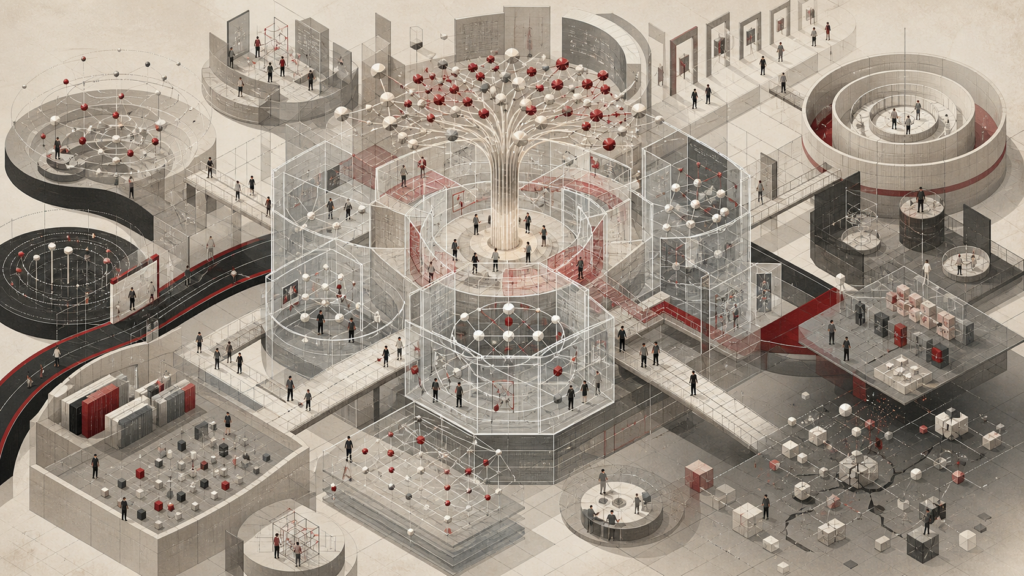
Interconnected landscape of people, infrastructure, waterways, institutions, and ecology gradually transitions into a layered research-table model with network diagrams, maps, feedback loops, and modular blocks.

Systems Thinking vs Systems Modeling: Understanding the Difference

Systems thinking and systems modeling are closely related approaches for understanding complex systems, but they operate at different levels of analysis. Systems thinking provides the conceptual lens: it emphasizes interdependence, feedback, emergence, nonlinearity, and whole-system structure. Systems modeling extends that perspective by translating systemic insight into formal representations such as equations, simulations, and computational models that can be tested, compared, and explored across scenarios. This article explains the distinction between conceptual framing and analytical implementation, showing how systems thinking helps identify structure while systems modeling makes that structure explicit and measurable. Across sustainability, economics, infrastructure, and governance, the two approaches work best together. Systems thinking without modeling can remain too abstract, while modeling without systems thinking can become technically precise but conceptually shallow.

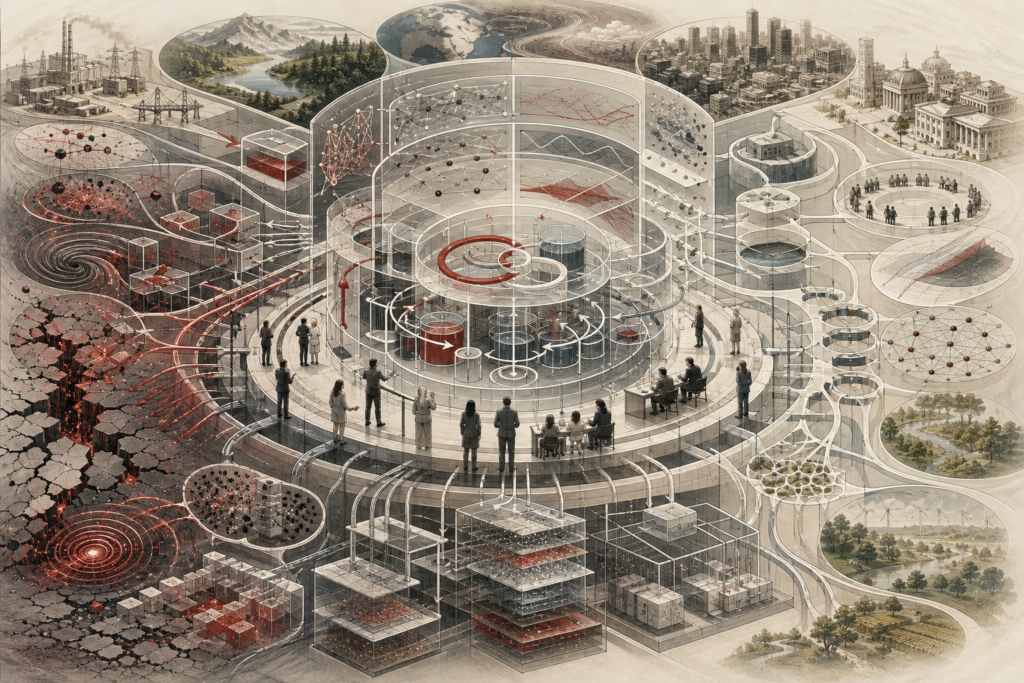
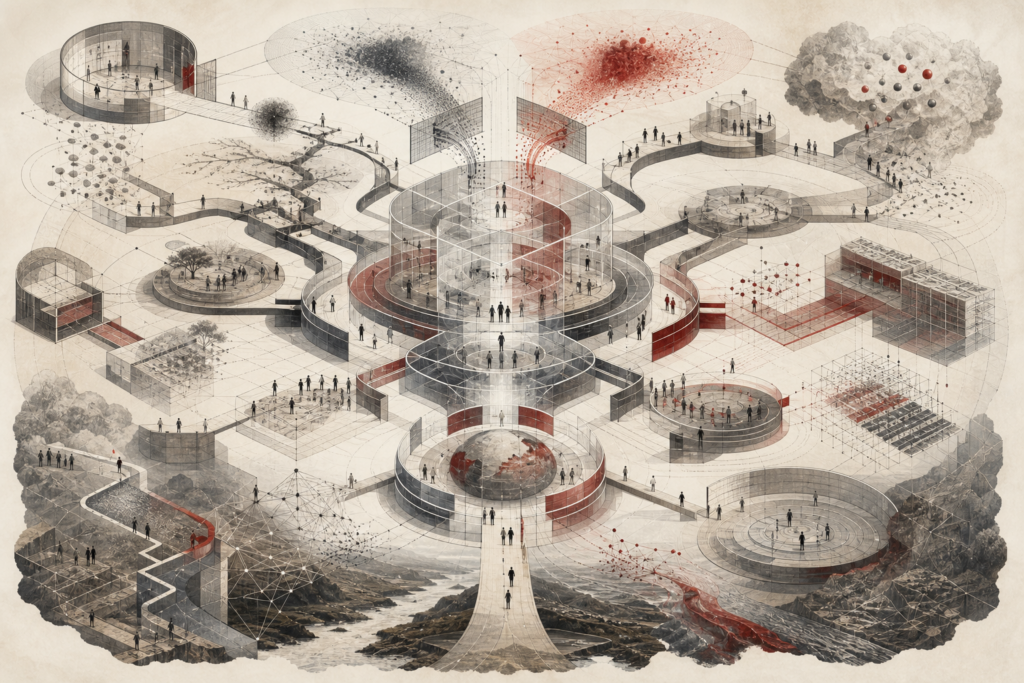
Layered systems model on a research table with maps, network diagrams, feedback loops, translucent planes, and small physical structures representing complex ecological, social, and infrastructure systems.

What Is Systems Modeling? Understanding Models of Complex Systems

Systems modeling is the formal study of how complex systems can be represented, analyzed, and simulated using mathematical, computational, or structured conceptual models. Rather than focusing on isolated variables, it examines how interactions among components generate dynamic patterns through feedback loops, nonlinear responses, delays, and structural interdependence. This article introduces the field as a whole, explains why formal models are necessary for understanding systems whose behavior cannot be grasped through intuition alone, and outlines the major modeling traditions that now shape research and policy analysis. It also emphasizes that systems modeling is not primarily about eliminating uncertainty, but about making assumptions explicit, exploring alternative futures, and improving judgment under complexity. Across climate, infrastructure, economics, public health, and sustainability, systems modeling matters because it turns dynamic interdependence into something that can be studied, compared, and used for more responsible decision-making.

Editorial scientific illustration of systems modeling as a formal-systems architecture, showing system boundaries, feedback loops, stock-and-flow reservoirs, scenario pathways, network dependencies, calibration and validation structures, infrastructure systems, ecological systems, climate feedback, public-policy corridors, governance institutions, shock propagation, cascading failure, resilience buffers, and responsible model interpretation.

Systems Modeling: Formal Methods for Understanding Complex Systems

Systems modeling examines how formal models are used to understand, simulate, and analyze complex systems composed of interacting components. Rather than focusing on isolated variables, it studies how feedback loops, nonlinear relationships, time delays, and structural dependencies generate behavior across time. This pillar introduces the field as a whole, explaining why systems modeling matters, what major methods it includes, and how it supports analysis in sustainability, governance, infrastructure, economics, and technology. It emphasizes that models do not eliminate uncertainty, but help make it more explicit, structured, and usable for decision-making. By clarifying how system structure produces outcomes, systems modeling allows researchers and policymakers to compare interventions, explore plausible futures, identify leverage points, and reason more carefully about long-term change in dynamic, interconnected worlds.

Editorial scientific illustration of content frameworks as a knowledge architecture and editorial systems framework, showing pillar structures, topic clusters, narrative pathways, educational scaffolds, conceptual models, message architecture, taxonomies, metadata layers, internal-link networks, content audits, digital knowledge systems, strategic ideation, storytelling, and scalable publishing workflows.

Content Frameworks: Designing Knowledge Architecture for Scalable Content Systems

Content frameworks turn scattered articles, concepts, methods, and resources into scalable knowledge architecture. This article map introduces the Content Frameworks series as a structured guide to designing, governing, and maintaining content systems that support learning, research, strategic communication, and institutional memory. It shows how pillar pages, topic clusters, internal links, narrative pathways, metadata, taxonomies, templates, and editorial workflows work together to create coherent bodies of knowledge. The map also emphasizes responsible use: frameworks should clarify complexity without flattening uncertainty, context, or judgment. Readers can use this guide to move from foundational ideas to applied methods, governance questions, and advanced framework design. Across the series, content frameworks are treated not as rigid templates, but as living systems that help organizations explain ideas, connect knowledge, scale editorial work, and build durable public understanding across articles, repositories, publications, and reusable editorial platforms.

Editorial scientific illustration of strategic ideation as an architecture-of-ideas systems framework, showing problem framing, divergent and convergent thinking, mental models, systems thinking, design inquiry, prototyping, scenario planning, decision pathways, tradeoffs, strategic fit, implementation pathways, adaptive learning, knowledge architecture, institutional memory, ethics, power, and long-term action.

Strategic Ideation: Generating Ideas for Complex Problem-Solving

Strategic Ideation examines how ideas become durable structures for judgment rather than remaining isolated acts of creativity. The article argues that serious ideation is not equivalent to casual brainstorming, because its real task is to transform fragmented information, uncertainty, and competing priorities into conceptual frameworks that can guide long-term thinking and coherent action. It develops this through the functions of problem definition, frame construction, option generation, conceptual structuring, strategic evaluation, and translation into implementation, while situating the field within cognition, systems thinking, design, foresight, and decision-making. The article emphasizes that strategic ideation matters because strong strategy depends on strong idea architecture: the capacity to build conceptual systems that remain structurally clear, cognitively aware, systemically grounded, and usable under real conditions of complexity.

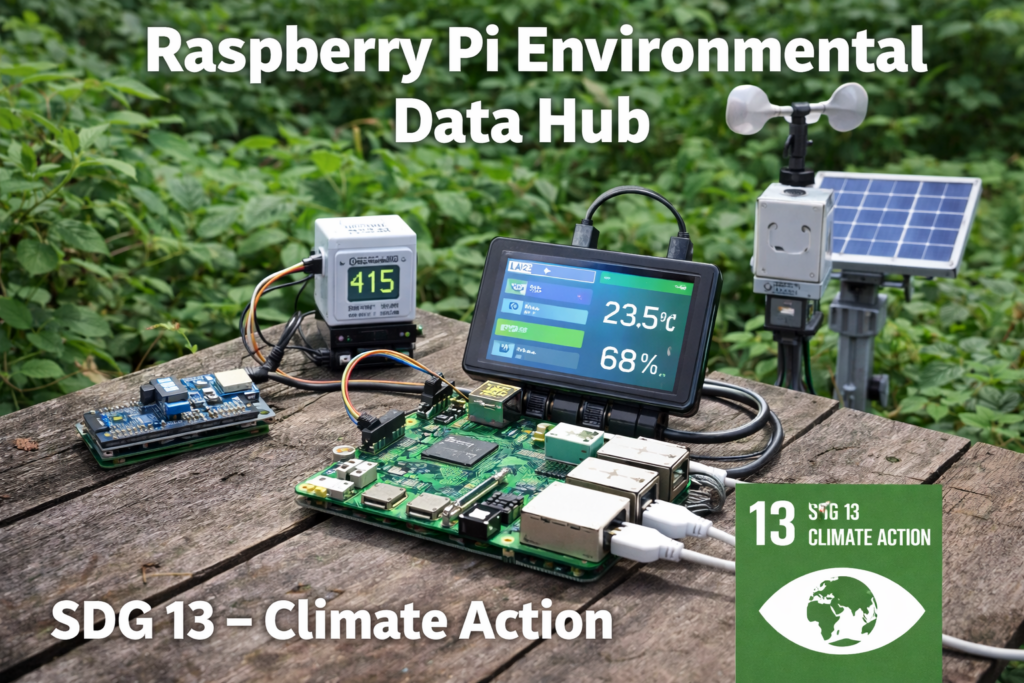
Raspberry Pi environmental data hub with climate and air quality sensors collecting local environmental data to support UN Sustainable Development Goal 13 Climate Action.

Building a Raspberry Pi Environmental Data Hub for Climate Monitoring (SDG 13: Climate Action)

A Raspberry Pi environmental data hub demonstrates how edge computing and low-cost sensing can support local climate monitoring, urban resilience, and SDG-aligned environmental intelligence. This project combines a Raspberry Pi with sensors such as the BME280 and optional particulate monitors to collect temperature, humidity, pressure, and air-quality data, store observations locally, and optionally integrate with broader climate datasets. While the prototype is not a certified scientific or regulatory monitoring station, it shows how distributed sensing can expand environmental visibility at neighborhood, classroom, field-lab, and community scales. The article connects the build to environmental monitoring systems, intelligent infrastructure, climate change as a planetary boundary, atmospheric aerosol risk, and sustainable development, showing how local data infrastructure can support better climate adaptation, public awareness, and environmental decision-making.

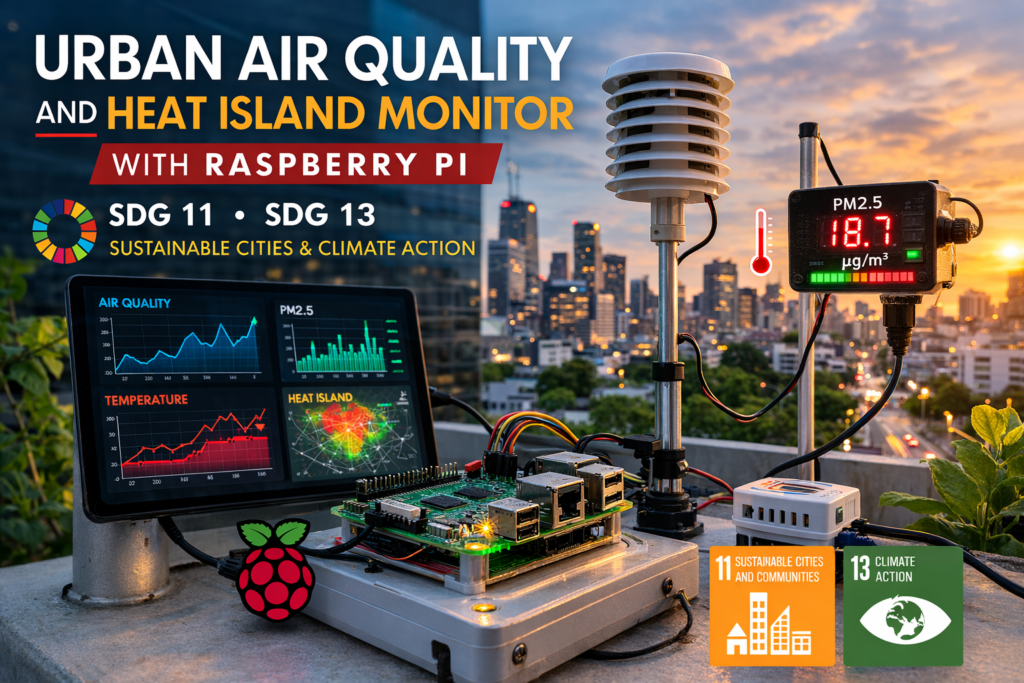
Raspberry Pi urban air quality and heat island monitoring station measuring PM2.5 pollution and temperature to support SDG 11 Sustainable Cities and SDG 13 Climate Action.

Urban Air Quality and Heat Island Monitor (SDG 11 / SDG 13)

A Raspberry Pi urban air quality monitor demonstrates how edge computing and low-cost environmental sensing can support neighborhood-scale climate adaptation, pollution awareness, and SDG 11: Sustainable Cities and Communities. This project combines a Raspberry Pi with a BME280 atmospheric sensor and PMS5003 particulate matter sensor to measure temperature, humidity, pressure, PM1.0, PM2.5, and PM10 while storing observations for later analysis. While the prototype is not a certified regulatory air-quality station, it shows how distributed monitoring can make urban heat islands, particulate pollution, and uneven environmental exposure more visible. The article connects the build to environmental monitoring systems, intelligent infrastructure, atmospheric aerosol risk, climate change, planetary boundaries, and sustainable development, showing how local data infrastructure can support healthier, more resilient cities.

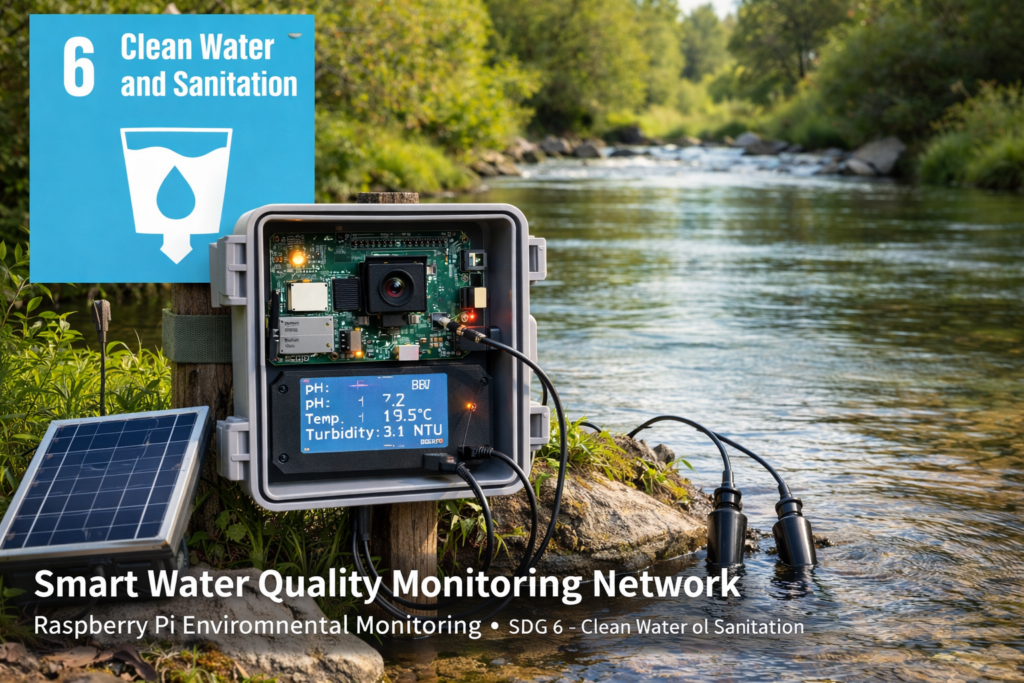
Raspberry Pi water quality monitoring station measuring pH and turbidity in a river to support SDG 6 Clean Water and Sanitation.

Smart Water Quality Monitoring Network with Raspberry Pi (SDG 6 – Clean Water and Sanitation)

A Raspberry Pi water quality monitoring system demonstrates how low-cost sensing, local logging, and edge computing can support freshwater stewardship, watershed monitoring, and SDG 6: Clean Water and Sanitation. This project combines a Raspberry Pi with sensors for pH, turbidity, and water temperature, using an ADS1115 analog-to-digital converter to collect readings that can be stored locally, exported to dashboards, or extended with anomaly detection. While the prototype is not a certified water-quality instrument or substitute for laboratory testing, it shows how distributed monitoring can make freshwater conditions more visible over time. The article connects the build to environmental monitoring systems, intelligent infrastructure, freshwater change, biogeochemical flows, planetary boundaries, and sustainable development, showing how practical data infrastructure can support better water governance and environmental decision-making.

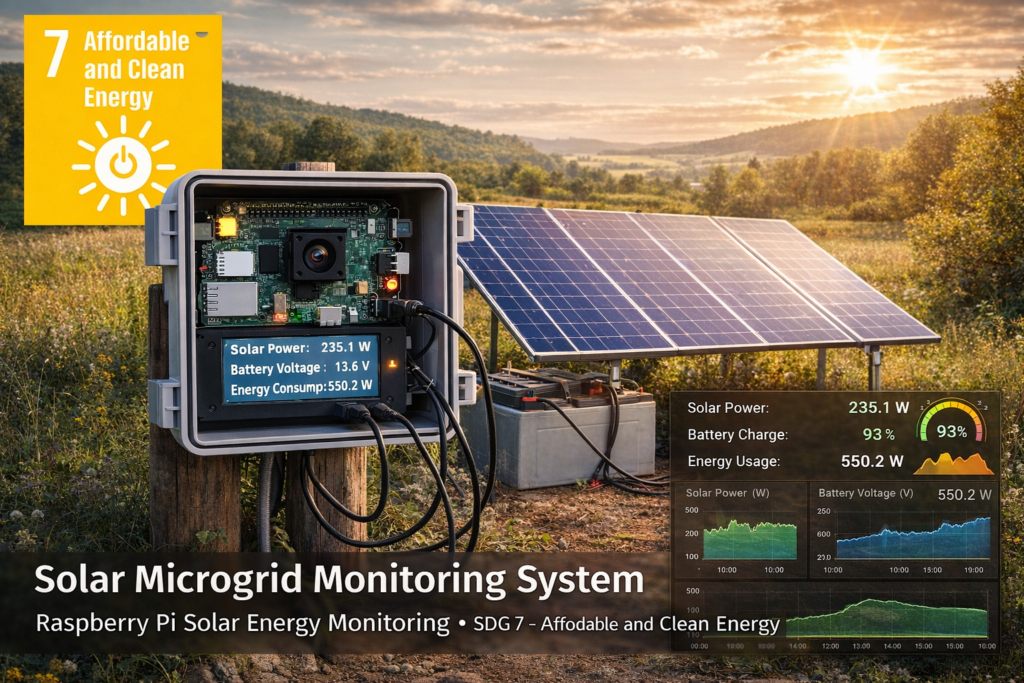
Raspberry Pi solar microgrid monitoring system measuring photovoltaic power generation and battery performance to support SDG 7 Affordable and Clean Energy.

Raspberry Pi Solar Microgrid Monitoring System (SDG 7: Affordable and Clean Energy)

A Raspberry Pi solar microgrid monitoring system demonstrates how edge computing, power sensing, and local data logging can support renewable energy visibility, community resilience, and SDG 7: Affordable and Clean Energy. This project combines a Raspberry Pi with an INA219 current and voltage sensor to measure solar-panel output, battery-related electrical conditions, instantaneous power, and logged energy trends. While the prototype is not a certified utility metering system or industrial energy-management platform, it shows how distributed monitoring can make renewable energy systems more observable, reliable, and maintainable. The article connects the build to intelligent infrastructure, environmental monitoring systems, climate change as a planetary boundary, planetary boundaries, and sustainable development, showing how practical data infrastructure can help communities understand clean-energy production, storage, load behavior, and microgrid resilience.

Scroll to Top