Content Frameworks

Content frameworks are structured models used to organize, communicate, and scale complex ideas across research, education, and strategic communication. Rather than presenting information as isolated articles or reports, content frameworks provide repeatable structures that help audiences understand how concepts relate to one another within a broader system of thought.

Effective content frameworks translate complex knowledge into navigable intellectual pathways. They may take the form of pillar pages, topic clusters, narrative models, educational sequences, or conceptual maps that guide readers through layered explanations of a subject. By structuring information in this way, content frameworks support deeper comprehension while maintaining coherence across large knowledge platforms.

Within research and policy contexts, content frameworks also help institutions communicate interdisciplinary insights to diverse audiences. They make it possible to connect specialized research, strategic analysis, and public-facing communication within a unified intellectual structure. As knowledge systems grow in scale and complexity, well-designed content frameworks become essential tools for maintaining clarity, accessibility, and long-term strategic alignment.

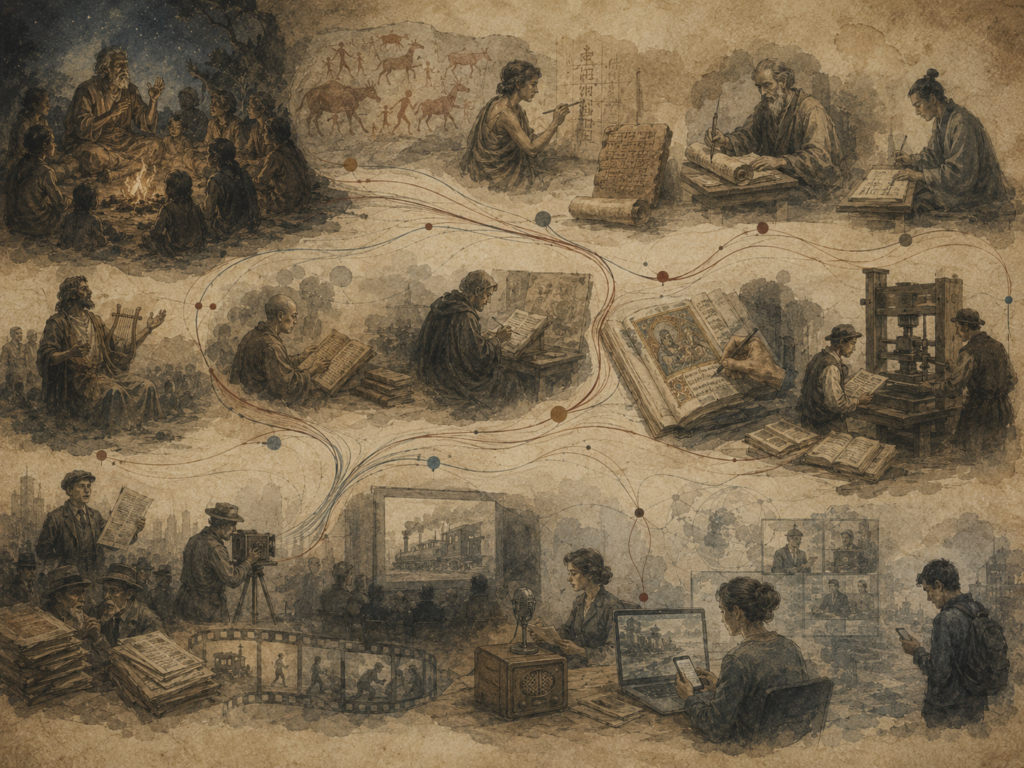
Editorial illustration showing the evolution of storytelling from oral tradition and cave symbols to manuscripts, printing, cinema, radio, and digital media.

The History of Storytelling: From Oral Tradition to Modern Media

The history of storytelling is the history of how human beings preserve, perform, circulate, and transform meaning across media. This article traces storytelling from oral tradition, myth, ritual, epic, and collective memory through writing, manuscript culture, print, theater, novels, photography, film, radio, television, digital platforms, games, and transmedia systems. It argues that storytelling history is not a straight line of progress from speech to screen, but a layered process in which older forms survive inside newer media. Each medium changes the relationship among memory, authority, audience participation, preservation, access, and power. The article explains how oral performance, textual record, printed circulation, visual narrative, broadcast seriality, networked platforms, and interactive systems shape what stories can do. It also considers archives, context loss, algorithmic visibility, cultural ownership, and ethical responsibility in studying storytelling history across cultures and technologies over long periods.
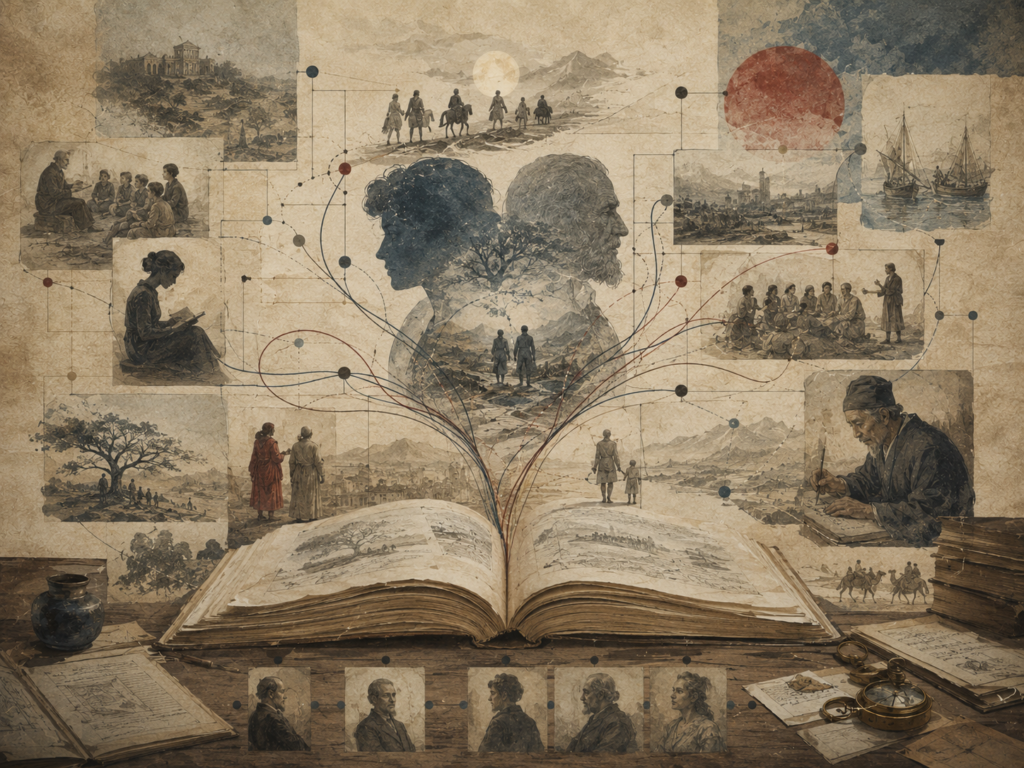
Editorial illustration of an open manuscript unfolding into connected narrative panels, symbolic threads, human figures, and knowledge pathways.

Storytelling as a Content Framework: Narrative Structure for Knowledge Systems

Storytelling becomes a content framework when narrative principles organize more than individual messages. This article examines storytelling as a structure for sequencing ideas, guiding audiences, connecting articles, shaping memory, clarifying stakes, and maintaining coherence across content systems. It explains how story can support content strategy, research communication, educational design, topic clusters, article maps, internal linking, editorial governance, and knowledge architecture without reducing complex subjects to formula or emotional manipulation. The article translates story elements such as setting, conflict, perspective, sequence, evidence, transformation, and closure into practical content design tools. It also considers the risks of storytelling frameworks when they become too linear, too heroic, unsupported by evidence, or detached from ethical responsibility. As part of the Storytelling series, it connects narrative theory with scalable content systems, audience pathways, and responsible editorial practice for long-term governance and public-facing knowledge work.

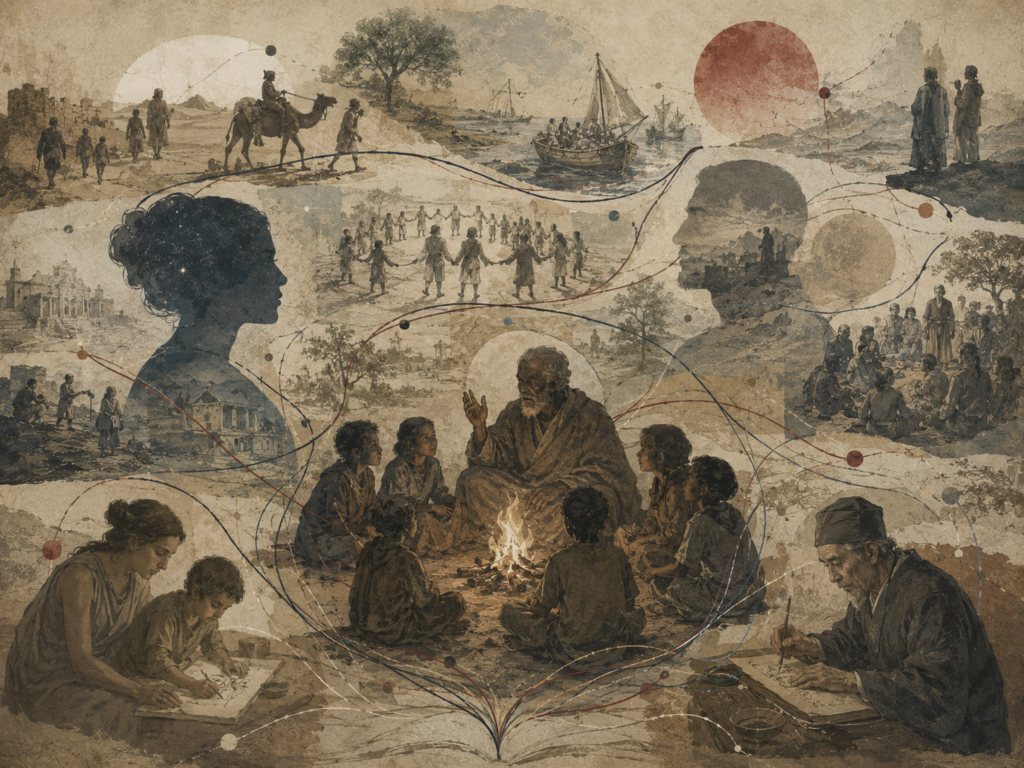
Editorial illustration of people across generations and cultures connected by symbolic threads of memory, teaching, ritual, travel, and shared meaning.

Why Storytelling Matters in Human Culture: Memory, Identity, and Meaning

Storytelling matters in human culture because stories help people remember, teach, belong, judge, mourn, persuade, and imagine across time. This article examines storytelling as a cultural system rather than a simple entertainment form. It explains how stories preserve collective memory, transmit values, support moral imagination, shape personal and group identity, create belonging, coordinate action, and give public life emotional meaning. The article also explores the risks of storytelling when narratives exclude, manipulate, stereotype, simplify history, or turn power into myth. By looking across oral tradition, family memory, religion, education, politics, institutions, media, and digital platforms, the article shows why storytelling remains one of humanity’s most durable ways of organizing experience. It provides a foundation for understanding story as memory, teaching, ethics, cultural transmission, and shared meaning in the wider Storytelling knowledge series for later narrative systems and ethics articles.

Editorial illustration of an open manuscript sending symbolic threads through layered scenes of memory, history, people, and ideas.

What Is Storytelling? Narrative, Meaning, Memory, and Human Culture

Storytelling is the human practice of organizing experience into meaningful sequence. It connects events, characters, conflict, memory, identity, culture, and transformation so people can understand what happened, why it mattered, and what changed. This article defines storytelling as more than entertainment, fiction, marketing, or technique. It examines story as a system for shaping time, preserving memory, transmitting values, forming identity, persuading audiences, and carrying ethical responsibility. The article explains core story elements such as sequence, setting, agency, causality, conflict, transformation, perspective, and interpretation while distinguishing narrative structure from rigid formula. It also considers oral, written, visual, and digital storytelling, the role of story in culture and public life, and the need for responsible representation when stories influence memory, judgment, and action across communities and institutions. It opens the series with a foundation for later narrative analysis, ethics, and governance.

Abstract institutional illustration contrasting scattered information with a structured knowledge framework, showing layered documents, modular systems, archives, and connected knowledge networks.

Why Content Frameworks Matter Today: Turning Content into Knowledge Infrastructure

Why Content Frameworks Matter Today examines why structured knowledge systems have become essential for modern communication, education, research, public reasoning, strategy, digital publishing, and AI-assisted workflows. The article shows how content frameworks help organize complexity, support trust, scale learning, connect evidence to claims, guide audience pathways, preserve institutional memory, structure reusable assets, and govern knowledge over time. It treats frameworks not as decorative templates, but as infrastructure for turning fragmented information into coherent, reusable, searchable, teachable, and maintainable knowledge systems. The article also connects content frameworks to knowledge architecture, evidence architecture, public reasoning, systems explanation, framework composition, scaling knowledge, framework limits, content governance, metadata, repositories, and platform readiness. Used responsibly, content frameworks help knowledge grow without losing clarity, accountability, context, or meaning in increasingly complex digital environments.

Abstract institutional illustration contrasting ordered framework grids with fractured, chaotic knowledge maps, showing the limits of rigid models when applied to complex reality.

The Limits of Framework Thinking: When Models Clarify and When They Distort

The Limits of Framework Thinking examines what structured models can and cannot do. The article shows how frameworks can clarify complexity, support comparison, guide communication, scale knowledge, and organize decisions, while also risking oversimplification, false precision, category errors, template dependence, model lock-in, hidden values, weak evidence, context loss, and audience fatigue. It treats frameworks as lenses rather than reality: useful for seeing certain patterns, but always partial, situated, and open to revision. The article also connects framework limits to framework composition, scaling knowledge, systems explanation, public reasoning, evidence architecture, content governance, and ethical communication. Used responsibly, limit-aware framework thinking helps writers, educators, strategists, researchers, institutions, and content teams know when a model clarifies, when it distorts, and when it should be revised, combined, simplified, or retired.

Scroll to Top