
Last Updated June 9, 2026
Storytelling is one of the oldest human systems for organizing experience into meaning. Before books, films, archives, databases, social platforms, or formal institutions, people used stories to remember what happened, explain why it mattered, teach what should be preserved, imagine what might come next, and connect individual lives to shared worlds.
What Is Storytelling? defines storytelling as a human practice of arranging events, characters, settings, conflicts, values, memories, and transformations into meaningful form. It examines storytelling as art, communication, memory, identity, cultural transmission, ethical responsibility, and narrative structure. The article treats story not as a simple entertainment format but as a deep human infrastructure for making sense of time, action, relationship, uncertainty, and change.
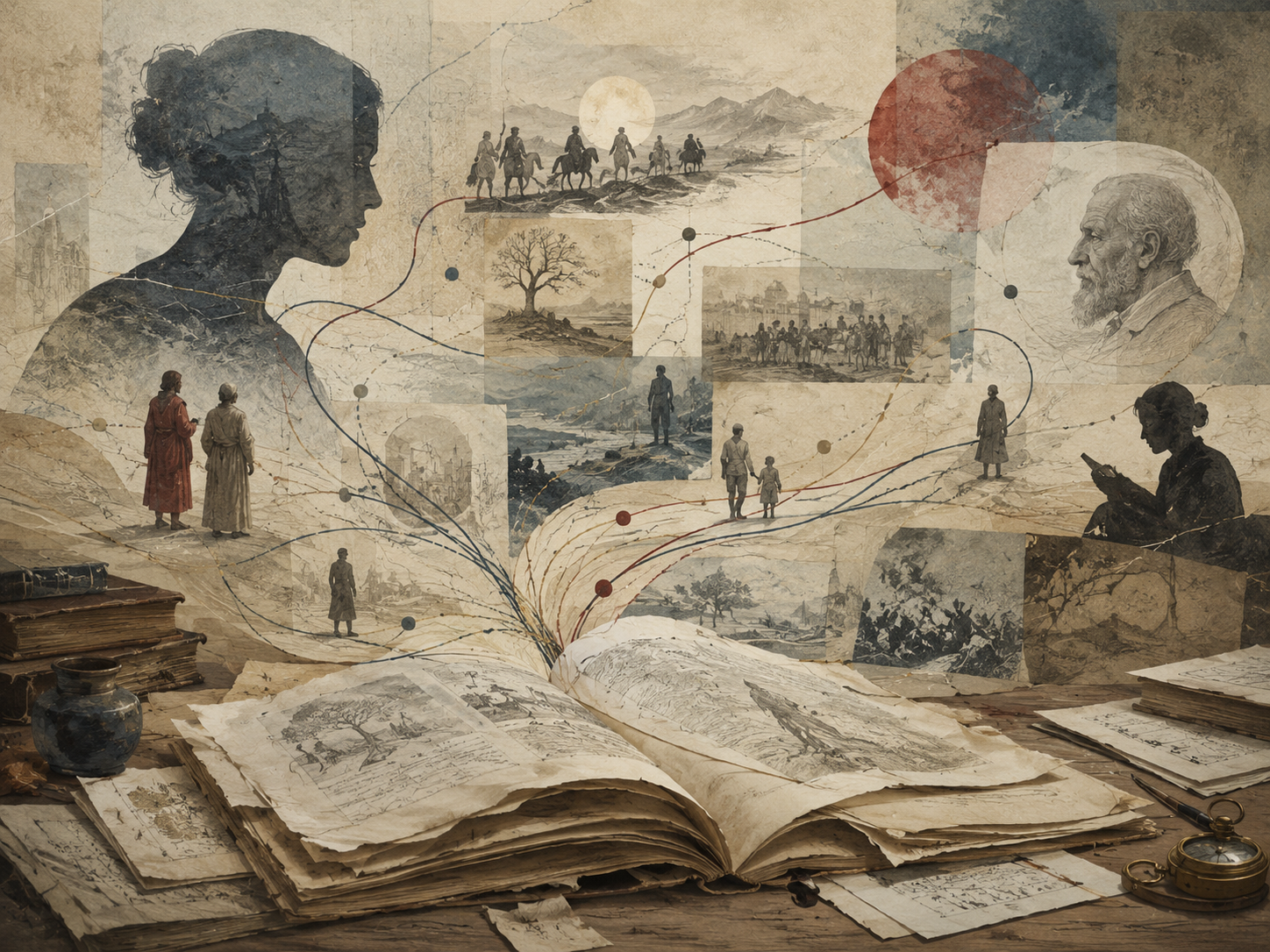
This article explains why storytelling matters as more than fiction, entertainment, branding, or technique. It examines the basic elements of story, the relationship between narrative and memory, the role of story in personal and collective identity, the cultural work of oral tradition and myth, the difference between structure and formula, and the ethical responsibilities that come with shaping human experience into narrative form. It also includes computational workflows for auditing narrative structure, character networks, motif inventories, transformation arcs, and governance risks in Catalyst Canvas-ready storytelling systems.
What Storytelling Means
Storytelling is the human practice of shaping experience into meaningful sequence. It connects events across time, gives actions context, places people or forces in relation, and invites an audience to understand why a sequence matters. A story does not merely list events. It organizes them.
A simple report might say that something happened. A story asks what led to it, who was affected, what was at stake, what changed, and why the sequence should be remembered. This movement from occurrence to meaning is central to storytelling.
A story may be spoken, written, sung, performed, filmed, remembered, archived, ritualized, dramatized, played, posted, or passed down across generations. It may be fictional or nonfictional, sacred or secular, personal or collective, intimate or public. What makes it storytelling is not one medium or one formula. Storytelling begins when experience is given meaningful form across time.
| Dimension | Basic question | Storytelling function |
|---|---|---|
| Time | What happened before and after? | Organizes events into sequence, memory, expectation, and consequence. |
| Action | Who or what acts? | Identifies agents, characters, communities, institutions, forces, or systems. |
| Meaning | Why does it matter? | Connects events to values, interpretation, stakes, and consequences. |
| Memory | What should be remembered? | Preserves experience in forms that can be shared, repeated, revised, or contested. |
| Identity | Who are we in relation to this story? | Links personal, communal, institutional, or cultural self-understanding to narrative form. |
| Ethics | What responsibility does the story carry? | Raises questions of truth, voice, representation, harm, consent, and power. |
Storytelling is therefore not simply a decorative layer added to information. It is one of the ways human beings make information intelligible, memorable, and consequential.
Storytelling Is More Than Entertainment
In everyday use, storytelling is often associated with novels, films, television, theater, games, advertising, speeches, podcasts, and personal anecdotes. These are important storytelling forms, but they do not exhaust what storytelling is. Stories also appear in courts, classrooms, rituals, archives, families, organizations, public institutions, religious traditions, political movements, research communication, and social media.
A courtroom depends on competing narratives of motive, action, harm, responsibility, and evidence. A family preserves stories of migration, hardship, humor, grief, conflict, repair, and belonging. A public institution tells stories about origin, legitimacy, reform, failure, continuity, and purpose. A religious tradition may organize sacred time through creation, covenant, exile, prophecy, sacrifice, revelation, and return. A scientific community may narrate discovery, uncertainty, evidence, error, correction, and method.
| Context | Storytelling role | Example narrative question |
|---|---|---|
| Education | Turns abstract concepts into memorable situations. | How does this idea appear in lived experience? |
| Law | Organizes evidence, motive, harm, and accountability. | What happened, and who bears responsibility? |
| Religion | Connects sacred meaning to time, ritual, moral order, and community. | How does this story orient belief and conduct? |
| Politics | Frames collective memory, crisis, legitimacy, and future direction. | What story is being told about the public good? |
| Organizations | Explains purpose, failure, transformation, and institutional identity. | What story does the organization tell about why it exists? |
| Personal life | Helps people interpret memory, aspiration, conflict, and change. | How does this experience fit into a life story? |
Storytelling entertains, but it also teaches, persuades, remembers, explains, warns, legitimizes, challenges, heals, distorts, and mobilizes. That is why storytelling must be studied as art, communication, structure, memory, culture, and ethics at the same time.
The Basic Elements of Storytelling
Different cultures, genres, and media organize stories differently, but many stories include some combination of sequence, setting, actors, perspective, causality, conflict, transformation, and interpretation. These elements do not have to appear in a single fixed order. They are building blocks, not universal rules.
A folktale may rely on recurring functions and recognizable roles. A memoir may organize memory around rupture and interpretation. A myth may relate human conduct to cosmic order. A legal narrative may organize evidence around motive and accountability. A documentary may shape reality through selection, sequence, voice, and framing. A game may distribute story across player choice, branching consequence, environment, rules, and worldbuilding.
| Story element | Question it answers | Analytical value |
|---|---|---|
| Sequence | What happens before and after? | Shows movement through time and the relationship among events. |
| Setting | Where and under what conditions does the story unfold? | Places action in a physical, cultural, historical, institutional, sacred, or imagined world. |
| Actors | Who or what acts? | Identifies characters, communities, institutions, forces, or symbolic figures. |
| Perspective | Who sees, speaks, remembers, or interprets? | Shapes what the audience knows, trusts, questions, or feels. |
| Causality | Why does one event lead to another? | Links motive, pressure, choice, chance, structure, consequence, or fate. |
| Conflict | What creates tension? | Reveals desire, obstacle, contradiction, risk, injustice, uncertainty, or loss. |
| Transformation | What changes? | Tracks altered identity, knowledge, relationship, power, status, or order. |
| Interpretation | What does the story mean? | Connects story form to value, warning, responsibility, memory, or possibility. |
A careful analysis of storytelling should ask how these elements work together. The same event can become different stories depending on where the storyteller begins, what is omitted, whose perspective is centered, what counts as conflict, and whether the ending offers closure, ambiguity, return, rupture, or unresolved consequence.
Story and Time
Storytelling is deeply tied to time. A story gives temporal experience a shape. It tells an audience not only that events occurred but how they are related through before, after, delay, repetition, memory, anticipation, return, reversal, and change.
Some stories are linear. They begin with an initiating condition, move through conflict or complication, and end with resolution or transformation. Other stories are cyclical, returning to seasons, rituals, ancestral patterns, recurring obligations, or repeated wounds. Others are fragmented, especially when memory is damaged, contested, traumatic, or incomplete. Still others are branching, as in games and interactive narratives, where different choices produce different possible sequences.
| Temporal form | How it works | Example use |
|---|---|---|
| Linear | Events unfold in an ordered sequence from beginning to end. | Adventure, biography, case study, historical explanation. |
| Cyclical | Events return through seasons, rituals, generations, or repeated patterns. | Myth, ecological narrative, ritual story, family memory. |
| Fragmented | Events appear as partial, broken, repeated, or interrupted memory. | Trauma narrative, modernist fiction, witness testimony. |
| Nested | One story contains another story inside it. | Frame tales, testimony, archival narrative, layered memoir. |
| Branching | Different pathways unfold through choice or conditional structure. | Interactive fiction, games, scenario narratives, decision pathways. |
| Retrospective | The story is told after the fact through memory and interpretation. | Memoir, confession, historical reflection, institutional review. |
Story converts time into meaning. A beginning matters because of what follows. A choice matters because of what it costs. A loss matters because of what it changes. A return matters because the person, community, or world is no longer the same.
Story and Meaning
Storytelling creates meaning by arranging relationships. It connects action to motive, event to consequence, character to value, memory to identity, and conflict to interpretation. A story does not simply add emotion to information. It helps audiences understand why information matters.
This is why stories are powerful in teaching and public communication. A principle may be abstract. A story places that principle under pressure. A policy may seem technical. A story can reveal who is affected, what tradeoffs appear, and what consequences follow. A moral claim may be general. A story can dramatize its difficulty in a particular situation.
| Meaning-making function | How storytelling performs it | Risk if misused |
|---|---|---|
| Selection | Chooses which events, details, and voices matter. | Important context may be omitted. |
| Sequence | Orders events so relationships become visible. | Order may imply false causality. |
| Emphasis | Highlights stakes, emotion, conflict, or consequence. | Emotion may overwhelm evidence. |
| Perspective | Centers a viewpoint from which events are understood. | Other viewpoints may be erased. |
| Closure | Suggests what has been resolved or learned. | Complex problems may be falsely settled. |
Meaning in storytelling is therefore powerful and dangerous. A strong story can clarify complexity, but it can also simplify too much. It can humanize, but it can also stereotype. It can preserve memory, but it can also distort memory. The interpretive force of story is why storytelling requires ethical care.
Story and Memory
Storytelling is one of the main ways memory becomes shareable. Human beings rarely remember experience as disconnected data. They remember scenes, voices, places, images, relationships, causes, emotional turning points, beginnings, endings, and unresolved questions. Stories organize these elements into forms that can be recalled, repeated, taught, challenged, or revised.
Oral traditions show this relationship clearly. Before writing, communities preserved knowledge through performance, repetition, rhythm, formula, genealogy, proverb, epic, chant, ritual speech, song, and tale. These forms supported cultural memory by making important knowledge memorable and repeatable.
UNESCO describes oral traditions and expressions as ways of passing on knowledge, cultural and social values, and collective memory. That connection between story, memory, and continuity is central to understanding storytelling as cultural infrastructure.
| Memory form | Storytelling role | Example |
|---|---|---|
| Personal memory | Organizes individual experience into life story. | A person explains a turning point, loss, migration, vocation, or recovery. |
| Family memory | Transmits kinship, humor, warning, grief, endurance, and belonging. | Stories repeated at gatherings or passed across generations. |
| Cultural memory | Preserves values, origins, obligations, rituals, and shared references. | Folktales, myths, epics, chants, songs, and proverbs. |
| Institutional memory | Explains founding, purpose, failure, reform, continuity, and legitimacy. | Origin stories, case histories, archives, public reports. |
| Public memory | Frames collective identity, trauma, commemoration, exclusion, and repair. | Monuments, memorial speeches, national narratives, truth commissions. |
Memory is not neutral. The stories a culture repeats shape what is honored, what is ignored, what is forgiven, what is contested, and what is forgotten. Responsible storytelling therefore asks not only what is remembered, but who controls the memory and whose experience has been left outside the frame.
Story and Identity
People often understand themselves through stories. A person may describe life as a journey, a struggle, a calling, a recovery, an exile, an education, a reinvention, a failure, a mission, or a return. These narrative forms do not merely decorate identity. They help organize self-understanding across time.
Identity depends partly on continuity. A person changes, but still tries to understand how childhood, memory, decision, harm, aspiration, relationship, failure, and hope belong to one life. Storytelling gives that continuity a form. It connects past experience to present interpretation and future possibility.
| Identity question | Storytelling function | Possible complication |
|---|---|---|
| Who was I? | Interprets memory and formative experience. | Memory may be partial, selective, or painful. |
| Who am I now? | Connects current identity to conflict, role, value, and relationship. | Different audiences may receive different self-stories. |
| Who am I becoming? | Projects aspiration, fear, repair, change, and future direction. | The future may not fit the hoped-for narrative. |
| What happened to me? | Gives shape to disruption, loss, injustice, or transformation. | Some experiences resist clean integration. |
| What am I responsible for? | Connects action, guilt, agency, repair, and moral judgment. | Self-protective stories may avoid accountability. |
A responsible account of storytelling must also recognize that not every life can be organized into a clean arc. Trauma may fragment narrative. Grief may repeat. Injustice may prevent closure. Memory may be contested. Identity stories can heal, but they can also trap people inside limiting scripts. Storytelling shapes identity, but identity remains more complex than any single story about the self.
Story and Culture
Storytelling is a cultural system. Communities use stories to transmit values, explain origins, mark belonging, dramatize danger, teach obligations, remember ancestors, criticize power, and imagine possible futures. Myths, legends, folktales, epics, sacred histories, public narratives, family stories, organizational narratives, and social movement narratives all do cultural work.
Stories help communities answer foundational questions: Where did we come from? What do we owe one another? What dangers should we remember? What counts as courage, wisdom, betrayal, justice, sacrifice, or repair? Who belongs inside the story, and who has been placed outside it?
| Cultural story form | Common function | Interpretive caution |
|---|---|---|
| Myth | Links human conduct to sacred, cosmic, symbolic, or foundational order. | Do not reduce myth to falsehood; examine its symbolic and cultural work. |
| Legend | Connects memory, place, person, and communal belief. | Ask how history and imagination interact. |
| Folktale | Transmits patterns, warnings, roles, humor, and moral imagination. | Attend to variation across tellings and communities. |
| Epic | Organizes heroic, communal, sacred, political, or ancestral memory at large scale. | Ask whose heroism and whose suffering are centered. |
| Public narrative | Frames collective identity, crisis, legitimacy, and action. | Examine power, exclusion, evidence, and simplification. |
| Institutional story | Explains founding, mission, continuity, reform, or authority. | Compare official story to lived experience and documented history. |
Culture is not simply reflected in stories. Culture is also produced, maintained, contested, and changed through stories. This makes storytelling essential for cultural understanding and risky when stories become instruments of exclusion, manipulation, or false inevitability.
Story and Structure
Stories have structure, but structure should not be confused with formula. A structure is an arrangement of relationships among events, actors, conflicts, values, and transformations. A formula is a rigid pattern imposed without enough attention to context, culture, medium, purpose, or meaning.
Some stories move through departure, trial, transformation, and return. Others move through downfall, recognition, loss, and irreversible consequence. Others are built around repetition, ritual, testimony, wandering, accumulation, fragmentation, communal voice, or unresolved conflict. Some stories center an individual protagonist. Others center a community, landscape, ancestor, institution, deity, system, or recurring pattern.
| Structural question | What it reveals | Why it matters |
|---|---|---|
| Where does the story begin? | The starting point the storyteller treats as meaningful. | Beginnings shape causality and sympathy. |
| What is selected? | The events, details, and voices included. | Selection shapes memory and judgment. |
| What is omitted? | The events, perspectives, or conditions left out. | Omission can simplify, distort, or reveal power. |
| What creates movement? | The desire, problem, conflict, pressure, mystery, or obligation that drives the story. | Movement shows what is at stake. |
| What changes? | The transformation in knowledge, identity, relationship, status, or world order. | Transformation gives the story consequence. |
| How does the story end? | The kind of closure, ambiguity, return, rupture, or continuation offered. | Endings shape interpretation and responsibility. |
A good storytelling analysis does not ask whether every story fits one universal model. It asks how a particular story organizes time, voice, conflict, action, memory, and meaning. Structure helps explain how stories work, but formula often prevents us from seeing what a story is actually doing.
Oral, Written, Visual, and Digital Storytelling
Storytelling changes across media. Oral storytelling depends on voice, gesture, rhythm, audience response, memory, variation, and performance. Written storytelling can preserve extended structure, interiority, revision, documentation, and archival continuity. Visual storytelling uses image, composition, movement, montage, framing, and symbolic detail. Digital storytelling may use interactivity, platform circulation, algorithmic visibility, branching choice, remix, participation, and networked audiences.
The medium changes what a story can do. A spoken tale may vary each time it is performed. A printed novel can sustain long interior reflection. A film can create meaning through image and editing. A game can make consequence depend partly on player agency. A short-form platform can compress narrative into fragments, hooks, loops, and shareable scenes.
| Medium | Storytelling strength | Analytical question |
|---|---|---|
| Oral | Embodied performance, audience relation, variation, repetition. | How does performance shape meaning? |
| Written | Extended structure, revision, documentation, interiority. | How does textual arrangement shape interpretation? |
| Theatrical | Live embodiment, scene, dialogue, gesture, shared presence. | How does performance create collective experience? |
| Film and television | Visual sequence, editing, sound, pacing, serial development. | How do image, cut, sound, and duration shape narrative? |
| Games | Agency, branching consequence, world systems, rule-based narrative. | How does player action interact with story structure? |
| Digital platforms | Participation, remix, algorithmic circulation, fragmented attention. | How does platform design shape storytelling behavior? |
Stories migrate across media, but they do not remain unchanged. Adaptation is not simply transfer. It is transformation.
Storytelling as a Human System
Storytelling can be understood as a human system because stories connect many interacting parts: teller, audience, medium, memory, character, event, setting, structure, purpose, cultural context, ethical stakes, institutional power, and interpretation. A story is not only an object. It is also a relationship.
A systems view helps explain why stories change as they move across contexts. A personal memory becomes different when told to a friend, written in a memoir, presented in court, archived in an institution, dramatized in film, or circulated through social media. A sacred story changes when translated, ritualized, taught, politicized, illustrated, or adapted. A public narrative changes when repeated by institutions, journalists, activists, educators, opponents, and audiences.
Thinking About Storytelling as a System
Storytelling systems can be analyzed by mapping how narrative elements interact. Events connect to characters. Characters connect to motives. Motives connect to conflict. Conflict connects to values. Values connect to audiences. Audiences connect to memory, action, and interpretation.
A systems approach does not reduce story to data. It helps researchers and analysts notice patterns, relationships, gaps, tensions, repetitions, and risks. It is useful for studying narrative networks, character arcs, motif inventories, public rhetoric, organizational storytelling, cultural memory, adaptation, and persuasive framing.
| System layer | Storytelling question | Example analytic artifact |
|---|---|---|
| Narrative structure | How are events arranged? | Event sequence, plot map, turning point inventory. |
| Character network | Who interacts with whom? | Character graph, relationship table, agency map. |
| Motif system | What images, themes, or patterns recur? | Motif inventory, repetition map, symbolic cluster. |
| Conflict structure | What tensions drive movement? | Conflict taxonomy, escalation curve, stakes matrix. |
| Ethical frame | Who is represented, omitted, or harmed? | Representation audit, consent note, power map. |
| Governance layer | How should the story be maintained, revised, or contextualized? | Review queue, source log, interpretive caution record. |
This systems view is especially useful for Catalyst Canvas-style knowledge architecture because narrative can be treated as structured, reviewable, and ethically governed without reducing storytelling to mechanical formula.
The Ethics of Storytelling
Storytelling is ethically charged because stories shape memory, identity, sympathy, blame, legitimacy, and action. A story may ask an audience to trust, fear, mourn, admire, condemn, forgive, join, buy, vote, resist, or remember. That power creates responsibility.
Ethical storytelling requires attention to voice, consent, evidence, representation, context, harm, and power. Who has the right to tell this story? Whose experience is being interpreted? What has been simplified? What has been left out? Does the story clarify complexity or exploit emotion? Does it create understanding or manipulate belief?
| Ethical issue | Question to ask | Risk if ignored |
|---|---|---|
| Voice | Who speaks, and who is spoken for? | Appropriation, erasure, or false authority. |
| Evidence | What supports the story? | Persuasive but inaccurate narrative. |
| Context | What conditions shape the events? | Overpersonalized blame or false simplicity. |
| Consent | Has lived experience been used responsibly? | Exploitation of trauma, identity, or vulnerability. |
| Representation | How are people, groups, and places portrayed? | Stereotype, dehumanization, or symbolic reduction. |
| Consequence | What might this story cause audiences to believe or do? | Manipulation, scapegoating, panic, or distortion. |
A story can be beautiful and harmful at the same time. A story can be emotionally compelling and ethically irresponsible. A story can feel meaningful while hiding evidence, silencing people, or simplifying causes. Responsible storytelling requires craft and judgment.
Examples of Strong and Weak Storytelling Analysis
The examples below show how storytelling analysis becomes stronger when it examines structure, meaning, evidence, voice, causality, and ethical stakes rather than treating story as a vague synonym for communication.
Definition
Weak: Storytelling is sharing information in an engaging way.
Stronger: Storytelling organizes events, actors, values, conflicts, and transformations into meaningful sequence.
Why it works: The stronger version distinguishes storytelling from general communication.
Structure
Weak: Every story follows the hero’s journey.
Stronger: Some stories use heroic departure, ordeal, and return, while others are cyclical, communal, tragic, fragmented, ritualized, or unresolved.
Why it works: It avoids forcing all traditions into one template.
Memory
Weak: Stories preserve the past.
Stronger: Stories preserve, organize, revise, contest, and sometimes distort memory.
Why it works: It treats memory as an active cultural process.
Ethics
Weak: A good story is emotional.
Stronger: A responsible story uses emotion without abandoning evidence, context, consent, or representation.
Why it works: It separates persuasive force from ethical quality.
Identity
Weak: People are the stories they tell.
Stronger: People often understand themselves through stories, but no person is reducible to one narrative arc.
Why it works: It recognizes narrative identity without oversimplifying the self.
Culture
Weak: Myths are old fictional stories.
Stronger: Myths are symbolic narratives that can organize cosmology, ritual, morality, social order, and cultural memory.
Why it works: It treats myth as cultural work rather than mere falsehood.
Strong storytelling analysis explains what a story does, how it does it, who it affects, and what interpretive responsibility follows.
Mathematics, Computation, and Modeling
Storytelling is not reducible to mathematics, but computational models can help researchers and analysts audit narrative structure, story metadata, character relationships, motif recurrence, event sequence, conflict escalation, transformation arcs, and ethical governance risks. These models should support interpretation rather than replace it.
A narrative coherence score can average major storytelling dimensions:
C_n = \frac{S + A + K + T + I}{5}
\]
Interpretation: Narrative coherence \(C_n\) averages sequence clarity \(S\), agency clarity \(A\), causal connection \(K\), transformation clarity \(T\), and interpretive relevance \(I\).
A motif recurrence score can estimate how strongly repeated narrative elements reinforce meaning:
M_r = \frac{f_m \times w_m}{N}
\]
Interpretation: Motif recurrence \(M_r\) increases when a motif appears frequently \(f_m\), carries interpretive weight \(w_m\), and remains meaningful relative to the total number of narrative units \(N\).
A character centrality score can help identify which figures carry narrative agency:
G_c = \frac{d_c + b_c + a_c}{3}
\]
Interpretation: Character centrality \(G_c\) averages relationship degree \(d_c\), bridge role \(b_c\), and agency score \(a_c\).
A narrative governance risk score can combine low evidence, low representation care, high persuasive intensity, and high audience consequence:
R_g = (1 – E_s)w_e + (1 – V_r)w_v + P_iw_p + A_cw_a
\]
Interpretation: Governance risk \(R_g\) rises when evidence strength \(E_s\) and representation care \(V_r\) are low, while persuasive intensity \(P_i\) and audience consequence \(A_c\) are high.
| Modeling task | Narrative question | Example output |
|---|---|---|
| Event sequence audit | Are events ordered clearly? | Story timeline, sequence table, turning point list. |
| Character network analysis | Who acts, influences, connects, or changes? | Character graph, agency score, relationship map. |
| Motif inventory | What images, objects, phrases, or themes recur? | Motif frequency table, symbolic cluster map. |
| Conflict analysis | What tensions drive narrative movement? | Conflict matrix, escalation curve, stakes table. |
| Transformation audit | What changes between beginning and end? | Character arc, knowledge shift, social order change. |
| Ethical governance audit | Where does the story need caution? | Representation warning, consent note, review queue. |
Computational storytelling models should be transparent, modest, and interpretive. They can reveal patterns and gaps, but they cannot determine meaning on their own.
Python Workflow: Narrative Structure and Story System Audit
The Python workflow below evaluates storytelling items by sequence clarity, agency, causal connection, conflict definition, transformation clarity, motif use, interpretive relevance, evidence strength, representation care, and governance priority. The companion repository version extends this into a Catalyst Canvas-ready module with schemas, package-style Python, tests, JSON exports, Canvas cards, markdown governance queues, and reusable narrative-system data contracts.
# narrative_structure_story_system_audit.py
# Dependency-light workflow for storytelling structure, meaning, and governance audits.

from __future__ import annotations

from dataclasses import dataclass
from pathlib import Path
import csv
import json
from statistics import mean

ARTICLE_ROOT = Path(__file__).resolve().parents[1]
OUTPUTS = ARTICLE_ROOT / "outputs"
TABLES = OUTPUTS / "tables"
JSON_DIR = OUTPUTS / "json"
MARKDOWN = OUTPUTS / "markdown"


@dataclass
class StoryItem:
    item: str
    story_type: str
    description: str
    sequence_clarity: float
    agency_clarity: float
    causal_connection: float
    conflict_definition: float
    transformation_clarity: float
    motif_use: float
    interpretive_relevance: float
    evidence_strength: float
    representation_care: float
    persuasive_intensity: float
    audience_consequence: float
    owner: str
    status: str

    def coherence_score(self) -> float:
        return mean([
            self.sequence_clarity,
            self.agency_clarity,
            self.causal_connection,
            self.transformation_clarity,
            self.interpretive_relevance,
        ])

    def craft_score(self) -> float:
        return mean([
            self.sequence_clarity,
            self.conflict_definition,
            self.transformation_clarity,
            self.motif_use,
            self.interpretive_relevance,
        ])

    def governance_risk(self) -> float:
        return min(
            1.0,
            (1 - self.evidence_strength) * 0.30
            + (1 - self.representation_care) * 0.30
            + self.persuasive_intensity * 0.20
            + self.audience_consequence * 0.20,
        )

    def review_priority(self) -> str:
        if self.status == "revise" or self.governance_risk() >= 0.48:
            return "high"
        if self.status == "review" or self.governance_risk() >= 0.34:
            return "medium"
        return "standard"


def write_csv(path: Path, rows: list[dict[str, object]]) -> None:
    path.parent.mkdir(parents=True, exist_ok=True)
    if not rows:
        raise ValueError(f"No rows to write: {path}")
    with path.open("w", newline="", encoding="utf-8") as handle:
        writer = csv.DictWriter(handle, fieldnames=list(rows[0].keys()))
        writer.writeheader()
        writer.writerows(rows)


def write_json(path: Path, payload: object) -> None:
    path.parent.mkdir(parents=True, exist_ok=True)
    path.write_text(json.dumps(payload, indent=2), encoding="utf-8")


def write_markdown_queue(path: Path, rows: list[dict[str, object]]) -> None:
    path.parent.mkdir(parents=True, exist_ok=True)
    lines = [
        "# Storytelling Governance Queue",
        "",
        "| Item | Story type | Risk | Priority | Owner | Status |",
        "|---|---|---:|---|---|---|",
    ]

    for row in rows:
        lines.append(
            f"| {row['item']} | {row['story_type']} | "
            f"{row['governance_risk']} | {row['review_priority']} | "
            f"{row['owner']} | {row['status']} |"
        )

    path.write_text("\n".join(lines) + "\n", encoding="utf-8")


def main() -> None:
    items = [
        StoryItem(
            "Origin story article opening",
            "institutional narrative",
            "Explains founding purpose and public meaning.",
            0.82, 0.78, 0.74, 0.68, 0.76, 0.64, 0.84,
            0.78, 0.72, 0.58, 0.66, "editorial", "active"
        ),
        StoryItem(
            "Personal transformation case",
            "life narrative",
            "Uses memory conflict and change to explain identity.",
            0.76, 0.80, 0.70, 0.72, 0.86, 0.58, 0.82,
            0.68, 0.62, 0.74, 0.78, "research", "review"
        ),
        StoryItem(
            "Campaign persuasion narrative",
            "public narrative",
            "Frames urgency agency obstacle and collective action.",
            0.72, 0.74, 0.66, 0.80, 0.70, 0.62, 0.76,
            0.56, 0.54, 0.88, 0.86, "communications", "revise"
        ),
        StoryItem(
            "Folktale motif inventory",
            "traditional story",
            "Tracks recurring figures objects thresholds and reversals.",
            0.84, 0.70, 0.76, 0.68, 0.78, 0.90, 0.80,
            0.74, 0.70, 0.42, 0.48, "archive", "active"
        ),
        StoryItem(
            "Ethical representation note",
            "governance artifact",
            "Documents voice context consent and representation cautions.",
            0.68, 0.72, 0.64, 0.60, 0.66, 0.54, 0.78,
            0.82, 0.88, 0.46, 0.70, "governance", "active"
        ),
    ]

    rows = []

    for item in items:
        rows.append({
            "item": item.item,
            "story_type": item.story_type,
            "description": item.description,
            "sequence_clarity": item.sequence_clarity,
            "agency_clarity": item.agency_clarity,
            "causal_connection": item.causal_connection,
            "conflict_definition": item.conflict_definition,
            "transformation_clarity": item.transformation_clarity,
            "motif_use": item.motif_use,
            "interpretive_relevance": item.interpretive_relevance,
            "evidence_strength": item.evidence_strength,
            "representation_care": item.representation_care,
            "persuasive_intensity": item.persuasive_intensity,
            "audience_consequence": item.audience_consequence,
            "coherence_score": round(item.coherence_score(), 3),
            "craft_score": round(item.craft_score(), 3),
            "governance_risk": round(item.governance_risk(), 3),
            "review_priority": item.review_priority(),
            "owner": item.owner,
            "status": item.status,
        })

    rows = sorted(rows, key=lambda row: row["governance_risk"], reverse=True)
    write_csv(TABLES / "storytelling_structure_audit.csv", rows)
    write_json(JSON_DIR / "storytelling_canvas_cards.json", rows)

    governance_queue = [
        row for row in rows
        if row["review_priority"] != "standard"
    ]

    write_csv(TABLES / "storytelling_governance_queue.csv", governance_queue)
    write_json(JSON_DIR / "storytelling_governance_queue.json", governance_queue)
    write_markdown_queue(MARKDOWN / "storytelling_governance_queue.md", governance_queue)

    print("Storytelling structure and governance audit complete.")


if __name__ == "__main__":
    main()
This workflow helps teams identify stories with weak structure, unclear transformation, unsupported claims, high persuasive pressure, or representation risks before publication.
R Workflow: Storytelling Diagnostics
The R workflow below creates a synthetic storytelling dataset, calculates coherence score, craft score, governance risk, and review priority, then exports summary tables and base R plots. It is intentionally portable and uses only base R.
# storytelling_diagnostics_report.R
# Base R workflow for storytelling structure and governance diagnostics.

args <- commandArgs(trailingOnly = FALSE)
file_arg <- grep("^--file=", args, value = TRUE)

if (length(file_arg) > 0) {
  script_path <- normalizePath(sub("^--file=", "", file_arg[1]), mustWork = TRUE)
  article_root <- normalizePath(file.path(dirname(script_path), ".."), mustWork = TRUE)
} else {
  article_root <- getwd()
}

setwd(article_root)

tables_dir <- file.path(article_root, "outputs", "tables")
figures_dir <- file.path(article_root, "outputs", "figures")

if (!dir.exists(tables_dir)) {
  dir.create(tables_dir, recursive = TRUE)
}

if (!dir.exists(figures_dir)) {
  dir.create(figures_dir, recursive = TRUE)
}

items <- data.frame(
  item = c(
    "Origin story article opening",
    "Personal transformation case",
    "Campaign persuasion narrative",
    "Folktale motif inventory",
    "Ethical representation note"
  ),
  story_type = c(
    "institutional narrative",
    "life narrative",
    "public narrative",
    "traditional story",
    "governance artifact"
  ),
  sequence_clarity = c(0.82, 0.76, 0.72, 0.84, 0.68),
  agency_clarity = c(0.78, 0.80, 0.74, 0.70, 0.72),
  causal_connection = c(0.74, 0.70, 0.66, 0.76, 0.64),
  conflict_definition = c(0.68, 0.72, 0.80, 0.68, 0.60),
  transformation_clarity = c(0.76, 0.86, 0.70, 0.78, 0.66),
  motif_use = c(0.64, 0.58, 0.62, 0.90, 0.54),
  interpretive_relevance = c(0.84, 0.82, 0.76, 0.80, 0.78),
  evidence_strength = c(0.78, 0.68, 0.56, 0.74, 0.82),
  representation_care = c(0.72, 0.62, 0.54, 0.70, 0.88),
  persuasive_intensity = c(0.58, 0.74, 0.88, 0.42, 0.46),
  audience_consequence = c(0.66, 0.78, 0.86, 0.48, 0.70),
  owner = c("editorial", "research", "communications", "archive", "governance"),
  status = c("active", "review", "revise", "active", "active"),
  stringsAsFactors = FALSE
)

items$coherence_score <- rowMeans(items[, c(
  "sequence_clarity",
  "agency_clarity",
  "causal_connection",
  "transformation_clarity",
  "interpretive_relevance"
)])

items$craft_score <- rowMeans(items[, c(
  "sequence_clarity",
  "conflict_definition",
  "transformation_clarity",
  "motif_use",
  "interpretive_relevance"
)])

items$governance_risk <- pmin(
  1,
  (1 - items$evidence_strength) * 0.30 +
    (1 - items$representation_care) * 0.30 +
    items$persuasive_intensity * 0.20 +
    items$audience_consequence * 0.20
)

items$review_priority <- ifelse(
  items$status == "revise" | items$governance_risk >= 0.48,
  "high",
  ifelse(
    items$status == "review" | items$governance_risk >= 0.34,
    "medium",
    "standard"
  )
)

items <- items[order(items$governance_risk, decreasing = TRUE), ]

write.csv(
  items,
  file.path(tables_dir, "storytelling_diagnostics_summary.csv"),
  row.names = FALSE
)

governance_queue <- items[items$review_priority != "standard", ]

write.csv(
  governance_queue,
  file.path(tables_dir, "storytelling_governance_queue.csv"),
  row.names = FALSE
)

png(file.path(figures_dir, "storytelling_coherence_score.png"), width = 1200, height = 700)
barplot(
  items$coherence_score,
  names.arg = items$item,
  las = 2,
  ylab = "Narrative coherence score",
  main = "Storytelling Coherence Score"
)
grid()
dev.off()

png(file.path(figures_dir, "storytelling_governance_risk.png"), width = 1200, height = 700)
barplot(
  items$governance_risk,
  names.arg = items$item,
  las = 2,
  ylab = "Governance risk",
  main = "Storytelling Governance Risk"
)
grid()
dev.off()

print(items[, c(
  "item",
  "story_type",
  "coherence_score",
  "craft_score",
  "governance_risk",
  "review_priority"
)])
This workflow turns storytelling analysis into an auditable content-governance artifact. It helps identify where a story needs clearer sequence, stronger evidence, better representation care, or more responsible interpretive framing.
GitHub Repository
The companion repository for this article supports storytelling as a Catalyst Canvas-ready narrative-systems module. It includes narrative arc analysis, character-network mapping, motif inventories, story metadata examples, ethical governance notes, reusable story schemas, synthetic datasets, JSON exports, Canvas cards, markdown review queues, SQL structures, Python and R workflows, documentation, and multi-language scaffolds for applied storytelling research and analysis.
Complete Code Repository
Companion repository for the article, including Catalyst Canvas-ready code for narrative structure audits, story metadata, character networks, motif analysis, ethical governance, JSON exports, Canvas cards, and reproducible multi-language workflows.
articles/what-is-storytelling/
├── canvas/
│   ├── canvas_manifest.json
│   ├── input_schema.json
│   ├── output_schema.json
│   ├── canvas_cards.json
│   └── governance_queue.json
├── html/
├── css/
├── php/
├── java/
├── python/
│   ├── storytelling_canvas/
│   │   ├── __init__.py
│   │   ├── __main__.py
│   │   ├── cli.py
│   │   ├── models.py
│   │   ├── scoring.py
│   │   ├── validation.py
│   │   ├── governance.py
│   │   └── exporters.py
│   ├── tests/
│   │   └── test_storytelling_canvas.py
│   └── run_storytelling_canvas_audit.py
├── r/
│   ├── storytelling_diagnostics_report.R
│   └── run_all_storytelling_workflows.R
├── sql/
│   ├── canvas_schema.sql
│   └── canvas_queries.sql
├── docs/
│   ├── article_notes.md
│   ├── modeling_principles.md
│   └── governance_notes.md
├── data/
│   ├── storytelling_items.csv
│   ├── narrative_events.csv
│   ├── characters.csv
│   └── motifs.csv
├── outputs/
│   ├── figures/
│   ├── json/
│   ├── markdown/
│   └── tables/
├── notebooks/
├── shared/
│   ├── schemas/
│   ├── narrative-templates/
│   ├── story-archetypes/
│   ├── character-models/
│   ├── plot-structures/
│   ├── rhetorical-frameworks/
│   ├── cultural-memory/
│   └── governance/
├── tests/
└── README.md
Related Articles
- Why Storytelling Matters in Human Culture
- Storytelling as a Content Framework
- The History of Storytelling from Oral Tradition to Modern Media
- Oral Tradition, Performance, and Collective Memory
- Narratology and the Grammar of Story
- Storytelling and the Ethics of Representation
A Practical Method for Analyzing Storytelling
1. Identify the story situation
Name the teller, audience, medium, context, purpose, and occasion.
2. Map the event sequence
List the major events and identify where the story begins, turns, slows, repeats, or ends.
3. Identify agents and relationships
Map characters, communities, institutions, forces, and systems that act or are acted upon.
4. Locate conflict and stakes
Ask what creates movement: desire, obstacle, injustice, danger, contradiction, obligation, or uncertainty.
5. Track transformation
Identify what changes in knowledge, identity, relationship, power, place, or moral understanding.
6. Examine perspective and voice
Ask who speaks, who sees, who remembers, who is silent, and how viewpoint shapes meaning.
7. Inventory motifs and patterns
Track repeated images, objects, phrases, symbols, roles, scenes, or structural movements.
8. Interpret cultural and ethical context
Ask what values the story carries, who it represents, who it omits, and what consequences it may have.
9. Distinguish structure from formula
Use models to clarify the story, not to force the story into a predetermined pattern.
10. Add governance notes
Document sources, evidence, representation cautions, interpretive limits, and review needs.
This method helps keep storytelling analysis rigorous without stripping story of its emotional, cultural, symbolic, and ethical force.
Common Pitfalls
Storytelling is often praised so broadly that the term becomes vague. Several pitfalls are especially common.
- Reducing storytelling to entertainment: Stories also organize memory, identity, law, religion, politics, education, ethics, and culture.
- Confusing story with fiction: Nonfiction, testimony, history, policy, law, and personal identity also depend on narrative form.
- Forcing every story into one model: The hero’s journey, three-act structure, and other models are tools, not universal laws.
- Ignoring oral tradition: Storytelling is not only written literature; performance, memory, repetition, and variation matter.
- Treating structure as formula: Structure reveals relationships; formula can flatten culture and meaning.
- Overvaluing emotional impact: A story can be powerful and still inaccurate, manipulative, or harmful.
- Ignoring omitted voices: Stories shape memory partly through what they leave out.
- Assuming closure is always desirable: Some stories responsibly remain unresolved, fragmented, cyclical, or open.
- Separating story from power: Public narratives can legitimize institutions, mobilize groups, erase harms, or challenge authority.
- Letting data replace interpretation: Computational analysis can support storytelling research, but it cannot determine meaning by itself.
The central pitfall is treating storytelling as a technique rather than a human system for organizing meaning, memory, identity, and responsibility.
Why Storytelling Still Matters
Storytelling matters because human beings live in time and need ways to understand what time does to experience. Stories help people remember, teach, warn, persuade, mourn, belong, imagine, repair, and act. They give form to conflict, identity, loss, hope, responsibility, and transformation.
Storytelling is not limited to fiction, entertainment, branding, or literary craft. It is part of how people build cultures, interpret memory, understand themselves, explain institutions, transmit values, challenge power, and imagine possible futures. It is also dangerous when it simplifies too much, manipulates emotion, erases voices, or turns complexity into mythic certainty.
To ask “What is storytelling?” is to ask how human beings turn experience into meaning. The answer is not one formula or one structure. Storytelling is a living system of sequence, voice, memory, culture, interpretation, and ethical responsibility.
Further Reading
- Aristotle (c. 335 BCE) Poetics. Translated by W.H. Fyfe. London: William Heinemann. Available at: https://scaife.perseus.org/library/urn:cts:greekLit:tlg0086.tlg034/
- Bruner, J. (1986) Actual Minds, Possible Worlds. Cambridge, MA: Harvard University Press. Available at: https://www.hup.harvard.edu/books/9780674003668
- Campbell, J. (1949) The Hero with a Thousand Faces. Princeton, NJ: Princeton University Press.
- Genette, G. (1980) Narrative Discourse: An Essay in Method. Translated by J.E. Lewin. Ithaca, NY: Cornell University Press. Available at: https://www.cornellpress.cornell.edu/book/9780801492594/narrative-discourse/
- Labov, W. and Waletzky, J. (1967) ‘Narrative Analysis: Oral Versions of Personal Experience’, in Helm, J. (ed.) Essays on the Verbal and Visual Arts. Seattle: University of Washington Press, pp. 12–44. Available at: https://archive.yiddish.nu/items/show/313
- Ong, W.J. (2012) Orality and Literacy: The Technologizing of the Word. 30th anniversary edn. London: Routledge. Available at: https://www.routledge.com/Orality-and-Literacy-30th-Anniversary-Edition/Ong/p/book/9780415538381
- Propp, V. (1968) Morphology of the Folktale. 2nd edn. Translated by L. Scott. Austin, TX: University of Texas Press. Available at: https://utpress.utexas.edu/9780292783768/
- Ricoeur, P. (1984) Time and Narrative, Volume 1. Translated by K. McLaughlin and D. Pellauer. Chicago: University of Chicago Press. Available at: https://press.uchicago.edu/ucp/books/book/chicago/T/bo5962044.html
- UNESCO (n.d.) Oral traditions and expressions including language as a vehicle of the intangible cultural heritage. Paris: UNESCO. Available at: https://ich.unesco.org/en/oral-traditions-and-expressions-00053
- Vansina, J. (1985) Oral Tradition as History. Madison, WI: University of Wisconsin Press.
References
- Aristotle (c. 335 BCE) Poetics. Available through Perseus Digital Library. Available at: https://scaife.perseus.org/library/urn:cts:greekLit:tlg0086.tlg034/
- Bruner, J. (1986) Actual Minds, Possible Worlds. Cambridge, MA: Harvard University Press. Available at: https://www.hup.harvard.edu/books/9780674003668
- Genette, G. (1980) Narrative Discourse: An Essay in Method. Translated by J.E. Lewin. Ithaca, NY: Cornell University Press. Available at: https://www.cornellpress.cornell.edu/book/9780801492594/narrative-discourse/
- Hyvärinen, M. (2016) ‘Narrative and Sociology’, Narrative Works, 6(1), pp. 38–62. Available at: https://www.erudit.org/en/journals/nw/2016-v6-n1-nw6_1/nw6_1art02/
- Labov, W. and Waletzky, J. (1967) ‘Narrative Analysis: Oral Versions of Personal Experience’, in Helm, J. (ed.) Essays on the Verbal and Visual Arts. Seattle: University of Washington Press, pp. 12–44. Available at: https://archive.yiddish.nu/items/show/313
- National Storytelling Network (n.d.) What Is Storytelling? Available at: https://storynet.org/what-is-storytelling/
- Ong, W.J. (2012) Orality and Literacy: The Technologizing of the Word. 30th anniversary edn. London: Routledge. Available at: https://www.routledge.com/Orality-and-Literacy-30th-Anniversary-Edition/Ong/p/book/9780415538381
- Propp, V. (1968) Morphology of the Folktale. 2nd edn. Translated by L. Scott. Austin, TX: University of Texas Press. Available at: https://utpress.utexas.edu/9780292783768/
- Ricoeur, P. (1984) Time and Narrative, Volume 1. Translated by K. McLaughlin and D. Pellauer. Chicago: University of Chicago Press. Available at: https://press.uchicago.edu/ucp/books/book/chicago/T/bo5962044.html
- UNESCO (n.d.) Oral traditions and expressions including language as a vehicle of the intangible cultural heritage. Paris: UNESCO. Available at: https://ich.unesco.org/en/oral-traditions-and-expressions-00053