Philosophy

Philosophy examines fundamental questions about reality, knowledge, ethics, justice, meaning, selfhood, and the good life. In interdisciplinary fields such as sustainability, governance, psychology, technology, and civilizational analysis, philosophical inquiry provides the deeper conceptual foundations through which human beings interpret truth, obligation, purpose, and order.

This field brings together traditions of reasoning that ask not only what works, but what ought to be valued, how human beings should live, what can be known, and how societies should be organized. It includes moral and political thought, metaphysical reflection, wisdom traditions, and competing accounts of freedom, virtue, reason, and human flourishing across cultures and historical periods.

Philosophy plays a central role in shaping intellectual life, public argument, institutional design, and ethical judgment. By clarifying first principles and exposing deeper assumptions, it helps individuals and societies reason more carefully about justice, responsibility, knowledge, and the long-term purposes that guide collective life.

Abstract metaphysical landscape with layered circular platforms, glowing spheres, geometric forms, and human silhouettes representing being, categories, and the structure of reality

Ontology: Being, Existence, and the Structure of Reality

Ontology is the branch of metaphysics concerned with being, existence, and the most general structure of reality. It asks what there is, what kinds of things exist, how those things are organized into categories, whether some entities are more fundamental than others, and how relations of dependence, composition, identity, and modality shape any serious account of the real. From Aristotle’s investigations into substance and category to contemporary debates over grounding, mereology, abstract objects, possible worlds, and social ontology, the history of ontology is the history of philosophy’s attempt to clarify what reality contains and how reality is structured. This content pillar explores ontology historically, systematically, and critically, providing a foundation for future work on being, essence, universals, particulars, truthmakers, fundamentality, and the layered architecture of the world.
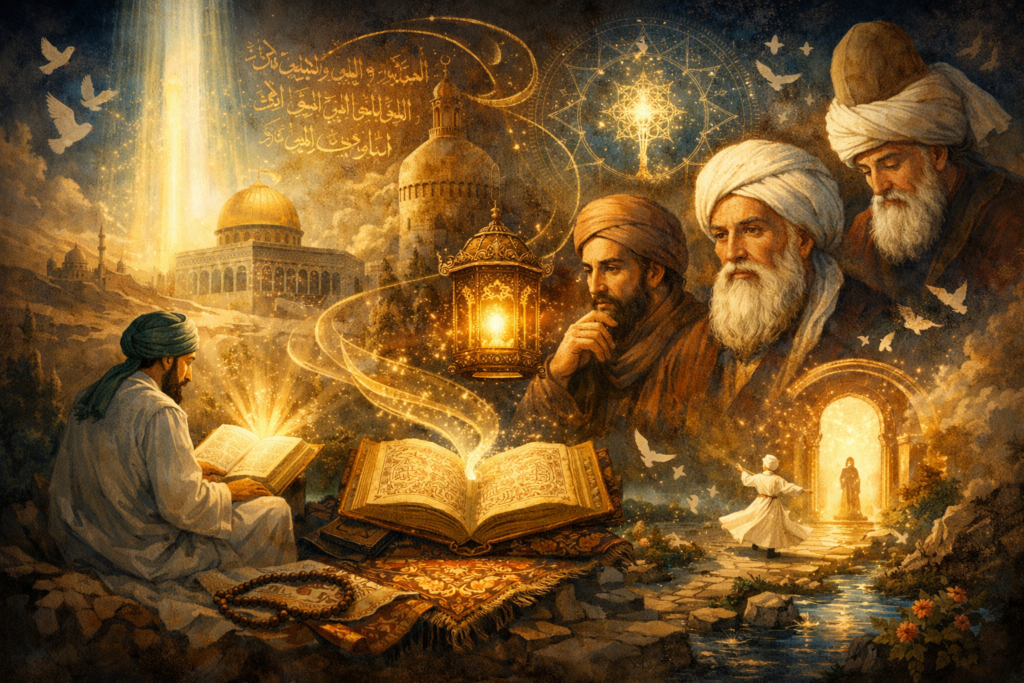
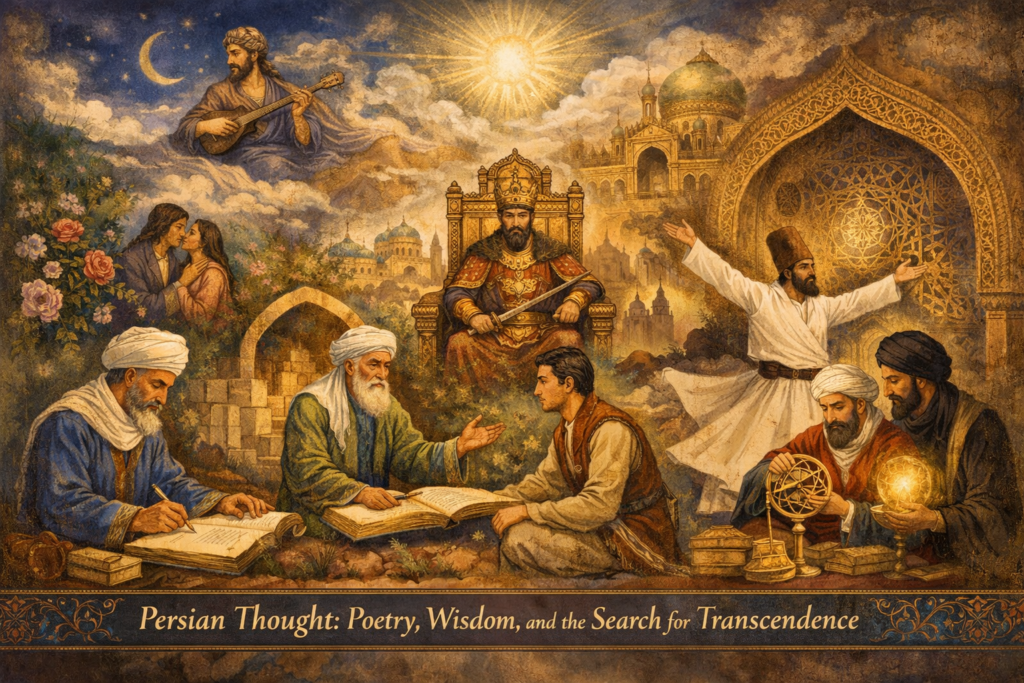
Illustration of Islamic and mystical thought showing revelation, wisdom, spiritual discipline, calligraphic light, and the inward journey of the soul.

Islamic and Mystical Thought: Revelation, Wisdom, and the Journey of the Soul

Islamic and mystical thought examines the intellectual and spiritual traditions through which Muslim thinkers reflected on revelation, wisdom, law, ethics, metaphysics, love, selfhood, and the soul’s relation to God. This pillar explores the Qur’anic and prophetic foundations of spirituality, the rise of Sufism, and the major syntheses of al-Ghazali, Suhrawardi, Ibn Arabi, Rumi, and Attar, showing how revelation, reason, beauty, and inward transformation became part of a single integrated search for truth.

Illustration of Persian thought showing poetry, ethical wisdom, kingship, mysticism, and philosophical reflection in Persian civilization.

Persian Thought: Poetry, Wisdom, and the Search for Transcendence

Persian thought examines the philosophical, poetic, ethical, mystical, political, historical, and civilizational traditions through which Persian writers and thinkers reflected on wisdom, beauty, justice, kingship, love, transcendence, and the meaning of human life. This field is not a narrow literary inheritance or a single doctrinal school, but a vast civilizational tradition in which epic memory, ethical prose, lyric poetry, metaphysical philosophy, Sufi longing, historiography, and political reflection continually inform one another. At its core lies a defining philosophical question: how should human beings seek truth, cultivate the soul, remember civilization, and live under the demands of beauty, justice, mortality, and transcendence? This content pillar explores pre-Islamic Iranian memory, Zoroastrian moral order, Ferdowsi, Saadi, Nizami, Attar, Nasir Khusraw, Omar Khayyam, Hafez, Rumi, Jami, Avicenna, Suhrawardi, Mulla Sadra, Shi‘i philosophy, mirrors-for-princes traditions, Persian historiography, and the wider Persianate world, showing why Persian thought remains one of the world’s most luminous traditions of integrated wisdom, poetic intelligence, and metaphysical depth.

Illustration of Russian thought showing literature, conscience, psychological depth, historical struggle, and the drama of the soul in the Russian tradition.

Russian Thought: Literature, Conscience, and the Drama of the Soul

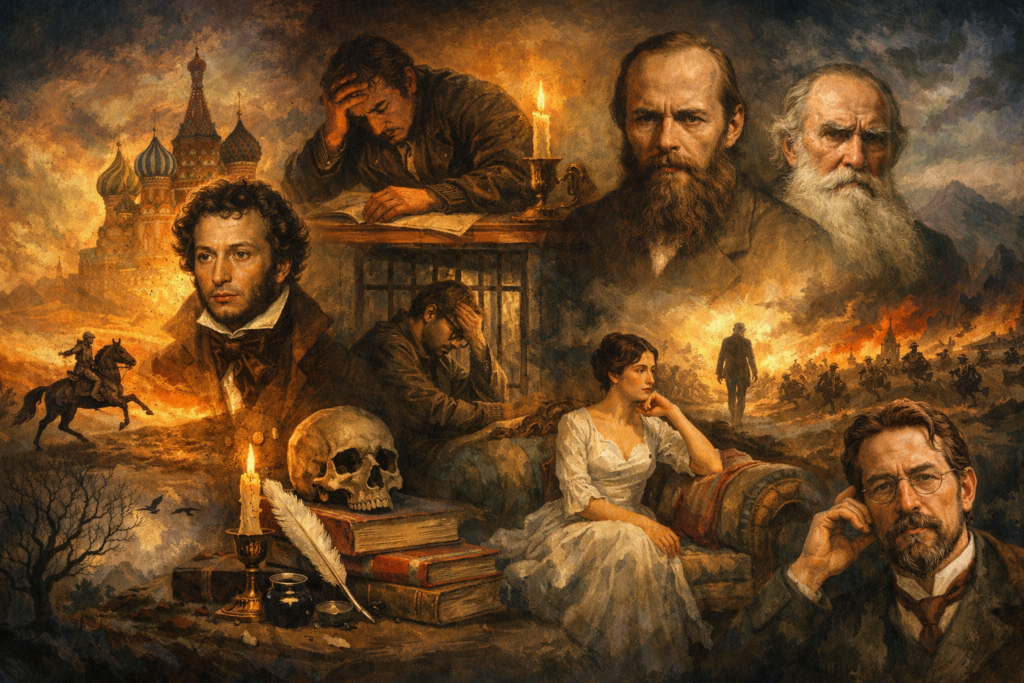
Russian thought examines the literary, moral, psychological, and civilizational traditions through which Russian writers and thinkers explored freedom, conscience, suffering, history, social order, and the meaning of human life. This pillar follows the arc from Pushkin to Chekhov, showing how Russian literature became one of the world’s most powerful mediums for philosophical inquiry, spiritual conflict, psychological depth, and the drama of human becoming.

Illustration of Chinese thought showing ritual order, harmony, self-cultivation, governance, and classical philosophical reflection in Chinese civilization.

Chinese Thought: Harmony, Cultivation, and the Order of Human Life

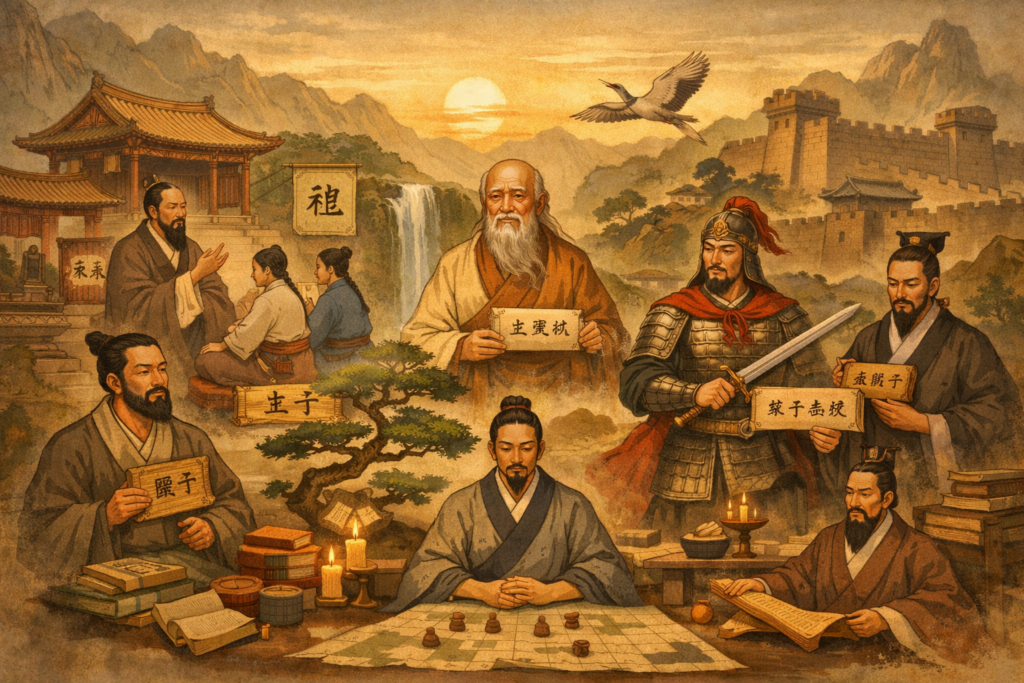
Chinese thought examines the major philosophical traditions that shaped conceptions of self-cultivation, harmony, governance, ritual order, moral formation, and the relationship between human life and the larger cosmos. This field is not merely a study of Confucianism, Daoism, Mohism, and Legalism in isolation, but a broad civilizational inquiry into how persons, families, states, and the world itself should be brought into fitting relation. At its core lies a defining philosophical question: how should human life be cultivated and ordered under heaven? This content pillar explores Confucius, Mencius, Xunzi, Laozi, Zhuangzi, Mozi, Han Feizi, Sunzi, the Yijing, Chinese Buddhism, Neo-Confucianism, qi, li, yin-yang, the Five Phases, ritual, law, empire, moral psychology, and the metaphysics of change, showing why Chinese thought remains one of the world’s deepest traditions for understanding ethics, governance, cosmology, and the disciplined art of living well.

Illustration of existential thought showing freedom, anxiety, selfhood, responsibility, and philosophical reflection on the human condition.

Existential Thought: Freedom, Finitude, and the Burden of Becoming

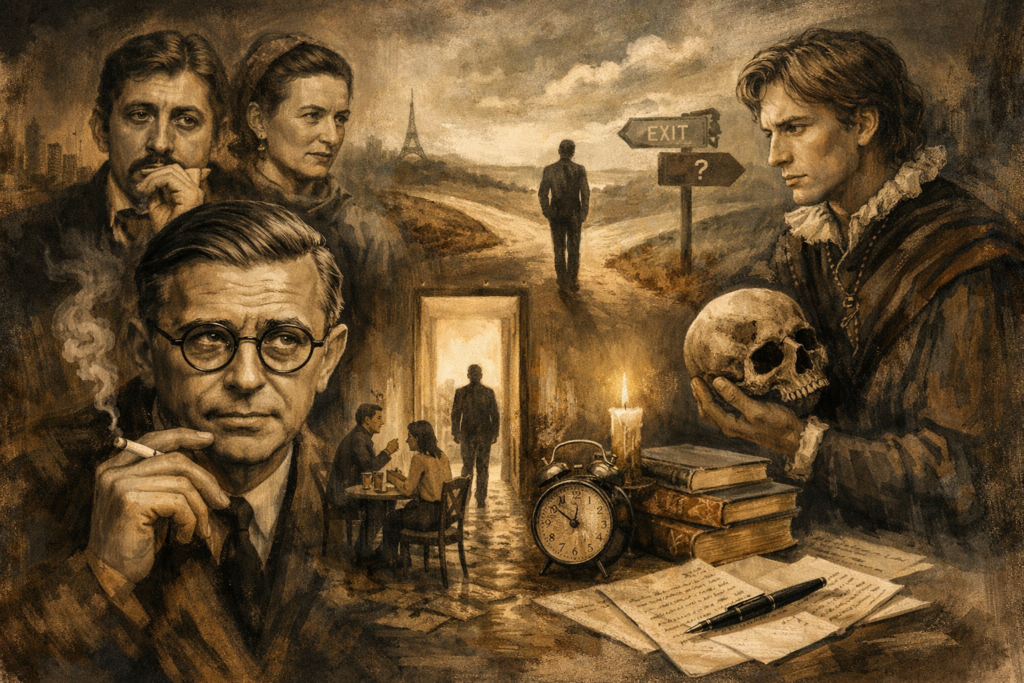
Existential thought examines the human condition through themes such as freedom, anxiety, inwardness, choice, responsibility, meaning, finitude, embodiment, alienation, and becoming. This field is not a single doctrine or rigid school, but a broad family of philosophical, literary, and spiritual approaches that begin from lived existence rather than abstract system alone. At its core lies a defining philosophical question: what does it mean for a human being to become a self under conditions of uncertainty, mortality, historical pressure, and moral burden? This content pillar explores Kierkegaard, Nietzsche, Heidegger, Sartre, Beauvoir, Camus, Marcel, Proust, Dostoevsky, Kafka, Stendhal, Balzac, Fanon, Black existentialism, anti-colonial struggle, embodiment, ambiguity, absurdity, and the politics of responsibility, showing why existential thought remains one of the most powerful traditions for understanding freedom, selfhood, fragility, and the burden of becoming.

Illustration of Greek and Roman thought showing virtue, reason, civic order, philosophy, and classical reflection in the ancient world.

Greek and Roman Thought: Virtue, Reason, and the Classical Search for Wisdom

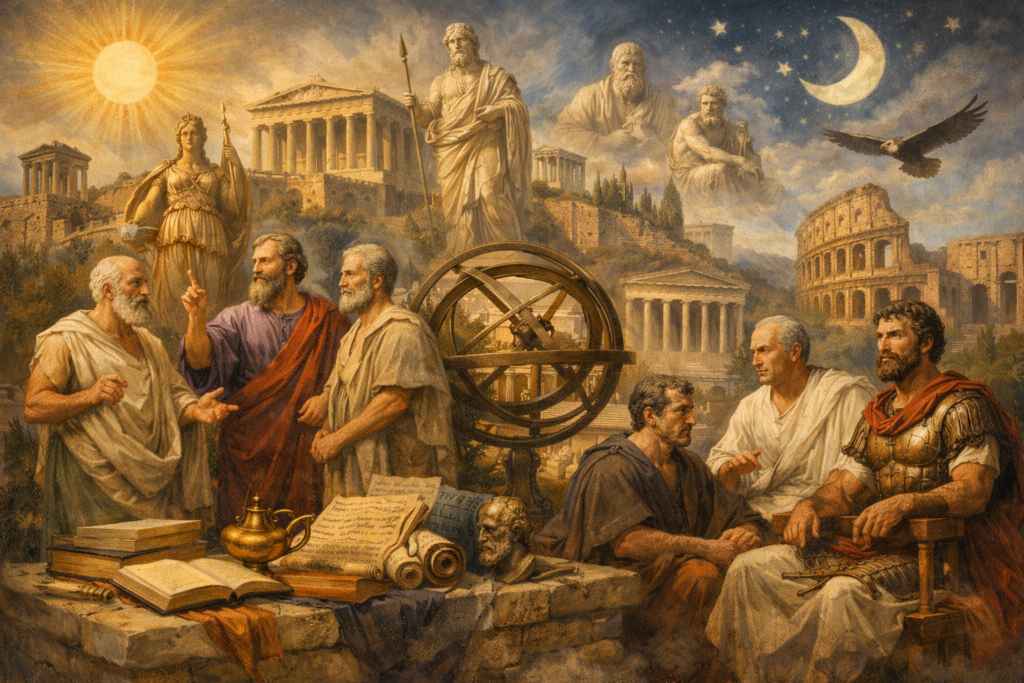
Greek and Roman thought examines the classical traditions of ancient philosophy that shaped enduring ideas about reason, virtue, civic order, law, rhetoric, metaphysics, mathematics, and the disciplined pursuit of wisdom. This field is not merely a study of canonical thinkers, but a broad inquiry into how the ancient Mediterranean world understood nature, truth, justice, education, the soul, political life, and the good life under conditions of mortality, hierarchy, and civic obligation. At its core lies a defining philosophical question: how should human beings order the self, the city, and their understanding of the cosmos in light of reason? This content pillar explores the pre-Socratics, Socrates, Plato, Aristotle, the Hellenistic schools, Roman philosophy, mathematics, tragedy, law, religion, exclusion, and the long afterlife of classical thought in late antiquity, Christianity, Islam, and medieval philosophy, showing why Greek and Roman thought remains one of the deepest foundations of philosophical reflection on human life.

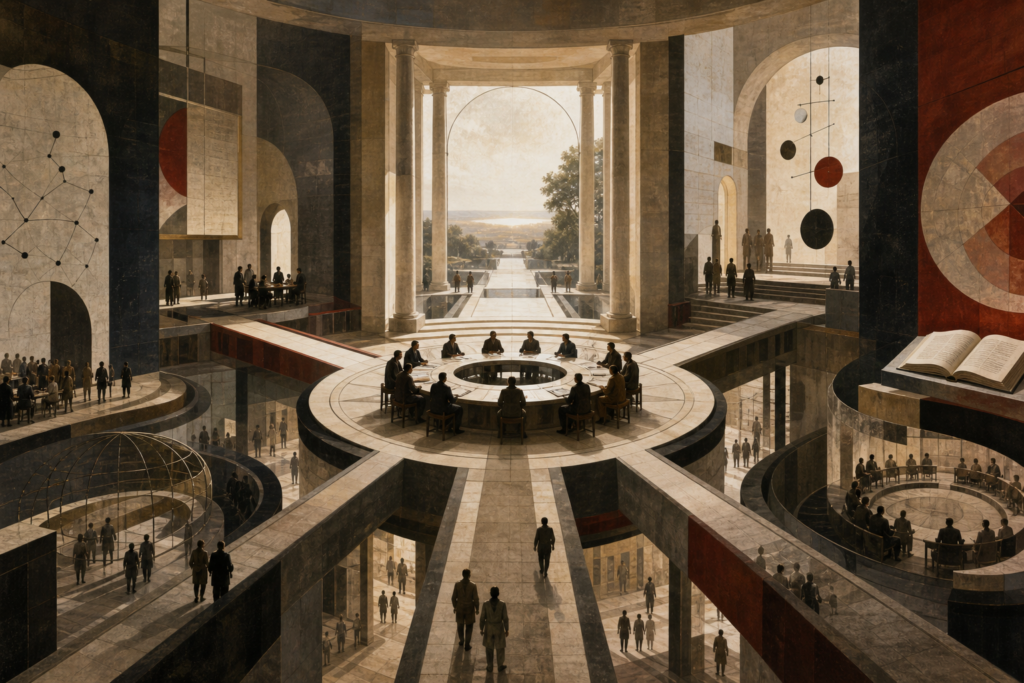
Editorial philosophical illustration of political philosophy and justice as a civic architecture of public reasoning, with converging pathways, deliberative forums, institutional thresholds, abstract civic networks, open books, and horizon light representing authority, liberty, equality, rights, democracy, legitimacy, and collective life.

Political Philosophy and Justice: Liberty, Legitimacy, and the Common Good

Political philosophy and justice examine the principles that govern authority, freedom, equality, rights, obligation, legitimacy, and the morally defensible organization of collective life. This field is not merely commentary on governments or public policy, but a sustained philosophical inquiry into how power should be justified, what political communities owe to their members, what makes institutions legitimate, and how justice should structure social order. At its core lies a defining political question: how can human beings live together under conditions of law, coercion, distribution, hierarchy, and shared vulnerability in ways that are morally intelligible and open to justification? This content pillar explores justice, liberty, rights, authority, democracy, obligation, equality, property, sovereignty, domination, and the common good, showing why political philosophy remains indispensable wherever institutions claim obedience, distribute power, and shape the terms of collective life.

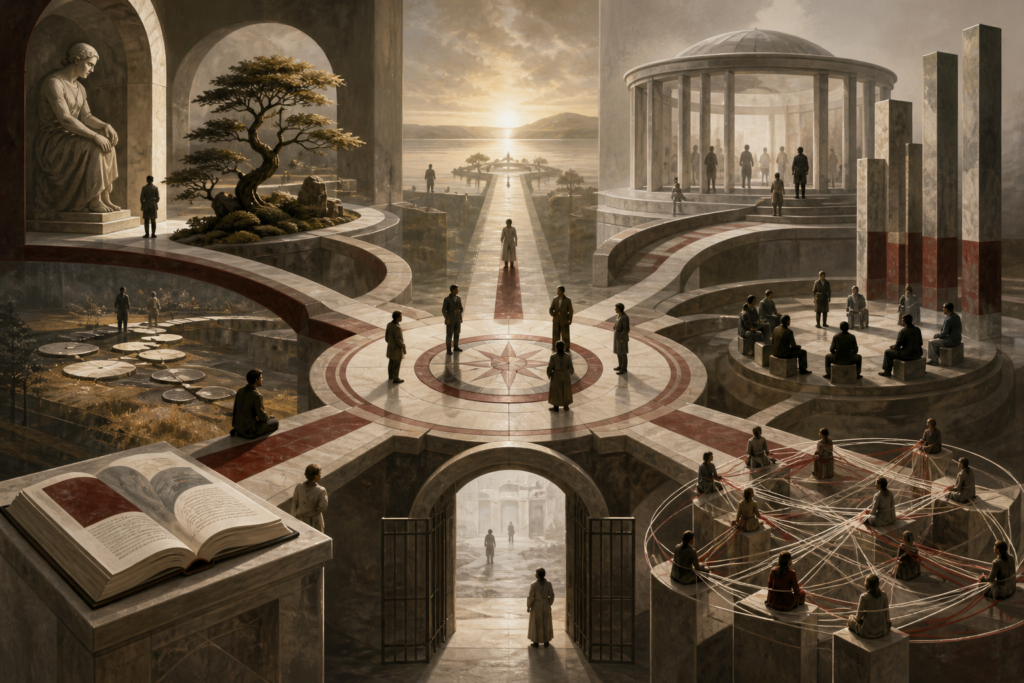
Editorial philosophical illustration of ethics and moral philosophy as a stone architecture of moral reasoning, with branching paths, reflective figures, civic forums, care networks, institutional gates, and horizon light representing virtue, duty, consequence, responsibility, and the search for the good life.

Ethics and Moral Philosophy: Virtue, Duty, and the Search for the Good Life

Ethics and Moral Philosophy: Virtue, Duty, and the Search for the Good Life examines the principles, values, traditions of judgment, and forms of reasoning through which human beings evaluate right action, responsibility, character, obligation, justice, dignity, and the conditions of a good life. This pillar explores virtue ethics, deontology, consequentialism, care ethics, metaethics, and applied ethics alongside broader civilizational traditions of moral reflection, including Islamic ethics and Chinese ethics, where revelation, self-cultivation, ritual order, accountability, and harmony shape the moral life in ways that both overlap with and challenge modern Western categories. By treating ethics not as a fixed catalogue of rules but as a living philosophical inquiry into flourishing, duty, consequence, relationship, conflict, and moral justification, the category provides a serious framework for understanding how persons, institutions, and societies reason about what ought to be valued, what may never be justified, and how one should live.

Scroll to Top