International Law

International law governs the relationships between states, international organizations, and other global actors. It provides the legal framework through which nations coordinate diplomacy, resolve disputes, regulate cross-border activity, and establish shared norms for global cooperation.

The field encompasses treaty law, customary international law, international humanitarian law, human rights law, environmental law, and the legal regimes governing trade, security, and global commons such as oceans and outer space. These legal systems are essential for managing collective challenges that transcend national borders.

International law plays an increasingly important role in addressing issues such as climate governance, global security, migration, and international development. By establishing rules, procedures, and accountability mechanisms, international legal frameworks help structure cooperation between sovereign states while balancing national interests with global responsibilities.

Scholarly illustration of an international criminal law archive with tribunal diagrams, evidence files, command-responsibility charts, witness records, scales, legal volumes, sealed documents, and accountability pathways.

War Crimes, Crimes Against Humanity, Genocide, and the Architecture of International Criminal Law

The law of war regulates how armed conflict is fought, even when war itself is unlawful. This article explains the core principles of international humanitarian law: distinction, proportionality, military necessity, humanity, precautions in attack, protection of civilians, civilian objects, medical units, persons hors de combat, and limits on methods and means of warfare. It examines Additional Protocol I, customary IHL, Rome Statute war crimes, targeting rules, urban warfare, siege tactics, hospitals, drones, cyber operations, autonomous systems, command responsibility, and the relationship between battlefield judgment and legal accountability. The article also addresses contemporary conflicts, including Gaza, Ukraine, and other settings where civilian harm, military objectives, dual-use infrastructure, and claims of necessity are contested. By connecting doctrine, case studies, and lawyer-facing workflows, it shows how the law of war seeks to restrain violence without legitimizing armed conflict across real-world operational settings.


Scholarly illustration of a weapons-law review dossier with arms-control diagrams, prohibited-weapons symbols, emerging military technology schematics, humanitarian indicators, scales, treaty files, maps, and legal oversight materials.

Weapons Law, Prohibited Means of Warfare, and Emerging Military Technologies

Weapons law regulates the means and methods of warfare by prohibiting weapons that cause superfluous injury, unnecessary suffering, indiscriminate effects, or lasting harm beyond lawful military necessity. This article explains treaty and customary limits on chemical weapons, biological weapons, blinding lasers, mines, cluster munitions, incendiary weapons, explosive remnants of war, and explosive weapons in populated areas. It also examines Article 36 weapons reviews, nuclear weapons, drones, autonomous weapons, AI-enabled targeting, cyber operations, space systems, environmental damage, arms transfers, and accountability for unlawful weapons use. The article connects IHL principles of distinction, proportionality, precautions, military necessity, and humanity to emerging military technologies whose effects may be difficult to predict, control, or audit. By combining doctrine, treaty frameworks, institutional practice, and lawyer-facing workflows, it shows how international law evaluates weapons before and during armed conflict with institutional caution, evidence, and restraint.

Scholarly illustration of an occupation-law dossier with a mapped war-torn territory, administrative zones, humanitarian routes, detention-review pathways, legal files, scales, maps, and archival records.

Occupation, Detention, and the Legal Governance of War-Torn Territory

Occupation and detention law governs territory and persons controlled during armed conflict, especially when military power administers civilian life after combat has shifted or ceased. This article explains belligerent occupation, effective control, the Hague Regulations, Geneva Convention IV, protected persons, internment, prisoners of war, security detention, fair trial guarantees, humanitarian relief, property, deportation, transfer, settlements, collective punishment, resource administration, and the continuing role of human rights law. It examines how occupying powers must preserve public order while respecting existing law, protecting civilians, allowing relief, and avoiding annexation or demographic engineering. The article also addresses non-international armed conflicts, detention by non-state armed groups, ICRC access, accountability, war crimes, and contested occupations in modern conflicts. By connecting doctrine, treaty law, case studies, and lawyer-facing workflows, it shows how law governs war-torn territory without treating domination as sovereignty in contemporary international practice.

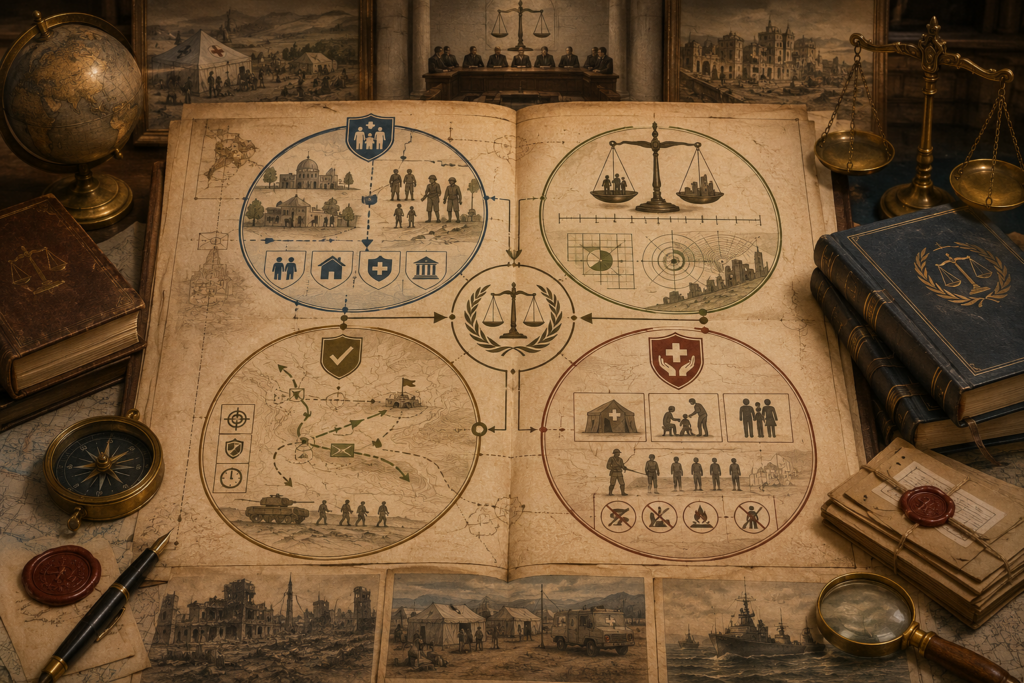
Scholarly illustration of a law-of-war dossier with four legal principles, scales, protected-person symbols, humanitarian relief imagery, military maps, treaty volumes, and archival legal materials.

The Law of War: Distinction, Proportionality, Necessity, and Humanity

The law of war regulates how armed conflict is fought, even when war itself is unlawful. This article explains the core principles of international humanitarian law: distinction, proportionality, military necessity, humanity, precautions in attack, protection of civilians, civilian objects, medical units, persons hors de combat, and limits on methods and means of warfare. It examines Additional Protocol I, customary IHL, Rome Statute war crimes, targeting rules, urban warfare, siege tactics, hospitals, drones, cyber operations, autonomous systems, command responsibility, and the relationship between battlefield judgment and legal accountability. The article also addresses contemporary conflicts, including Gaza, Ukraine, and other settings where civilian harm, military objectives, dual-use infrastructure, and claims of necessity are contested. By connecting doctrine, case studies, and lawyer-facing workflows, it shows how the law of war seeks to restrain violence without legitimizing armed conflict across contested operational, evidentiary, humanitarian, and institutional decision points.

Scholarly illustration of a legal dossier on international humanitarian law with Geneva Convention motifs, protected persons, medical symbols, detention imagery, battlefield limits, aid transport, and accountability pathways.

International Humanitarian Law: The Geneva Conventions and the Regulation of Armed Conflict

International humanitarian law governs the conduct of armed conflict even when the resort to force is unlawful. Centered on the Geneva Conventions, their Additional Protocols, Common Article 3, customary international humanitarian law, and war-crimes doctrine, this article explains how IHL protects wounded and sick combatants, prisoners of war, civilians, medical personnel, humanitarian relief, and persons in occupied territory. It examines conflict classification, international and non-international armed conflicts, protected persons, occupation, detention, humanitarian access, targeting, distinction, proportionality, military necessity, humane treatment, and the relationship between IHL and international human rights law. The article also addresses enforcement gaps, grave breaches, command responsibility, non-state armed groups, new technologies, urban warfare, Gaza, Ukraine, and selective compliance. By connecting doctrine, treaty texts, institutional practice, and lawyer-facing workflows, it shows how the law of armed conflict restrains violence without legitimizing war itself in modern practice.

Scholarly illustration of a UN-style legal chamber and parchment policy diagram with humanitarian pathways, protection symbols, scales, legal books, maps, and crisis-response imagery representing humanitarian intervention, Responsibility to Protect, and the limits of sovereignty.

Humanitarian Intervention, Responsibility to Protect, and the Limits of Sovereignty

Humanitarian intervention and the Responsibility to Protect sit at the difficult boundary between sovereignty, non-intervention, human rights, atrocity prevention, and the prohibition on the use of force. This article explains how international law addresses claims that force may be used to prevent genocide, crimes against humanity, war crimes, ethnic cleansing, or mass civilian suffering. It examines the UN Charter, Article 2(4), Security Council authorization, Rwanda, Srebrenica, Kosovo, Libya, Syria, Palestine, Gaza, and the 2005 World Summit formulation of R2P. The article also explores the risks of abuse: selective enforcement, regime-change mandates, great-power manipulation, racialized humanitarianism, Global South skepticism, and the weakening of collective security. By connecting doctrine, institutional practice, case studies, and lawyer-facing workflows, it shows why humanitarian protection remains morally urgent but legally constrained by sovereignty, Charter authority, and political power in modern crises.

Scholarly illustration of a parchment legal diagram with UN Charter motifs, a council chamber, scales, a gavel, maps, and institutional pathways representing self-defense, collective security, and the UN legal framework.

Self-Defense, Collective Security, and the UN Charter Framework

Self-defense is the principal Charter exception to the prohibition on the use of force, but it is not a general license for unilateral military action. This article explains how Article 51 of the United Nations Charter preserves individual and collective self-defense when an armed attack occurs, while requiring necessity, proportionality, immediacy, Security Council reporting, and respect for the wider collective-security system. It examines armed attack, anticipatory and preventive self-defense, collective defense, non-state actors, proxy force, occupation, cyber operations, drones, and the relationship between self-defense and Security Council authorization. The article also addresses leading ICJ jurisprudence, the Definition of Aggression, contested uses of force, Palestine, Ukraine, Iraq, Afghanistan, and selective invocation by powerful states. By connecting doctrine, institutions, cases, and lawyer-facing workflows, it shows how self-defense remains legally vital but politically vulnerable in modern international law across contemporary global disputes.

Scholarly illustration of an international legal archive with a central prohibition symbol, UN Charter-style legal diagrams, maps, council chamber imagery, scales, treaty volumes, and a gavel representing the prohibition on the use of force.

The Prohibition on the Use of Force in International Law

The prohibition on the use of force is one of the central rules of modern international law. Anchored in Article 2(4) of the United Nations Charter, it restricts states from using or threatening force against the territorial integrity or political independence of other states, while leaving narrow space for Security Council authorization and self-defense. This article explains the legal meaning of force, threats of force, aggression, intervention, occupation, proxy warfare, drones, cyber operations, and humanitarian intervention claims. It examines the UN Charter, the Definition of Aggression, ICJ jurisprudence, self-defense doctrine, collective security, and the relationship between use-of-force law and state responsibility. It also addresses selective enforcement, great-power impunity, Palestine, Ukraine, Iraq, Kosovo, and the future of the Charter framework in an age of hybrid conflict, technological change, and geopolitical fragmentation.

Scholarly illustration of an international legal archive with a judgment flowchart, compliance files, monitoring reports, scales, a gavel, maps, and institutional records representing the limits of international adjudication.

Compliance, Enforcement, and the Limits of International Adjudication

International adjudication can clarify legal obligations, produce authoritative findings, order remedies, and create records of responsibility, but its effectiveness depends on compliance, enforcement, political support, institutional follow-through, and domestic implementation. This article examines why international judgments, advisory opinions, provisional measures, arbitral awards, human-rights decisions, criminal-court orders, and WTO rulings matter even when enforcement is imperfect. It explains the role of UN Charter Article 94, Security Council politics, ICJ compliance, ICC cooperation, regional human-rights supervision, arbitral award enforcement, domestic courts, sanctions, non-recognition, reparations, guarantees of non-repetition, and civil-society legal mobilization. It also addresses selective enforcement, unequal access, great-power resistance, and the gap between legal authority and practical consequence. By connecting doctrine, institutions, and lawyer-facing workflows, the article shows how international adjudication constrains power while revealing the limits of law in a decentralized global legal order.

Scroll to Top