
Last Updated June 24, 2026
International humanitarian law is the body of international law that regulates armed conflict after war has begun. It does not decide whether the resort to force was lawful. That question belongs primarily to the jus ad bellum: the UN Charter rules on the use of force, self-defense, and collective security. International humanitarian law instead asks a different question: once an armed conflict exists, what limits bind the parties? The Geneva Conventions, their Additional Protocols, customary international humanitarian law, and the wider law of armed conflict seek to protect people who are not fighting, people who can no longer fight, civilian objects, medical services, humanitarian relief, prisoners of war, the wounded and sick, shipwrecked forces, occupied populations, and civilians trapped inside war.
International humanitarian law is one of the most morally urgent parts of international law because it operates where legal order is most visibly under strain. It accepts the grim fact that armed conflict occurs, but refuses the conclusion that war is a lawless space. The law does not make war humane in any simple sense. It limits cruelty, structures military conduct, protects vulnerable persons, disciplines means and methods of warfare, and preserves a minimum legal distinction between fighting and extermination, military operations and terror, detention and disappearance, occupation and annexation, targeting and collective punishment.
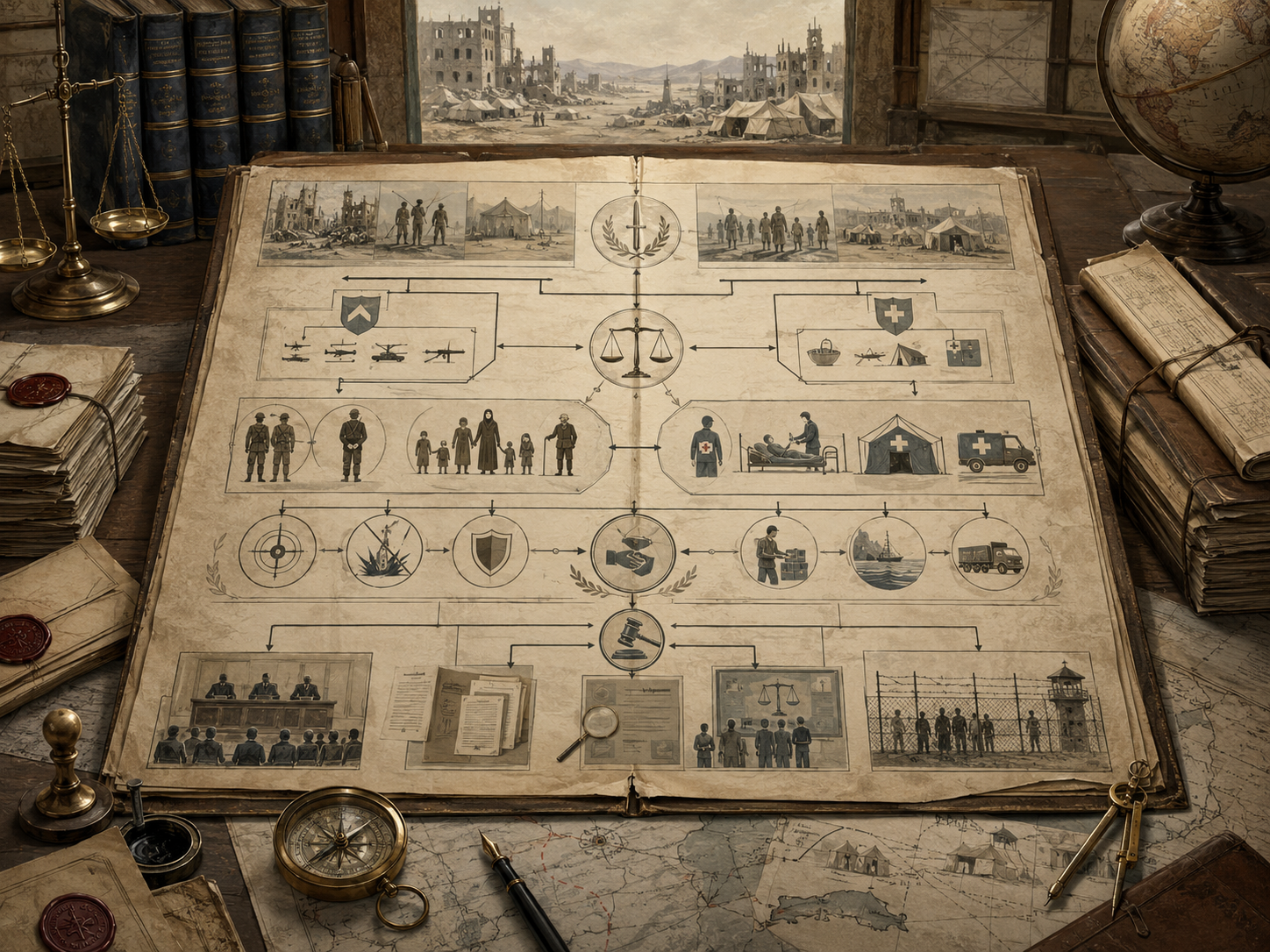
This article explains international humanitarian law as the law governing armed conflict. It examines the Geneva Conventions, Additional Protocols, Common Article 3, international and non-international armed conflict, protected persons, prisoners of war, medical neutrality, occupation, humanitarian relief, targeting, civilian protection, customary IHL, war crimes, accountability, and the continuing challenge of applying humanitarian law in urban warfare, siege, drones, cyber operations, autonomous weapons, detention operations, and conflicts involving non-state armed groups.
What Is International Humanitarian Law?
International humanitarian law, often called IHL or the law of armed conflict, is the set of rules that applies in situations of armed conflict. Its central purpose is to limit the effects of war for humanitarian reasons. It protects persons who are not participating in hostilities, persons who are no longer participating, and certain objects, services, and spaces essential to civilian survival and human dignity. It also restricts the means and methods of warfare available to parties to conflict.
IHL is not the law of peace in the ordinary sense. It does not assume that war can always be prevented. It is a law of restraint inside violence. That makes it morally complicated but legally necessary. The law begins from the recognition that, even when armed conflict exists, parties are not free to do whatever military power makes possible. They must distinguish combatants from civilians, military objectives from civilian objects, lawful attacks from unlawful attacks, detention from abuse, occupation from annexation, and military necessity from cruelty.
Humanitarian law premise
“International humanitarian law is a set of rules which seek, for humanitarian reasons, to limit the effects of armed conflict.”
International Committee of the Red Cross, introductory formulation of IHL.
This formulation captures IHL’s basic structure: it does not eliminate war, but it seeks to limit its human effects.
IHL is treaty-based and customary. The treaty core includes the four Geneva Conventions of 1949, the Additional Protocols of 1977 and 2005, weapons treaties, cultural-property instruments, and criminal-law instruments that define war crimes. Customary IHL supplements treaty law and binds parties where rules have crystallized through state practice and opinio juris. In practice, lawyers must analyze both treaty obligations and customary rules.
The law applies to states and, in important respects, to non-state armed groups. It applies in international armed conflicts between states and in non-international armed conflicts between a state and organized armed groups, or between such groups where the relevant threshold is met. The exact classification matters because not all treaty rules apply identically in every conflict type. But the minimum humanitarian floor is not optional.
IHL is therefore both highly technical and deeply human. It requires classification, jurisdictional analysis, textual interpretation, factual investigation, command responsibility analysis, and assessment of military operations. But its underlying purpose is simple: to preserve human beings from unlimited violence.
Jus ad Bellum and Jus in Bello
One of the most important distinctions in the law of armed conflict is the distinction between jus ad bellum and jus in bello. Jus ad bellum concerns the legality of resorting to force. It asks whether a state’s use of force is justified under the UN Charter, self-defense, Security Council authorization, or another claimed legal basis. Jus in bello, or international humanitarian law, concerns the conduct of parties once armed conflict exists.
The distinction matters because IHL applies regardless of which party is legally or morally responsible for starting the conflict. A state fighting a lawful defensive war must still comply with IHL. A state committing aggression is still entitled to certain protections for its wounded, prisoners of war, and civilians. Soldiers on both sides remain protected by rules governing detention, medical care, and humane treatment. Civilians do not lose protection because their government acted unlawfully. Humanitarian law would collapse if protection depended on resolving the political legality of the war first.
This separation does not mean the two bodies of law are unrelated. Aggression, occupation, annexation, and unlawful force may shape the wider legal context. They may affect responsibility, reparations, non-recognition, and institutional response. But IHL’s operational rules still apply independently. The attacker must distinguish civilians from military objectives even if the war is unlawful. The defender must also comply with IHL even when resisting aggression.
This principle prevents humanitarian protection from becoming a reward for the legally favored side. IHL protects people because of their status and vulnerability, not because of the political righteousness of the authority claiming to act for them. It is precisely in morally charged conflicts that this discipline matters most.
For lawyers, the distinction is indispensable. A memorandum on a military operation must ask both questions separately: was the resort to force lawful, and was the conduct of hostilities lawful? A lawful defensive war may contain unlawful attacks. An unlawful war may contain individual operations conducted in compliance with IHL. The categories should not be collapsed.
The Geneva Conventions of 1949
The four Geneva Conventions of 1949 form the treaty foundation of modern international humanitarian law. Adopted after the Second World War, they codified and expanded protections for wounded and sick armed forces in the field, wounded, sick, and shipwrecked armed forces at sea, prisoners of war, and civilians in time of war. They are among the most universally accepted treaties in international law and remain the central legal architecture for humanitarian protection in armed conflict.
The First Geneva Convention protects wounded and sick members of armed forces in the field. The Second Geneva Convention adapts similar protections to wounded, sick, and shipwrecked members of armed forces at sea. The Third Geneva Convention governs prisoners of war, including status, treatment, labor, discipline, trial, and repatriation. The Fourth Geneva Convention protects civilians, including those in occupied territory and those in the hands of a party to the conflict of which they are not nationals.
Geneva Conventions framework
“The Geneva Conventions and their Additional Protocols are international treaties that contain the most important rules limiting the barbarity of war.”
International Committee of the Red Cross, Geneva Conventions and their Commentaries.
The Conventions are not peripheral humanitarian aspirations. They are the treaty core of modern IHL.
The Geneva Conventions are built around protected status, humane treatment, medical care, non-discrimination, respect for humanitarian personnel, and constraints on detention, occupation, and civilian harm. They are especially important because they create obligations not merely between states, but toward individuals. The wounded soldier, the prisoner of war, the civilian in occupied territory, the medical worker, and the shipwrecked combatant become legal subjects protected by treaty.
The Conventions also contain enforcement provisions. They require dissemination, national implementation, penal sanctions for grave breaches, search for persons alleged to have committed grave breaches, and cooperation with humanitarian activities. Their legal force depends not only on battlefield compliance but on domestic criminalization, military training, command systems, and political willingness to investigate violations.
Their significance should not be reduced to history. Contemporary conflicts continue to raise Geneva Convention questions every day: treatment of detainees, evacuation of the wounded, hospital protection, civilian displacement, occupation administration, relief access, prisoner exchanges, missing persons, siege conditions, forced transfers, and accountability for grave breaches.
The Additional Protocols and the Modernization of IHL
The Additional Protocols of 1977 expanded and modernized the Geneva framework. Additional Protocol I applies to international armed conflicts and develops rules on the conduct of hostilities, civilian protection, methods and means of warfare, and wars of national liberation. Additional Protocol II applies to certain non-international armed conflicts and strengthens protections for persons affected by internal armed conflict. Additional Protocol III, adopted in 2005, introduced the red crystal as an additional protective emblem.
Additional Protocol I is especially important because it codifies many core targeting rules that now define modern IHL analysis. It elaborates distinction, civilian immunity, proportionality, precautions in attack, protection of civilian objects, protection of works and installations containing dangerous forces, and prohibitions on indiscriminate attacks. Even where not every state is party to Additional Protocol I, many of its core rules are widely treated as reflecting customary law.
Protocol I targeting rule
“The civilian population as such, as well as individual civilians, shall not be the object of attack.”
Additional Protocol I to the Geneva Conventions, Article 51(2).
The rule is central to modern targeting law: civilians are not lawful objects of attack unless and for such time as they directly participate in hostilities.
Additional Protocol II was historically significant because treaty law for non-international armed conflicts had been much thinner than the law for inter-state war. Common Article 3 provided a minimum floor, but Additional Protocol II expanded protections in conflicts between state armed forces and organized armed groups that meet the Protocol’s threshold. It addresses humane treatment, persons deprived of liberty, wounded and sick persons, protection of civilians, relief, and forced movement of civilians.
The Protocols also demonstrate how IHL evolves in response to changing conflict realities. The post-1945 world saw decolonization wars, internal conflicts, guerrilla warfare, aerial bombardment, technological change, and growing recognition that civilian protection needed stronger operational rules. The Additional Protocols responded by bringing conduct-of-hostilities law more fully into treaty form.
For legal analysis, the Protocols require careful attention to ratification, conflict classification, customary status, and the relationship between treaty text and operational practice. A state may not be party to a Protocol, yet a rule in the Protocol may still bind it as customary law. Conversely, treaty obligations may be more detailed than customary rules in some settings. Lawyers should not treat the Protocols as either universally binding in every provision or irrelevant where not ratified. The analysis must be precise.
Common Article 3 and Minimum Protections
Common Article 3 appears in all four Geneva Conventions and is often described as a convention in miniature. It applies in non-international armed conflicts and establishes minimum protections for persons taking no active part in hostilities, including members of armed forces who have laid down their arms and those placed hors de combat by sickness, wounds, detention, or any other cause.
Common Article 3 prohibits violence to life and person, murder, mutilation, cruel treatment, torture, taking hostages, outrages upon personal dignity, humiliating and degrading treatment, and sentences or executions without judgment by a regularly constituted court affording judicial guarantees. It also requires the wounded and sick to be collected and cared for.
Minimum humanitarian floor
“Persons taking no active part in the hostilities… shall in all circumstances be treated humanely.”
Common Article 3 to the Geneva Conventions of 1949.
Common Article 3 is foundational because it creates minimum protections even in internal armed conflicts.
The importance of Common Article 3 cannot be overstated. Many of the world’s most devastating conflicts are not classic inter-state wars. They involve civil wars, insurgencies, armed groups, fragmented authority, foreign support to non-state actors, proxy conflicts, or mixed conflicts with both international and non-international dimensions. Common Article 3 ensures that minimum humanitarian protections do not disappear because a conflict is internal.
Common Article 3 also has moral and institutional significance. It rejects the idea that a state may treat internal enemies however it wishes simply because the conflict is domestic. It gives international legal significance to humane treatment inside non-international conflict. That was a major transformation in a legal order historically centered on sovereign states.
For lawyers, Common Article 3 is often the first provision to analyze when the conflict classification is contested. Even if a party denies that an international armed conflict exists, even if it denies the legitimacy of the opposing armed group, even if it describes operations as counterterrorism or domestic security, Common Article 3 may still apply if the threshold for non-international armed conflict is met.
Classification of Armed Conflicts
Conflict classification is one of the threshold tasks in IHL analysis. The applicable treaty framework often depends on whether the situation is an international armed conflict, a non-international armed conflict, an occupation, or a mixed situation involving multiple overlapping classifications. Misclassification can distort the entire legal analysis.
An international armed conflict generally exists when there is resort to armed force between states. It does not require a declaration of war. It does not require formal recognition of war. It may arise through invasion, occupation, bombardment, cross-border hostilities, or other armed confrontation between states. The Geneva Conventions apply in international armed conflict and in cases of partial or total occupation, even if the occupation meets no armed resistance.
A non-international armed conflict generally involves protracted armed violence between governmental authorities and organized armed groups, or between such groups, with sufficient intensity and organization. The threshold is higher than internal disturbance, riot, sporadic violence, or ordinary criminality. The legal classification turns on facts: intensity of hostilities, organization of armed groups, command structure, territorial control, duration, weapons, casualties, displacement, and the state’s response.
Some conflicts are mixed. A civil war may become internationalized through foreign intervention. A state may occupy territory while also fighting organized armed groups. A non-state armed group may operate across borders. A coalition may use force in support of one party. Different legal relationships within the same theater may be classified differently. Lawyers should avoid assuming that a conflict has a single classification for all purposes.
Classification is not merely technical. It affects detention authority, combatant immunity, prisoner-of-war status, occupation law, grave-breach regimes, targeting rules, and criminal accountability. Parties may strategically resist classification because legal consequences follow. A government may call a conflict an internal security operation to avoid the language of armed conflict. A state may deny occupation to avoid duties toward the population. Legal analysis must therefore be evidence-based rather than rhetorical.
Protected Persons and Civilian Protection
Civilian protection is one of the central purposes of IHL. Civilians are protected against direct attack unless and for such time as they directly participate in hostilities. Civilian objects are protected unless they become military objectives. The law also prohibits acts or threats of violence whose primary purpose is to spread terror among the civilian population, collective punishment, hostage-taking, forced displacement except where lawfully justified, and attacks on objects indispensable to civilian survival.
The Fourth Geneva Convention is central to civilian protection, especially for civilians in the hands of a party to the conflict or occupying power of which they are not nationals. It regulates treatment, internment, occupied territory, transfers, relief, penal legislation, and protections against coercion. It is especially important where a civilian population lives under occupation, siege, detention, or hostile control.
Civilian protection also depends on conduct-of-hostilities rules. A party may not intentionally target civilians. It may not treat an entire city, neighborhood, hospital area, refugee camp, or civilian population as an undifferentiated enemy. It must distinguish specific military objectives from protected civilians and civilian objects. It must assess proportionality and take feasible precautions. Civilian protection is therefore both status-based and operation-specific.
The difficult questions arise in urban warfare, irregular conflict, and conflicts involving armed groups embedded in civilian areas. The presence of fighters or military objectives among civilians does not erase civilian protection. At the same time, IHL does not prohibit every attack that risks civilian harm. It prohibits direct attacks on civilians, indiscriminate attacks, disproportionate attacks, and attacks conducted without required precautions. The law demands disciplined analysis rather than slogans.
Protected persons must not be reduced to categories in a spreadsheet. Civilian protection is the place where international law tries to prevent military logic from consuming human life. Its practical effect depends on intelligence quality, command culture, rules of engagement, legal review, targeting processes, humanitarian access, after-action investigation, and willingness to hold violators accountable.
Wounded, Sick, Shipwrecked, and Medical Protection
The protection of the wounded, sick, shipwrecked, medical personnel, medical units, and medical transports is one of the oldest and most recognizable parts of humanitarian law. The First and Second Geneva Conventions focus on these protections in land and sea warfare, and the Additional Protocols expand the modern framework. The basic principle is that those who are wounded, sick, shipwrecked, or otherwise hors de combat must be respected, protected, collected, and cared for without adverse distinction.
Medical neutrality is essential to IHL. Medical personnel must not be attacked for performing medical duties. Hospitals, ambulances, medical units, and medical transports are protected. The protective emblems — including the red cross, red crescent, and red crystal — mark protected humanitarian and medical functions. Misuse of these emblems undermines the protective system and may itself be unlawful.
The law recognizes that medical facilities may lose protection if they are used, outside their humanitarian function, to commit acts harmful to the enemy. But this exception must be read narrowly. The presence of wounded combatants in a hospital does not make the hospital a military objective. Medical protection would be meaningless if care for enemy wounded could transform a hospital into a target. Warnings, reasonable time limits, precautions, and proportionality remain central where loss of protection is alleged.
Attacks on medical infrastructure are especially devastating because they multiply harm. Destroying a hospital, ambulance system, clinic, power supply, water facility, or medical supply chain affects not only immediate casualties but future wounded, infants, pregnant people, chronic patients, people with disabilities, elderly civilians, and public health systems. IHL’s protection of medical services is therefore also protection of civilian survival.
For lawyers, medical-protection analysis requires careful factual inquiry: What was the object? What was its function? Was it being used for harmful acts outside its humanitarian function? Was warning required and given? Were feasible precautions taken? Was the expected incidental harm excessive? Was there investigation after attack? The legal analysis cannot rest on bare assertions of military use.
Prisoners of War and Detention
The Third Geneva Convention governs the treatment of prisoners of war in international armed conflict. Prisoner-of-war status is not a reward for moral conduct. It is a legal status designed to protect captured combatants and certain other categories of persons from abuse, revenge, disappearance, coercion, and unlawful prosecution merely for lawful participation in hostilities. POWs must be treated humanely, protected against violence and intimidation, given adequate food, shelter, and medical care, allowed communication and relief, and released and repatriated in accordance with the Convention.
Detention in armed conflict is one of the areas where IHL, human rights law, domestic law, and security policy often collide. States may seek intelligence, incapacitation, leverage, or punishment. IHL insists that detention is regulated. Torture, cruel treatment, humiliation, enforced disappearance, denial of fair trial guarantees, hostage-taking, and execution without due process are prohibited.
In international armed conflict, combatant status and POW status are central. In non-international armed conflict, there is no identical treaty-based POW regime, but Common Article 3, Additional Protocol II where applicable, customary law, human rights law, and domestic law constrain detention and treatment. Persons detained in NIAC do not fall into a legal black hole.
The most dangerous detention practices often arise when parties use labels to evade law. A detainee may be called a terrorist, unlawful combatant, security detainee, infiltrator, enemy operative, or criminal suspect. Labels may matter for classification, but they do not erase minimum protections. A person in custody is under the control of the detaining authority, and that control triggers legal duties.
Detention analysis must also address access by the ICRC, family contact, registration, conditions of confinement, interrogation, transfer risk, trial rights, release, and accountability for abuse. In many conflicts, detention is where the legal order is tested most brutally because the detainee is no longer a battlefield threat but remains vulnerable to the detaining power.
Occupation and the Legal Governance of Controlled Territory
Occupation law regulates the situation in which territory comes under the authority of a hostile army. Occupation does not transfer sovereignty. The occupying power acquires temporary authority and assumes duties toward the protected population. These duties include public order and safety, respect for existing laws unless prevented, protection of civilians, humane treatment, provision of food and medical supplies, facilitation of relief, and restrictions on transfers, deportations, settlement, destruction of property, and annexationist measures.
The Fourth Geneva Convention and Hague Regulations are central to occupation law. Occupation is not made lawful simply because it is administered efficiently. Nor is it erased because the occupying power denies the label. The test is factual: whether territory is placed under the authority of hostile forces and whether that authority can be exercised. Legal duties flow from effective control.
Occupation law is especially important because occupation can become a long-term structure of domination. Temporary military control may evolve into settlement, resource extraction, demographic engineering, annexation, dependency, fragmentation, and permanent denial of self-determination. IHL regulates occupation, but occupation also raises questions under the law of self-determination, human rights, non-recognition, state responsibility, and the prohibition on acquisition of territory by force.
The occupying power must balance security needs against duties to the occupied population. Security may justify some measures, but it does not authorize collective punishment, forcible transfer, settlement implantation, arbitrary detention, destruction of property not justified by military necessity, or exploitation of resources for the occupier’s benefit. Occupation law exists precisely because military control over another people creates extreme vulnerability.
For legal analysis, occupation requires attention to effective control, territorial scope, applicable instruments, protected-person status, security measures, relief obligations, property rules, detention, transfers, settlement activity, administrative changes, and relationship to self-determination. The longer the occupation, the more urgent the question becomes whether temporary military administration has become a mechanism for permanent domination.
Humanitarian Relief, Starvation, and Siege Warfare
Humanitarian relief is one of the central practical questions in modern armed conflict. Civilians caught in war require food, water, medicine, shelter, electricity, fuel, sanitation, evacuation, and access to medical care. IHL regulates relief operations, protects humanitarian personnel and objects, and imposes duties related to civilian survival. Parties must allow and facilitate rapid and unimpeded passage of humanitarian relief for civilians in need, subject to lawful control measures under applicable rules.
The starvation of civilians as a method of warfare is prohibited. This prohibition is not limited to literal denial of food. It includes attacks on or deprivation of objects indispensable to civilian survival, such as foodstuffs, agricultural areas, crops, livestock, drinking water installations, irrigation works, and other systems necessary for civilian life. Siege warfare must still comply with IHL. A siege does not suspend civilian protection.
Relief law becomes especially urgent in urban warfare and encirclement. A party may seek to isolate enemy forces, but it may not use civilian starvation as a weapon. It may not arbitrarily deny humanitarian access. It may not impose conditions that make relief meaningless. It must take feasible steps to protect civilians and allow relief consistent with IHL. Humanitarian access disputes should not be treated as mere logistics; they are legal issues.
Humanitarian organizations also require independence, impartiality, and security. The ICRC, UN agencies, medical organizations, and local relief networks often operate in conditions of extreme danger. Attacking, obstructing, or instrumentalizing humanitarian relief can deepen civilian suffering and undermine the law’s protective architecture.
For lawyers, relief analysis requires identifying the applicable conflict classification, the civilian need, the party controlling access, the legal basis for relief, any asserted security objections, the proportionality of restrictions, the treatment of humanitarian personnel, and whether denial of relief forms part of a broader pattern of starvation, forced displacement, collective punishment, or siege abuse.
Targeting, Distinction, Proportionality, and Precautions
Targeting law is often where IHL becomes most operational. The principle of distinction requires parties to distinguish between civilians and combatants, and between civilian objects and military objectives. Attacks may be directed only against military objectives. Civilian objects are protected unless and for such time as they become military objectives. Indiscriminate attacks are prohibited.
Proportionality prohibits attacks expected to cause incidental civilian death, civilian injury, damage to civilian objects, or a combination thereof that would be excessive in relation to the concrete and direct military advantage anticipated. This is not a balancing of civilian life against vague strategic benefit. It requires a concrete and direct military advantage, reasonable ex ante assessment, and serious consideration of expected civilian harm.
Customary IHL excerpt
“Launching an attack which may be expected to cause incidental loss of civilian life… which would be excessive in relation to the concrete and direct military advantage anticipated, is prohibited.”
ICRC Customary IHL Study, Rule 14.
The proportionality rule is central to operational legal review of attacks.
Precautions require parties to take feasible measures to verify targets, choose means and methods that reduce civilian harm, give effective advance warning where circumstances permit, and cancel or suspend attacks where it becomes apparent that the target is not lawful or that civilian harm would be excessive. Precautions are not afterthoughts. They are part of the legality of attack planning and execution.
Targeting analysis is difficult because it depends on information available at the time, not perfect hindsight. But this does not mean any asserted intelligence is enough. Lawyers must examine what was known, what should reasonably have been known, what verification steps were feasible, what alternatives existed, what civilian harm was expected, how military advantage was defined, and whether commanders reassessed as circumstances changed.
Modern conflicts make targeting analysis harder. Urban warfare, tunnels, drones, cyber operations, dual-use infrastructure, human shields, explosive weapons in populated areas, and real-time intelligence all complicate the legal assessment. But complexity does not eliminate the rules. It makes disciplined legal review more important.
Customary International Humanitarian Law
Customary international humanitarian law is essential because treaty participation varies and because many conflicts involve parties that are not states. Customary rules arise from general practice accepted as law. In IHL, customary law helps extend core protections across conflict types and fills gaps where treaty law is limited, not ratified, or unclear.
The ICRC’s Customary IHL Study is a major reference point, identifying rules on distinction, proportionality, precautions, medical protection, humanitarian relief, detention, weapons, civilian objects, cultural property, missing persons, and implementation. The study is influential, though particular rules and formulations may be debated. Lawyers should use it carefully: it is an important resource, not a substitute for independent legal analysis of state practice and opinio juris where contested.
Customary IHL is especially important for non-international armed conflicts. Treaty law for NIAC remains thinner than for international armed conflict, but many customary rules apply in both. This helps protect civilians and detainees in the conflicts most common in contemporary practice.
Customary law also matters for states that have not ratified certain Additional Protocols or weapons treaties. A state may reject a treaty provision as treaty law while still being bound by an equivalent customary rule. Conversely, not every treaty provision has customary status. The distinction must be analyzed rather than assumed.
The practical value of customary IHL is that it resists legal fragmentation. It helps ensure that core humanitarian protections do not depend entirely on technical ratification status or the formal identity of the parties. Its weakness is that custom can be contested, and powerful states may resist rules they find operationally inconvenient. For that reason, customary IHL must be grounded in evidence and defended with doctrinal rigor.
War Crimes and Individual Criminal Responsibility
Serious violations of IHL may constitute war crimes. War crimes can be prosecuted in domestic courts, international criminal tribunals, hybrid courts, or the International Criminal Court where jurisdiction exists. The move from state responsibility to individual criminal responsibility is one of the major developments in modern international law. It means that commanders, political leaders, soldiers, and other individuals may be held personally responsible for grave violations.
War crimes include, among other acts, willful killing, torture, inhuman treatment, unlawful deportation or transfer, unlawful confinement, taking hostages, intentionally directing attacks against civilians, intentionally directing attacks against civilian objects, attacking humanitarian or peacekeeping personnel where protected, employing prohibited weapons in applicable circumstances, conscripting or enlisting children under the relevant age threshold, and intentionally starving civilians as a method of warfare under applicable law.
Command responsibility is especially important. A commander may be responsible not only for direct orders but also for failing to prevent or punish crimes by subordinates where the legal threshold is met. This doctrine reflects the reality that organized violence operates through hierarchy, command systems, discipline, intelligence, logistics, and operational control. Accountability cannot stop with the person who physically commits the act.
Criminal accountability also depends on evidence. Targeting records, orders, communications, detention logs, medical records, satellite imagery, chain-of-command documents, witness statements, forensic evidence, and open-source materials may all matter. In modern conflict, digital evidence has become increasingly important, but it requires authentication, preservation, contextualization, and legal analysis.
War-crimes accountability is often selective. Some perpetrators are prosecuted; others are protected by state power, alliance structures, lack of jurisdiction, or practical inability to arrest suspects. This selectivity does not make war-crimes law meaningless. It makes enforcement a central legal and political challenge.
Urban Warfare, Cyber Operations, Drones, and Autonomous Weapons
International humanitarian law applies to new technologies and changing forms of warfare. The core rules do not disappear because the means of warfare change. Cyber operations, drones, autonomous systems, artificial intelligence-enabled targeting, satellite surveillance, electronic warfare, and long-range precision weapons must still be assessed under distinction, proportionality, precautions, military necessity, humanity, weapons law, and accountability standards.
Urban warfare is one of the most devastating contemporary settings for IHL. Military objectives, civilians, hospitals, schools, religious sites, markets, tunnels, infrastructure, and armed groups may exist in close proximity. Explosive weapons with wide-area effects can cause catastrophic civilian harm in populated areas. The legal question is not simply whether a military objective exists somewhere in the area. It is whether the attack is directed at a lawful military objective, whether expected civilian harm is excessive, and whether feasible precautions have been taken.
Cyber operations raise questions about what counts as an attack, what objects are protected, how civilian harm is measured, and how reverberating effects should be assessed. A cyber operation that disables electricity, water systems, hospitals, transportation, or financial infrastructure may cause civilian harm even without kinetic destruction. IHL analysis must account for foreseeable indirect effects, not only immediate physical damage.
Drones and remote warfare create a different challenge. Distance can improve surveillance and precision, but it can also lower political cost, normalize targeted killing, obscure accountability, and rely on intelligence patterns that misidentify civilians. The legality of a drone strike depends on conflict classification, target status, location, consent or use-of-force law, distinction, proportionality, precautions, and post-strike review.
Autonomous weapons raise perhaps the most difficult future-facing questions. If a system selects and engages targets with limited human control, can it comply reliably with distinction and proportionality? Who is responsible for unlawful harm: commander, programmer, manufacturer, state, operator, or all of them? IHL does not require nostalgia for older weapons. But it does require that legal judgment not be outsourced beyond accountability.
IHL and International Human Rights Law
IHL and international human rights law often operate together in armed conflict. IHL is the specialized law of armed conflict. Human rights law continues to apply, subject to lawful derogations and the interaction between the two regimes. The relationship is not always simple. Some questions are governed primarily by IHL, some by human rights law, and some by both.
The right to life, detention protections, fair trial rights, prohibition of torture, family life, freedom of movement, property rights, health, food, water, and non-discrimination may all remain relevant during armed conflict. IHL provides the lex specialis for certain conduct-of-hostilities questions, but human rights law can remain crucial for occupation, detention, policing, internal security, and long-term control over populations.
The International Court of Justice has repeatedly recognized that human rights obligations do not necessarily cease in armed conflict. The Nuclear Weapons advisory opinion, Wall advisory opinion, and other materials reflect the continuing relevance of human rights law alongside IHL. The precise relationship must be analyzed issue by issue.
This is especially important in occupation and long-term security control. A situation may involve armed conflict, but the occupying or controlling authority may also exercise functions similar to governance, policing, detention administration, resource control, movement regulation, and public-service management. Human rights law helps evaluate these longer-term structures of control.
For lawyers, the practical rule is not to choose IHL or human rights law too quickly. Identify the conduct, classify the conflict, determine territorial or extraterritorial jurisdiction, identify applicable treaties, assess derogations, and analyze how the regimes interact. The goal is not doctrinal tidiness. The goal is protection.
Selective Enforcement and the Crisis of Humanitarian Law
International humanitarian law faces a crisis not because its basic principles are obsolete, but because compliance and enforcement are often selective. States and armed groups invoke IHL when accusing enemies, minimize it when constraining themselves, and manipulate its language to justify conduct that the law was designed to restrain. Powerful states and their allies often escape accountability more easily than weaker actors.
This selectivity is especially visible in conflicts involving occupation, siege, mass civilian casualties, detention abuse, targeted killings, starvation, indiscriminate bombardment, attacks on medical infrastructure, and denial of humanitarian relief. The law may be clear in principle, but enforcement depends on political will, jurisdiction, evidence, access, domestic courts, international institutions, and willingness to impose consequences.
Selective enforcement damages IHL because the law’s legitimacy depends on universality. If the rules are treated as binding only on enemies, then humanitarian law becomes another weapon of information warfare. But the answer is not to abandon IHL. The answer is to insist that the same rules apply regardless of alliance, ideology, identity, or geopolitical convenience.
IHL also faces the danger of technocratic misuse. Legal compliance language can become a way to normalize repeated civilian harm if analysis is reduced to formulas, secret intelligence, or broad military claims. A targeting process may be formally legalistic while structurally permissive. A serious humanitarian-law analysis must therefore examine both legal categories and institutional practice.
The crisis of IHL is ultimately a crisis of political courage. The law contains powerful protections. The question is whether states, courts, investigators, military lawyers, civil society, journalists, humanitarian organizations, and publics are willing to apply those protections consistently to friends as well as enemies.
Conclusion
International humanitarian law is one of the most important achievements of modern international law because it insists that even armed conflict remains subject to legal restraint. The Geneva Conventions, Additional Protocols, Common Article 3, customary IHL, weapons law, and war-crimes frameworks protect people who would otherwise be left to the full violence of military necessity, revenge, occupation, detention, siege, and technological power.
But IHL is not self-enforcing. Its effectiveness depends on training, command discipline, legal review, humanitarian access, domestic implementation, investigation, prosecution, reparations, and political willingness to apply the rules consistently. Its deepest weakness is not that the law lacks relevance. It is that parties often violate, manipulate, or selectively invoke it when legal restraint conflicts with military or political objectives.
The law also must be defended against two opposite distortions. It should not be dismissed as naïve because violations occur. Nor should it be used to sanitize war by treating technical compliance language as a substitute for humanitarian judgment. IHL is strongest when it is applied rigorously, publicly, and equally, with attention to the actual human consequences of military operations.
The Geneva Conventions remain essential because they preserve a minimum moral and legal claim in the worst conditions: the wounded must be cared for, prisoners must be treated humanely, civilians must not be targeted, hospitals must be protected, occupation must be regulated, starvation must not be used as a weapon, and war crimes must not disappear into the fog of military rhetoric. The law does not end war. But without it, war more easily becomes extermination, disappearance, terror, and impunity.
Lawyer’s IHL Analysis Checklist
- Classify the situation: Determine whether there is an international armed conflict, non-international armed conflict, occupation, mixed conflict, or internal disturbance below IHL threshold.
- Identify applicable law: Map the Geneva Conventions, Additional Protocols, customary IHL, weapons treaties, human rights law, domestic law, and criminal-law instruments.
- Identify parties and protected persons: Determine the status of states, armed groups, civilians, combatants, detainees, medical personnel, aid workers, occupied persons, and persons hors de combat.
- Separate jus ad bellum from IHL: Do not let the legality of resort to force determine whether humanitarian protections apply.
- Analyze conduct of hostilities: Apply distinction, military objective, proportionality, precautions, indiscriminate attack rules, and weapons restrictions.
- Analyze detention and treatment: Assess POW status, humane treatment, fair-trial guarantees, torture prohibitions, ICRC access, registration, transfer risk, and release obligations.
- Assess occupation duties: Evaluate effective control, civilian administration, relief, property, transfers, settlement, security measures, and the relationship to self-determination.
- Assess humanitarian access: Examine relief needs, consent, denial, conditions, starvation risk, attacks on aid workers, and obstruction of medical care.
- Evaluate responsibility: Consider state responsibility, individual criminal responsibility, command responsibility, grave breaches, domestic prosecution, and international jurisdiction.
- Document evidence: Preserve orders, targeting logs, videos, witness statements, medical records, satellite imagery, detention records, and chain-of-command materials.
International Humanitarian Law Practice Table
| Issue | Core Legal Question | Main Authorities | Practice Notes |
|---|---|---|---|
| Conflict classification | Is the situation IAC, NIAC, occupation, mixed conflict, or below threshold? | Geneva Conventions Common Articles 2 and 3; Additional Protocols; ICTY Tadić | Start with facts, not labels used by parties. |
| Civilian targeting | Was the attack directed at a lawful military objective? | Additional Protocol I; customary IHL rules on distinction | Separate target status from proportionality and precautions. |
| Proportionality | Was expected incidental civilian harm excessive in relation to concrete and direct military advantage? | Additional Protocol I; customary IHL Rule 14 | Use ex ante information, but test reasonableness rigorously. |
| Precautions | Were feasible measures taken to verify targets and reduce civilian harm? | Additional Protocol I; customary IHL precautions rules | Analyze alternatives, warnings, timing, weapons, and cancellation duties. |
| Detention | What status and protections apply to persons deprived of liberty? | GC III, GC IV, Common Article 3, human rights law | Labels do not erase humane-treatment obligations. |
| Occupation | Does a hostile force exercise effective control over territory? | Hague Regulations; GC IV; customary IHL | Occupation is factual and does not transfer sovereignty. |
| Humanitarian relief | Are civilians in need being denied rapid and unimpeded relief? | GC IV, Additional Protocols, customary IHL | Assess starvation, siege, arbitrary denial, and aid-worker protection. |
| War crimes | Does the conduct constitute a serious IHL violation with individual criminal responsibility? | Rome Statute; grave-breach provisions; customary law | Map actus reus, mens rea, command structure, and jurisdiction. |
Leading Authorities for IHL Analysis
Geneva Conventions of 1949
The foundational treaty framework protecting wounded and sick forces, shipwrecked forces, prisoners of war, and civilians.
Additional Protocol I
Key treaty framework for international armed conflict, conduct of hostilities, civilian protection, and targeting rules.
Additional Protocol II
Important treaty development for non-international armed conflicts meeting its threshold.
Common Article 3
Minimum humanitarian floor for non-international armed conflicts and persons not actively participating in hostilities.
ICRC Customary IHL Study
Major resource identifying customary IHL rules across conflict types.
ICJ Nuclear Weapons Advisory Opinion
Major judicial statement on fundamental IHL principles and weapons analysis.
ICTY Tadić
Leading authority on conflict classification, especially non-international armed conflict and internationalization.
Rome Statute
Core international criminal law instrument defining war crimes within ICC jurisdiction.
Applied IHL Examples
Example 1: Urban Airstrike on a Claimed Command Center
The analysis begins by asking whether the claimed command center is a military objective. If it is, the inquiry continues to expected civilian harm, feasible precautions, available alternatives, warning, weapon selection, timing, intelligence reliability, and whether the attack was expected to cause excessive incidental harm. The presence of a military objective in a civilian area does not eliminate civilian protection.
Example 2: Detention of Fighters in a Non-International Armed Conflict
Even without POW status, detainees remain protected by Common Article 3, customary IHL, human rights law, and domestic law. The detaining authority must ensure humane treatment, prohibit torture, provide basic judicial guarantees, register detention, and prevent disappearance or transfer to abuse.
Example 3: Hospital Strike Allegedly Based on Military Use
The legal analysis must establish the hospital’s protected status, the factual basis for alleged loss of protection, whether harmful acts outside humanitarian function occurred, whether warning was required and given, whether feasible precautions were taken, and whether expected civilian and medical-system harm was excessive.
Example 4: Siege and Denial of Relief Supplies
A siege does not suspend IHL. The analysis must examine civilian need, starvation risk, objects indispensable to survival, humanitarian access, evacuation, medical care, and whether restrictions are arbitrary or amount to starvation of civilians as a method of warfare.
Memo, Brief, and Advisory Workflow
- Frame the issue: Identify the factual conduct: attack, detention, occupation measure, denial of relief, weapon use, transfer, or treatment of protected persons.
- Classify the conflict: State the classification and explain the evidence supporting it.
- Identify governing law: List treaty obligations, customary rules, human rights law, criminal-law provisions, and domestic implementing rules.
- Apply status rules: Identify civilians, combatants, POWs, medical personnel, detainees, occupied persons, or persons hors de combat.
- Apply conduct rules: Analyze distinction, proportionality, precautions, humane treatment, relief, or occupation duties as appropriate.
- Address defenses and claims: Consider military necessity, security, direct participation, loss of protection, human shields, intelligence uncertainty, and feasibility.
- Assess responsibility: Evaluate state responsibility, individual criminal liability, command responsibility, and institutional accountability.
- Recommend action: Propose compliance measures, investigation, preservation of evidence, relief access, operational change, reparations, or referral pathways.
Common Pitfalls in IHL Analysis
- Collapsing jus ad bellum and IHL: A lawful war can contain unlawful conduct; an unlawful war does not erase protections for persons on either side.
- Assuming party labels control classification: Conflict classification depends on facts and legal thresholds, not political terminology.
- Treating civilian harm as automatically unlawful: IHL prohibits direct, indiscriminate, and disproportionate attacks, but not every incidental harm in armed conflict.
- Treating military necessity as unlimited: Military necessity operates within IHL; it does not override IHL’s prohibitions.
- Ignoring precautions: An attack may be unlawful because feasible precautions were not taken even if the target was a military objective.
- Overlooking reverberating effects: Damage to electricity, water, hospitals, communications, and infrastructure may cause foreseeable civilian harm beyond the blast radius.
- Assuming detention labels eliminate rights: Terrorist, unlawful combatant, or security detainee labels do not erase humane-treatment and fair-process protections.
- Using IHL to sanitize policy: Technical legal compliance language should not obscure patterns of civilian harm, occupation, starvation, or systematic abuse.
GitHub Repository
The companion repository folder supports this article with structured research materials, source metadata, treaty tables, conflict-classification notes, targeting-law matrices, protected-persons summaries, quote logs, and editorial documentation. It is intended to make the article’s research workflow more transparent while keeping the public article focused on legal explanation rather than technical setup.
Complete Code Repository
Explore the supporting research materials for this article, including Geneva Conventions notes, Additional Protocol summaries, Common Article 3 materials, conflict-classification matrices, protected-persons mapping, targeting-law frameworks, occupation-law notes, humanitarian-relief materials, war-crimes references, and structured outputs on the regulation of armed conflict.
Related Articles
- International Law Foundations
- The Prohibition on the Use of Force in International Law
- Self-Defense, Collective Security, and the UN Charter Framework
- Humanitarian Intervention, Responsibility to Protect, and the Limits of Sovereignty
- The Law of War: Distinction, Proportionality, Necessity, and Humanity
- Occupation, Detention, and the Legal Governance of War-Torn Territory
- Weapons Law, Prohibited Means of Warfare, and Emerging Military Technologies
- War Crimes, Crimes Against Humanity, Genocide, and the Architecture of International Criminal Law
Primary Authorities
- International Committee of the Red Cross (1949) Geneva Convention I for the Amelioration of the Condition of the Wounded and Sick in Armed Forces in the Field. Available at: https://ihl-databases.icrc.org/en/ihl-treaties/gci-1949.
- International Committee of the Red Cross (1949) Geneva Convention II for the Amelioration of the Condition of Wounded, Sick and Shipwrecked Members of Armed Forces at Sea. Available at: https://ihl-databases.icrc.org/en/ihl-treaties/gcii-1949.
- International Committee of the Red Cross (1949) Geneva Convention III relative to the Treatment of Prisoners of War. Available at: https://ihl-databases.icrc.org/en/ihl-treaties/gciii-1949.
- International Committee of the Red Cross (1949) Geneva Convention IV relative to the Protection of Civilian Persons in Time of War. Available at: https://ihl-databases.icrc.org/en/ihl-treaties/gciv-1949.
- International Committee of the Red Cross (1977) Additional Protocol I to the Geneva Conventions. Available at: https://ihl-databases.icrc.org/en/ihl-treaties/api-1977.
- International Committee of the Red Cross (1977) Additional Protocol II to the Geneva Conventions. Available at: https://ihl-databases.icrc.org/en/ihl-treaties/apii-1977.
- International Committee of the Red Cross (2005) Additional Protocol III to the Geneva Conventions. Available at: https://ihl-databases.icrc.org/en/ihl-treaties/apiii-2005.
- International Committee of the Red Cross (n.d.) The Geneva Conventions and their Commentaries. Available at: https://www.icrc.org/en/law-and-policy/geneva-conventions-and-their-commentaries.
- International Committee of the Red Cross (n.d.) Customary International Humanitarian Law Database. Available at: https://ihl-databases.icrc.org/en/customary-ihl.
- International Committee of the Red Cross (n.d.) Customary IHL Rule 1: The Principle of Distinction between Civilians and Combatants. Available at: https://ihl-databases.icrc.org/en/customary-ihl/v1/rule1.
- International Committee of the Red Cross (n.d.) Customary IHL Rule 14: Proportionality in Attack. Available at: https://ihl-databases.icrc.org/en/customary-ihl/v1/rule14.
- International Court of Justice (1996) Legality of the Threat or Use of Nuclear Weapons. Available at: https://www.icj-cij.org/case/95.
- International Criminal Court (1998) Rome Statute of the International Criminal Court. Available at: https://www.icc-cpi.int/publications/core-legal-texts/rome-statute-international-criminal-court.
- International Criminal Tribunal for the former Yugoslavia (1995) Prosecutor v. Tadić, Decision on Jurisdiction. Available at: https://www.icty.org/x/cases/tadic/acdec/en/51002.htm.
Further Reading
- Dinstein, Y. (2016) The Conduct of Hostilities under the Law of International Armed Conflict. 3rd edn. Cambridge: Cambridge University Press. Available at: https://www.cambridge.org/core/books/conduct-of-hostilities-under-the-law-of-international-armed-conflict/.
- Henckaerts, J.-M. and Doswald-Beck, L. (2005) Customary International Humanitarian Law. Cambridge: Cambridge University Press / ICRC. Available at: https://www.icrc.org/en/publication/0860-customary-international-humanitarian-law-volume-i-rules.
- Kolb, R. and Hyde, R. (2008) An Introduction to the International Law of Armed Conflicts. Oxford: Hart Publishing. Available at: https://www.bloomsbury.com/us/introduction-to-the-international-law-of-armed-conflicts-9781841137995/.
- Melzer, N. (2019) International Humanitarian Law: A Comprehensive Introduction. Geneva: ICRC. Available at: https://www.icrc.org/en/publication/4231-international-humanitarian-law-comprehensive-introduction.
- Sassòli, M. (2019) International Humanitarian Law: Rules, Controversies, and Solutions to Problems Arising in Warfare. Cheltenham: Edward Elgar. Available at: https://www.e-elgar.com/shop/gbp/international-humanitarian-law-9781786438546.html.
- International Committee of the Red Cross (n.d.) How Does Law Protect in War? Available at: https://casebook.icrc.org/.
References
- International Committee of the Red Cross (1949) Geneva Convention I. Available at: https://ihl-databases.icrc.org/en/ihl-treaties/gci-1949.
- International Committee of the Red Cross (1949) Geneva Convention II. Available at: https://ihl-databases.icrc.org/en/ihl-treaties/gcii-1949.
- International Committee of the Red Cross (1949) Geneva Convention III. Available at: https://ihl-databases.icrc.org/en/ihl-treaties/gciii-1949.
- International Committee of the Red Cross (1949) Geneva Convention IV. Available at: https://ihl-databases.icrc.org/en/ihl-treaties/gciv-1949.
- International Committee of the Red Cross (1977) Additional Protocol I. Available at: https://ihl-databases.icrc.org/en/ihl-treaties/api-1977.
- International Committee of the Red Cross (1977) Additional Protocol II. Available at: https://ihl-databases.icrc.org/en/ihl-treaties/apii-1977.
- International Committee of the Red Cross (n.d.) The Geneva Conventions and their Commentaries. Available at: https://www.icrc.org/en/law-and-policy/geneva-conventions-and-their-commentaries.
- International Committee of the Red Cross (n.d.) Customary International Humanitarian Law Database. Available at: https://ihl-databases.icrc.org/en/customary-ihl.
- International Court of Justice (1996) Legality of the Threat or Use of Nuclear Weapons. Available at: https://www.icj-cij.org/case/95.
- International Criminal Court (1998) Rome Statute of the International Criminal Court. Available at: https://www.icc-cpi.int/publications/core-legal-texts/rome-statute-international-criminal-court.
- International Criminal Tribunal for the former Yugoslavia (1995) Prosecutor v. Tadić, Decision on Jurisdiction. Available at: https://www.icty.org/x/cases/tadic/acdec/en/51002.htm.