
Last Updated August 5, 2026
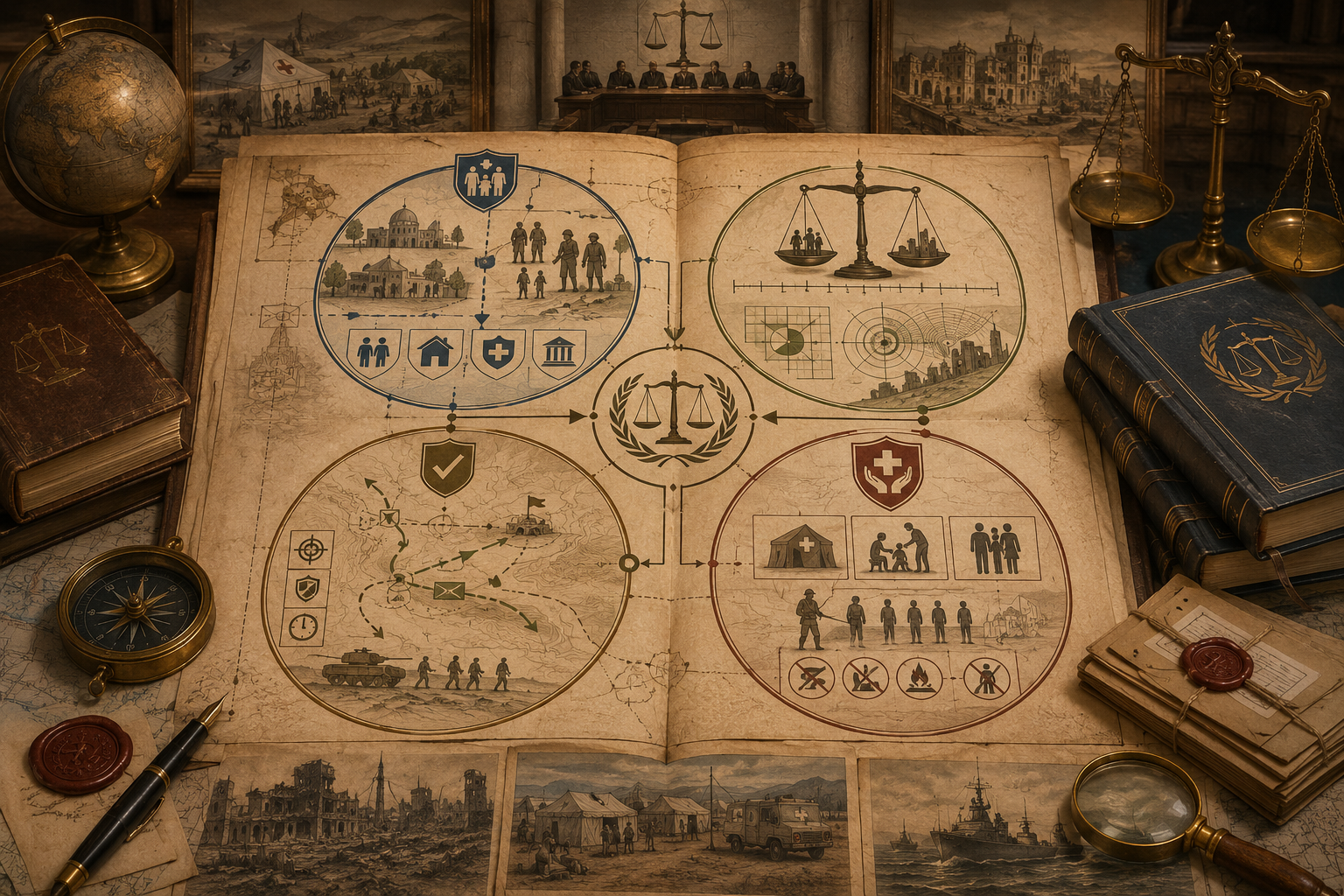
The law of war is built around a hard moral and legal proposition: even when armed conflict exists, violence is not unlimited. International humanitarian law does not make war good, lawful, or humane in a sentimental sense. It regulates war because war predictably produces suffering, destruction, fear, displacement, injury, captivity, and death. The principles of distinction, proportionality, military necessity, and humanity are the core legal grammar through which the law of armed conflict attempts to restrain violence, protect civilians, discipline military operations, and preserve human dignity amid organized violence.
These principles do not operate as abstract slogans. They structure targeting decisions, operational planning, weapons review, detention policy, humanitarian access, occupation law, command responsibility, war-crimes analysis, and the legal assessment of battlefield conduct. They ask basic but difficult questions: who or what may be attacked? What counts as a military objective? When is expected civilian harm excessive? What precautions must be taken? What military advantage is legally relevant? What suffering is forbidden even when a military goal exists? How should law evaluate urban warfare, siege, drones, cyber operations, artificial intelligence, starvation, human shields, hospitals, schools, evacuation routes, and dual-use infrastructure?
Main Library
Publications
Article Map
International Law
Related Topic
Institutions & Governance
Related Topic
International Organizations
Related Topic
Sustainable Development
The law of war is often misunderstood in two opposite ways. One mistake is to think that because a war is unlawful under the UN Charter, all conduct by the aggressor is automatically unlawful under humanitarian law while all conduct by the victim state is automatically lawful. International law does not work that way. The legality of resort to force is governed by jus ad bellum; the conduct of hostilities is governed by jus in bello. A state fighting a lawful defensive war can still commit war crimes. A state fighting an unlawful aggressive war is still bound by IHL rules, and its soldiers may still be protected when hors de combat or captured.
The opposite mistake is to think that because IHL regulates war, it legitimizes war. It does not. The law of armed conflict exists because human beings require protection even when political institutions have failed to prevent violence. Its principles are not moral ornaments. They are working legal standards for commanders, legal advisers, courts, investigators, humanitarian organizations, diplomats, journalists, and communities affected by war.
This article explains the four principles that organize much of the modern law of war: distinction, proportionality, military necessity, and humanity. It connects them to treaty law, customary international humanitarian law, the Geneva Conventions, Additional Protocol I, the Rome Statute, command responsibility, operational practice, and contemporary disputes over urban warfare, siege, starvation, hospitals, dual-use infrastructure, drones, cyber operations, and artificial intelligence. It argues that the law of war is neither pacifist nor permissive. It is a disciplined legal effort to preserve human limits where violence threatens to erase them.
Why the Core Principles Matter
The principles of distinction, proportionality, military necessity, and humanity matter because they translate the broad idea of limiting war into operational legal obligations. They are not merely philosophical ideals. They guide who may be targeted, what objects may be attacked, how incidental civilian harm must be assessed, what weapons may be used, what precautions must be taken, how prisoners and detainees must be treated, and how military advantage must be balanced against humanitarian protection.
Distinction is the organizing principle of targeting. It requires parties to distinguish civilians from combatants and civilian objects from military objectives. Without distinction, war becomes violence against a population rather than combat against lawful military targets. Proportionality prohibits attacks expected to cause incidental civilian harm that would be excessive in relation to the concrete and direct military advantage anticipated. Precautions require feasible steps to verify targets, choose means and methods that reduce harm, and cancel or suspend attacks when legal conditions are not met.
Military necessity allows force only to the extent required to achieve a legitimate military purpose not otherwise prohibited by international law. It does not mean whatever a commander finds useful. Humanity prohibits unnecessary suffering, cruelty, and the reduction of human beings to instruments of military convenience. Together, necessity and humanity form one of IHL’s deepest internal tensions: war permits violence, but only within limits that preserve human dignity and legal restraint.
ICRC Customary International Humanitarian Law, Rule 1.
These principles are especially important because modern war often takes place in civilian spaces. Fighting occurs in cities, refugee camps, hospitals, ports, electrical grids, communication networks, tunnels, schools, apartment blocks, industrial zones, and digital systems. Armed groups may blend with civilian populations. States may attack dual-use infrastructure. Military planners may rely on surveillance, predictive models, drones, cyber capabilities, and remote targeting. In this environment, legal judgment becomes more difficult, not less necessary.
The principles also matter because they create standards for later accountability. War-crimes prosecutors, commissions of inquiry, fact-finding missions, military lawyers, domestic courts, human-rights bodies, and international tribunals all use these concepts to evaluate conduct. A targeting decision is not judged simply by outcome; it is judged through information reasonably available at the time, verification efforts, target classification, expected civilian harm, anticipated military advantage, feasible precautions, and the commander’s legal obligations.
The law of war therefore works both prospectively and retrospectively. It guides conduct before and during operations, and it provides standards for legal assessment after harm occurs. Its value depends on whether these standards are taken seriously before destruction becomes irreversible.
Jus ad Bellum and Jus in Bello
A serious account of the law of war must begin by distinguishing jus ad bellum from jus in bello. Jus ad bellum concerns the legality of resorting to force: whether a state may use force under the UN Charter, self-defense, or Security Council authorization. Jus in bello, or international humanitarian law, concerns the conduct of hostilities once an armed conflict exists. The two bodies of law are related, but analytically distinct.
This distinction is essential because IHL applies equally to all parties to an armed conflict, regardless of which side is legally or morally responsible for the war’s outbreak. A state that is the victim of aggression must still comply with distinction, proportionality, precautions, humane treatment, detention rules, and weapons law. A state that unlawfully initiated the war is still bound by IHL and cannot be denied the law’s obligations or protections on the theory that its cause is illegitimate.
This separation serves humanitarian purposes. If IHL depended on agreement about who started the war lawfully, every party would deny protection to the other by claiming legal superiority. The result would be escalation of cruelty. By separating the law governing resort to force from the law governing conduct in conflict, IHL ensures that civilians, prisoners, wounded fighters, medical personnel, and other protected persons do not lose protection because of disputes over political blame.
The separation does not excuse aggression. An unlawful use of force remains unlawful. Leaders may face responsibility for aggression, and states may incur responsibility for violating the Charter. But those issues do not eliminate IHL obligations. Lawful self-defense does not authorize indiscriminate bombing. Unlawful aggression does not make every soldier outside legal protection. The two frameworks address different legal questions.
This matters in public debate because arguments about war often collapse the distinction. One side says its cause is just and therefore its methods are lawful. Another says the adversary’s cause is unjust and therefore any harm suffered by the adversary’s population is legally irrelevant. Both moves are dangerous. IHL’s discipline lies in refusing to let political cause erase humanitarian limits.
The law of war therefore begins with a difficult proposition: even in the face of aggression, atrocity, occupation, terrorism, or existential threat, legal limits remain. That proposition is not naïve. It is the condition for preserving law when violence is most tempted to abandon it.
Distinction: Civilians, Combatants, and Military Objectives
Distinction requires parties to an armed conflict to distinguish between civilians and combatants and between civilian objects and military objectives. Attacks may be directed only against combatants and military objectives. Civilians are protected against direct attack unless and for such time as they directly participate in hostilities. Civilian objects are protected unless they become military objectives under the applicable legal test.
Additional Protocol I states the basic rule directly: parties must distinguish between the civilian population and combatants and between civilian objects and military objectives, and they must direct operations only against military objectives. The ICRC’s Customary IHL Study identifies distinction between civilians and combatants as a customary rule applicable in international and non-international armed conflicts.
Additional Protocol I to the Geneva Conventions, Article 48.
The legal status of persons is central. Combatants in international armed conflict may be targeted, subject to other IHL rules, because they are members of the armed forces of a party. Civilians may not be targeted as such. In non-international armed conflict, the categories are more complex, but the same protective logic applies: civilians remain protected unless they directly participate in hostilities, while members of organized armed groups with a continuous combat function may be targetable under certain interpretations.
Distinction is violated by direct attacks against civilians, indiscriminate attacks, attacks that fail to target a specific military objective, and operations that treat an entire area or population as a target. A military force cannot lawfully attack a neighborhood simply because enemy fighters are believed to be somewhere inside it. It must identify military objectives and assess each attack through distinction, proportionality, and precautions.
Distinction also prohibits terrorizing civilians as a method of warfare. Acts or threats of violence whose primary purpose is to spread terror among the civilian population are forbidden. That prohibition matters because parties may try to use fear as a weapon: bombardment designed to break civilian morale, public executions, hostage-taking, threats of mass destruction, or attacks meant to drive population movement.
Distinction is also tested by organized armed groups that operate among civilians. Such conduct may violate IHL if fighters use civilians to shield military objectives or fail to distinguish themselves where required. But one party’s violation does not release the other party from its obligations. The presence of enemy fighters in a civilian area does not make all civilians lawful targets. IHL is reciprocal in application but not conditional in protection.
The principle of distinction therefore prevents the logic of war from expanding into a logic of collective liability. It insists that legal judgment must separate people, objects, conduct, and status even when war pressures commanders to see entire populations as threats.
Civilian Objects, Dual-Use Infrastructure, and Military Objectives
Distinction also requires separating civilian objects from military objectives. Civilian objects are all objects that are not military objectives. Under Additional Protocol I, military objectives are limited to objects which by their nature, location, purpose, or use make an effective contribution to military action and whose total or partial destruction, capture, or neutralization offers a definite military advantage in the circumstances ruling at the time.
This definition is crucial because modern war often targets infrastructure. Bridges, roads, ports, telecommunications systems, power plants, water facilities, data centers, factories, railways, fuel depots, airports, and administrative buildings may have civilian and military functions. The law does not treat all dual-use infrastructure as immune, but neither does it treat dual-use status as automatic permission to attack. The military contribution and military advantage must be specific, effective, and definite.
Additional Protocol I to the Geneva Conventions, Article 52(2).
Civilian infrastructure cannot be attacked merely because it indirectly supports the enemy’s economy, morale, or general war effort. Treating an entire society’s infrastructure as a military objective risks collapsing distinction. The more attenuated the claimed military contribution, the more dangerous the legal argument becomes. A power plant used to supply a military command center raises different questions from a power plant whose destruction primarily deprives civilians of water, hospitals, food storage, communications, and sanitation.
The temporal element also matters. An object may become a military objective through use, but that status may change. A school used as a firing position may become targetable while used for military purposes, subject to proportionality and precautions. But the same school does not remain targetable forever if the military use ends. A hospital may lose protection if used outside its humanitarian function to commit acts harmful to the enemy, but only after warnings and conditions required by IHL are considered, and loss of special protection does not make civilian patients lawful targets.
Dual-use infrastructure therefore demands careful legal analysis. The legal adviser should ask: What is the object? What is its civilian function? What is its alleged military function? Is the contribution effective? Is the advantage definite? What civilian harm is expected? Are there feasible alternatives? Can timing, weapon choice, warning, or method reduce harm? Is the attack part of a pattern that effectively disables civilian life?
The central danger is category inflation. If every object useful to the enemy state becomes a military objective, civilian protection disappears. The military-objective test is designed to prevent that outcome by requiring specificity, contribution, and advantage in the circumstances of the attack.
Proportionality: Incidental Harm and Concrete Military Advantage
The proportionality rule prohibits attacks expected to cause incidental loss of civilian life, injury to civilians, damage to civilian objects, or a combination of these harms that would be excessive in relation to the concrete and direct military advantage anticipated. Proportionality does not mean equality of casualties between the parties. It does not mean a purely mathematical ratio. It is a legal judgment about expected incidental civilian harm and anticipated military advantage.
Additional Protocol I to the Geneva Conventions, Article 51(5)(b).
Proportionality applies only after a lawful military objective has been identified. An attack directed at civilians is unlawful because it violates distinction; it is not rescued by proportionality. The proportionality inquiry assumes that the target is military and then asks whether expected incidental civilian harm is excessive. This sequence matters because proportionality cannot turn intentional civilian targeting into lawful conduct.
The rule is forward-looking. It assesses what was expected at the time of the attack, based on information reasonably available, not solely what happened afterward. An attack that causes unexpected civilian harm is not automatically unlawful if the harm was not reasonably foreseeable. Conversely, an attack that causes less harm than expected may still have been unlawful if the expected harm was excessive when the decision was made.
The phrase “concrete and direct military advantage” is also important. The advantage must be military, not political, psychological, retaliatory, or punitive. It must be concrete and direct, not speculative, generalized, or long-term in an abstract strategic sense. Destroying an enemy command post, disabling artillery, stopping an imminent attack, or neutralizing a military communications node may provide concrete advantage. Inflicting hardship on civilians to pressure political leadership does not qualify as a lawful military advantage.
Expected civilian harm includes more than immediate deaths at the blast site. Depending on foreseeability, it may include injury, destruction of homes, damage to medical facilities, disruption of water and electricity, secondary explosions, fire, displacement, and foreseeable reverberating effects. Contemporary proportionality analysis increasingly struggles with indirect harm, especially where attacks on infrastructure predictably affect hospitals, sanitation, food systems, and civilian survival.
Proportionality is difficult because it requires judgment under uncertainty. But difficulty is not permission. Commanders must make good-faith assessments, legal advisers must challenge assumptions, intelligence must be scrutinized, and precautions must be integrated into planning. The law does not demand omniscience. It demands disciplined, humane, and legally accountable judgment.
Precautions in Attack and Operational Judgment
Precautions operationalize distinction and proportionality. Parties must take feasible precautions to verify that targets are military objectives, choose means and methods with a view to avoiding or minimizing civilian harm, and refrain from attacks when the target is not lawful or expected civilian harm would be excessive. Where circumstances permit, effective advance warning must be given for attacks that may affect civilians.
Additional Protocol I Article 57 is the central treaty provision on precautions in attack. The ICRC Customary IHL Study also identifies precautions in attack as customary. Precautions matter because legal compliance is not limited to the final question of whether an attack occurred. It includes the planning process, intelligence review, choice of weapon, timing, angle of attack, target verification, civilian presence assessment, warnings, cancellation, suspension, and post-strike review.
Additional Protocol I to the Geneva Conventions, Article 57.
“Feasible” means practicable or practically possible, taking into account the circumstances at the time, including humanitarian and military considerations. Feasible does not mean convenient. Nor does it require measures that are impossible in the circumstances. It requires serious effort to reduce harm where measures are reasonably available.
Precautions are especially important in urban warfare. A commander might reduce harm by attacking at a different time, using a smaller munition, changing the angle of attack, waiting for civilians to leave, isolating the target, using ground forces rather than explosive weapons, giving warnings, choosing a different target, or not attacking. The correct precaution depends on context, but the legal obligation is active, not passive.
Warnings are not magic. A warning may reduce civilian harm, but it does not transform civilians who remain into lawful targets. Civilians may be unable to leave because of age, disability, poverty, fear, lack of transport, siege conditions, blocked routes, family obligations, detention, weather, or because there is no safe place to go. A warning also must be effective in context. Leaflets, text messages, phone calls, evacuation orders, or “knock” procedures must be judged by whether they meaningfully allow civilian protection.
Precautions also require reassessment. If new information emerges that civilians are present, the target is misidentified, expected harm is higher than anticipated, or the military advantage has changed, the attack must be reviewed. The duty to cancel or suspend is central because lawful targeting is not frozen at the moment of initial approval.
Precautions therefore express a larger legal ethic: civilian protection must be built into military decision-making rather than considered only after harm occurs. They are the procedural heart of lawful targeting.
Military Necessity and the Limits of Operational Freedom
Military necessity is often invoked but frequently misunderstood. It permits measures that are necessary to achieve a legitimate military objective and are not otherwise prohibited by international law. It does not override specific IHL rules. A commander cannot justify torture, direct attacks on civilians, starvation of civilians, denial of quarter, or prohibited weapons by claiming military necessity. Necessity works inside the law, not above it.
Military necessity recognizes that armed conflict involves military operations. IHL is not a demand that parties refrain from all violence once war exists. It allows attacks on combatants and military objectives. It permits capture, detention, maneuver, destruction of military equipment, and other measures connected to defeating the adversary’s military capacity. But it limits these measures through humanity, distinction, proportionality, precautions, and specific treaty prohibitions.
The danger is that necessity can become a rhetorical solvent dissolving every restraint. Parties often say a measure was necessary because it advanced military goals. But IHL asks a narrower question: was the measure required for a legitimate military purpose, and was it otherwise lawful? Military usefulness is not the same as military necessity. A tactic may be useful, intimidating, or convenient but still unlawful.
Necessity also interacts with choice. If multiple methods can achieve a comparable military objective, and one produces significantly less civilian harm, precautions and humanity push toward the less harmful method where feasible. Necessity does not allow the most destructive method simply because it is operationally easier. Legal necessity must be assessed in relation to available alternatives, risk, and humanitarian consequence.
Necessity also does not permit collective punishment. Destroying civilian homes, infrastructure, food systems, or livelihoods to punish a population, deter support for an enemy, or impose pressure on political authorities is not military necessity. The object must be connected to military action, and the anticipated advantage must be military. Punitive destruction corrodes the distinction between war against armed forces and war against a people.
The relationship between military necessity and humanity is foundational. Necessity gives IHL realism; humanity gives it moral and legal limit. Without necessity, the law could become detached from the realities of armed conflict. Without humanity, necessity would become an all-purpose justification for cruelty. The law of war exists in the tension between the two.
Humanity and the Prohibition of Unnecessary Suffering
The principle of humanity requires that war be conducted with respect for human dignity and that suffering not justified by lawful military necessity be avoided. It underlies prohibitions on torture, cruel treatment, murder of detainees, mutilation, outrages upon personal dignity, denial of quarter, unnecessary suffering, and attacks on persons who are not or are no longer participating in hostilities.
Humanity is sometimes treated as softer than the other principles because it sounds moral rather than technical. That is a mistake. Humanity has legal force throughout IHL. It appears in the humane-treatment guarantees of Common Article 3, in protections for wounded and sick persons, in rules governing prisoners of war, in prohibitions on unnecessary suffering, in weapons law, in detention standards, and in the Martens Clause tradition.
Common Article 3 is one of the clearest expressions of humanity. It requires humane treatment of persons taking no active part in hostilities, including members of armed forces placed hors de combat by sickness, wounds, detention, or any other cause. It prohibits violence to life and person, cruel treatment, torture, hostage-taking, humiliating and degrading treatment, and sentences without regularly constituted judicial guarantees.
Common Article 3 to the Geneva Conventions.
Humanity also limits weapons and methods of warfare. Weapons that cause superfluous injury or unnecessary suffering are prohibited. Indiscriminate weapons or methods that cannot be directed at a specific military objective, or whose effects cannot be limited as IHL requires, raise serious legal concerns. Humanity therefore governs not only how persons are treated after capture, but also how force is designed, selected, and deployed.
The principle is especially important when emotions of revenge, fear, humiliation, racism, dehumanization, or collective blame enter the battlefield. War propaganda often portrays the enemy as less than human. Humanity rejects that move. The enemy fighter may be targetable while fighting, but not tortureable when captured. The civilian population may live under enemy authority, but not be starved, terrorized, or collectively punished. The wounded body, the captive, the child, the patient, the old person, the displaced family, and the person under occupation remain human subjects of law.
Humanity is therefore not sentimentality. It is the legal insistence that even organized violence must not erase the human status of those it touches.
Hors de Combat, Surrender, and Humane Treatment
A person who is hors de combat is out of the fight and may not be attacked. This includes persons in the power of an adverse party, persons who clearly express an intention to surrender, and persons rendered unconscious or otherwise incapacitated by wounds or sickness, provided they abstain from hostile acts and do not attempt escape. The rule is central to the distinction between combat and killing.
The protection of persons hors de combat is essential because war creates moments of extreme vulnerability. A wounded fighter on the ground, a captured soldier, a surrendering combatant, a detainee, or a person unable to defend themselves is no longer a lawful target. Killing such persons is not combat; it is unlawful violence. The rule helps preserve the possibility of surrender and reduces incentives to fight to the death.
Surrender must be assessed carefully. A person must clearly indicate intent to surrender in the circumstances, but the law also requires attacking forces not to exploit uncertainty in bad faith. If surrender is accepted or the person is in the power of the adversary, humane treatment obligations attach immediately. Status questions may remain, but basic protections do not wait for paperwork.
Humane treatment includes protection from murder, torture, cruel treatment, medical neglect, humiliation, intimidation, hostage-taking, and unfair trial. Prisoners of war in international armed conflict receive extensive protection under the Third Geneva Convention. Civilians in the power of a party to the conflict receive protection under the Fourth Geneva Convention. In non-international armed conflict, Common Article 3 and customary IHL establish minimum guarantees.
The rule also matters for remote warfare. Drone operators, snipers, and air crews may observe persons who appear wounded, surrendering, or incapacitated. Targeting decisions must account for hors de combat status. Technology may increase observation capacity, but it does not reduce legal obligation.
Hors de combat protections reveal one of the deepest commitments of IHL: targetability is not a permanent identity. A combatant may be attacked while fighting, but once captured, wounded, or surrendering, the legal relationship changes. The law demands that violence stop when military necessity ends.
Hospitals, Medical Units, Schools, Cultural Property, and Humanitarian Relief
IHL provides special protection to certain persons, places, and activities because civilian survival depends on them. Medical units, hospitals, ambulances, medical personnel, humanitarian relief personnel, cultural property, religious sites, and certain civilian infrastructure may receive specific protection in addition to general civilian-object protection. These protections are not decorative. They are central to preserving life amid war.
Medical units and hospitals must be respected and protected. They may lose special protection only if used, outside their humanitarian function, to commit acts harmful to the enemy, and even then protection may cease only after due warning, setting a reasonable time limit where appropriate, and after such warning has remained unheeded. The presence of wounded fighters in a hospital does not by itself make the hospital a military objective. Nor does treatment of enemy wounded eliminate medical protection.
Schools are civilian objects unless they become military objectives. Their use by armed forces may endanger their protection, but attacks still require distinction, proportionality, and precautions. Cultural property receives protection because armed conflict can destroy not only lives but also memory, identity, religion, history, and community continuity. Humanitarian relief operations must be respected, and parties must allow and facilitate relief subject to IHL conditions.
Protected sites create recurring legal disputes because parties sometimes allege misuse: weapons stored in hospitals, fighters using schools, command posts hidden near civilian sites, or humanitarian convoys exploited for military movement. Such allegations must be assessed through evidence, not assumption. Misuse by one party may violate IHL, but it does not automatically authorize indiscriminate attack by the other.
The legal adviser must ask: What is the site’s protected status? What evidence supports loss of protection? Has a warning been issued where required? Is the alleged military use current? What civilians, patients, children, medical staff, displaced persons, or humanitarian workers are present? What alternatives exist? Would attack cause excessive harm? Are feasible precautions being taken?
Protection of hospitals, schools, cultural property, and relief operations is especially important in urban and siege contexts. When these institutions collapse, civilian suffering multiplies. IHL therefore treats them as more than ordinary objects. They are part of the human infrastructure that prevents war from becoming total destruction.
Siege Warfare, Starvation, and Objects Indispensable to Survival
Siege warfare tests the limits of the law of war because it often targets not only fighters but the conditions of civilian life. Siege may be used to encircle enemy forces, restrict movement, and pressure military surrender. But IHL prohibits starvation of civilians as a method of warfare and protects objects indispensable to the survival of the civilian population, including food, agricultural areas, crops, livestock, drinking water installations, and irrigation works.
Starvation is not limited to the absence of food. It can include deprivation of water, medicine, fuel, electricity necessary for survival, humanitarian access, sanitation, and other essentials when used to deprive civilians of objects indispensable to survival. A siege that blocks military supplies may be lawful in some circumstances; a siege that deliberately starves civilians or denies indispensable relief is unlawful.
Humanitarian relief is therefore central. Parties must allow and facilitate rapid and unimpeded passage of humanitarian relief for civilians in need, subject to their right of control under IHL. Consent to relief operations may not be arbitrarily withheld. Security screening and routing may be legitimate, but they cannot be used as a disguised method of starvation, collective punishment, or forced displacement.
Siege also raises proportionality and precautions concerns. Even if a siege has military objectives, foreseeable civilian harm must be assessed. The longer a siege continues, the more predictable civilian harm becomes. Damage to water, electricity, hospitals, sewage, food distribution, and transport systems may produce reverberating effects that are legally relevant.
The rhetoric of siege often dehumanizes civilians by treating them as pressure points. IHL rejects that. Civilians do not become bargaining chips because enemy forces are nearby. They cannot be starved to induce surrender. They cannot be denied medicine to weaken morale. They cannot be forced to choose between displacement and death.
Siege law shows why humanity and necessity must be read together. Military encirclement may serve a military purpose, but the method cannot lawfully make civilian survival itself the target.
Urban Warfare, Human Shields, and Civilian Harm
Urban warfare is one of the hardest contexts for applying distinction, proportionality, precautions, necessity, and humanity. Cities contain civilians, homes, hospitals, markets, schools, religious sites, roads, tunnels, telecommunications, water systems, power networks, and administrative buildings. Military forces operating in cities create constant risk that civilian spaces will become battlefields.
The use of human shields is prohibited. Parties may not use the presence or movement of civilians to render military objectives immune from attack. Armed groups or state forces that deliberately place military assets among civilians, force civilians to remain near targets, or exploit protected sites violate IHL. But the opposing party remains bound by distinction, proportionality, and precautions. Human shielding does not erase civilian protection.
Urban combat also increases reverberating harm. Destroying an apartment building may kill civilians immediately and displace survivors. Destroying a power node may affect hospitals, refrigeration, water pumping, communications, and sanitation. Damaging roads may block ambulances and humanitarian relief. The legal assessment of civilian harm must consider foreseeable indirect effects where they are reasonably knowable.
Explosive weapons with wide-area effects are especially dangerous in populated areas. Even when not categorically prohibited, their use in dense civilian environments raises serious distinction, proportionality, and precautions concerns. The question is not only whether the weapon is lawful in abstract, but whether its use in the specific environment can comply with IHL.
Evacuation orders also require legal care. Civilians may be warned or evacuated for their security or imperative military reasons, but forced displacement is prohibited unless required by civilian security or imperative military necessity. Evacuation cannot be used to cleanse territory, punish a population, or create free-fire zones. Civilians who remain retain protection.
Urban warfare therefore demands heightened legal discipline. The density of civilians does not make lawful operations impossible in every case, but it makes careless legal reasoning catastrophic. When war enters the city, the principles of distinction, proportionality, precautions, necessity, and humanity become more important precisely because they become harder to apply.
Weapons Law, Indiscriminate Effects, and New Technologies
Weapons law is another field where the core principles of IHL operate. Parties may not use weapons that are by nature indiscriminate, cause superfluous injury or unnecessary suffering, or are prohibited by specific treaties. Weapons must be capable of being directed at military objectives and of having effects limited as IHL requires.
This does not mean that every weapon causing severe harm is unlawful. War involves destructive force. But the law prohibits means and methods whose effects cannot be legally controlled or whose suffering exceeds what lawful military necessity can justify. Chemical weapons, biological weapons, certain expanding bullets, blinding laser weapons, anti-personnel mines for parties to the Ottawa Convention, cluster munitions for parties to the relevant convention, and other weapons regimes illustrate different forms of weapons regulation.
Even lawful weapons may be used unlawfully. Artillery, bombs, missiles, drones, cyber tools, small arms, and naval weapons all require context-specific assessment. A weapon lawful in an open battlefield may create unlawful risks in a dense city. A precision weapon may still be used unlawfully if the target is civilian, the expected harm is excessive, or precautions are inadequate. A crude weapon may be unlawful if it cannot be directed at a specific military objective in the circumstances.
Weapons reviews are therefore essential. Article 36 of Additional Protocol I requires states party to determine whether the employment of a new weapon, means, or method of warfare would be prohibited by international law. Even where a state is not party to Additional Protocol I, weapons review reflects a broader legal and operational need to assess compliance before deployment.
New technologies intensify the challenge. Autonomous systems, AI-assisted targeting, cyber capabilities, loitering munitions, sensor fusion, data-driven pattern analysis, and remote platforms may increase precision in some contexts and increase opacity in others. The legal question is not whether technology sounds advanced. It is whether human legal responsibility, target verification, proportionality assessment, precautions, accountability, and meaningful control are preserved.
Weapons law therefore turns the principles of IHL into design, procurement, review, and operational questions. Legal compliance begins long before the moment of attack.
Cyber Operations, Drones, and Algorithmic Targeting
Cyber operations, drones, and algorithmic targeting have changed how armed conflict is planned and conducted, but they have not displaced the core principles of IHL. Distinction, proportionality, precautions, necessity, and humanity remain applicable where cyber or technologically mediated operations occur in armed conflict and produce effects governed by IHL.
Cyber operations may affect civilian infrastructure without kinetic explosion. They may disable power grids, hospitals, banking systems, transportation networks, satellites, communications systems, water treatment plants, or military command systems. The absence of blast does not eliminate legal concern. If cyber operations cause death, injury, physical damage, or severe functional disruption of civilian objects, IHL rules may be engaged. Even where classification is contested, the humanitarian stakes can be serious.
Drones raise questions of distance, surveillance, and accountability. They may allow persistent observation and precision, which can improve distinction and precautions. But they may also normalize targeted killing, expand battlefields, reduce perceived political cost, and rely on patterns of life, metadata, or uncertain intelligence. Drone operations must still identify lawful targets, assess civilian presence, evaluate proportionality, and take feasible precautions.
Algorithmic targeting creates deeper accountability concerns. If machine-learning systems recommend targets, estimate collateral damage, classify behavior, or prioritize attack lists, legal advisers must ask how the system was trained, what data it uses, how errors are detected, whether bias affects classification, whether commanders understand the basis of recommendations, and whether meaningful human judgment exists. A commander cannot outsource legal responsibility to a model.
Automation may also accelerate operations faster than legal review can function. Speed is not itself illegitimate, but speed can undermine verification, context, proportionality, and reassessment. If an operation depends on automated correlations rather than reliable identification, the risk of unlawful targeting increases. Legal review must therefore be built into systems architecture, not added as ceremonial approval afterward.
Technology does not change the central legal question: can the party distinguish military objectives from civilians and civilian objects, assess expected harm, take feasible precautions, and preserve human responsibility? If not, the method is legally suspect no matter how sophisticated it appears.
The future law of war will increasingly depend on whether military systems are designed to preserve legal judgment rather than overwhelm it.
War Crimes, Command Responsibility, and Individual Liability
Serious violations of the law of war may constitute war crimes. The Rome Statute includes war crimes such as intentionally directing attacks against civilians, intentionally directing attacks against civilian objects, intentionally directing attacks against protected humanitarian or peacekeeping personnel, launching disproportionate attacks in international armed conflict, attacking undefended places, killing or wounding persons hors de combat, torture, inhuman treatment, extensive destruction of property not justified by military necessity, and starvation of civilians as a method of warfare.
War-crimes analysis requires careful attention to the elements of the crime, the type of armed conflict, the protected status of persons or objects, intent and knowledge, contextual elements, and the relationship between the accused and the conduct. Not every IHL violation automatically produces international criminal liability. But grave violations may expose commanders, political leaders, soldiers, pilots, artillery officers, intelligence personnel, detention officials, and others to responsibility.
Command responsibility is especially important. Commanders may incur liability where they knew or should have known that subordinates were committing or about to commit crimes and failed to take necessary and reasonable measures to prevent them or punish perpetrators. This doctrine reflects the reality that unlawful violence often results not only from individual cruelty but from command climate, rules of engagement, targeting policy, permissive discipline, inadequate training, intelligence failures, and failure to investigate.
Documentation matters. Targeting logs, legal advice, intelligence assessments, collateral damage estimates, weapons choices, operational orders, communications, after-action reports, warnings, detention records, medical records, satellite imagery, and witness testimony may all become evidence. The law of war is therefore not only a battlefield discipline; it is an evidentiary discipline.
War-crimes accountability is also politically uneven. Some perpetrators face prosecution; others are shielded by power, alliance, jurisdictional limits, complementarity, non-cooperation, or Security Council politics. This selectivity is real. But selectivity does not nullify the legal standards. It shows why consistent application and documentation are essential.
Individual liability reinforces the core principles by making clear that unlawful war conduct is not merely an abstract state wrong. Persons who plan, order, enable, or execute unlawful attacks may bear responsibility. The law of war therefore addresses both institutional conduct and human agency.
Conflict Classification and the Scope of IHL
Before applying distinction or proportionality, counsel must determine whether an armed conflict exists and how it is classified. International armed conflict generally arises whenever states resort to armed force against one another, including occupation even when it meets no armed resistance. Non-international armed conflict requires sufficient organization of the non-state party and sufficient intensity of hostilities. Several conflicts may overlap in one territory.
Classification controls treaty applicability, combatant and prisoner-of-war status, detention authority, occupation law, grave-breach regimes, and some war-crime provisions. It does not determine whether resort to force was lawful under the Charter. Nor does political refusal to recognize a conflict prevent IHL from applying when the factual threshold is met.
| Situation | Primary classification question | Common analytical error |
|---|---|---|
| Interstate hostilities | Have armed forces of two states resorted to force against one another? | Requiring a declaration of war or minimum casualty count. |
| Occupation | Is territory placed under the effective authority of a hostile foreign force? | Assuming occupation requires annexation or active resistance. |
| State versus armed group | Does the group possess sufficient organization and have hostilities reached sufficient intensity? | Calling every riot, terrorist incident, or security operation an armed conflict. |
| Internationalized or parallel conflicts | Are different legal relationships operating simultaneously? | Using one classification for every actor and operation in the territory. |
The analysis should identify the parties, geography, dates, organization, intensity indicators, foreign control or intervention, occupation status, and changes over time. Classification should be updated as facts change.
Status, Conduct, and Targetability
IHL does not make every member of an opposing society targetable. Targetability depends on legal status and conduct. In international armed conflict, members of armed forces are generally combatants, except medical and religious personnel. Civilians are protected from direct attack unless and for such time as they directly participate in hostilities.
In non-international armed conflict, treaty terminology is less complete. Members of state armed forces may be targeted under the conduct-of-hostilities rules, while members of organized armed groups may be targetable under approaches that examine continuous combat function. Civilians retain protection unless and for such time as they directly participate.
Status and conduct must not be inferred from nationality, age, sex, location, dress, political sympathy, family relation, religious identity, phone ownership, social-media activity, or presence in a contested area. Intelligence indicators can support analysis, but they require validation against the legal category being applied.
Targetability also ends. A combatant who surrenders, becomes wounded and incapacitated, is detained, or is otherwise hors de combat may not be attacked. A civilian’s loss of protection through direct participation is temporary under the relevant rule.
Direct Participation in Hostilities and Organized Armed Groups
Direct participation in hostilities is a narrow exception to civilian protection. The ICRC’s interpretive framework identifies three cumulative elements: a threshold of harm, direct causation, and belligerent nexus. Other authorities and states formulate aspects differently, but the core concern is preventing ordinary political, economic, humanitarian, journalistic, or social activity from being treated as combat.
Loading ammunition for an imminent attack, transmitting tactical targeting information, sabotaging military equipment, or operating a weapon may qualify in context. General political advocacy, paying taxes, providing ordinary food, remote ideological support, or working in the civilian economy ordinarily does not by itself make a civilian targetable.
Membership in an organized armed group must also be assessed carefully. Organizational affiliation is not proved merely by appearing on a list, communicating with members, living in controlled territory, or sharing political goals. A continuous-combat-function approach asks whether the person has an enduring function involving direct participation.
Doubt matters. Where civilian status is uncertain, the applicable presumption and feasible verification requirements protect against treating ambiguity as permission to attack. Operational urgency does not eliminate the need for a reasonable evidentiary basis.
Doubt, Presumptions, and Target Verification
Target verification converts distinction from a principle into a process. Decision-makers must do everything feasible to verify that the person or object is a lawful target. Verification should test source reliability, recency, identity, location, behavior, pattern interpretation, potential deception, civilian explanation, and the legal rule connecting the evidence to targetability.
Single-source intelligence, automated correlations, anonymous tips, outdated imagery, intercepted metadata, and pattern-of-life analysis can all be wrong. Confirmation bias becomes especially dangerous when intelligence teams are rewarded for finding targets rather than testing alternative explanations.
| Verification control | Question | Failure signal |
|---|---|---|
| Identity resolution | Is the observed person or object the intended target? | Aliases, shared devices, stale coordinates, or family association. |
| Legal-status review | What rule makes the target attackable now? | Reliance on broad organizational or geographic labels. |
| Source corroboration | Do independent sources support the same conclusion? | Circular reporting or one data provider repeated across systems. |
| Temporal validation | Is the military use or participation current? | Old imagery, ended use, completed participation, or changed control. |
| Red-team review | What civilian explanation fits the same evidence? | No documented alternative hypothesis. |
Verification continues until execution. New civilians, changed target use, lost surveillance, unexpected movement, or contradictory intelligence can require cancellation or suspension.
The Military-Objective Lifecycle
Objects are military objectives only when both parts of the legal test are satisfied in the circumstances ruling at the time: the object makes an effective contribution to military action by nature, location, purpose, or use, and its destruction, capture, or neutralization offers a definite military advantage.
This status is dynamic. A school used temporarily as a command post may become a military objective during that use. A bridge may be military when it carries reinforcements toward an active battle. A communications system may contain separable military and civilian functions. When the contribution ends, civilian-object protection can return.
“Purpose” concerns intended future use, but intent must be supported by evidence rather than speculation. “Location” does not permit attacking an entire neighborhood because military units operate somewhere within it. “Nature” is not a label for every government or industrial object.
Target folders should record the contribution, anticipated advantage, time sensitivity, civilian functions, dependency relationships, protected-site proximity, expected restoration time, and criteria for revalidation. A target approved yesterday is not automatically lawful today.
Reverberating Effects and Civilian Systems
Expected civilian harm can extend beyond the blast radius. Attacks on electricity, water, wastewater, communications, bridges, ports, fuel, cloud infrastructure, or medical supply chains can create foreseeable downstream effects. Hospitals may lose power, pumps may stop, food may spoil, emergency calls may fail, and disease risk may rise.
These reverberating effects are not unlimited speculation. They become legally important when they are reasonably foreseeable from information available at the time. Prior attacks, engineering assessments, humanitarian warnings, seasonal conditions, redundancy, repair capacity, and dependency maps can make consequences predictable.
System-level analysis should identify direct harm, first-order service interruption, dependent facilities, population exposure, duration, cascading failure, displacement, environmental release, and mitigation. The same object may present very different proportionality risks in winter, during epidemic conditions, or after redundant systems have already been destroyed.
Military advantage should be assessed with similar specificity. A concrete tactical advantage cannot be inflated by vague claims about weakening an entire economy or population. The comparison remains qualitative and legal, but better evidence makes judgment more disciplined.
Proportionality Under Uncertainty
Proportionality is an ex ante judgment made under uncertainty. Commanders estimate civilian presence, weapon effects, structural collapse, secondary explosions, protected persons, reverberating harm, and military advantage. Each estimate has a range rather than a single perfect value.
Uncertainty does not eliminate the obligation. It affects confidence, precautions, and whether the operation can responsibly proceed. Poor intelligence, unfamiliar weapons, degraded surveillance, or disputed target use should widen the expected-harm range and may require delay, additional verification, a different method, or cancellation.
Expected value alone can conceal low-probability catastrophic outcomes. Scenario analysis should examine plausible upper-harm cases, not only a central estimate. Repeated attacks also require attention to cumulative effects where individual operations degrade the same civilian system.
Proportionality records should identify who estimated harm and advantage, which assumptions were used, what uncertainty remained, what alternatives were considered, and what event would trigger reapproval. A conclusory statement that harm was “not excessive” is not a sufficient decision record.
Feasible Precautions and Alternative Means
Precautions require active comparison of feasible ways to achieve the military objective with less civilian harm. Relevant choices can include timing, route, munition, fuse, angle, aim point, power level, cyber rather than kinetic action, isolation, capture, warning, evacuation support, or not attacking.
“Feasible” incorporates humanitarian and military considerations but is not equivalent to easy, cheap, or customary. Commanders should identify operational risk honestly without treating any increased danger to forces as automatically decisive. Force protection matters, but civilian life cannot be excluded from the analysis.
Where several military objectives offer comparable advantage, the object expected to cause the least danger to civilians should be selected when the applicable rule and circumstances require. Where an objective can be neutralized temporarily rather than destroyed, that option should be evaluated.
Precautions also protect civilians under a party’s own control. Defenders should avoid locating military objectives within or near densely populated areas where feasible, remove civilians and civilian objects from vicinity where feasible, and take other necessary precautions against attack effects.
Warnings, Evacuation, and Safe Passage
Effective advance warning must be given when attacks may affect civilians unless circumstances do not permit. Effectiveness depends on clarity, timing, language, delivery, geographic precision, credibility, routes, destination, and whether civilians can act.
A warning is not permission to attack unlawfully. It does not make a civilian targetable, cure a disproportionate attack, or eliminate duties to take other precautions. Repeated false warnings or attacks on evacuation routes can destroy credibility and reduce protective value.
Evacuation requires safe and humane conditions. Parties should consider transportation, disability, children, family unity, food, shelter, medical care, documentation, property, return, and protection against detention or screening abuse. A destination is not safe merely because it lies outside the announced strike area.
Forced displacement is prohibited unless civilian security or imperative military reasons require it under the applicable law. Temporary evacuation cannot become permanent demographic change, collective punishment, or a method of territorial control.
Explosive Weapons in Populated Areas
Explosive weapons with wide-area effects create acute civilian risk in cities and other populated areas. Large blast and fragmentation radius, inaccuracy, multiple munitions, structural collapse, fire, unexploded ordnance, and reverberating infrastructure damage can make compliance difficult.
These weapons are not all prohibited as a category, but their use must comply with distinction, proportionality, and precautions. The 2022 Political Declaration on Explosive Weapons in Populated Areas is a nonbinding commitment that recognizes humanitarian consequences and promotes policies and practices to strengthen civilian protection.
Operational review should consider population density, building construction, subterranean effects, time of day, weapon reliability, circular error, fragmentation, secondary hazards, evacuation limits, and available alternatives. The fact that a weapon is accurate to its aim point does not mean its area effects are compatible with the environment.
Post-conflict harm from unexploded ordnance and destroyed infrastructure should inform planning, clearance, marking, warning, and victim assistance.
Medical Protection and Alleged Loss of Protection
Medical personnel, units, transports, and facilities receive special protection. A medical unit does not lose protection merely because it treats enemy fighters, possesses small arms taken from patients, or is guarded. Protection may cease only when the unit is used outside its humanitarian function to commit acts harmful to the enemy and after required warning conditions are satisfied.
Allegations of misuse require reliable, current, and specific evidence. Even where special protection ceases, ordinary distinction, proportionality, and precautions rules continue. Patients, wounded persons, medical staff, and civilians do not become lawful targets.
Operations should evaluate evacuation feasibility, continuity of care, alternative facilities, oxygen and power dependence, ambulances, neonatal and intensive-care patients, contagious disease, records, and long-term health-system impact.
Search, inspection, or evacuation of medical facilities must also respect applicable rules. Protection cannot be made meaningless through repeated unverified accusations or by imposing impossible warning conditions.
Humanitarian Relief and Protected Personnel
Parties must allow and facilitate humanitarian relief for civilians in need subject to applicable conditions and rights of control. Humanitarian personnel, transports, warehouses, communications, and premises require respect and protection.
Security screening, inspection, routing, and temporary suspension may be lawful when genuinely required, but they cannot become arbitrary denial, starvation, collective punishment, or a method of forced displacement. Relief access should be assessed across the complete chain: authorization, border entry, movement, distribution, fuel, communications, staff safety, and beneficiary access.
Security Council resolution 2730 (2024) addressed protection of humanitarian personnel and UN and associated personnel. The Secretary-General’s 2025 protection-of-civilians report continued to emphasize civilian and humanitarian harm. Institutional developments strengthen attention and reporting but do not replace the underlying IHL rules.
Deconfliction systems can reduce risk but may also expose sensitive locations. Sharing coordinates does not transfer responsibility to humanitarian actors or excuse attack when the attacking party fails to verify.
Cultural Property, the Environment, and Civilian Survival
War damages more than immediate military targets. Cultural property, religious sites, archives, ecosystems, dams, industrial facilities, farmland, water, and soil can sustain identity and civilian survival across generations.
Cultural property receives general and, in some regimes, enhanced or special protection. Military use can affect protection, but necessity exceptions are narrow and fact dependent. Looting, vandalism, and appropriation are separately prohibited.
The natural environment is civilian in character unless a part becomes a military objective. IHL also contains specific environmental protections, including rules concerning widespread, long-term, and severe damage in applicable treaty law and broader customary duties of care and proportionality.
Environmental analysis should include toxic release, fire, water contamination, habitat destruction, dam failure, unexploded ordnance, agricultural loss, and long-term displacement. Damage that appears geographically remote can return through food, water, weather, or public health systems.
Cyber Operations, Civilian Data, and Digital Infrastructure
IHL applies to cyber operations conducted in connection with armed conflict. The established prohibitions on attacking civilians and civilian objects, indiscriminate attacks, disproportionate attacks, and failure to take precautions apply to cyber means and methods where the legal conditions are met.
Open questions remain, including when loss of functionality constitutes damage or an attack and how civilian data should be protected. Civilian dependence on data makes deletion, corruption, encryption, and manipulation potentially life-threatening even without physical destruction.
In 2024 the International Conference of the Red Cross and Red Crescent adopted a resolution concerning protection against the human cost of ICT activities during armed conflict. ICRC work in 2025 and 2026 has also addressed civilian hackers, technology companies, digital infrastructure, and the application of IHL in the new UN Global Mechanism.
Cyber review should map civilian users, interconnection, propagation, reversibility, spillover, shared cloud services, medical and humanitarian dependencies, attribution, and loss of control. Malware that cannot be reliably confined can raise indiscriminate-effects concerns.
Military AI, Decision Support, and Human Judgment
AI systems can classify imagery, rank targets, fuse sensor data, estimate civilian presence, predict behavior, recommend routes, translate communications, and support command decisions. These tools can increase processing capacity while introducing opacity, automation bias, data drift, adversarial manipulation, and false confidence.
Human judgment remains essential because IHL decisions are contextual and normative. A system may estimate probability but cannot itself assume legal and moral responsibility. The commander and supporting personnel must understand limitations, verify material outputs, consider alternative explanations, and retain authority to reject or stop the recommendation.
The ICRC’s 2026 military-AI guidance identifies autonomous weapons, AI decision-support systems, and AI-enabled cyber operations as areas of particular concern. That guidance is institutional policy and legal interpretation, not a new treaty, but it reflects the growing need for human-centered controls.
Validation should test representative environments, rare civilians, protected sites, sensor failure, adversarial inputs, distribution shift, subgroup error, confidence, latency, and human interaction. A model’s benchmark accuracy is not proof that it supports lawful targeting.
Autonomous Weapon Systems and Control
Autonomous weapon systems can select and engage targets after activation without further human intervention. Their legality depends on the system, target type, environment, predictability, constraints, supervision, and ability to comply with IHL.
The central challenges include unpredictable interaction, broad target profiles, changing environments, temporal and geographic scope, civilian presence, surrender, hors de combat status, and accountability. Systems directed against persons raise especially serious humanitarian and ethical concerns.
The 2026 Convention on Certain Conventional Weapons expert process continued considering elements of an instrument or other measures concerning lethal autonomous weapons. General Assembly resolution 80/57 also addressed the subject. These processes remain ongoing and should not be described as a completed autonomous-weapons treaty.
Meaningful control can involve human understanding, predictable system behavior, constrained targets, bounded time and space, effective supervision, intervention and deactivation, testing, and command accountability. A nominal human approval step is insufficient if the person cannot understand or alter the system’s operation.
Article 36 Weapons Review and Lifecycle Assurance
Additional Protocol I Article 36 requires states party to determine whether a new weapon, means, or method of warfare would be prohibited in some or all circumstances by applicable international law. States not party still need a process to ensure legal compliance before fielding capabilities.
A weapons review should identify intended use, technical characteristics, effects, reliability, target set, environment, failure modes, data dependencies, operator interface, cyber risk, updates, and applicable prohibitions. Review of an autonomous or AI-enabled system must include software, model, sensor, training data, configuration, and human-machine interaction.
Review is not a one-time certification. Material software updates, new target profiles, changed operational environments, compressed models, new sensors, emergent failures, or altered doctrine can require re-review.
The review should remain independent enough to challenge procurement and operational pressure. Documentation, testing records, assumptions, restrictions, and deployment conditions should be preserved.
Detention, Interrogation, and Humane Treatment
The conduct-of-hostilities principles do not exhaust IHL. Persons captured or otherwise in a party’s power are governed by detention, treatment, judicial-guarantee, transfer, and release rules. Torture, cruel treatment, outrages on personal dignity, hostage-taking, and summary execution are prohibited.
Status screening cannot delay humane treatment. Medical care, food, water, shelter, family contact, registration, protection from disappearance, and independent oversight are practical safeguards. Interrogation rules must exclude torture and coercive abuse.
Transfer creates risk where the receiving authority may torture, disappear, unlawfully prosecute, or mistreat the person. Detaining authorities should assess and monitor transfer conditions under applicable law.
Military necessity does not authorize cruelty. Information value, deterrence, revenge, or security pressure cannot justify prohibited treatment.
Sexual Violence, Gender, and Conflict Harm
Rape and other forms of sexual violence are prohibited and may constitute war crimes, crimes against humanity, torture, or genocide depending on context and elements. Command structures, detention practices, forced displacement, checkpoints, exploitation, and collapse of services can create predictable risk.
Gender analysis is not limited to women and girls. Men, boys, LGBTQ+ persons, detainees, disabled persons, and members of stigmatized groups can face distinct forms of violence and underreporting. Protective systems should avoid stereotypes that conceal victims or misclassify risk.
Operational planning should consider lighting, shelter, sanitation, screening, search procedures, detention separation, reporting channels, medical care, confidentiality, and retaliation risk. Investigation should be survivor-centered and avoid repeated or unsafe testimony collection.
Sexual violence is not an inevitable byproduct of war. Prevention, training, discipline, command accountability, and prosecution are legal and operational responsibilities.
Battle-Damage Assessment, Investigation, and Correction
Post-strike review tests whether assumptions were accurate, civilians were harmed, the target was lawful, the weapon performed as expected, and operational changes are required. Battle-damage assessment should not focus only on whether the military object was destroyed.
Credible allegations of serious violations require prompt, impartial, and effective investigation under applicable law. Investigators need access to targeting records, sensor data, communications, weapon information, site evidence, witnesses, medical records, and command decisions.
Learning systems should distinguish lawful unforeseen harm, negligence, policy failure, systemic bias, reckless decision-making, and intentional violation. Corrective actions can include suspension, retraining, revised intelligence standards, weapon restrictions, software rollback, discipline, compensation, public acknowledgment, and referral.
Secrecy can protect operations, but categorical refusal to disclose methodology or investigate credible harm undermines legal accountability. Findings should be communicated to affected persons where possible.
The 2025–2026 Civilian-Protection and Technology Context
The Secretary-General’s 2025 report on protection of civilians in armed conflict documented continuing pressure on civilians, humanitarian personnel, medical care, and essential infrastructure. Security Council and General Assembly attention has increasingly connected civilian protection to explosive weapons, humanitarian access, cyber operations, and emerging military technology.
In the digital domain, the ICRC’s 2025 work examined civilian hackers and private technology actors, while its July 2026 statement to the Global Mechanism emphasized that existing IHL applies when ICT capabilities are used for military purposes in armed conflict.
In the AI domain, the ICRC’s June 2026 guidance emphasized human judgment in military decision-making. The 2026 CCW expert process continued work on autonomous weapons, and General Assembly resolutions 80/57 and 80/58 addressed autonomous weapons and military AI. These initiatives are institutionally important but do not replace treaty and customary IHL.
The continuing legal task is implementation: reliable target verification, protection of civilian systems, bounded weapon effects, meaningful human judgment, independent review, and accountability when harm reveals failure.
Worked Diagnostic: A Proposed Strike on a Dual-Use Urban Facility
Consider a fictional operation against a communications and data facility used partly by an armed force and partly by hospitals, emergency services, banks, and civilian internet providers. An AI system ranks the site as a high-value target.
Step 1: Classify the conflict and applicable law
Identify the parties, conflict type, treaty obligations, customary rules, special protections, and relevant operational directives.
Step 2: Verify the target and military contribution
Test current military use, source independence, physical location, network segmentation, alternative explanations, and whether the contribution is effective.
Step 3: Define the concrete and direct military advantage
State what capability will be neutralized, for how long, and how that result affects the operation.
Step 4: Estimate direct and reverberating civilian harm
Assess people on site, structural damage, hospital communications, emergency response, payment systems, repair time, cascading failure, and displacement.
Step 5: Evaluate the AI recommendation
Review model provenance, error, confidence, training distribution, feature use, operator understanding, and contradictory intelligence.
Step 6: Compare feasible alternatives and precautions
Consider cyber isolation, temporary disruption, a different node, timing, smaller effects, warning, evacuation, capture, or non-attack.
Step 7: Make and document the proportionality decision
Record uncertainty, upper-harm scenarios, military advantage, protected dependencies, cancellation conditions, and approving authority.
Step 8: Monitor execution and investigate results
Maintain surveillance, cancel if conditions change, assess civilian effects, preserve logs, investigate credible harm, and correct the system.
| Decision pattern | Immediate attraction | Legal weakness |
|---|---|---|
| Accept the AI ranking | Speed and apparent objectivity. | Ranking does not establish target status, advantage, proportionality, or precautions. |
| Attack because the object is dual-use | Simple classification. | Dual use is not automatic targetability and ignores civilian dependencies. |
| Governed targeting review | Connects verification, systems harm, alternatives, human judgment, execution, and investigation. | May require delay, restriction, or cancellation where evidence remains inadequate. |
The diagnostic demonstrates why technological confidence and military relevance cannot substitute for the complete IHL analysis.
Selective Compliance, Impunity, and the Politics of Legal Judgment
The law of war is often invoked selectively. States condemn adversaries for violations while minimizing or denying similar conduct by allies. Armed groups appeal to civilian suffering while violating distinction themselves. Powerful states demand accountability for some conflicts while blocking it in others. Media and political actors may treat civilian harm as tragic but lawful when caused by favored forces and as criminal when caused by opponents.
This selectivity damages the credibility of IHL. The principles of distinction, proportionality, necessity, and humanity are meant to apply universally. If they are applied only to enemies, they become propaganda. If they are applied only to weak actors, they become hierarchy. If they are ignored whenever enforcement is inconvenient, they become moral performance rather than law.
Selective compliance also appears in legal rhetoric. Parties may cite human shields to excuse excessive attacks. They may cite self-defense to avoid IHL analysis. They may cite military necessity to justify destruction that is punitive or terrorizing. They may cite proportionality without disclosing the military advantage claimed or the civilian harm anticipated. They may cite warnings as if warnings erase civilian status. These rhetorical shortcuts must be resisted.
The answer is not to abandon IHL because it is imperfectly enforced. The answer is to apply it more rigorously and consistently. IHL provides a language for documenting harm, challenging unlawful conduct, advising commanders, protecting civilians, prosecuting war crimes, and preserving legal memory. Its weakness lies not in the principles themselves, but in political willingness, institutional access, evidentiary capacity, and enforcement.
Communities affected by war often understand this more clearly than distant commentators. For them, the law of war is not an academic framework. It is the difference between being seen as civilians or as targetable background; between a hospital being protected or suspected by default; between a warning that enables survival and an evacuation order that masks displacement; between lawful military action and collective punishment.
The politics of legal judgment therefore matters. IHL must be defended not as a vocabulary of state legitimacy, but as a discipline of human protection. Its principles must constrain allies, adversaries, states, armed groups, powerful militaries, and weak forces alike.
Lawyer’s Law-of-War Analysis Checklist
- Classify the conflict. Identify international, non-international, occupation, or overlapping legal relationships.
- Separate jus ad bellum and jus in bello. The cause of war does not determine compliance in attack or treatment.
- Identify applicable sources. Map Geneva law, Additional Protocols, customary IHL, weapons treaties, criminal law, and operational directives.
- Classify persons and objects. Determine civilian, combatant, organized-group, direct-participation, medical, humanitarian, detainee, hors-de-combat, civilian-object, military-objective, and specially protected status.
- Verify the target. Test identity, source independence, recency, legal rule, alternative civilian explanation, and changed circumstances.
- Apply the military-objective test. Establish effective contribution and definite advantage in the circumstances ruling at the time.
- Estimate direct and reverberating harm. Include death, injury, structures, services, displacement, environment, medical care, and cascading effects.
- Define military advantage. Exclude punitive, political, morale, or speculative benefits.
- Apply proportionality under uncertainty. Assess plausible harm ranges and cumulative effects, not one unsupported point estimate.
- Compare feasible precautions. Evaluate timing, weapon, route, warning, evacuation, isolation, capture, temporary neutralization, and cancellation.
- Check special and technology-specific protections. Review medical care, relief, culture, survival objects, cyber infrastructure, AI, autonomy, and Article 36 requirements.
- Preserve accountability. Record decision-makers, intelligence, assumptions, changes, execution, post-strike findings, investigation, remedy, and corrective action.
Law of War Practice Table
| Principle | Core Question | Common Legal Error | Practical Evidence |
|---|---|---|---|
| Distinction | Is the attack directed only at combatants or military objectives? | Treating an area, population, or dual-use system as targetable without specific military-objective analysis. | Target packet, intelligence basis, identification process, civilian presence assessment. |
| Proportionality | Is expected incidental civilian harm excessive relative to concrete and direct military advantage? | Using political goals, punishment, deterrence, or vague strategic benefit as the military advantage. | Collateral damage estimate, commander assessment, legal review, expected reverberating effects. |
| Precautions | Were feasible steps taken to verify the target and reduce civilian harm? | Treating target approval as final despite new information or feasible alternatives. | Warnings, weapon choice, timing, surveillance, cancellation decisions, post-strike review. |
| Military Necessity | Is the measure required for a legitimate military purpose and otherwise lawful? | Using necessity as an override for specific prohibitions. | Operational objective, alternatives considered, necessity memo, rules of engagement. |
| Humanity | Does the conduct preserve humane treatment and avoid unnecessary suffering? | Treating enemy status as permission for cruelty, humiliation, or denial of care. | Detention records, medical access, surrender treatment, interrogation rules, weapons review. |
| Special Protection | Does a hospital, relief convoy, cultural site, or indispensable survival object receive additional protection? | Assuming alleged misuse automatically removes all protection. | Warnings, evidence of misuse, civilian/patient presence, relief coordination, proportionality analysis. |
Leading Authorities for Distinction, Proportionality, Necessity, and Humanity
- Geneva Conventions of 1949: foundational treaty framework for the protection of wounded and sick persons, shipwrecked persons, prisoners of war, and civilians.
- Common Article 3: minimum humane-treatment guarantees for non-international armed conflicts.
- Additional Protocol I, Article 48: basic rule of distinction.
- Additional Protocol I, Article 51: protection of the civilian population and prohibition of indiscriminate and disproportionate attacks.
- Additional Protocol I, Article 52: civilian objects and military objectives.
- Additional Protocol I, Article 57: precautions in attack.
- ICRC Customary IHL Rules 1, 7, 14, 15, 53, 54, and related rules: customary expressions of distinction, proportionality, precautions, starvation, and protection of civilian objects.
- Rome Statute Article 8: war-crimes provisions relevant to civilian targeting, protected objects, disproportionate attacks, starvation, and unlawful treatment.
- ICJ Nuclear Weapons advisory opinion: major statement on IHL principles in relation to weapons and methods of warfare.
- ICTY jurisprudence: important case law on targeting, shelling, command responsibility, civilian attacks, and the conduct of hostilities.
Applied Law-of-War Examples
Example 1: Attack on a command post inside a residential building
The legal analysis begins with distinction. Is the command post a military objective? What evidence confirms its current military use? The analysis then moves to proportionality: what civilian harm is expected from the selected weapon, timing, and method? Precautions may require choosing a smaller munition, waiting for civilians to leave, issuing warnings, selecting a different angle of attack, or cancelling the strike if expected harm is excessive.
Example 2: Power station supplying both military and civilian systems
The power station may be dual-use, but dual-use status is not automatic targetability. The legal adviser must assess effective contribution to military action, definite military advantage, expected civilian harm, reverberating effects on hospitals and water systems, feasible alternatives, and whether the attack would function as collective punishment or unlawful pressure on civilians.
Example 3: Armed group fires from near a hospital
The armed group may violate IHL by endangering the hospital and civilians. But the opposing force remains bound by distinction, proportionality, and precautions. The hospital’s special protection, patient presence, warning requirements, evidence of misuse, alternative methods, and expected harm must be assessed carefully.
Example 4: Surrendering fighters in a drone feed
Once fighters clearly express intent to surrender and are not engaging in hostile acts or attempting escape, they may become hors de combat. Continued attack may be unlawful. The operator and commander must assess the observed conduct, communications, feasibility of capture, and whether targetability has ended.
Example 5: Cyber operation against a water-treatment system
A cyber operation may avoid blast effects but still cause severe civilian harm. The analysis should assess whether the system is a military objective, whether civilian survival depends on it, whether the operation risks disease or deprivation of water, whether effects can be limited, and whether the operation violates rules protecting objects indispensable to survival.
Memo, Brief, and Advisory Workflow
- Question presented. Define the operation, target, policy, weapon, detention practice, or alleged violation.
- Conflict classification and parties. State the legal relationships, geography, dates, occupation, and relevant non-state organization.
- Applicable law. Identify treaty, customary, weapons, criminal, human-rights, and domestic operational sources.
- Facts and evidence. Record target identity, civilian presence, protected functions, intelligence quality, timing, weapon effects, and uncertainty.
- Status and distinction. Classify persons, objects, direct participation, organized-group function, military objective, and loss or restoration of protection.
- Military advantage. Define the concrete and direct advantage and reject generalized political or economic claims.
- Civilian-harm analysis. Include direct, reverberating, cumulative, environmental, medical, displacement, and digital effects.
- Proportionality and precautions. Compare harm with advantage and document feasible alternatives, warnings, timing, means, cancellation, and suspension.
- Special regimes. Address hospitals, relief, culture, starvation, detention, sexual violence, weapons review, cyber, AI, and autonomy.
- Responsibility and evidence preservation. Identify command, operator, developer, intelligence, state, and individual accountability pathways.
- Post-operation review. Assess actual harm, investigate credible allegations, notify affected persons, provide remedy, and correct policy or systems.
- Conclusion. Separate established facts, legal confidence, contested interpretation, missing evidence, restrictions, and review triggers.
Common Pitfalls in Law-of-War Analysis
- Collapsing jus ad bellum and jus in bello: Lawful defense does not make every attack lawful, and aggression does not remove humanitarian protection.
- Skipping conflict classification: Status, detention, occupation, and criminal rules depend on the legal relationship.
- Using labels instead of target verification: “Fighter,” “terrorist,” “dual use,” or “command node” requires evidence and a legal test.
- Treating uncertainty as zero: Weak surveillance, model error, and stale intelligence should widen harm estimates and strengthen precautions.
- Using proportionality to excuse civilian targeting: Proportionality applies only after a lawful military objective is identified.
- Ignoring reverberating effects: Foreseeable failure of water, power, health, communications, and food systems may be legally relevant.
- Treating warnings as a liability waiver: Civilians who cannot or do not leave retain protection.
- Assuming human shields erase obligations: The shielding party may violate IHL, but the attacker remains bound by distinction, proportionality, and precautions.
- Equating precision with legality: An accurate weapon can still attack the wrong target or produce excessive harm.
- Outsourcing judgment to AI: A model cannot assume command responsibility or resolve normative legal questions.
- Reviewing a weapon only once: Software, models, target profiles, environments, and system behavior can change.
- Investigating only adversaries: Credibility requires equivalent standards for one’s own forces, partners, and allies.
Conclusion
The law of war is built on a refusal to let armed conflict become unlimited violence. Distinction protects civilians from being treated as enemies. Proportionality limits incidental harm even when military objectives are lawful. Precautions require active efforts to reduce civilian suffering. Military necessity permits force only within legal bounds. Humanity preserves the dignity of persons who war would otherwise reduce to targets, obstacles, or instruments of pressure.
These principles are difficult to apply because war is chaotic, intelligence is imperfect, combatants adapt, civilians remain in danger, and military decisions are made under pressure. But difficulty is precisely why legal principles matter. Without them, every hard case would become an excuse for unlimited discretion. IHL does not demand impossible purity. It demands disciplined judgment, feasible protection, evidence-based targeting, humane treatment, and accountability when legal limits are crossed.
The principles also expose the moral weakness of selective legal argument. A state that invokes IHL against enemies must apply it to itself. A movement that claims protection for its civilians must not endanger civilians unlawfully. A powerful state that demands accountability for adversaries must accept the same standards for allies. The credibility of the law of war depends on universality.
The future of these principles will be tested by urban conflict, siege warfare, drones, cyber operations, artificial intelligence, autonomous weapons, information warfare, fragmented armed groups, and geopolitical impunity. But the legal question remains old and direct: will war be governed by human limits, or will necessity, fear, vengeance, and power swallow the civilian world?
The law of war cannot abolish war. But it can mark the line between combat and atrocity, between military action and collective punishment, between lawful targeting and civilian destruction, between capture and murder, between operational necessity and cruelty. That line is fragile. It must be defended before, during, and after every conflict.
Structured Targeting and Civilian-Harm Research Companion
The companion build treats IHL review as a transparent evidence record. It separates target confidence, military-objective strength, civilian presence, direct and reverberating harm, concrete advantage, feasible alternatives, warnings, protected-site status, human shielding, weapon area effects, data quality, AI reliance, human review, investigation, and consequence.
| Output | Purpose | Safeguard |
|---|---|---|
| Synthetic operation diagnostics | Practice structured IHL issue spotting. | No record represents a real target or operational recommendation. |
| Control-pathway comparison | Compare verification, weapon change, warning, delay, isolation, capture, and cancellation. | Scores cannot determine lawfulness or approve attack. |
| Stress scenarios | Test civilian influx, degraded intelligence, protected-site evidence, and system failure. | Results remain conditional on fictional values. |
| Uncertainty ensemble | Show how weak data broadens proportionality and precaution risk. | Quantification does not replace commander judgment, legal review, or investigation. |
| Validation and checksums | Preserve reproducibility and artifact integrity. | Technical integrity is not substantive legal correctness. |
Python, R, and Go workflows are included in the bundle. They must not be used for targeting, collateral-damage estimation, weapon selection, detention decisions, or legal authorization.
GitHub Repository
The companion repository folder supports this article with structured research materials, source metadata, principle matrices, targeting-law notes, treaty excerpts, customary IHL references, and editorial documentation. It is intended to make the article’s research workflow more transparent while keeping the public article focused on legal explanation rather than technical setup.
Related Articles
- International Law Foundations
- The Prohibition on the Use of Force in International Law
- Self-Defense, Collective Security, and the UN Charter Framework
- Humanitarian Intervention, Responsibility to Protect, and the Limits of Sovereignty
- International Humanitarian Law: The Geneva Conventions and the Regulation of Armed Conflict
- Occupation, Detention, and the Legal Governance of War-Torn Territory
- Weapons Law, Prohibited Means of Warfare, and Emerging Military Technologies
- International Courts and Tribunals
Primary Authorities
- United Nations General Assembly (2025) Resolution 80/58: Artificial Intelligence in the Military Domain and Its Implications for International Peace and Security. Available at: https://public.e-delegate.un.org/reports/ga80_resolutions.html
- United Nations General Assembly (2025) Resolution 80/57: Lethal Autonomous Weapons Systems. Available at: https://public.e-delegate.un.org/reports/ga80_resolutions.html
- International Committee of the Red Cross (2026) Global Mechanism on ICTs: Statement on International Law. Available at: https://www.icrc.org/en/statement/global-mechanism-icts-statement-international-law
- International Committee of the Red Cross (2026) Autonomous Weapon Systems and International Humanitarian Law: Selected Issues. Available at: https://www.icrc.org/en/article/autonomous-weapon-systems-and-international-humanitarian-law-selected-issues
- International Committee of the Red Cross (2026) Frequently Asked Questions: Artificial Intelligence in the Military Domain. Available at: https://www.icrc.org/en/article/faq-artificial-intelligence-in-military-domain
- International Committee of the Red Cross (2025) IHL and the Growing Involvement of Civilians in Cyber Operations and Other Digital Activities During Armed Conflict. Available at: https://www.icrc.org/en/publication/ihl-and-growing-involvement-civilians-cyber-operations-and-other-digital-activities
- United Nations Secretary-General (2025) Protection of civilians in armed conflict (S/2025/271). Available at: https://digitallibrary.un.org/record/4082183
- International Committee of the Red Cross (1949) Geneva Conventions of 1949 and their Additional Protocols. Available at: https://www.icrc.org/en/law-and-policy/geneva-conventions-and-their-commentaries.
- International Committee of the Red Cross (1977) Additional Protocol I, Article 48: Basic Rule. Available at: https://ihl-databases.icrc.org/en/ihl-treaties/api-1977/article-48.
- International Committee of the Red Cross (1977) Additional Protocol I, Article 51: Protection of the Civilian Population. Available at: https://ihl-databases.icrc.org/en/ihl-treaties/api-1977/article-51.
- International Committee of the Red Cross (1977) Additional Protocol I, Article 52: General Protection of Civilian Objects. Available at: https://ihl-databases.icrc.org/en/ihl-treaties/api-1977/article-52.
- International Committee of the Red Cross (1977) Additional Protocol I, Article 57: Precautions in Attack. Available at: https://ihl-databases.icrc.org/en/ihl-treaties/api-1977/article-57.
- International Committee of the Red Cross (n.d.) Customary IHL Database: Rules. Available at: https://ihl-databases.icrc.org/en/customary-ihl/v1.
- International Committee of the Red Cross (n.d.) Customary IHL Rule 1: The Principle of Distinction between Civilians and Combatants. Available at: https://ihl-databases.icrc.org/en/customary-ihl/v1/rule1.
- International Committee of the Red Cross (n.d.) Fundamental Principles of IHL. Available at: https://casebook.icrc.org/a_to_z/glossary/fundamental-principles-ihl.
- International Criminal Court (1998) Rome Statute of the International Criminal Court. Available at: https://www.icc-cpi.int/publications/core-legal-texts/rome-statute-international-criminal-court.
- United Nations (1998) Rome Statute of the International Criminal Court. Available at: https://legal.un.org/icc/statute/99_corr/cstatute.htm.
- International Court of Justice (1996) Legality of the Threat or Use of Nuclear Weapons. Available at: https://www.icj-cij.org/case/95.
Further Reading
- United Nations General Assembly (2025) Resolution 80/58: Artificial Intelligence in the Military Domain and Its Implications for International Peace and Security. Available at: https://public.e-delegate.un.org/reports/ga80_resolutions.html
- United Nations General Assembly (2025) Resolution 80/57: Lethal Autonomous Weapons Systems. Available at: https://public.e-delegate.un.org/reports/ga80_resolutions.html
- International Committee of the Red Cross (2026) Global Mechanism on ICTs: Statement on International Law. Available at: https://www.icrc.org/en/statement/global-mechanism-icts-statement-international-law
- International Committee of the Red Cross (2026) Autonomous Weapon Systems and International Humanitarian Law: Selected Issues. Available at: https://www.icrc.org/en/article/autonomous-weapon-systems-and-international-humanitarian-law-selected-issues
- International Committee of the Red Cross (2026) Frequently Asked Questions: Artificial Intelligence in the Military Domain. Available at: https://www.icrc.org/en/article/faq-artificial-intelligence-in-military-domain
- International Committee of the Red Cross (2025) IHL and the Growing Involvement of Civilians in Cyber Operations and Other Digital Activities During Armed Conflict. Available at: https://www.icrc.org/en/publication/ihl-and-growing-involvement-civilians-cyber-operations-and-other-digital-activities
- United Nations Secretary-General (2025) Protection of civilians in armed conflict (S/2025/271). Available at: https://digitallibrary.un.org/record/4082183
- Dinstein, Y. (2022) The Conduct of Hostilities under the Law of International Armed Conflict. 4th edn. Cambridge: Cambridge University Press. Available at: https://www.cambridge.org/core/books/conduct-of-hostilities-under-the-law-of-international-armed-conflict/7F681733A1B391A5F49D30A29C71D314.
- Henckaerts, J.-M. and Doswald-Beck, L. (2005) Customary International Humanitarian Law. Cambridge: Cambridge University Press / ICRC. Available at: https://ihl-databases.icrc.org/en/customary-ihl.
- International Committee of the Red Cross (n.d.) How Does Law Protect in War? Available at: https://casebook.icrc.org/.
- Kalshoven, F. and Zegveld, L. (2011) Constraints on the Waging of War. 4th edn. Cambridge: Cambridge University Press. Available at: https://www.cambridge.org/core/books/constraints-on-the-waging-of-war/.
- Melzer, N. (2016) International Humanitarian Law: A Comprehensive Introduction. Geneva: ICRC. Available at: https://www.icrc.org/en/document/international-humanitarian-law-comprehensive-introduction.
- Schmitt, M.N. (ed.) (2017) Tallinn Manual 2.0 on the International Law Applicable to Cyber Operations. Cambridge: Cambridge University Press. Available at: https://www.cambridge.org/core/books/tallinn-manual-20-on-the-international-law-applicable-to-cyber-operations/.
References
- International Committee of the Red Cross (1949) Geneva Conventions of 1949 and their Additional Protocols. Available at: https://www.icrc.org/en/law-and-policy/geneva-conventions-and-their-commentaries.
- International Committee of the Red Cross (1977) Additional Protocol I, Article 48. Available at: https://ihl-databases.icrc.org/en/ihl-treaties/api-1977/article-48.
- International Committee of the Red Cross (1977) Additional Protocol I, Article 51. Available at: https://ihl-databases.icrc.org/en/ihl-treaties/api-1977/article-51.
- International Committee of the Red Cross (1977) Additional Protocol I, Article 57. Available at: https://ihl-databases.icrc.org/en/ihl-treaties/api-1977/article-57.
- International Committee of the Red Cross (n.d.) Customary IHL Database: Rules. Available at: https://ihl-databases.icrc.org/en/customary-ihl/v1.
- International Committee of the Red Cross (n.d.) Fundamental Principles of IHL. Available at: https://casebook.icrc.org/a_to_z/glossary/fundamental-principles-ihl.
- International Court of Justice (1996) Legality of the Threat or Use of Nuclear Weapons. Available at: https://www.icj-cij.org/case/95.
- International Criminal Court (1998) Rome Statute of the International Criminal Court. Available at: https://www.icc-cpi.int/publications/core-legal-texts/rome-statute-international-criminal-court.