
Last Updated June 25, 2026
The law of armed conflict does not give parties an unlimited freedom to choose how they fight. It restricts the means and methods of warfare through general principles, treaty prohibitions, customary rules, weapons-review obligations, disarmament instruments, environmental limits, civilian-protection duties, and criminal accountability. Some weapons are prohibited because they cause superfluous injury or unnecessary suffering. Some are unlawful because they cannot be directed at military objectives or because their effects cannot be limited as required by international humanitarian law. Some are restricted because their use in populated areas, civilian environments, medical zones, forests, infrastructure systems, or post-conflict settings produces predictable humanitarian harm.
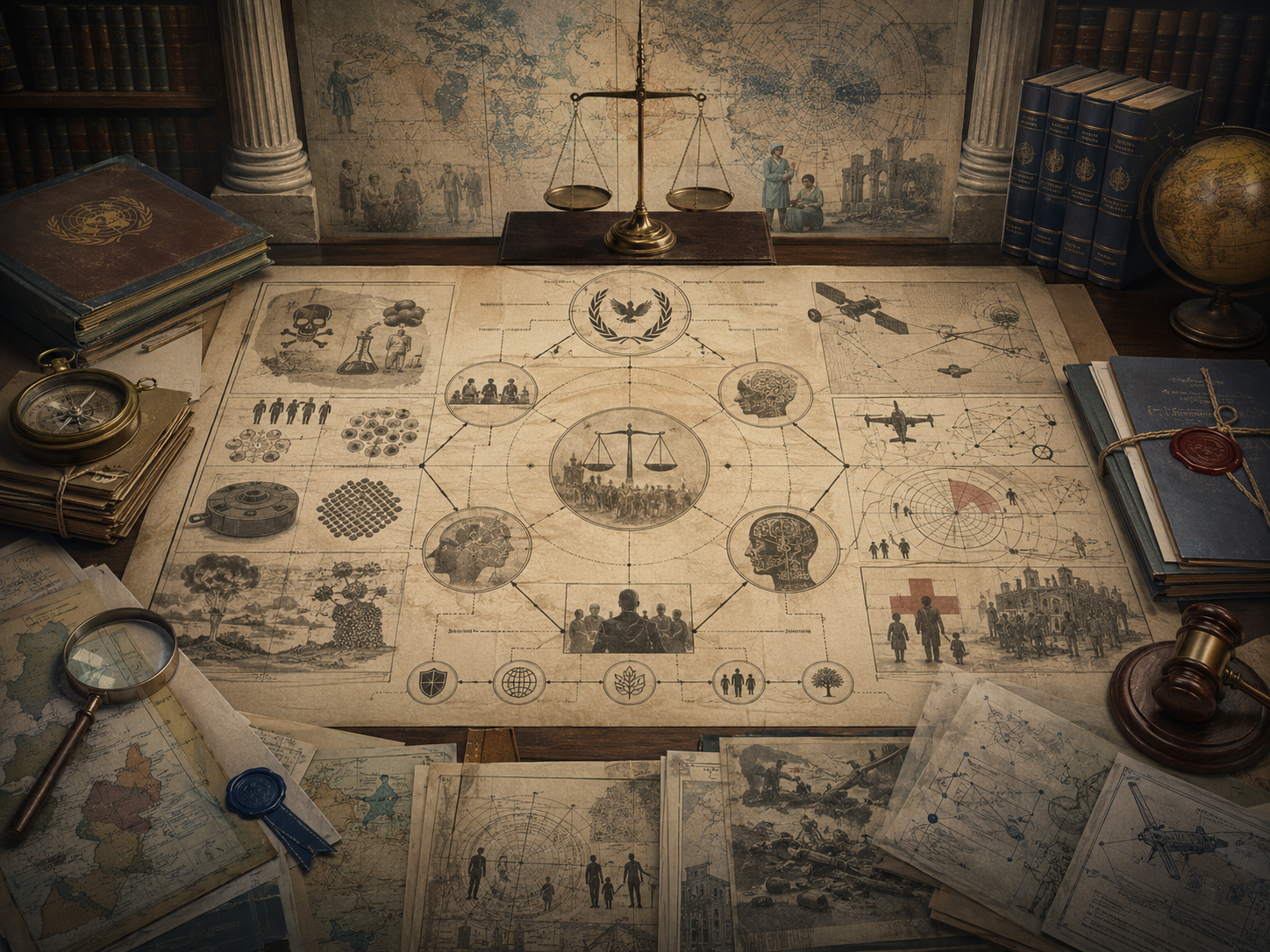
Weapons law sits at the meeting point of military technology, humanitarian protection, state security, industrial innovation, scientific uncertainty, and legal judgment. A weapon may be lawful in the abstract yet unlawful in a particular use. A technology may be new, but the legal questions are old: Can it distinguish civilians from combatants? Can it be controlled? Can its effects be limited? Does it cause unnecessary suffering? Does it leave civilians at risk after the battle? Does it make accountability harder? Does it create environmental, medical, digital, or infrastructural effects that commanders can reasonably foresee?
This article examines weapons law, prohibited means of warfare, and emerging military technologies as a field of legal constraint and institutional review. It covers superfluous injury, unnecessary suffering, inherently indiscriminate weapons, chemical and biological weapons, poison, mines, cluster munitions, incendiary weapons, blinding lasers, explosive remnants of war, explosive weapons in populated areas, cyber operations, drones, loitering munitions, autonomous weapon systems, AI-enabled targeting, space-enabled warfare, weapons transfers, Article 36 reviews, war crimes, and the practical workflows lawyers use to assess legality before and after deployment.
Why Weapons Law Matters
Weapons law matters because weapons are not neutral tools once placed inside armed conflict. A weapon shapes what commanders can imagine, what soldiers can do, what civilians experience, what infrastructure survives, what injuries medical systems must treat, what evidence remains, and what kinds of violence become routine. Law therefore regulates not only decisions to attack but also the tools, systems, and operational methods that make attack possible.
International humanitarian law begins from a basic premise: the right of parties to a conflict to choose means and methods of warfare is not unlimited. This premise appears across the Hague tradition, the Geneva tradition, Additional Protocol I, customary law, weapons treaties, disarmament instruments, and international criminal law. It rejects the claim that military advantage alone can justify any weapon or method. Even in war, legal judgment asks whether harm is excessive, indiscriminate, unnecessary, cruel, uncontrollable, environmentally catastrophic, or incompatible with humanity.
Weapons law also matters because technological development often moves faster than treaty drafting. Drones, autonomous systems, cyber capabilities, AI-enabled targeting tools, space-based military services, biometric surveillance systems, directed-energy systems, and data-driven kill chains raise questions that older treaties did not name in technical terms. But newness does not create a legal vacuum. Existing rules still apply, and Article 36 weapons review exists precisely because new weapons, means, and methods must be tested against existing law before use.
What weapons law asks
A lawyer analyzing weapons law should resist two errors. The first is assuming that a weapon is lawful merely because it is not expressly named in a treaty ban. The second is assuming that every shocking weapon is automatically unlawful. Legal analysis requires category, treaty status, customary law, foreseeable effects, operational context, user capability, target environment, safeguards, review procedures, accountability mechanisms, and the difference between abstract legality and concrete use.
Means and Methods of Warfare
Weapons law often distinguishes between means and methods of warfare. Means are the weapons, weapon systems, munitions, platforms, software-enabled tools, or devices through which violence or military effects are delivered. Methods are the ways those means are used: siege tactics, bombardment patterns, cyber operations, deception, targeting procedures, sequencing, area denial, remote strikes, autonomous modes, or combined operations.
The distinction is useful, but it should not be overstated. A weapon’s legality depends partly on how it is used. A precision munition may be used unlawfully if directed at civilians. A cyber tool may be unlawful if its effects spread beyond the military objective. An incendiary weapon may trigger different legal restrictions depending on target environment and delivery method. A mine may be treated differently depending on detectability, marking, recording, monitoring, and post-conflict clearance obligations.
Some weapons are prohibited because of their nature. Others are restricted because of the circumstances in which they are used. Still others are not specifically prohibited, but their use must satisfy general IHL rules. The lawyer’s task is therefore not to ask only, “Is the weapon banned?” The fuller question is: is this weapon, in this configuration, used by this actor, against this target, in this environment, with these foreseeable effects, under these safeguards, lawful under treaty law, customary law, and criminal law?
| Analytical category | Legal focus | Examples |
|---|---|---|
| Means of warfare | The weapon, munition, device, platform, software, or system used to create military effects. | Missiles, artillery, mines, drones, loitering munitions, cyber tools, autonomous systems, chemical agents. |
| Methods of warfare | The way force or military effect is organized, sequenced, directed, or delivered. | Siege tactics, area bombardment, cyber disruption, remote strikes, human shielding, denial tactics, autonomous loitering modes. |
| Specific prohibition | A treaty or customary rule prohibits or restricts a named category. | Chemical weapons, biological weapons, blinding lasers, anti-personnel mines for states parties, cluster munitions for states parties. |
| Contextual unlawfulness | The weapon may be lawful in the abstract but unlawful in a particular use. | Large explosive weapons in dense urban areas, incendiary weapons near civilian concentrations, cyber tools affecting hospitals. |
| Review obligation | States assess legality before studying, developing, acquiring, or adopting new weapons, means, or methods. | Article 36 legal reviews, internal weapons-review boards, technical and legal testing protocols. |
The Baseline Principles: Distinction, Proportionality, Necessity, Humanity, and Precautions
The general principles of international humanitarian law apply to all weapons and methods. Distinction requires parties to distinguish civilians from combatants and civilian objects from military objectives. Proportionality prohibits attacks expected to cause incidental civilian harm excessive in relation to the concrete and direct military advantage anticipated. Precautions require feasible steps to verify targets, choose means and methods that reduce civilian harm, and cancel or suspend attacks when the legal assessment changes.
Military necessity permits only those measures not otherwise prohibited by international law that are necessary to achieve a legitimate military purpose. It is not a blank check. Humanity limits methods that inflict suffering beyond military purpose, degrade persons into objects, or treat civilian survival as a secondary concern. The prohibition of superfluous injury and unnecessary suffering protects combatants from weapons whose injurious effects exceed what is needed to put them hors de combat.
These principles do not disappear when a technology is advanced. Autonomous functions, machine-learning classification, sensor fusion, remote command, cyber effects, and space-enabled targeting do not reduce the legal burden. They often increase the need for review because the chain between human judgment and battlefield effect becomes more complex.
Baseline legal principles for weapons review
A weapons-law review should therefore ask whether the weapon can be directed at a military objective, whether its effects can be limited, whether civilian harm can be predicted, whether commanders can make proportionality judgments, whether precautions can be implemented, whether medical and environmental consequences are foreseeable, and whether accountability records can be preserved.
Superfluous Injury and Unnecessary Suffering
The prohibition on weapons and methods that cause superfluous injury or unnecessary suffering is one of the classic limits on the conduct of war. It protects combatants and fighters from weapons whose effects exceed the military purpose of disabling or defeating the adversary. War may involve lawful force against combatants, but it does not permit the deliberate design or use of weapons that inflict suffering with no legitimate military justification.
This principle explains restrictions on certain projectiles, fragments, poisons, expanding bullets, weapons designed to blind permanently, and other means whose primary effect is not merely to neutralize but to mutilate, poison, burn, blind, or cause wounds that serve no necessary military function. The analysis is legal, technical, and medical. It asks about the nature of the injury, the reliability of the weapon, the availability of less injurious alternatives, the intended military effect, and the suffering caused after the immediate tactical moment.
The principle also matters for emerging technologies. Directed-energy weapons, novel projectiles, neurotechnological weapons, certain incapacitating agents, biometric targeting tools, or AI-selected effects may require specialized medical, technical, and legal assessment. The relevant question is not whether a weapon is modern or efficient. It is whether its foreseeable effects are compatible with the law’s prohibition on unnecessary suffering.
Indiscriminate Weapons and Uncontrollable Effects
Indiscriminate weapons are unlawful when they cannot be directed at a specific military objective or when their effects cannot be limited as required by international humanitarian law. This rule is central to weapons law because it addresses the physical, technical, and operational character of a weapon or method. Some systems may be too imprecise for certain environments. Others may produce effects that spread unpredictably. Others may create long-term hazards that continue to harm civilians after the military operation ends.
Indiscriminate effects can arise from blast radius, fragmentation pattern, area coverage, persistence, sensor unreliability, environmental spread, software propagation, inability to deactivate, failure to distinguish targets, or use in a densely populated environment. A weapon lawful in one setting may be unlawful in another because the environment makes its effects uncontrollable. The law therefore requires technical understanding as well as doctrinal analysis.
This is especially important for cyber tools, autonomous systems, explosive weapons in populated areas, mines, cluster munitions, and weapons with long-lasting environmental effects. The question is not simply whether a weapon can be aimed. The question is whether its foreseeable effects can be contained within lawful boundaries.
Indiscriminate weapons analysis also forces a distinction between intended target and actual effects. A party may claim to target a military objective, but if the weapon or method cannot be directed at that objective or cannot limit harm to surrounding civilian life, the legal problem remains. Intent does not cure uncontrollable effects.
Indicators of indiscriminate effect
Poison, Chemical Weapons, and Biological Weapons
The law has long treated poison, chemical weapons, and biological weapons as especially serious threats because their effects can spread, persist, terrorize, contaminate, and overwhelm medical systems. The prohibition of poison and poisoned weapons belongs to the older Hague tradition. The 1925 Geneva Gas Protocol prohibited the use of asphyxiating, poisonous, or other gases and bacteriological methods of warfare. Later treaties went further by addressing development, production, stockpiling, transfer, and destruction.
Chemical weapons are governed principally by the Chemical Weapons Convention. Biological weapons are governed principally by the Biological Weapons Convention. These instruments reflect the judgment that certain forms of harm are not merely operationally dangerous but categorically inconsistent with the legal and humanitarian limits of warfare. The legal concern is not only the immediate battlefield use of such weapons. It is also the threat posed by development, stockpiling, transfer, proliferation, concealment, normalization, and loss of control.
Riot control agents illustrate how weapons-law analysis can be precise rather than simplistic. A substance may have uses in domestic law enforcement, but the Chemical Weapons Convention prohibits the use of riot control agents as a method of warfare. Lawyers must therefore distinguish law-enforcement context, armed-conflict context, treaty definitions, purpose, method, and operational setting.
Biological weapons raise additional governance concerns because disease agents, delivery mechanisms, research infrastructure, dual-use biotechnology, and public-health systems can intersect. Legal review must account for deliberate use, development, facilitation, assistance, proliferation risk, dual-use research, and the difficulty of attribution.
Nuclear Weapons and the Limits of Legal Categorization
Nuclear weapons occupy a distinctive place in weapons law. They are not merely larger conventional weapons. Their blast, heat, radiation, long-term health effects, environmental consequences, and potential civilizational effects raise deep problems under distinction, proportionality, unnecessary suffering, environmental protection, and the principles of humanity.
The International Court of Justice’s Nuclear Weapons advisory opinion remains a central reference point because it framed nuclear weapons through the general principles of international humanitarian law while also confronting the limits of existing treaty law and state practice. The opinion did not provide a simple universal formula for every nuclear scenario. It instead highlighted the tension between catastrophic humanitarian effects and the structure of international law at the time.
Later developments, including the Treaty on the Prohibition of Nuclear Weapons, reflect the humanitarian-disarmament approach to weapons whose effects are incompatible with human survival. But not all nuclear-armed states are parties to that treaty, and nuclear weapons remain embedded in deterrence doctrines. The gap between humanitarian principle and geopolitical practice is therefore especially visible in nuclear law.
For lawyer-facing analysis, nuclear weapons should not be treated as a topic separate from weapons law. They test the same underlying questions at the extreme: Can the weapon distinguish? Can effects be limited? Can suffering be justified? Can environmental damage be contained? Can accountability function after use? Can law meaningfully restrain weapons whose humanitarian consequences may overwhelm legal remedies?
Incendiary Weapons, Fire, and Civilian Concentrations
Incendiary weapons raise legal concerns because fire spreads, burns are medically devastating, civilian structures ignite, and urban environments can transform a localized attack into a wider humanitarian disaster. Protocol III to the Convention on Certain Conventional Weapons restricts incendiary weapons and prohibits their use against civilians. It also restricts attacks against military objectives located within concentrations of civilians.
The legal analysis of incendiary weapons often turns on definition, design, delivery method, target environment, and foreseeable effects. Some munitions produce incendiary effects even if the weapon is not classified as an incendiary weapon under treaty definitions. White phosphorus debates illustrate the difficulty: a munition may be used for smoke, illumination, marking, or incendiary effect, but the legal analysis must examine purpose, effects, environment, civilian harm, and applicable treaty or customary rules.
Incendiary weapons are especially problematic in cities, shelters, hospitals, refugee camps, forests, schools, and infrastructure networks. Fire does not respect legal categories once unleashed. The fact that a military objective exists nearby does not eliminate the duty to consider civilian concentrations, feasible alternatives, precautions, and proportionality.
Weapons law therefore requires practical operational questions: Is the target inside or near civilian concentration? Is the munition air-delivered or ground-delivered? Are fire-control measures feasible? Are civilians sheltered in combustible structures? Are medical services capable of treating burns? Are forests, crops, or ecological systems at risk? Are there less harmful means available?
Blinding Lasers, Non-Detectable Fragments, Expanding Bullets, and Other Specific Prohibitions
Weapons law contains specific prohibitions that reflect both technical assessment and humanitarian judgment. Protocol IV to the Convention on Certain Conventional Weapons prohibits laser weapons specifically designed to cause permanent blindness to unenhanced vision. This is an important example of preventive weapons law: the legal restriction addressed a technology before widespread battlefield normalization.
The law also prohibits weapons whose primary effect is to injure by fragments not detectable by X-rays in the human body, as well as certain bullets that expand or flatten easily in the human body and certain exploding projectiles used against persons. These rules reflect a common logic: some weapons produce medical suffering that is legally unnecessary, difficult to treat, or disproportionate to any legitimate military function.
These prohibitions matter for emerging technologies because they show that law can act before humanitarian harm becomes ordinary. The legal system does not need to wait for widespread catastrophe before regulating a weapon. Technical design, intended effect, foreseeable injury, and the dictates of humanity can justify prohibition or restriction.
The lesson for legal review is that new weapons should be assessed not only against existing named categories but also against the humanitarian logic behind them. If a new system creates blinding, poisoning, uncontrollable fragments, permanent neurological injury, hidden post-conflict hazards, or impossible medical burdens, the absence of an exact treaty label does not end the legal inquiry.
Mines, Booby Traps, Cluster Munitions, and Area Effects
Mines, booby traps, and cluster munitions illustrate how weapons can remain dangerous long after the immediate battle. Their humanitarian harm comes not only from initial use but also from persistence, uncertainty, unexploded ordnance, civilian return, agricultural use, children’s curiosity, blocked roads, reconstruction delays, and the cost of clearance.
Anti-personnel mines are addressed by the Anti-Personnel Mine Ban Convention, also known as the Ottawa Convention, for states parties. The convention prohibits use, stockpiling, production, and transfer of anti-personnel mines and requires destruction and clearance obligations. Even outside treaty membership, customary international humanitarian law imposes obligations related to distinction, precautions, recording, marking, and protection of civilians.
Cluster munitions are addressed by the Convention on Cluster Munitions for states parties. The convention prohibits use, production, stockpiling, and transfer and includes obligations relating to stockpile destruction, clearance, risk education, and victim assistance. The legal concern is the combination of wide-area effect and unexploded submunitions that can kill or injure civilians long after combat.
Booby traps and other devices are restricted because they can exploit civilian behavior, protected objects, medical signs, children’s objects, food, religious objects, or ordinary patterns of civilian life. The law is especially concerned when weapons turn civilian trust into a delivery mechanism for harm.
A weapons-law assessment of these systems must ask not only whether a munition hits its intended target, but what remains afterward: maps, markings, clearance capacity, civilian warnings, humanitarian access, technical failure rates, environmental conditions, and responsibility for remediation.
Explosive Remnants of War and Post-Conflict Harm
Explosive remnants of war include unexploded and abandoned explosive ordnance that continues to endanger civilians after hostilities. Protocol V to the Convention on Certain Conventional Weapons addresses post-conflict remedial measures, including clearance, removal or destruction, recording and sharing information, warnings, risk education, and assistance to affected populations.
This area of law is important because civilian harm does not stop when firing stops. A shell that fails to explode, a bomblet in a field, abandoned ammunition near a school, or unexploded ordnance in rubble can turn ordinary life into a continuing battlefield. Farmers, children, displaced families, construction workers, humanitarian actors, and returning residents become the victims of weapons used earlier.
Explosive remnants law also demonstrates the relationship between conduct of hostilities and post-conflict recovery. Parties that use explosive ordnance should anticipate downstream duties: record locations, preserve information, assist clearance, warn civilians, cooperate with humanitarian actors, and support risk education. A legally responsible weapons policy does not end at target impact.
The post-conflict dimension is especially important for urban warfare. When dense infrastructure is struck repeatedly, unexploded ordnance can become embedded in homes, schools, roads, hospitals, water systems, and electrical facilities. Reconstruction becomes dangerous, expensive, and slow. Weapons law must therefore account for humanitarian time horizons longer than the immediate attack.
Explosive Weapons in Populated Areas
Explosive weapons in populated areas have become one of the central humanitarian concerns of contemporary armed conflict. Heavy artillery, rockets, large bombs, mortars, missiles, and other explosive systems can produce wide-area effects when used in cities, towns, camps, or dense civilian infrastructure. Even when a military objective exists, the surrounding environment may make civilian harm highly foreseeable.
The legal analysis begins with distinction, proportionality, and precautions. But the policy and practice concern goes further: explosive weapons with wide-area effects in populated areas create direct and reverberating harm. Direct harm includes death, injury, blast trauma, burns, fragmentation wounds, and destruction of homes. Reverberating effects include damage to water systems, electricity, hospitals, schools, roads, sanitation, food supply, communications, and displacement routes.
The 2022 Political Declaration on strengthening the protection of civilians from the humanitarian consequences arising from the use of explosive weapons in populated areas reflects growing recognition that civilian protection requires changes in policy, training, data collection, operational practice, and after-action review. Although it is not the same as a treaty ban, it is legally and politically significant because it articulates standards for reducing civilian harm and strengthening implementation.
Lawyers should treat EWIPA analysis as both legal and evidentiary. The relevant record includes weapon type, explosive yield, delivery accuracy, target location, civilian density, building materials, infrastructure interdependence, warning feasibility, alternative means, timing, expected reverberating effects, casualty tracking, and post-strike review.
Article 36 Weapons Reviews
Article 36 of Additional Protocol I requires states parties, in the study, development, acquisition, or adoption of a new weapon, means, or method of warfare, to determine whether its employment would be prohibited by the Protocol or by any other applicable rule of international law. This is one of the most important governance mechanisms in weapons law.
A meaningful weapons review is not a rubber stamp. It should involve legal, military, technical, medical, environmental, data, cyber, and operational expertise. It should examine the weapon’s intended use, foreseeable misuse, operating environment, reliability, failure modes, training requirements, target-recognition limits, civilian-harm profile, environmental effects, accountability records, and compatibility with treaty and customary law.
Article 36 review is especially important for emerging military technologies. A state cannot wait until after deployment to discover that a system cannot distinguish, cannot be controlled, cannot record decisions, cannot limit effects, or cannot function lawfully in realistic battlefield conditions. Review should occur early enough to alter design, restrict use, impose safeguards, or reject adoption.
Weapons review also matters beyond states formally party to Additional Protocol I. Many states maintain internal review procedures as a matter of policy or customary implementation. Even when a specific treaty obligation is contested, the underlying governance logic remains powerful: states should not introduce weapons or methods into war without assessing legality in advance.
Article 36 review questions
Drones, Loitering Munitions, and Remote Warfare
Drones are not a single legal category. Some are surveillance platforms. Some deliver weapons. Some are remotely piloted. Some have autonomous functions. Some are small commercial systems adapted for military use. Some are loitering munitions that search, wait, and strike. Their legality depends on capability, use, target, control, environment, and compliance with international humanitarian law.
Remote operation does not by itself make a strike unlawful. But it can create legal and evidentiary problems. Operators may rely on limited visual feeds, metadata, pattern analysis, signals intelligence, or algorithmic recommendations. Distance can improve deliberation, but it can also create abstraction, target misidentification, and overconfidence in technical systems.
Loitering munitions raise particular questions because they combine surveillance, persistence, target acquisition, and strike capacity. Legal review should examine who or what selects the target, how the target is defined, whether the system can abort, what happens when civilians enter the area, how long the system remains active, whether communications can fail, whether the munition can be recovered or self-destruct, and whether operators retain meaningful control.
Drone warfare also raises accountability issues. Records may be rich if systems preserve telemetry, video, command logs, and targeting data. But accountability may be weak if decisions are distributed across intelligence analysts, commanders, contractors, software systems, and remote operators. A lawful weapons policy must preserve human responsibility rather than allowing responsibility to dissolve into a technical chain.
Autonomous Weapon Systems
Autonomous weapon systems are weapons that, after activation, can select and apply force to targets without further human intervention. The legal debate is not only about machines “deciding” in a philosophical sense. It is about whether human commanders and operators can understand, limit, supervise, and remain responsible for the weapon’s effects in real operational environments.
Autonomous systems raise questions under distinction, proportionality, precautions, accountability, and the principles of humanity. Can the system reliably distinguish combatants from civilians? Can it identify surrender, hors de combat status, medical protection, civilian presence, or changing conditions? Can it operate only within bounded time, space, target profile, and environment? Can humans predict its effects? Can it be deactivated or recalled? Can logs explain what occurred? Can commanders make proportionality judgments if the system selects the target later?
The ICRC has recommended new legally binding rules, including prohibitions on unpredictable autonomous weapons and autonomous systems designed or used to target humans, as well as strict restrictions on other autonomous weapon systems. The UN Convention on Certain Conventional Weapons process has continued to discuss emerging technologies in the area of lethal autonomous weapons systems. These debates show that existing IHL applies, but many states, humanitarian actors, and experts argue that additional rules are needed.
Autonomous weapons are not legally assessed by asking whether autonomy is good or bad in the abstract. The analysis should focus on function, target type, operating environment, duration, geographic boundary, human supervision, predictability, reliability, fail-safe mechanisms, data quality, accountability, and whether the system preserves meaningful human judgment over life-and-death decisions.
AI-Enabled Targeting, Data Systems, and Human Judgment
AI-enabled targeting systems do not necessarily fire weapons. They may collect data, rank targets, classify objects, flag patterns, recommend strikes, estimate collateral damage, generate no-strike lists, identify movement, or support intelligence fusion. These systems affect legal outcomes because they shape what humans see, trust, ignore, verify, and authorize.
The legal issue is not only whether an AI system is itself a weapon. A targeting-support system may influence distinction, proportionality, precautions, and accountability even if a human commander approves the final attack. If the system misclassifies civilians, relies on biased or outdated data, fails under battlefield conditions, obscures uncertainty, or creates automation bias, human approval may become formal rather than meaningful.
AI targeting review should examine data provenance, model limits, uncertainty communication, explainability, adversarial manipulation, environmental shift, human training, verification requirements, audit logs, error rates, target taxonomy, escalation thresholds, protected-object identification, civilian-pattern recognition, and the ability to contest or halt outputs. It should also ask whether commanders are given enough information to make genuine legal judgments.
A strong legal workflow treats AI as a decision-support system subject to human responsibility, not as a legal actor. The commander cannot outsource distinction, proportionality, or precautions to a statistical model. The state cannot outsource legal responsibility to software vendors. Technical complexity does not dissolve accountability.
| AI-targeting issue | Legal concern | Review question |
|---|---|---|
| Training data | Biased, outdated, or incomplete data may distort target classification. | What data trained the system, and does it reflect the operational environment? |
| Uncertainty | Commanders may not understand confidence levels or error rates. | Does the system communicate uncertainty in a legally usable way? |
| Automation bias | Humans may over-trust machine outputs. | Are operators trained and empowered to challenge or reject outputs? |
| Protected-object recognition | Medical, humanitarian, cultural, civilian, or dual-use objects may be misclassified. | Can the system recognize protected status and flag uncertainty? |
| Auditability | Accountability may fail if outputs cannot be reconstructed. | Are logs, model versions, data inputs, and human decisions preserved? |
| Operational drift | Models may fail when conditions shift. | Is there testing for weather, terrain, adversarial behavior, civilian movement, and degraded sensors? |
Cyber Operations as Means and Methods of Warfare
Cyber operations can be means or methods of warfare when connected to an armed conflict. They may disrupt military communications, disable air-defense systems, corrupt logistics data, manipulate sensors, degrade satellites, interfere with power grids, disrupt hospitals, or cause physical effects through digital means. The ICRC has emphasized that IHL limits cyber operations during armed conflict just as it limits other means and methods of warfare.
The weapons-law questions are both familiar and technically complex. Can the operation be directed at a military objective? Will it affect civilian objects? Can malware be contained? Will effects spread across networks used by hospitals, water systems, banks, civilian communications, or humanitarian organizations? Are civilian data and digital infrastructure protected? Is there a foreseeable risk of reverberating harm?
Cyber operations challenge traditional categories because harm may be invisible, delayed, reversible, cascading, or difficult to attribute. A cyber operation that disables a military server may be lawful in one context. A cyber tool that spreads through civilian networks and disrupts hospitals, electricity, or water systems may be indiscriminate or disproportionate.
Legal review should therefore include technical containment, network mapping, dependency analysis, civilian infrastructure assessment, data protection, malware reversibility, emergency restoration, evidentiary logs, and command authorization. Cyber is not outside the law of war because it uses code. Code can be a means of warfare when it produces military effects in armed conflict.
Space Systems, Dual-Use Infrastructure, and Civilian Dependence
Space systems are increasingly central to targeting, communications, navigation, weather, surveillance, early warning, and command systems. They are also deeply entangled with civilian life. Satellites support banking, transport, agriculture, disaster response, internet connectivity, emergency services, humanitarian coordination, and ordinary communications. This dual-use character makes weapons-law analysis more difficult.
Attacks on or through space systems may implicate IHL if connected to armed conflict. The legal questions include whether a satellite or ground station is a military objective, whether the expected civilian consequences are excessive, whether debris risks are foreseeable, whether the effect spreads to civilian services, whether alternative means exist, and whether the operation creates long-term hazards for other states and civilian activities.
Anti-satellite capabilities and space-enabled cyber operations raise particular concerns because effects may not be geographically confined. Space debris can create persistent hazards. Disabling navigation or communications can affect civilian aviation, shipping, hospitals, emergency services, and humanitarian operations. Legal analysis must therefore account for indirect and reverberating effects.
Weapons law does not require lawyers to become aerospace engineers, but it does require them to understand enough of the system architecture to identify civilian dependencies. A dual-use object is not immune from attack merely because civilians use it, but civilian use is central to proportionality, precautions, and feasible alternatives.
Environmental Harm, Long-Term Effects, and Human Survival
Weapons can harm the environment directly through fire, contamination, radiation, unexploded ordnance, chemical release, oil spills, water contamination, infrastructure collapse, or ecosystem destruction. They can also harm the environment indirectly by damaging dams, power plants, industrial facilities, forests, agricultural systems, and waste-treatment infrastructure. Environmental harm is not separate from civilian protection; it often determines whether communities can survive after combat.
Additional Protocol I prohibits methods or means of warfare intended or expected to cause widespread, long-term, and severe damage to the natural environment. Customary rules and environmental treaties may also be relevant. International criminal law can address certain attacks expected to cause excessive environmental damage in relation to anticipated military advantage.
Environmental weapons analysis should include the type of munition, target environment, chemical or radiological risk, fire spread, water systems, agricultural land, protected areas, industrial facilities, dams, nuclear plants, weather conditions, season, population dependency, and long-term remediation capacity. The legal assessment should avoid treating environmental harm as merely collateral property damage.
Emerging technologies can increase both risk and capacity. Remote sensing, satellite imagery, environmental modeling, and data analysis can help foresee harm. But cyber operations, autonomous systems, and attacks on industrial control systems can also create environmental consequences that are difficult to contain. Legal review should use available technical tools to improve precaution rather than excuse uncertainty.
Weapons Transfers, Assistance, and Complicity
Weapons law is not only about the state that fires the weapon. It also concerns states, companies, intermediaries, financiers, intelligence partners, logistics providers, and technology suppliers that assist, transfer, maintain, train, or enable weapons use. The Arms Trade Treaty, export-control rules, sanctions, domestic criminal law, state responsibility, aiding-and-assisting principles, and human-rights due diligence may all become relevant.
A transfer may be legally and politically contested when there is a clear risk that weapons will be used to commit or facilitate serious violations of international humanitarian law or human rights law. Lawyers must examine end use, recipient conduct, past violations, safeguards, monitoring, diversion risk, operational doctrine, accountability mechanisms, and whether assistance continues after credible allegations arise.
Emerging military technologies complicate transfer analysis. Software updates, targeting databases, cloud services, maintenance contracts, sensor packages, training models, data pipelines, and decision-support tools may enable weapons use even when no traditional munition crosses a border. A legal review of assistance should therefore include digital infrastructure and technical support.
The central point is responsibility. A state or company cannot treat weapons as ordinary commodities once the foreseeable context is armed conflict, civilian harm, or repeated misuse. The legal analysis should ask what the provider knew, what it should have known, what risk-mitigation measures existed, whether support was suspended or conditioned, and whether assistance substantially contributed to unlawful conduct.
War Crimes and Accountability for Unlawful Weapons Use
Unlawful weapons use can give rise to state responsibility, individual criminal responsibility, command responsibility, civil liability in domestic systems, sanctions, export-control consequences, and institutional accountability. International criminal law is especially relevant when weapons are used intentionally against civilians, civilian objects, protected buildings, hospitals, humanitarian personnel, or in attacks expected to cause excessive civilian harm.
The Rome Statute includes war crimes related to intentionally directing attacks against civilians or civilian objects, launching disproportionate attacks in international armed conflict, employing poison or poisoned weapons, certain gases, expanding bullets, and other prohibited weapons listed in the Statute and amendments. Other treaty regimes may require domestic criminalization, national implementation, investigation, or cooperation.
Weapons accountability often depends on evidence. Investigators must identify the weapon, delivery system, target, impact site, remnants, trajectory, command chain, intent, warnings, alternatives, intelligence, civilian-harm estimates, battle-damage assessment, and post-strike conduct. Emerging technologies may create new evidence through logs, sensor data, AI outputs, metadata, drone video, communication records, and software version history.
Accountability also requires attention to design and review. If a weapon was reviewed inadequately, deployed outside authorized conditions, used by untrained personnel, modified without review, or combined with unreliable targeting data, responsibility may extend beyond the trigger puller. Lawyers should examine the full lifecycle: design, acquisition, review, transfer, training, deployment, use, after-action assessment, and remediation.
Lawyer’s Weapons Law Analysis Checklist
Weapons-law review sequence
Weapons Law Practice Table
| Issue | Legal question | Evidence to collect | Analytical risk |
|---|---|---|---|
| New weapon review | Can the weapon be used consistently with IHL in foreseeable circumstances? | Technical specifications, tests, intended use, operating limits, review records. | Treating review as a formality rather than a real legality assessment. |
| Indiscriminate effects | Can the weapon be directed and can its effects be limited? | Accuracy data, blast radius, spread models, failure rates, environmental conditions. | Confusing intent to target lawfully with ability to limit effects. |
| Unnecessary suffering | Does the weapon cause injury beyond legitimate military purpose? | Medical evidence, wound profiles, alternatives, design purpose, expert reports. | Analyzing only civilian harm while ignoring combatant-protection rules. |
| Urban explosive use | Are wide-area and reverberating effects foreseeable in populated environments? | Weapon type, target location, civilian density, infrastructure dependencies. | Ignoring water, power, health care, sanitation, displacement, and humanitarian access. |
| Autonomous functions | Do humans retain meaningful control over target selection and force application? | Human-machine interface, logs, target profiles, operating boundaries, abort options. | Assuming human approval is meaningful when system outputs are not understood. |
| Cyber operation | Can digital effects be contained to military objectives? | Network maps, malware behavior, dependency analysis, restoration plans. | Underestimating civilian infrastructure dependence and cascading effects. |
| Weapons transfer | Is there a clear risk of serious violations by the recipient? | Recipient record, targeting procedures, end-use monitoring, prior incidents, suspension conditions. | Treating transfer as separate from foreseeable operational misuse. |
| Post-conflict hazard | Will the weapon continue to endanger civilians after hostilities? | Failure rates, maps, markings, clearance capacity, victim-assistance plans. | Ending legal review at the moment of impact. |
Leading Authorities for Weapons Law
Applied Weapons Law Examples
Example 1: Wide-Area Explosive Weapon in a Dense Neighborhood
Scenario: A commander identifies a military objective in a densely populated urban area and proposes using a large explosive munition.
Legal review: The analysis should examine target verification, civilian density, blast and fragmentation radius, building-collapse risk, nearby hospitals or shelters, water and power infrastructure, feasible alternatives, timing, warnings, and reverberating effects.
Legal issue: The question is not only whether the target is a military objective. The question is whether this means and method of attack can be used consistently with proportionality, precautions, and civilian-protection obligations in the actual urban environment.
Example 2: Loitering Munition with Autonomous Target-Recognition Mode
Scenario: A loitering munition is programmed to search an area for a class of vehicles and strike without further human confirmation.
Legal review: The analysis should examine target profile, similarity between civilian and military vehicles, operating duration, geographic limits, ability to abort, weather effects, sensor error, civilian entry into the area, data logs, and human override capacity.
Legal issue: The central question is whether human commanders retain meaningful control and can make distinction, proportionality, and precautions judgments at the legally relevant moment.
Example 3: Cyber Operation Against Military Logistics Software
Scenario: A cyber operation is designed to disrupt military logistics software but may propagate through a shared civilian network.
Legal review: The analysis should examine whether the tool can be contained, whether hospitals or emergency services share dependencies, whether data corruption could cause civilian harm, whether restoration is possible, and whether cascading effects are foreseeable.
Legal issue: The question is whether the expected military advantage outweighs foreseeable civilian effects and whether the cyber method can be directed and limited as required by international humanitarian law.
Example 4: Transfer of Precision-Guided Munitions to a Partner Force
Scenario: A state proposes transferring precision-guided munitions to a partner force accused of repeated unlawful strikes.
Legal review: The analysis should examine recipient conduct, targeting procedures, training, end-use monitoring, civilian-casualty tracking, investigation practices, risk of serious IHL violations, diversion risk, suspension triggers, and continuing-support conditions.
Legal issue: The transfer question is not limited to the technical precision of the weapon. It also concerns foreseeable misuse, complicity, arms-transfer obligations, due diligence, and whether continued assistance would contribute to unlawful conduct.
Example 5: Incendiary Munition Near a Civilian Concentration
Scenario: A military objective is located near a populated district, and a proposed munition creates fire effects.
Legal review: The analysis should examine Protocol III applicability, delivery method, target environment, combustible structures, wind, evacuation possibilities, medical capacity, available alternative weapons, and whether fire effects can be controlled.
Legal issue: The question is whether the foreseeable incendiary effects can be limited in a civilian environment and whether the proposed attack satisfies distinction, proportionality, precautions, and any applicable incendiary-weapons restrictions.
Memo, Brief, and Advisory Workflow
Weapons-law memorandum workflow
- Frame the weapon or method precisely: Avoid generic labels. Identify the system, function, delivery mechanism, mode, target profile, operational environment, and intended effects.
- Build the legal authority map: Separate universal principles, treaty obligations for parties, customary rules, domestic implementing law, export-control obligations, and criminal-law exposure.
- Conduct effects analysis: Use technical and humanitarian evidence to evaluate accuracy, spread, persistence, suffering, medical consequences, environmental harm, civilian infrastructure, and post-conflict danger.
- Test context-specific legality: Ask whether the weapon can be used lawfully in the specific scenario, not merely whether it is lawful in the abstract.
- Evaluate review and governance: Examine Article 36 or equivalent review, operating restrictions, training, authorization rules, safeguards, logs, audits, and post-use assessment.
- Address accountability and remedies: Identify potential state responsibility, criminal liability, transfer risk, command responsibility, investigation duties, victim assistance, clearance obligations, and policy reforms.
Common Pitfalls in Weapons Law Analysis
Conclusion
Weapons law is one of the clearest expressions of the idea that war is legally constrained even at the level of tools, systems, and technical design. It rejects unlimited military choice. It asks whether weapons can distinguish, whether their effects can be limited, whether suffering is unnecessary, whether civilian harm is foreseeable, whether the environment is protected, whether post-conflict hazards are addressed, and whether human accountability survives the machinery of war.
The field is also one of the most important tests of international law’s future. Emerging military technologies are not outside law because they are new. Drones, cyber operations, autonomous weapons, AI targeting systems, and space-enabled military infrastructure all remain subject to the principles and obligations that structure the law of armed conflict. But existing law must be implemented through serious review, technical understanding, institutional discipline, transparency, and accountability.
At its best, weapons law turns humanitarian principle into practical governance. It asks engineers, commanders, lawyers, policymakers, and states to confront harm before it becomes normal. It insists that legal review must happen before deployment, that civilian effects must be studied, that technological complexity does not erase responsibility, and that even in armed conflict there are tools and methods humanity must refuse.
Complete Code Repository
The companion repository folder supports this article with structured research materials, source metadata, weapons-law matrices, Article 36 review workflows, treaty tables, emerging-technology issue maps, and reproducible outputs for analyzing prohibited means of warfare and emerging military technologies.
Weapons Law Repository Folder
Explore the supporting research materials for this article, including treaty tables, Article 36 review notes, weapons-law issue matrices, emerging-technology analysis, and legal workflow materials.
Related Articles
- International Humanitarian Law: The Geneva Conventions and the Regulation of Armed Conflict
- The Law of War: Distinction, Proportionality, Necessity, and Humanity
- Occupation, Detention, and the Legal Governance of War-Torn Territory
- Humanitarian Intervention, Responsibility to Protect, and the Limits of Sovereignty
- Self-Defense, Collective Security, and the UN Charter Framework
- War Crimes, Crimes Against Humanity, Genocide, and the Architecture of International Criminal Law
- Command Responsibility, Individual Criminal Liability, and Modes of Participation
- Cyber Operations, Digital Sovereignty, and International Law in the Information Age
- International Space Law and the Governance of Outer Space
Primary Authorities
- Hague Peace Conference (1899) Declaration concerning Expanding Bullets. The Hague. Available at: https://ihl-databases.icrc.org/en/ihl-treaties/hague-decl-iv-3-1899.
- Hague Peace Conference (1907) Convention IV respecting the Laws and Customs of War on Land and its annex: Regulations concerning the Laws and Customs of War on Land. The Hague. Available at: https://ihl-databases.icrc.org/en/ihl-treaties/hague-conv-iv-1907.
- League of Nations (1925) Protocol for the Prohibition of the Use in War of Asphyxiating, Poisonous or Other Gases, and of Bacteriological Methods of Warfare. Geneva. Available at: https://ihl-databases.icrc.org/en/ihl-treaties/geneva-gas-prot-1925.
- International Committee of the Red Cross (1949) Geneva Conventions of 12 August 1949. Geneva: International Committee of the Red Cross. Available at: https://ihl-databases.icrc.org/en/ihl-treaties/geneva-conventions-1949additional-protocols-and-their-commentaries.
- International Committee of the Red Cross (1977) Protocol Additional to the Geneva Conventions of 12 August 1949, and relating to the Protection of Victims of International Armed Conflicts. Geneva: International Committee of the Red Cross. Available at: https://ihl-databases.icrc.org/en/ihl-treaties/api-1977.
- International Committee of the Red Cross (1977) Protocol Additional to the Geneva Conventions of 12 August 1949, and relating to the Protection of Victims of Non-International Armed Conflicts. Geneva: International Committee of the Red Cross. Available at: https://ihl-databases.icrc.org/en/ihl-treaties/apii-1977.
- United Nations (1972) Convention on the Prohibition of the Development, Production and Stockpiling of Bacteriological Biological and Toxin Weapons and on their Destruction. London, Moscow and Washington. Available at: https://disarmament.unoda.org/en/our-work/weapons-mass-destruction/biological-weapons/biological-weapons-convention.
- United Nations (1976) Convention on the Prohibition of Military or Any Other Hostile Use of Environmental Modification Techniques. New York: United Nations. Available at: https://disarmament.unoda.org/enmod/.
- United Nations (1980) Convention on Prohibitions or Restrictions on the Use of Certain Conventional Weapons Which May Be Deemed to Be Excessively Injurious or to Have Indiscriminate Effects. Geneva: United Nations. Available at: https://disarmament.unoda.org/en/our-work/conventional-arms/convention-certain-conventional-weapons.
- United Nations (1980) Protocol I to the Convention on Certain Conventional Weapons: Protocol on Non-Detectable Fragments. Geneva: United Nations. Available at: https://ihl-databases.icrc.org/en/ihl-treaties/ccw-protocol-i-1980.
- United Nations (1980, amended 1996) Protocol II to the Convention on Certain Conventional Weapons: Protocol on Prohibitions or Restrictions on the Use of Mines, Booby-Traps and Other Devices. Geneva: United Nations. Available at: https://ihl-databases.icrc.org/en/ihl-treaties/ccw-protocol-ii-1980.
- United Nations (1980) Protocol III to the Convention on Certain Conventional Weapons: Protocol on Prohibitions or Restrictions on the Use of Incendiary Weapons. Geneva: United Nations. Available at: https://ihl-databases.icrc.org/en/ihl-treaties/ccw-protocol-iii-1980.
- United Nations (1995) Protocol IV to the Convention on Certain Conventional Weapons: Protocol on Blinding Laser Weapons. Vienna: United Nations. Available at: https://ihl-databases.icrc.org/en/ihl-treaties/ccw-protocol-iv-1995.
- United Nations (2003) Protocol V to the Convention on Certain Conventional Weapons: Protocol on Explosive Remnants of War. Geneva: United Nations. Available at: https://ihl-databases.icrc.org/en/ihl-treaties/ccw-protocol-v-2003.
- Organisation for the Prohibition of Chemical Weapons (1993) Convention on the Prohibition of the Development, Production, Stockpiling and Use of Chemical Weapons and on their Destruction. The Hague: OPCW. Available at: https://www.opcw.org/sites/default/files/documents/CWC/CWC_en.pdf.
- United Nations (1997) Convention on the Prohibition of the Use, Stockpiling, Production and Transfer of Anti-Personnel Mines and on their Destruction. Oslo: United Nations. Available at: https://www.apminebanconvention.org/en/convention-text.
- United Nations (1998) Rome Statute of the International Criminal Court. Rome: United Nations. Available at: https://www.icc-cpi.int/sites/default/files/2024-05/Rome-Statute-eng.pdf.
- United Nations (2008) Convention on Cluster Munitions. Dublin: United Nations. Available at: https://www.clusterconvention.org/convention-text/.
- United Nations General Assembly (2013) Arms Trade Treaty. New York: United Nations. Available at: https://thearmstradetreaty.org/treaty-text.html.
- United Nations (2017) Treaty on the Prohibition of Nuclear Weapons. New York: United Nations. Available at: https://disarmament.unoda.org/en/our-work/weapons-mass-destruction/nuclear-weapons/treaty-prohibition-nuclear-weapons.
- United Nations Office for Disarmament Affairs (2022) Political Declaration on Strengthening the Protection of Civilians from the Humanitarian Consequences Arising from the Use of Explosive Weapons in Populated Areas. New York: UNODA. Available at: https://ewipa.org/the-political-declaration.
Selected Advisory Opinions, Manuals, and Institutional Materials
- International Court of Justice (1996) Legality of the Threat or Use of Nuclear Weapons, Advisory Opinion. The Hague: International Court of Justice. Available at: https://www.icj-cij.org/case/95.
- International Committee of the Red Cross (2006) A Guide to the Legal Review of New Weapons, Means and Methods of Warfare: Measures to Implement Article 36 of Additional Protocol I of 1977. Geneva: International Committee of the Red Cross. Available at: https://www.icrc.org/en/publication/0902-guide-legal-review-new-weapons-means-and-methods-warfare-measures-implement-article.
- International Committee of the Red Cross (n.d.) Customary International Humanitarian Law Database: Rules on Weapons. Geneva: International Committee of the Red Cross. Available at: https://ihl-databases.icrc.org/en/customary-ihl.
- International Committee of the Red Cross (n.d.) Methods and Means of Warfare. Geneva: International Committee of the Red Cross. Available at: https://www.icrc.org/en/law-and-policy/methods-and-means-warfare.
- International Committee of the Red Cross (n.d.) Weapons and Disarmament. Geneva: International Committee of the Red Cross. Available at: https://www.icrc.org/en/law-and-policy/weapons-and-disarmament.
- International Committee of the Red Cross (2022) What You Need to Know About Autonomous Weapons. Geneva: International Committee of the Red Cross. Available at: https://www.icrc.org/en/document/what-you-need-know-about-autonomous-weapons.
- International Committee of the Red Cross (2026) Autonomous Weapon Systems and International Humanitarian Law: Selected Issues. Geneva: International Committee of the Red Cross. Available at: https://www.icrc.org/en/article/autonomous-weapon-systems-and-international-humanitarian-law-selected-issues.
- International Committee of the Red Cross (n.d.) Cyber and Information Operations. Geneva: International Committee of the Red Cross. Available at: https://www.icrc.org/en/law-and-policy/cyber-and-information-operations.
- United Nations Office for Disarmament Affairs (n.d.) Convention on Certain Conventional Weapons. New York: UNODA. Available at: https://disarmament.unoda.org/en/our-work/conventional-arms/convention-certain-conventional-weapons.
- United Nations Office for Disarmament Affairs (2025) Group of Governmental Experts on Lethal Autonomous Weapons Systems. New York and Geneva: UNODA. Available at: https://meetings.unoda.org/ccw/convention-on-certain-conventional-weapons-group-of-governmental-experts-on-lethal-autonomous-weapons-systems-2025.
Further Reading
- Boothby, W.H. (2016) Weapons and the Law of Armed Conflict. 2nd edn. Oxford: Oxford University Press. Available at: https://global.oup.com/academic/product/weapons-and-the-law-of-armed-conflict-9780198728504.
- Boothby, W.H. (2019) New Technologies and the Law in War and Peace. Cambridge: Cambridge University Press. Available at: https://www.cambridge.org/core/books/new-technologies-and-the-law-in-war-and-peace/EA443B91A25E9806DE32F327A0736B87.
- Boothby, W.H. and Heintschel von Heinegg, W. (eds.) (2018) The Law of War: A Detailed Assessment of the US Department of Defense Law of War Manual. Cambridge: Cambridge University Press. Available at: https://www.cambridge.org/core/books/law-of-war/52EE33D74D851812122B0291982E1A10.
- Dinstein, Y. (2016) The Conduct of Hostilities under the Law of International Armed Conflict. 3rd edn. Cambridge: Cambridge University Press. Available at: https://www.cambridge.org/core/books/conduct-of-hostilities-under-the-law-of-international-armed-conflict/6B5F67465224EE10E7A61DDADBA23023.
- Doswald-Beck, L. (ed.) (1996) Blinding Weapons: Reports of the Meetings of Experts Convened by the International Committee of the Red Cross on Battlefield Laser Weapons 1989–1991. Geneva: International Committee of the Red Cross. Available at: https://library.icrc.org/library/search/notice?noticeNr=12323.
- Fleck, D. (ed.) (2021) The Handbook of International Humanitarian Law. 4th edn. Oxford: Oxford University Press. Available at: https://global.oup.com/academic/product/the-handbook-of-international-humanitarian-law-9780198847960.
- Gill, T.D., Fleck, D., Boothby, W.H. and Vanheusden, A. (eds.) (2017) The Leuven Manual on the International Law Applicable to Peace Operations. Cambridge: Cambridge University Press. Available at: https://www.cambridge.org/core/books/leuven-manual-on-the-international-law-applicable-to-peace-operations/060940F1C8315178734B73D8156E4658.
- Gisel, L., Rodenhäuser, T. and Dörmann, K. (2020) ‘Twenty Years on: International Humanitarian Law and the Protection of Civilians against the Effects of Cyber Operations during Armed Conflicts’, International Review of the Red Cross, 102(913), pp. 287–334. Available at: https://international-review.icrc.org/articles/twenty-years-on-international-humanitarian-law-and-the-protection-of-civilians-against-the-effects-of-cyber-operations-during-armed-conflicts-913.
- Henckaerts, J.-M. and Doswald-Beck, L. (2005) Customary International Humanitarian Law, Volume I: Rules. Cambridge: Cambridge University Press and International Committee of the Red Cross. Available at: https://ihl-databases.icrc.org/en/customary-ihl.
- International Committee of the Red Cross (2006) A Guide to the Legal Review of New Weapons, Means and Methods of Warfare: Measures to Implement Article 36 of Additional Protocol I of 1977. Geneva: International Committee of the Red Cross. Available at: https://www.icrc.org/en/publication/0902-guide-legal-review-new-weapons-means-and-methods-warfare-measures-implement-article.
- International Committee of the Red Cross (2011) International Humanitarian Law and New Weapon Technologies. Geneva: International Committee of the Red Cross. Available at: https://www.icrc.org/en/doc/assets/files/2011/ihl-new-weapon-technologies-34ic-2011-11-4.pdf.
- International Committee of the Red Cross (2019) International Humanitarian Law and the Challenges of Contemporary Armed Conflicts. Geneva: International Committee of the Red Cross. Available at: https://www.icrc.org/en/document/international-humanitarian-law-and-challenges-contemporary-armed-conflicts.
- International Committee of the Red Cross (2022) Explosive Weapons with Wide Area Effects: A Deadly Choice in Populated Areas. Geneva: International Committee of the Red Cross. Available at: https://www.icrc.org/en/publication/4498-explosive-weapons-wide-area-effects-deadly-choice-populated-areas.
- International Committee of the Red Cross (2026) Autonomous Weapon Systems and International Humanitarian Law: Selected Issues. Geneva: International Committee of the Red Cross. Available at: https://www.icrc.org/en/article/autonomous-weapon-systems-and-international-humanitarian-law-selected-issues.
- Kelsey, J. (2008) ‘Hacking into International Humanitarian Law: The Principles of Distinction and Neutrality in the Age of Cyber Warfare’, Michigan Law Review, 106(7), pp. 1427–1451. Available at: https://repository.law.umich.edu/mlr/vol106/iss7/7/.
- McClelland, J. (2003) ‘The Review of Weapons in Accordance with Article 36 of Additional Protocol I’, International Review of the Red Cross, 85(850), pp. 397–415. Available at: https://international-review.icrc.org/articles/review-weapons-accordance-article-36-additional-protocol-i.
- Melzer, N. (2016) International Humanitarian Law: A Comprehensive Introduction. Geneva: International Committee of the Red Cross. Available at: https://www.icrc.org/en/publication/4231-international-humanitarian-law-comprehensive-introduction.
- Program on Humanitarian Policy and Conflict Research at Harvard University (2013) HPCR Manual on International Law Applicable to Air and Missile Warfare. Cambridge, MA: Harvard University. Available at: https://reliefweb.int/report/world/manual-international-law-applicable-air-and-missile-warfare.
- Schmitt, M.N. (ed.) (2017) Tallinn Manual 2.0 on the International Law Applicable to Cyber Operations. Cambridge: Cambridge University Press. Available at: https://www.cambridge.org/core/books/tallinn-manual-20-on-the-international-law-applicable-to-cyber-operations/4E2F38D4D7051C3E4C1955DFF2CE6DDB.
- Solis, G.D. (2021) The Law of Armed Conflict: International Humanitarian Law in War. 3rd edn. Cambridge: Cambridge University Press. Available at: https://www.cambridge.org/core/books/law-of-armed-conflict/9DB9B4574898A5AA74449767B45FB8B3.
- United Nations Institute for Disarmament Research (2020) The Human Element in Decisions about the Use of Force. Geneva: UNIDIR. Available at: https://unidir.org/publication/human-element-decisions-about-use-force/.
- United Nations Institute for Disarmament Research (2022) Algorithmic Bias and the Weaponization of Increasingly Autonomous Technologies. Geneva: UNIDIR. Available at: https://unidir.org/publication/algorithmic-bias-and-weaponization-increasingly-autonomous-technologies/.
- Wilmshurst, E. and Breau, S. (eds.) (2007) Perspectives on the ICRC Study on Customary International Humanitarian Law. Cambridge: Cambridge University Press. Available at: https://www.cambridge.org/core/books/perspectives-on-the-icrc-study-on-customary-international-humanitarian-law/1C2343CE9ED4D8B8AF06CF90C0E8C470.
References
- Boothby, W.H. (2016) Weapons and the Law of Armed Conflict. 2nd edn. Oxford: Oxford University Press. Available at: https://global.oup.com/academic/product/weapons-and-the-law-of-armed-conflict-9780198728504.
- Dinstein, Y. (2016) The Conduct of Hostilities under the Law of International Armed Conflict. 3rd edn. Cambridge: Cambridge University Press. Available at: https://www.cambridge.org/core/books/conduct-of-hostilities-under-the-law-of-international-armed-conflict/6B5F67465224EE10E7A61DDADBA23023.
- Fleck, D. (ed.) (2021) The Handbook of International Humanitarian Law. 4th edn. Oxford: Oxford University Press. Available at: https://global.oup.com/academic/product/the-handbook-of-international-humanitarian-law-9780198847960.
- Gisel, L., Rodenhäuser, T. and Dörmann, K. (2020) ‘Twenty Years on: International Humanitarian Law and the Protection of Civilians against the Effects of Cyber Operations during Armed Conflicts’, International Review of the Red Cross, 102(913), pp. 287–334. Available at: https://international-review.icrc.org/articles/twenty-years-on-international-humanitarian-law-and-the-protection-of-civilians-against-the-effects-of-cyber-operations-during-armed-conflicts-913.
- Hague Peace Conference (1899) Declaration concerning Expanding Bullets. The Hague. Available at: https://ihl-databases.icrc.org/en/ihl-treaties/hague-decl-iv-3-1899.
- Hague Peace Conference (1907) Convention IV respecting the Laws and Customs of War on Land and its annex: Regulations concerning the Laws and Customs of War on Land. The Hague. Available at: https://ihl-databases.icrc.org/en/ihl-treaties/hague-conv-iv-1907.
- Henckaerts, J.-M. and Doswald-Beck, L. (2005) Customary International Humanitarian Law, Volume I: Rules. Cambridge: Cambridge University Press and International Committee of the Red Cross. Available at: https://ihl-databases.icrc.org/en/customary-ihl.
- International Committee of the Red Cross (1977) Protocol Additional to the Geneva Conventions of 12 August 1949, and relating to the Protection of Victims of International Armed Conflicts. Geneva: International Committee of the Red Cross. Available at: https://ihl-databases.icrc.org/en/ihl-treaties/api-1977.
- International Committee of the Red Cross (2006) A Guide to the Legal Review of New Weapons, Means and Methods of Warfare: Measures to Implement Article 36 of Additional Protocol I of 1977. Geneva: International Committee of the Red Cross. Available at: https://www.icrc.org/en/publication/0902-guide-legal-review-new-weapons-means-and-methods-warfare-measures-implement-article.
- International Committee of the Red Cross (2022) Explosive Weapons with Wide Area Effects: A Deadly Choice in Populated Areas. Geneva: International Committee of the Red Cross. Available at: https://www.icrc.org/en/publication/4498-explosive-weapons-wide-area-effects-deadly-choice-populated-areas.
- International Committee of the Red Cross (2026) Autonomous Weapon Systems and International Humanitarian Law: Selected Issues. Geneva: International Committee of the Red Cross. Available at: https://www.icrc.org/en/article/autonomous-weapon-systems-and-international-humanitarian-law-selected-issues.
- International Court of Justice (1996) Legality of the Threat or Use of Nuclear Weapons, Advisory Opinion. The Hague: International Court of Justice. Available at: https://www.icj-cij.org/case/95.
- Kelsey, J. (2008) ‘Hacking into International Humanitarian Law: The Principles of Distinction and Neutrality in the Age of Cyber Warfare’, Michigan Law Review, 106(7), pp. 1427–1451. Available at: https://repository.law.umich.edu/mlr/vol106/iss7/7/.
- League of Nations (1925) Protocol for the Prohibition of the Use in War of Asphyxiating, Poisonous or Other Gases, and of Bacteriological Methods of Warfare. Geneva. Available at: https://ihl-databases.icrc.org/en/ihl-treaties/geneva-gas-prot-1925.
- McClelland, J. (2003) ‘The Review of Weapons in Accordance with Article 36 of Additional Protocol I’, International Review of the Red Cross, 85(850), pp. 397–415. Available at: https://international-review.icrc.org/articles/review-weapons-accordance-article-36-additional-protocol-i.
- Melzer, N. (2016) International Humanitarian Law: A Comprehensive Introduction. Geneva: International Committee of the Red Cross. Available at: https://www.icrc.org/en/publication/4231-international-humanitarian-law-comprehensive-introduction.
- Organisation for the Prohibition of Chemical Weapons (1993) Convention on the Prohibition of the Development, Production, Stockpiling and Use of Chemical Weapons and on their Destruction. The Hague: OPCW. Available at: https://www.opcw.org/sites/default/files/documents/CWC/CWC_en.pdf.
- Schmitt, M.N. (ed.) (2017) Tallinn Manual 2.0 on the International Law Applicable to Cyber Operations. Cambridge: Cambridge University Press. Available at: https://www.cambridge.org/core/books/tallinn-manual-20-on-the-international-law-applicable-to-cyber-operations/4E2F38D4D7051C3E4C1955DFF2CE6DDB.
- Solis, G.D. (2021) The Law of Armed Conflict: International Humanitarian Law in War. 3rd edn. Cambridge: Cambridge University Press. Available at: https://www.cambridge.org/core/books/law-of-armed-conflict/9DB9B4574898A5AA74449767B45FB8B3.
- United Nations (1972) Convention on the Prohibition of the Development, Production and Stockpiling of Bacteriological Biological and Toxin Weapons and on their Destruction. London, Moscow and Washington. Available at: https://disarmament.unoda.org/en/our-work/weapons-mass-destruction/biological-weapons/biological-weapons-convention.
- United Nations (1980) Convention on Prohibitions or Restrictions on the Use of Certain Conventional Weapons Which May Be Deemed to Be Excessively Injurious or to Have Indiscriminate Effects. Geneva: United Nations. Available at: https://disarmament.unoda.org/en/our-work/conventional-arms/convention-certain-conventional-weapons.
- United Nations (1997) Convention on the Prohibition of the Use, Stockpiling, Production and Transfer of Anti-Personnel Mines and on their Destruction. Oslo: United Nations. Available at: https://www.apminebanconvention.org/en/convention-text.
- United Nations (2008) Convention on Cluster Munitions. Dublin: United Nations. Available at: https://www.clusterconvention.org/convention-text/.
- United Nations General Assembly (2013) Arms Trade Treaty. New York: United Nations. Available at: https://thearmstradetreaty.org/treaty-text.html.
- United Nations Office for Disarmament Affairs (2022) Political Declaration on Strengthening the Protection of Civilians from the Humanitarian Consequences Arising from the Use of Explosive Weapons in Populated Areas. New York: UNODA. Available at: https://ewipa.org/the-political-declaration.
- United Nations Office for Disarmament Affairs (2025) Group of Governmental Experts on Lethal Autonomous Weapons Systems. New York and Geneva: UNODA. Available at: https://meetings.unoda.org/ccw/convention-on-certain-conventional-weapons-group-of-governmental-experts-on-lethal-autonomous-weapons-systems-2025.
- United Nations Institute for Disarmament Research (2020) The Human Element in Decisions about the Use of Force. Geneva: UNIDIR. Available at: https://unidir.org/publication/human-element-decisions-about-use-force/.
- United Nations Institute for Disarmament Research (2022) Algorithmic Bias and the Weaponization of Increasingly Autonomous Technologies. Geneva: UNIDIR. Available at: https://unidir.org/publication/algorithmic-bias-and-weaponization-increasingly-autonomous-technologies/.