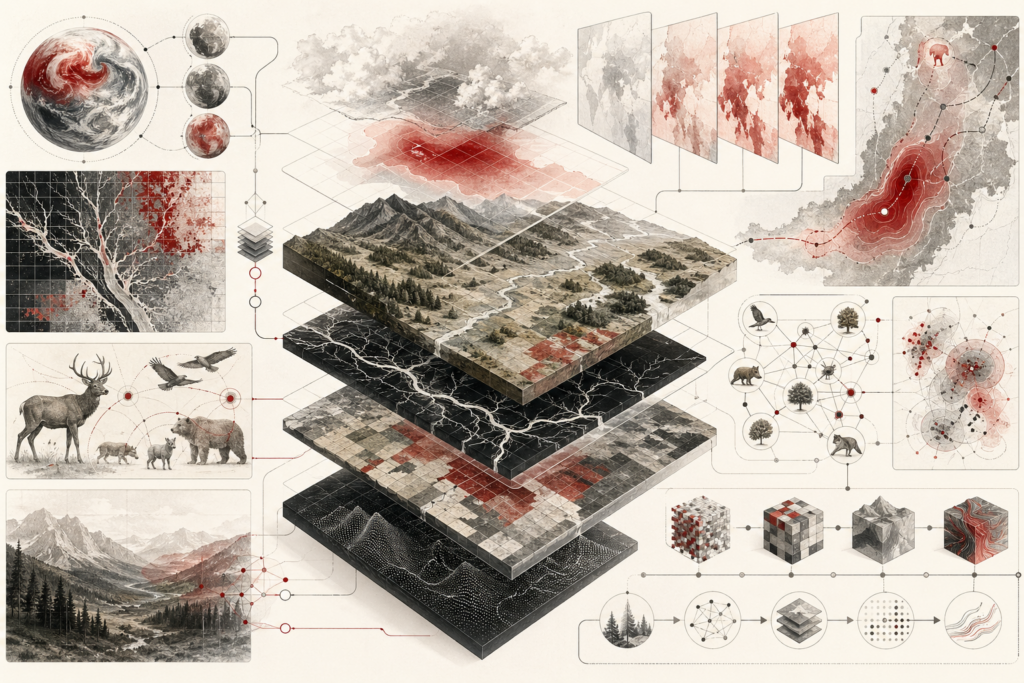
Computational Ecology and Environmental Modeling
Computational Ecology and Environmental Modeling examines how ecological systems can be studied through mathematical models, environmental data, spatial analysis, remote sensing, simulations, uncertainty, and reproducible computational workflows. The article explains how computational ecology helps scientists model species distributions, habitat suitability, population dynamics, patch occupancy, hydrology, climate stress, land-use change, restoration scenarios, ecosystem processes, and environmental risk. Written for ecologists, conservation biologists, marine biologists, environmental scientists, restoration ecologists, biodiversity researchers, geospatial analysts, computational biologists, data engineers, sustainability scientists, and scientific software developers, the article emphasizes model assumptions, spatial and temporal scale, validation, provenance, open data, scenario analysis, and responsible interpretation. It shows how ecological modeling can make environmental change more visible, testable, auditable, and useful for decision-making under uncertainty.