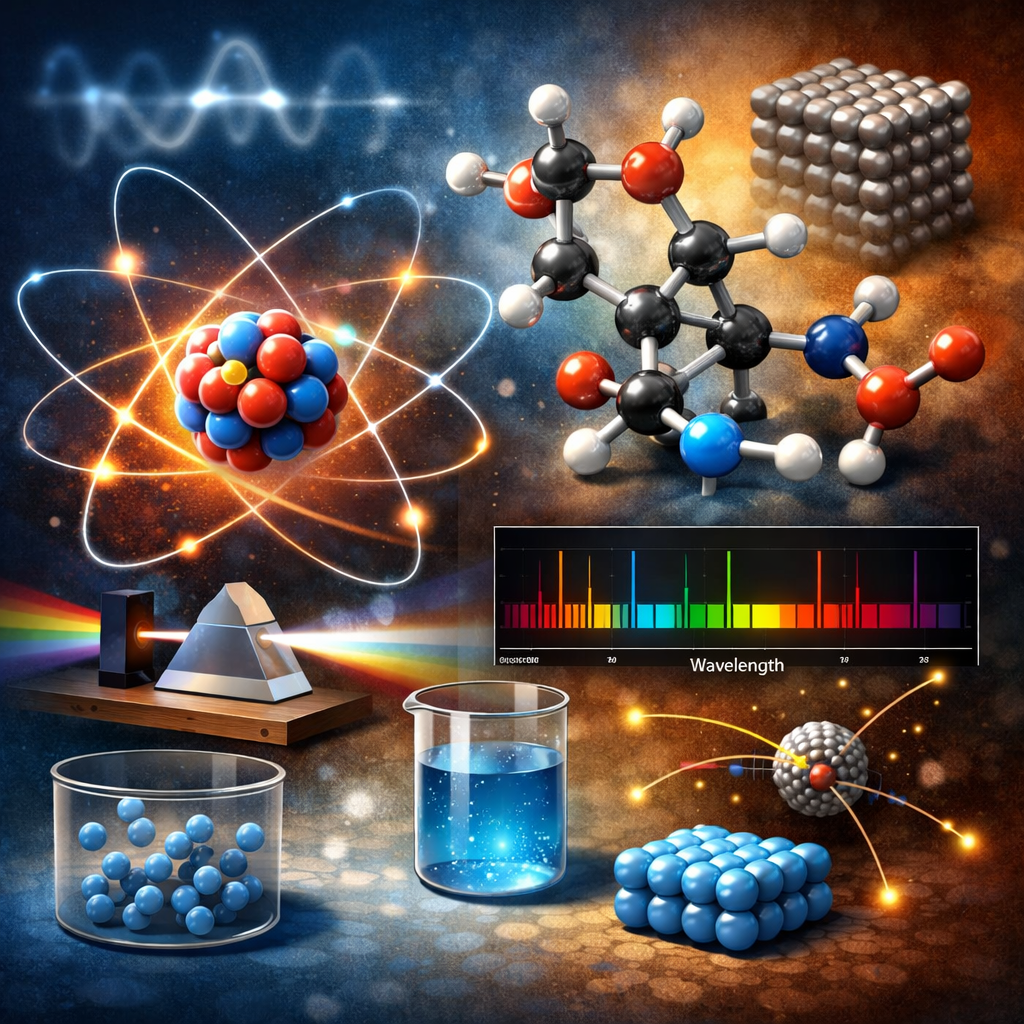
Atoms, Molecules, and the Structure of Matter
Atoms, molecules, and the structure of matter explain how the visible diversity of the material world emerges from discrete microscopic organization. This article traces the development of atomic and molecular theory from Dalton, Avogadro, Rutherford, Bohr, and Schrödinger to the modern quantum view of matter. It shows how atoms are structured through nuclei and electron states, how molecules form through energy-lowering bonds, and how spectra, geometry, polarity, and collective organization reveal the architecture of physical substance. The article also connects atomic and molecular structure to measurement, spectroscopy, quantum mechanics, materials science, and computational modeling, showing how equations such as E=hν, E=hc/λ, and
H
^
ψ=Eψ help translate microscopic structure into observable physical behavior.