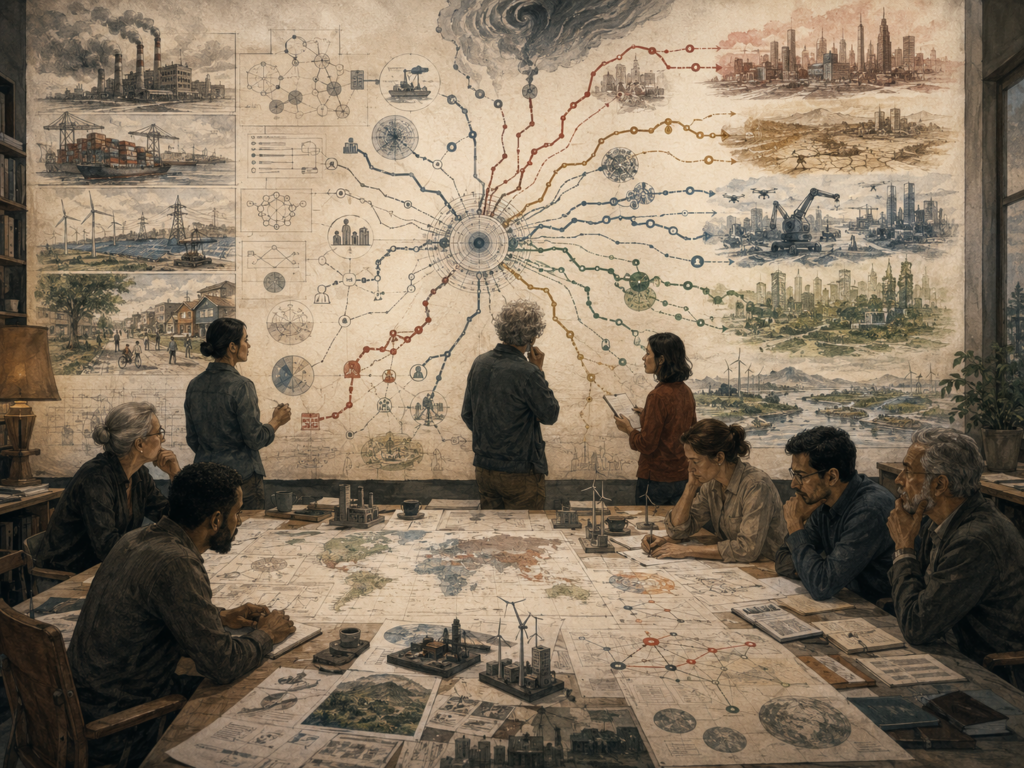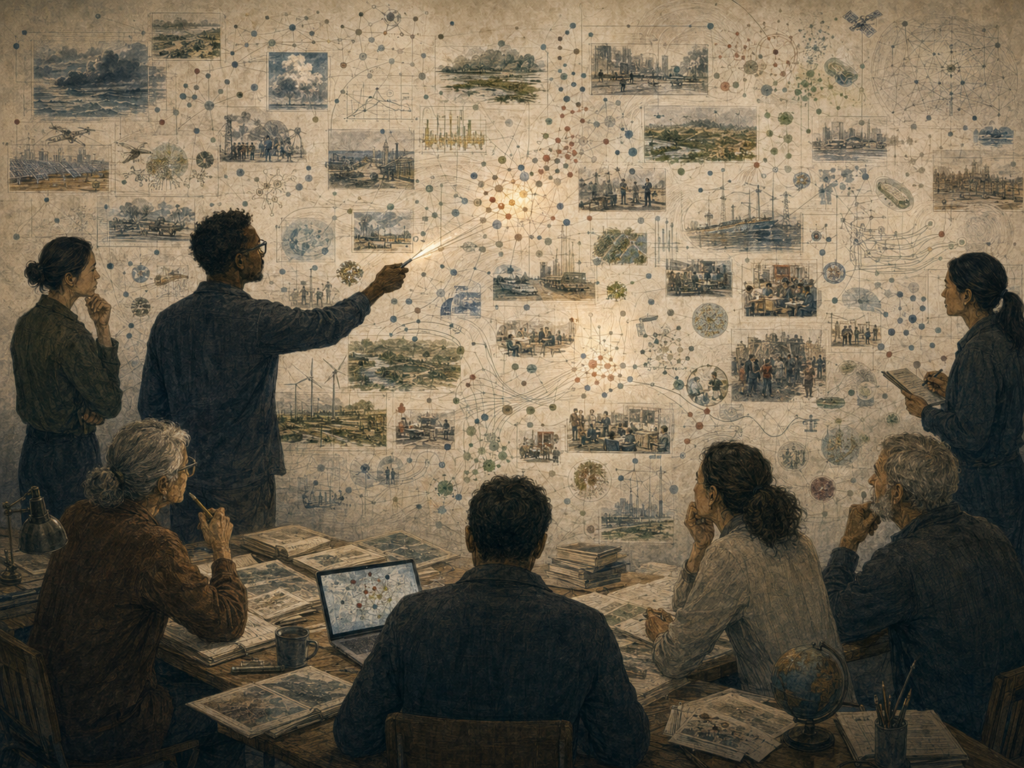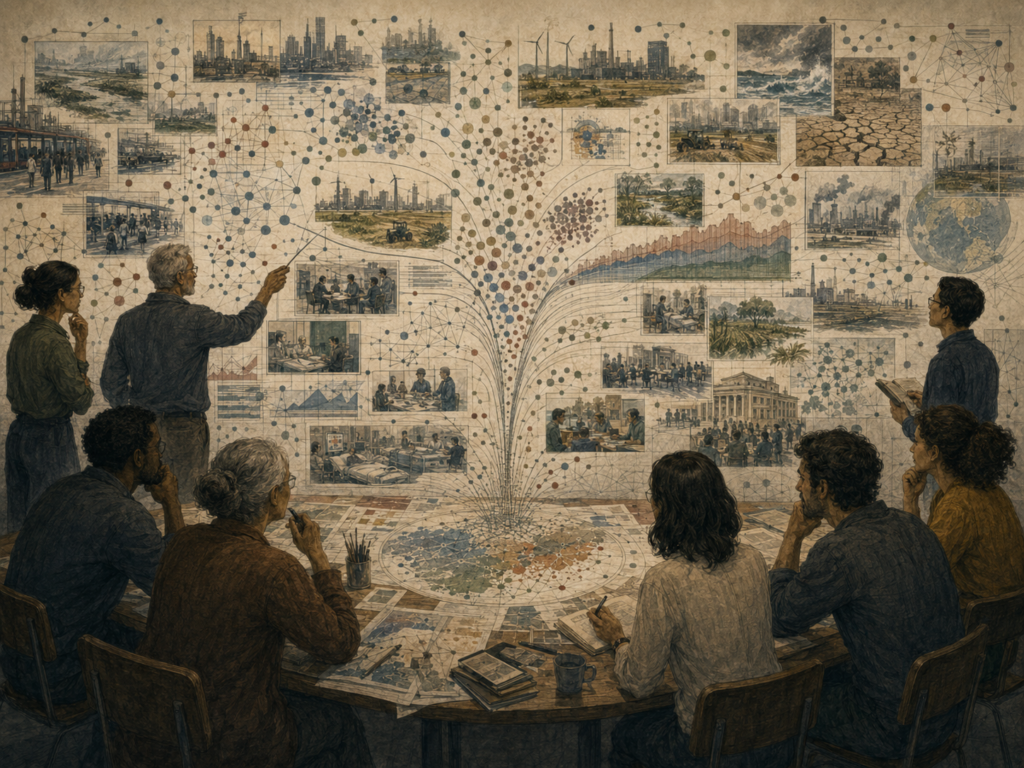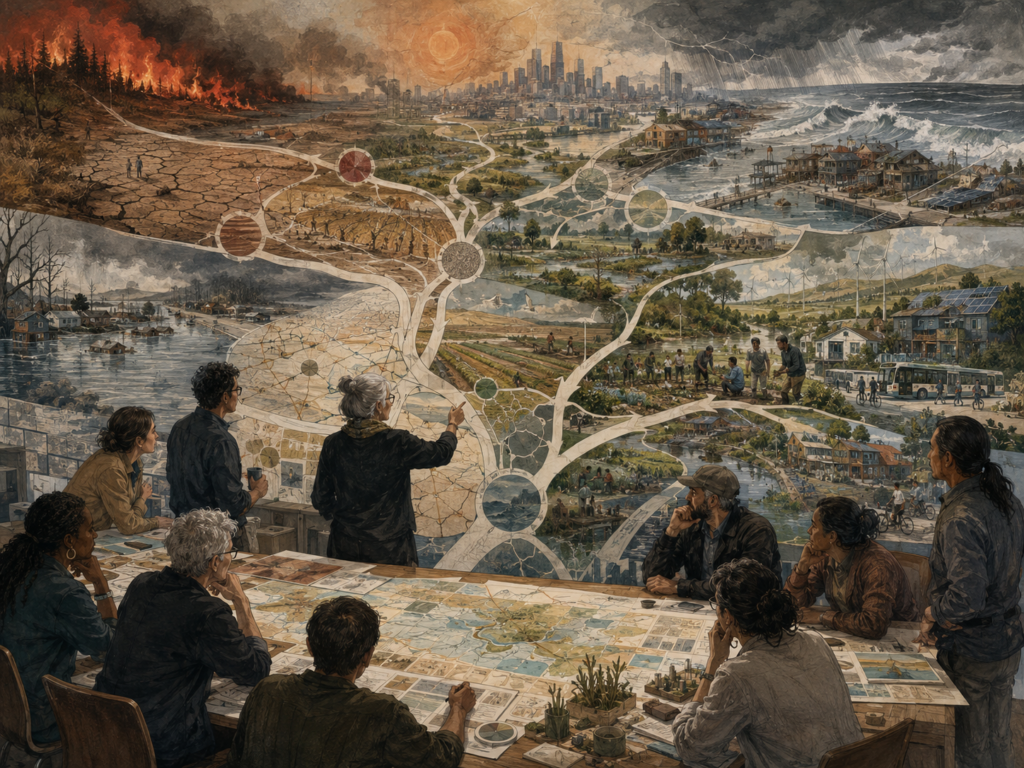
A foresight group examines branching climate futures across wildfire, drought, flooding, coastal risk, cities, farms, renewable energy, and ecological restoration.

Climate Futures and Environmental Change: Anticipating Risk, Uncertainty, and Planetary Transformation

Climate Futures and Environmental Change examines how Earth systems may evolve under anthropogenic pressure, long-term transformation, and deep uncertainty. The article argues that climate change is not a single-variable environmental problem, but a systemic interaction among atmospheric dynamics, ecological thresholds, infrastructure, political economy, technological change, and unequal human vulnerability. It develops this through complex-systems reasoning, emissions pathways, deep uncertainty, tipping points, planetary boundaries, adaptation and mitigation, climate risk, transition dynamics, and the difficulty of coordinating governance across fragmented institutions. The article emphasizes that climate futures are shaped not only by physical forcing, but by how societies govern transition, manage feedbacks, and distribute risk under nonstationary conditions.
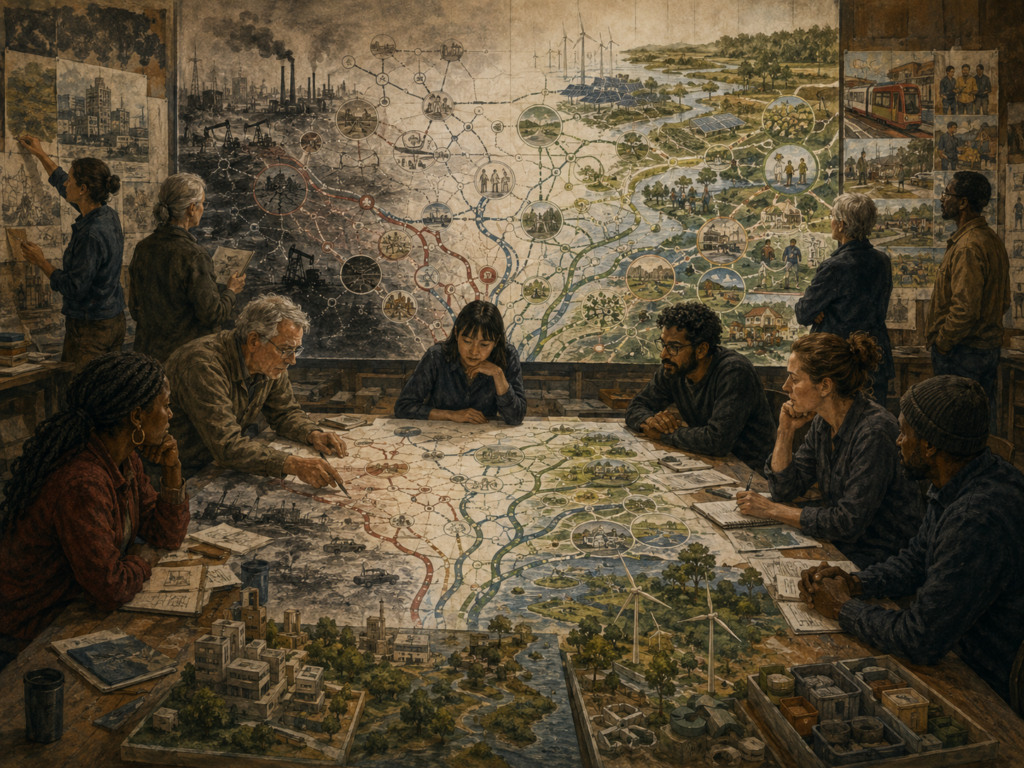
A diverse foresight group maps sustainability futures across pollution, renewable energy, ecological restoration, communities, infrastructure, and long-term systems change.

Futures Thinking and Sustainability: Anticipating and Designing Long-Term System Transitions

Futures Thinking and Sustainability examines how long-horizon foresight and sustainability become inseparable once ecological stability, social equity, and economic viability are treated as problems of system transition rather than short-term management. The article argues that sustainability is inherently a futures problem because present decisions must be made under uncertainty about long-term system behavior, thresholds, and irreversible risk. It develops this through complex systems reasoning, uncertainty, backcasting, technological change, resilience, adaptation, transformation, political economy, and the difficulty of implementing sustainable pathways within existing institutional constraints. The article emphasizes that sustainability is not simply about preserving the present, but about intentionally shaping more viable futures under ecological limits and contested transition politics.

A diverse planning group works backward from a desired future to map strategic steps across infrastructure, communities, ecology, and public systems.

Backcasting and Strategic Planning: Designing Pathways from Desired Futures to Present Action

Backcasting and Strategic Planning explains how long-range strategy can begin from a desired future rather than from the inertia of present trends. The article argues that backcasting is a normative planning method designed for contexts where continuation is inadequate, undesirable, or structurally incapable of delivering long-term goals. It develops this through the distinction between forecasting and backcasting, the logic of pathway design, the role of systems thinking, socio-technical transitions, applications across policy and business, and the political and institutional constraints that shape feasibility. The article emphasizes that backcasting is not simply a planning technique but a way of translating preferred futures into staged, actionable transitions under uncertainty.

A strategy group studies branching business futures across supply chains, energy transition, infrastructure, climate risk, markets, and long-term systems change.

Futures Thinking in Business Strategy: Anticipation, Adaptation, and Competitive Advantage

Futures Thinking in Business Strategy examines how organizations can use foresight to remain competitive under conditions of technological disruption, market volatility, systemic uncertainty, and structural change. The article argues that business strategy can no longer rely on assumptions of stability or linear market evolution, but must instead be designed to operate across multiple plausible futures. It develops this through foresight methods, uncertainty, dynamic capabilities, competitive advantage, systems thinking, organizational culture, institutional constraints, and the practical challenge of translating future awareness into strategic action. The article emphasizes that the value of futures thinking lies not in predicting one correct future, but in increasing strategic range, resilience, and coherence before disruption forces reactive change.

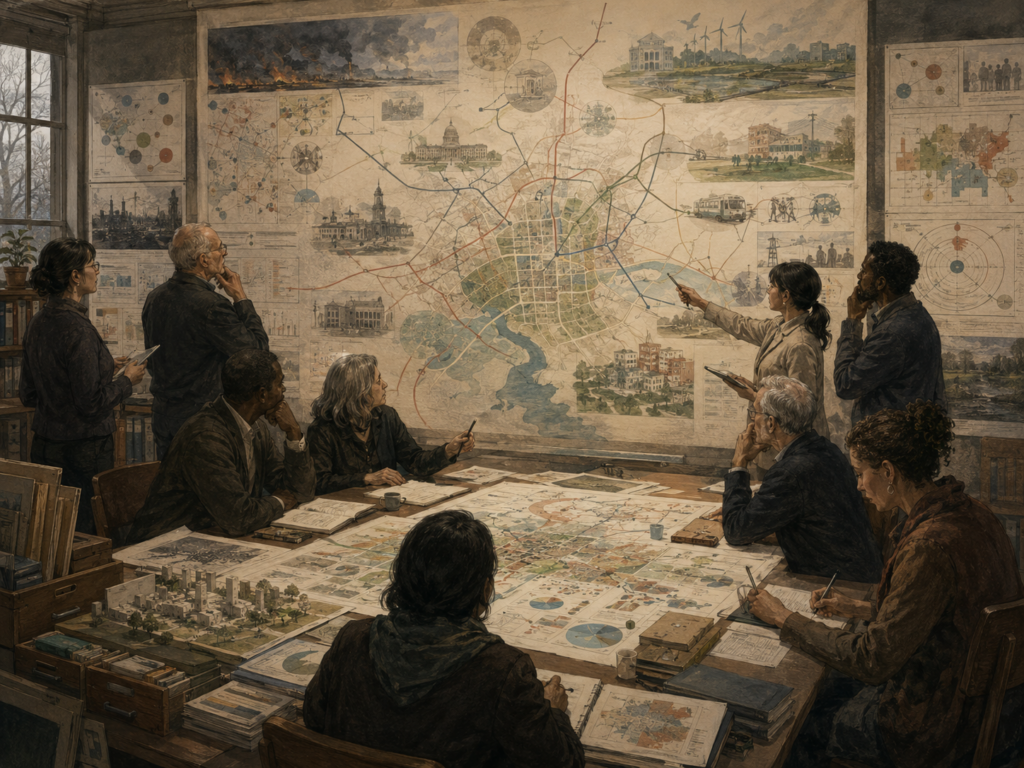
Policy researchers and civic planners examine long-term public policy scenarios across cities, infrastructure, climate risk, governance, and community systems.

Futures Thinking in Public Policy: Anticipation, Governance, and Long-Term Decision-Making

Futures Thinking in Public Policy examines how governments and public institutions can use foresight to govern under long time horizons, systemic uncertainty, and interacting social, economic, environmental, and technological pressures. The article argues that public policy can no longer rely mainly on reactive response or short-term linear analysis, but must build anticipatory capacity to detect change, interpret uncertainty, and design policies that remain viable across multiple futures. It develops this through foresight methods, policy-making under uncertainty, anticipatory governance, complex systems, institutional learning, implementation constraints, and the political economy of public decision-making. The article emphasizes that the value of futures thinking in policy lies not in predicting one future correctly, but in improving the robustness, adaptability, and long-range intelligence of governance.

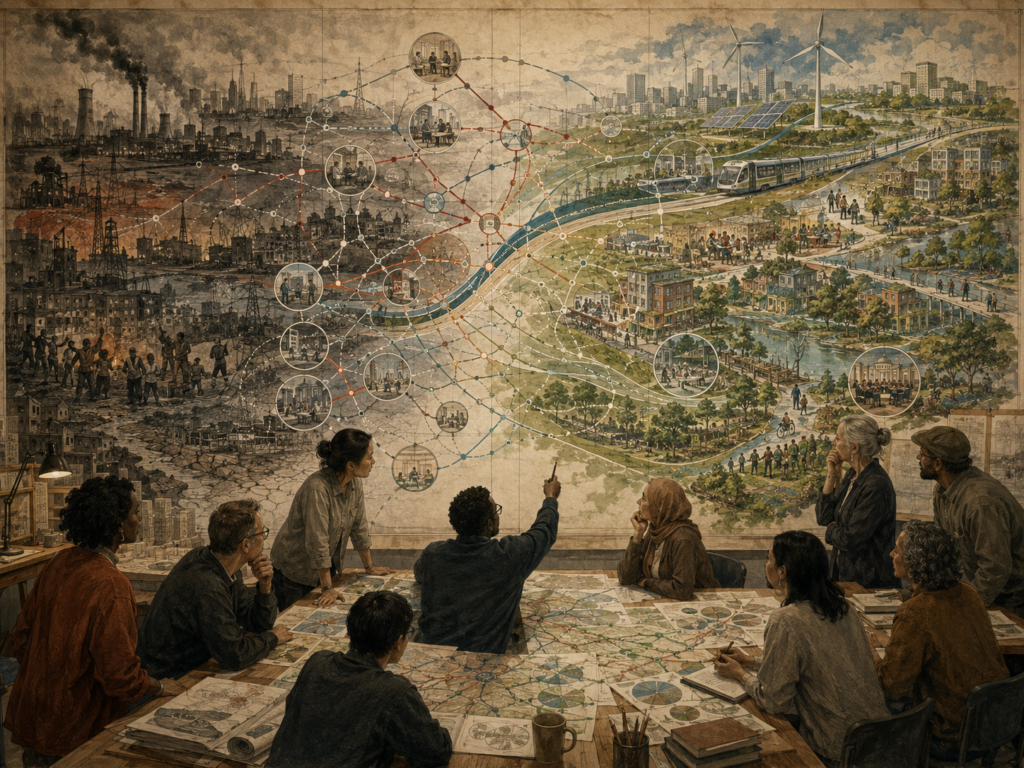
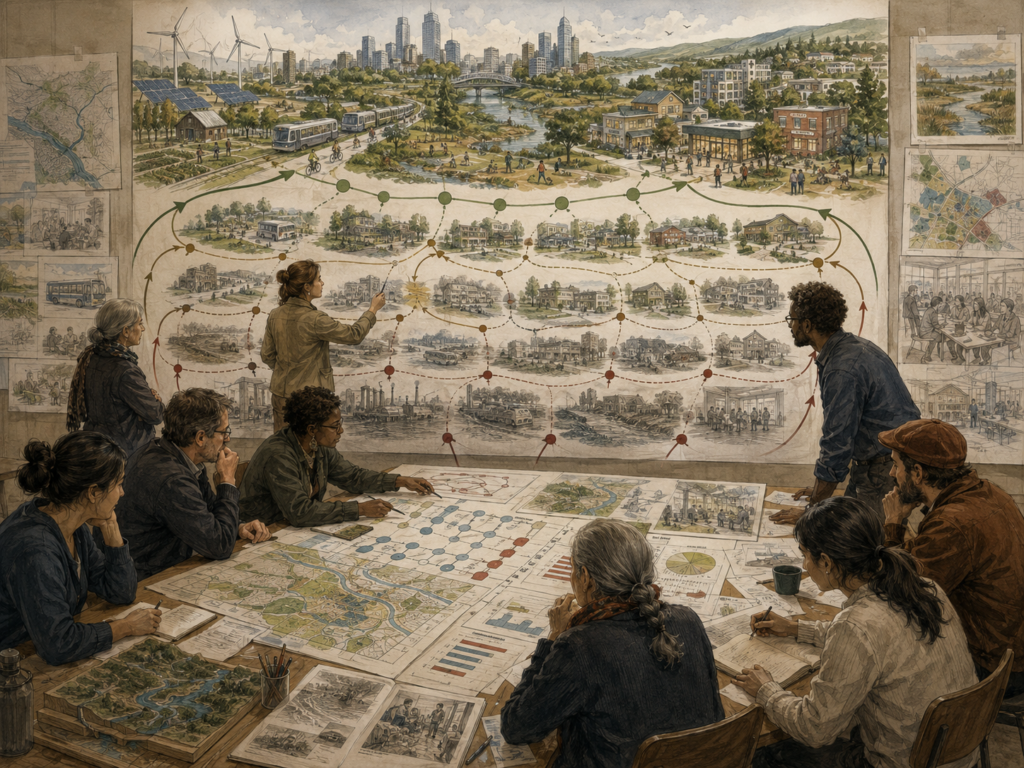
A foresight group studies long-term societal transformation from industrial decline toward resilient communities, renewable systems, public institutions, and ecological restoration.

Societal Transformation and Long-Term Change: Understanding Structural Shifts in Complex Systems

Societal Transformation and Long-Term Change examines how deep structural shifts emerge across technological, economic, ecological, institutional, and social systems over extended periods. The article argues that transformation is not simply rapid change, but system-level reorganization produced by interacting drivers whose effects accumulate, reinforce one another, and sometimes cross thresholds. It develops this through structural drivers, nonlinear transformation patterns, the movement from weak signals to large-scale change, uncertainty, resilience, and the role of power and institutional friction in shaping which futures become possible. The article emphasizes that long-term change is never purely technical: it is also a contested reordering of institutions, incentives, and social power.

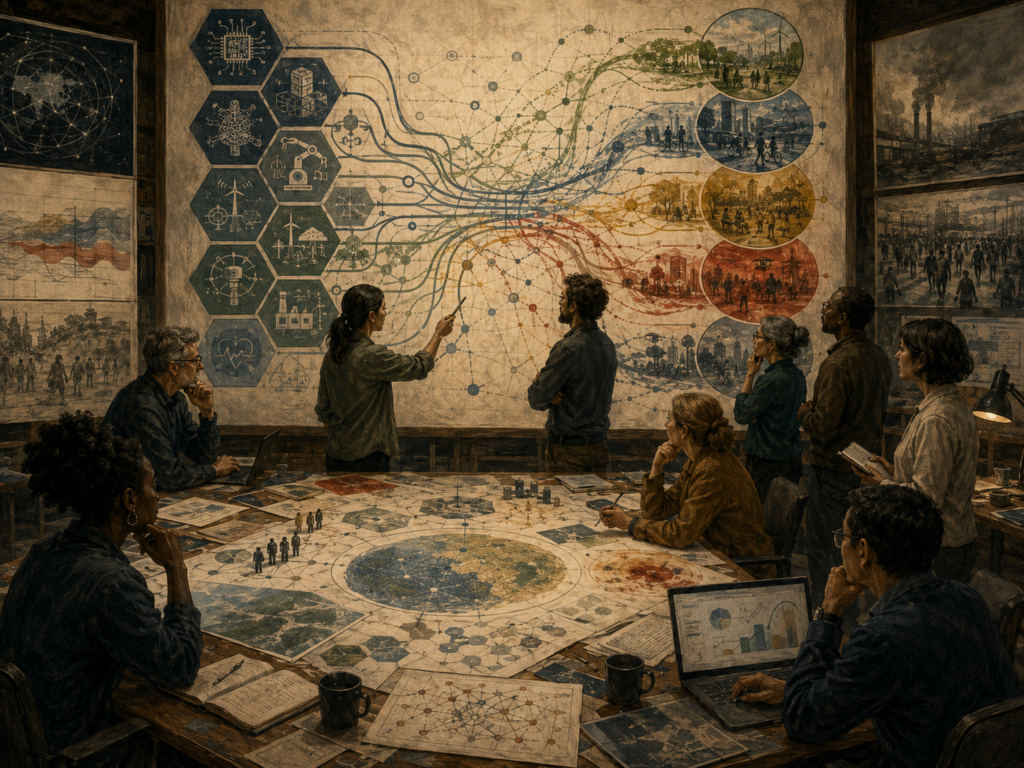
A diverse foresight team maps technology signals, infrastructure systems, social impacts, ecological risks, and future governance pathways.

Technology Foresight: Anticipating Innovation, Disruption, and Systemic Change

Technology Foresight examines how emerging technologies can be analyzed not as isolated inventions but as socio-technical forces that reshape economic systems, governance, infrastructure, and long-term development pathways. The article argues that foresight is most valuable when it moves beyond simple prediction and instead explores multiple technological trajectories under conditions of uncertainty, lock-in, institutional constraint, and political contestation. It develops this through system-level analysis, socio-technical transitions, methods such as horizon scanning and scenario planning, nonlinear adoption dynamics, and the political economy that shapes which technologies scale and how. The article emphasizes that technology does not diffuse in a neutral vacuum: it evolves within systems of capital, regulation, legitimacy, and power.

Researchers identify weak signals and early indicators across interconnected climate, technology, infrastructure, governance, and ecological systems.

Weak Signals and Early Indicators: Interpreting Emergent Change in Complex Systems

Weak Signals and Early Indicators examines the earliest observable signs of change before they mature into trends, broader patterns, or structural transformation. The article argues that the central challenge is not merely detection, but interpretation under ambiguity: deciding whether anomalies, fragments, and marginal developments represent noise or the first manifestations of deeper systemic change. It develops this through distinctions between weak signals and early indicators, the problem of signal versus noise, propagation and scaling, movement from signals to structure, institutional blindness, and the strategic value of earlier recognition under uncertainty. The article emphasizes that weak signals matter because they extend the time available for reflection, experimentation, and response before change becomes unavoidable.

Researchers study weak signals, emerging risks, trend patterns, and social-ecological change across a wall of interconnected future indicators.

Horizon Scanning: Early Detection, Strategic Attention, and the Search for Emerging Change

Horizon Scanning explains how institutions can systematically look beyond dominant trends to detect emerging issues, weak signals, and early indicators before they become obvious, measurable, or strategically unavoidable. The article argues that horizon scanning is not just a monitoring exercise but a disciplined practice of attention under uncertainty, designed to widen institutional perception before surprise hardens into crisis. It develops this through early detection in complex systems, types of signals, the problem of signal versus noise, source diversity, scanning process design, integration into the wider foresight pipeline, and the institutional blind spots that often cause organizations to miss what matters. The article emphasizes that the real challenge is not merely collecting information, but interpreting partial visibility with enough rigor to recognize which marginal developments may later reshape the center.

Scroll to Top