
Last Updated June 3, 2026
Futures thinking and sustainability are deeply interconnected fields concerned with understanding long-term change and shaping pathways toward desirable system outcomes. Futures thinking provides the tools to explore uncertainty, anticipate transformation, compare alternative pathways, and reason beyond short-term optimization. Sustainability supplies the normative horizon: ecological stability, social equity, institutional durability, economic viability, intergenerational responsibility, and human wellbeing within long-term planetary constraints.
Sustainability challenges such as climate change, biodiversity loss, resource depletion, pollution, water stress, soil degradation, food insecurity, infrastructure fragility, public health vulnerability, displacement, and social inequality are fundamentally long-term, systemic, and uncertain. They cannot be addressed through static planning, linear forecasting, compliance checklists, or short-term efficiency alone. They require the ability to think across multiple futures, understand system dynamics, identify thresholds, evaluate tradeoffs, and design strategies that remain viable under changing ecological, technological, political, and social conditions.
The central question is not simply whether a policy, technology, city, business model, or institution looks sustainable today. The deeper question is whether it remains viable, just, adaptive, and ecologically responsible across multiple plausible futures. Futures thinking provides a disciplined way to ask that question before unsustainable pathways become locked in.
This article examines sustainability as a futures problem. It explores long-term viability, uncertainty, complex systems, backcasting, transition pathways, technology, resilience, adaptation, transformation, political economy, policy applications, institutional capacity, and the risks of superficial sustainability narratives. It also includes mathematical and computational workflows for comparing sustainability futures and simulating transition pathways under ecological and institutional stress.
Main Library
Publications
Article Map
Futures Thinking
Related Topic
Systems Thinking
Related Topic
Resilience Thinking
Related Topic
Risk & Resilience
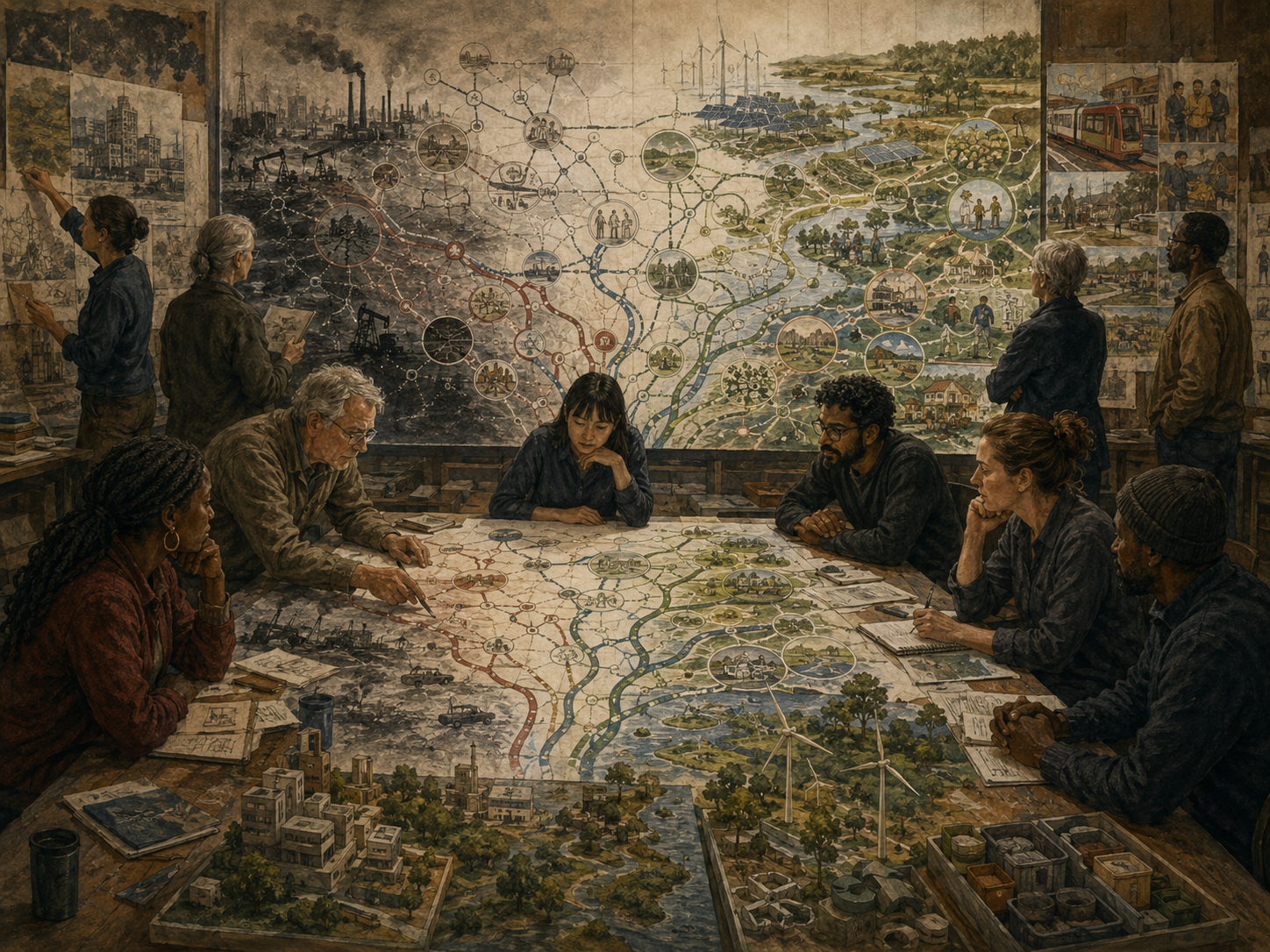
Sustainability as a Futures Problem
Sustainability is inherently futures-oriented because it concerns the relationship between present action and long-term system viability. It asks whether current patterns of production, consumption, governance, energy use, land use, finance, infrastructure, technology, and resource extraction preserve or undermine the ability of future generations to live well within stable ecological and social conditions.
This introduces a fundamental challenge: decisions must be made today under uncertainty about long-term system behavior. Sustainability problems unfold over long time horizons, involve interacting systems, and often contain irreversible or hard-to-reverse consequences. Climate change, biodiversity collapse, groundwater depletion, soil degradation, infrastructure lock-in, carbon-intensive capital stock, and widening inequality all illustrate how delayed recognition can narrow future options.
Sustainability is therefore not a static checklist, brand claim, reporting category, or compliance exercise. It is a question of pathways, thresholds, tradeoffs, institutional capacity, and long-run consequences. A city may reduce emissions while increasing displacement. A technology may lower operational carbon while expanding mineral extraction. A supply chain may become more efficient while weakening labor rights or ecological resilience. A policy may appear beneficial in one forecast but fail under climate stress, migration pressure, political backlash, or financial instability.
| Sustainability Question | Futures Thinking Question | Why It Matters |
|---|---|---|
| Can this system remain viable over time? | Under which future conditions does viability fail? | Sustainability depends on long-term system performance, not present appearance. |
| What ecological limits are relevant? | What thresholds, feedbacks, and irreversible changes must be anticipated? | Delayed action can lock systems into degradation. |
| Who benefits and who bears risk? | How do alternative futures distribute harm and opportunity? | Sustainability without justice can reproduce unequal power. |
| What assumptions are embedded in current strategy? | What happens if energy prices, climate conditions, politics, technology, or social expectations change? | Hidden assumptions create brittle sustainability plans. |
| What pathways are available? | Which options remain open, and which are closing? | Path dependency makes timing strategically important. |
| What must transform? | Which systems can adapt incrementally, and which require structural redesign? | Some sustainability problems cannot be solved by optimization alone. |
Futures thinking is indispensable because it provides ways of exploring alternative trajectories before systems become locked into unsustainable outcomes.
The Role of Futures Thinking in Sustainability
Futures thinking supports sustainability by enabling decision-makers to anticipate change, explore uncertainty, and design pathways toward desirable outcomes. It contributes in at least three major ways: exploration, interpretation, and design.
Exploration involves examining multiple possible future conditions rather than assuming a single forecast. Sustainability decisions must account for climate pathways, technological development, institutional change, demographic shifts, social conflict, ecological thresholds, market volatility, and political uncertainty.
Interpretation involves identifying risks, opportunities, early signals, path dependencies, system dynamics, feedback loops, and distributional consequences. It helps decision-makers understand not only what might happen, but why certain futures become more likely under particular structural conditions.
Design involves creating strategies aligned with long-term ecological and social goals. It asks which actions can move systems toward lower emissions, stronger resilience, more inclusive development, better governance, healthier ecosystems, and stronger public capacity.
| Futures Practice | Sustainability Use | Example |
|---|---|---|
| Scenario planning | Compares alternative sustainability futures under uncertainty. | Testing urban climate adaptation strategies under heat, flood, migration, and housing scenarios. |
| Horizon scanning | Detects weak signals of ecological, technological, social, and regulatory change. | Monitoring biodiversity policy, battery chemistry, water stress, food system risk, and migration signals. |
| Backcasting | Starts from a desired future and works backward to staged action. | Designing a pathway from today’s energy system to a low-carbon, reliable, affordable grid. |
| Systems mapping | Shows feedbacks, tradeoffs, and interdependencies. | Mapping links among land use, water, food, climate, infrastructure, and inequality. |
| Robust strategy | Identifies actions that remain useful across multiple futures. | Investing in energy efficiency, ecological restoration, public health resilience, and adaptive infrastructure. |
| Early warning systems | Tracks indicators of threshold risk or system stress. | Monitoring drought, ecosystem decline, grid stress, supply-chain bottlenecks, or social vulnerability. |
This connects directly to Strategic Foresight Methods, where signals, patterns, scenarios, and strategic options are linked into a coherent process. In sustainability contexts, that integration matters because decisions must account not only for uncertainty, but for the long-term consequences of inaction, delay, or poorly designed transition.
Futures thinking does not guarantee sustainable outcomes, but it improves the quality of long-horizon reasoning needed to pursue them.
Sustainability and Complex Systems
Sustainability challenges operate within complex systems characterized by interaction, feedback, delay, nonlinearity, adaptation, emergence, and threshold effects. Climate systems interact with economic and political systems. Energy transitions reshape infrastructure, markets, employment, finance, and governance. Agricultural systems affect biodiversity, water, food security, land use, public health, labor, and rural livelihoods simultaneously. Nothing important in sustainability exists in isolation.
This connects directly to Systems Modeling and Resilience Thinking. In complex systems, small changes can produce large effects, feedback loops can amplify or dampen change, and thresholds can trigger rapid transformation. Policies aimed at one outcome may generate unintended consequences elsewhere if system structure is poorly understood.
For example, expanding irrigation may improve crop yields in the short term while accelerating groundwater depletion. Renewable energy deployment may reduce emissions while increasing demand for critical minerals. Urban densification may reduce transport emissions while increasing housing displacement if not paired with affordability protections. Carbon markets may create incentives for emissions reduction but also risk offset abuse or land conflict if governance is weak.
| Complex-System Feature | Sustainability Meaning | Futures Implication |
|---|---|---|
| Feedback loops | Actions reinforce or counteract system behavior over time. | Strategies must identify reinforcing and balancing dynamics. |
| Delays | Consequences may appear years or decades after decisions. | Waiting for visible crisis can make action too late. |
| Thresholds | Systems may shift rapidly after crossing critical points. | Monitoring slow variables and early warning signals becomes essential. |
| Interdependence | Climate, food, water, energy, health, finance, and governance affect one another. | Single-sector strategies can create cross-system risk. |
| Path dependence | Infrastructure, institutions, habits, and investments constrain future options. | Early design choices shape decades of consequences. |
| Unequal exposure | Groups experience risks differently based on power, wealth, geography, and rights. | Sustainability assessment must include distributional analysis. |
| Emergence | System outcomes arise from many interacting decisions. | Planning must account for adaptation and unintended consequences. |
Sustainability is therefore not simply about solving one problem at a time. It is about governing interacting systems whose long-term behavior cannot be understood through linear reasoning alone.
Uncertainty and Long-Term Decision-Making
Uncertainty is central to sustainability challenges. Future environmental conditions, technological developments, political alignments, financial systems, social movements, cultural values, demographic shifts, and institutional responses cannot be predicted with precision. Yet decisions still have to be made in the present. This creates a tension between incomplete knowledge and irreversible consequence.
This connects directly to Scenario Planning and Foresight vs Forecasting. Futures thinking does not try to eliminate uncertainty. It works with uncertainty by considering multiple plausible futures, identifying robust strategies, reducing overreliance on single-point prediction, and asking what kinds of decisions remain valuable under different future conditions.
For sustainability, uncertainty is not a reason to delay action. It is a reason to design actions that remain viable across multiple possible futures. This is especially important where delay increases risk, narrows choice, or locks systems more deeply into unsustainable pathways.
| Uncertainty Type | Sustainability Example | Futures Thinking Response |
|---|---|---|
| Environmental uncertainty | Future climate impacts, ecosystem response, water availability, biodiversity change. | Use climate scenarios, ecological monitoring, threshold analysis, and adaptive planning. |
| Technological uncertainty | Energy storage, carbon removal, AI, biotechnology, circular manufacturing. | Use technology foresight, adoption scenarios, and governance readiness assessment. |
| Political uncertainty | Regulation, public trust, geopolitical conflict, institutional legitimacy. | Use political scenario analysis and institutional stress testing. |
| Social uncertainty | Migration, inequality, consumer behavior, labor transitions, public acceptance. | Use participatory foresight, distributional analysis, and social vulnerability mapping. |
| Economic uncertainty | Inflation, debt, commodity prices, investment cycles, stranded assets. | Use robust strategy, sensitivity analysis, and transition-risk assessment. |
| Implementation uncertainty | Coordination failure, weak capacity, financing gaps, governance fragmentation. | Use institutional readiness assessment and staged transition planning. |
Long-term decision-making also requires distinguishing between uncertainty and ignorance. Uncertainty means multiple outcomes are possible. Ignorance means the system contains unknowns that current models may not capture. Futures thinking helps by widening the frame of inquiry, not by pretending that all futures can be calculated.
Backcasting and Sustainability Transitions
One of the most important contributions of futures thinking to sustainability is Backcasting and Strategic Planning. Backcasting begins with a desired future state—such as a low-carbon economy, a regenerative food system, a circular materials economy, a climate-resilient city, or a more equitable urban metabolism—and works backward to identify the steps needed to reach it.
This is especially valuable because current trends often do not lead toward sustainable outcomes. If prevailing trajectories intensify ecological damage, inequality, financial fragility, infrastructure lock-in, or public health vulnerability, then simply extrapolating forward is insufficient. Backcasting makes it possible to reason from normative long-term goals instead of inherited momentum alone.
Sustainability often requires transition rather than continuation. Backcasting helps make that transition thinkable by translating long-term aspiration into staged, strategic action under uncertainty.
| Backcasting Step | Sustainability Purpose | Example Question |
|---|---|---|
| Define the desired future | Clarifies the long-term sustainability horizon. | What would a low-carbon, equitable, resilient city look like in 2040? |
| Identify present conditions | Maps current systems, constraints, capacities, and lock-ins. | What infrastructure, policies, habits, and inequalities shape the present? |
| Map the gap | Shows the distance between current trajectory and desired future. | Which emissions, land-use, finance, housing, or governance gaps must close? |
| Identify staged actions | Translates long-term goals into near-term decisions. | What must happen in the next 1, 5, 10, and 20 years? |
| Test across scenarios | Evaluates robustness under uncertainty. | Does the pathway still work under heat, migration, supply-chain, or fiscal stress? |
| Build adaptive governance | Creates mechanisms for learning and adjustment. | How will institutions monitor, revise, and correct the pathway over time? |
Backcasting also prevents sustainability from becoming vague aspiration. It forces practical sequencing: what must be built, financed, regulated, repaired, protected, phased out, or transformed? It connects long-term vision to present institutional responsibility.
Technology, Innovation, and Sustainability
Technology and innovation play a central role in sustainability transitions. Renewable energy, electrification, storage, digital monitoring, precision agriculture, circular manufacturing, building efficiency, ecological restoration tools, advanced materials, data systems, and efficiency-enhancing infrastructure all influence what forms of transition become possible. This connects directly to Technology Foresight.
Yet technology alone is never sufficient. Its effects depend on institutions, incentives, ownership, infrastructure, labor arrangements, public legitimacy, distributional consequences, and ecological context. A technology may improve efficiency while worsening extraction elsewhere. It may reduce emissions while increasing dependence on fragile supply chains. It may promise sustainability while reinforcing inequality if benefits are captured unevenly.
Technology is not a substitute for sustainability governance. It is one variable within broader systems of power, policy, and political economy.
| Technology Area | Sustainability Contribution | Risk if Poorly Governed |
|---|---|---|
| Renewable energy | Reduces fossil fuel dependence and operational emissions. | Mineral extraction, land conflict, grid bottlenecks, unequal access. |
| Energy storage | Supports grid flexibility and renewable integration. | Critical mineral dependency, waste, cost barriers, supply concentration. |
| Digital monitoring | Improves environmental sensing, infrastructure management, and early warning. | Surveillance, data inequality, cybersecurity risk, false precision. |
| Precision agriculture | May reduce inputs and improve yield efficiency. | Corporate control, farmer dependency, data extraction, ecological oversimplification. |
| Circular manufacturing | Supports repair, reuse, remanufacturing, and material recovery. | Unsafe recycling labor, weak product standards, greenwashing. |
| Carbon removal | May help address residual emissions if credible and durable. | Delay of emissions reduction, land conflict, measurement uncertainty. |
| AI and optimization | Can support modeling, forecasting, sensing, and resource efficiency. | Energy demand, bias, institutional overconfidence, automation of poor assumptions. |
A futures approach asks not only whether a technology works, but under which future conditions it remains responsible. Who owns it? Who benefits? What infrastructure does it require? What materials does it depend on? What labor systems support it? What risks does it shift? What forms of governance make it legitimate?
Resilience, Adaptation, and Transformation
Sustainability requires systems to remain viable under changing conditions while also adapting and, when necessary, transforming more deeply. This connects directly to Resilience Thinking. Three concepts are especially important here: resilience, adaptation, and transformation.
Resilience is the capacity to absorb shock without collapse. Adaptation is incremental adjustment to changing conditions. Transformation is structural reorganization when existing systems become untenable. These concepts are related, but not interchangeable.
Some systems can adapt incrementally. Others require deeper transformation because the old structure itself is incompatible with long-term viability. A carbon-intensive energy regime, for example, may not simply need greater efficiency; it may require wholesale transition in infrastructure, finance, governance, labor, regulation, and consumption patterns.
| Concept | Core Meaning | Sustainability Example | Risk if Misused |
|---|---|---|---|
| Resilience | Capacity to absorb disturbance and maintain function. | A city maintains water, energy, health, and transport services during extreme weather. | Can preserve unjust or unsustainable systems if not linked to transformation. |
| Adaptation | Adjustment to changing conditions. | Heat action plans, flood-resistant infrastructure, drought-resistant agriculture. | Can become reactive patching if root causes remain unaddressed. |
| Transformation | Structural change when existing systems are no longer viable. | Decarbonizing energy, redesigning food systems, shifting land-use governance. | Can be disruptive or unjust if poorly governed. |
| Just transition | Transformation that protects workers, communities, and vulnerable groups. | Supporting fossil fuel workers and regions while building clean-energy futures. | Can become rhetorical if power and material support are absent. |
| Adaptive governance | Institutions capable of learning, revising, and coordinating over time. | Climate governance that updates policy as risks, data, and capacities change. | Can become vague flexibility without accountability. |
Sustainability is not only about preserving systems. It is also about judging when systems must change fundamentally in order to remain viable and just.
The Political Economy of Sustainability
Sustainability transitions are not purely technical problems. They are shaped by political economy: power structures, vested interests, regulatory regimes, property relations, labor systems, public finance, trade rules, debt systems, ownership patterns, and unequal distributions of risk and reward. This introduces a central tension: desired sustainable futures often conflict with existing incentives and institutional arrangements.
Fossil fuel dependence, land concentration, extractive agriculture, speculative real estate, short-term capital markets, weak labor protections, fragmented governance, and unequal political influence can all slow or distort transition. Futures thinking must therefore account not only for what is technically possible, but for what is politically feasible, institutionally constrained, financially supported, and socially contested.
A sustainability pathway is always also a power pathway. This means that long-horizon environmental goals cannot be separated from questions of justice, ownership, inequality, accountability, and governance capacity.
| Political-Economy Constraint | Sustainability Effect | Futures Thinking Response |
|---|---|---|
| Vested interests | Powerful actors may resist transitions that threaten profits or control. | Map incentives, influence, institutional lock-in, and transition coalitions. |
| Short-term finance | Investment horizons may undervalue long-term resilience and ecological stability. | Use transition finance, public investment, and risk-adjusted valuation. |
| Unequal land and resource control | Communities may be excluded from decisions affecting land, water, forests, or minerals. | Include rights, participation, consent, and distributional justice in scenario design. |
| Regulatory weakness | Markets may externalize ecological and social costs. | Design enforceable standards, disclosure, monitoring, and accountability mechanisms. |
| Debt and fiscal constraint | Governments may lack resources for adaptation and transition. | Analyze public finance capacity and long-term investment pathways. |
| Labor insecurity | Workers may bear transition costs without support. | Include workforce planning, social protection, and just transition policy. |
| Fragmented governance | Institutions act separately despite interconnected systems. | Use systems mapping and cross-sector coordination structures. |
Futures thinking becomes more serious when it refuses to treat sustainability as a neutral technical consensus. Sustainability futures are contested because they affect wealth, labor, land, infrastructure, energy, food, mobility, housing, public finance, and power.
Justice, Power, and Contested Sustainability Futures
Sustainability futures are not equally imagined, funded, or imposed. Some futures are promoted by states, corporations, financial institutions, technology firms, universities, philanthropies, and international organizations. Other futures are articulated by Indigenous peoples, workers, farmers, migrants, informal settlements, disabled communities, youth movements, climate-vulnerable regions, small island states, and communities living near extraction, pollution, or infrastructure risk.
A futures-thinking approach to sustainability must ask whose future is being planned, whose knowledge counts, whose risks are visible, whose land is used, whose labor is required, whose losses are acceptable, and whose voice is missing from the room. Without those questions, foresight can reproduce the same unequal power relations it claims to transcend.
Sustainability without justice can become managed sacrifice for the vulnerable and managed continuity for the powerful.
| Justice Question | Sustainability Relevance | Foresight Practice |
|---|---|---|
| Who defines the desirable future? | Visions of sustainability can reflect elite priorities. | Use participatory and community-grounded foresight. |
| Who bears transition costs? | Workers, renters, consumers, farmers, and marginalized communities may absorb disruption. | Include just transition, affordability, and social protection pathways. |
| Whose land and resources are used? | Renewable energy, minerals, conservation, and infrastructure can create land conflict. | Use rights-based governance, consent, and benefit-sharing. |
| Whose knowledge is recognized? | Local, Indigenous, and experiential knowledge may be marginalized. | Combine scientific, local, historical, and lived knowledge systems. |
| Who is most exposed to ecological risk? | Climate and pollution burdens are unevenly distributed. | Map social vulnerability and cumulative exposure. |
| Who benefits from green investment? | Transition finance can enrich incumbents while bypassing vulnerable communities. | Track distributional outcomes, ownership, and public value. |
Justice also matters epistemically. Different communities often notice different signals first. Farmers may see ecological change before policymakers. Workers may see operational fragility before executives. Indigenous communities may carry long historical knowledge of land and ecological relationships. Frontline communities may understand cumulative harm before risk models recognize it.
A serious sustainability future is not only low-carbon. It is accountable, participatory, materially just, ecologically grounded, and capable of hearing those most affected by system failure.
Core Dimensions of Sustainability Futures
Sustainability futures can be evaluated across several interacting dimensions. These dimensions should not be treated separately. Ecological integrity depends on governance, finance, land use, labor, technology, and social legitimacy. Social equity depends on climate adaptation, public services, housing, income, health, and political voice. Adaptive capacity depends on institutions, knowledge systems, infrastructure, trust, and learning.
1. Ecological Integrity
Ecological integrity refers to the health, stability, and regenerative capacity of climate, biodiversity, soils, water systems, forests, oceans, and ecosystems. A sustainability future cannot be credible if it treats ecological systems as infinite sinks or endlessly substitutable inputs.
2. Social Equity and Wellbeing
Social equity and wellbeing include health, housing, food security, mobility, education, public safety, labor dignity, cultural belonging, and protection from unequal risk. Sustainability must improve human life without pushing harm onto vulnerable groups.
3. Adaptive Capacity
Adaptive capacity is the ability to learn, adjust, reorganize, and respond as conditions change. It depends on knowledge, monitoring, institutional flexibility, public trust, financing, and the capacity to revise assumptions.
4. Governance Coordination
Governance coordination refers to the ability of institutions to act across sectors, jurisdictions, time horizons, and social groups. Sustainability challenges often fail when governance remains fragmented while problems are interconnected.
5. Technological Responsibility
Technological responsibility evaluates whether innovation supports long-term sustainability without intensifying extraction, inequality, surveillance, dependency, or ecological burden elsewhere in the system.
6. Economic Viability and Public Finance
Economic viability includes the capacity to fund transition, maintain public services, support livelihoods, avoid debt fragility, and create durable value without depending on ecological depletion or social extraction.
7. Resilience and Risk Reduction
Resilience and risk reduction involve preparing for shocks, reducing exposure, strengthening redundancy, protecting critical systems, and avoiding brittle optimization that fails under stress.
8. Justice and Democratic Legitimacy
Justice and democratic legitimacy require participation, rights, transparency, accountability, fair distribution of costs and benefits, and meaningful voice for communities most affected by sustainability decisions.
| Dimension | Core Question | Failure if Ignored |
|---|---|---|
| Ecological integrity | Does the system remain within ecological limits? | Environmental degradation undermines long-term viability. |
| Social equity | Who benefits, who is protected, and who is exposed? | Sustainability becomes unequal or exclusionary. |
| Adaptive capacity | Can institutions learn and adjust under changing conditions? | Plans become rigid and fail under uncertainty. |
| Governance coordination | Can fragmented institutions manage interconnected systems? | Cross-sector risks remain unmanaged. |
| Technological responsibility | Does innovation reduce harm without shifting it elsewhere? | Technology becomes green branding for new extraction. |
| Economic viability | Can transition be financed fairly and durably? | Good intentions collapse under fiscal or market stress. |
| Resilience | Can essential systems withstand shocks? | Optimization creates fragility. |
| Justice and legitimacy | Are affected communities included and protected? | Transition loses trust and reproduces unequal power. |
Sustainability futures are strongest when ecological integrity, social equity, adaptive capacity, governance, technology, finance, resilience, and justice reinforce one another rather than being traded away in isolation.
Applications in Policy, Strategy, and Institutions
Futures thinking is applied to sustainability across many domains, including climate policy, urban planning, energy transition, food systems, water governance, biodiversity strategy, infrastructure design, public health, corporate risk, supply chains, finance, and long-term public investment. In each case, it supports decision-making under uncertainty rather than merely extending current trend lines.
For example, cities can use futures thinking to explore how heat, flooding, migration, housing pressure, energy demand, public health, and infrastructure capacity interact over time. Energy systems can use it to compare transition pathways across cost, reliability, emissions, mineral demand, labor, public legitimacy, and resilience. Firms can use it to assess physical and transition risk, stranded assets, supply-chain vulnerability, regulatory change, and long-term strategic positioning.
| Application Area | Futures Thinking Contribution | Sustainability Outcome |
|---|---|---|
| Climate policy | Compares mitigation, adaptation, finance, and loss pathways. | More robust climate strategies under uncertainty. |
| Urban planning | Tests housing, heat, mobility, flood, infrastructure, and demographic futures. | More resilient and inclusive cities. |
| Energy transition | Maps pathways for decarbonization, reliability, affordability, and labor transition. | Cleaner energy systems with stronger public legitimacy. |
| Food systems | Explores land use, water, biodiversity, nutrition, labor, and supply risk. | More resilient and equitable food futures. |
| Water governance | Anticipates drought, flood, contamination, allocation conflict, and infrastructure stress. | Stronger water security and adaptive management. |
| Infrastructure | Stress-tests long-lived assets against climate, demand, finance, and technology shifts. | Lower lock-in risk and better public investment. |
| Business strategy | Identifies transition risk, supply exposure, changing demand, and regulatory pressure. | More responsible long-term strategy beyond green marketing. |
| Public finance | Evaluates investment needs, adaptation costs, debt stress, and resilience benefits. | Stronger capacity to fund transition and public goods. |
The practical value of futures thinking in sustainability lies in turning abstract long-range risk into structured options for present action.
Sustainability Scenarios
Sustainability futures can unfold across multiple plausible pathways. These scenarios are not predictions. They are structured contexts for testing assumptions about ecology, equity, technology, governance, finance, resilience, and political legitimacy.
| Scenario | Description | Risk | Strategic Opportunity |
|---|---|---|---|
| Managed Sustainable Transition | Institutions coordinate climate action, ecological restoration, public investment, and social protection. | Requires long-term governance capacity and political legitimacy. | Builds resilience, equity, and ecological stability together. |
| High-Consumption Fragile Future | Growth and consumption continue while ecological and social stress accumulate. | Thresholds, inequality, infrastructure failure, and climate losses intensify. | Early warning systems can expose unsustainable trajectory before crisis deepens. |
| Fragmented Unequal Adaptation | Wealthier groups adapt while vulnerable communities face exposure and abandonment. | Sustainability becomes unequal, politically unstable, and morally unacceptable. | Justice-centered adaptation and public investment can reduce unequal vulnerability. |
| Technologically Assisted Green Shift | Innovation accelerates renewable energy, efficiency, monitoring, and circular systems. | Technology creates new extraction, surveillance, labor, or governance risks. | Responsible innovation can support transition when embedded in accountable institutions. |
| Climate Shock Governance Crisis | Extreme events overwhelm public systems and reveal institutional fragility. | Reactive crisis response replaces planned transformation. | Preparedness, adaptation finance, and institutional learning reduce future losses. |
| Regenerative Regional Resilience | Regions rebuild food, water, energy, ecological, and community systems around resilience. | Can become parochial or under-resourced if disconnected from broader systems. | Place-based resilience can strengthen local capacity and ecological repair. |
| Green Growth Without Justice | Low-carbon investment expands but benefits are captured unevenly. | Transition reproduces inequality, displacement, labor insecurity, and resource extraction. | Just transition, public ownership, labor protections, and participatory governance improve legitimacy. |
Scenario analysis helps reveal that sustainability is conditional. A strategy that succeeds under stable governance may fail under institutional fragmentation; a technology that reduces emissions may create unjust extraction unless governance, labor, and land rights are addressed.
Strategic Questions for Sustainability Futures
Sustainability futures analysis should guide strategic questions for governments, businesses, universities, civil society organizations, infrastructure planners, investors, community groups, and public institutions. These questions reveal hidden assumptions about viability, equity, ecology, technology, and power.
| Strategic Question | What It Reveals | Why It Matters |
|---|---|---|
| What future does this strategy assume? | Embedded assumptions about climate, politics, technology, markets, and society. | Plans fail when assumptions remain hidden. |
| What ecological limits or thresholds are relevant? | Biophysical constraints and tipping risks. | Sustainability cannot be evaluated without ecological boundaries. |
| Who benefits and who bears risk? | Distribution of costs, benefits, exposure, and voice. | Unjust transitions lose legitimacy and deepen harm. |
| What gets locked in? | Infrastructure, land use, debt, technology, behavior, and institutional commitments. | Lock-in can narrow future options for decades. |
| What must be preserved, adapted, or transformed? | Difference between continuity, adjustment, and structural change. | Not all systems should be made resilient in their current form. |
| What indicators would warn us that the pathway is failing? | Signals of ecological, social, financial, or institutional stress. | Early warning allows correction before collapse. |
| What forms of knowledge are being ignored? | Local, Indigenous, worker, community, historical, and experiential knowledge gaps. | Sustainability planning improves when multiple knowledge systems are included. |
| How will institutions learn over time? | Capacity for monitoring, revision, accountability, and adaptation. | Static plans become obsolete under changing conditions. |
Sustainability futures work is strongest when it connects long-term ecological responsibility to institutional design, public finance, social justice, and practical implementation capacity.
Limitations and Failure Modes
Despite its value, futures thinking in sustainability faces real limitations. Uncertainty cannot be eliminated. Political systems often prioritize short-term gains over long-term resilience. Implementation requires coordination across institutions that may be fragmented, under-resourced, captured, or misaligned. Scenario work can expand imagination without automatically producing action.
There is also a risk of abstraction. Sustainability futures can become too general if they fail to engage material inequality, ecological limits, political economy, and the real politics of transition. Foresight is not a substitute for governance, investment, regulation, organizing, enforcement, or social conflict. It is a framework for improving how such decisions are made.
| Failure Mode | Problem | Corrective Practice |
|---|---|---|
| Scenario theater | Organizations create scenarios without changing decisions. | Connect foresight directly to budgets, policy, investment, and governance. |
| Greenwashing | Sustainability language hides weak action or harmful practices. | Use measurable commitments, independent verification, and accountability. |
| Technological solutionism | Technology is treated as a substitute for governance and justice. | Evaluate institutions, ownership, labor, extraction, and distributional effects. |
| Distributional blindness | Aggregate sustainability gains hide unequal harms. | Include equity, vulnerability, and community impact analysis. |
| Forecast dependence | Strategies rely on one expected future. | Test across scenarios and build robust adaptive options. |
| Implementation gap | Long-term visions are not translated into staged action. | Use backcasting, milestones, accountability, and institutional responsibility. |
| Depoliticized sustainability | Power, ownership, and conflict are ignored. | Include political economy and democratic legitimacy in foresight work. |
| Overgeneralization | Global sustainability language ignores local conditions. | Combine global frameworks with place-based, community-grounded knowledge. |
The challenge is not merely to imagine sustainable futures, but to build institutional capacity capable of moving toward them.
Mathematical Lens: Sustainability Pathways Under Uncertainty
A stylized sustainability formulation can represent long-term viability as depending on ecological integrity, social equity, adaptive capacity, and governance strength, offset by accumulated degradation and destabilizing pressure:
S_t = \alpha E_t + \beta Q_t + \gamma A_t + \delta G_t – \lambda D_t
\]
Interpretation: \(S_t\) is sustainability viability at time \(t\), \(E_t\) is ecological integrity, \(Q_t\) is social equity, \(A_t\) is adaptive capacity, \(G_t\) is governance coordination, and \(D_t\) is accumulated degradation or destabilizing pressure. Sustainability improves when ecological, social, adaptive, and governance capacity exceed degrading forces over time.
A pathway comparison can be represented as:
\Pi_k = \{V_{k1}, V_{k2}, \dots, V_{kn}\}
\]
Interpretation: \(\Pi_k\) is the performance profile of transition strategy \(k\) across multiple futures, and \(V_{ks}\) is the viability of strategy \(k\) under scenario \(s\). This reflects one of the core insights of futures thinking: sustainability strategies should be judged not only by how they perform under one forecast, but by how they hold up across multiple plausible environmental, technological, political, and social conditions.
A backcasting-oriented transition problem can be represented as:
T = \sum_{i=1}^{n} a_i
\]
Interpretation: \(T\) is the total transition pathway and \(a_i\) are staged actions required to move from present conditions toward a desired future state. This highlights the practical logic of sustainability transitions: long-term goals become actionable only when translated into sequences of present interventions.
A robustness score can be represented as:
R_k = \min(V_{k1}, V_{k2}, \dots, V_{kn})
\]
Interpretation: \(R_k\) is the robustness of strategy \(k\) across scenarios. A strategy is more robust when its weakest scenario performance remains acceptable. This is useful for sustainability planning because the goal is not only best-case performance but survivability under adverse conditions.
An equity-adjusted sustainability measure can be represented as:
S^*_t = S_t – \theta I_t
\]
Interpretation: \(S^*_t\) is equity-adjusted sustainability and \(I_t\) is inequality or unequal exposure. Even if aggregate sustainability improves, unequal distribution of harm can reduce the legitimacy and moral quality of the pathway.
These equations are conceptual tools. They are not complete predictive models. Their purpose is to make assumptions explicit: sustainability futures depend on ecological integrity, equity, adaptive capacity, governance, degradation, robustness, and the distribution of risk.
Computational Modeling for Sustainability Futures
Computational modeling can help compare sustainability futures, test assumptions, and make transition pathways more transparent. It should not be used to hide political choices behind technical language or pretend that complex futures can be calculated with certainty. Its value lies in clarifying assumptions, comparing scenarios, identifying tradeoffs, and making uncertainty visible.
A professional sustainability futures workflow may include:
- Sustainability profiles: ecological integrity, social equity, adaptive capacity, governance coordination, technological responsibility, public finance capacity, and resilience.
- Scenario records: managed transition, high-consumption fragility, fragmented adaptation, technological green shift, climate shock, and regenerative regional resilience.
- Risk indicators: climate exposure, biodiversity decline, water stress, food insecurity, infrastructure fragility, social vulnerability, and governance weakness.
- Transition strategies: mitigation, adaptation, circularity, ecological restoration, just transition, public investment, regulatory reform, and participatory governance.
- Outputs: sustainability profile scores, transition viability paths, robustness scores, vulnerability rankings, and reproducibility reports.
Sustainability modeling should support judgment, accountability, and learning—not replace democratic deliberation or lived knowledge.
Advanced R Workflow: Comparing Sustainability Futures Profiles
The R workflow below compares several stylized sustainability futures across ecological integrity, social equity, adaptive capacity, technological leverage, governance coordination, public finance capacity, resilience, and justice. It is designed as an evergreen illustration of how sustainability futures can be analyzed as multidimensional system profiles rather than as one environmental indicator alone.
# ------------------------------------------------------------
# R Workflow: Comparing Sustainability Futures Profiles
# Purpose:
#   Build stylized profiles across several sustainability futures
#   using ecological, social, institutional, technological,
#   financial, resilience, and justice dimensions.
#
# Optional dependency:
#   install.packages(c("tidyverse"))
# ------------------------------------------------------------

library(tidyverse)

futures <- tibble(
  future_type = c(
    "High-Consumption Fragile Future",
    "Managed Sustainable Transition",
    "Fragmented Unequal Adaptation",
    "Technologically Assisted Green Shift",
    "Climate Shock Governance Crisis",
    "Regenerative Regional Resilience",
    "Green Growth Without Justice"
  ),
  ecological_integrity = c(0.32, 0.78, 0.44, 0.66, 0.38, 0.74, 0.58),
  social_equity = c(0.38, 0.72, 0.34, 0.52, 0.40, 0.70, 0.36),
  adaptive_capacity = c(0.46, 0.79, 0.48, 0.68, 0.42, 0.76, 0.58),
  technological_leverage = c(0.58, 0.62, 0.41, 0.82, 0.52, 0.54, 0.76),
  governance_coordination = c(0.29, 0.76, 0.31, 0.54, 0.34, 0.68, 0.46),
  public_finance_capacity = c(0.42, 0.72, 0.36, 0.58, 0.34, 0.62, 0.50),
  resilience_capacity = c(0.40, 0.78, 0.42, 0.64, 0.36, 0.80, 0.52),
  justice_legitimacy = c(0.34, 0.74, 0.28, 0.48, 0.32, 0.72, 0.30)
)

futures <- futures %>%
  mutate(
    sustainability_profile =
      0.18 * ecological_integrity +
      0.16 * social_equity +
      0.15 * adaptive_capacity +
      0.10 * technological_leverage +
      0.15 * governance_coordination +
      0.10 * public_finance_capacity +
      0.08 * resilience_capacity +
      0.08 * justice_legitimacy,

    fragility_profile =
      0.18 * (1 - ecological_integrity) +
      0.16 * (1 - social_equity) +
      0.14 * (1 - adaptive_capacity) +
      0.14 * (1 - governance_coordination) +
      0.12 * (1 - public_finance_capacity) +
      0.12 * (1 - resilience_capacity) +
      0.10 * (1 - justice_legitimacy) +
      0.04 * technological_leverage,

    future_class = case_when(
      sustainability_profile >= 0.68 & fragility_profile < 0.42 ~ "Stronger sustainability pathway",
      fragility_profile >= 0.62 ~ "High sustainability fragility",
      TRUE ~ "Mixed or transitional sustainability future"
    )
  ) %>%
  arrange(desc(sustainability_profile))

print(futures)

futures_long <- futures %>%
  select(
    future_type,
    ecological_integrity,
    social_equity,
    adaptive_capacity,
    technological_leverage,
    governance_coordination,
    public_finance_capacity,
    resilience_capacity,
    justice_legitimacy
  ) %>%
  pivot_longer(
    cols = -future_type,
    names_to = "dimension",
    values_to = "value"
  )

ggplot(futures_long, aes(x = dimension, y = value, fill = future_type)) +
  geom_col(position = "dodge") +
  labs(
    title = "Stylized Sustainability Futures Dimensions",
    x = "Dimension",
    y = "Value",
    fill = "Future Type"
  ) +
  theme_minimal(base_size = 12) +
  coord_flip()

ggplot(futures, aes(x = reorder(future_type, sustainability_profile), y = sustainability_profile)) +
  geom_col() +
  coord_flip() +
  labs(
    title = "Stylized Sustainability Futures Profile",
    x = "Future Type",
    y = "Profile Score"
  ) +
  theme_minimal(base_size = 12)

ggplot(futures, aes(x = sustainability_profile, y = fragility_profile, label = future_type)) +
  geom_point(size = 3) +
  geom_text(nudge_y = 0.02, size = 3) +
  labs(
    title = "Sustainability Profile vs Fragility",
    x = "Sustainability Profile",
    y = "Fragility Profile"
  ) +
  theme_minimal(base_size = 12)

dir.create("outputs", showWarnings = FALSE)
write_csv(futures, "outputs/sustainability_futures_profiles.csv")
This workflow illustrates why sustainability futures should be evaluated through ecological, social, institutional, financial, resilience, and justice dimensions—not environmental indicators alone.
Advanced Python Workflow: Simulating Sustainability Transitions Under Stress
The Python workflow below simulates stylized sustainability trajectories under repeated ecological and institutional stress. It shows how adaptive capacity, governance quality, ecological integrity, public finance, and justice affect long-term transition viability.
# ------------------------------------------------------------
# Python Workflow: Simulating Sustainability Transitions
# Purpose:
#   Compare stylized transition pathways under repeated stress
#   with different levels of ecological integrity, governance,
#   adaptation, finance, resilience, and justice capacity.
#
# Optional dependencies:
#   pip install pandas numpy matplotlib
# ------------------------------------------------------------

from pathlib import Path

import numpy as np
import pandas as pd
import matplotlib.pyplot as plt

OUTPUT_DIR = Path("outputs")
OUTPUT_DIR.mkdir(exist_ok=True)

time_steps = np.arange(1, 41)

systems = [
    {
        "system": "Coordinated Sustainable Transition",
        "ecology": 0.78,
        "governance": 0.76,
        "adaptation": 0.79,
        "public_finance": 0.72,
        "resilience": 0.78,
        "justice": 0.74
    },
    {
        "system": "Uneven Reactive Transition",
        "ecology": 0.48,
        "governance": 0.38,
        "adaptation": 0.44,
        "public_finance": 0.40,
        "resilience": 0.42,
        "justice": 0.36
    },
    {
        "system": "Technologically Assisted Green Shift",
        "ecology": 0.66,
        "governance": 0.54,
        "adaptation": 0.68,
        "public_finance": 0.58,
        "resilience": 0.64,
        "justice": 0.48
    },
    {
        "system": "Regenerative Regional Resilience",
        "ecology": 0.74,
        "governance": 0.68,
        "adaptation": 0.76,
        "public_finance": 0.62,
        "resilience": 0.80,
        "justice": 0.72
    }
]

def simulate_system(
    ecology,
    governance,
    adaptation,
    public_finance,
    resilience,
    justice,
    initial_state=1.0
):
    state = np.zeros(len(time_steps))
    stress_exposure = np.zeros(len(time_steps))
    institutional_capacity = np.zeros(len(time_steps))

    state[0] = initial_state
    stress_exposure[0] = (
        0.24 * (1 - ecology)
        + 0.20 * (1 - resilience)
        + 0.18 * (1 - governance)
        + 0.14 * (1 - public_finance)
        + 0.12 * (1 - adaptation)
        + 0.12 * (1 - justice)
    )

    institutional_capacity[0] = (
        0.24 * governance
        + 0.22 * adaptation
        + 0.20 * public_finance
        + 0.18 * resilience
        + 0.16 * justice
    )

    for t in range(1, len(time_steps)):
        stress = 0.16 if (t + 1) % 9 == 0 else 0.06

        response_gain = (
            0.20 * ecology
            + 0.20 * governance
            + 0.18 * adaptation
            + 0.16 * public_finance
            + 0.14 * resilience
            + 0.12 * justice
        )

        stress_exposure[t] = np.clip(
            stress_exposure[t - 1]
            + 0.05 * stress
            - 0.03 * ecology
            - 0.03 * resilience
            - 0.02 * governance
            - 0.02 * justice,
            0,
            1.4
        )

        institutional_capacity[t] = np.clip(
            institutional_capacity[t - 1]
            + 0.03 * governance
            + 0.03 * adaptation
            + 0.02 * public_finance
            + 0.02 * justice
            - 0.04 * stress,
            0,
            1.5
        )

        state[t] = np.clip(
            state[t - 1]
            + 0.07 * response_gain
            + 0.04 * institutional_capacity[t]
            - stress
            - 0.05 * stress_exposure[t],
            0,
            1.8
        )

    return state, stress_exposure, institutional_capacity

rows = []

for system in systems:
    viability, exposure, capacity = simulate_system(
        system["ecology"],
        system["governance"],
        system["adaptation"],
        system["public_finance"],
        system["resilience"],
        system["justice"]
    )

    for t, v, e, c in zip(time_steps, viability, exposure, capacity):
        rows.append({
            "system": system["system"],
            "time": t,
            "sustainability_viability": v,
            "stress_exposure": e,
            "institutional_capacity": c
        })

df = pd.DataFrame(rows)

summary = (
    df.groupby("system")
    .agg(
        final_viability=("sustainability_viability", "last"),
        mean_viability=("sustainability_viability", "mean"),
        mean_stress_exposure=("stress_exposure", "mean"),
        final_institutional_capacity=("institutional_capacity", "last")
    )
    .reset_index()
    .sort_values("final_viability", ascending=False)
)

print(summary)

plt.figure(figsize=(10, 6))
for system_name in df["system"].unique():
    subset = df[df["system"] == system_name]
    plt.plot(subset["time"], subset["sustainability_viability"], label=system_name)

plt.xlabel("Time Step")
plt.ylabel("Sustainability Viability")
plt.title("Sustainability Transitions Under Repeated Stress")
plt.legend()
plt.tight_layout()
plt.savefig(OUTPUT_DIR / "sustainability_transition_paths.png", dpi=150)
plt.close()

plt.figure(figsize=(10, 6))
for system_name in df["system"].unique():
    subset = df[df["system"] == system_name]
    plt.plot(subset["time"], subset["stress_exposure"], label=system_name)

plt.xlabel("Time Step")
plt.ylabel("Stress Exposure")
plt.title("Sustainability Stress Exposure")
plt.legend()
plt.tight_layout()
plt.savefig(OUTPUT_DIR / "sustainability_stress_exposure_paths.png", dpi=150)
plt.close()

df.to_csv(OUTPUT_DIR / "sustainability_transition_paths.csv", index=False)
summary.to_csv(OUTPUT_DIR / "sustainability_transition_summary.csv", index=False)
This workflow illustrates how sustainability futures can be compared as dynamic trajectories rather than static labels. Systems with stronger governance, ecological integrity, finance, resilience, and justice capacity remain more viable under repeated stress.
GitHub Repository
The companion repository for this article contains computational examples for sustainability futures, transition pathways, ecological integrity, social equity, adaptive capacity, governance coordination, public finance, resilience, justice, scenario comparison, and reproducible sustainability foresight workflows.
Complete Code Repository
The companion code includes Python, R, Julia, SQL, Rust, Go, C++, Fortran, C, documentation, synthetic datasets, outputs, and notebook placeholders for applied futures thinking and sustainability workflows.
Why This Matters
Sustainability is one of the defining long-horizon challenges of the modern world. It requires managing complex systems under uncertainty across ecological, economic, social, technological, political, and institutional dimensions. Futures thinking provides the tools needed to engage that challenge because it connects uncertainty, system dynamics, transition design, strategic preparation, and institutional learning.
Without futures thinking, sustainability can become reactive. Institutions respond after damage is visible, after infrastructure is locked in, after ecosystems are degraded, after inequality deepens, after political trust erodes, after financial risk accumulates, and after adaptation becomes more expensive. Futures thinking helps societies act before options close.
Ultimately, sustainability is not only about preserving systems. It is about intentionally shaping the future of those systems under conditions of uncertainty, conflict, unequal power, and irreversible risk.
This means sustainability must be more than branding, reporting, or isolated environmental management. It must become a long-term public capacity: the capacity to anticipate, govern, invest, repair, adapt, transform, and remain accountable to both present communities and future generations.
Futures thinking matters because the future is not a single destination waiting to arrive. It is shaped by present choices, institutional incentives, social struggle, ecological limits, public investment, technological design, and moral imagination. Sustainability futures are therefore not merely technical pathways. They are choices about what kinds of societies remain possible.
A serious sustainability future is ecological, democratic, adaptive, just, and institutionally capable. Futures thinking helps make that future more visible, more contestable, and more actionable.
Related Articles
- Futures Thinking
- Financial Futures and Systemic Risk
- Climate Futures and Environmental Change
- Scenario Planning
- Backcasting and Strategic Planning
- Technology Foresight
- Systems Modeling
- Strategic Robustness Across Futures
- Early Warning Systems and Futures Intelligence
- Resilience Thinking
- Systems Thinking
- Risk & Resilience
Further Reading
- Brundtland Commission (1987) Our Common Future. Oxford: Oxford University Press. Available at: https://sustainabledevelopment.un.org/content/documents/5987our-common-future.pdf.
- Folke, C. et al. (2010) ‘Resilience thinking: integrating resilience, adaptability and transformability’, Ecology and Society, 15(4). Available at: https://www.ecologyandsociety.org/vol15/iss4/art20/.
- Geels, F.W. (2002) ‘Technological transitions as evolutionary reconfiguration processes’, Research Policy, 31(8–9), pp. 1257–1274.
- Intergovernmental Panel on Climate Change (IPCC) (no date) Reports. Available at: https://www.ipcc.ch/reports/.
- Meadows, D.H. (2008) Thinking in Systems. White River Junction, VT: Chelsea Green.
- Raworth, K. (2017) Doughnut Economics: Seven Ways to Think Like a 21st-Century Economist. London: Random House.
- Rockström, J. et al. (2009) ‘A safe operating space for humanity’, Nature, 461, pp. 472–475.
- Sachs, J.D. (2015) The Age of Sustainable Development. New York: Columbia University Press.
- Stockholm Resilience Centre (no date) Planetary boundaries. Available at: https://www.stockholmresilience.org/research/planetary-boundaries.html.
- United Nations (no date) Sustainable Development Goals. Available at: https://www.un.org/sustainabledevelopment/.
References
- Brundtland Commission (1987) Our Common Future. Oxford: Oxford University Press. Available at: https://sustainabledevelopment.un.org/content/documents/5987our-common-future.pdf.
- Folke, C. et al. (2010) ‘Resilience thinking: integrating resilience, adaptability and transformability’, Ecology and Society, 15(4), article 20. Available at: https://www.ecologyandsociety.org/vol15/iss4/art20/.
- Geels, F.W. (2002) ‘Technological transitions as evolutionary reconfiguration processes: a multi-level perspective and a case-study’, Research Policy, 31(8–9), pp. 1257–1274.
- Intergovernmental Panel on Climate Change (IPCC) (no date) Reports. Available at: https://www.ipcc.ch/reports/.
- Meadows, D.H. (2008) Thinking in Systems: A Primer. White River Junction, VT: Chelsea Green.
- Raworth, K. (2017) Doughnut Economics: Seven Ways to Think Like a 21st-Century Economist. London: Random House.
- Rockström, J. et al. (2009) ‘A safe operating space for humanity’, Nature, 461, pp. 472–475. Available at: https://www.nature.com/articles/461472a.
- Sachs, J.D. (2015) The Age of Sustainable Development. New York: Columbia University Press.
- Stockholm Resilience Centre (no date) Planetary boundaries. Available at: https://www.stockholmresilience.org/research/planetary-boundaries.html.
- United Nations (no date) Sustainable Development Goals. Available at: https://www.un.org/sustainabledevelopment/.