Machine Learning Foundations: How Systems Learn from Data
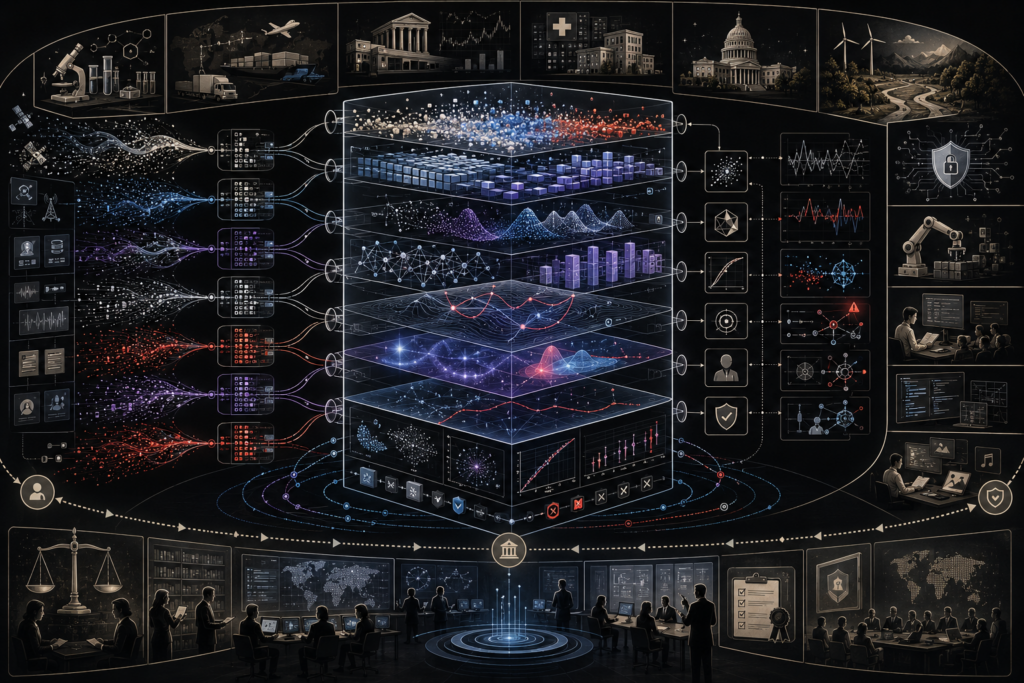
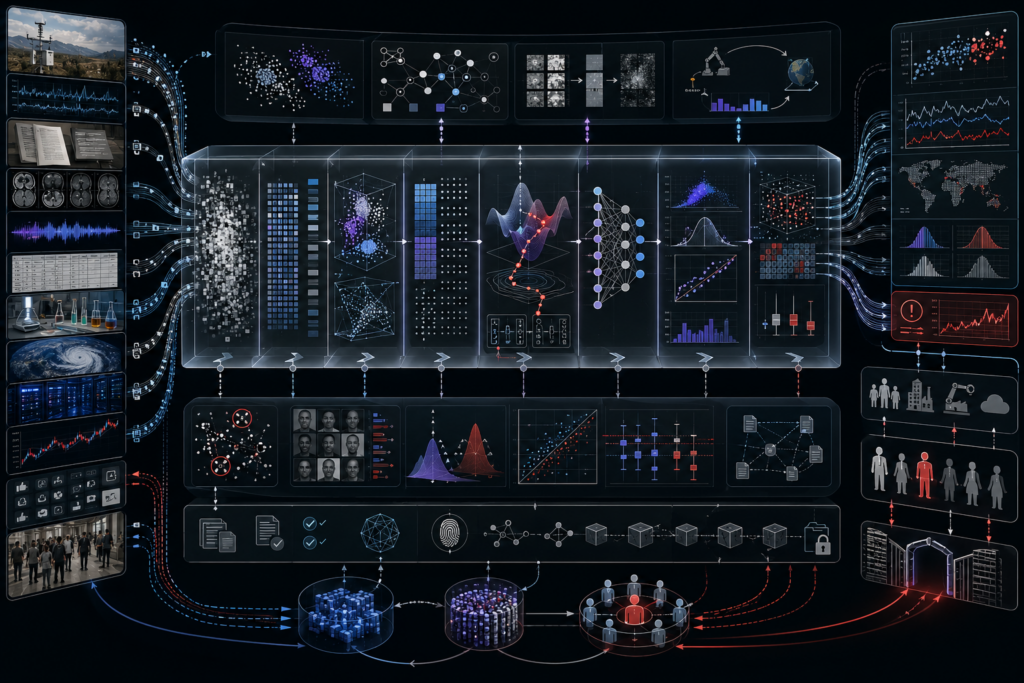
Machine learning foundations explain how computational systems learn from data by estimating structure, updating internal parameters, and improving performance on defined tasks under uncertainty. This article explains machine learning as adaptive computation, statistical inference, empirical risk minimization, representation learning, optimization, generalization, validation, deployment, monitoring, and governance. It covers supervised, unsupervised, reinforcement, self-supervised, and semi-supervised learning; features and embeddings; loss functions; gradient descent; overfitting; model capacity; uncertainty; distribution shift; calibration; error analysis; feedback loops; and responsible deployment. The article also introduces mathematical lenses for datasets, predictions, empirical risk, expected risk, gradient updates, generalization gaps, distribution shift, and calibration, alongside Python and R workflows for supervised learning, evaluation metrics, calibration diagnostics, grouped error analysis, and monitoring. By connecting learning from data to auditability, it frames machine learning as a systems discipline.