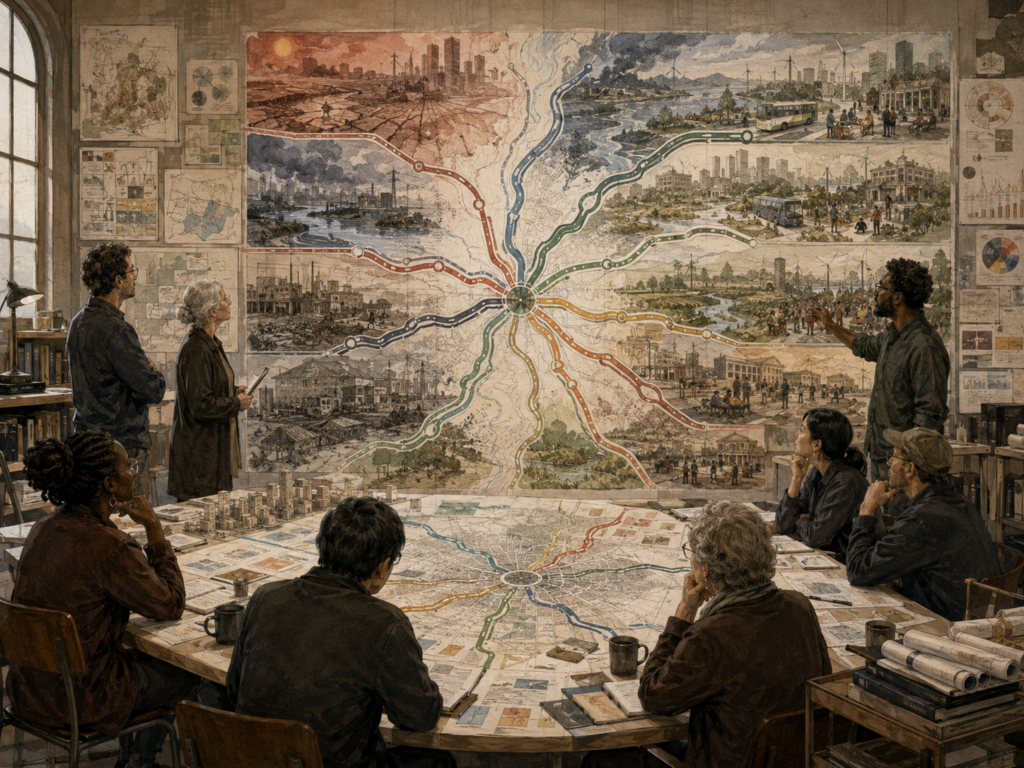
A diverse planning group studies branching scenario pathways across cities, infrastructure, climate risks, public institutions, and ecological systems.

Scenario Planning: Exploring Multiple Futures for Strategic Decision-Making Under Uncertainty

Scenario Planning explains how institutions can reason rigorously under uncertainty by constructing multiple plausible futures rather than relying on a single forecast. The article argues that scenario planning is not merely a planning tool but an epistemological framework that shifts decision-making from prediction toward structured exploration, from assumed continuity toward plurality, and from optimization for one expected future toward robustness across many possible ones. It develops this through drivers of change, critical uncertainties, scenario construction, types of scenarios, complex-systems reasoning, strategic robustness, historical development, and common failure modes. The article emphasizes that the real value of scenarios lies not in forecasting which future will occur, but in testing assumptions and preparing strategies that remain viable when conditions diverge from expectation.
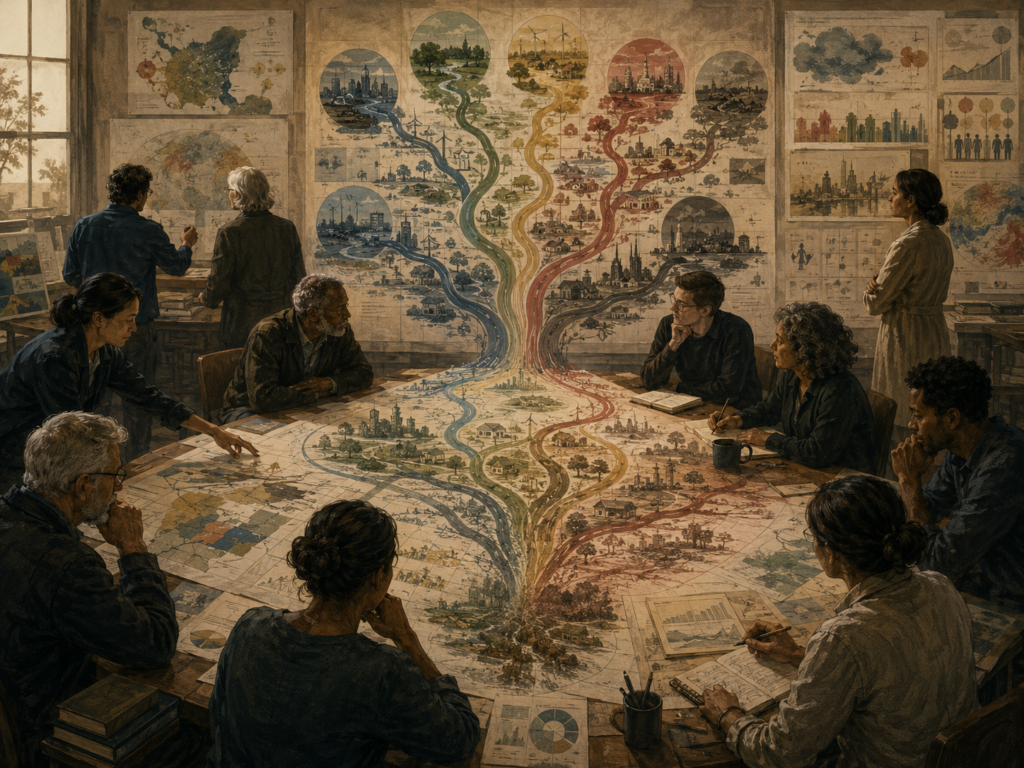

Researchers study branching future scenarios across maps, civic systems, infrastructure, ecology, and social change.

What Is Futures Thinking? Strategic Foresight and Long-Term Change

Futures Thinking is the disciplined practice of exploring multiple possible futures in order to improve present-day judgment, strategy, and decision-making under uncertainty. The article argues that the future is not singular or fully predictable, but open, contingent, and shaped by both structural forces and human choices. It develops this through the practical importance of long-term thinking, the distinction between futures thinking and prediction, the role of assumptions, major foresight methods, its relationship to foresight and forecasting, and its relevance for strategy, policy, complex systems, and sustainability. The article emphasizes that futures thinking is not about being right about the future, but about becoming more anticipatory, resilient, and strategically prepared before change becomes unavoidable.

Panoramic illustration of planners and field teams exploring future resilience pathways across a river valley shaped by wildfire, drought, restored wetlands, transit, renewable energy, and monitoring systems.

Future Directions in Resilience Thinking: Innovation, Complexity, and the Next Generation of Adaptive Systems

Future Directions in Resilience Thinking examines how resilience theory must evolve as systems become more tightly coupled, risks more compounding, and instability more deeply shaped by climate change, digital dependence, governance stress, and unequal exposure. The article argues that resilience can no longer be treated simply as the capacity to recover from disturbance within existing arrangements. Instead, future resilience thinking must integrate adaptive capacity, transformation, digital infrastructures, cross-scale coordination, equity, climate-resilient development, and more sophisticated measurement and decision-support systems. It explores how the field is shifting from optimization toward adaptability, from isolated hazards toward systemic risk, and from local recovery toward planetary-scale resilience. It also includes an evergreen mathematical lens, along with advanced R and Python workflows for comparing resilience pathways and analyzing uncertainty in future strategic choices.

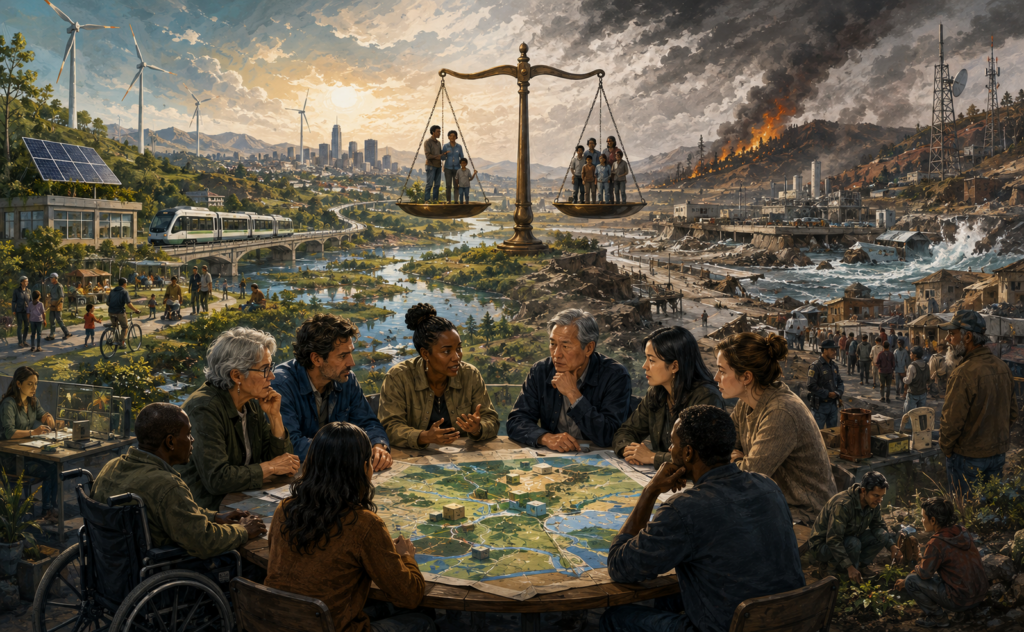
Panoramic illustration of communities, planners, and public officials debating resilience decisions across a landscape divided between green infrastructure, transit, renewable energy, wildfire, damaged coastlines, and unequal exposure.

Ethics and Politics of Resilience: Power, Responsibility, and the Distribution of Risk

The Ethics and Politics of Resilience examines how resilience is never only a technical question of system survival, but also a political and ethical question of who is protected, who bears risk, and what kinds of systems are being preserved. The article argues that resilience strategies can reinforce inequality, shift responsibility onto vulnerable communities, and stabilize unjust arrangements unless questions of power, justice, accountability, and participation are made explicit. It explores resilience as a normative concept, the distribution of risk and resources, governance, responsibility, global inequality, and the tension between preserving existing systems and pursuing transformation. It also includes an evergreen mathematical lens, along with advanced R and Python workflows for comparing justice-sensitive resilience strategies and analyzing uncertainty in ethically contested resilience decisions.

Panoramic illustration of a storm-stressed financial district, flooded infrastructure, ports, rail lines, wildfire, emergency coordination, and planners reviewing system risk maps.

Financial System Resilience: Stability, Risk Propagation, and Adaptive Capacity in Complex Financial Networks

Financial System Resilience examines how financial institutions, markets, payment infrastructures, and regulatory systems absorb shocks, preserve core functions, and adapt without cascading into systemic breakdown. The article argues that financial resilience is not simply the absence of crisis or the stability of individual firms, but a system-level property shaped by interdependence, contagion, thresholds, liquidity, governance, and infrastructural robustness. It explores capital adequacy, liquidity, central banking, regulation, global financial integration, digital finance, inequality, and stress testing as interconnected dimensions of resilience rather than isolated technical issues. It also includes an evergreen mathematical lens, along with advanced R and Python workflows for comparing financial resilience strategies and analyzing uncertainty in systemwide risk and stability choices.

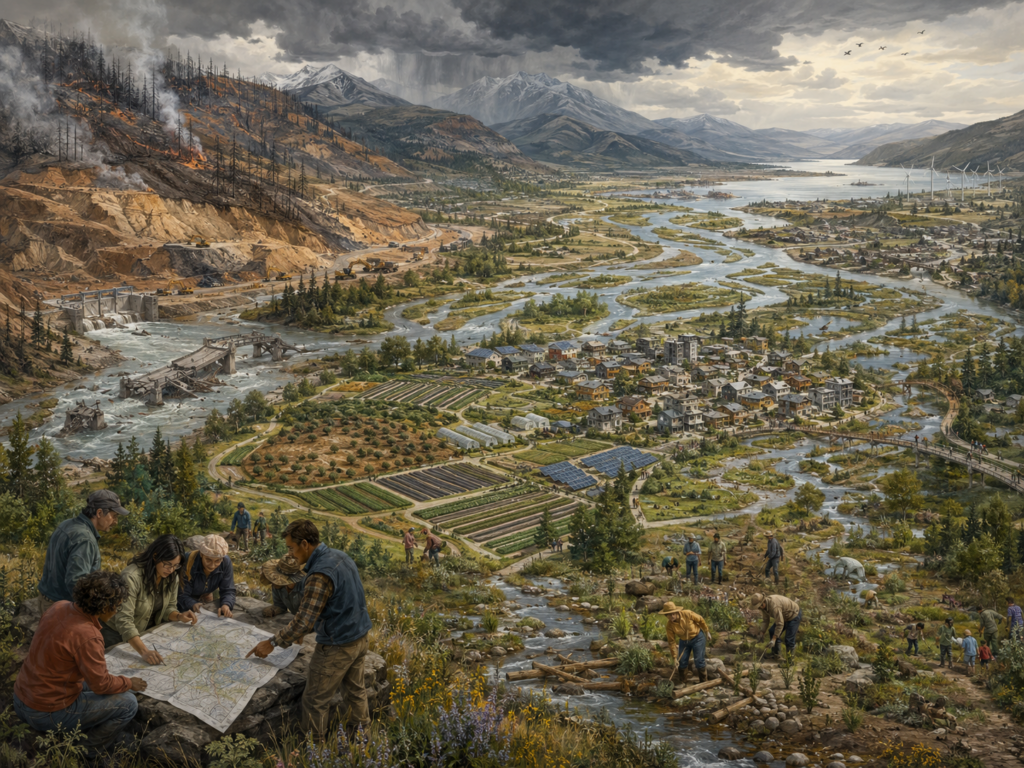
Panoramic systems illustration of a disturbed mountain watershed being transformed through ecological restoration, adaptive infrastructure, renewable energy, farms, wetlands, and community planning.

Transformation in Complex Systems: Structural Change, Adaptation, and System Reconfiguration

Transformation in Complex Systems examines how systems shift from one regime to another when existing structures can no longer absorb stress or sustain viable function. The article argues that transformation is not simply large-scale adaptation, but a deeper reorganization of system structure, feedbacks, governance, and resource flows. It explores the distinction between adaptation and transformation, the role of thresholds and regime shifts, adaptive cycles and panarchy, the drivers of transformation, and the importance of governance, social-ecological dynamics, and sustainable development in shaping systemic change. It also includes an evergreen mathematical lens, along with advanced R and Python workflows for comparing transformation pathways and analyzing uncertainty in strategic choices about systemic reorganization.

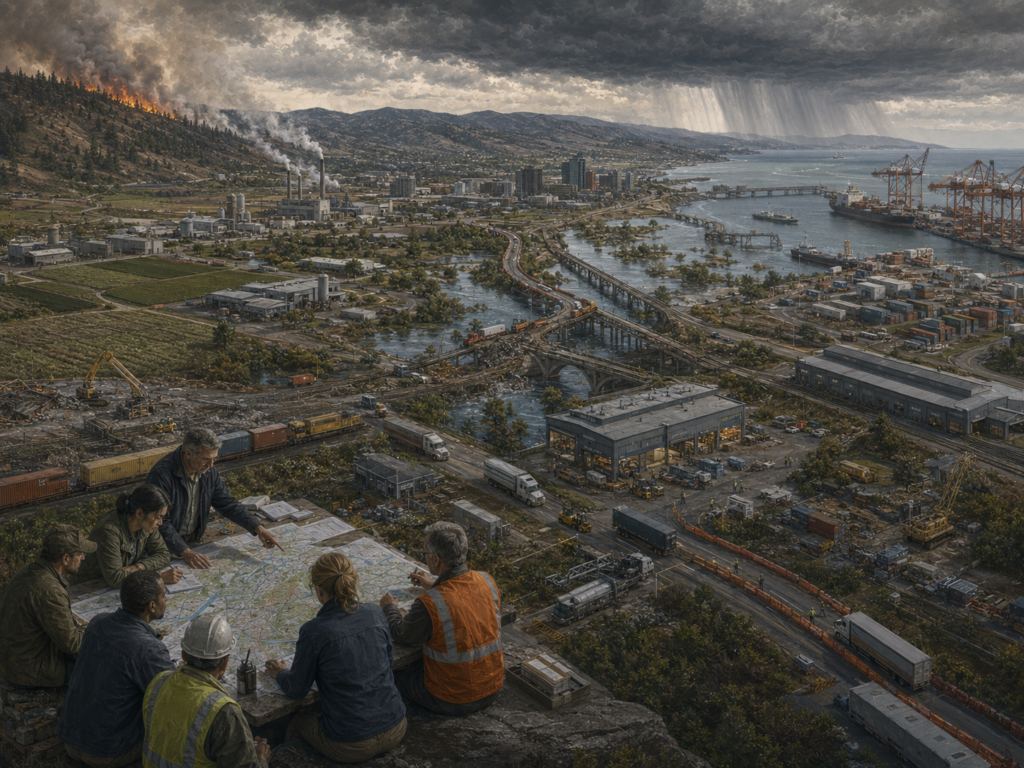
Panoramic illustration of a storm-stressed port and logistics corridor with ships, cranes, rail lines, warehouses, trucks, damaged infrastructure, wildfire, flooding, and planners reviewing supply-chain maps.

Resilience in Global Supply Chains: Interdependence, Adaptation, and System Stability Under Disruption

Resilience in Global Supply Chains examines how interconnected production, logistics, and distribution networks absorb shocks, adapt to disruption, and maintain the movement of goods and services under stress. The article argues that supply chain resilience is not simply a matter of restoring operations after isolated disruption, but a system-level question shaped by interdependence, network structure, infrastructure dependence, climate risk, governance, digital vulnerability, and the trade-off between efficiency and adaptability. It explores redundancy, flexibility, visibility, coordination, food and water systems, and the cascading effects that local failures can generate across global networks. It also includes an evergreen mathematical lens, along with advanced R and Python workflows for comparing supply chain resilience strategies and analyzing uncertainty in networked logistics and sourcing choices.

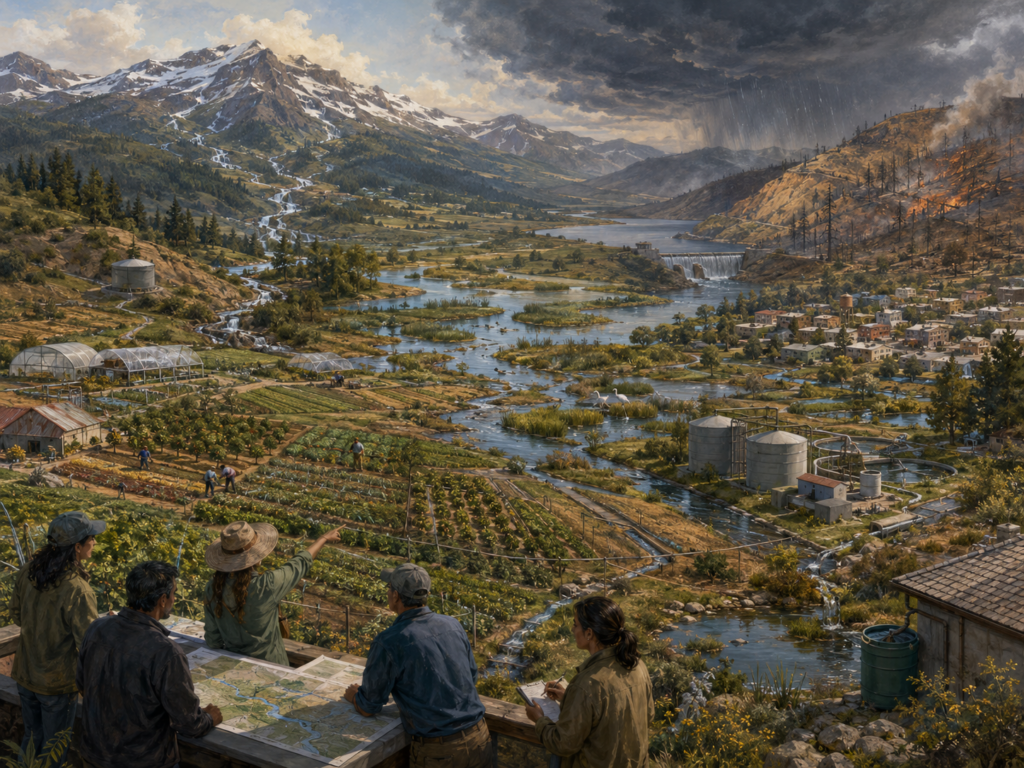
Panoramic illustration of a mountain watershed with farms, wetlands, water infrastructure, reservoirs, irrigation, food production, wildfire risk, storm clouds, and planners reviewing maps.

Resilience in Food and Water Systems: Security, Adaptation, and System Stability Under Stress

Resilience in Food and Water Systems examines how agricultural, hydrological, ecological, infrastructural, and supply systems interact to sustain reliable access to food and water under stress. The article argues that resilience in these systems is not simply a matter of preserving aggregate output, but of maintaining availability, access, quality, stability, and adaptive capacity as climate change, ecosystem degradation, infrastructure failure, market volatility, and inequality place increasing pressure on basic human needs. It explores food-water interdependence, climate risk, governance, infrastructure, community dynamics, and ecological support as mutually linked dimensions of resilience. It also includes an evergreen mathematical lens, along with advanced R and Python workflows for comparing food and water resilience strategies and analyzing uncertainty in long-term resource-system choices.

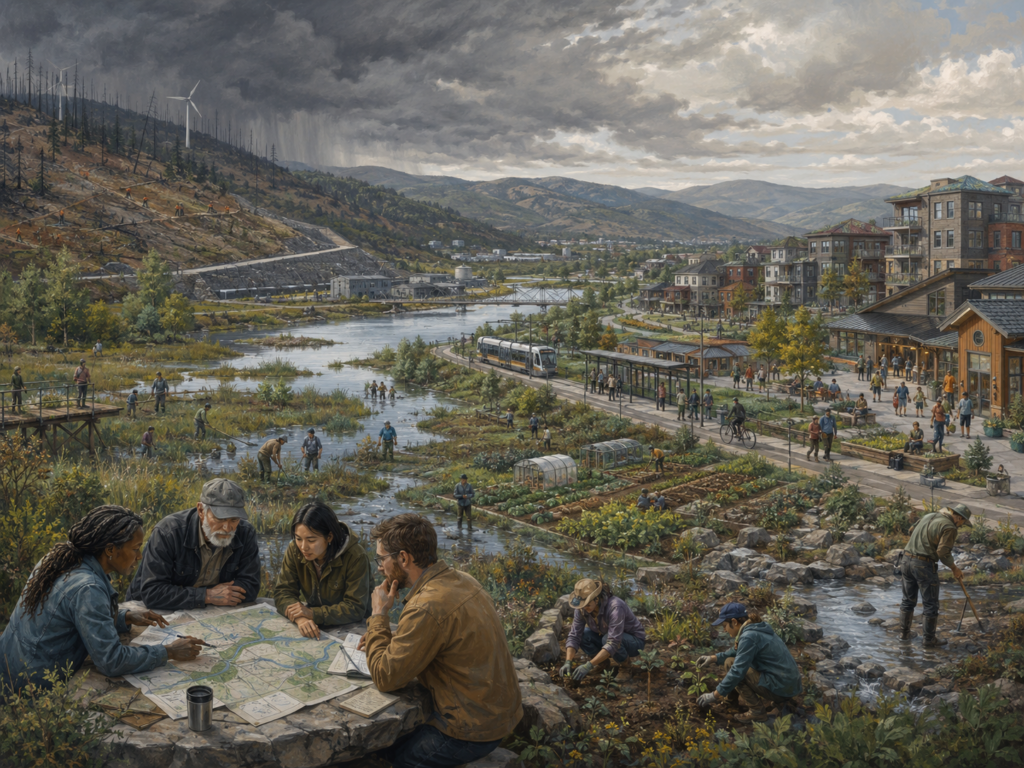
Panoramic illustration of a riverside community with restored wetlands, farms, transit, housing, public spaces, renewable energy, burned hillsides, storm clouds, and residents planning sustainable recovery.

Resilience and Sustainable Development: Integrating Stability, Adaptation, and Long-Term System Viability

Resilience and Sustainable Development examines how resilience and sustainability work together as a unified framework for long-term system viability under disturbance, uncertainty, and ecological constraint. The article argues that resilience provides the dynamic dimension of how systems absorb shocks, adapt, and evolve, while sustainable development provides the normative dimension of what kinds of futures are worth sustaining across generations. It explores why their integration matters for complex systems facing climate change, inequality, biodiversity loss, and resource stress, and develops this through planetary boundaries, social-ecological systems, adaptive capacity, transformation, equity, and long-term planning. It also includes an evergreen mathematical lens, along with advanced R and Python workflows for comparing development pathways and analyzing uncertainty in long-horizon strategic choices.

Scroll to Top