
Last Updated June 2, 2026
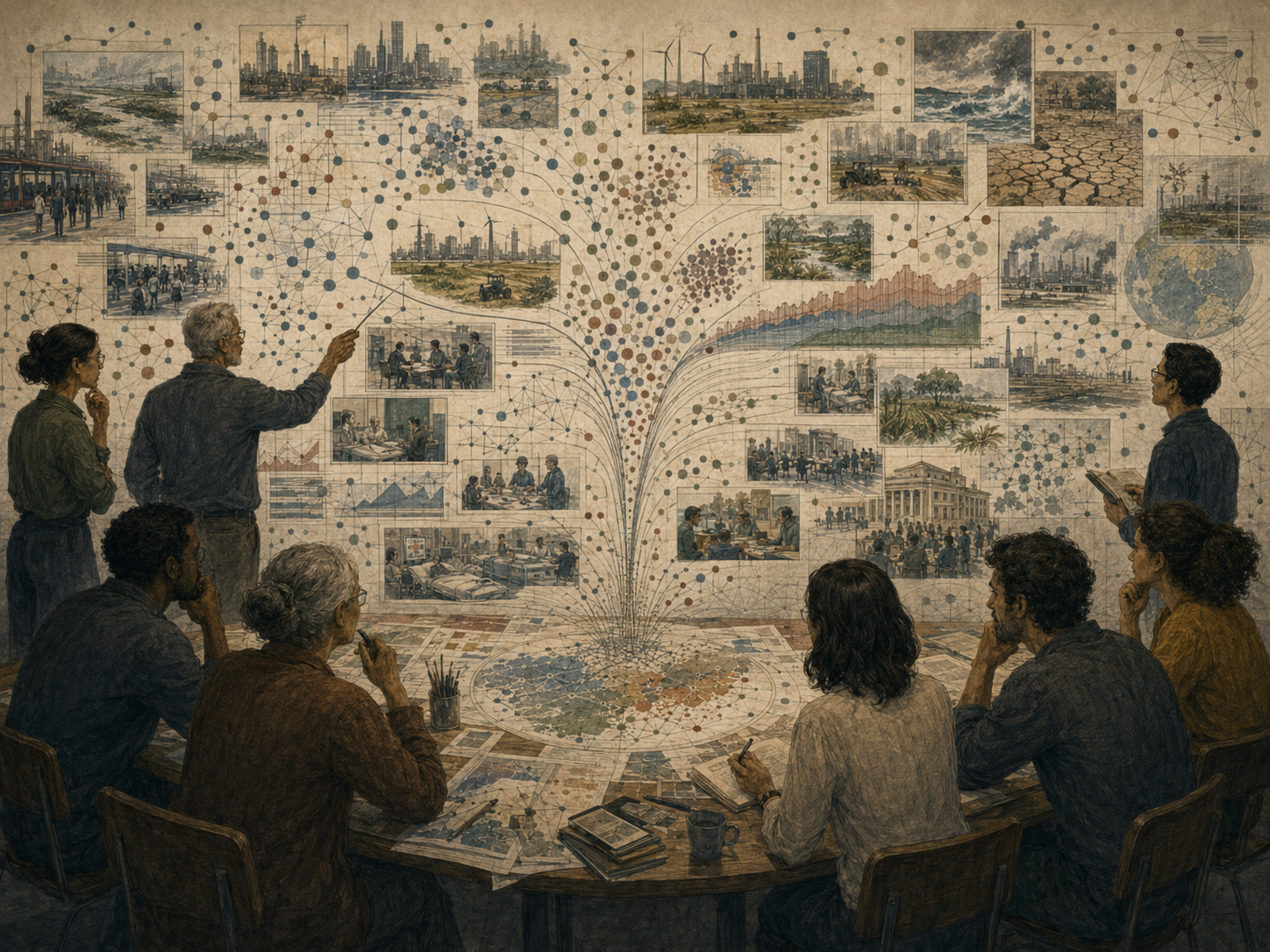
Horizon scanning is a systematic process for identifying emerging issues, weak signals, disruptions, and early indicators of change that may shape future conditions. It supports strategic foresight by extending attention beyond dominant trends and visible developments toward signals that remain fragmented, ambiguous, peripheral, or only partially legible. In practice, horizon scanning helps institutions detect change before it becomes obvious, measurable, or widely recognized.
In complex systems, major transformation rarely arrives fully formed. It often begins at the margins: an unexpected research result, a subtle regulatory shift, a niche technology, a new behavioral pattern, a geopolitical anomaly, a local institutional experiment, a cultural disturbance, a new public concern, or a small response to mounting ecological, economic, or institutional stress. These early signs are easy to dismiss because they do not yet resemble established trends. Horizon scanning provides a disciplined method for noticing them, interpreting them, and assessing whether they may signal deeper structural change.
At its highest level, horizon scanning is not merely a monitoring exercise. It is a strategic practice of attention under uncertainty. It asks what organizations are not yet seeing, what assumptions are blinding them, which sources are missing from their field of vision, and which developments at the edge of visibility may eventually reshape the center. In that sense, horizon scanning is not only about collecting signals. It is about widening institutional perception before surprise becomes unavoidable.
Horizon scanning is especially important because institutions often fail to recognize change while it is still actionable. By the time a signal becomes a trend, the range of strategic options may already have narrowed. By the time a trend becomes a crisis, the cost of adaptation may be far higher. Horizon scanning gives organizations, governments, communities, researchers, and public-interest institutions a way to extend attention forward without pretending to predict the future.
Main Library
Publications
Article Map
Futures Thinking
Related Topic
Systems Modeling
Related Topic
Resilience Thinking
Related Topic
Sustainable Development
What Is Horizon Scanning?
Horizon scanning is the structured identification, collection, interpretation, and prioritization of emerging issues, weak signals, early indicators, and disruptive developments that may influence future outcomes. It involves deliberately searching across diverse domains in order to detect changes that could have strategic implications before they become prominent in mainstream discourse, established trend reports, or standard planning models.
Horizon scanning typically addresses questions such as: What developments are emerging across technological, social, political, environmental, cultural, institutional, and economic systems? Which signals may indicate deeper underlying change? What is still marginal today but may become strategically significant tomorrow? What developments appear weak, ambiguous, or peripheral because they do not yet fit existing categories? What risks or opportunities are visible to some communities before they are visible to dominant institutions?
Unlike forecasting, which projects known patterns forward, horizon scanning is oriented toward what is not yet fully understood. It is therefore especially valuable when historical data are insufficient, system conditions are shifting, novelty is emerging faster than institutions can interpret it, or conventional categories no longer capture what is happening. Forecasting begins with known patterns. Horizon scanning begins with partial visibility.
Horizon scanning is also distinct from trend analysis. Trend analysis examines patterns that have already become sufficiently visible to track over time. Horizon scanning operates earlier, when evidence is fragmented and strategic judgment matters more than statistical confidence. A signal may not yet be measurable enough to count as a trend, but it may still deserve attention because it challenges current assumptions or hints at future transformation.
| Horizon Scanning Question | Strategic Purpose |
|---|---|
| What is emerging at the margins? | Detect early developments before they become dominant. |
| Which signals challenge current assumptions? | Reveal blind spots in existing strategy and planning. |
| What sources are not usually included? | Expand attention beyond familiar institutional channels. |
| Which weak signals are converging? | Identify provisional clusters that may indicate emerging patterns. |
| What might become strategically significant? | Prioritize developments for deeper analysis and monitoring. |
| What should feed scenarios, trends, and strategy? | Convert early evidence into foresight inputs. |
Its distinctive role is to widen the evidence base before the future hardens into a narrower set of recognized trends.
Why Horizon Scanning Matters
Horizon scanning matters because strategic surprise rarely comes only from developments that were wholly invisible. More often, the issue was visible in fragmentary form, but institutions failed to notice it, failed to interpret it, failed to connect it to broader system change, or failed to assign it significance. The problem was not always absence of information. It was weakness of attention, interpretation, source diversity, or institutional willingness to act on early ambiguity.
This is why horizon scanning should be understood as an institutional capability, not just a method. It enables organizations to detect emerging risks and opportunities earlier, reduce exposure to delayed reaction, improve scenario quality by broadening the evidence base, challenge present-day assumptions about what matters, and create monitoring systems for uncertain developments.
Horizon scanning also matters because institutions are often optimized for what they already know how to see. Budgets, reporting systems, performance metrics, regulatory categories, organizational charts, professional expertise, and leadership incentives all shape attention. They encourage organizations to monitor what is already recognized as important. Horizon scanning pushes against this tendency by asking what may become important before established systems are prepared to measure it.
This connects directly to trend analysis. Trend analysis works once a pattern becomes visible. Horizon scanning operates earlier, when pattern recognition is still uncertain and strategic judgment matters more than measurement. In that sense, horizon scanning buys time: time to question assumptions, test signals, build scenarios, create options, and avoid being forced into reactive adaptation.
| Why Horizon Scanning Matters | Practical Value |
|---|---|
| Strategic surprise often has early traces. | Scanning helps identify issues before they become unavoidable. |
| Institutions have blind spots. | Scanning expands attention beyond familiar sources and categories. |
| Trends begin before they are measurable. | Scanning detects change at the pre-trend stage. |
| Complex systems amplify small changes. | Scanning helps detect early deviations before they cascade. |
| Scenarios need broad input. | Scanning strengthens scenario planning and uncertainty analysis. |
| Delayed recognition narrows options. | Scanning preserves time for adaptive strategy. |
The practical value of horizon scanning lies in buying time before recognition becomes compulsory.
Horizon Scanning as Early Detection in Complex Systems
In complex systems, significant change often begins with small deviations from the expected path. These deviations may appear isolated, weak, contradictory, or trivial. Yet because systems are interconnected, nonlinear, and feedback-driven, seemingly minor changes can propagate into wider transformation. Horizon scanning belongs naturally alongside systems modeling, resilience thinking, scenario planning, and anticipatory governance because it focuses on the early conditions of future change.
In systems terms, horizon scanning is a way of detecting possible future shifts before they become system-wide expressions. It attempts to observe change at the edge of the system before that change passes through feedback loops, thresholds, regime dynamics, adoption curves, political conflict, infrastructure lock-in, institutional imitation, or cultural normalization.
A new technology may begin in a niche community before becoming a platform infrastructure. A subtle administrative workaround may indicate future institutional adaptation. A small demographic shift may foreshadow a larger fiscal or political change. A local climate response may become a model for adaptation elsewhere. A new language of risk may signal that public concern is reorganizing before policy catches up.
This early-detection function is essential because complex systems often appear stable until they are not. Stress accumulates through slow variables, hidden dependencies, and delayed feedback. Horizon scanning helps institutions notice possible preconditions of change: anomalies, experiments, unusual responses, boundary cases, and weak indicators that suggest the system may be approaching a new phase.
| Complex Systems Feature | Horizon Scanning Response |
|---|---|
| Feedback loops | Look for signals that may amplify through reinforcing dynamics. |
| Thresholds | Monitor early indicators of movement toward tipping points or regime shifts. |
| Emergence | Watch for patterns arising from interaction among many small developments. |
| Path dependency | Identify early lock-in before options narrow. |
| Cascading risk | Track signals across linked systems rather than within one sector only. |
| Adaptive actors | Notice how institutions, communities, firms, and publics respond to stress. |
| Delayed visibility | Attend to weak indicators before official metrics recognize change. |
Horizon scanning is therefore closely related to early-warning logic. It focuses on the preconditions of change rather than only on its visible outcomes.
Core Signal Types in Horizon Scanning
Horizon scanning identifies different categories of signals depending on their maturity, visibility, and interpretive clarity. These categories are not rigid boxes. They describe a progression from ambiguous emergence to more established pattern recognition. A signal may move from one category to another as evidence accumulates, interpretation improves, or the system changes.
1. Emerging Issues
Emerging issues are developments that may become significant over time but are not yet fully understood. They often appear as niche debates, early-stage technologies, new public concerns, legal disputes, policy experiments, unusual organizational practices, or changes in institutional language. They matter because they may indicate that a new problem or opportunity is beginning to form.
2. Weak Signals
Weak signals are early signs of potential change that remain uncertain, fragmented, and ambiguous. They may not yet form a stable pattern, but they suggest that something structurally new may be developing. A weak signal does not prove that a future will occur. It indicates that a possible future deserves attention, comparison, and monitoring.
3. Early Indicators
Early indicators are more observable and interpretable signs that a broader development may be taking shape. They remain emergent, but their implications are increasingly legible. Early indicators may appear as repeated cases, measurable adoption, policy movement, funding shifts, public attention, scientific convergence, or institutional imitation.
4. Disruptions and Discontinuities
Disruptions are developments that break continuity with expected trajectories. Some disruptions are sudden shocks. Others emerge gradually through compounding pressures. Horizon scanning pays attention to discontinuities because they challenge linear extrapolation and may reveal that the future environment is changing faster than existing plans assume.
5. Trends
Trends are more established and measurable patterns of change that show continuity, direction, and persistence. Horizon scanning does not focus only on trends, but it helps identify where weak signals may be developing into trend-level evidence. A scanned signal becomes more strategically important when it begins to repeat across contexts and time.
6. Megatrends
Megatrends are large-scale, long-duration forces shaping multiple systems across decades. Horizon scanning often detects signals that indicate how megatrends are evolving, interacting, or producing new consequences. Climate stress, demographic aging, digital transformation, geopolitical fragmentation, public trust decline, and ecological degradation all generate horizon-scanning signals at their edges.
7. Counter-Signals
Counter-signals are developments that run against a dominant trend or expected pathway. They matter because they may indicate backlash, reversal, fragmentation, adaptation, or alternative futures. A strong horizon scan does not only collect signals that confirm expected change. It also looks for signs that current expectations may be wrong.
| Signal Type | Visibility | Strategic Use | Common Risk |
|---|---|---|---|
| Emerging issue | Low to moderate. | Identify new issue areas before they mature. | Dismissed because it lacks immediate evidence. |
| Weak signal | Low and ambiguous. | Detect early possibility and monitor for convergence. | Overinterpreted or ignored. |
| Early indicator | Moderate and increasingly legible. | Track movement toward broader pattern formation. | Treated as certain too early. |
| Disruption | Variable. | Identify breaks in expected continuity. | Framed as isolated rather than structural. |
| Trend | Higher and measurable. | Feed trend analysis and scenario development. | Assumed to continue unchanged. |
| Megatrend | High but slow-moving. | Frame long-term structural context. | Underestimated because it unfolds gradually. |
| Counter-signal | Often low or contested. | Challenge assumptions and detect reversal or backlash. | Excluded because it is inconvenient. |
Horizon scanning focuses primarily on the earlier stages of this progression. Its distinctive value lies in detecting issues before they harden into trends. That makes it especially useful in domains where delayed recognition carries high strategic cost.
Signal, Noise, and the Problem of Interpretation
One of the deepest challenges in horizon scanning is that not every unusual development is meaningful. Some developments are random anomalies. Some are transient fads. Some are artifacts of media amplification, data bias, institutional fashion, speculative hype, or algorithmic visibility. Others are meaningful but appear weak because they have not yet accumulated evidence. This means the central challenge of horizon scanning is not merely collection, but discrimination: distinguishing signal from noise without becoming overconfident.
Effective horizon scanning requires analysts to ask whether a development is isolated or connected to broader structural forces, whether it is likely to fade or could scale through feedback and adoption, whether it challenges current assumptions or merely decorates them, and what conditions would need to change for it to become consequential.
These are not purely technical questions. They are interpretive, strategic, and often political. Horizon scanning sits at the boundary between evidence gathering and meaning-making. The quality of scanning depends not only on the volume of information collected, but on the clarity and discipline with which that information is framed, challenged, compared, and tested.
Signal interpretation also requires humility. A signal that appears weak from one institutional perspective may be strong from another. A local community may see an environmental or social signal before a national agency does. A worker may see labor displacement before executives call it a trend. A youth movement may detect future legitimacy crises before formal institutions recognize them. A marginalized group may recognize harm that aggregate metrics hide.
| Interpretive Question | Why It Matters |
|---|---|
| Is this signal isolated or repeated? | Repeated signals may indicate emerging pattern formation. |
| Does it connect to structural drivers? | Signals linked to larger forces are more likely to matter. |
| Who is noticing it? | Different groups see different forms of early change. |
| What assumptions does it challenge? | Strategically important signals often disrupt existing expectations. |
| What would make it scale? | Scaling conditions reveal whether the signal could become consequential. |
| What would make it disappear? | Failure conditions help avoid overreaction to noise. |
| Who benefits if it is ignored? | Signal dismissal may reflect power, not evidence alone. |
The crucial task is not only to see anomalies, but to understand which anomalies may later reorganize the structure of the system.
Sources of Horizon Scanning
Effective horizon scanning draws on a wide range of information sources because emerging change often appears outside conventional channels. A narrow information diet increases the risk of blind spots, especially when institutions rely only on familiar metrics, established expert communities, official reports, or their own sector’s dominant narratives.
Useful sources include academic research and scientific publications, policy reports and institutional analysis, journalism and specialized industry reporting, startup activity and patent filings, standards development, regulatory proposals, court cases, cultural production, artistic practice, local experiments, community organizing, behavior change, social discourse, activist claims, professional forums, technical communities, ecological observations, and international developments.
In some cases, signals appear first in research communities. In others, they emerge through consumer behavior, local policy experimentation, grassroots mobilization, fringe communities, community adaptation, labor conflict, environmental stress, or cultural change before formal institutions acknowledge them. The point is not to treat all sources as equally reliable. The point is to scan widely, evaluate carefully, and avoid confusing institutional familiarity with strategic relevance.
| Source Type | Possible Signal Value | Risk if Used Poorly |
|---|---|---|
| Academic research | Early scientific, technological, ecological, or social developments. | May lag practical adoption or overstate narrow findings. |
| Policy reports | Emerging governance concerns, regulatory shifts, institutional priorities. | May reflect official blind spots. |
| Specialized journalism | New issues before they reach mainstream attention. | May amplify novelty without structural significance. |
| Patent and standards activity | Technical development, infrastructure direction, industrial priorities. | May not translate into real-world adoption. |
| Local experiments | Practical responses to stress before national recognition. | May be context-specific and hard to generalize. |
| Community knowledge | Early lived experience of risk, harm, adaptation, or exclusion. | Often undervalued by formal institutions. |
| Social and cultural discourse | Changing meanings, values, fears, hopes, and legitimacy conditions. | May be noisy or algorithmically distorted. |
| Ecological and environmental observations | Early stress indicators, threshold movement, local system change. | Can be missed if monitoring is too aggregate. |
Diversity of source material matters because emerging change is rarely distributed evenly across domains. What looks peripheral in one domain may be central in another.
The Horizon Scanning Process
Horizon scanning usually follows a structured process, though in advanced practice the stages are iterative rather than strictly linear. The goal is to transform scattered emergence into usable foresight input without pretending that uncertainty has been solved.
| Phase | Purpose | Guiding Questions | Outputs |
|---|---|---|---|
| 1. Frame the scan | Define the focal issue, time horizon, domains, and intended use. | What are we scanning for? Why? For whom? | Scanning brief, focal question, domain map. |
| 2. Collect signals | Gather developments from diverse sources and perspectives. | What is emerging across systems and at the margins? | Signal register, source log. |
| 3. Filter and tag | Identify which developments may have strategic significance. | What is relevant, novel, uncertain, or assumption-challenging? | Tagged signal list, filtering notes. |
| 4. Cluster signals | Group related developments into provisional issue areas. | Which signals appear connected? | Signal clusters, emerging issue map. |
| 5. Interpret implications | Analyze trajectories, uncertainties, interactions, and possible consequences. | What might this mean if it scales or interacts? | Interpretive briefs, uncertainty notes. |
| 6. Prioritize for action | Rank signals for monitoring, scenario input, or strategic review. | What deserves deeper attention? | Priority list, watchlist, review triggers. |
| 7. Integrate into foresight | Feed insights into scenarios, trend analysis, risk, strategy, or governance. | How should this change our planning assumptions? | Scenario inputs, strategy implications, assumption updates. |
| 8. Review and learn | Revisit signals as evidence changes. | What is strengthening, weakening, converging, or disappearing? | Updated signal register, learning dashboard. |
This process transforms fragmented information into structured insight. But quality depends less on volume than on interpretive discipline. Scanning more information is not the same as seeing more clearly. Strong scanning requires good filtering, good framing, plural sources, effective challenge, and institutional pathways for moving insight into action.
The point of horizon scanning is not information accumulation alone. It is the conversion of scattered emergence into strategically usable meaning.
Horizon Scanning and Strategic Foresight
Horizon scanning is a foundational component of strategic foresight. It provides the raw inputs that inform weak signal analysis, trend development, scenario planning, backcasting, assumption review, and wider futures interpretation. Without horizon scanning, foresight risks becoming a closed system built from familiar assumptions.
The relationship among methods is sequential but also recursive. Horizon scanning identifies signals. Weak signals analysis interprets their possible significance. Trend analysis organizes repeated signals into directional patterns. Megatrend analysis situates those patterns in larger structural conditions. Scenario planning explores how drivers and uncertainties may interact under different futures. Backcasting connects preferred futures to present action. Monitoring loops then return to scanning as conditions change.
This sequencing matters because foresight quality depends on the depth and diversity of its inputs. Weak scanning produces shallow scenarios. Narrow scanning produces narrow strategy. Elite-only scanning produces elite futures. A scanning process that excludes marginal sources may miss signals that are already visible to affected communities.
| Foresight Method | Relationship to Horizon Scanning |
|---|---|
| Weak signals analysis | Interprets ambiguous scanned developments. |
| Trend analysis | Tracks signals that begin to form visible directional patterns. |
| Megatrend analysis | Frames scanned signals within long-term structural forces. |
| Scenario planning | Uses signals and drivers to build plausible future contexts. |
| Backcasting | Uses signals to assess whether preferred futures require new pathways. |
| Strategic risk analysis | Uses signals to identify emerging vulnerabilities and response options. |
| Anticipatory governance | Uses scanning to support earlier public-policy learning and regulatory readiness. |
Horizon scanning is therefore not peripheral to foresight. It is one of the earliest and most important layers in the broader process of future-oriented reasoning.
Horizon Scanning and Complex Systems
In complex systems, change emerges through interaction, feedback, delay, and threshold behavior rather than linear progression. Horizon scanning helps detect early signals within those systems before they produce large-scale effects. A technological shift may alter behavior, which influences regulation, which changes investment, which accelerates infrastructure transformation. A local climate adaptation experiment may influence insurance practice, housing policy, public-health planning, and migration patterns. By the time the full system effect becomes visible, the window for early action may already be narrowing.
This is why horizon scanning is especially useful in systems marked by interdependence. It encourages organizations to look not only for direct developments, but for linked changes across sectors, regions, institutions, and communities. A signal in one part of the system may only become meaningful when understood in relation to others.
For example, a new AI governance standard is not only a technology signal. It may be a labor signal, a regulatory signal, a public trust signal, a procurement signal, a civil rights signal, and an institutional accountability signal. A shift in climate insurance pricing is not only a financial signal. It may be a housing signal, a migration signal, an infrastructure signal, and a public-policy signal. Horizon scanning asks analysts to read such signals relationally.
| Signal Domain | Possible Cross-System Meaning |
|---|---|
| AI procurement pilots | Public services, labor, civil rights, data governance, accountability. |
| Climate insurance withdrawal | Housing markets, migration, infrastructure finance, public adaptation policy. |
| Youth political mobilization | Intergenerational legitimacy, climate futures, education, democratic participation. |
| Local water scarcity response | Food systems, land use, public health, migration, regional governance. |
| Care workforce shortages | Demography, public health, labor policy, gender equity, social protection. |
| Platform moderation changes | Information systems, democratic trust, safety, speech, governance, public discourse. |
Horizon scanning expands strategic awareness by making it possible to see interconnection before interconnection becomes crisis.
Applications of Horizon Scanning
Horizon scanning is used across multiple domains because early detection is valuable wherever uncertainty, change, and strategic consequence are high. Its purpose varies by context, but the core logic remains the same: detect emerging developments, interpret significance, prioritize monitoring, and feed insight into foresight, policy, strategy, and governance.
| Domain | Horizon Scanning Use | Example Question |
|---|---|---|
| Public policy | Identify emerging risks, vulnerabilities, opportunities, and governance challenges. | What early issues may require policy attention before crisis? |
| Business strategy | Anticipate market, technological, labor, regulatory, and competitive change. | What weak signals could disrupt current strategy? |
| Technology assessment | Monitor early-stage innovation, adoption, standards, harms, and regulatory gaps. | What technologies require governance before adoption scales? |
| Sustainability planning | Detect environmental, institutional, and social shifts before they compound. | What sustainability risks are emerging at the margins? |
| Climate adaptation | Track early indicators of exposure, vulnerability, infrastructure stress, and retreat pressure. | Where are adaptation windows narrowing? |
| Security and risk analysis | Identify precursors of instability, systemic fragility, or strategic surprise. | What small developments may indicate future instability? |
| Public health | Track disease signals, misinformation, workforce strain, climate-health links, and care stress. | What health-system pressures are emerging before official crisis metrics? |
| Education and research | Identify future knowledge needs, emerging disciplines, and new literacy demands. | What should learning systems prepare for before labor markets fully shift? |
In each context, horizon scanning extends the strategic horizon and reduces the lag between emergence and response. The earlier an institution can frame a meaningful development, the more options it usually retains.
Horizon scanning is most valuable when it gives institutions time to prepare before visible trends force action under pressure.
Institutional Blind Spots and Scanning Failure
One reason horizon scanning matters is that institutions are often structurally poor at it. Large organizations tend to privilege information that confirms existing priorities, reinforces dominant assumptions, comes from familiar sources, or fits existing categories. This creates blind spots. Scanning fails when organizations look only where they are already comfortable looking, dismiss weak signals because they lack immediate proof, ignore marginal developments because they fall outside established categories, or collect signals without ever integrating them into strategic processes.
Institutional blind spots are not only cognitive. They are structural. Funding systems reward certain indicators. Professional disciplines define what counts as evidence. Leadership incentives may discourage uncomfortable findings. Bureaucratic categories may exclude ambiguous developments. Corporate strategy may ignore harms that do not affect revenue. Public agencies may undervalue signals from marginalized communities if those signals are not already translated into official metrics.
Effective horizon scanning therefore requires institutional humility. Organizations must accept that what matters most tomorrow may not yet look important today, and that established categories may be exactly what prevents emerging reality from being recognized. Without this humility, scanning becomes ceremonial rather than transformative.
| Scanning Failure Mode | What Goes Wrong | Corrective Practice |
|---|---|---|
| Confirmation scanning | Only collects signals that fit existing strategy. | Include assumption-challenging and counter-trend signals. |
| Source narrowness | Relies on familiar expert or institutional sources. | Use plural sources, community knowledge, and cross-domain scanning. |
| Novelty chasing | Overweights fashionable developments. | Score structural connection, relevance, and convergence. |
| Signal hoarding | Collects information without interpretation. | Use filtering, clustering, and implication analysis. |
| Category blindness | Ignores developments that do not fit existing classifications. | Use open coding and periodic taxonomy revision. |
| Leadership avoidance | Uncomfortable signals are softened or ignored. | Create protected pathways for dissenting foresight insights. |
| No decision uptake | Scanning never changes scenarios, strategy, or monitoring. | Link signals to owners, review triggers, and decision cycles. |
The deepest failure mode in horizon scanning is not missing information. It is preserving an interpretive frame too narrow to recognize significance when it appears.
Participation, Power, and Source Diversity
Horizon scanning is often described as a technical process of information gathering, but it is also shaped by power. Who scans? Which sources are trusted? Which communities are consulted? Which signals are considered credible? Which forms of knowledge are treated as evidence? These questions shape the future that institutions become capable of seeing.
Dominant institutions often scan from their own vantage point. Corporations scan markets, technologies, competitors, and regulation. Governments scan policy risks, fiscal pressures, security issues, and service demand. Universities scan research trends, credentials, funding, and knowledge production. These perspectives are useful, but incomplete. Communities, workers, youth, Indigenous knowledge holders, disabled people, migrants, caregivers, frontline public servants, and people exposed to environmental harm may see future-relevant signals that official scanning systems miss.
Participation improves horizon scanning because early change is unevenly distributed. The first people to experience a signal may not be the people with the authority to interpret it. Heat risk, surveillance, housing stress, care-system strain, environmental exposure, workplace algorithmic control, and institutional mistrust may all appear in lived experience before they appear in official dashboards.
Participatory scanning should not be tokenistic. It should influence source selection, signal interpretation, priority ranking, scenario inputs, and decision uptake. Otherwise, participation becomes a symbolic layer placed on top of an unchanged institutional scanning system.
| Power Question | Why It Matters | Scanning Practice Response |
|---|---|---|
| Whose sources are included? | Source selection shapes what becomes visible. | Use cross-sector, community, scientific, policy, cultural, and local sources. |
| Who judges credibility? | Credibility standards can exclude lived knowledge. | Use plural review and document evidence type. |
| Which signals are dismissed? | Dismissal may reflect institutional comfort rather than evidence. | Track rejected signals and review them periodically. |
| Who experiences early harm? | Frontline groups often detect risk first. | Include exposed communities in interpretation. |
| Who benefits from delay? | Delayed recognition can protect powerful interests. | Document beneficiaries, burdens, and accountability stakes. |
| Does scanning affect decisions? | Participation without uptake is symbolic. | Link participatory signals to strategy, policy, and monitoring. |
Horizon scanning becomes more legitimate and more accurate when it treats source diversity as a methodological strength, not a public-relations gesture.
Strengths and Limitations
Horizon scanning offers clear strengths. It detects change earlier than most conventional planning methods. It supports proactive rather than reactive strategy. It expands institutional awareness beyond visible trends and dominant assumptions. It improves the quality of scenario work and strategic preparation by making earlier layers of emergence visible. It also helps institutions develop habits of curiosity, monitoring, interpretation, and adaptive learning.
But horizon scanning also has real limitations. Signals may be ambiguous or misleading. Interpretation is partly subjective. Not all signals become consequential. Weak scanning can generate noise without insight, especially when organizations confuse collection with analysis. There is always the danger of overreading novelty, misjudging relevance, becoming distracted by anomalies that never scale, or allowing institutional bias to shape what counts as strategic.
These limitations do not weaken the method. They define its discipline. Horizon scanning is valuable precisely because it works at the frontier where certainty is not yet available. Its purpose is not to produce final answers. Its purpose is to expand attention, structure ambiguity, and create a learning system for possible future change.
| Strength | Strategic Value |
|---|---|
| Early detection | Identifies developments before they become dominant trends. |
| Assumption challenge | Reveals where existing strategy may be too narrow. |
| Scenario enrichment | Improves the depth and diversity of scenario inputs. |
| Cross-domain awareness | Connects signals across technology, ecology, governance, culture, and economy. |
| Learning orientation | Creates monitoring habits and review cycles. |
| Limitation | Risk | Corrective Practice |
|---|---|---|
| Signal ambiguity | Signals may be hard to interpret. | Use clustering, review, and scenario testing. |
| Noise overload | Too much information without meaning. | Use scoring, filtering, and priority criteria. |
| Novelty bias | Fashionable signals may crowd out structural ones. | Score structural connection and strategic relevance. |
| Source bias | Important signals may be excluded. | Diversify sources and include affected communities. |
| No uptake | Scanning has no effect on decisions. | Connect outputs to scenarios, owners, and review cycles. |
Horizon scanning is not a guarantee against surprise. It is a disciplined attempt to reduce avoidable blindness.
A Practical Horizon Scanning Workflow
A practical horizon scanning workflow should move from purpose and scope to source diversity, signal collection, tagging, clustering, interpretation, prioritization, integration, and review. The workflow below can be adapted for public agencies, businesses, universities, research teams, civic organizations, sustainability planning, technology governance, climate adaptation, and risk monitoring.
| Phase | Action | Output |
|---|---|---|
| Frame | Define the focal issue, domain boundaries, time horizon, intended users, and decision context. | Scanning brief. |
| Source | Identify diverse sources across research, policy, technology, communities, media, ecology, culture, and industry. | Source map. |
| Scan | Collect signals, emerging issues, anomalies, counter-signals, and early indicators. | Signal register. |
| Tag | Classify signals by domain, maturity, uncertainty, impact, novelty, source type, and affected groups. | Tagged database. |
| Cluster | Group related signals into issue areas or possible emerging patterns. | Signal clusters. |
| Interpret | Assess structural connection, scaling conditions, assumptions challenged, and possible consequences. | Interpretive briefs. |
| Prioritize | Rank signals for monitoring, scenario input, strategic attention, or deeper research. | Watchlist and priority map. |
| Integrate | Feed outputs into trend analysis, scenario planning, risk assessment, policy, strategy, or governance. | Foresight inputs and strategy implications. |
| Review | Revisit signals periodically to detect strengthening, weakening, convergence, or disappearance. | Learning dashboard and updated signal register. |
The strongest workflows avoid treating horizon scanning as a one-time report. Scanning should be a recurring institutional practice. Signals should be revisited. Categories should be revised. New sources should be added. Rejected signals should sometimes be reviewed. Strategy should be adjusted when signals strengthen or converge.
A good horizon scanning workflow is not just a collection mechanism. It is a learning architecture for uncertainty.
Mathematical Lens: Detection, Filtering, and Strategic Relevance
A stylized way to represent horizon scanning is as the structured evaluation of observed developments for future relevance:
H_t = \alpha O_t + \beta D_t + \gamma C_t – \delta N_t
\]
Interpretation: \(H_t\) is horizon-scanning relevance at time \(t\), \(O_t\) is observed emergence, \(D_t\) is domain diversity of supporting evidence, \(C_t\) is connection to broader structural forces, and \(N_t\) is background noise or misleading novelty. Relevance depends not only on detection, but on contextual connection and filtering.
A threshold model can also represent the movement from scanned signal to strategic concern:
R_t =
\begin{cases}
0, & \text{if } H_t < \theta \\ 1, & \text{if } H_t \geq \theta \end{cases} \]
Interpretation: \(R_t\) indicates whether a scanned development crosses the threshold of strategic relevance, while \(\theta\) represents the level of coherence, concern, or institutional attention needed to trigger deeper analysis.
Clustering can be represented conceptually as:
K = \sum_{i=1}^{n} s_i
\]
Interpretation: \(K\) is a pattern cluster formed by multiple related signals \(s_i\). Isolated signals often remain ambiguous, but their strategic meaning strengthens when multiple signals converge around a common issue area.
A signal watch score can combine uncertainty, impact, novelty, and structural connection:
W_i = w_u U_i + w_p P_i + w_n N_i + w_c C_i
\]
Interpretation: \(W_i\) is the watch score for signal \(i\), \(U_i\) is uncertainty, \(P_i\) is potential impact, \(N_i\) is novelty, and \(C_i\) is structural connection. The weights \(w\) should reflect the decision context.
These equations are conceptual tools rather than deterministic predictions. They help make the logic of horizon scanning explicit: detection, diversity, filtering, clustering, and strategic relevance must be considered together.
Computational Modeling for Horizon Scanning
Computational modeling can support horizon scanning by making signal collection, tagging, prioritization, clustering, and monitoring more transparent. It should not replace human judgment, domain expertise, public participation, or ethical interpretation. The purpose is to support disciplined attention, not automate foresight.
A useful computational horizon scanning workflow may include:
- Signal registers: structured records of scanned developments, domains, source types, descriptions, and dates.
- Signal scoring: weights for uncertainty, impact, novelty, source diversity, and structural connection.
- Signal clustering: grouping related signals into emerging issue areas or possible future patterns.
- Source diversity audits: checking whether scanning relies too heavily on familiar or elite sources.
- Assumption challenge logs: documenting which institutional assumptions each signal challenges.
- Watchlists: ranked lists of signals requiring continued monitoring or deeper analysis.
- Scenario inputs: converting priority signals into scenario drivers, uncertainties, or narrative material.
- Learning dashboards: recurring outputs showing which signals are strengthening, weakening, or converging.
Computational scanning should be transparent. It should show how scores were created, how signals were classified, which sources were used, which groups were included, what assumptions were challenged, and what remains uncertain. This is especially important when horizon scanning informs public policy, technology governance, climate adaptation, public health, infrastructure planning, or decisions affecting vulnerable communities.
The goal is not to mechanize attention. The goal is to make attention structured, auditable, and easier to revise.
Advanced R Workflow: Comparing Horizon Scanning Profiles Across Domains
The R workflow below compares several stylized scanned developments across visibility, ambiguity, structural connection, domain diversity, source diversity, assumption challenge, and strategic relevance. It is designed as an evergreen illustration of how scanning can move from raw observation toward structured comparison.
# ------------------------------------------------------------
# R Workflow: Comparing Horizon Scanning Profiles
# Purpose:
#   Build stylized scanning profiles across domains using
#   visibility, ambiguity, structural connection, domain diversity,
#   source diversity, assumption challenge, and strategic relevance.
#
# Optional dependency:
#   install.packages(c("tidyverse"))
# ------------------------------------------------------------

library(tidyverse)

items <- tibble(
  issue_type = c(
    "Emerging Climate-Tech Policy Shift",
    "Unusual Consumer Behavior Pattern",
    "Niche Governance Innovation",
    "Early Geopolitical Technology Restriction",
    "Community Heat-Adaptation Experiment",
    "AI Public-Service Accountability Concern"
  ),
  visibility = c(0.34, 0.41, 0.26, 0.38, 0.29, 0.36),
  ambiguity = c(0.74, 0.68, 0.77, 0.63, 0.70, 0.66),
  structural_connection = c(0.81, 0.58, 0.64, 0.86, 0.78, 0.84),
  domain_diversity = c(0.72, 0.49, 0.57, 0.78, 0.70, 0.76),
  source_diversity = c(0.66, 0.42, 0.62, 0.70, 0.82, 0.68),
  assumption_challenge = c(0.80, 0.52, 0.68, 0.86, 0.76, 0.88),
  strategic_relevance = c(0.84, 0.55, 0.61, 0.88, 0.74, 0.86)
)

items <- items %>%
  mutate(
    horizon_scanning_profile =
      0.10 * visibility -
      0.08 * ambiguity +
      0.22 * structural_connection +
      0.18 * domain_diversity +
      0.14 * source_diversity +
      0.14 * assumption_challenge +
      0.30 * strategic_relevance,
    priority_class = case_when(
      horizon_scanning_profile >= 0.70 ~ "High-priority watchlist",
      horizon_scanning_profile >= 0.58 ~ "Monitor and cluster",
      TRUE ~ "Low-priority or exploratory"
    )
  ) %>%
  arrange(desc(horizon_scanning_profile))

print(items)

items_long <- items %>%
  pivot_longer(
    cols = c(
      visibility,
      ambiguity,
      structural_connection,
      domain_diversity,
      source_diversity,
      assumption_challenge,
      strategic_relevance
    ),
    names_to = "dimension",
    values_to = "value"
  )

ggplot(items_long, aes(x = dimension, y = value, fill = issue_type)) +
  geom_col(position = "dodge") +
  labs(
    title = "Stylized Horizon Scanning Dimensions",
    x = "Dimension",
    y = "Value",
    fill = "Issue Type"
  ) +
  theme_minimal(base_size = 12) +
  coord_flip()

ggplot(items, aes(x = reorder(issue_type, horizon_scanning_profile), y = horizon_scanning_profile)) +
  geom_col() +
  coord_flip() +
  labs(
    title = "Stylized Horizon Scanning Profile",
    x = "Issue Type",
    y = "Profile Score"
  ) +
  theme_minimal(base_size = 12)

dir.create("outputs", showWarnings = FALSE)

write_csv(items, "outputs/horizon_scanning_profiles.csv")
write_csv(items_long, "outputs/horizon_scanning_profiles_long.csv")
This workflow is not a claim that signals can be reduced to numbers. It is a transparent way to compare signal profiles, document assumptions, and support structured discussion about which developments deserve monitoring.
Advanced Python Workflow: Simulating Signal Detection and Strategic Filtering
The Python workflow below simulates stylized scanning outputs under different levels of signal strength, ambiguity, filtering quality, source diversity, and institutional uptake. It is useful for showing why organizations with similar access to information may still differ sharply in what they recognize and act upon.
# ------------------------------------------------------------
# Python Workflow: Simulating Horizon Scanning
# Purpose:
#   Compare stylized scanning systems under different levels
#   of signal strength, ambiguity, filtering quality, source
#   diversity, and institutional uptake.
#
# Optional dependencies:
#   pip install pandas numpy matplotlib
# ------------------------------------------------------------

from pathlib import Path

import numpy as np
import pandas as pd
import matplotlib.pyplot as plt

OUTPUT_DIR = Path("outputs")
OUTPUT_DIR.mkdir(exist_ok=True)

time_steps = np.arange(1, 37)

systems = [
    {
        "system": "High-Quality Scanning System",
        "signal_strength": 0.74,
        "ambiguity": 0.42,
        "filtering": 0.78,
        "source_diversity": 0.82,
        "uptake": 0.74
    },
    {
        "system": "Noisy Reactive Scanning System",
        "signal_strength": 0.68,
        "ambiguity": 0.71,
        "filtering": 0.39,
        "source_diversity": 0.44,
        "uptake": 0.42
    },
    {
        "system": "Elite-Narrow Scanning System",
        "signal_strength": 0.66,
        "ambiguity": 0.58,
        "filtering": 0.62,
        "source_diversity": 0.30,
        "uptake": 0.56
    },
    {
        "system": "Participatory Scanning System",
        "signal_strength": 0.70,
        "ambiguity": 0.52,
        "filtering": 0.72,
        "source_diversity": 0.90,
        "uptake": 0.76
    }
]

def simulate_scanning(
    signal_strength,
    ambiguity,
    filtering,
    source_diversity,
    uptake,
    initial_state=0.20
):
    state = np.zeros(len(time_steps))
    state[0] = initial_state

    for t in range(1, len(time_steps)):
        gain = (
            0.20 * signal_strength +
            0.22 * filtering +
            0.18 * source_diversity +
            0.16 * uptake
        )

        distortion = 0.20 * ambiguity
        review_bonus = 0.035 if (t + 1) % 6 == 0 else 0.0
        noise = 0.025 if (t + 1) % 5 != 0 else 0.065

        state[t] = (
            state[t - 1]
            + gain / 5
            - distortion / 5
            + review_bonus
            - noise / 8
        )

        state[t] = np.clip(state[t], 0, 2.0)

    return state

rows = []

for system in systems:
    path = simulate_scanning(
        system["signal_strength"],
        system["ambiguity"],
        system["filtering"],
        system["source_diversity"],
        system["uptake"]
    )

    for time, value in zip(time_steps, path):
        rows.append({
            "system": system["system"],
            "time": time,
            "scanning_effectiveness": value
        })

df = pd.DataFrame(rows)

summary = (
    df.groupby("system")["scanning_effectiveness"]
    .agg(
        final_value="last",
        mean_value="mean",
        min_value="min",
        max_value="max"
    )
    .reset_index()
    .sort_values("final_value", ascending=False)
)

print("\nScanning system summary:")
print(summary)

df.to_csv(OUTPUT_DIR / "horizon_scanning_effectiveness.csv", index=False)
summary.to_csv(OUTPUT_DIR / "horizon_scanning_effectiveness_summary.csv", index=False)

plt.figure(figsize=(10, 6))
for system_name in df["system"].unique():
    subset = df[df["system"] == system_name]
    plt.plot(
        subset["time"],
        subset["scanning_effectiveness"],
        marker="o",
        linewidth=1.5,
        label=system_name
    )

plt.xlabel("Time Step")
plt.ylabel("Scanning Effectiveness")
plt.title("Signal Detection and Strategic Filtering")
plt.legend()
plt.tight_layout()
plt.savefig(OUTPUT_DIR / "horizon_scanning_effectiveness.png", dpi=150)
plt.close()

plt.figure(figsize=(10, 6))
plt.barh(summary["system"], summary["final_value"])
plt.xlabel("Final Scanning Effectiveness")
plt.title("Final Horizon Scanning Effectiveness by System")
plt.tight_layout()
plt.savefig(OUTPUT_DIR / "horizon_scanning_system_summary.png", dpi=150)
plt.close()
This workflow demonstrates a central institutional lesson: access to information is not the same as horizon scanning capacity. Filtering quality, source diversity, interpretation, and decision uptake determine whether signals become usable foresight.
GitHub Repository
The companion repository for this article contains computational examples for horizon scanning, signal registers, source diversity, strategic filtering, signal prioritization, watchlists, institutional uptake, and scanning-system effectiveness.
Complete Code Repository
The companion code includes Python, R, Julia, SQL, Rust, Go, C++, Fortran, C, documentation, synthetic datasets, outputs, and notebook placeholders for applied horizon scanning workflows.
Why This Matters
Horizon scanning provides one of the earliest layers of insight in futures thinking. It enables decision-makers to detect emerging signals before they become trends or megatrends, and to engage uncertainty before it hardens into crisis or surprise. In environments shaped by rapid change, interdependence, institutional stress, ecological disruption, technological acceleration, and strategic volatility, this capability is critical.
Its value lies not in predicting the future, but in expanding what institutions are capable of noticing. It helps organizations recognize signals that do not yet fit established categories, monitor ambiguous developments without overreacting, include knowledge from outside dominant sources, and feed early evidence into scenarios, strategies, and adaptive governance.
Horizon scanning is therefore a civic and institutional discipline as much as an analytical technique. It asks whether organizations are willing to look beyond what confirms their existing worldview. It asks whether weak signals from marginalized communities, ecological systems, workers, youth, or local institutions will be treated as evidence before harm becomes undeniable. It asks whether future-oriented attention will be broad enough to support responsibility rather than merely advantage.
Horizon scanning is not merely a tool for finding signals. It is a way of extending institutional attention into the future before the future becomes unavoidable.
Related Articles
- Futures Thinking
- What Is Futures Thinking?
- Forecasting, Foresight, and Futures Studies
- Futures Literacy and Anticipatory Capacity
- Scenario Planning
- Strategic Foresight Methods
- Trend Analysis and Megatrends
- Weak Signals and Early Indicators
- Backcasting and Strategic Planning
- Systems Modeling
- Resilience Thinking
Further Reading
- Amanatidou, E., Butter, M., Carabias, V., Könnölä, T., Leis, M., Saritas, O., Schaper-Rinkel, P. and van Rij, V. (2012) ‘On concepts and methods in horizon scanning: Lessons from initiating policy dialogues on emerging issues’, Science and Public Policy, 39(2), pp. 208–221.
- Bengston, D.N. (2019) ‘Horizon scanning for environmental foresight: a review of issues and approaches’, Futures, 113. Available at: ScienceDirect.
- Government Office for Science (2024) The Futures Toolkit: Tools for Futures Thinking and Foresight Across UK Government. London: Government Office for Science. Available at: UK Government.
- Government Office for Science (2025) A Brief Guide to Futures Thinking and Foresight. London: Government Office for Science. Available at: UK Government.
- Hines, A. and Bishop, P. (2015) Thinking About the Future: Guidelines for Strategic Foresight. 2nd edn. Houston: Hinesight.
- Organisation for Economic Co-operation and Development (OECD) (2021) Strategic Foresight for Better Policies: Building Effective Governance in the Face of Uncertain Futures. Paris: OECD Publishing. Available at: OECD.
- Organisation for Economic Co-operation and Development (OECD) (2025) Foresight Toolkit for Resilient Public Policy. Paris: OECD Publishing. Available at: OECD.
- Sutherland, W.J. et al. (2015) ‘A horizon scan of global conservation issues for 2015’, Trends in Ecology & Evolution, 30(1), pp. 17–24.
- Sutherland, W.J. and Woodroof, H.J. (2009) ‘The need for environmental horizon scanning’, Trends in Ecology & Evolution, 24(10), pp. 523–527.
- United Nations Development Programme (UNDP) (2018) Foresight Manual: Empowered Futures for the 2030 Agenda. New York: UNDP. Available at: UNDP.
- Voros, J. (2003) ‘A generic foresight process framework’, Foresight, 5(3), pp. 10–21. Available at: Emerald.
References
- Amanatidou, E., Butter, M., Carabias, V., Könnölä, T., Leis, M., Saritas, O., Schaper-Rinkel, P. and van Rij, V. (2012) ‘On concepts and methods in horizon scanning: Lessons from initiating policy dialogues on emerging issues’, Science and Public Policy, 39(2), pp. 208–221.
- Bengston, D.N. (2019) ‘Horizon scanning for environmental foresight: a review of issues and approaches’, Futures, 113. Available at: ScienceDirect.
- Government Office for Science (2024) The Futures Toolkit: Tools for Futures Thinking and Foresight Across UK Government. London: Government Office for Science. Available at: UK Government.
- Government Office for Science (2025) A Brief Guide to Futures Thinking and Foresight. London: Government Office for Science. Available at: UK Government.
- Organisation for Economic Co-operation and Development (OECD) (no date) Strategic Foresight. Available at: OECD.
- Organisation for Economic Co-operation and Development Observatory of Public Sector Innovation (OECD OPSI) (no date) Futures & Foresight. Available at: OECD OPSI.
- Organisation for Economic Co-operation and Development (OECD) (2021) Strategic Foresight for Better Policies: Building Effective Governance in the Face of Uncertain Futures. Paris: OECD Publishing. Available at: OECD.
- Organisation for Economic Co-operation and Development (OECD) (2025) Foresight Toolkit for Resilient Public Policy. Paris: OECD Publishing. Available at: OECD.
- Sutherland, W.J. and Woodroof, H.J. (2009) ‘The need for environmental horizon scanning’, Trends in Ecology & Evolution, 24(10), pp. 523–527.
- Sutherland, W.J. et al. (2015) ‘A horizon scan of global conservation issues for 2015’, Trends in Ecology & Evolution, 30(1), pp. 17–24.
- United Nations Development Programme (UNDP) (2018) Foresight Manual: Empowered Futures for the 2030 Agenda. New York: UNDP. Available at: UNDP.
- United Nations Educational, Scientific and Cultural Organization (UNESCO) (no date) Futures Literacy & Foresight. Available at: UNESCO.
- Voros, J. (2003) ‘A generic foresight process framework’, Foresight, 5(3), pp. 10–21. Available at: Emerald.