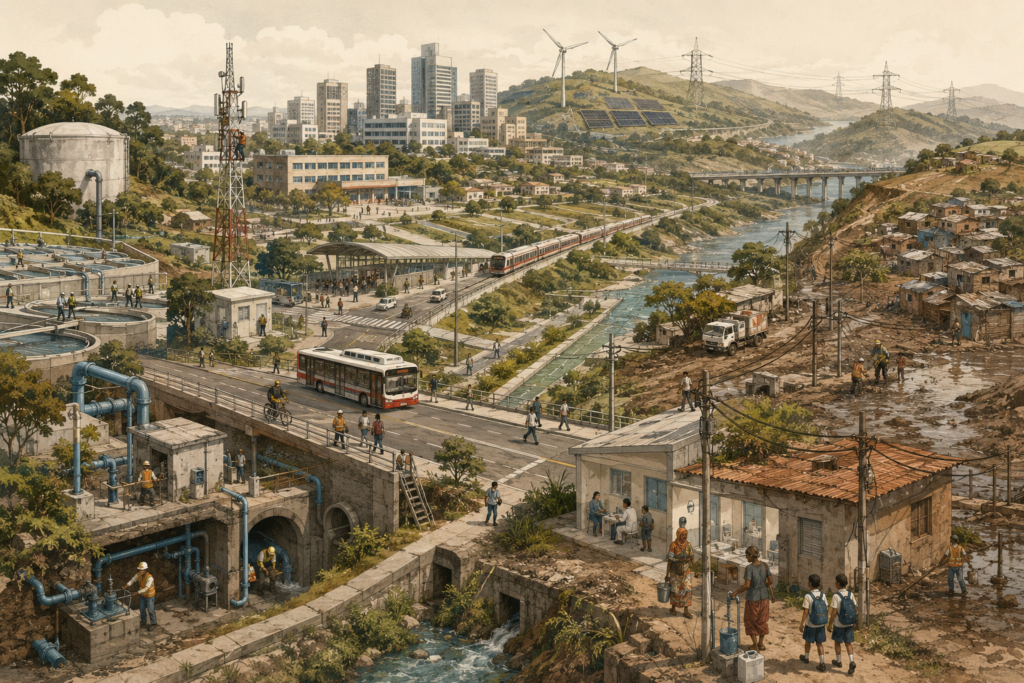
Editorial sustainability illustration showing interconnected infrastructure systems including water, transport, electricity, digital connectivity, public services, and uneven territorial access across urban and peripheral communities.

Infrastructure as the Material Basis of Development

Infrastructure as the Material Basis of Development examines why development depends not only on policy ambition or economic growth, but on whether societies possess the material systems that make collective life workable at scale. The article argues that infrastructure is not a backdrop to development. Water, sanitation, electricity, transport, digital networks, logistics, drainage, and public-service systems are part of the physical basis through which access, capability, institutional reach, and territorial integration become real. It explores the shift from viewing infrastructure as isolated assets to understanding it as interdependent material systems, the role of maintenance and resilience, the territorial unevenness of access, the climate vulnerabilities embedded in infrastructure decisions, and the long-term risks of infrastructural lock-in. The core claim is that sustainable development requires infrastructure systems that are not only extensive, but equitable, reliable, resilient, and ecologically viable.

Editorial sustainability illustration showing interconnected water, energy, agriculture, housing, transport, health, ecosystems, industry, and governance systems linked by feedback loops and policy coordination pathways

Policy Coordination Across Complex Systems

Policy Coordination Across Complex Systems examines why sustainable development depends not only on good policy within individual sectors, but on whether institutions can govern the interactions among sectors, scales, and time horizons. The article argues that development problems emerge through interdependence: water, housing, energy, transport, social protection, infrastructure, climate risk, and public finance continuously reshape one another through spillovers, feedback loops, delays, and competing incentives. It explores the limits of siloed governance, the importance of policy coherence, the role of trade-offs and unintended consequences, the challenges of multilevel coordination, and the political realities that make coordination more than a technical exercise. The core claim is that sustainable development requires institutions capable of governing interaction, managing systemic risk, and aligning policy across complex systems rather than merely administering isolated parts.

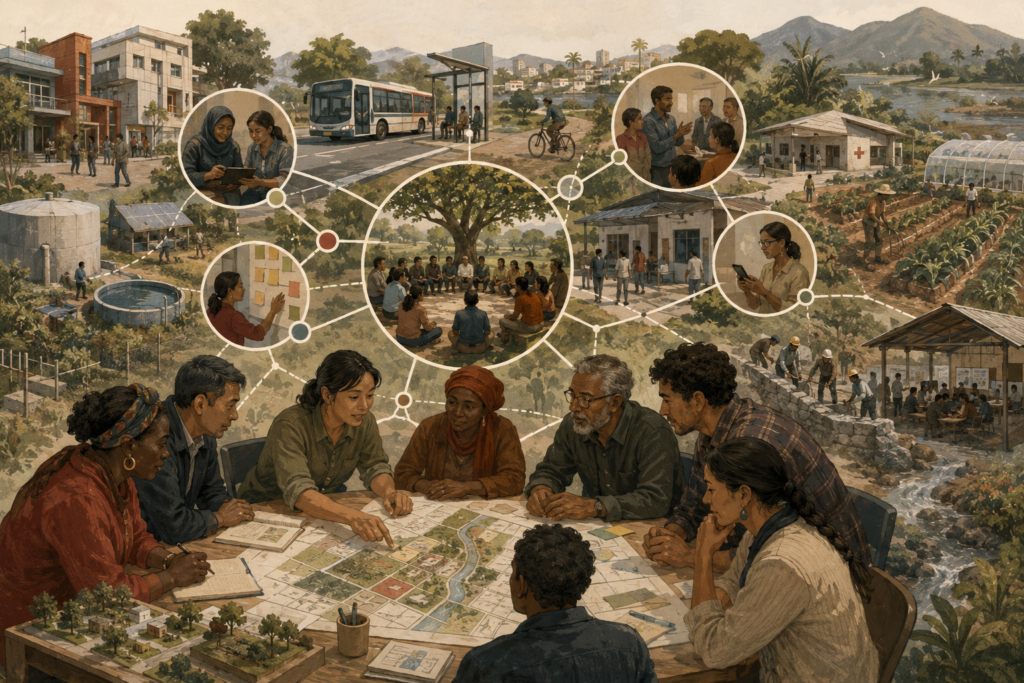
Editorial sustainability illustration showing diverse community members planning local development around a shared map, with connected scenes of public services, infrastructure, agriculture, transit, health, and civic participation.

Participation, Voice, and Community-Led Development

Participation, Voice, and Community-Led Development examines why sustainable development becomes more legitimate, informed, and durable when people can shape the priorities, decisions, and institutions that affect their lives. The article argues that communities should not be treated merely as beneficiaries of policy, but as agents of development whose knowledge, oversight, and participation can improve relevance, ownership, accountability, and long-run trust. It explores the shift from beneficiary models to community agency, the role of local knowledge in improving development intelligence, the importance of voice for legitimacy and institutional trust, the risks of tokenism and elite capture, and the need to link participation to real decision space and local governance capacity. The core claim is that sustainable development is strongest when it is built with communities rather than simply delivered to them.

Abstract sustainability illustration of corruption, accountability, and institutional trust, showing public integrity, procurement transparency, service delivery, hidden corruption systems, state capture, inequality, accountability, and sustainable development governance.

Corruption, Accountability, and Institutional Trust

Corruption, Accountability, and Institutional Trust examines why sustainable development depends not only on resources, plans, and formal rules, but on whether institutions remain honest, answerable, and credible enough to govern in the public interest. The article argues that corruption is not merely a matter of stolen funds or individual misconduct. It is a structural force that distorts public priorities, weakens service delivery, redistributes harm, and erodes the trust on which long-horizon development depends. It explores the shift from viewing corruption as simple leakage to understanding it as institutional distortion, the role of accountability and integrity systems, the effects of corruption on public goods and everyday governance, the unequal burdens corruption imposes on less powerful groups, and the deeper threat posed by state capture. The core claim is that sustainable development requires institutions that are not only formally capable, but genuinely trustworthy, reviewable, and publicly oriented.

Abstract sustainability illustration of law, rights, and sustainable development, showing rule of law, access to justice, legal remedy, environmental rights, accountability, participation, non-discrimination, public power, and human dignity.

Law, Rights, and Sustainable Development

Law, Rights, and Sustainable Development examines why development becomes durable not through aspiration alone, but through legal frameworks that structure public power, protect human dignity, and make public obligations reviewable across time. The article argues that law is not merely the background framework of development. It is one of the main ways development becomes institutionally binding, politically contestable, and normatively defensible. It explores the shift from policy aspiration to legal obligation, the role of rights in redefining the meaning of development beyond aggregate growth, the importance of rule of law and access to justice, the growing significance of environmental rights, and the risks of legal exclusion, underenforcement, and inherited legal structures that lock in unequal outcomes. The core claim is that sustainable development requires legal orders capable of protecting people, disciplining power, and preserving the possibility of justice across time.

Abstract sustainability illustration of international organizations and global development governance, showing multilateral cooperation, development finance, standards, knowledge systems, sovereignty, interdependence, legitimacy, inequality, resilience, and sustainable development.

International Organizations and Global Development Governance

International Organizations and Global Development Governance examines why sustainable development depends not only on domestic institutions, but also on multilateral bodies capable of coordinating action across borders in a world of structured interdependence. The article argues that international organizations are not peripheral to development. They help organize finance, standards, knowledge, implementation support, and long-horizon cooperation around problems no single state can govern alone, including debt distress, climate change, pandemics, and cross-border ecological risk. It explores the role of international organizations in collective action, development finance, standard setting, resilience, and epistemic power, while also addressing the limits imposed by unequal influence, fragmentation, legitimacy tensions, and institutional lock-in.

Abstract sustainability illustration of local governance, cities, and territorial development, showing urban systems, spatial justice, housing, basic services, infrastructure, mobility, climate resilience, local delivery, multilevel governance, and sustainable development.

Local Governance, Cities, and Territorial Development

Local Governance, Cities, and Territorial Development examines why sustainable development is always place-based before it is abstract, taking shape through the territorial institutions that govern land, infrastructure, mobility, housing, risk, and everyday access to opportunity. The article argues that local governance is not a subordinate administrative layer beneath “real” development, but one of the principal arenas in which development becomes materially visible, politically contested, and socially experienced. It explores cities as tightly coupled development systems, the importance of territorial coordination, the relationship between land, housing, and services, the role of local governance in resilience and climate adaptation, and the ways spatial inequality and multilevel incoherence can undermine otherwise ambitious development agendas. The core claim is that sustainable development depends on local institutions capable of governing territory in ways that keep places livable, inclusive, resilient, and coherent across time.

Abstract sustainability illustration of state capacity, public administration, and delivery systems, showing implementation, local service delivery, public trust, accountability, coordination, administrative justice, equal access, resilience, and sustainable development.

State Capacity, Public Administration, and Delivery Systems

State Capacity, Public Administration, and Delivery Systems examines why sustainable development depends not only on ambitious goals or policy vision, but on whether public institutions can actually implement priorities, coordinate action, deliver services, and sustain legitimacy over time. The article argues that development is experienced through the everyday state: clinics that function, benefits that arrive, permits that are processed fairly, infrastructure that is maintained, and public systems that remain reachable and credible under pressure. It explores implementation capacity, coordination, trust, accountability, institutional learning, delivery reliability, and administrative justice, while also emphasizing the risks posed by fragmentation, capture, and weak state coherence. The core claim is that sustainable development succeeds or fails in large part through the strength, legitimacy, and practical reach of state capacity and delivery systems.

Abstract sustainability illustration of institutions and sustainable development, showing governance, coordination, accountability, public trust, justice, implementation capacity, resilience, policy coherence, and long-horizon development.

Why Institutions Matter for Sustainable Development

Why Institutions Matter for Sustainable Development examines why development depends not only on goals, technologies, or resources, but on the institutional architecture that makes collective action durable across time. The article argues that sustainable development succeeds or fails through the quality of rules, organizations, administrative systems, and public norms that allow societies to coordinate action, implement policy, manage trade-offs, protect rights, and sustain legitimacy under pressure. It explores implementation capacity, collective-action problems, policy coherence, accountability, trust, resilience, inclusion, state learning, and institutional lock-in, showing that institutions are not background machinery but part of development’s core conditions of possibility. The central claim is that sustainable development becomes durable only when institutions are capable, adaptive, and publicly legitimate enough to carry collective purpose across political cycles and generations.

Scroll to Top