
Last Updated May 7, 2026
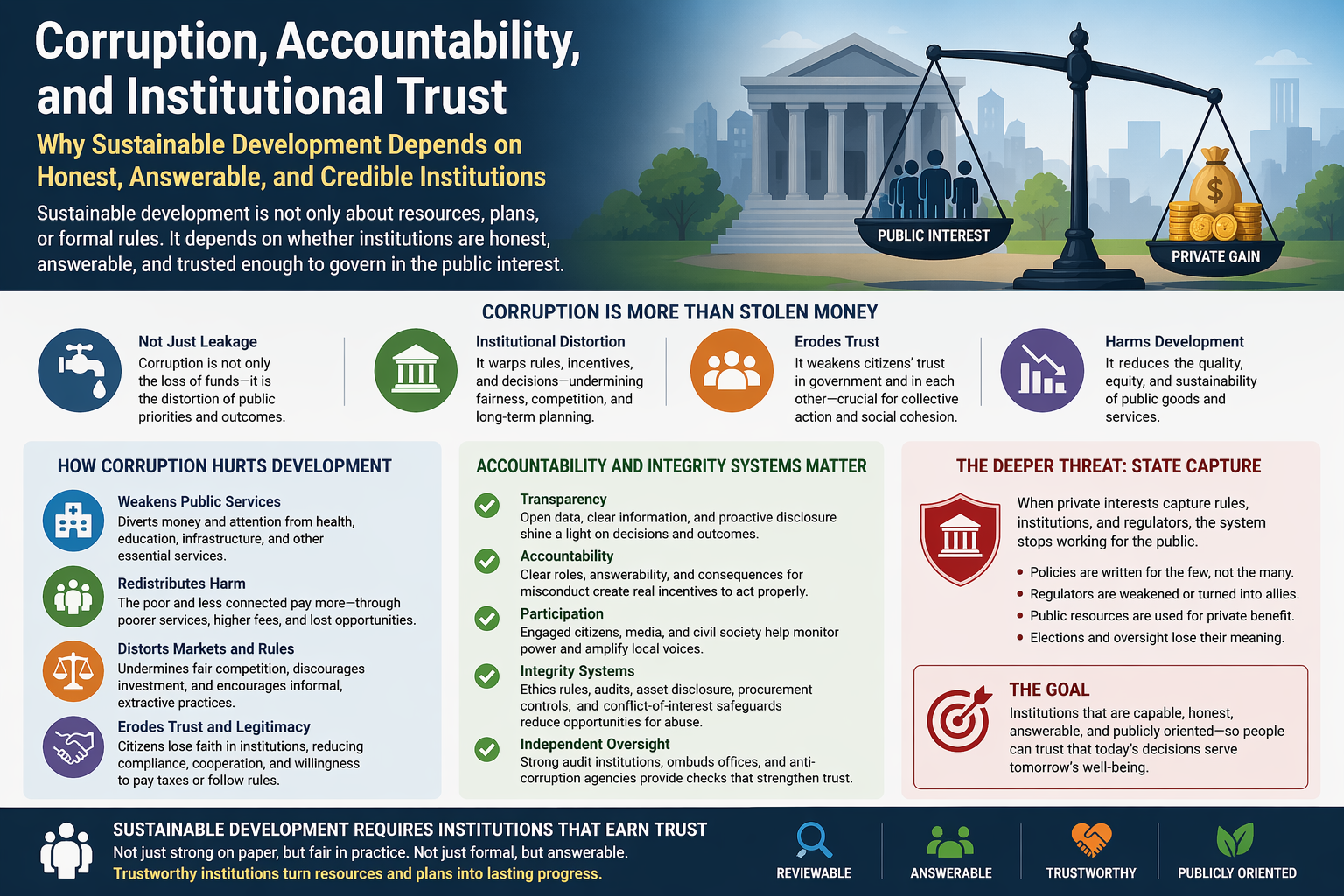
Corruption matters for sustainable development because it does more than divert money or violate rules. It distorts public priorities, weakens service delivery, undermines fairness, and erodes the institutional trust on which long-horizon development depends. When corruption becomes embedded in procurement, licensing, budgeting, enforcement, hiring, regulation, or political influence, it changes how public systems actually function.
Resources meant for health, education, infrastructure, environmental protection, climate resilience, social protection, and public administration are not only lost; they are redirected into patterns of private gain that weaken public purpose. Sustainable development is therefore not only threatened by lack of resources. It is threatened by the corruption of the institutions meant to govern those resources.
Main Library
Publications
Article Map
Sustainable Development
Related Topic
Institutions & Governance

The 2030 Agenda makes this connection explicit through Goal 16, which links sustainable development to peace, justice, strong institutions, and the reduction of corruption and bribery. That framing matters because corruption is not treated as a narrow ethics issue or an isolated governance defect. It is treated as a structural obstacle to development itself. Anti-corruption is developmentally central because corruption weakens the capacity of institutions to act fairly, effectively, and credibly across time.
The deeper reason corruption matters is that sustainable development depends on institutional trust as much as on formal policy. Societies must believe that public rules are applied with some degree of fairness, that public funds are used for public purposes, and that sacrifice today will not simply be converted into private advantage for the powerful. Integrity supports trust, engagement, and the effective functioning of government. Corruption corrodes that foundation by making institutions appear partial, extractive, or performative rather than publicly oriented.
This article argues that corruption, accountability, and institutional trust should be understood together because corruption is not only misconduct within institutions; it is a force that degrades the credibility, capacity, and legitimacy of development governance. It examines how corruption distorts public systems, why accountability matters for sustainable development, how trust is built or broken institutionally, and why anti-corruption must be understood as part of the enabling architecture of long-run development.
What Corruption Means in Development
Corruption in development terms is broader than bribery in the narrow sense. It includes the abuse of entrusted power for private gain, but it also includes the wider institutional patterns through which public authority is bent away from public purpose. This can involve procurement fraud, patronage, kickbacks, regulatory capture, embezzlement, conflicts of interest, illicit financial flows, favoritism, opaque ownership structures, political clientelism, and the informal sale of access, influence, or administrative discretion.
This matters because corruption is not only an episodic violation of rules. It can become a governing logic. When institutions routinely operate through informal payments, political patronage, opaque contracting, selective enforcement, or hidden influence, corruption stops being a deviation from the system and becomes part of how the system works. Under those conditions, development is not simply slowed. It is reorganized around distorted incentives.
Corruption also differs by level and form. Petty bribery may shape access to routine services. Procurement corruption may affect the cost and quality of infrastructure. Regulatory capture may weaken environmental, labor, financial, or safety standards. Political corruption may redirect budgets and administrative appointments toward patronage. State capture may shape the rules themselves so that private advantage is protected through formally legal institutions.
To understand corruption seriously in sustainable development terms is therefore to see it not only as personal misconduct, but as institutional deformation. It alters who gets access, which projects are prioritized, what risks are ignored, whether laws are enforced, and whether the public sphere remains meaningfully public. Corruption is not merely something that happens inside development systems. It can become a force that redirects those systems away from public purpose.
Development analysis must therefore ask not only whether corruption exists, but where it is embedded: in procurement, licensing, inspection, budgeting, service delivery, land governance, political financing, regulation, public employment, or enforcement. Each location produces different development harms and requires different accountability responses.
Why Corruption Matters for Sustainable Development
Corruption matters because sustainable development depends on institutions that can allocate resources, provide services, enforce standards, protect rights, regulate markets, and maintain legitimacy over time. Where corruption is pervasive, each of these functions becomes weaker. Public money is diverted, projects become more expensive or lower quality, enforcement becomes selective, and political trust erodes.
This is why anti-corruption is not an optional governance add-on. Corruption impedes progress across the sustainable development agenda, not only because it wastes resources, but because it makes institutions less capable of carrying development commitments into practice. A society may adopt ambitious goals for health, education, climate adaptation, clean water, biodiversity, energy transition, and public infrastructure, yet see those goals weakened if procurement, enforcement, staffing, or budgeting are distorted by private gain.
Corruption also changes incentives. It can make maintenance less attractive than new construction because new projects create larger opportunities for rents. It can make complex procedures politically useful because opacity creates opportunities for discretionary payments. It can weaken inspection because enforcement threatens corrupt networks. It can redirect investment toward visible prestige projects rather than less glamorous but essential public goods.
The development harm is therefore not only that corruption steals. It also misgoverns. It changes what institutions see, what they reward, whom they serve, and what they ignore. Under corrupt conditions, the formal language of development may remain in place while the operational logic of institutions shifts toward extraction, patronage, and insider advantage.
Sustainable development therefore depends not only on having more plans, more targets, or even more finance. It depends on whether institutions are honest and accountable enough for those resources and commitments to remain publicly oriented. Without integrity, additional resources can become additional opportunities for capture.
From Resource Leakage to Institutional Distortion
A common way to describe corruption is as leakage: funds are stolen, contracts are inflated, services are underdelivered. That description is true but incomplete. Corruption also distorts institutional priorities long before money visibly disappears. Projects may be selected because they create opportunities for rent extraction rather than because they serve public need. Oversight may be weakened because scrutiny threatens political networks. Administrative complexity may be preserved because opacity creates opportunity for discretionary payments.
This matters because corruption changes the internal logic of governance. A development system affected by corruption does not simply deliver less of the same output. It often delivers different outputs entirely: more prestige projects, fewer maintenance commitments, weaker frontline services, greater tolerance for exclusion, and more permissive treatment of politically connected actors. Corruption can therefore redirect development away from the places, people, and systems that most need public investment.
Institutional distortion is especially visible in procurement. Public procurement is where development plans become contracts, materials, infrastructure, medicines, school supplies, energy systems, road networks, digital platforms, and service arrangements. If procurement is corrupt, the consequences are not limited to financial waste. Poor-quality roads fail sooner, hospitals lack equipment, schools receive inferior materials, environmental safeguards are bypassed, and maintenance costs rise over time.
Corruption also distorts enforcement. A standard that can be avoided through payment is no longer a true public standard. A permit issued because of influence rather than evidence weakens the credibility of regulation. A polluter protected by political connections shifts environmental burdens onto communities. A workplace inspector who looks away converts legal protection into empty language. In each case, corruption turns rule-based governance into selective governance.
Corruption is therefore better understood not only as loss, but as institutional redirection. It changes the development pathway itself by altering priorities, weakening public goods, increasing hidden costs, and normalizing unequal access to public power.
Accountability as a Development Condition
Accountability matters because anti-corruption cannot depend on moral exhortation alone. Institutions require mechanisms through which decisions, expenditures, contracts, appointments, enforcement choices, and outcomes can be reviewed, challenged, and corrected. This includes oversight bodies, audit systems, procurement transparency, judicial review, beneficial ownership disclosure, sanctions, civic scrutiny, legislative oversight, independent media, whistleblower protections, open data, and accessible complaint mechanisms.
This matters because sustainable development is inherently a long-horizon project. It requires people to trust that public commitments will not be quietly hollowed out by private capture. Accountability systems provide part of that assurance. They reduce the space within which corruption can become normalized and create feedback structures through which institutional failure can be exposed.
Accountability is therefore not peripheral to development. It is one of the conditions under which development remains publicly answerable rather than politically extractive. When public budgets, contracts, environmental approvals, social-protection systems, and infrastructure decisions are visible and reviewable, it becomes harder for private interests to hide inside the machinery of public purpose.
Accountability must also operate at multiple points in the development cycle. It should shape project selection before contracts are awarded, procurement while funds are allocated, implementation while services are delivered, monitoring while outcomes are assessed, and remedy when harm occurs. Accountability after scandal matters, but accountability before and during implementation is often more developmentally valuable because it prevents distortion before damage becomes entrenched.
Strong accountability also requires institutional independence. Audit bodies, courts, anti-corruption agencies, inspectors, media, and civil society cannot function well if they are politically intimidated, underfunded, captured, or denied information. Sustainable development depends on accountability systems that are not merely present on paper, but capable of acting against powerful interests when public purpose is at stake.
Corruption and the Erosion of Institutional Trust
Institutional trust matters because sustainable development depends on compliance, cooperation, and public belief in the legitimacy of collective decisions. Trust in public institutions is tied to responsiveness, integrity, fairness, and the way people experience state action. Where corruption is visible or widely assumed, trust weakens because people come to believe that rules are applied selectively and that public systems serve insiders first.
This matters because low trust raises the costs of governance. Citizens may become less willing to comply with taxation, regulation, conservation rules, public-health guidance, or long-term reforms. Public employees may become more cynical. Political contestation may harden into generalized suspicion. Even well-designed policies may face resistance if people assume that implementation will be corrupt, unequal, or performative.
Corruption therefore harms development not only through money lost, but through legitimacy lost. A public system that repeatedly appears captured may still possess formal authority, but it loses the moral and practical credibility needed for durable collective action. People may comply only when coerced, seek private alternatives when possible, or assume that public decisions are merely covers for private deals.
Trust is also difficult to rebuild once broken. A single corruption scandal may confirm a wider public belief that institutions are untrustworthy. Repeated everyday corruption in services can produce a slow erosion of civic confidence. When people believe corruption is normal, they may stop expecting public institutions to act in the public interest. This can become self-reinforcing: low trust reduces cooperation, reduced cooperation weakens public systems, weaker public systems create more space for informal workarounds, and informal workarounds normalize corruption further.
Sustainable development requires trust because many of its most important policies involve delayed benefits, shared sacrifice, and long-term coordination. Climate adaptation, tax compliance, public-health cooperation, infrastructure maintenance, and institutional reform all depend on a belief that public commitments are not simply channels for private gain. Integrity is therefore not only a moral value. It is development infrastructure.
Public Goods, Service Delivery, and Everyday Governance
Corruption matters most concretely where people encounter the state: in clinics, schools, licensing offices, police interactions, infrastructure projects, courts, land registries, inspection systems, social protection offices, and local government services. These are everyday development domains, not exceptional ones. The quality of public institutions is experienced through whether services are accessible, fair, and reliable rather than contingent on informal payments, personal connections, political loyalty, or administrative discretion.
This matters because the damage of corruption is often cumulative rather than spectacular. A bribe demanded for service, a school built poorly because of procurement fraud, a medicine contract manipulated, a permit delayed to solicit payment, a road built with inferior materials, or a complaint ignored because of patronage all communicate that public goods are conditional on informal access. Development then becomes less universal and more transactional.
Everyday corruption also creates hidden burdens. Households may pay unofficial fees for services already publicly funded. Workers may lose time navigating corrupt offices. Small firms may face arbitrary demands that larger or connected firms can avoid. Communities may receive lower-quality infrastructure because funds were diverted. Citizens may stop reporting problems because they assume nothing will happen without payment or political access.
Service corruption is especially damaging because it changes the meaning of citizenship. People who must pay informally for routine rights and services are taught that public institutions do not fully recognize them. They are required to purchase access to what should be public. The result is not only inefficiency, but humiliation, exclusion, and weakened civic belonging.
Corruption thus weakens sustainable development at the level of lived experience. The school, clinic, road, registry, water system, permit desk, and grievance office are not small administrative details. They are where institutional trust is either built or broken.
Corruption, Inequality, and Uneven Burdens
Corruption is never socially neutral. Those with fewer resources are less able to bypass corrupt systems, less able to absorb added costs, and less able to secure remedy when harmed. The burden of corruption is therefore distributed unequally across social groups, territories, and administrative settings. Poorer households, informal workers, migrants, rural communities, marginalized neighborhoods, and politically weaker groups often face the sharpest consequences.
This matters because corruption compounds existing inequality. Wealthier actors may treat corrupt access as a cost of doing business; poorer households may experience it as exclusion from basic rights, services, or protection. Corruption therefore turns unequal social position into unequal administrative vulnerability. It can also deepen territorial and sectoral inequality by redirecting public investment away from less powerful communities.
Corruption also affects who is exposed to harm. If environmental inspections can be avoided, lower-income communities may carry heavier pollution burdens. If housing permits or land protections are manipulated, residents may face displacement or unsafe conditions. If public contracts are steered toward connected firms, local needs may be ignored. If social benefits are distributed through patronage, people outside political networks may be excluded.
Gender, disability, age, migration status, documentation status, and geography can also shape corruption burdens. A person dependent on a frontline official for benefits, health care, legal recognition, or safe passage may have less ability to refuse corrupt demands. Where corruption interacts with vulnerability, it can become a form of coercive extraction from those least able to resist.
To take corruption seriously in sustainable development is therefore to see it as a distributive problem as well as a governance problem. It does not merely reduce efficiency; it redistributes harm downward. This section also complements Inequality and Inclusive Development.
Measurement, Visibility, and the Problem of Hidden Systems
One reason corruption is difficult to govern is that much of it is hidden, normalized, or difficult to measure directly. This difficulty is not incidental. It is part of the problem. Corruption often survives through opacity, blurred accountability, weak traceability, informal patronage, shell companies, selective enforcement, underreported bribery, and blurred lines between legal discretion and illicit influence.
This matters because what cannot be seen clearly is harder to govern. Corruption may be embedded in hidden beneficial ownership structures, opaque contracting, informal political networks, underreported service payments, or administrative practices that are technically legal but substantively captured. Weak visibility allows corruption to be dismissed as anecdotal even when it is systemic.
Measurement is also difficult because corruption has incentives to conceal itself. Official records may not show informal payments. Procurement data may not reveal collusion. Asset declarations may miss hidden ownership. Citizens may avoid reporting corruption because they fear retaliation, believe nothing will change, or rely on informal payments to access urgent services. The absence of reported corruption is therefore not necessarily evidence of integrity. It may indicate fear, normalization, or weak complaint systems.
Sustainable development therefore requires not only anti-corruption norms, but better institutional visibility. Procurement data, beneficial ownership registers, audit trails, budget transparency, open contracting, asset declarations, service-delivery surveys, complaint mechanisms, whistleblower protections, and independent oversight all help make hidden systems more governable. Visibility does not solve corruption by itself, but invisibility almost always protects it.
Measurement must also be used carefully. Corruption indicators can help identify risk, but they can also oversimplify, stigmatize, or hide variation across sectors and communities. The goal should not be to reduce corruption to one score, but to make institutional vulnerabilities visible enough to guide reform, accountability, and public learning.
Integrity Systems, Prevention, and Institutional Design
Anti-corruption is strongest when treated as an institutional design problem rather than only a punishment problem. Integrity systems include internal control, risk management, public procurement safeguards, disclosure requirements, audit trails, conflict-of-interest standards, simpler procedures, professional civil-service norms, independent oversight, whistleblower protection, transparent appointments, asset declarations, beneficial ownership visibility, and accessible complaint mechanisms. These measures do more than respond to scandal. They alter the structure of opportunity through which corruption spreads.
This matters because institutions can be designed either to reduce corruption opportunities or to reproduce them. Systems that rely heavily on discretion without transparency, complicated procedures without explanation, concentrated authority without review, or opaque contracting without public oversight are more vulnerable to corrupt capture. Preventive integrity systems help make corruption harder to normalize.
Integrity is therefore not just the absence of corruption. It is a positive institutional quality that supports trust, fairness, and the reliable pursuit of public purpose. An institution with integrity can explain decisions, trace funds, disclose interests, review conflicts, sanction misconduct, protect complainants, and correct failures. Integrity is built through design, culture, professional norms, political commitment, and public scrutiny working together.
Prevention is especially important because corruption often becomes more difficult to address after networks are entrenched. Once corrupt actors control contracts, appointments, enforcement, or political finance, reform becomes more costly and contested. Preventive design reduces the opportunity for capture before it reorganizes the institution around itself.
Integrity systems must also be proportionate and usable. Overly complex anti-corruption procedures can create new bottlenecks and discretionary power. The goal is not bureaucracy for its own sake, but transparent, predictable, reviewable, and accessible systems that reduce corruption opportunities while still allowing institutions to deliver effectively.
Corruption, State Capture, and Developmental Redirection
Corruption becomes especially damaging when it reaches the level of state capture. At that point, the issue is no longer simply illicit payment within existing rules, but the shaping of rules themselves to serve narrow interests. Laws, regulatory frameworks, procurement systems, tax concessions, licensing procedures, enforcement practices, budget priorities, and public appointments can all be bent toward private advantage while retaining the formal appearance of legality.
This matters because sustainable development depends on public institutions being capable of defining and pursuing public purpose. When capture is extensive, development is redirected structurally. The problem is no longer only that resources leak out; it is that the state’s developmental orientation is reorganized toward selective benefit, weaker oversight, and a narrowing of the public interest itself.
State capture is especially dangerous because it can make corruption appear lawful. A contract may be legally awarded under rules that were designed to favor insiders. A tax benefit may be formally approved while serving narrow interests. A regulatory exemption may be lawful while undermining environmental protection. A public appointment may follow procedure while embedding loyalty over competence. In such cases, legality and public purpose diverge.
Capture also weakens reform because captured systems protect themselves. Oversight bodies may be underfunded, watchdogs discredited, prosecutors politicized, regulators intimidated, procurement rules rewritten, media pressured, and civil society constrained. The more corruption shapes the rules of the system, the harder it becomes to correct corruption through ordinary institutional channels.
State capture therefore marks a deeper threshold of corruption: the point at which corruption ceases to be only misconduct inside the system and becomes part of the architecture of the system itself. Sustainable development cannot be credible where public institutions are formally active but substantively redirected toward private or factional advantage.
Anti-Corruption, Service Delivery, and Public Trust
Anti-corruption is strongest when it improves the everyday experience of governance. People are less likely to trust institutions because an anti-corruption strategy exists on paper. They are more likely to trust institutions when services become fairer, permits become clearer, procurement becomes more transparent, complaints receive responses, public officials are disciplined consistently, and public resources visibly produce public goods.
This matters because trust is built through repeated experience. A household that no longer has to pay informally for a basic service learns that rules can work. A contractor that loses a bid fairly learns that procurement can be credible. A community that sees environmental rules enforced learns that public standards are not only symbolic. A civil servant protected from political pressure learns that professional integrity is possible.
Anti-corruption therefore has to connect enforcement with institutional repair. Punishing misconduct matters, but punishment alone may not change the everyday systems that made misconduct possible. Procurement processes may still be opaque. Service procedures may still be complicated. Complaint systems may still be inaccessible. Political appointments may still undermine professional norms. Anti-corruption becomes developmentally meaningful when it changes these operating conditions.
Service delivery is a crucial testing ground. If anti-corruption efforts do not make schools, clinics, infrastructure, permits, inspections, benefits, courts, and local services more reliable and fair, public trust may remain weak. People judge integrity through lived contact with institutions, not only through official announcements.
The strongest anti-corruption agenda is therefore not only punitive, but developmental. It asks how public systems can be redesigned so that funds reach services, rules apply fairly, information is visible, complaints matter, and people can see public institutions acting in the public interest.
Why Anti-Corruption Is Not Enough by Itself
It is not enough simply to denounce corruption or multiply anti-corruption campaigns. Anti-corruption can become symbolic if underlying administrative weakness, political patronage, weak service delivery, exclusionary institutions, low public trust, and concentrated power remain unchanged. Corruption must be addressed within the wider context of governance, institutions, rule of law, public administration, accountability, and delivery systems.
This matters because corruption is often embedded in broader systems of power. Where accountability institutions are weak, incentives distorted, and trust already low, anti-corruption rhetoric can become another political instrument rather than a route to institutional repair. Selective anti-corruption campaigns can be used to punish opponents while protecting allies. Public scandals can generate temporary outrage without changing procurement, oversight, or service systems. New agencies can be created without independence or resources.
Anti-corruption is also insufficient if it ignores inclusion. A system may reduce certain forms of bribery while remaining inaccessible to marginalized groups. It may improve audit compliance while leaving public services underfunded. It may increase formal reporting while citizens still fear retaliation. Sustainable development therefore requires anti-corruption to be integrated with transparency, accountability, participation, public-service quality, legal remedy, and institutional reform.
The deeper goal is not only cleaner institutions in the narrow sense. It is more credible institutions: institutions capable of using power for public purposes in ways that people can see, contest, and trust. That requires integrity, but it also requires capacity, fairness, responsiveness, and public legitimacy.
The proper conclusion is not that anti-corruption is secondary. It is that anti-corruption must be developmentally embedded. It must repair the institutional conditions that allow corruption to distort public purpose in the first place.
Why This Matters for Sustainable Development
Corruption, accountability, and institutional trust belong together because corruption does more than steal resources. It distorts institutions, degrades public goods, redistributes harm, and erodes the trust on which sustainable development depends. A serious development framework must therefore ask not only how much money is invested or what goals are declared, but whether institutions are honest, answerable, and credible enough to carry those goals into practice.
This is why corruption matters so much for sustainable development. It reveals a central truth that narrow efficiency-based thinking can miss: development can become self-undermining when institutions meant to serve public purpose are bent toward private gain. Accountability systems and integrity institutions matter because they help keep development publicly oriented, reviewable, and fair.
The issue is also one of justice. Corruption burdens are not evenly distributed. Those with fewer resources, weaker legal protection, less political access, or greater dependence on frontline services often carry the heaviest costs. Corruption can turn rights into transactions, services into favors, public goods into patronage, and development into extraction. Sustainable development cannot be credible if public institutions improve aggregate indicators while leaving marginalized communities exposed to corrupt systems.
To take corruption seriously is therefore to take sustainable development seriously. It is to recognize that long-run human progress depends not only on resources and plans, but on whether institutions remain trustworthy enough to govern in the public interest. Integrity is not an ethical decoration around development. It is part of the architecture that allows development to endure.
Development becomes credible when public resources serve public purposes, accountability is strong enough to expose distortion, and institutions are trustworthy enough that people can believe collective sacrifice will not be converted into private advantage.
Mathematical Lens
Institutional integrity can be clarified by thinking in terms of corruption risk, accountability strength, and trust support rather than scandal counts alone. Let \(I_c\) represent developmentally usable institutional integrity, \(A\) accountability strength, \(T\) trust support, and \(C\) corruption risk:
I_c = \alpha A + \beta T – \gamma C
\]
Interpretation: Institutional integrity rises when accountability and trust support public-purpose governance, and falls when corruption risk increases.
This captures a central point in the article: sustainable development depends not only on punishing corruption, but on building systems where accountability and trust support public-purpose governance.
We can also express corruption distortion as a weighted function of procurement opacity, discretionary power, and capture risk:
D_c = w_1 P + w_2 S + w_3 K
\]
Interpretation: Corruption distortion rises when procurement opacity, unchecked discretion, and capture risk reinforce one another.
Here, \(P\) is procurement opacity, \(S\) is selective enforcement or unchecked discretion, and \(K\) is capture risk. Higher \(D_c\) means institutions are more likely to redirect public systems away from public need.
Finally, trust erosion can be represented as a function of perceived unfairness, weak accountability, and poor service integrity:
E_t = \lambda F + \mu (1 – A) + \nu (1 – Q)
\]
Interpretation: Trust erosion rises when perceived unfairness increases, accountability weakens, and service integrity declines.
Here, \(F\) is perceived unfairness, \(A\) is accountability, and \(Q\) is service quality or integrity. This helps show why corruption degrades development not only by wasting resources, but by weakening cooperation and legitimacy.
| Term | Meaning | Interpretive role |
|---|---|---|
| \(I_c\) | Institutional integrity capacity | Represents developmentally usable integrity created by accountability, trust, and reduced corruption risk. |
| \(A\) | Accountability strength | Represents oversight, audit capacity, transparency, complaint access, sanctions, and review mechanisms. |
| \(T\) | Trust support | Represents public confidence that institutions serve public purpose and apply rules with fairness. |
| \(C\) | Corruption risk | Represents exposure to bribery, capture, opaque contracting, selective enforcement, or diversion of public resources. |
| \(D_c\) | Corruption distortion | Represents the degree to which corruption redirects institutions away from public need. |
| \(E_t\) | Trust erosion | Represents legitimacy loss caused by unfairness, weak accountability, and poor service integrity. |
| \(Q\) | Service quality or integrity | Represents whether public services are delivered reliably, fairly, and without informal extraction. |
The equations are conceptual rather than predictive. Their value is to make visible the structure of the problem: corruption risk, accountability, trust, procurement integrity, enforcement, service quality, and capture risk interact to determine whether institutions remain developmentally credible.
Advanced Python Workflow: Corruption Risk and Institutional Integrity Scoring
This Python workflow translates the article’s core argument into a structured institutional-integrity model. Rather than treating corruption as isolated scandal, it scores countries, regions, or sectors across procurement integrity, accountability strength, service integrity, beneficial ownership visibility, audit capacity, complaint access, trust support, capture risk, selective enforcement risk, corruption visibility gaps, whistleblower protection, and sanction credibility. That makes it possible to compare not only where corruption risk is high, but where integrity systems appear stronger or weaker in developmental terms.
from __future__ import annotations

import pandas as pd
import numpy as np

INPUT_FILE = "corruption_integrity_panel.csv"
OUTPUT_FILE = "corruption_risk_and_integrity_scores.csv"


def load_data(path: str) -> pd.DataFrame:
    """
    Load a country, region, or institutional-domain corruption-risk dataset.

    All *_index columns should be normalized to [0, 1].
    Higher values should mean more of the named property.

    Examples:
      - procurement_integrity_index: higher = stronger procurement integrity
      - accountability_strength_index: higher = stronger accountability
      - capture_risk_index: higher = greater capture risk
      - corruption_visibility_gap_index: higher = greater hidden-corruption risk
    """
    df = pd.read_csv(path)

    required_columns = [
        "country_or_region",
        "region",
        "institutional_domain",
        "procurement_integrity_index",
        "accountability_strength_index",
        "service_integrity_index",
        "beneficial_ownership_visibility_index",
        "audit_capacity_index",
        "complaint_access_index",
        "trust_support_index",
        "capture_risk_index",
        "selective_enforcement_risk_index",
        "corruption_visibility_gap_index",
        "whistleblower_protection_index",
        "sanction_credibility_index",
    ]

    missing = [col for col in required_columns if col not in df.columns]

    if missing:
        raise ValueError(f"Missing required columns: {missing}")

    return df


def validate_indices(df: pd.DataFrame) -> pd.DataFrame:
    """Validate that all *_index fields are complete and normalized to [0, 1]."""
    index_columns = [col for col in df.columns if col.endswith("_index")]

    for col in index_columns:
        if df[col].isna().any():
            raise ValueError(f"Column '{col}' contains missing values.")

        if ((df[col] < 0) | (df[col] > 1)).any():
            raise ValueError(f"Column '{col}' contains values outside [0, 1].")

    return df


def compute_scores(df: pd.DataFrame) -> pd.DataFrame:
    """
    Compute integrity systems, institutional distortion risk,
    trust resilience, visibility readiness, and constrained integrity.

    Integrity systems rise with procurement integrity, accountability,
    service integrity, beneficial ownership visibility, audit capacity,
    complaint access, whistleblower protection, and credible sanctions.

    Institutional distortion risk rises with capture, selective enforcement,
    weak procurement integrity, weak service integrity, weak sanctions,
    and hidden visibility gaps.
    """
    df = df.copy()

    df["integrity_system_score"] = (
        0.17 * df["procurement_integrity_index"] +
        0.16 * df["accountability_strength_index"] +
        0.13 * df["service_integrity_index"] +
        0.12 * df["beneficial_ownership_visibility_index"] +
        0.12 * df["audit_capacity_index"] +
        0.10 * df["complaint_access_index"] +
        0.10 * df["whistleblower_protection_index"] +
        0.10 * df["sanction_credibility_index"]
    ).clip(lower=0, upper=1)

    df["institutional_distortion_risk_score"] = (
        0.28 * df["capture_risk_index"] +
        0.23 * df["selective_enforcement_risk_index"] +
        0.17 * (1 - df["procurement_integrity_index"]) +
        0.13 * (1 - df["service_integrity_index"]) +
        0.10 * (1 - df["sanction_credibility_index"]) +
        0.09 * df["corruption_visibility_gap_index"]
    ).clip(lower=0, upper=1)

    df["visibility_readiness_score"] = (
        0.30 * df["beneficial_ownership_visibility_index"] +
        0.24 * df["audit_capacity_index"] +
        0.18 * df["complaint_access_index"] +
        0.16 * df["whistleblower_protection_index"] +
        0.12 * df["accountability_strength_index"]
    ).clip(lower=0, upper=1)

    df["trust_resilience_score"] = (
        0.34 * df["trust_support_index"] +
        0.22 * df["service_integrity_index"] +
        0.18 * df["accountability_strength_index"] +
        0.14 * df["complaint_access_index"] +
        0.12 * (1 - df["institutional_distortion_risk_score"])
    ).clip(lower=0, upper=1)

    df["constrained_integrity_score"] = (
        0.40 * df["integrity_system_score"] +
        0.22 * df["trust_resilience_score"] +
        0.18 * df["visibility_readiness_score"] +
        0.12 * (1 - df["institutional_distortion_risk_score"]) +
        0.08 * df["sanction_credibility_index"]
    ).clip(lower=0, upper=1)

    df["integrity_trust_gap"] = (
        df["integrity_system_score"] -
        df["trust_support_index"]
    )

    df["integrity_band"] = np.select(
        [
            df["constrained_integrity_score"] >= 0.80,
            df["constrained_integrity_score"] >= 0.60,
            df["constrained_integrity_score"] >= 0.40,
        ],
        [
            "High integrity capacity",
            "Strong integrity capacity",
            "Moderate integrity capacity",
        ],
        default="Constrained integrity capacity",
    )

    df["integrity_warning"] = np.select(
        [
            df["institutional_distortion_risk_score"] >= 0.75,
            df["capture_risk_index"] >= 0.70,
            df["selective_enforcement_risk_index"] >= 0.70,
            df["corruption_visibility_gap_index"] >= 0.70,
        ],
        [
            "Severe institutional distortion risk",
            "High capture risk",
            "High selective-enforcement risk",
            "High corruption visibility gap",
        ],
        default="Lower corruption distortion warning",
    )

    return df


def build_summary(df: pd.DataFrame) -> pd.DataFrame:
    """Return a ranked summary table for review or reporting."""
    columns = [
        "country_or_region",
        "region",
        "institutional_domain",
        "integrity_system_score",
        "institutional_distortion_risk_score",
        "visibility_readiness_score",
        "trust_resilience_score",
        "constrained_integrity_score",
        "integrity_band",
        "integrity_warning",
    ]

    summary = df[columns].copy()

    summary = summary.sort_values(
        by=[
            "constrained_integrity_score",
            "integrity_system_score",
            "trust_resilience_score",
            "institutional_distortion_risk_score",
        ],
        ascending=[False, False, False, True],
    ).reset_index(drop=True)

    return summary


def main() -> None:
    df = load_data(INPUT_FILE)
    df = validate_indices(df)
    scored = compute_scores(df)
    summary = build_summary(scored)

    summary.to_csv(OUTPUT_FILE, index=False)

    print("Corruption risk and institutional integrity scoring complete.")
    print(summary.to_string(index=False))


if __name__ == "__main__":
    main()
This workflow is intentionally transparent. It does not claim that corruption or integrity can be reduced to one objective score. Instead, it makes assumptions visible: procurement integrity, accountability, service integrity, beneficial ownership visibility, audit capacity, complaint access, trust support, capture risk, selective enforcement, visibility gaps, whistleblower protection, and sanction credibility are treated as distinct components. The value of the model is diagnostic. It helps identify where anti-corruption systems are stronger, where service distortion risk is rising, and where hidden vulnerabilities may be degrading institutional credibility.
Advanced R Workflow: Accountability, Trust, and Service Distortion Analysis
This R workflow is designed for the part of the article that emphasizes uneven corruption burdens across countries, regions, sectors, and institutions. It compares places across procurement integrity, service integrity, accountability strength, audit capacity, beneficial ownership visibility, complaint access, trust support, capture risk, selective enforcement risk, visibility gaps, whistleblower protection, and sanction credibility. It then builds grouped summaries that help reveal where public systems are more exposed to distortion and where anti-corruption capacity appears stronger.
library(readr)
library(dplyr)

input_file <- "corruption_accountability_country_panel.csv"
country_output_file <- "cross_country_integrity_summary.csv"
domain_output_file <- "cross_domain_integrity_summary.csv"
region_output_file <- "cross_region_integrity_summary.csv"

corr_df <- read_csv(input_file, show_col_types = FALSE)

required_cols <- c(
  "country_or_region",
  "region",
  "institutional_domain",
  "procurement_integrity_index",
  "service_integrity_index",
  "accountability_strength_index",
  "audit_capacity_index",
  "beneficial_ownership_visibility_index",
  "complaint_access_index",
  "trust_support_index",
  "capture_risk_index",
  "selective_enforcement_risk_index",
  "corruption_visibility_gap_index",
  "whistleblower_protection_index",
  "sanction_credibility_index"
)

missing_cols <- setdiff(required_cols, names(corr_df))

if (length(missing_cols) > 0) {
  stop(paste("Missing required columns:", paste(missing_cols, collapse = ", ")))
}

index_cols <- names(corr_df)[grepl("_index$", names(corr_df))]

invalid_index_cols <- index_cols[
  vapply(
    corr_df[index_cols],
    function(x) any(is.na(x) | x < 0 | x > 1),
    logical(1)
  )
]

if (length(invalid_index_cols) > 0) {
  stop(
    paste(
      "Index columns must be complete and normalized to [0, 1]:",
      paste(invalid_index_cols, collapse = ", ")
    )
  )
}

corr_df <- corr_df %>%
  mutate(
    integrity_proxy = (
      procurement_integrity_index +
      service_integrity_index +
      accountability_strength_index +
      audit_capacity_index +
      beneficial_ownership_visibility_index +
      complaint_access_index +
      whistleblower_protection_index +
      sanction_credibility_index
    ) / 8,
    distortion_risk_proxy = (
      capture_risk_index +
      selective_enforcement_risk_index +
      (1 - procurement_integrity_index) +
      (1 - service_integrity_index) +
      corruption_visibility_gap_index
    ) / 5,
    trust_resilience_proxy = (
      trust_support_index +
      service_integrity_index +
      accountability_strength_index +
      complaint_access_index +
      (1 - distortion_risk_proxy)
    ) / 5,
    constrained_integrity_proxy = (
      integrity_proxy +
      trust_resilience_proxy +
      beneficial_ownership_visibility_index +
      sanction_credibility_index +
      (1 - distortion_risk_proxy)
    ) / 5,
    integrity_band = case_when(
      constrained_integrity_proxy >= 0.75 ~ "High integrity capacity",
      constrained_integrity_proxy >= 0.55 ~ "Strong integrity capacity",
      constrained_integrity_proxy >= 0.35 ~ "Moderate integrity capacity",
      TRUE ~ "Constrained integrity capacity"
    )
  )

country_summary <- corr_df %>%
  group_by(country_or_region) %>%
  summarise(
    avg_constrained_integrity = mean(constrained_integrity_proxy, na.rm = TRUE),
    avg_integrity_proxy = mean(integrity_proxy, na.rm = TRUE),
    avg_distortion_risk = mean(distortion_risk_proxy, na.rm = TRUE),
    avg_trust_resilience = mean(trust_resilience_proxy, na.rm = TRUE),
    avg_procurement_integrity = mean(procurement_integrity_index, na.rm = TRUE),
    avg_service_integrity = mean(service_integrity_index, na.rm = TRUE),
    avg_accountability_strength = mean(accountability_strength_index, na.rm = TRUE),
    avg_audit_capacity = mean(audit_capacity_index, na.rm = TRUE),
    avg_beneficial_ownership_visibility = mean(beneficial_ownership_visibility_index, na.rm = TRUE),
    avg_complaint_access = mean(complaint_access_index, na.rm = TRUE),
    avg_trust_support = mean(trust_support_index, na.rm = TRUE),
    avg_capture_risk = mean(capture_risk_index, na.rm = TRUE),
    avg_selective_enforcement_risk = mean(selective_enforcement_risk_index, na.rm = TRUE),
    avg_visibility_gap = mean(corruption_visibility_gap_index, na.rm = TRUE),
    observations = n(),
    .groups = "drop"
  ) %>%
  mutate(
    integrity_band = case_when(
      avg_constrained_integrity >= 0.75 ~ "High integrity capacity",
      avg_constrained_integrity >= 0.55 ~ "Strong integrity capacity",
      avg_constrained_integrity >= 0.35 ~ "Moderate integrity capacity",
      TRUE ~ "Constrained integrity capacity"
    )
  ) %>%
  arrange(desc(avg_constrained_integrity))

domain_summary <- corr_df %>%
  group_by(institutional_domain) %>%
  summarise(
    avg_constrained_integrity = mean(constrained_integrity_proxy, na.rm = TRUE),
    avg_integrity_proxy = mean(integrity_proxy, na.rm = TRUE),
    avg_distortion_risk = mean(distortion_risk_proxy, na.rm = TRUE),
    avg_trust_resilience = mean(trust_resilience_proxy, na.rm = TRUE),
    avg_procurement_integrity = mean(procurement_integrity_index, na.rm = TRUE),
    avg_service_integrity = mean(service_integrity_index, na.rm = TRUE),
    avg_capture_risk = mean(capture_risk_index, na.rm = TRUE),
    avg_visibility_gap = mean(corruption_visibility_gap_index, na.rm = TRUE),
    observations = n(),
    .groups = "drop"
  ) %>%
  arrange(desc(avg_constrained_integrity))

region_summary <- corr_df %>%
  group_by(region) %>%
  summarise(
    avg_constrained_integrity = mean(constrained_integrity_proxy, na.rm = TRUE),
    avg_integrity_proxy = mean(integrity_proxy, na.rm = TRUE),
    avg_distortion_risk = mean(distortion_risk_proxy, na.rm = TRUE),
    avg_trust_resilience = mean(trust_resilience_proxy, na.rm = TRUE),
    avg_trust_support = mean(trust_support_index, na.rm = TRUE),
    avg_capture_risk = mean(capture_risk_index, na.rm = TRUE),
    observations = n(),
    .groups = "drop"
  ) %>%
  arrange(desc(avg_constrained_integrity))

write_csv(country_summary, country_output_file)
write_csv(domain_summary, domain_output_file)
write_csv(region_summary, region_output_file)

cat("Cross-country integrity summary exported to:", country_output_file, "\n")
print(country_summary)

cat("\nCross-domain integrity summary exported to:", domain_output_file, "\n")
print(domain_summary)

cat("\nCross-region integrity summary exported to:", region_output_file, "\n")
print(region_summary)
This workflow helps distinguish formal anti-corruption presence from developmentally consequential integrity capacity. A country or institutional domain may have anti-corruption laws but weak trust, poor complaint access, hidden ownership structures, weak sanctions, or high capture risk. Another may have moderate formal systems but stronger procurement integrity, service integrity, audit capacity, and institutional visibility. The workflow therefore treats corruption and accountability as development conditions, not as narrow compliance issues.
GitHub Repository
Complete Code Repository
The full code distribution for this article, including corruption-risk scoring workflows, accountability and trust diagnostics, SQL materials, optional institutional-integrity support tooling, supporting documentation, and repository structure, is available on GitHub.
Related Articles
- Why Institutions Matter for Sustainable Development
- Law, Rights, and Sustainable Development
- State Capacity, Public Administration, and Delivery Systems
- Policy Coordination Across Complex Systems
- Inequality and Inclusive Development
- Participation, Voice, and Community-Led Development
- Infrastructure as the Material Basis of Development
- Local Governance, Cities, and Territorial Development
- International Organizations and Global Development Governance
- Trade-Offs, Synergies, and Policy Coherence
Further Reading
- United Nations Department of Economic and Social Affairs (n.d.) Goal 16: Promote peaceful and inclusive societies for sustainable development, provide access to justice for all and build effective, accountable and inclusive institutions at all levels. New York: United Nations. Available at: https://sdgs.un.org/goals/goal16
- United Nations Development Programme (n.d.) Anti-corruption. New York: UNDP. Available at: https://www.undp.org/governance/inclusive-and-future-smart-public-goods-and-services/anti-corruption
- United Nations Development Programme (n.d.) Anti-Corruption. Oslo: UNDP Global Policy Centre for Governance. Available at: https://www.undp.org/policy-centre/governance/anti-corruption
- World Bank Group (n.d.) Global Program on Anticorruption for Development. Washington, DC: World Bank Group. Available at: https://www.worldbank.org/en/programs/anticorruption-for-development
- World Bank Group (n.d.) Transparency, Good Governance and Anti-Corruption Mechanisms. Washington, DC: World Bank Group. Available at: https://ppp.worldbank.org/keyword/transparency-good-governance-and-anti-corruption-mechanisms?page=1
- Organisation for Economic Co-operation and Development (2025) Integrity and anti-corruption strategies. In: Government at a Glance 2025. Paris: OECD Publishing. Available at: https://www.oecd.org/en/publications/government-at-a-glance-2025_0efd0bcd-en/full-report/structure-of-government-expenditures-by-economic-transaction_72b48e08.html
- Organisation for Economic Co-operation and Development (2026) Advancing Public Integrity in Thailand. Paris: OECD Publishing. Available at: https://www.oecd.org/content/dam/oecd/en/publications/reports/2026/03/advancing-public-integrity-in-thailand_16412239/91fa1cd8-en.pdf
- United Nations Development Programme (2015) A Users’ Guide to Measuring Corruption and Anti-corruption. New York: UNDP. Available at: https://www.undp.org/publications/users-guide-measuring-corruption-and-anticorruption
References
- United Nations Department of Economic and Social Affairs (n.d.) Goal 16: Promote peaceful and inclusive societies for sustainable development, provide access to justice for all and build effective, accountable and inclusive institutions at all levels. New York: United Nations. Available at: https://sdgs.un.org/goals/goal16
- United Nations Development Programme (n.d.) Anti-corruption. New York: UNDP. Available at: https://www.undp.org/governance/inclusive-and-future-smart-public-goods-and-services/anti-corruption
- United Nations Development Programme (n.d.) Anti-Corruption. Oslo: UNDP Global Policy Centre for Governance. Available at: https://www.undp.org/policy-centre/governance/anti-corruption
- World Bank Group (n.d.) Global Program on Anticorruption for Development. Washington, DC: World Bank Group. Available at: https://www.worldbank.org/en/programs/anticorruption-for-development
- World Bank Group (n.d.) Transparency, Good Governance and Anti-Corruption Mechanisms. Washington, DC: World Bank Group. Available at: https://ppp.worldbank.org/keyword/transparency-good-governance-and-anti-corruption-mechanisms?page=1
- Organisation for Economic Co-operation and Development (2025) Integrity and anti-corruption strategies. In: Government at a Glance 2025. Paris: OECD Publishing. Available at: https://www.oecd.org/en/publications/government-at-a-glance-2025_0efd0bcd-en/full-report/structure-of-government-expenditures-by-economic-transaction_72b48e08.html
- Organisation for Economic Co-operation and Development (2026) Advancing Public Integrity in Thailand. Paris: OECD Publishing. Available at: https://www.oecd.org/content/dam/oecd/en/publications/reports/2026/03/advancing-public-integrity-in-thailand_16412239/91fa1cd8-en.pdf
- United Nations Development Programme (2015) A Users’ Guide to Measuring Corruption and Anti-corruption. New York: UNDP. Available at: https://www.undp.org/publications/users-guide-measuring-corruption-and-anticorruption