
Last Updated May 7, 2026
International organizations matter for sustainable development because many development problems exceed the authority, capacity, or territorial reach of any single state. Debt distress, climate change, pandemics, trade rules, humanitarian shocks, development finance, technology transfer, migration pressures, cross-border ecological risks, and financial instability all require governance beyond the nation-state. Sustainable development therefore depends not only on domestic institutions, but also on international organizations that can coordinate action, mobilize resources, set standards, produce knowledge, and sustain cooperation across unequal and politically diverse societies.
International organizations do not replace states, local governments, communities, or domestic public systems. But they help organize the wider institutional environment in which national and territorial development takes place. They create forums, rules, financing channels, data systems, technical norms, reporting expectations, expert networks, and cooperative routines through which states attempt to manage shared risks and long-horizon development commitments.
Main Library
Publications
Article Map
Sustainable Development
Related Topic
International Organizations
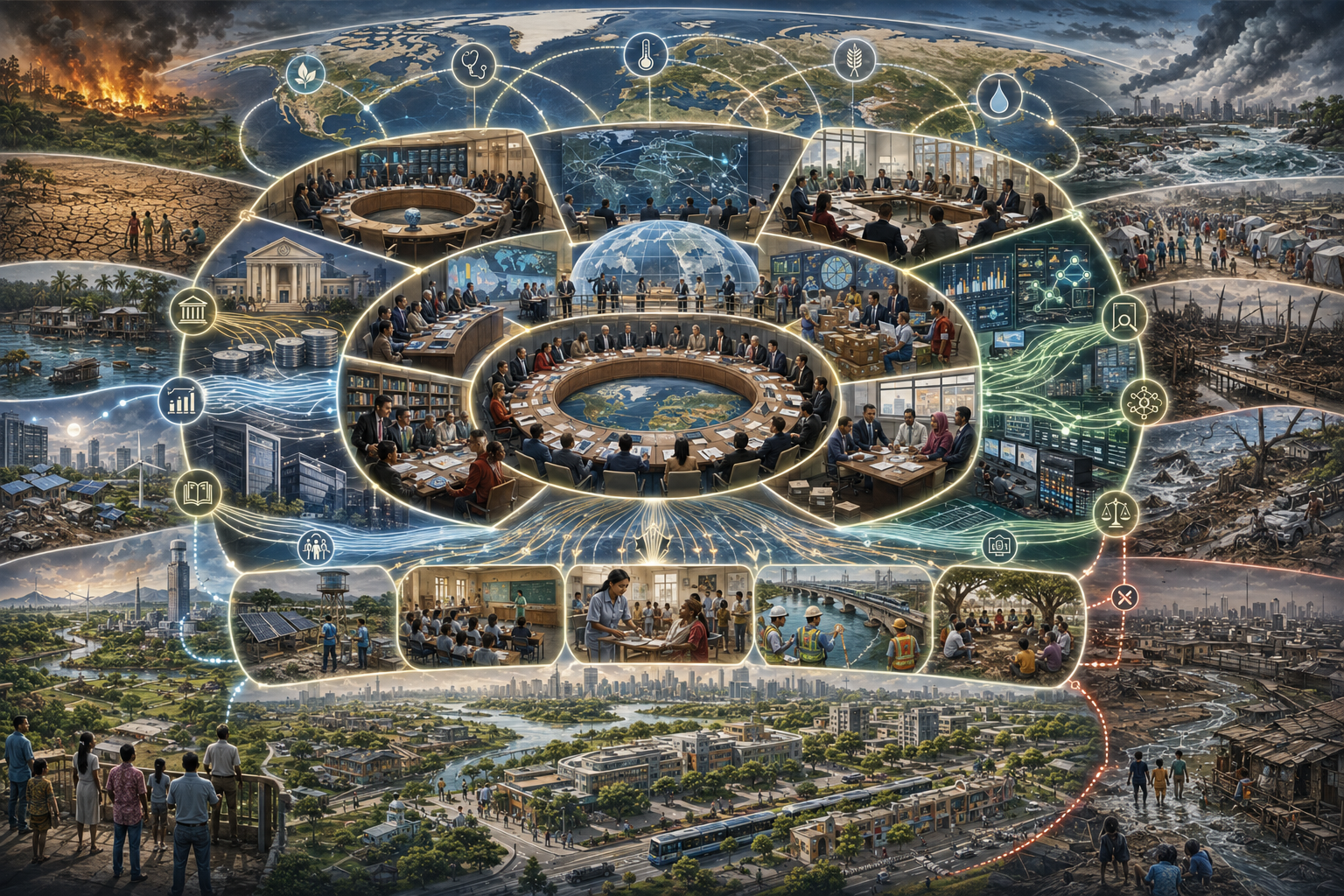
The deeper reason international organizations matter is that sustainable development is now pursued in a world of structured interdependence. States remain the primary legal and political actors in international order, yet their development prospects are shaped by financial systems, ecological systems, health threats, technological regimes, and geopolitical pressures that no state can govern alone. International organizations help make that interdependence more governable. They do not eliminate sovereignty, but they create arenas, procedures, and institutional routines through which states attempt to manage shared risks, negotiate burdens, and coordinate long-horizon objectives.
This makes international organizations central to global development governance rather than peripheral to it. They help organize development finance, debt discussions, country diagnostics, statistical frameworks, technical standards, monitoring systems, humanitarian coordination, climate negotiations, public-health cooperation, and the epistemic categories through which progress and failure are interpreted. They shape not only what resources are available for development, but also how development itself is understood, measured, prioritized, and politically justified.
At the same time, international organizations are not neutral containers of cooperation. They operate within a world marked by unequal bargaining power, institutional asymmetry, historical hierarchy, and competing visions of development. Their importance lies not in transcending politics, but in structuring politics across borders. They can widen cooperation, but they can also reflect power disparities, reproduce institutional fragmentation, or distance decision-making from those most affected by its consequences.
What International Organizations Are
International organizations are institutional arrangements created by states, and sometimes shaped in interaction with non-state actors, to coordinate action across borders. They include universal organizations, specialized agencies, international financial institutions, technical bodies, expert panels, development banks, treaty bodies, humanitarian coordination systems, statistical institutions, and multilateral forums. Some focus on norm-setting, some on finance, some on operational assistance, some on knowledge production, and some on monitoring, convening, or coordination.
What unites them is that they provide more continuity, structure, and procedural regularity than ad hoc diplomacy alone. They create recurring spaces where states can negotiate, report, learn, borrow, coordinate, contest, and sometimes cooperate under shared rules. International organizations do not erase conflict among states, but they make certain forms of cooperation more predictable and more durable than they would be if every issue had to be addressed through one-time bargaining.
This matters because sustainable development is not a purely domestic undertaking. It unfolds in a world shaped by shared ecological systems, unequal financial structures, interdependent markets, global health threats, cross-border data and technology systems, and international legal and policy commitments. International organizations help structure the environment within which states act. They organize expectations, create repeated sites of negotiation, and make some forms of cooperation more durable than they would otherwise be.
International organizations also differ in authority and function. Some produce binding rules; others produce soft law, guidance, standards, indicators, technical recommendations, funding criteria, or expert assessments. Some operate directly in crisis settings; others work through national governments, local authorities, civil society, or implementing partners. Some are universal in membership; others are regional or issue-specific. Sustainable development depends on this varied institutional ecology because development problems rarely fit neatly into one jurisdiction or policy domain.
To ask what international organizations are, in development terms, is therefore to ask what kinds of institutions make cross-border coordination durable. They are part of the governance architecture through which states attempt to manage problems larger than themselves without surrendering the political centrality of sovereignty altogether.
Why Global Development Needs Them
Global development needs international organizations because many development challenges are transboundary in cause, consequence, or solution. Climate change, biodiversity loss, debt vulnerability, trade dependence, pandemic risk, migration systems, food-price instability, humanitarian crisis, technology access, and financial instability do not stop at borders. Even when their impacts are experienced locally, the conditions that produce them are often internationally mediated.
This matters because sustainable development requires more than domestic policy competence. It also requires institutions that can connect states to financing, technical knowledge, negotiated targets, cooperative mechanisms, emergency support, comparative data, and systems of burden-sharing. Without such organizations, development governance would depend more heavily on fragmented bilateral bargaining and uneven voluntary alignment, which would often leave weaker states with fewer resources, weaker leverage, and less institutional support.
International organizations therefore matter because they help transform a world of formal sovereign equality but real material inequality into a somewhat more governable field of cooperation. They do not eliminate those inequalities, and they sometimes reproduce them. But they also create institutional channels through which poorer states, vulnerable regions, small island states, crisis-affected societies, and less powerful actors can articulate claims, access resources, and participate in rule-making processes that would otherwise be dominated even more completely by power politics.
Global development also needs international organizations because many public goods are global or regional in scale. A stable climate, reduced pandemic risk, functioning humanitarian coordination, financial stability, open and fairer knowledge systems, biodiversity protection, and disaster preparedness all require cooperation that extends beyond one state’s administrative reach. International organizations provide the institutional memory, convening power, technical staff, and reporting frameworks needed to keep these issues on the agenda across political cycles.
The need is not only practical but temporal. Sustainable development is a long-horizon project, while domestic politics often operates through short cycles of budget pressure, elections, crises, and shifting priorities. International organizations can help preserve continuity by embedding goals, indicators, agreements, and monitoring systems in institutions that outlast any single government. They cannot guarantee implementation, but they help sustain the cooperative field in which implementation remains possible.
From Sovereign States to Governed Interdependence
One of the most important reasons international organizations matter is that they help manage the tension between sovereignty and interdependence. States remain the primary legal and political units of international order, yet their developmental prospects are deeply affected by forces they do not control alone. International organizations provide procedures, rules, and forums through which this interdependence can be governed rather than merely endured.
This is developmentally significant because ungoverned interdependence often benefits the powerful and exposes the vulnerable. Finance can move faster than regulation. Emissions can accumulate faster than adaptation. Commodity shocks can destabilize fragile economies. Knowledge and technology can remain concentrated in some parts of the system while needs intensify elsewhere. Disease can travel faster than public-health capacity. Ecological damage can move through atmospheres, oceans, rivers, food systems, and markets. International organizations matter because they create partial institutional responses to these asymmetries.
They do not abolish power politics. But they can make cooperation more predictable, create channels through which weaker states articulate claims, stabilize expectations in areas where unilateral action is inadequate, and produce common frameworks that make shared problems more visible. In this sense, they help move global order from mere coexistence toward governed interdependence, however imperfectly.
This tension is especially clear in sustainable development because the Agenda depends on national implementation but global cooperation. States are responsible for delivering many development outcomes, but the conditions of delivery are shaped by debt rules, climate finance, trade regimes, technology access, migration systems, global health cooperation, environmental agreements, and international knowledge systems. Domestic sovereignty remains real, but it is exercised within a deeply structured international environment.
International organizations therefore matter because they help define the institutional middle ground between isolated sovereignty and world government. They are not a global state. They are not merely conferences. They are imperfect but indispensable mechanisms for governing interdependence in a world where development problems are increasingly shared, unequal, and cross-border.
International Organizations and Collective Action
Sustainable development is a collective-action problem at global scale. Many of its benefits are diffuse and long-term, while many of its costs are immediate and politically concentrated. Climate mitigation, debt restructuring, pandemic preparedness, technology sharing, environmental monitoring, refugee protection, humanitarian response, and development finance all involve incentives to delay, free-ride, underfund, or shift burdens onto others. International organizations matter because they help reduce some of those coordination failures.
This matters because collective action across unequal states is especially difficult. Countries differ in fiscal capacity, historical responsibility, vulnerability, bargaining strength, administrative reach, and geopolitical influence. International organizations provide negotiated rules, reporting systems, convening spaces, financing channels, expert processes, and technical support that can lower the transaction costs of cooperation and increase the credibility of commitments.
They thus matter not because they stand above politics, but because they make politics more structured. Sustainable development at global scale is possible only when recurring institutional process replaces one-off diplomatic aspiration. International organizations are among the main structures through which that replacement occurs. They create repeated interactions, shared calendars, formal reporting cycles, technical working groups, review processes, and financing windows that keep cooperation from depending solely on temporary political alignment.
Collective action also requires trust, and trust is difficult under conditions of unequal power. International organizations can help build limited forms of trust through monitoring, transparency, shared data, dispute procedures, peer review, technical standards, and predictable rules. These mechanisms do not eliminate mistrust, but they make cooperation somewhat less dependent on goodwill alone. In areas such as climate, public health, finance, humanitarian response, and statistical reporting, such institutionalized trust can be developmentally significant.
International organizations are therefore best understood as collective-action infrastructure. They are not always efficient, and they are not always just. But without them, global development cooperation would be more episodic, more fragmented, and more dependent on the priorities of the most powerful actors.
Finance, Knowledge, and Standard Setting
International organizations play especially important roles in finance, knowledge production, and standard setting. Development banks and international financial institutions mobilize capital, concessional finance, grants, loans, diagnostics, and technical assistance. UN agencies, expert panels, and statistical bodies generate indicators, frameworks, and reporting systems. Specialized institutions help define what counts as development progress, what is measured, what is prioritized, and how states compare performance.
This matters because development is not only financed materially; it is also governed epistemically. Indicators, benchmarks, country diagnostics, reporting templates, evidence platforms, technical standards, eligibility categories, and financing criteria shape which problems become visible and which interventions become legible to policymakers and funders. International organizations therefore influence not only the resources available for development, but also the conceptual language through which development itself is organized.
Finance is crucial because many lower-income and climate-vulnerable states face development needs that exceed domestic fiscal capacity. Concessional lending, grants, emergency financing, debt discussions, climate finance channels, and multilateral development-bank operations can shape the practical space within which governments invest in health, education, infrastructure, social protection, climate adaptation, and institutional reform. The structure of finance influences not only how much development is possible, but what kind of development becomes feasible.
Knowledge production is equally important. The SDG framework, human-development indicators, climate-risk assessments, governance diagnostics, debt sustainability analysis, public-health guidelines, and statistical systems all shape how development problems are perceived. What is measured becomes easier to govern; what is not measured can remain politically invisible. International organizations therefore help establish the categories through which states and publics understand development priorities.
Standard setting matters because cooperation requires shared expectations. Technical standards, reporting definitions, policy guidelines, environmental metrics, procurement principles, public-health norms, statistical classifications, and monitoring indicators help make cooperation administratively possible across different states. Sustainable development depends on such common frameworks because coordination becomes difficult when every actor defines the problem differently.
International organizations are thus part of the infrastructure of global knowledge as well as global finance. Sustainable development depends on both. Without money, goals remain underfunded. Without common metrics and categories, cooperation becomes harder to coordinate and accountability harder to sustain.
Legitimacy, Power, and Global Inequality
International organizations matter, but they also reflect unequal power. Some states possess more voting power, greater agenda-setting influence, stronger financial leverage, broader institutional reach, or more capacity to shape technical language than others. Development governance at the international level is therefore never purely neutral. It is structured by histories of empire, unequal development, debt dependence, strategic alliances, market power, and asymmetrical bargaining capacity.
This matters because legitimacy is central to whether international governance can sustain cooperation. If international organizations are experienced as vehicles of domination, conditionality without fairness, technocratic insulation from affected populations, or selective enforcement, their authority weakens. Yet if they are too weakly institutionalized, coordination also weakens. Sustainable development therefore faces a recurring tension: international organizations must be strong enough to coordinate, but legitimate enough to be followed.
Power also shapes whose problems become urgent. Issues affecting wealthy states often receive faster institutional attention, while problems concentrated in poorer, marginalized, or politically less powerful regions may remain underfunded or framed through external priorities. Development governance can therefore reproduce inequality not only through resource distribution, but through agenda-setting, policy categories, and institutional voice.
Representation matters because decisions about finance, debt, climate, trade, health, technology, and development standards affect people far beyond the meeting rooms where they are negotiated. International organizations often derive authority from member states, but affected communities, Indigenous peoples, workers, migrants, informal settlements, small producers, and marginalized groups may have limited direct influence. This creates a legitimacy gap between global decision-making and lived consequence.
The question is not whether power exists within international organizations. It clearly does. The harder question is whether these institutions can govern interdependence in ways that are sufficiently inclusive, accountable, and developmentally just to maintain cooperation under unequal conditions. Sustainable development requires not only multilateral capacity, but legitimacy under conditions of global inequality.
Implementation Beyond the Global Scale
International organizations do not implement sustainable development on their own. Most implementation still occurs through states, local governments, public systems, civil society, communities, firms, and markets. This is why international organizations matter not only as direct actors, but as institutions that shape the wider conditions under which implementation occurs. They influence national strategies, financing availability, technical norms, reporting expectations, reform incentives, administrative learning, and public-policy language.
This matters because global governance becomes developmentally meaningful only when it connects to domestic and territorial institutions. A global target has little force if budgeting systems, delivery chains, local governments, public agencies, or community organizations cannot support it. International organizations are therefore most effective when they strengthen implementation ecosystems rather than assuming that global agreement automatically translates into local change.
The gap between agreement and implementation is one of the central problems of sustainable development. A country may endorse global targets but lack fiscal space, administrative capacity, technical staff, data systems, legal frameworks, or local delivery capacity. An international organization may produce valuable guidance, but that guidance must still be translated into national planning, sectoral budgets, procurement systems, service delivery, monitoring, and public accountability.
This is why international organizations should be understood as part of multilevel governance. They interact with national ministries, local authorities, development agencies, civil society organizations, research institutions, and frontline delivery systems. Their developmental influence often comes indirectly: shaping what national and territorial institutions are able, willing, or expected to do.
Sustainable development depends not only on global agreement, but on whether international institutions can help bridge the gap between agreement and implementation. This section aligns naturally with Why Institutions Matter for Sustainable Development, State Capacity, Public Administration, and Delivery Systems, and Local Governance, Cities, and Territorial Development.
International Organizations, Risk, and Resilience
Sustainable development increasingly unfolds under conditions of overlapping risk: climate instability, debt stress, food insecurity, ecological disruption, humanitarian spillover, public-health emergency, technological disruption, and geopolitical fragmentation. International organizations matter because resilience at global scale requires institutions that can mobilize knowledge, coordinate response, pool finance, and support adaptation before crises become permanent reversals in development.
This is especially important in a world of cascading shocks. A climate event can trigger food-price stress, fiscal strain, migration pressure, infrastructure damage, public-health burdens, and political instability. A pandemic can become an education crisis, debt crisis, labor-market crisis, care crisis, and governance crisis. A conflict can become a food, energy, refugee, health, and debt shock across regions. International organizations help create the frameworks through which such interconnected risk is interpreted and, at least sometimes, jointly managed.
Risk governance beyond borders requires common assessment, early warning, emergency finance, humanitarian coordination, public-health surveillance, climate adaptation support, and shared technical standards. No single state can provide all of these for the international system as a whole. International organizations help institutionalize some of the capacity needed to anticipate and respond to systemic risk.
They also matter because vulnerability is uneven. Countries with limited fiscal space, high climate exposure, humanitarian stress, or weaker administrative systems may face shocks more intensely and recover more slowly. International organizations can help redistribute some capacity through finance, technical support, data, coordination, and convening. Whether they do so sufficiently or fairly remains a central political question, but the need for such institutions is difficult to deny.
International organizations therefore matter not only during periods of orderly planning, but under conditions where uncoordinated national responses would intensify systemic fragility. Resilience in an interdependent world is partly an institutional achievement of coordination beyond borders.
Fragmentation, Overlap, and Regime Complexity
The contemporary system of global development governance is highly plural. Many organizations operate at once, with overlapping mandates, different financing instruments, competing data systems, distinct forms of authority, and varied accountability relationships. This plurality can be productive because different organizations bring different strengths. But it can also generate fragmentation, duplication, forum shopping, competition for agenda control, and uneven accountability.
This matters because sustainable development is already cross-sectoral and institutionally complex. When the governance system itself becomes too fragmented, coordination costs rise and coherence weakens. Organizations may ask countries to report against multiple frameworks, navigate multiple funding windows, align with partially overlapping priorities, or respond to inconsistent technical expectations. Institutional density does not automatically produce institutional effectiveness.
Regime complexity can also burden lower-capacity states disproportionately. A wealthy state may have the administrative capacity to manage multiple reporting systems, funding applications, standards, and negotiations. A lower-capacity state may experience the same institutional plurality as fragmentation and administrative overload. The same global governance ecosystem can therefore feel enabling to some actors and exhausting to others.
Fragmentation also makes accountability harder. When many organizations influence the same development domain, responsibility can become diffuse. If climate finance is insufficient, debt restructuring is delayed, humanitarian response is underfunded, or public-health coordination fails, it may be difficult to identify which institutions had authority, which had resources, and which had responsibility. Sustainable development requires coordination not only within states, but among international institutions themselves.
International organizations therefore matter not only individually, but relationally. Their developmental value depends partly on whether they can coordinate with one another without dissolving into regime complexity that overwhelms weaker states and obscures accountability.
Path Dependence, Reform, and Institutional Lock-In
International organizations also matter because they create continuity, and continuity can be both enabling and constraining. Rules, voting structures, lending models, conditionality practices, reporting templates, organizational cultures, professional norms, and policy categories often persist long after the context that produced them has changed. This is the problem of path dependence at global scale. Institutions designed for one era of development governance may continue to shape another.
This matters because sustainable development often requires institutional reform, not only programmatic expansion. If financing rules remain too rigid, if representation remains too unequal, if reporting systems remain burdensome, if organizational incentives reward narrow sectoral outcomes over integrated resilience, or if risk frameworks understate lived vulnerability, international organizations can inadvertently reproduce the very fragmentation they are meant to reduce.
Institutional lock-in can be especially powerful because international organizations accumulate authority through routine. Their categories, funding instruments, review processes, and professional languages become normal. Once embedded, they shape how governments plan, how donors fund, how experts evaluate, and how publics interpret development. Reform is difficult because changing an international organization often requires agreement among actors with unequal interests and different visions of legitimacy.
Path dependence does not mean international organizations are static. They evolve, adapt, and reform. But adaptation can be slow, contested, and partial. Sustainable development requires institutions that can learn from changing conditions: climate risk, debt vulnerability, inequality, technological change, ecological stress, and the demands of more legitimate global representation.
Global development governance therefore depends not only on having international organizations, but on whether those organizations can reform themselves in response to changing development realities. Institutions that help govern interdependence must also be governable themselves.
Epistemic Power and Development Language
International organizations also exercise epistemic power. They help define the categories through which development is described and governed: fragile states, climate resilience, low-income status, debt sustainability, human development, governance quality, implementation gaps, concessional eligibility, institutional capacity, risk exposure, and many others. These categories are not trivial. They shape what is measured, what is fundable, what counts as reform, and what becomes thinkable in policy debate.
This matters because development is governed partly through language, indicators, and comparative frameworks. International organizations are central to the production of those frameworks. The SDG architecture, human-development language, climate-risk assessments, development-finance categories, debt frameworks, governance diagnostics, and statistical reporting systems all help organize how states, donors, publics, and researchers interpret development challenges.
Epistemic power can be useful when it makes invisible harms visible. Indicators can reveal poverty, inequality, health burdens, educational exclusion, gender disparities, climate vulnerability, governance gaps, and environmental degradation. Shared categories can help coordinate action and compare progress. Without common language, cooperation becomes harder.
But epistemic power can also narrow imagination. If development is defined too heavily through externally produced metrics, technical classifications, or financing eligibility categories, local knowledge and alternative priorities may be marginalized. Communities may experience development problems in ways that do not fit global templates. A category that helps govern from above may not fully capture lived realities below.
To understand why international organizations matter, then, is also to understand how they shape the grammar of global development governance. They do not only fund and coordinate. They also define what is legible enough to govern. Sustainable development therefore requires not only better indicators, but more accountable and plural ways of producing development knowledge.
Why International Organizations Are Not Enough
It is not enough simply to have international organizations. They can be underfunded, politically constrained, technocratic, slow, unevenly representative, or overly dependent on member-state willingness. They can generate standards without enforcement, mobilize finance without justice, or produce reporting burdens that do not translate into meaningful change on the ground.
This matters because sustainable development cannot be outsourced upward. International organizations can coordinate, finance, inform, and convene, but they cannot substitute for domestic state capacity, local governance, democratic legitimacy, territorial implementation, community participation, or accountable public systems. Their strength lies in structuring cooperation, not replacing politics.
International organizations are also constrained by the interests of their members. If powerful states refuse finance, block reform, weaken commitments, or selectively apply principles, organizations may be unable to act at the scale required. If member states agree to goals but fail to provide implementation resources, institutional language can outpace institutional capacity. Global development governance depends on organizations, but organizations depend on political will.
They are also insufficient because development is ultimately lived locally. A global agreement must become a budget, a law, a service, a school, a clinic, a clean-energy project, a protected watershed, a functioning transit system, or a risk-reduction plan. International organizations can support those transformations, but they cannot complete them without domestic and territorial institutions able to act.
The real question is therefore not whether international organizations are sufficient. They are not. The question is whether global development governance can function without them. In a deeply interdependent world, the answer is increasingly no. They are insufficient institutions, but indispensable ones.
Why This Matters for Sustainable Development
International organizations and global development governance belong together because sustainable development increasingly depends on institutions that can organize cooperation across borders, mobilize resources, structure knowledge, and manage shared risks in a world no single state can govern alone. A serious development framework must therefore look beyond domestic institutions without abandoning them. Global development governance is not an optional layer above real development. It is part of the institutional terrain on which development now unfolds.
This is why international organizations matter so much. They reveal a central truth that purely state-centric development thinking can miss: long-run development depends not only on national ambition and local delivery, but also on whether interdependence itself is governed through institutions capable of finance, coordination, legitimacy, and learning. Where those institutions are weak, fragmented, underfunded, or unjust, sustainable development becomes harder to coordinate and easier to derail.
The issue is also one of justice. Global institutions influence whose debt burdens are recognized, whose climate vulnerability is financed, whose knowledge counts, whose crises receive attention, whose development pathways are treated as legitimate, and whose voices are marginalized in the governance of shared risks. Sustainable development cannot be credible if global cooperation preserves hierarchy while asking the most vulnerable to absorb the costs of interdependence.
To take international organizations seriously is therefore to take sustainable development seriously. It is to recognize that global development governance is not a secondary overlay on top of domestic development, but part of the multilevel institutional architecture through which human development, ecological stability, and long-horizon cooperation must increasingly be pursued.
Development becomes credible when international cooperation is strong enough to coordinate shared risks, legitimate enough to be trusted, just enough to confront unequal power, and practical enough to support implementation in the places where development is actually lived.
Mathematical Lens
Global development governance capacity can be clarified by thinking in terms of coordination, finance, knowledge, and legitimacy rather than organization count alone. Let \(G_d\) represent developmentally usable global governance capacity, \(C\) coordination strength, \(F\) financing support, \(K\) knowledge and standards capacity, and \(L\) legitimacy:
G_d = \alpha C + \beta F + \gamma K + \delta L
\]
Interpretation: Global development governance capacity rises when coordination strength, financing support, knowledge capacity, and legitimacy reinforce one another.
This captures a central point in the article: international organizations matter not merely because they exist, but because they help organize cooperation, resources, standards, and shared institutional expectations across borders.
We can also express cooperation effectiveness as a weighted function of collective-action alignment, implementation support, and resilience coordination:
M_c = w_1 A + w_2 I + w_3 R
\]
Interpretation: Multilateral cooperation effectiveness rises when alignment, implementation support, and resilience coordination improve together.
Here, \(A\) is collective-action alignment, \(I\) is implementation support, and \(R\) is resilience coordination. Higher \(M_c\) means multilateral institutions are more likely to translate agreement into durable cooperative practice.
Finally, regime fragility can be represented as a function of fragmentation, unequal influence, and institutional lock-in:
Q_g = \lambda F_r + \mu U + \nu P
\]
Interpretation: Global-governance fragility rises when fragmentation risk, unequal influence, and path dependence reinforce one another.
Here, \(F_r\) is fragmentation risk, \(U\) is unequal influence, and \(P\) is path dependence or institutional lock-in. This helps show why international organizations can be indispensable while still remaining constrained, contested, or insufficiently legitimate.
| Term | Meaning | Interpretive role |
|---|---|---|
| \(G_d\) | Global development governance capacity | Represents developmentally usable multilateral capacity created by coordination, finance, knowledge, and legitimacy. |
| \(C\) | Coordination strength | Represents the ability of international organizations to convene, align expectations, reduce transaction costs, and structure cooperation. |
| \(F\) | Financing support | Represents concessional finance, grants, development lending, emergency support, debt-related mechanisms, and resource mobilization. |
| \(K\) | Knowledge and standards capacity | Represents indicators, technical standards, assessments, reporting systems, diagnostics, and shared policy language. |
| \(L\) | Legitimacy | Represents representation, fairness, accountability, transparency, and acceptance of institutional authority under unequal conditions. |
| \(M_c\) | Multilateral cooperation effectiveness | Represents the likelihood that international agreement becomes durable cooperative practice. |
| \(Q_g\) | Global-governance fragility | Represents weakness caused by fragmentation, unequal influence, and institutional lock-in. |
The equations are conceptual rather than predictive. Their value is to make visible the structure of the problem: global development governance depends on coordination, finance, knowledge, legitimacy, implementation support, resilience coordination, and resistance to fragmentation working together.
Advanced Python Workflow: Global Development Governance Capacity Scoring
This Python workflow translates the article’s core argument into a structured multilateral-governance model. Rather than treating international organizations as generic cooperation containers, it scores countries, organizations, regimes, or governance domains across coordination strength, financing support, standards capacity, implementation support, legitimacy, resilience coordination, fragmentation risk, unequal influence risk, institutional lock-in risk, and reform readiness. That makes it possible to compare not only whether multilateral structures exist, but whether they are likely to support usable development cooperation.
from __future__ import annotations

import pandas as pd
import numpy as np

INPUT_FILE = "global_development_governance_panel.csv"
OUTPUT_FILE = "global_development_governance_scores.csv"


def load_data(path: str) -> pd.DataFrame:
    """
    Load a country, organization, regime, or governance-domain dataset.

    All *_index columns should be normalized to [0, 1].
    Higher values should mean more of the named property.

    Examples:
      - coordination_strength_index: higher = stronger coordination capacity
      - financing_support_index: higher = stronger financing support
      - fragmentation_risk_index: higher = greater regime fragmentation
      - reform_readiness_index: higher = stronger institutional reform readiness
    """
    df = pd.read_csv(path)

    required_columns = [
        "country_or_regime",
        "region",
        "governance_domain",
        "coordination_strength_index",
        "financing_support_index",
        "knowledge_standards_index",
        "implementation_support_index",
        "legitimacy_index",
        "resilience_coordination_index",
        "fragmentation_risk_index",
        "unequal_influence_risk_index",
        "institutional_lockin_risk_index",
        "reform_readiness_index",
    ]

    missing = [col for col in required_columns if col not in df.columns]

    if missing:
        raise ValueError(f"Missing required columns: {missing}")

    return df


def validate_indices(df: pd.DataFrame) -> pd.DataFrame:
    """Validate that all *_index fields are complete and normalized to [0, 1]."""
    index_columns = [col for col in df.columns if col.endswith("_index")]

    for col in index_columns:
        if df[col].isna().any():
            raise ValueError(f"Column '{col}' contains missing values.")

        if ((df[col] < 0) | (df[col] > 1)).any():
            raise ValueError(f"Column '{col}' contains values outside [0, 1].")

    return df


def compute_scores(df: pd.DataFrame) -> pd.DataFrame:
    """
    Compute multilateral capacity, institutional friction,
    legitimacy-adjusted capacity, and constrained global governance capacity.

    Multilateral capacity rises with coordination, finance, standards,
    implementation support, legitimacy, and resilience coordination.

    Institutional friction rises with fragmentation, unequal influence,
    institutional lock-in, and weak reform readiness.
    """
    df = df.copy()

    df["multilateral_capacity_score"] = (
        0.21 * df["coordination_strength_index"] +
        0.18 * df["financing_support_index"] +
        0.17 * df["knowledge_standards_index"] +
        0.16 * df["implementation_support_index"] +
        0.15 * df["legitimacy_index"] +
        0.13 * df["resilience_coordination_index"]
    ).clip(lower=0, upper=1)

    df["institutional_friction_score"] = (
        0.34 * df["fragmentation_risk_index"] +
        0.28 * df["unequal_influence_risk_index"] +
        0.22 * df["institutional_lockin_risk_index"] +
        0.16 * (1 - df["reform_readiness_index"])
    ).clip(lower=0, upper=1)

    df["implementation_translation_score"] = (
        0.34 * df["implementation_support_index"] +
        0.24 * df["financing_support_index"] +
        0.20 * df["knowledge_standards_index"] +
        0.12 * df["coordination_strength_index"] +
        0.10 * df["resilience_coordination_index"]
    ).clip(lower=0, upper=1)

    df["legitimacy_adjusted_capacity_score"] = (
        0.50 * df["multilateral_capacity_score"] +
        0.30 * df["legitimacy_index"] +
        0.20 * (1 - df["unequal_influence_risk_index"])
    ).clip(lower=0, upper=1)

    df["constrained_global_governance_score"] = (
        0.38 * df["multilateral_capacity_score"] +
        0.22 * df["legitimacy_adjusted_capacity_score"] +
        0.18 * df["implementation_translation_score"] +
        0.12 * (1 - df["institutional_friction_score"]) +
        0.10 * df["reform_readiness_index"]
    ).clip(lower=0, upper=1)

    df["governance_legitimacy_gap"] = (
        df["multilateral_capacity_score"] -
        df["legitimacy_index"]
    )

    df["governance_band"] = np.select(
        [
            df["constrained_global_governance_score"] >= 0.80,
            df["constrained_global_governance_score"] >= 0.60,
            df["constrained_global_governance_score"] >= 0.40,
        ],
        [
            "High multilateral capacity",
            "Strong multilateral capacity",
            "Moderate multilateral capacity",
        ],
        default="Constrained multilateral capacity",
    )

    df["governance_warning"] = np.select(
        [
            df["institutional_friction_score"] >= 0.75,
            df["fragmentation_risk_index"] >= 0.70,
            df["unequal_influence_risk_index"] >= 0.70,
            df["institutional_lockin_risk_index"] >= 0.70,
        ],
        [
            "Severe institutional friction risk",
            "High fragmentation risk",
            "High unequal-influence risk",
            "High institutional lock-in risk",
        ],
        default="Lower global-governance friction warning",
    )

    return df


def build_summary(df: pd.DataFrame) -> pd.DataFrame:
    """Return a ranked summary table for review or reporting."""
    columns = [
        "country_or_regime",
        "region",
        "governance_domain",
        "multilateral_capacity_score",
        "institutional_friction_score",
        "implementation_translation_score",
        "legitimacy_adjusted_capacity_score",
        "constrained_global_governance_score",
        "governance_band",
        "governance_warning",
    ]

    summary = df[columns].copy()

    summary = summary.sort_values(
        by=[
            "constrained_global_governance_score",
            "multilateral_capacity_score",
            "implementation_translation_score",
            "institutional_friction_score",
        ],
        ascending=[False, False, False, True],
    ).reset_index(drop=True)

    return summary


def main() -> None:
    df = load_data(INPUT_FILE)
    df = validate_indices(df)
    scored = compute_scores(df)
    summary = build_summary(scored)

    summary.to_csv(OUTPUT_FILE, index=False)

    print("Global development governance capacity scoring complete.")
    print(summary.to_string(index=False))


if __name__ == "__main__":
    main()
This workflow is intentionally transparent. It does not claim that global development governance can be reduced to one objective score. Instead, it makes assumptions visible: coordination strength, financing support, standards capacity, implementation support, legitimacy, resilience coordination, fragmentation, unequal influence, institutional lock-in, and reform readiness are treated as distinct components. The value of the model is diagnostic. It helps identify where global-development-governance systems are stronger, where implementation support is thinner, and where institutional overlap, legitimacy weakness, or reform constraints may be limiting cooperation.
Advanced R Workflow: Multilateral Capacity, Finance, and Institutional Variation Analysis
This R workflow is designed for the part of the article that emphasizes variation across regions, governance domains, and institutional arrangements. It compares settings across coordination strength, financing support, standards capacity, implementation support, legitimacy, resilience coordination, fragmentation risk, unequal influence, institutional lock-in, and reform readiness. It then builds grouped summaries that help show where multilateral systems are stronger and where institutional friction remains developmentally costly.
library(readr)
library(dplyr)

input_file <- "global_governance_country_panel.csv"
country_output_file <- "cross_country_global_governance_summary.csv"
domain_output_file <- "cross_domain_global_governance_summary.csv"
region_output_file <- "cross_region_global_governance_summary.csv"

gov_df <- read_csv(input_file, show_col_types = FALSE)

required_cols <- c(
  "country_or_regime",
  "region",
  "governance_domain",
  "coordination_strength_index",
  "financing_support_index",
  "knowledge_standards_index",
  "implementation_support_index",
  "legitimacy_index",
  "resilience_coordination_index",
  "fragmentation_risk_index",
  "unequal_influence_risk_index",
  "institutional_lockin_risk_index",
  "reform_readiness_index"
)

missing_cols <- setdiff(required_cols, names(gov_df))

if (length(missing_cols) > 0) {
  stop(paste("Missing required columns:", paste(missing_cols, collapse = ", ")))
}

index_cols <- names(gov_df)[grepl("_index$", names(gov_df))]

invalid_index_cols <- index_cols[
  vapply(
    gov_df[index_cols],
    function(x) any(is.na(x) | x < 0 | x > 1),
    logical(1)
  )
]

if (length(invalid_index_cols) > 0) {
  stop(
    paste(
      "Index columns must be complete and normalized to [0, 1]:",
      paste(invalid_index_cols, collapse = ", ")
    )
  )
}

gov_df <- gov_df %>%
  mutate(
    governance_capacity_proxy = (
      coordination_strength_index +
      financing_support_index +
      knowledge_standards_index +
      implementation_support_index +
      legitimacy_index +
      resilience_coordination_index
    ) / 6,
    institutional_friction_proxy = (
      fragmentation_risk_index +
      unequal_influence_risk_index +
      institutional_lockin_risk_index +
      (1 - reform_readiness_index)
    ) / 4,
    legitimacy_adjusted_capacity_proxy = (
      governance_capacity_proxy +
      legitimacy_index +
      (1 - unequal_influence_risk_index)
    ) / 3,
    constrained_governance_proxy = (
      governance_capacity_proxy +
      legitimacy_adjusted_capacity_proxy +
      implementation_support_index +
      reform_readiness_index +
      (1 - institutional_friction_proxy)
    ) / 5,
    governance_band = case_when(
      constrained_governance_proxy >= 0.75 ~ "High multilateral capacity",
      constrained_governance_proxy >= 0.55 ~ "Strong multilateral capacity",
      constrained_governance_proxy >= 0.35 ~ "Moderate multilateral capacity",
      TRUE ~ "Constrained multilateral capacity"
    )
  )

country_summary <- gov_df %>%
  group_by(country_or_regime) %>%
  summarise(
    avg_constrained_governance = mean(constrained_governance_proxy, na.rm = TRUE),
    avg_governance_capacity = mean(governance_capacity_proxy, na.rm = TRUE),
    avg_institutional_friction = mean(institutional_friction_proxy, na.rm = TRUE),
    avg_legitimacy_adjusted_capacity = mean(legitimacy_adjusted_capacity_proxy, na.rm = TRUE),
    avg_coordination_strength = mean(coordination_strength_index, na.rm = TRUE),
    avg_financing_support = mean(financing_support_index, na.rm = TRUE),
    avg_knowledge_standards = mean(knowledge_standards_index, na.rm = TRUE),
    avg_implementation_support = mean(implementation_support_index, na.rm = TRUE),
    avg_legitimacy = mean(legitimacy_index, na.rm = TRUE),
    avg_resilience_coordination = mean(resilience_coordination_index, na.rm = TRUE),
    avg_fragmentation_risk = mean(fragmentation_risk_index, na.rm = TRUE),
    avg_unequal_influence_risk = mean(unequal_influence_risk_index, na.rm = TRUE),
    avg_institutional_lockin_risk = mean(institutional_lockin_risk_index, na.rm = TRUE),
    avg_reform_readiness = mean(reform_readiness_index, na.rm = TRUE),
    observations = n(),
    .groups = "drop"
  ) %>%
  mutate(
    governance_band = case_when(
      avg_constrained_governance >= 0.75 ~ "High multilateral capacity",
      avg_constrained_governance >= 0.55 ~ "Strong multilateral capacity",
      avg_constrained_governance >= 0.35 ~ "Moderate multilateral capacity",
      TRUE ~ "Constrained multilateral capacity"
    )
  ) %>%
  arrange(desc(avg_constrained_governance))

domain_summary <- gov_df %>%
  group_by(governance_domain) %>%
  summarise(
    avg_constrained_governance = mean(constrained_governance_proxy, na.rm = TRUE),
    avg_governance_capacity = mean(governance_capacity_proxy, na.rm = TRUE),
    avg_institutional_friction = mean(institutional_friction_proxy, na.rm = TRUE),
    avg_coordination_strength = mean(coordination_strength_index, na.rm = TRUE),
    avg_financing_support = mean(financing_support_index, na.rm = TRUE),
    avg_knowledge_standards = mean(knowledge_standards_index, na.rm = TRUE),
    avg_implementation_support = mean(implementation_support_index, na.rm = TRUE),
    avg_legitimacy = mean(legitimacy_index, na.rm = TRUE),
    avg_resilience_coordination = mean(resilience_coordination_index, na.rm = TRUE),
    avg_fragmentation_risk = mean(fragmentation_risk_index, na.rm = TRUE),
    avg_unequal_influence_risk = mean(unequal_influence_risk_index, na.rm = TRUE),
    avg_institutional_lockin_risk = mean(institutional_lockin_risk_index, na.rm = TRUE),
    avg_reform_readiness = mean(reform_readiness_index, na.rm = TRUE),
    observations = n(),
    .groups = "drop"
  ) %>%
  arrange(desc(avg_constrained_governance))

region_summary <- gov_df %>%
  group_by(region) %>%
  summarise(
    avg_constrained_governance = mean(constrained_governance_proxy, na.rm = TRUE),
    avg_governance_capacity = mean(governance_capacity_proxy, na.rm = TRUE),
    avg_institutional_friction = mean(institutional_friction_proxy, na.rm = TRUE),
    avg_financing_support = mean(financing_support_index, na.rm = TRUE),
    avg_implementation_support = mean(implementation_support_index, na.rm = TRUE),
    avg_legitimacy = mean(legitimacy_index, na.rm = TRUE),
    avg_fragmentation_risk = mean(fragmentation_risk_index, na.rm = TRUE),
    observations = n(),
    .groups = "drop"
  ) %>%
  arrange(desc(avg_constrained_governance))

write_csv(country_summary, country_output_file)
write_csv(domain_summary, domain_output_file)
write_csv(region_summary, region_output_file)

cat("Cross-country global governance summary exported to:", country_output_file, "\n")
print(country_summary)

cat("\nCross-domain global governance summary exported to:", domain_output_file, "\n")
print(domain_summary)

cat("\nCross-region global governance summary exported to:", region_output_file, "\n")
print(region_summary)
This workflow helps distinguish formal international institutional presence from developmentally consequential multilateral capacity. A governance domain may have many organizations but weak legitimacy, high fragmentation, or thin implementation support. Another may have fewer institutions but stronger coordination, finance, standards, and reform readiness. The workflow therefore treats international organizations as development conditions, not as background diplomatic architecture.
GitHub Repository
Complete Code Repository
The full code distribution for this article, including multilateral-capacity scoring workflows, finance and fragmentation diagnostics, SQL materials, optional global-governance support tooling, supporting documentation, and repository structure, is available on GitHub.
Related Articles
- Policy Coordination Across Complex Systems
- Why Institutions Matter for Sustainable Development
- State Capacity, Public Administration, and Delivery Systems
- Law, Rights, and Sustainable Development
- Climate Change as a Development Constraint
- Development Under Deep Uncertainty
- Infrastructure as the Material Basis of Development
- Local Governance, Cities, and Territorial Development
- Participation, Voice, and Community-Led Development
- Trade-Offs, Synergies, and Policy Coherence
Further Reading
- United Nations Department of Economic and Social Affairs (n.d.) Goal 17: Strengthen the means of implementation and revitalize the Global Partnership for Sustainable Development. New York: United Nations. Available at: https://sdgs.un.org/goals/goal17
- United Nations (2015) Transforming our world: the 2030 Agenda for Sustainable Development. New York: United Nations. Available at: https://sdgs.un.org/2030agenda
- United Nations Department of Economic and Social Affairs (n.d.) Multi-stakeholder partnerships and voluntary commitments. New York: United Nations. Available at: https://sdgs.un.org/topics/multi-stakeholder-partnerships
- United Nations Development Programme (n.d.) Governance for people and planet. New York: UNDP. Available at: https://www.undp.org/governance
- United Nations Development Programme (2023) Global Programme Project Document: Governance for People and Planet. New York: UNDP. Available at: https://www.undp.org/governance/publications/global-programme-project-document-governance-people-and-planet
- International Development Association (n.d.) What is IDA? Washington, DC: World Bank Group. Available at: https://ida.worldbank.org/en/about
- International Development Association (n.d.) Governance and Institutions. Washington, DC: World Bank Group. Available at: https://ida.worldbank.org/en/topics/cross-cutting/governance-and-institutions
- Intergovernmental Panel on Climate Change (2022) Chapter 14: International Cooperation. In: Climate Change 2022: Mitigation of Climate Change. Geneva: IPCC. Available at: https://www.ipcc.ch/report/ar6/wg3/chapter/chapter-14/
- Intergovernmental Panel on Climate Change (2022) Chapter 18: Climate Resilient Development Pathways. In: Climate Change 2022: Impacts, Adaptation and Vulnerability. Geneva: IPCC. Available at: https://www.ipcc.ch/report/ar6/wg2/chapter/chapter-18/
References
- United Nations Department of Economic and Social Affairs (n.d.) Goal 17: Strengthen the means of implementation and revitalize the Global Partnership for Sustainable Development. New York: United Nations. Available at: https://sdgs.un.org/goals/goal17
- United Nations (2015) Transforming our world: the 2030 Agenda for Sustainable Development. New York: United Nations. Available at: https://sdgs.un.org/2030agenda
- United Nations Department of Economic and Social Affairs (n.d.) Multi-stakeholder partnerships and voluntary commitments. New York: United Nations. Available at: https://sdgs.un.org/topics/multi-stakeholder-partnerships
- United Nations Development Programme (n.d.) Governance for people and planet. New York: UNDP. Available at: https://www.undp.org/governance
- United Nations Development Programme (2023) Global Programme Project Document: Governance for People and Planet. New York: UNDP. Available at: https://www.undp.org/governance/publications/global-programme-project-document-governance-people-and-planet
- International Development Association (n.d.) What is IDA? Washington, DC: World Bank Group. Available at: https://ida.worldbank.org/en/about
- International Development Association (n.d.) Governance and Institutions. Washington, DC: World Bank Group. Available at: https://ida.worldbank.org/en/topics/cross-cutting/governance-and-institutions
- Intergovernmental Panel on Climate Change (2022) Chapter 14: International Cooperation. In: Climate Change 2022: Mitigation of Climate Change. Geneva: IPCC. Available at: https://www.ipcc.ch/report/ar6/wg3/chapter/chapter-14/
- Intergovernmental Panel on Climate Change (2022) Chapter 18: Climate Resilient Development Pathways. In: Climate Change 2022: Impacts, Adaptation and Vulnerability. Geneva: IPCC. Available at: https://www.ipcc.ch/report/ar6/wg2/chapter/chapter-18/