
Last Updated May 7, 2026
Participation matters for sustainable development because development is not durable when it is merely administered from above. It becomes more legitimate, more informed, and often more resilient when people can shape the priorities, decisions, and institutions that affect their lives. Voice matters because sustainable development is not only about delivering services or reaching aggregate targets. It is also about whether people can influence public choices, contest exclusion, contribute local knowledge, and help determine what development should mean in their own communities.
Community-led development matters because local actors are not only beneficiaries of policy. They are also agents of development whose participation can improve relevance, ownership, accountability, trust, and long-run legitimacy. Sustainable development is strongest when communities are not treated as passive recipients of decisions already made elsewhere, but as people with knowledge, rights, histories, priorities, and institutional claims of their own.
Main Library
Publications
Article Map
Sustainable Development
Related Topic
Institutions & Governance
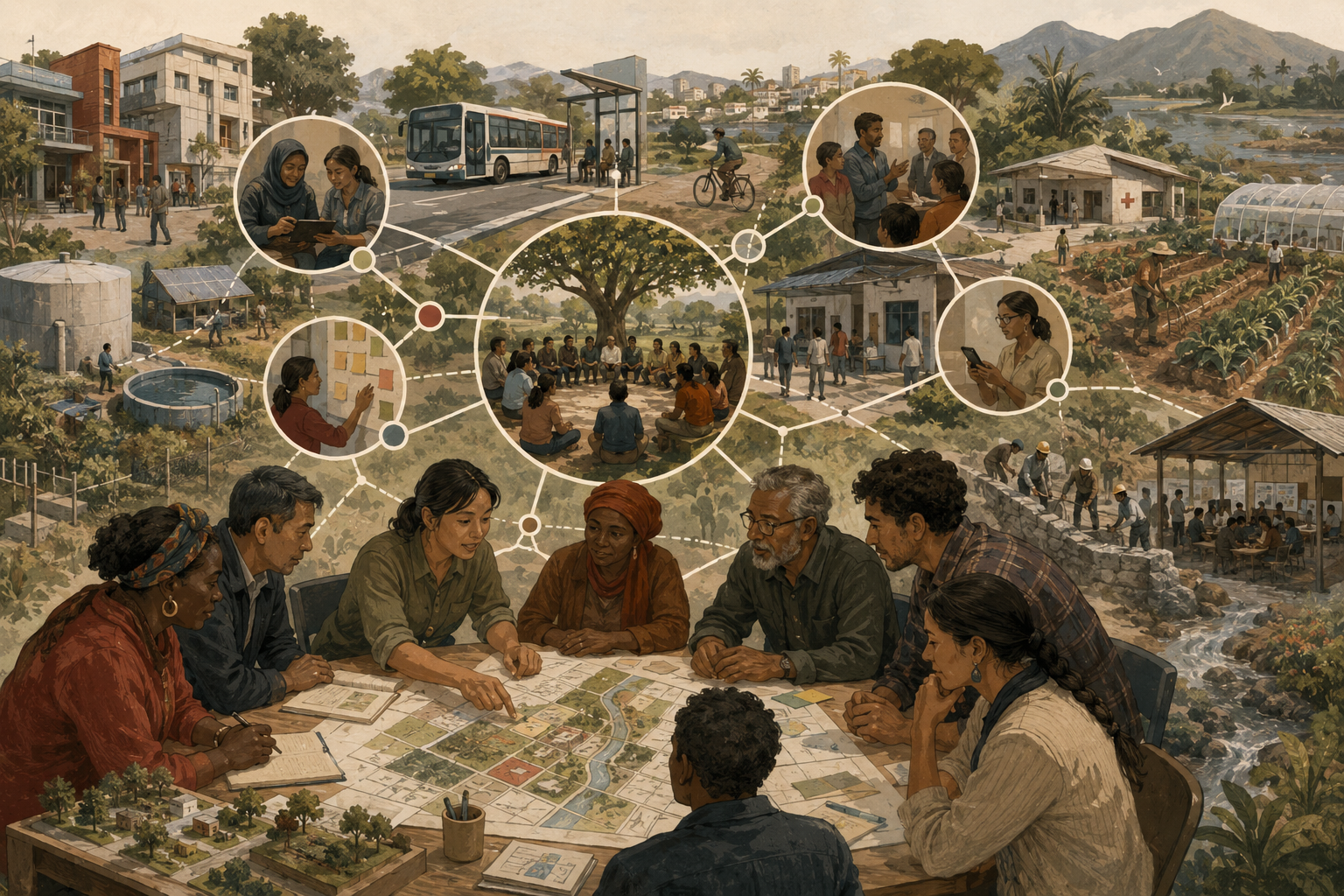
The deeper reason participation matters is that sustainable development is always a problem of collective action under conditions of difference. Communities do not share identical needs, risks, histories, or priorities. Technocratic planning can organize resources efficiently in some settings, but it can also fail by overlooking lived realities, reinforcing administrative distance, or treating people as passive recipients of decisions already made elsewhere. Participation changes the structure of development by widening who counts as a knower, who counts as a stakeholder, and who counts as entitled to shape public purpose.
This does not mean participation is automatically transformative. It can be performative, tokenistic, selective, or captured by better-resourced actors. But where participation is meaningful, it can improve institutional trust, surface local intelligence, strengthen accountability, and anchor development in the social realities of place. Community-led development is especially important because it shifts development from an externally delivered model toward one in which communities exercise real influence over planning, implementation, monitoring, and adaptation.
Contemporary institutional framing reinforces this point. Goal 16 places inclusive institutions near the center of sustainable development, while governance and community-development institutions increasingly connect civic engagement, local governance, community control, participation, and trust. Participation is therefore not peripheral to sustainable development. It is part of the institutional architecture through which development becomes more accountable, more context-sensitive, and more publicly legitimate.
What Participation and Voice Mean
Participation, in development terms, is broader than consultation in the narrow sense. It includes the opportunities and institutional channels through which people can influence public priorities, shape decisions, co-design interventions, monitor implementation, contest exclusion, and contribute to the governance of collective resources. Voice refers to the ability of individuals and communities to express needs, preferences, grievances, risks, and local knowledge in ways that are taken seriously within decision-making processes.
This matters because development is often framed as a problem of delivery rather than a problem of democratic inclusion. Under that framing, institutions decide and communities receive. Participation complicates that hierarchy. It suggests that development is not only improved by technical expertise and administrative competence, but also by the meaningful inclusion of those who live with the outcomes of policy. Voice matters because it changes who is recognized as relevant to development decisions.
Participation can occur through many institutional forms: public hearings, participatory budgeting, community assemblies, local development committees, social audits, citizen panels, grievance mechanisms, co-design processes, community-managed funds, deliberative forums, neighborhood planning, participatory monitoring, and local adaptation planning. These forms differ in depth. Some merely collect opinions. Others redistribute decision-making power, funds, or monitoring authority. The difference matters.
Voice is also more than expression. People may speak and still not be heard. Communities may submit feedback and still have no influence. Participation becomes developmentally meaningful only when institutions provide pathways for voice to shape priorities, alter decisions, reveal harm, or trigger accountability. A meeting without influence is not the same as participation with consequence.
To ask what participation means is therefore to ask whether development processes treat people as passive targets of policy or as agents entitled to shape collective decisions. Sustainable development depends partly on how that question is answered institutionally.
Why Participation Matters for Sustainable Development
Participation matters because sustainable development requires collective decisions that are both effective and legitimate. Policies related to land, housing, climate adaptation, social protection, infrastructure, resource management, public health, education, conservation, and public services often generate trade-offs, and those trade-offs cannot be treated purely as technical matters. They affect lives unevenly, and communities frequently possess knowledge about needs, risks, and constraints that distant institutions do not see clearly.
This matters because development can fail even when resources are available if it lacks social legitimacy or local fit. Interventions designed without meaningful participation may misread priorities, ignore social realities, understate institutional barriers, or provoke resistance from the people they are meant to benefit. Participation can reduce those failures by making development more attentive to local conditions and more responsive to contested realities.
Sustainable development also depends on trust, and trust is shaped by process as well as outcomes. People are more likely to accept difficult decisions when they believe they had a fair opportunity to be heard, when reasons were explained, when alternatives were considered, and when institutions treated their concerns with seriousness. Participation can therefore strengthen the legitimacy needed for long-horizon development commitments.
Participation is especially important because sustainability decisions often involve delayed benefits and immediate burdens. Climate adaptation may require changing land use. Conservation may restrict activities. Infrastructure may disrupt neighborhoods. Social reforms may require new administrative rules. Energy transitions may affect workers and regions unevenly. Participatory processes help expose who bears costs, who receives benefits, and what forms of compensation, redesign, or support may be necessary.
Sustainable development therefore depends not only on deciding well, but on deciding with forms of inclusion that strengthen legitimacy, relevance, and accountability. Participation does not guarantee good outcomes, but its absence often increases the risk of poorly grounded ones. This section also aligns naturally with Why Institutions Matter for Sustainable Development and Local Governance, Cities, and Territorial Development.
From Beneficiaries to Agents
One of the most important shifts in development thinking is the movement from treating communities as beneficiaries to treating them as agents. In beneficiary models, people are positioned mainly as recipients of services, funds, or projects designed elsewhere. In agency-oriented models, communities are recognized as capable of setting priorities, making decisions, contributing knowledge, monitoring implementation, and shaping institutional practice.
This matters because beneficiary models can preserve institutional distance even while appearing benevolent. People may receive assistance while remaining excluded from agenda setting, oversight, or decisions about what would actually improve their lives. A program may deliver a service but still reproduce dependency if communities have no influence over design, maintenance, accountability, or adaptation. Community-led development changes this structure by recognizing that agency is itself a development good.
Agency matters because development is not only about material provision. It is also about the expansion of people’s practical ability to shape the conditions of their lives. When people participate in setting priorities, managing resources, monitoring delivery, and revising interventions, development becomes a field of collective capability rather than only administrative output. This does not romanticize communities. It recognizes that people affected by development have standing in defining it.
The shift from beneficiaries to agents also changes institutional responsibility. Institutions are not relieved of duty simply because communities participate. Instead, they must create conditions under which participation is real: accessible information, meaningful decision space, inclusive representation, resources, facilitation, legal recognition, and channels for accountability. Agency requires institutional support, not abandonment.
Development becomes more durable when people are not only served, but also institutionally recognized as participants in shaping the systems that serve them. Agency, in this sense, is not an optional democratic extra. It is part of what makes development meaningful and sustainable.
Community-Led Development and Local Ownership
Community-led development matters because ownership affects whether development interventions endure. When communities have meaningful control over planning decisions, fund management, project implementation, and monitoring, development can become more locally grounded and more likely to reflect actual priorities. Local ownership can improve the match between intervention and context, increase social commitment to maintenance and oversight, and strengthen the sense that development is collectively built rather than externally imposed.
This matters because externally designed development often struggles with uptake, maintenance, legitimacy, and alignment with local needs. Community ownership can improve the fit between institutions and lived reality by giving communities a more direct role in shaping what is built, how it is monitored, how its benefits are distributed, and how it is adjusted when conditions change. Ownership is especially important where state legitimacy is weak or where past development efforts have been extractive, top-down, or politically distant.
Community-led development can also strengthen accountability. When local actors know how resources are allocated and have a role in monitoring implementation, it becomes harder for funds, projects, or services to disappear into administrative opacity. Local oversight does not replace formal auditing, but it can reveal failures that distant systems miss. A community that knows what was promised and has channels to challenge underdelivery is better positioned to defend public purpose.
Local ownership also supports maintenance. Many development projects fail not because they are never built, but because they are not maintained, adapted, or socially embedded after the initial intervention. Community involvement can support long-term stewardship by aligning projects with local priorities, responsibilities, and capacities. A project built with community influence is more likely to be understood as part of collective life rather than as an external artifact.
Community-led development therefore matters not because communities are inherently more virtuous than institutions, but because development becomes stronger when those closest to its lived consequences have real influence over direction and design.
Participation, Knowledge, and Development Intelligence
Participation matters because communities possess knowledge that is often invisible to centralized planning systems. Local experience can reveal seasonal risks, informal institutions, social barriers, livelihood strategies, service bottlenecks, spatial patterns of vulnerability, conflict histories, gendered burdens, disability barriers, migration dynamics, and forms of exclusion that are difficult to detect through administrative data alone. Participation therefore improves not only democratic legitimacy, but also development intelligence.
This matters because sustainable development depends on learning under conditions of complexity. Climate risks vary by neighborhood, watershed, coast, settlement type, and livelihood system. Service gaps vary by gender, disability, migration status, tenure status, infrastructure quality, and distance from public institutions. Community participation can surface this granular knowledge and help institutions design interventions that are more responsive to actual conditions rather than to generalized assumptions.
Participation also helps correct the limits of indicators. Quantitative data can show patterns, but it may not explain why those patterns occur, how people experience them, or which interventions would be socially workable. A map may show flood exposure; residents may know which routes are passable, which households need assistance, which drainage channels are blocked, and which warnings people trust. Administrative records may show service coverage; communities may know whether services are usable, safe, respectful, or accessible.
Development intelligence is therefore relational. Institutions need technical expertise, administrative data, scientific evidence, and community knowledge together. Participation helps connect these forms of knowledge. It can make governance more accurate because it brings lived experience into contact with planning systems that would otherwise see territory, risk, and need too abstractly.
Participation is therefore epistemically important. It widens the knowledge base of development governance by incorporating lived experience into planning, implementation, and revision. Development systems that exclude local knowledge often become less accurate as well as less legitimate. This section also complements Human Development Indicators and Their Limits.
Voice, Legitimacy, and Institutional Trust
Voice matters because institutional trust is shaped not only by outcomes, but by whether people feel heard and taken seriously by public systems. Institutions become more credible when communities can see that their concerns, knowledge, and preferences are not merely collected but treated as relevant to decision-making. Participation can therefore strengthen legitimacy by making governance more visibly responsive and less administratively distant.
This matters because sustainable development often requires long-horizon cooperation, public patience, and compliance with policies whose benefits may be delayed. Trust becomes harder to sustain when institutions appear closed, indifferent, or predetermined. Voice can support legitimacy by making governance more transparent, more accountable, and more recognizably connected to public reasoning rather than administrative fiat.
Voice is especially important where communities have experienced neglect, dispossession, discrimination, or extractive development. In such settings, participation is not only about gathering preferences. It is about repairing institutional relationships damaged by history. Listening must therefore be more than symbolic. It must involve recognition, explanation, responsiveness, and sometimes the redistribution of decision-making power.
Trust also depends on feedback. Communities need to know how their input was used, why certain decisions were made, what constraints shaped outcomes, and what remedies exist if commitments are broken. Without feedback, participation can feel extractive: institutions take people’s time, stories, and knowledge without showing how that contribution changed anything. Feedback turns participation from consultation into relationship.
Voice therefore matters not only as expression, but as a condition of governability. Development is easier to sustain when people believe institutions listen as well as act. Sustainable development requires institutions that can hear, respond, and be changed by what communities know.
Accountability and Social Oversight
Participation also matters because it can strengthen accountability. Communities that have access to information, decision space, monitoring roles, or grievance channels are better able to identify underdelivery, exclusion, corruption, elite capture, or mismatch between plans and implementation. Participation can therefore function as a form of social oversight that complements formal administrative accountability.
This matters because sustainable development frequently fails in the gap between central intention and local implementation. Services may be announced but not delivered, funds may be allocated but poorly used, and interventions may overlook the most vulnerable. Community oversight can help reveal these failures earlier and create pressures for correction that purely top-down systems may miss.
Social oversight can take many forms: public expenditure tracking, community scorecards, social audits, participatory monitoring, open meetings, local oversight committees, complaint channels, citizen reporting, and community review of service quality. These mechanisms are strongest when people have access to usable information, when institutions are required to respond, and when retaliation risks are minimized.
Participation also helps make accountability concrete. A budget line is abstract until communities can connect it to whether a school was repaired, a clinic stocked, a road maintained, a water point fixed, or a resilience project completed. Social oversight translates public commitments into observable local questions: What was promised? What was funded? What was delivered? Who benefited? Who was excluded? Who is responsible for correction?
Participation therefore matters not only because it includes people in decision-making, but because it can make institutions more publicly answerable while development is underway. Accountability becomes stronger when those affected have channels to observe and contest what institutions actually do. This section also aligns with Corruption, Accountability, and Institutional Trust.
Participation, Inequality, and Representation
Participation is never automatically equal. Some voices are louder, better resourced, more politically connected, or more institutionally legible than others. Gender, class, education, ethnicity, age, disability, land tenure, migration status, language, caste, race, religion, geography, and social status can all shape who participates and whose participation counts. This means that participation can reproduce inequality if its design ignores existing asymmetries of power.
This matters because community-led development can be romanticized if communities are treated as internally harmonious or equally empowered. In practice, local participation can be dominated by local elites, more educated residents, better-connected associations, property owners, party networks, or socially advantaged groups unless institutions actively address representation and inclusion. Sustainable development therefore requires participatory systems that are attentive to internal community inequalities as well as to state-community distance.
Representation requires more than an open invitation. Meetings held at the wrong time may exclude caregivers and workers. Technical language may exclude those without formal education. Digital consultations may exclude those without connectivity. Public meetings may silence women, young people, disabled people, minorities, or people who fear retaliation. A participatory process can appear inclusive while systematically filtering out those most affected.
Good participatory design therefore requires active inclusion: accessible formats, translation, childcare, disability access, safe participation channels, compensation for time where appropriate, outreach to marginalized groups, protection against retaliation, and attention to who has decision-making authority. It also requires transparency about how participants are selected and how their views shape outcomes.
To take participation seriously is therefore not simply to ask whether people are invited, but who is present, who speaks, who is heard, and who can influence outcomes. Participation that ignores representation can strengthen legitimacy rhetorically while leaving exclusion structurally intact. This section also pairs naturally with Inequality and Inclusive Development and Gender, Exclusion, and Development Justice.
Local Governance and Community Capacity
Participation matters most when it is connected to capable local governance. Community voice cannot substitute entirely for functioning local institutions, just as local institutions cannot govern well if they remain detached from communities. Sustainable development is strongest when participatory processes and local administrative systems reinforce one another rather than operating as separate worlds.
This matters because local governance is where development is often lived: in service access, local planning, infrastructure maintenance, settlement upgrading, land use, risk management, public safety, water systems, waste services, transport, and community facilities. Participatory mechanisms can improve these systems by making them more informed and accountable, but only if local institutions possess enough capacity to respond. Voice without institutional uptake produces frustration; administration without voice produces distance and misfit.
Community capacity also matters. Participation requires time, organization, knowledge, confidence, and sometimes technical support. Communities may need assistance interpreting budgets, understanding legal rights, reviewing environmental information, monitoring infrastructure, or managing funds. Community-led development should not assume that communities can carry administrative burdens without support. Capacity building is part of meaningful participation.
The relationship between local institutions and communities should therefore be reciprocal. Institutions need community intelligence, legitimacy, and oversight. Communities need resources, information, legal recognition, technical support, and responsive public systems. Participation becomes stronger when both sides have capacity to engage meaningfully.
Community-led development therefore depends partly on the quality of the institutional relationships through which participation becomes actionable. Sustainable development requires public systems that can hear, interpret, and respond to community intelligence rather than merely soliciting it symbolically.
Participation, Risk, and Resilience
Participation also matters under conditions of risk. Climate stress, water insecurity, public-health shocks, livelihood disruption, food insecurity, disaster exposure, infrastructure failure, and territorial vulnerability often affect communities unevenly and in ways that central systems do not immediately perceive. Participatory processes can help identify local exposure, social vulnerability, coping strategies, trusted networks, and practical priorities for adaptation and resilience building.
This matters because resilient development depends on more than technical forecasting. It also depends on whether institutions can incorporate community knowledge, trust networks, and local capacities into planning and response. Community-led processes can strengthen resilience by helping institutions anticipate where stress is likely to fall hardest and what forms of support or redesign are most useful in context.
Resilience planning without participation can misread vulnerability. A flood map may identify risk zones, but residents may know evacuation barriers, informal drainage routes, household mobility constraints, and which warnings are ignored because previous alerts were false or politically manipulated. A heat plan may identify temperature exposure, but communities may know which workers lack rest, which elderly residents are isolated, and which public spaces are usable. Participation connects technical risk analysis to lived capacity.
Participation also strengthens recovery. After shocks, communities often organize mutual aid, information sharing, local repair, care networks, and informal support before formal institutions arrive. Development systems that recognize these capacities can build more grounded resilience. Systems that ignore them may weaken the very social infrastructure that helps communities survive disruption.
Participation therefore matters not only for justice and legitimacy, but for institutional learning under uncertainty. Resilient development is more likely when communities are not merely informed after decisions are made, but involved before and during them. This section also connects clearly to Development Under Deep Uncertainty and Local Governance, Cities, and Territorial Development.
Path Dependence, Tokenism, and Participatory Failure
Participation does not enter empty institutional space. It enters systems shaped by history, hierarchy, and administrative habit. Many institutions inherit traditions of top-down planning, centralized expertise, weak transparency, controlled consultation, or selective listening. Under those conditions, participatory processes can be absorbed into existing routines without changing who actually decides. This is one reason tokenism persists: institutions may invite voice while preserving older distributions of authority.
This matters because failed participation has consequences. If people repeatedly give time, knowledge, and attention to processes that have little effect on outcomes, mistrust can deepen rather than decline. Participation then becomes associated not with empowerment but with performance. Community-led development can also be weakened when externally designed timelines, reporting requirements, or donor logics crowd out the slower and more contested work of collective local decision-making.
Tokenism can take many forms. Institutions may consult only after key decisions are already made. They may invite participants without sharing usable information. They may record comments without explaining how they influenced outcomes. They may prefer participants who are easier to manage. They may claim community endorsement from a narrow group. They may hold meetings without giving communities any real decision space. In each case, participation exists formally while influence remains thin.
Participatory failure can also emerge from fatigue. Communities facing repeated consultations, surveys, meetings, and workshops may become exhausted if those processes do not produce visible change. Participation demands time and emotional labor. Institutions should not ask for that labor casually. Meaningful participation requires respect for people’s time, clarity of purpose, and visible accountability after engagement.
Sustainable development therefore requires more than adding participatory moments to otherwise unchanged systems. It requires institutional willingness to redistribute influence, revise plans, and accept that participation may alter priorities rather than merely legitimate them.
Why Participation Alone Is Not Enough
It is not enough simply to call for participation. Participation can be symbolic, exhausting, or politically manipulative if it is not connected to real influence, transparency, resources, institutional responsiveness, and accountability. Consultation without decision space may create frustration rather than empowerment. Repeated engagement without visible effect can deepen mistrust rather than rebuild it. Participation must therefore be judged by quality, consequence, and institutional uptake, not by the number of meetings held.
This matters because participation is sometimes used to legitimize decisions that have already been made. Under such conditions, voice becomes performative and community-led development becomes rhetoric rather than institutional reality. Sustainable development therefore requires more than participation in form. It requires participation with consequence.
Participation also cannot substitute for rights, resources, state capacity, technical competence, or legal accountability. Communities should not be asked to compensate for institutions that refuse to fund services, enforce laws, protect rights, or deliver public goods. Participation should strengthen public systems, not become a way to shift responsibility downward without power or resources.
Participation is also not automatically inclusive. Without careful design, participatory processes can reproduce local hierarchies, elite capture, gender exclusion, class bias, and administrative distance. Meaningful participation requires institutions to ask who is missing, who is silent, who is unsafe, who has influence, and who bears the cost of participation.
The deeper goal is not participation as an event, but participation as an institutional relationship. Development becomes more democratic and more durable when voice is linked to decision-making, when communities have access to usable information, and when institutions are capable of acting on what participation reveals.
Why This Matters for Sustainable Development
Participation, voice, and community-led development belong together because sustainable development depends not only on institutional capacity and technical design, but on whether people can shape the processes that govern their lives. A serious development framework must therefore ask not only what is delivered, but who has influence over priorities, design, oversight, and adaptation.
This is why participation matters so much for sustainable development. It reveals a central truth that administrative models alone can miss: development is more likely to endure when it is socially owned, locally informed, and institutionally answerable to those it affects. Voice strengthens legitimacy; community-led development strengthens ownership; both can improve the fit between policy and lived reality.
The issue is also one of justice. Participation determines whose knowledge counts, whose risks are seen, whose burdens are named, whose priorities shape decisions, and whose exclusion can be contested. Sustainable development cannot be credible if institutions claim public legitimacy while treating affected communities as administrative objects rather than political and moral subjects.
To take participation seriously is therefore to take sustainable development seriously. It is to recognize that long-run human progress depends not only on what institutions do for communities, but on whether communities have meaningful power to shape what institutions do. Participation is not a decorative democratic gesture around development. It is part of the architecture through which development becomes legitimate, accountable, and grounded in lived reality.
Development becomes credible when communities are heard with consequence, when participation alters decisions, when representation includes those most often marginalized, and when institutions are responsive enough to transform voice into public action.
Mathematical Lens
Participation can be clarified by thinking in terms of influence, representation, and institutional responsiveness rather than consultation counts alone. Let \(D_p\) represent developmentally meaningful participation, \(P\) participatory depth, \(V\) voice effectiveness, \(R\) representation quality, and \(U\) institutional uptake:
D_p = \alpha P + \beta V + \gamma R + \delta U
\]
Interpretation: Meaningful participation rises when participatory depth, voice effectiveness, representation quality, and institutional uptake reinforce one another.
This captures a central point in the article: participation matters not only when people are invited, but when their presence, knowledge, and preferences can actually shape outcomes.
We can also express participatory legitimacy as a weighted function of inclusion, transparency, and feedback:
L_p = w_1 I + w_2 T + w_3 F
\]
Interpretation: Participatory legitimacy rises when inclusion, transparency, and feedback or demonstrable responsiveness improve together.
Here, \(I\) is inclusion, \(T\) is transparency, and \(F\) is feedback or demonstrable responsiveness. Higher \(L_p\) means institutions are more likely to generate trust through participatory practice rather than symbolic consultation.
Finally, tokenism risk can be represented as a function of low decision space, weak representation, and low institutional response:
K_t = \lambda (1 – S) + \mu (1 – R) + \nu (1 – U)
\]
Interpretation: Tokenism risk rises when actual decision space, representation quality, and institutional uptake are weak.
Here, \(S\) is actual decision space, \(R\) is representation quality, and \(U\) is institutional uptake. This helps show why participation can be visible yet politically thin.
| Term | Meaning | Interpretive role |
|---|---|---|
| \(D_p\) | Developmentally meaningful participation | Represents participation that has depth, voice effectiveness, representation, and institutional consequence. |
| \(P\) | Participatory depth | Represents whether participation moves beyond consultation toward co-design, monitoring, oversight, or decision influence. |
| \(V\) | Voice effectiveness | Represents whether people can express needs, knowledge, and grievances in ways institutions take seriously. |
| \(R\) | Representation quality | Represents whether participation includes affected groups rather than only the most powerful or visible voices. |
| \(U\) | Institutional uptake | Represents whether institutions respond to participation and allow voice to shape decisions. |
| \(L_p\) | Participatory legitimacy | Represents the trust-building value of inclusion, transparency, and feedback. |
| \(K_t\) | Tokenism risk | Represents the danger that participation remains visible but politically thin. |
The equations are conceptual rather than predictive. Their value is to make visible the structure of the problem: participation contributes to sustainable development only when voice, representation, transparency, accountability, decision space, and institutional response work together.
Advanced Python Workflow: Participation and Community-Led Development Scoring
This Python workflow translates the article’s core argument into a structured participation model. Rather than treating participation as a binary presence or absence, it scores countries, programs, or local institutions across participatory depth, voice effectiveness, representation quality, institutional uptake, community control, accountability channels, local knowledge integration, trust support, inclusion safeguards, decision-space strength, feedback quality, and tokenism risk. That makes it possible to compare not only whether participatory channels exist, but whether they are likely to support meaningful community influence.
from __future__ import annotations

import pandas as pd
import numpy as np

INPUT_FILE = "participation_and_cld_panel.csv"
OUTPUT_FILE = "participation_and_cld_scores.csv"


def load_data(path: str) -> pd.DataFrame:
    """
    Load a country, region, program, or local-institution participation dataset.

    All *_index columns should be normalized to [0, 1].
    Higher values should mean more of the named property.

    Examples:
      - participatory_depth_index: higher = deeper participation
      - institutional_uptake_index: higher = stronger institutional response
      - tokenism_risk_index: higher = greater tokenism risk
      - representation_quality_index: higher = stronger representation quality
    """
    df = pd.read_csv(path)

    required_columns = [
        "country_or_region",
        "region",
        "program_domain",
        "participatory_depth_index",
        "voice_effectiveness_index",
        "representation_quality_index",
        "institutional_uptake_index",
        "community_control_index",
        "accountability_channel_index",
        "local_knowledge_integration_index",
        "trust_support_index",
        "inclusion_safeguard_index",
        "decision_space_index",
        "feedback_quality_index",
        "tokenism_risk_index",
    ]

    missing = [col for col in required_columns if col not in df.columns]

    if missing:
        raise ValueError(f"Missing required columns: {missing}")

    return df


def validate_indices(df: pd.DataFrame) -> pd.DataFrame:
    """Validate that all *_index fields are complete and normalized to [0, 1]."""
    index_columns = [col for col in df.columns if col.endswith("_index")]

    for col in index_columns:
        if df[col].isna().any():
            raise ValueError(f"Column '{col}' contains missing values.")

        if ((df[col] < 0) | (df[col] > 1)).any():
            raise ValueError(f"Column '{col}' contains values outside [0, 1].")

    return df


def compute_scores(df: pd.DataFrame) -> pd.DataFrame:
    """
    Compute participatory legitimacy, community-led development,
    institutional responsiveness, tokenism exposure, and constrained
    participatory capacity.

    Participatory legitimacy rises with depth, voice effectiveness,
    representation quality, institutional uptake, trust support,
    inclusion safeguards, and feedback quality.

    Community-led development rises with community control, local knowledge
    integration, decision space, accountability channels, and representation.

    Tokenism exposure rises with tokenism risk, weak decision space,
    weak uptake, weak representation, and weak feedback.
    """
    df = df.copy()

    df["participatory_legitimacy_score"] = (
        0.17 * df["participatory_depth_index"] +
        0.16 * df["voice_effectiveness_index"] +
        0.16 * df["representation_quality_index"] +
        0.14 * df["institutional_uptake_index"] +
        0.13 * df["trust_support_index"] +
        0.12 * df["inclusion_safeguard_index"] +
        0.12 * df["feedback_quality_index"]
    ).clip(lower=0, upper=1)

    df["community_led_development_score"] = (
        0.24 * df["community_control_index"] +
        0.19 * df["local_knowledge_integration_index"] +
        0.18 * df["decision_space_index"] +
        0.15 * df["institutional_uptake_index"] +
        0.13 * df["accountability_channel_index"] +
        0.11 * df["representation_quality_index"]
    ).clip(lower=0, upper=1)

    df["institutional_responsiveness_score"] = (
        0.30 * df["institutional_uptake_index"] +
        0.22 * df["feedback_quality_index"] +
        0.18 * df["accountability_channel_index"] +
        0.16 * df["decision_space_index"] +
        0.14 * df["trust_support_index"]
    ).clip(lower=0, upper=1)

    df["tokenism_exposure_score"] = (
        0.34 * df["tokenism_risk_index"] +
        0.22 * (1 - df["decision_space_index"]) +
        0.18 * (1 - df["institutional_uptake_index"]) +
        0.14 * (1 - df["representation_quality_index"]) +
        0.12 * (1 - df["feedback_quality_index"])
    ).clip(lower=0, upper=1)

    df["constrained_participation_score"] = (
        0.34 * df["participatory_legitimacy_score"] +
        0.28 * df["community_led_development_score"] +
        0.18 * df["institutional_responsiveness_score"] +
        0.12 * df["accountability_channel_index"] +
        0.08 * (1 - df["tokenism_exposure_score"])
    ).clip(lower=0, upper=1)

    df["participation_uptake_gap"] = (
        df["participatory_depth_index"] -
        df["institutional_uptake_index"]
    )

    df["participation_band"] = np.select(
        [
            df["constrained_participation_score"] >= 0.80,
            df["constrained_participation_score"] >= 0.60,
            df["constrained_participation_score"] >= 0.40,
        ],
        [
            "High participatory capacity",
            "Strong participatory capacity",
            "Moderate participatory capacity",
        ],
        default="Constrained participatory capacity",
    )

    df["participation_warning"] = np.select(
        [
            df["tokenism_exposure_score"] >= 0.75,
            df["decision_space_index"] <= 0.30,
            df["institutional_uptake_index"] <= 0.30,
            df["representation_quality_index"] <= 0.30,
        ],
        [
            "Severe tokenism exposure",
            "Low decision space",
            "Low institutional uptake",
            "Weak representation quality",
        ],
        default="Lower participatory fragility warning",
    )

    return df


def build_summary(df: pd.DataFrame) -> pd.DataFrame:
    """Return a ranked summary table for review or reporting."""
    columns = [
        "country_or_region",
        "region",
        "program_domain",
        "participatory_legitimacy_score",
        "community_led_development_score",
        "institutional_responsiveness_score",
        "tokenism_exposure_score",
        "constrained_participation_score",
        "participation_band",
        "participation_warning",
    ]

    summary = df[columns].copy()

    summary = summary.sort_values(
        by=[
            "constrained_participation_score",
            "participatory_legitimacy_score",
            "community_led_development_score",
            "tokenism_exposure_score",
        ],
        ascending=[False, False, False, True],
    ).reset_index(drop=True)

    return summary


def main() -> None:
    df = load_data(INPUT_FILE)
    df = validate_indices(df)
    scored = compute_scores(df)
    summary = build_summary(scored)

    summary.to_csv(OUTPUT_FILE, index=False)

    print("Participation and community-led development scoring complete.")
    print(summary.to_string(index=False))


if __name__ == "__main__":
    main()
This workflow is intentionally transparent. It does not claim that democratic practice can be reduced to one objective score. Instead, it makes assumptions visible: participatory depth, voice effectiveness, representation quality, institutional uptake, community control, accountability, local knowledge, trust, inclusion safeguards, decision space, feedback quality, and tokenism risk are treated as distinct components. The value of the model is diagnostic. It helps identify where participatory systems are stronger, where community-led development is more substantive, and where tokenism remains a significant institutional risk.
Advanced R Workflow: Inclusion, Representation, and Local Governance Analysis
This R workflow is designed for the part of the article that emphasizes uneven participation across places, groups, and institutions. It compares countries, territories, or program domains across participatory depth, voice effectiveness, representation quality, institutional uptake, community control, local knowledge integration, trust support, inclusion safeguards, decision space, feedback quality, and tokenism risk. It then builds grouped summaries that help show where voice is more consequential and where community participation remains thin or selective.
library(readr)
library(dplyr)

input_file <- "participation_governance_country_panel.csv"
country_output_file <- "cross_country_participation_summary.csv"
domain_output_file <- "cross_domain_participation_summary.csv"
region_output_file <- "cross_region_participation_summary.csv"

part_df <- read_csv(input_file, show_col_types = FALSE)

required_cols <- c(
  "country_or_region",
  "region",
  "program_domain",
  "participatory_depth_index",
  "voice_effectiveness_index",
  "representation_quality_index",
  "institutional_uptake_index",
  "community_control_index",
  "accountability_channel_index",
  "local_knowledge_integration_index",
  "trust_support_index",
  "inclusion_safeguard_index",
  "decision_space_index",
  "feedback_quality_index",
  "tokenism_risk_index"
)

missing_cols <- setdiff(required_cols, names(part_df))

if (length(missing_cols) > 0) {
  stop(paste("Missing required columns:", paste(missing_cols, collapse = ", ")))
}

index_cols <- names(part_df)[grepl("_index$", names(part_df))]

invalid_index_cols <- index_cols[
  vapply(
    part_df[index_cols],
    function(x) any(is.na(x) | x < 0 | x > 1),
    logical(1)
  )
]

if (length(invalid_index_cols) > 0) {
  stop(
    paste(
      "Index columns must be complete and normalized to [0, 1]:",
      paste(invalid_index_cols, collapse = ", ")
    )
  )
}

part_df <- part_df %>%
  mutate(
    participation_proxy = (
      participatory_depth_index +
      voice_effectiveness_index +
      representation_quality_index +
      institutional_uptake_index +
      community_control_index +
      local_knowledge_integration_index
    ) / 6,
    legitimacy_proxy = (
      representation_quality_index +
      trust_support_index +
      inclusion_safeguard_index +
      feedback_quality_index +
      (1 - tokenism_risk_index)
    ) / 5,
    community_led_proxy = (
      community_control_index +
      local_knowledge_integration_index +
      decision_space_index +
      accountability_channel_index +
      institutional_uptake_index
    ) / 5,
    tokenism_exposure_proxy = (
      tokenism_risk_index +
      (1 - decision_space_index) +
      (1 - institutional_uptake_index) +
      (1 - representation_quality_index) +
      (1 - feedback_quality_index)
    ) / 5,
    constrained_participation_proxy = (
      participation_proxy +
      legitimacy_proxy +
      community_led_proxy +
      accountability_channel_index +
      (1 - tokenism_exposure_proxy)
    ) / 5,
    participation_band = case_when(
      constrained_participation_proxy >= 0.75 ~ "High participatory capacity",
      constrained_participation_proxy >= 0.55 ~ "Strong participatory capacity",
      constrained_participation_proxy >= 0.35 ~ "Moderate participatory capacity",
      TRUE ~ "Constrained participatory capacity"
    )
  )

country_summary <- part_df %>%
  group_by(country_or_region) %>%
  summarise(
    avg_constrained_participation = mean(constrained_participation_proxy, na.rm = TRUE),
    avg_participation_proxy = mean(participation_proxy, na.rm = TRUE),
    avg_legitimacy_proxy = mean(legitimacy_proxy, na.rm = TRUE),
    avg_community_led_proxy = mean(community_led_proxy, na.rm = TRUE),
    avg_tokenism_exposure = mean(tokenism_exposure_proxy, na.rm = TRUE),
    avg_participatory_depth = mean(participatory_depth_index, na.rm = TRUE),
    avg_voice_effectiveness = mean(voice_effectiveness_index, na.rm = TRUE),
    avg_representation_quality = mean(representation_quality_index, na.rm = TRUE),
    avg_institutional_uptake = mean(institutional_uptake_index, na.rm = TRUE),
    avg_community_control = mean(community_control_index, na.rm = TRUE),
    avg_decision_space = mean(decision_space_index, na.rm = TRUE),
    avg_feedback_quality = mean(feedback_quality_index, na.rm = TRUE),
    avg_tokenism_risk = mean(tokenism_risk_index, na.rm = TRUE),
    observations = n(),
    .groups = "drop"
  ) %>%
  mutate(
    participation_band = case_when(
      avg_constrained_participation >= 0.75 ~ "High participatory capacity",
      avg_constrained_participation >= 0.55 ~ "Strong participatory capacity",
      avg_constrained_participation >= 0.35 ~ "Moderate participatory capacity",
      TRUE ~ "Constrained participatory capacity"
    )
  ) %>%
  arrange(desc(avg_constrained_participation))

domain_summary <- part_df %>%
  group_by(program_domain) %>%
  summarise(
    avg_constrained_participation = mean(constrained_participation_proxy, na.rm = TRUE),
    avg_participation_proxy = mean(participation_proxy, na.rm = TRUE),
    avg_legitimacy_proxy = mean(legitimacy_proxy, na.rm = TRUE),
    avg_community_led_proxy = mean(community_led_proxy, na.rm = TRUE),
    avg_tokenism_exposure = mean(tokenism_exposure_proxy, na.rm = TRUE),
    avg_representation_quality = mean(representation_quality_index, na.rm = TRUE),
    avg_institutional_uptake = mean(institutional_uptake_index, na.rm = TRUE),
    avg_tokenism_risk = mean(tokenism_risk_index, na.rm = TRUE),
    observations = n(),
    .groups = "drop"
  ) %>%
  arrange(desc(avg_constrained_participation))

region_summary <- part_df %>%
  group_by(region) %>%
  summarise(
    avg_constrained_participation = mean(constrained_participation_proxy, na.rm = TRUE),
    avg_participation_proxy = mean(participation_proxy, na.rm = TRUE),
    avg_legitimacy_proxy = mean(legitimacy_proxy, na.rm = TRUE),
    avg_community_led_proxy = mean(community_led_proxy, na.rm = TRUE),
    avg_tokenism_exposure = mean(tokenism_exposure_proxy, na.rm = TRUE),
    avg_trust_support = mean(trust_support_index, na.rm = TRUE),
    observations = n(),
    .groups = "drop"
  ) %>%
  arrange(desc(avg_constrained_participation))

write_csv(country_summary, country_output_file)
write_csv(domain_summary, domain_output_file)
write_csv(region_summary, region_output_file)

cat("Cross-country participation summary exported to:", country_output_file, "\n")
print(country_summary)

cat("\nCross-domain participation summary exported to:", domain_output_file, "\n")
print(domain_summary)

cat("\nCross-region participation summary exported to:", region_output_file, "\n")
print(region_summary)
This workflow helps distinguish formal participatory presence from developmentally consequential participation. A country, region, or program domain may hold consultations but still have weak representation, low decision space, minimal institutional uptake, or high tokenism risk. Another may have fewer formal mechanisms but stronger community control, feedback quality, and accountability channels. The workflow therefore treats participation as a development condition, not as a decorative consultation exercise.
GitHub Repository
Complete Code Repository
The full code distribution for this article, including participation scoring workflows, representation and tokenism diagnostics, SQL materials, optional participatory-governance support tooling, supporting documentation, and repository structure, is available on GitHub.
Related Articles
- Why Institutions Matter for Sustainable Development
- Local Governance, Cities, and Territorial Development
- Corruption, Accountability, and Institutional Trust
- Inequality and Inclusive Development
- Gender, Exclusion, and Development Justice
- Development Under Deep Uncertainty
- Policy Coordination Across Complex Systems
- State Capacity, Public Administration, and Delivery Systems
- Law, Rights, and Sustainable Development
- Trade-Offs, Synergies, and Policy Coherence
Further Reading
- United Nations Department of Economic and Social Affairs (n.d.) Goal 16: Promote peaceful and inclusive societies for sustainable development, provide access to justice for all and build effective, accountable and inclusive institutions at all levels. New York: United Nations. Available at: https://sdgs.un.org/goals/goal16
- United Nations (n.d.) Goal 16: Peace, justice and strong institutions. New York: United Nations. Available at: https://www.un.org/sustainabledevelopment/peace-justice/
- United Nations Development Programme (n.d.) Civic engagement. New York: UNDP. Available at: https://www.undp.org/governance/civic-engagement
- United Nations Development Programme (n.d.) Local governance. New York: UNDP. Available at: https://www.undp.org/governance/local-governance
- World Bank Group (n.d.) Community and Local Development. Washington, DC: World Bank Group. Available at: https://www.worldbank.org/ext/en/topic/social-development/community-and-local-development
- World Bank Group (2024) IDA: Taking a Community Approach to Development. Washington, DC: World Bank Group. Available at: https://www.worldbank.org/en/projects-operations/products-and-services/publication/ida-taking-a-community-approach-to-development
- World Bank (2010) Local and Community Driven Development. Washington, DC: World Bank. Available at: https://openknowledge.worldbank.org/entities/publication/308d9ce3-f63b-5689-8f12-f9f63864c9f3
- Organisation for Economic Co-operation and Development (2022) OECD Guidelines for Citizen Participation Processes. Paris: OECD Publishing. Available at: https://www.oecd.org/en/publications/oecd-guidelines-for-citizen-participation-processes_f765caf6-en.html
- Organisation for Economic Co-operation and Development (2025) Citizen participation and deliberation. In: Government at a Glance 2025. Paris: OECD Publishing. Available at: https://www.oecd.org/en/publications/government-at-a-glance-2025_0efd0bcd-en/full-report/citizen-participation-and-deliberation_52b90285.html
- Organisation for Economic Co-operation and Development (2025) Drivers of trust in public institutions. In: Government at a Glance 2025. Paris: OECD Publishing. Available at: https://www.oecd.org/en/publications/government-at-a-glance-2025_0efd0bcd-en/full-report/drivers-of-trust-in-public-institutions_fe2b7742.html
References
- United Nations Department of Economic and Social Affairs (n.d.) Goal 16: Promote peaceful and inclusive societies for sustainable development, provide access to justice for all and build effective, accountable and inclusive institutions at all levels. New York: United Nations. Available at: https://sdgs.un.org/goals/goal16
- United Nations (n.d.) Goal 16: Peace, justice and strong institutions. New York: United Nations. Available at: https://www.un.org/sustainabledevelopment/peace-justice/
- United Nations Development Programme (n.d.) Civic engagement. New York: UNDP. Available at: https://www.undp.org/governance/civic-engagement
- United Nations Development Programme (n.d.) Local governance. New York: UNDP. Available at: https://www.undp.org/governance/local-governance
- United Nations Development Programme (2026) Enhancing Local Governance Through Citizen Participation. Ulaanbaatar: UNDP Mongolia. Available at: https://www.undp.org/mongolia/stories/enhancing-local-governance-through-citizen-participation
- World Bank Group (n.d.) Community and Local Development. Washington, DC: World Bank Group. Available at: https://www.worldbank.org/ext/en/topic/social-development/community-and-local-development
- World Bank Group (2024) IDA: Taking a Community Approach to Development. Washington, DC: World Bank Group. Available at: https://www.worldbank.org/en/projects-operations/products-and-services/publication/ida-taking-a-community-approach-to-development
- World Bank (2010) Local and Community Driven Development. Washington, DC: World Bank. Available at: https://openknowledge.worldbank.org/entities/publication/308d9ce3-f63b-5689-8f12-f9f63864c9f3
- Organisation for Economic Co-operation and Development (2022) OECD Guidelines for Citizen Participation Processes. Paris: OECD Publishing. Available at: https://www.oecd.org/en/publications/oecd-guidelines-for-citizen-participation-processes_f765caf6-en.html
- Organisation for Economic Co-operation and Development (2025) Citizen participation and deliberation. In: Government at a Glance 2025. Paris: OECD Publishing. Available at: https://www.oecd.org/en/publications/government-at-a-glance-2025_0efd0bcd-en/full-report/citizen-participation-and-deliberation_52b90285.html
- Organisation for Economic Co-operation and Development (2025) Drivers of trust in public institutions. In: Government at a Glance 2025. Paris: OECD Publishing. Available at: https://www.oecd.org/en/publications/government-at-a-glance-2025_0efd0bcd-en/full-report/drivers-of-trust-in-public-institutions_fe2b7742.html