Thinking

Thinking refers to the frameworks through which complexity is interpreted, uncertainty is framed, and change is understood across time. Contemporary thought increasingly recognizes that many real-world conditions are dynamic, adaptive, and interconnected, requiring approaches that move beyond linear analysis toward more relational and systems-oriented ways of understanding.

Modern approaches to thinking draw from multiple disciplines, including systems theory, design research, ecology, futures studies, and organizational learning. These frameworks help individuals and institutions make sense of patterns, feedback, resilience, emergence, and long-term change, while providing more structured ways to engage with uncertainty.

Effective thinking is central to research, governance, innovation, and strategy. In rapidly changing environments, organizations increasingly rely on interdisciplinary thinking frameworks to strengthen sense-making, support adaptive learning, and improve the quality of judgment in complex settings.

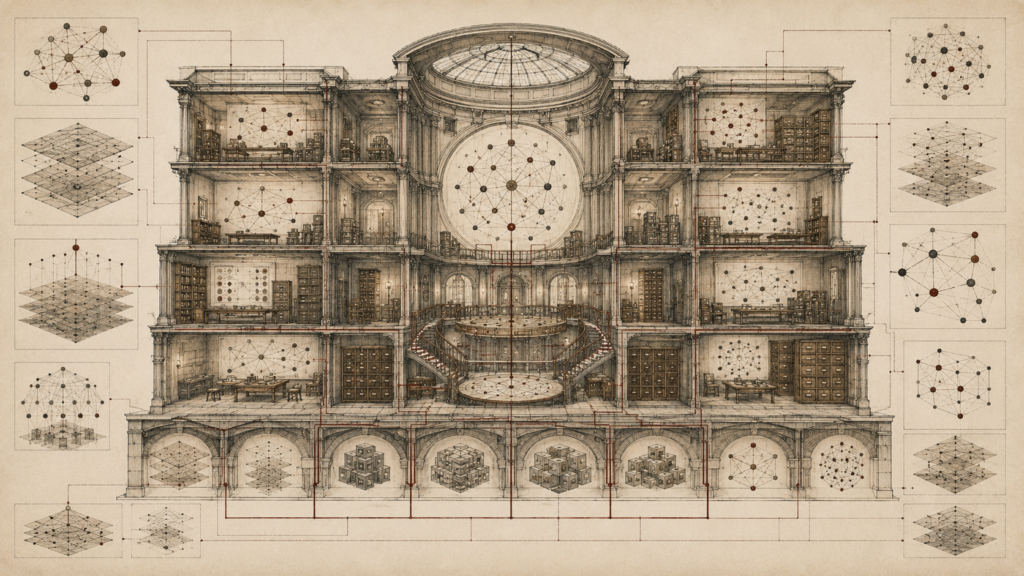
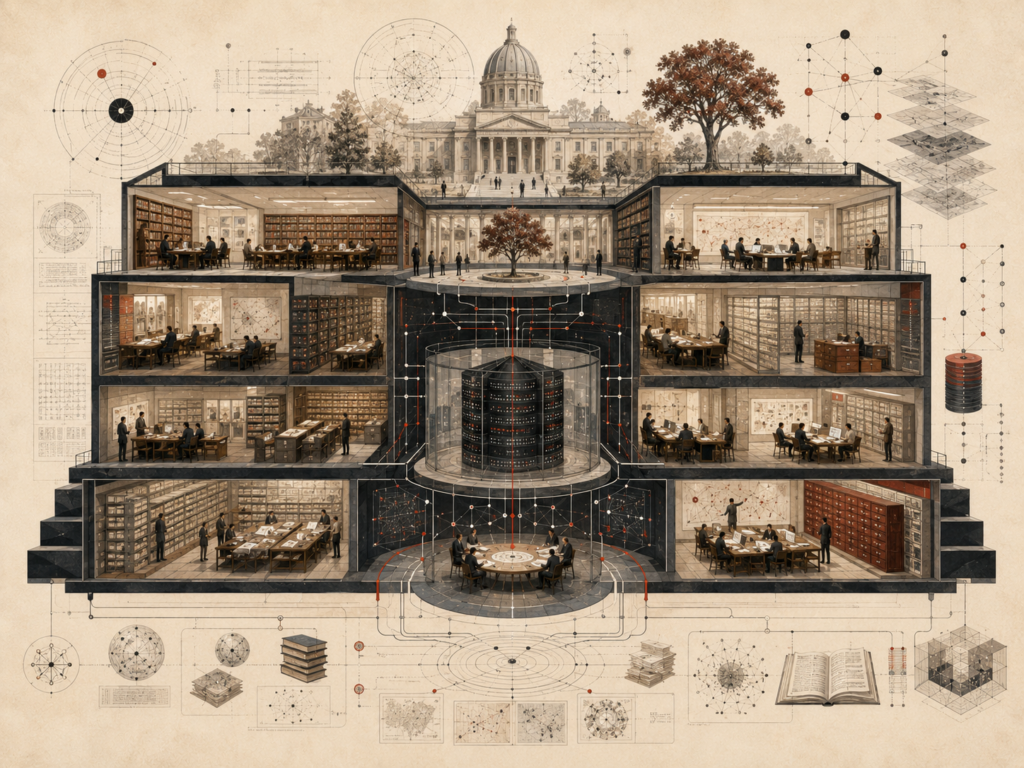
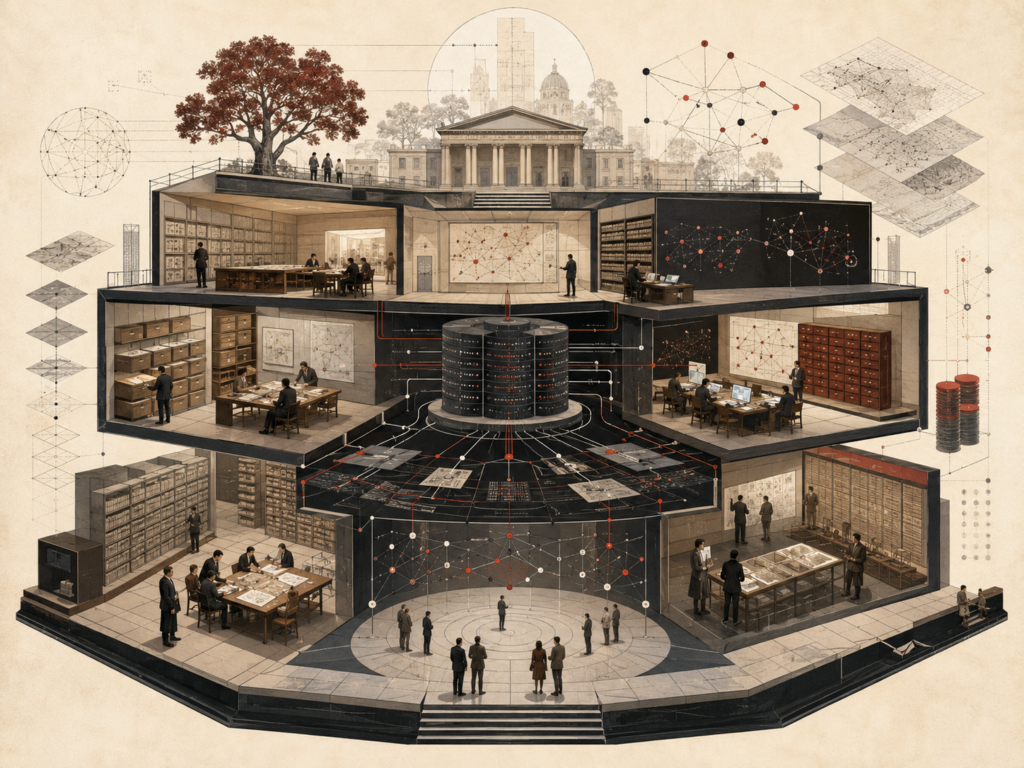
Editorial illustration of a research institution as a layered knowledge system, with archives, reading rooms, databases, semantic networks, analytical workspaces, and civic research infrastructure.

Knowledge Systems in Research Institutions

Knowledge systems in research institutions are the structures through which universities, laboratories, libraries, archives, hospitals, research centers, and policy institutes create, organize, preserve, share, evaluate, and reuse knowledge. This article explains why institutional knowledge systems must include more than publications or repositories: they also require metadata, taxonomies, archives, data offices, ethics records, research-information systems, governance practices, institutional memory, and responsible AI retrieval. It examines formal and informal knowledge systems, the research lifecycle, libraries, data stewardship, FAIR data, open science, interdisciplinary translation, knowledge graphs, institutional accountability, and epistemic justice. Within knowledge architecture, research institutions show why knowledge must be connected across people, projects, datasets, code, methods, sources, communities, and time. The article frames institutional knowledge systems as infrastructure for preserving context, supporting reproducibility, strengthening integrity, and making research knowledge findable, interpretable, reusable, and ethically governed.
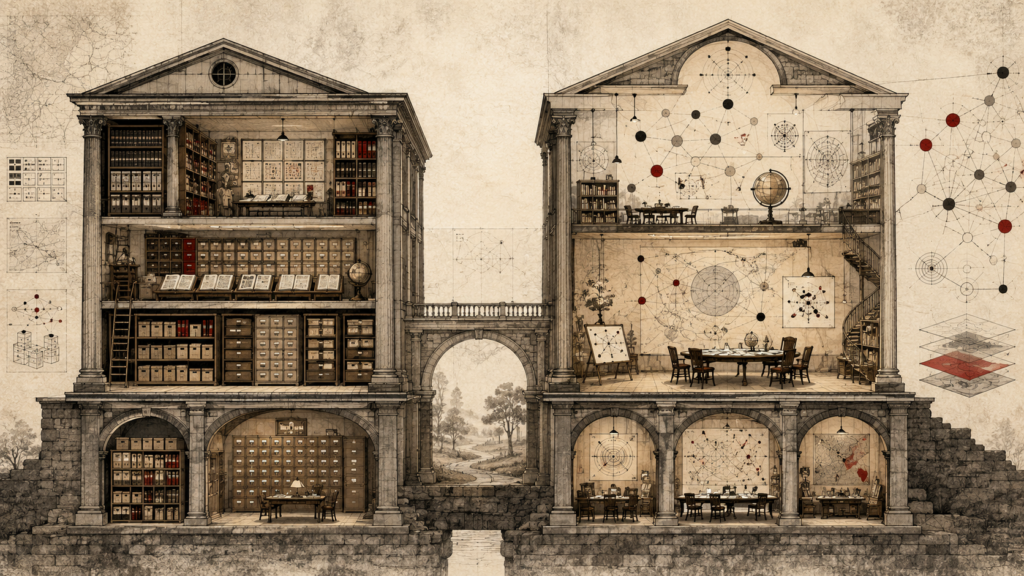
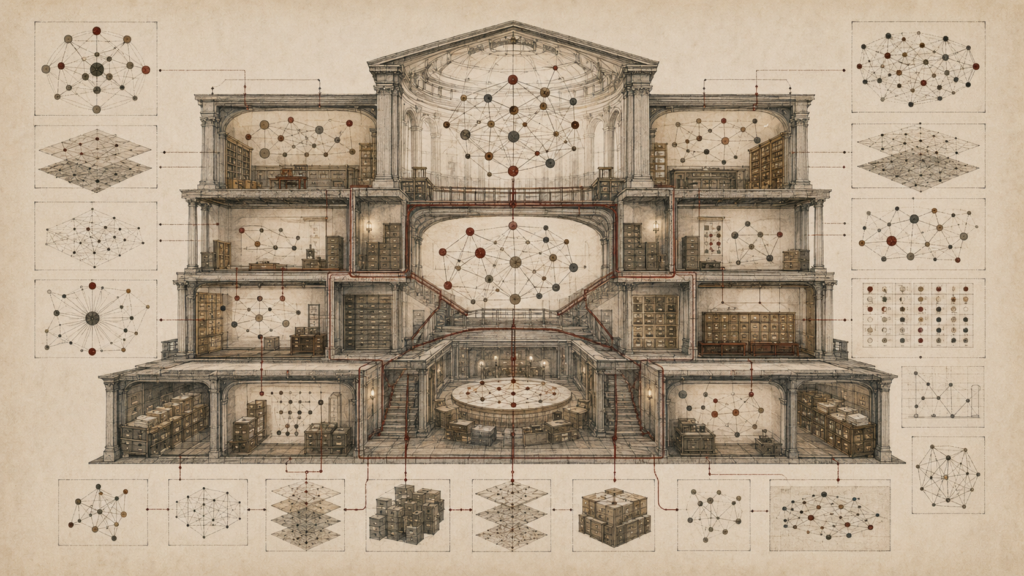
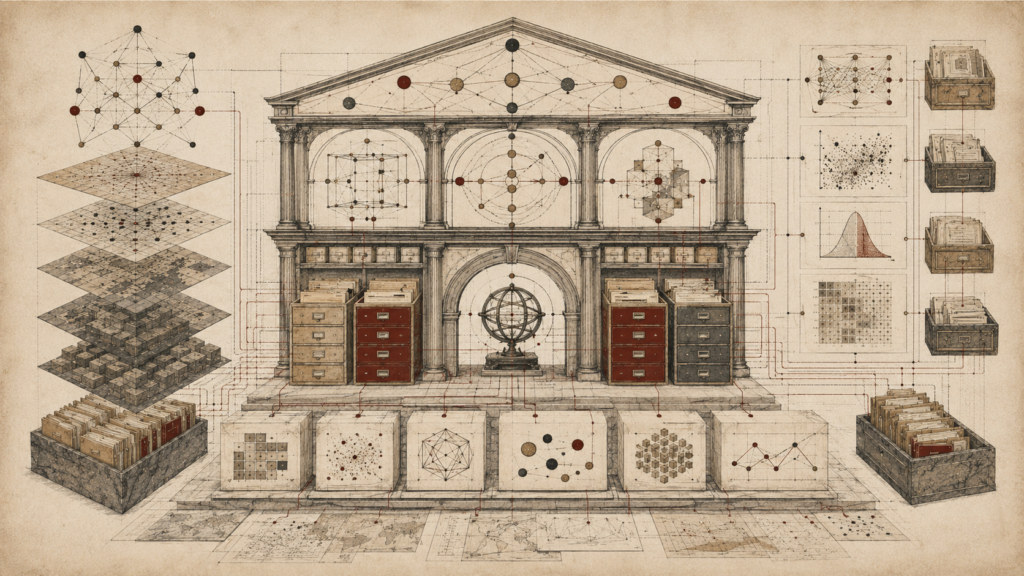
Editorial illustration of a grand archival knowledge structure with semantic node networks, linked concept clusters, layered graph diagrams, card catalogs, and interconnected knowledge chambers.

Ontologies and Semantic Networks

Ontologies and semantic networks organize knowledge by making relationships explicit. This article explains how ontologies define entities, classes, properties, constraints, and formal relationships, while semantic networks show how concepts, documents, datasets, methods, institutions, and ideas connect across fields of meaning. It examines ontology modeling, semantic relationships, RDF, RDFS, OWL, SKOS, linked data, metadata, knowledge graphs, research platforms, AI-assisted retrieval, governance, versioning, and interdisciplinary knowledge systems. Within knowledge architecture, ontologies and semantic networks provide the bridge between human conceptual organization and machine-readable structure. They help knowledge systems move beyond flat categories toward relationships that can be inspected, queried, revised, and reused. The article frames semantic structure as intellectual infrastructure for preserving meaning, improving retrieval, supporting responsible AI systems, and maintaining coherence across growing research platforms, digital libraries, repositories, article maps, and interdisciplinary knowledge environments.

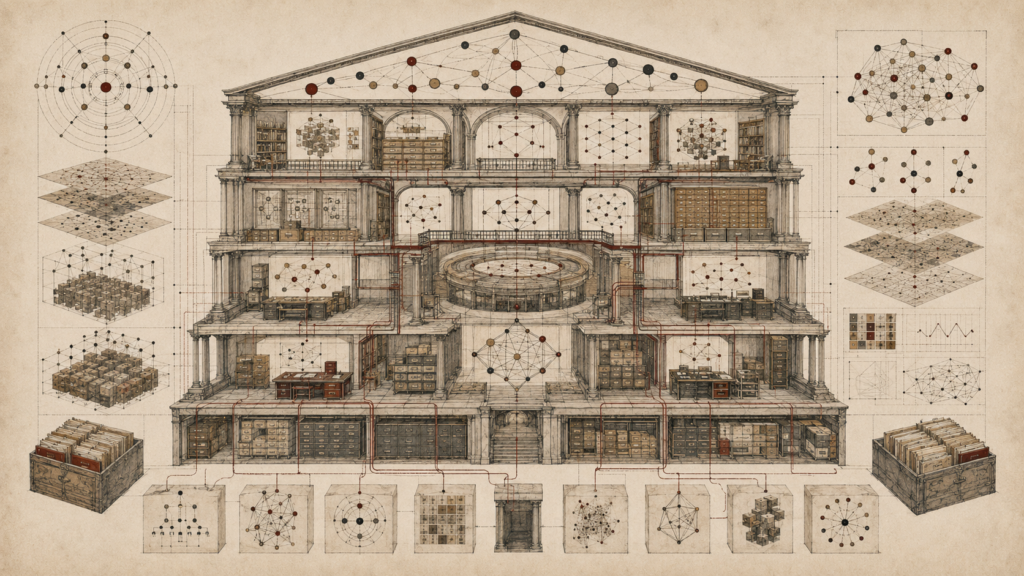
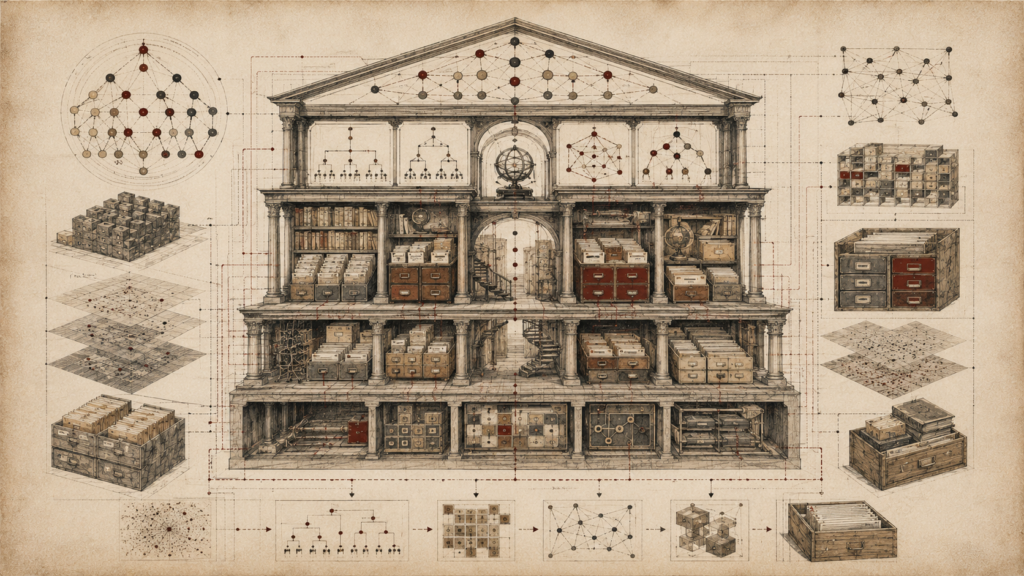
Editorial illustration of an architectural research framework with analytical diagrams, archival drawers, layered data maps, model blocks, and connected evidence pathways.

Research Frameworks and Analytical Models

Research frameworks and analytical models give inquiry its working structure by clarifying how a research problem is organized, which dimensions matter, what relationships should be examined, and how evidence should be interpreted. This article explains how frameworks, models, methods, evidence, and interpretation work together to move research from broad questions to structured analysis. It distinguishes conceptual, theoretical, analytical, methodological, causal, evaluative, and systems-oriented frameworks, while showing how models can take the form of diagrams, matrices, graphs, schemas, statistical structures, computational workflows, and evidence maps. Within knowledge architecture, research frameworks and analytical models help transform accumulated information into coherent inquiry. They support article maps, metadata schemas, repositories, reproducible code, interdisciplinary synthesis, AI-assisted retrieval, and transparent reasoning. The article frames frameworks and models as tools for making research visible, testable, revisable, and accountable across growing knowledge systems and institutional research platforms.

Scroll to Top