
Last Updated May 27, 2026
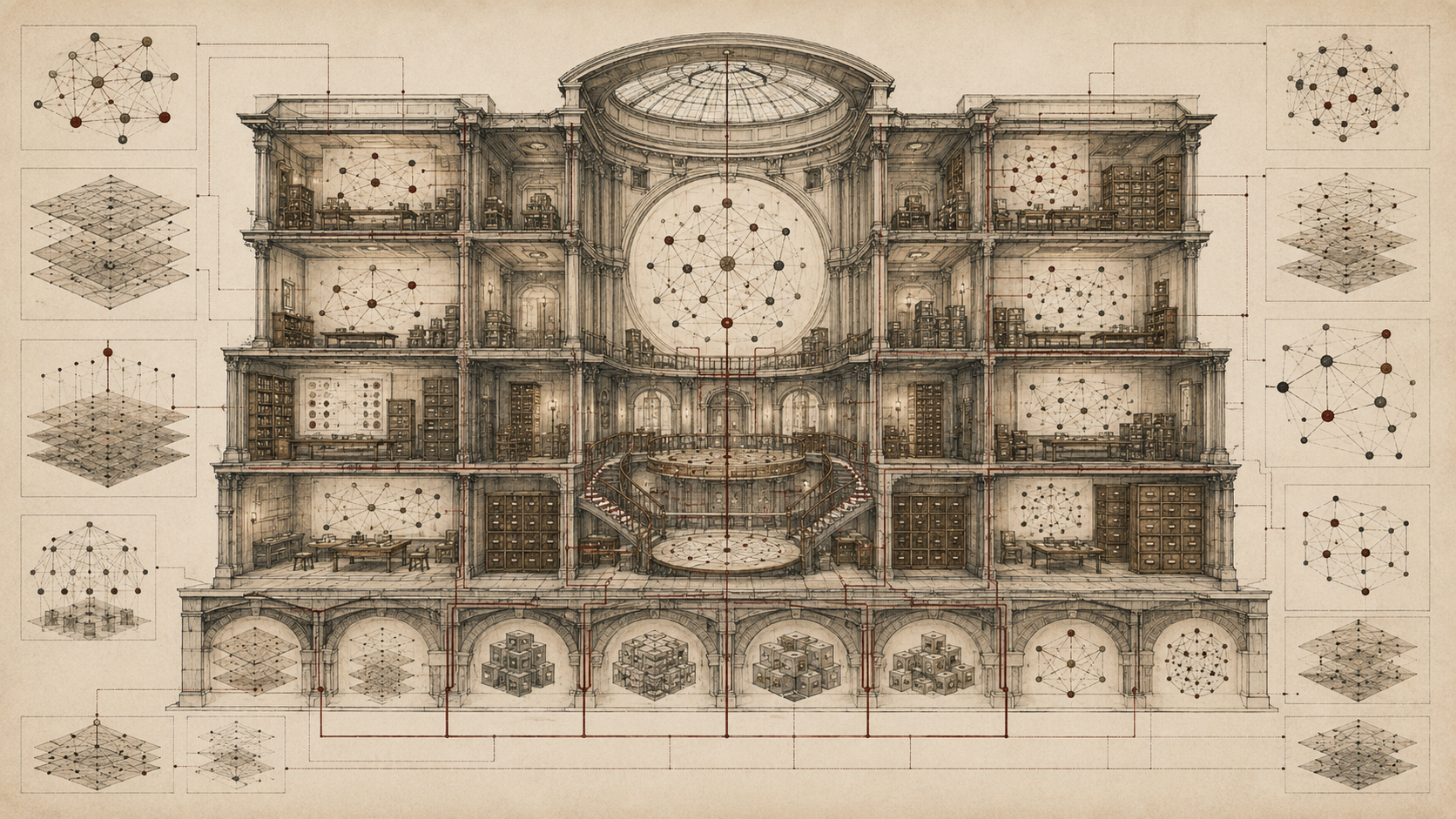
Knowledge mapping and conceptual models make the structure of understanding visible. They help researchers, educators, analysts, platform builders, and knowledge architects see how concepts relate, where evidence fits, which ideas are central, what pathways connect fields, and where gaps remain. A knowledge map does not merely show information. It shows the relationships that give information meaning.
Conceptual models serve a similar architectural function. They organize ideas into structured representations: diagrams, matrices, systems models, causal pathways, taxonomies, semantic networks, logic models, entity-relationship structures, and computational graphs. A conceptual model clarifies how a problem is being understood before analysis begins. It helps move inquiry from scattered terms to organized reasoning.
Within knowledge architecture, knowledge mapping and conceptual modeling connect frameworks, taxonomies, ontologies, metadata systems, knowledge graphs, research repositories, and article maps. They are practical tools for building intellectual infrastructure. They help a knowledge system become navigable, auditable, teachable, revisable, and capable of growth without losing coherence.
What Is Knowledge Mapping?
Knowledge mapping is the practice of representing concepts, relationships, evidence, actors, methods, domains, sources, and pathways so that the structure of a knowledge system can be seen, reviewed, and improved. A knowledge map may be visual, textual, tabular, computational, or semantic. It may appear as a concept map, topic map, article map, evidence map, systems diagram, ontology diagram, knowledge graph, research matrix, or repository structure.
The purpose of knowledge mapping is not simply to create a diagram. Its purpose is to make structure visible. A map shows what belongs to the system, how the parts connect, what levels of abstraction exist, which concepts are central, which areas are underdeveloped, where evidence is strong, and where conceptual gaps remain.
A knowledge map can support many tasks: orienting readers, guiding research, designing curricula, structuring article series, connecting datasets to methods, mapping evidence to claims, identifying internal-link opportunities, building knowledge graphs, and supporting AI-assisted retrieval. In each case, the map serves as a structured representation of meaning.
KM = (C, R, E, P, G)
\]
Interpretation: A knowledge map \(KM\) can be understood as a structure of concepts \(C\), relationships \(R\), evidence \(E\), pathways \(P\), and governance rules \(G\).
Knowledge mapping differs from ordinary organization because it emphasizes relationships. A list tells users what exists. A map shows how things connect. A folder tree stores objects. A knowledge map explains their intellectual placement. A tag system groups items. A knowledge map reveals conceptual pathways.
What Are Conceptual Models?
A conceptual model is a structured representation of how a problem, domain, system, process, or research question is understood. It identifies the key concepts, entities, relationships, assumptions, mechanisms, boundaries, and pathways that organize inquiry. A conceptual model may be expressed as prose, a diagram, a graph, a matrix, a schema, a logic model, a causal pathway, or a computational representation.
Conceptual models are used across many fields. In science, they help represent systems, mechanisms, and processes. In policy research, they clarify institutions, stakeholders, interventions, outcomes, and implementation pathways. In information science, they organize entities, metadata, categories, and relationships. In education, they structure learning pathways. In data systems, they define entities, attributes, and relationships before database implementation.
A conceptual model is not the same as the world it represents. It is a structured simplification. Its value depends on whether it clarifies the problem without distorting it. A good conceptual model helps users reason. A poor model hides assumptions, overstates certainty, or forces complexity into misleading form.
| Model Element | Function | Example |
|---|---|---|
| Concept | Defines a unit of meaning. | Knowledge map, taxonomy, ontology, repository, evidence source. |
| Relationship | Connects concepts or entities. | supports, depends on, belongs to, cites, extends, contrasts with. |
| Boundary | Defines scope. | Knowledge Architecture series rather than the entire field of information science. |
| Pathway | Shows movement or sequence. | Foundations → Taxonomy Design → Ontologies → Knowledge Graphs. |
| Evidence link | Connects claims to sources or data. | A W3C standard supports RDF terminology. |
| Governance rule | Maintains the model over time. | Review relationship types and deprecated terms quarterly. |
Conceptual models are essential to knowledge architecture because they bridge interpretation and implementation. They can guide article maps, metadata schemas, SQL databases, ontology design, GitHub repository structures, diagrams, code examples, and AI retrieval workflows. They give the system a design logic before technical implementation begins.
Why Mapping Matters in Knowledge Systems
Knowledge systems fail when their structure becomes invisible. A platform may contain strong articles, useful datasets, careful references, and valuable code, but users may not understand how the parts relate. Editors may not know where new material belongs. Researchers may miss important connections. AI systems may retrieve fragments without context. Mapping addresses these problems by making the structure of knowledge inspectable.
Mapping matters because knowledge is relational. A concept may depend on earlier concepts. An article may extend a framework. A dataset may support a model. A method may operationalize an idea. A source may define a standard. A repository folder may reproduce an analytical example. Without a map, these relationships remain implicit.
Knowledge mapping also supports scale. Small systems can rely on memory. Large systems cannot. As a knowledge platform grows, it needs article maps, concept maps, repository maps, metadata maps, evidence maps, and semantic relationship maps. These maps help the system grow coherently rather than merely accumulate material.
Mapping also helps identify gaps. A knowledge map can show that some concepts are highly connected while others are isolated. It can reveal missing evidence, weak relationships, overloaded categories, or underdeveloped domains. It can show where a series needs foundational articles, methods articles, applied examples, or repository support.
Finally, mapping supports accountability. If a knowledge system makes claims, users should be able to trace those claims to sources, methods, data, and interpretive frameworks. Knowledge maps make these pathways visible. They help transform publishing into maintained intellectual infrastructure.
Knowledge Maps as Knowledge Architecture
Knowledge maps are a form of knowledge architecture because they organize how a system understands itself. They show the relationship among domains, topics, concepts, methods, datasets, sources, and outputs. They help translate intellectual structure into navigable form.
An article map is one kind of knowledge map. It organizes a series into sections and article pathways. A taxonomy is another kind of map. It classifies topics into categories and levels. A knowledge graph is another. It connects entities and relationships. A repository structure is another. It maps code, data, documentation, and outputs to an article or research project.
These maps should align. If the article map says a topic belongs to one domain, the metadata should reflect that domain. If the GitHub repository has an article folder, the article’s GitHub block should point to it. If the SQL schema defines concepts and relationships, the article should explain those concepts and relationships. If a knowledge graph connects the article to a source, the references should support the connection.
| Knowledge Map Type | What It Organizes | Architectural Function |
|---|---|---|
| Article map | Articles and series structure. | Guides publication sequence and reader navigation. |
| Concept map | Concepts and conceptual relationships. | Clarifies meaning and dependencies. |
| Evidence map | Sources, claims, and evidence types. | Supports traceability and research integrity. |
| Repository map | Code, data, documentation, and outputs. | Supports reproducibility and technical maintenance. |
| Ontology map | Classes, properties, entities, and constraints. | Supports semantic modeling and interoperability. |
| Knowledge graph | Nodes, edges, metadata, and relationship types. | Supports semantic retrieval, discovery, and AI grounding. |
A mature knowledge architecture does not rely on one map. It uses multiple maps that reinforce one another. The article map gives public orientation. The taxonomy gives classification. The ontology gives semantic precision. The repository map gives reproducible structure. The knowledge graph gives relational depth. Together, they form a durable intellectual system.
Concepts, Relationships, Pathways, and Boundaries
Knowledge mapping depends on four basic design elements: concepts, relationships, pathways, and boundaries. Concepts are the units of meaning. Relationships explain how those units connect. Pathways show movement through the system. Boundaries define what belongs inside the map and what remains outside.
Concept selection is the first challenge. A map that includes too few concepts may oversimplify the domain. A map that includes too many may become unreadable. Concepts should be selected based on the purpose of the map. A teaching map may emphasize learning sequence. A research map may emphasize evidence and methods. A repository map may emphasize data, code, and outputs. A semantic map may emphasize relationship types.
Relationship design is the second challenge. A map that connects everything with vague lines is not very useful. Relationships should be named when possible. A concept may be broader than another, dependent on another, evidence for another, method for another, example of another, or in tension with another. These relationship types determine the meaning of the map.
Pathways are the third challenge. A knowledge system should help users move. A pathway may move from introductory to advanced material, from concept to evidence, from article to repository, from problem to method, from domain to subdomain, or from source to claim. A good map helps users travel through the system intentionally.
Boundaries are the fourth challenge. Every map excludes something. A knowledge map should be transparent about its scope. A map of knowledge architecture is not a map of all information science. A map of conceptual frameworks is not a map of every research method. Boundaries help preserve clarity.
MapQuality = C_r + R_c + P_u + B_s – A
\]
Interpretation: Map quality can be conceptualized as improving with relevant concepts \(C_r\), clear relationships \(R_c\), usable pathways \(P_u\), and scoped boundaries \(B_s\), while declining with ambiguity \(A\).
A knowledge map succeeds when it helps people understand the domain better than they could without it. It should clarify, not merely display. It should reveal structure, not merely decorate complexity.
Types of Knowledge Maps
Knowledge maps come in many forms because knowledge systems have many kinds of structure. Some maps organize topics. Some organize evidence. Some organize methods. Some organize learning pathways. Some organize relationships among people, institutions, documents, or data. Some maps are visual; others are tabular, semantic, or computational.
A concept map shows relationships among concepts. A topic map organizes subjects and domains. An evidence map connects claims to sources, datasets, or methods. A systems map shows feedback loops and causal pathways. A repository map organizes code, data, documentation, and outputs. A semantic map models typed relationships. A knowledge graph stores these relationships in a queryable form.
| Map Type | Main Purpose | Typical Use |
|---|---|---|
| Concept map | Shows relationships among ideas. | Research design, teaching, article planning, conceptual review. |
| Topic map | Organizes subject domains. | Article maps, site navigation, library structures. |
| Evidence map | Connects evidence to claims, outcomes, or questions. | Systematic review, policy research, research transparency. |
| Systems map | Represents feedback, flows, and interdependence. | Sustainability science, governance, public health, infrastructure. |
| Repository map | Connects code, data, documentation, and outputs. | Reproducible research and companion-code design. |
| Semantic map | Represents typed relationships among entities. | Ontologies, metadata systems, AI retrieval, knowledge graphs. |
| Learning map | Shows sequence from foundational to advanced material. | Curriculum design, course pathways, knowledge-series planning. |
Each map type answers a different question. A topic map asks where material belongs. A concept map asks how ideas relate. An evidence map asks what supports what. A repository map asks how artifacts are organized. A semantic map asks what relationship types exist. A learning map asks how understanding develops over time.
Complex knowledge systems often need several maps at once. A single map rarely carries the whole architecture. The challenge is to keep these maps aligned so they do not create contradictory structures.
Types of Conceptual Models
Conceptual models also take many forms. A model may represent a process, system, causal relationship, classification structure, data model, research framework, logic pathway, or semantic structure. The type of model should match the purpose of the inquiry.
A process model shows stages or steps. A causal model shows hypothesized influence. A systems model shows feedback and interdependence. A logic model connects inputs, activities, outputs, outcomes, and impacts. A data model defines entities and relationships for databases. A semantic model defines concepts and relationship types. A conceptual framework organizes inquiry.
| Conceptual Model Type | What It Represents | Knowledge Architecture Use |
|---|---|---|
| Process model | Stages, sequences, or workflows. | Show how taxonomy design moves from inventory to governance. |
| Causal model | Hypothesized cause-effect relationships. | Model how metadata quality affects retrieval quality. |
| Systems model | Feedback, interdependence, and constraints. | Represent knowledge-system growth, drift, and governance. |
| Logic model | Inputs, activities, outputs, outcomes, impacts. | Plan educational or policy knowledge systems. |
| Data model | Entities, attributes, and relationships. | Design SQL schemas for concepts, articles, and sources. |
| Semantic model | Classes, properties, and relationship types. | Support ontologies, knowledge graphs, and AI retrieval. |
| Research framework | Concepts, assumptions, evidence, and methods. | Organize inquiry across an article series or project. |
The best conceptual models are explicit about their purpose. A data model should not pretend to be a causal model. A causal model should not pretend to represent all relationships. A concept map should not imply evidence unless evidence is documented. A semantic model should not collapse contested meanings into fixed categories without explanation.
Conceptual modeling is therefore an act of disciplined simplification. It helps users think more clearly by making assumptions visible. It should reduce confusion without erasing complexity.
Mapping Evidence, Methods, and Sources
Knowledge mapping becomes especially important when a system needs to connect claims to evidence. A research platform should not only publish arguments. It should help users see what sources, datasets, methods, code, and outputs support those arguments. Evidence mapping makes these relationships visible.
An evidence map may connect a claim to a reference, a dataset, a method, a model, or a repository output. It may show which claims are strongly supported, which are provisional, which depend on synthetic examples, and which need future research. It can also show where a body of work is over-reliant on certain sources or underdeveloped in certain domains.
Method mapping is equally important. A method should be linked to the problem it addresses, the data it requires, the assumptions it makes, and the outputs it produces. A Python graph audit, an R taxonomy diagnostic, and a SQL schema are not merely code examples. They are methodological artifacts. They show how a conceptual model becomes inspectable.
| Mapped Object | Relationship to Preserve | Example |
|---|---|---|
| Claim | supportedBy | Knowledge maps support gap analysis. |
| Source | defines, supports, contextualizes | A W3C standard defines RDF concepts. |
| Dataset | usedBy, generatedBy, supportsModel | A synthetic concept table supports graph diagnostics. |
| Method | appliesTo, tests, models | Degree centrality helps identify central concepts. |
| Output | generatedBy, documents, validates | A CSV summary records node degrees. |
| Repository folder | supportsArticle, containsCode, containsData | An article folder supports reproducible examples. |
Evidence and method mapping support accountability. Users can see how a claim is supported, how an output was generated, and how the article connects to reproducible assets. This is especially important for knowledge systems that aspire to be research-grade rather than merely content-rich.
Knowledge Mapping for Research Platforms
Research platforms benefit from knowledge mapping because they contain many kinds of knowledge objects. Articles, source lists, datasets, code folders, figures, notebooks, article maps, taxonomies, ontologies, and metadata fields all need to connect. A platform that cannot show those relationships remains difficult to evaluate.
A knowledge map can show how a research platform is organized across levels. At the top may be libraries or publication areas. Beneath them may be article maps. Beneath article maps may be individual articles. Each article may connect to concepts, sources, code repositories, datasets, models, and outputs. Metadata can preserve these relationships in structured form.
For example, the Knowledge Architecture series can be mapped from foundations to taxonomy design, hierarchies, ontologies, semantic networks, knowledge graphs, conceptual models, digital libraries, AI-assisted organization, governance, and future knowledge platforms. This map gives readers orientation and gives editors a structure for future development.
Knowledge mapping also supports repository design. If each article has a corresponding GitHub folder, the repository can mirror the article map. Each folder can contain Python, R, Julia, SQL, Rust, Go, C++, Fortran, C, documentation, data, and outputs where appropriate. This makes the intellectual structure visible in code as well as prose.
Research platforms become stronger when the public article structure, repository structure, metadata structure, and semantic structure reinforce one another. Knowledge mapping is the practice that helps align these layers.
Conceptual Models and AI-Assisted Systems
AI-assisted systems benefit from conceptual models because models give retrieval systems structure. A language model can search text and generate summaries, but conceptual models help define what kinds of objects exist, how they relate, what roles they play, and which pathways matter. Without conceptual modeling, AI-assisted retrieval can flatten differences among articles, concepts, sources, datasets, and methods.
A conceptual model can distinguish a foundational article from an advanced method, a synthetic dataset from empirical evidence, a code example from a research claim, a taxonomy category from an ontology class, and a related concept from an equivalent concept. These distinctions matter for responsible retrieval and summarization.
Knowledge maps can also support AI grounding. They can provide article sequences, concept relationships, evidence pathways, and repository links. Instead of retrieving isolated passages, an AI system can retrieve context: the broader domain, prerequisite concepts, related articles, supporting sources, and reproducible artifacts.
However, AI does not remove the need for human conceptual modeling. Automated systems can suggest clusters, detect entities, or recommend links, but human review is needed to decide whether those relationships are meaningful and responsible. Conceptual models encode judgment. That judgment must remain inspectable.
Strong knowledge architecture therefore treats AI as a user of the map, not the author of the whole map. AI can help maintain, query, and extend knowledge structures, but the architecture should remain governed by human standards of meaning, evidence, ethics, and revision.
Governance, Versioning, and Revision
Knowledge maps and conceptual models must be governed because knowledge systems change. New articles are published. Concepts are revised. Evidence shifts. Categories split or merge. Repository structures evolve. AI systems introduce new retrieval pathways. A map that is not maintained eventually becomes misleading.
Governance defines how maps are created, reviewed, revised, versioned, and retired. It should clarify who can add concepts, who can approve relationship types, how evidence links are documented, how outdated models are handled, and how changes are recorded. Governance keeps maps from becoming decorative artifacts that no longer match the system they describe.
Versioning is especially important. A conceptual model may change as research develops. A knowledge map may need to show historical structure as well as current structure. If a category is renamed, if an article moves to a different series, or if a relationship is reinterpreted, users should be able to understand what changed and why.
| Governance Area | Purpose | Example Practice |
|---|---|---|
| Concept governance | Maintains definitions and scope. | Review whether “model,” “framework,” and “map” are used consistently. |
| Relationship governance | Maintains connection meaning. | Distinguish supports, cites, dependsOn, extends, and relatedTo. |
| Evidence governance | Preserves traceability. | Require source notes for evidence relationships. |
| Versioning | Tracks structural change. | Document map revisions and model changes. |
| Repository alignment | Keeps code assets connected to articles. | Validate that article folders match article slugs. |
| Review cycle | Prevents drift. | Schedule periodic article-map and repository audits. |
Governance should not freeze the map. A knowledge map should evolve as the knowledge system grows. The goal is disciplined revision: change that is visible, documented, and intellectually justified.
Mathematical and Computational Modeling
Knowledge maps and conceptual models can be represented computationally as graphs, matrices, adjacency lists, relational tables, ontologies, RDF triples, or repository manifests. These representations make structure inspectable. They can help identify central concepts, orphaned nodes, weak evidence links, missing methods, overloaded hubs, and underdeveloped pathways.
G_M = (V_C, E_R)
\]
Interpretation: A knowledge map graph \(G_M\) can be represented as concept nodes \(V_C\) and relationship edges \(E_R\).
Coverage = \frac{|C_E|}{|C_M|}
\]
Interpretation: Concept coverage can be approximated as the share of mapped concepts \(C_M\) that are linked to evidence-supported concepts \(C_E\).
PathwayDensity = \frac{|P|}{|C|}
\]
Interpretation: Pathway density can be approximated as the number of documented pathways \(P\) relative to mapped concepts \(C\). Low pathway density may indicate weak navigational structure.
OrphanRate = \frac{|O|}{|V|}
\]
Interpretation: Orphan rate measures the share of nodes \(O\) with no meaningful relationships among all nodes \(V\). Orphans may indicate weak integration or future expansion areas.
These metrics should support review rather than replace interpretation. A concept may be central because it is genuinely foundational, or because it is too vague. An orphaned node may be a neglected topic, or it may be newly introduced. A sparse map may be underdeveloped, or it may reflect careful scope. Computational modeling provides signals. Human interpretation determines meaning.
For knowledge architecture, the strongest approach combines conceptual modeling, computational diagnostics, repository documentation, and governance. The map becomes both an interpretive artifact and an auditable structure.
Python Section: Building a Lightweight Knowledge Map
The following Python example builds a lightweight knowledge map with concepts, relationships, evidence status, and pathway diagnostics. It produces CSV outputs that can support review and repository documentation.
# knowledge_mapping_conceptual_model.py
# Lightweight knowledge map and conceptual model diagnostics.

from pathlib import Path
import csv
from collections import defaultdict, Counter

ROOT = Path(".")
OUTPUTS = ROOT / "outputs"
OUTPUTS.mkdir(exist_ok=True)

concepts = [
    {"id": "knowledge_mapping", "label": "Knowledge Mapping", "type": "method"},
    {"id": "conceptual_model", "label": "Conceptual Model", "type": "model"},
    {"id": "taxonomy", "label": "Taxonomy", "type": "structure"},
    {"id": "ontology", "label": "Ontology", "type": "structure"},
    {"id": "knowledge_graph", "label": "Knowledge Graph", "type": "structure"},
    {"id": "metadata", "label": "Metadata", "type": "context"},
    {"id": "evidence_map", "label": "Evidence Map", "type": "evidence"},
    {"id": "repository", "label": "Repository", "type": "artifact"},
    {"id": "ai_retrieval", "label": "AI-Assisted Retrieval", "type": "application"},
]

relationships = [
    {"source": "knowledge_mapping", "target": "conceptual_model", "relationship": "uses", "evidence_linked": True},
    {"source": "knowledge_mapping", "target": "taxonomy", "relationship": "can_include", "evidence_linked": True},
    {"source": "knowledge_mapping", "target": "ontology", "relationship": "can_include", "evidence_linked": True},
    {"source": "knowledge_mapping", "target": "knowledge_graph", "relationship": "can_generate", "evidence_linked": True},
    {"source": "metadata", "target": "evidence_map", "relationship": "supports", "evidence_linked": True},
    {"source": "repository", "target": "conceptual_model", "relationship": "documents", "evidence_linked": False},
    {"source": "knowledge_graph", "target": "ai_retrieval", "relationship": "grounds", "evidence_linked": True},
    {"source": "ontology", "target": "knowledge_graph", "relationship": "structures", "evidence_linked": True},
    {"source": "taxonomy", "target": "metadata", "relationship": "informs", "evidence_linked": False},
]

degree = defaultdict(int)
relationship_counts = Counter()
evidence_linked_count = 0

for edge in relationships:
    degree[edge["source"]] += 1
    degree[edge["target"]] += 1
    relationship_counts[edge["relationship"]] += 1
    if edge["evidence_linked"]:
        evidence_linked_count += 1

concept_lookup = {concept["id"]: concept for concept in concepts}

with (OUTPUTS / "knowledge_map_node_diagnostics.csv").open("w", newline="", encoding="utf-8") as f:
    writer = csv.writer(f)
    writer.writerow(["id", "label", "type", "degree", "is_orphan"])
    for concept in concepts:
        concept_id = concept["id"]
        writer.writerow([
            concept_id,
            concept["label"],
            concept["type"],
            degree[concept_id],
            degree[concept_id] == 0
        ])

with (OUTPUTS / "knowledge_map_relationships.csv").open("w", newline="", encoding="utf-8") as f:
    writer = csv.DictWriter(
        f,
        fieldnames=["source", "target", "relationship", "evidence_linked"]
    )
    writer.writeheader()
    writer.writerows(relationships)

with (OUTPUTS / "relationship_type_summary.csv").open("w", newline="", encoding="utf-8") as f:
    writer = csv.writer(f)
    writer.writerow(["relationship", "count"])
    for relationship, count in relationship_counts.items():
        writer.writerow([relationship, count])

summary = {
    "concept_count": len(concepts),
    "relationship_count": len(relationships),
    "orphan_count": sum(1 for concept in concepts if degree[concept["id"]] == 0),
    "evidence_coverage": round(evidence_linked_count / len(relationships), 3),
    "relationship_type_count": len(relationship_counts)
}

with (OUTPUTS / "knowledge_map_summary.csv").open("w", newline="", encoding="utf-8") as f:
    writer = csv.writer(f)
    writer.writerow(["metric", "value"])
    for key, value in summary.items():
        writer.writerow([key, value])

print("Wrote knowledge mapping diagnostics to outputs/")
This example can be extended with graph libraries, repository manifests, RDF triples, article metadata, source links, ontology files, and visualization tools. The basic principle remains the same: a knowledge map should make concepts, relationships, and evidence status inspectable.
R Section: Conceptual Model Coverage Diagnostics
The following R example summarizes concept types, relationship types, degree counts, and evidence coverage for a conceptual model. It can help identify underdeveloped areas and support model review.
# conceptual_model_coverage_diagnostics.R
# Lightweight conceptual model diagnostics for knowledge mapping.

concepts <- data.frame(
  id = c(
    "knowledge_mapping",
    "conceptual_model",
    "taxonomy",
    "ontology",
    "knowledge_graph",
    "metadata",
    "evidence_map",
    "repository",
    "ai_retrieval"
  ),
  label = c(
    "Knowledge Mapping",
    "Conceptual Model",
    "Taxonomy",
    "Ontology",
    "Knowledge Graph",
    "Metadata",
    "Evidence Map",
    "Repository",
    "AI-Assisted Retrieval"
  ),
  type = c(
    "method",
    "model",
    "structure",
    "structure",
    "structure",
    "context",
    "evidence",
    "artifact",
    "application"
  )
)

relationships <- data.frame(
  source = c(
    "knowledge_mapping",
    "knowledge_mapping",
    "knowledge_mapping",
    "knowledge_mapping",
    "metadata",
    "repository",
    "knowledge_graph",
    "ontology",
    "taxonomy"
  ),
  target = c(
    "conceptual_model",
    "taxonomy",
    "ontology",
    "knowledge_graph",
    "evidence_map",
    "conceptual_model",
    "ai_retrieval",
    "knowledge_graph",
    "metadata"
  ),
  relationship = c(
    "uses",
    "can_include",
    "can_include",
    "can_generate",
    "supports",
    "documents",
    "grounds",
    "structures",
    "informs"
  ),
  evidence_linked = c(TRUE, TRUE, TRUE, TRUE, TRUE, FALSE, TRUE, TRUE, FALSE)
)

dir.create("outputs", showWarnings = FALSE)

concept_type_summary <- as.data.frame(table(concepts$type))
names(concept_type_summary) <- c("concept_type", "count")

relationship_summary <- as.data.frame(table(relationships$relationship))
names(relationship_summary) <- c("relationship", "count")

degree_table <- data.frame(
  id = concepts$id,
  label = concepts$label,
  type = concepts$type,
  degree = sapply(concepts$id, function(x) {
    sum(relationships$source == x) + sum(relationships$target == x)
  })
)

degree_table$is_orphan <- degree_table$degree == 0

coverage_summary <- data.frame(
  relationship_count = nrow(relationships),
  evidence_linked_relationships = sum(relationships$evidence_linked),
  evidence_coverage = mean(relationships$evidence_linked),
  orphan_count = sum(degree_table$is_orphan)
)

write.csv(concept_type_summary, "outputs/concept_type_summary.csv", row.names = FALSE)
write.csv(relationship_summary, "outputs/model_relationship_summary.csv", row.names = FALSE)
write.csv(degree_table, "outputs/model_degree_table.csv", row.names = FALSE)
write.csv(coverage_summary, "outputs/model_coverage_summary.csv", row.names = FALSE)

print(concept_type_summary)
print(relationship_summary)
print(degree_table)
print(coverage_summary)
R is useful for conceptual model review because it can summarize coverage, concept balance, relationship distribution, and evidence support. These diagnostics help transform mapping from a static diagram into a repeatable review practice.
SQL Section: Knowledge Map and Conceptual Model Schema
SQL can support knowledge mapping by storing maps, concepts, relationships, pathways, evidence links, model versions, and revision records. A relational schema can serve as a practical bridge between conceptual modeling and more advanced semantic or graph infrastructure.
-- knowledge_mapping_conceptual_model_schema.sql
-- Minimal schema for knowledge maps, conceptual models, concepts, relationships, and evidence.

CREATE TABLE IF NOT EXISTS knowledge_maps (
  map_id TEXT PRIMARY KEY,
  title TEXT NOT NULL,
  purpose TEXT,
  domain TEXT,
  version TEXT,
  status TEXT DEFAULT 'draft',
  created_at DATE,
  updated_at DATE
);

CREATE TABLE IF NOT EXISTS map_concepts (
  concept_id TEXT PRIMARY KEY,
  map_id TEXT NOT NULL,
  label TEXT NOT NULL,
  concept_type TEXT,
  definition TEXT,
  scope_note TEXT,
  status TEXT DEFAULT 'active',
  FOREIGN KEY (map_id) REFERENCES knowledge_maps(map_id)
);

CREATE TABLE IF NOT EXISTS map_relationships (
  relationship_id INTEGER PRIMARY KEY,
  map_id TEXT NOT NULL,
  source_concept_id TEXT NOT NULL,
  target_concept_id TEXT NOT NULL,
  relationship_type TEXT NOT NULL,
  evidence_status TEXT DEFAULT 'provisional',
  notes TEXT,
  FOREIGN KEY (map_id) REFERENCES knowledge_maps(map_id),
  FOREIGN KEY (source_concept_id) REFERENCES map_concepts(concept_id),
  FOREIGN KEY (target_concept_id) REFERENCES map_concepts(concept_id)
);

CREATE TABLE IF NOT EXISTS evidence_sources (
  evidence_id TEXT PRIMARY KEY,
  citation TEXT NOT NULL,
  source_type TEXT,
  url TEXT,
  notes TEXT
);

CREATE TABLE IF NOT EXISTS relationship_evidence (
  relationship_id INTEGER NOT NULL,
  evidence_id TEXT NOT NULL,
  evidence_role TEXT,
  PRIMARY KEY (relationship_id, evidence_id),
  FOREIGN KEY (relationship_id) REFERENCES map_relationships(relationship_id),
  FOREIGN KEY (evidence_id) REFERENCES evidence_sources(evidence_id)
);

CREATE TABLE IF NOT EXISTS map_pathways (
  pathway_id TEXT PRIMARY KEY,
  map_id TEXT NOT NULL,
  title TEXT NOT NULL,
  pathway_type TEXT,
  description TEXT,
  FOREIGN KEY (map_id) REFERENCES knowledge_maps(map_id)
);

CREATE TABLE IF NOT EXISTS map_revisions (
  revision_id INTEGER PRIMARY KEY,
  map_id TEXT NOT NULL,
  change_type TEXT NOT NULL,
  change_note TEXT,
  changed_at DATE,
  FOREIGN KEY (map_id) REFERENCES knowledge_maps(map_id)
);
This schema separates maps, concepts, relationships, evidence sources, pathways, and revisions. That separation matters because a map is not the same as its concepts, a relationship is not the same as evidence, and a revision is not noise. These distinctions allow the system to preserve context and change over time.
A schema like this can support article maps, research pathways, evidence reviews, repository documentation, AI retrieval metadata, and knowledge-graph exports. It gives conceptual modeling a durable data structure.
GitHub Repository
This article is supported by a companion repository folder with reproducible examples, small synthetic datasets, documentation, and language-specific modeling scaffolds for knowledge mapping and conceptual model analysis.
Complete Code Repository
This folder contains companion research and code assets for the Knowledge Mapping and Conceptual Models article, including Python, R, Julia, SQL, Rust, Go, C++, Fortran, C, documentation, data, and generated outputs.
The repository structure mirrors the article’s mapping and modeling argument. Python supports lightweight knowledge-map construction and diagnostics. R supports concept coverage, relationship summaries, and evidence-status analysis. SQL supports knowledge maps, concepts, relationships, evidence links, pathways, and revisions. Systems-language folders provide space for validation utilities, graph-processing experiments, and reproducible tooling. Documentation, data, and outputs preserve the connection between conceptual modeling, computational review, and knowledge-system governance.
Quality Criteria for Knowledge Mapping
A good knowledge map should be clear, purposeful, scoped, relationship-aware, evidence-aware, usable, governed, and revisable. It should help users understand the domain more effectively than a list or search result would. It should show relationships without overwhelming users. It should make assumptions visible.
Clarity means concepts and relationship types are understandable. Purpose means the map is designed for a specific task, such as research planning, teaching, repository design, article sequencing, or evidence review. Scope means the map defines its boundaries. Relationship awareness means connections are named and meaningful. Evidence awareness means claims and pathways are traceable. Usability means the map helps real users. Governance means it can be maintained.
| Quality Criterion | Evaluation Question | Warning Sign |
|---|---|---|
| Clarity | Are concepts and relationships understandable? | The map looks impressive but users cannot explain it. |
| Purpose | Does the map support a defined task? | The map includes many elements without a clear use case. |
| Scope | Are boundaries visible? | The map expands until it tries to represent everything. |
| Relationship quality | Are connections named and meaningful? | Most links are vague “related to” relationships. |
| Evidence awareness | Are claims and pathways traceable? | The map asserts relationships without sources or rationale. |
| Usability | Can users navigate or apply the map? | The map is too dense or too abstract to guide action. |
| Governance | Can the map be revised and audited? | No versioning, ownership, or review process exists. |
Knowledge mapping should be evaluated with both structural diagnostics and human review. A computational audit can identify orphaned nodes, missing evidence, and relationship imbalance. Human review must decide whether the map is intellectually responsible, domain-appropriate, and useful.
Interpretive Cautions and Ethical Limits
Knowledge maps and conceptual models are powerful because they shape how people see a domain. They decide what appears central, what appears peripheral, what is connected, what is missing, and what pathways seem natural. This power creates responsibility.
A map can clarify, but it can also distort. It can make uncertain relationships look settled. It can make contested categories appear neutral. It can hide marginalized knowledge by omitting it or placing it at the edge. It can privilege concepts that are easier to formalize while ignoring lived experience, tacit knowledge, oral traditions, or historical silences.
Conceptual models can also over-simplify. They can reduce social, ecological, legal, cultural, or ethical complexity into boxes and arrows. They can make causal relationships appear stronger than the evidence supports. They can create a false sense of completeness. A clean model is not necessarily a true model.
Responsible knowledge mapping should therefore include scope notes, uncertainty, provenance, revision history, and interpretive humility. It should distinguish evidence from assumption, similarity from equivalence, influence from causation, and visibility from importance. It should remain open to critique.
The goal is not to avoid mapping. Without maps, complex knowledge becomes difficult to navigate. The goal is to map responsibly: to make structure visible while acknowledging that every map is partial, situated, and revisable.
Why Knowledge Mapping Belongs to Knowledge Architecture
Knowledge mapping belongs to knowledge architecture because architecture requires visible structure. A knowledge system cannot be governed, expanded, or trusted if its relationships are hidden. Mapping makes the architecture inspectable.
For article maps, knowledge mapping shows publication pathways. For taxonomies, it shows categories and subcategories. For ontologies, it shows classes and properties. For knowledge graphs, it shows nodes and semantic relationships. For repositories, it shows how code, data, documents, and outputs support articles. For AI-assisted systems, it provides structured context for retrieval and summarization.
Conceptual models belong to knowledge architecture for the same reason. They organize how a system understands a problem. They clarify concepts, relationships, boundaries, and assumptions. They help transform scattered ideas into structured inquiry.
At their best, knowledge maps and conceptual models turn complexity into navigable intellectual infrastructure. They do not eliminate ambiguity. They make ambiguity visible. They do not replace interpretation. They support it. They do not freeze knowledge. They give it a structure that can be revised. That is why mapping and modeling are foundational practices for any knowledge system that aims to grow without losing meaning.
Related Articles
- Foundations of Knowledge Architecture
- What Is Knowledge Architecture?
- Conceptual Frameworks in Research
- Research Frameworks and Analytical Models
- Taxonomy Design for Knowledge Systems
- Knowledge Graphs and Semantic Relationships
Further Reading
- Eppler, M.J. (2006) ‘A Comparison between Concept Maps, Mind Maps, Conceptual Diagrams, and Visual Metaphors as Complementary Tools for Knowledge Construction and Sharing’, Information Visualization, 5(3), pp. 202–210.
- Hyerle, D. (2009) Visual Tools for Transforming Information into Knowledge. 2nd edn. Thousand Oaks, CA: Corwin Press.
- Novak, J.D. and Cañas, A.J. (2008) The Theory Underlying Concept Maps and How to Construct and Use Them. Institute for Human and Machine Cognition.
- Okada, A., Buckingham Shum, S. and Sherborne, T. (eds.) (2008) Knowledge Cartography: Software Tools and Mapping Techniques. London: Springer.
- Wheeldon, J. and Faubert, J. (2009) ‘Framing Experience: Concept Maps, Mind Maps, and Data Collection in Qualitative Research’, International Journal of Qualitative Methods, 8(3), pp. 68–83.
References
- Eppler, M.J. (2006) ‘A Comparison between Concept Maps, Mind Maps, Conceptual Diagrams, and Visual Metaphors as Complementary Tools for Knowledge Construction and Sharing’, Information Visualization, 5(3), pp. 202–210. Available at: https://doi.org/10.1057/palgrave.ivs.9500131
- Novak, J.D. and Cañas, A.J. (2008) The Theory Underlying Concept Maps and How to Construct and Use Them. Institute for Human and Machine Cognition. Available at: https://cmap.ihmc.us/docs/theory-of-concept-maps
- Okada, A., Buckingham Shum, S. and Sherborne, T. (eds.) (2008) Knowledge Cartography: Software Tools and Mapping Techniques. London: Springer.
- W3C (2009) SKOS Simple Knowledge Organization System Reference. W3C Recommendation. Available at: https://www.w3.org/TR/skos-reference/
- W3C (2014) RDF 1.1 Concepts and Abstract Syntax. W3C Recommendation. Available at: https://www.w3.org/TR/rdf11-concepts/
- Wheeldon, J. and Faubert, J. (2009) ‘Framing Experience: Concept Maps, Mind Maps, and Data Collection in Qualitative Research’, International Journal of Qualitative Methods, 8(3), pp. 68–83. Available at: https://doi.org/10.1177/160940690900800307