
Energy Systems

Energy Systems examines the technical, institutional, economic, ecological, and geopolitical foundations of modern energy life. It treats energy as more than a sector of infrastructure or a collection of technologies. Energy systems shape industrial production, transportation, housing, agriculture, public health, national security, household wellbeing, and the material conditions of development. They also sit at the center of climate change, environmental risk, resource extraction, public investment, and long-term questions about justice, resilience, and planetary responsibility.

This category explores how societies produce, convert, store, transmit, distribute, govern, and use energy across scales. Topics include electricity grids, renewable energy, fossil-fuel transition, nuclear power, energy storage, hydrogen, electrification, efficiency, industrial decarbonization, energy markets, public utilities, critical minerals, infrastructure resilience, and energy access. It also examines the social and political dimensions of energy transformation: who benefits, who bears risk, how transition costs are distributed, and how energy policy can support both ecological stability and human flourishing.

At its core, Energy Systems is a category for understanding one of the defining transitions of the twenty-first century: the movement from high-carbon, extraction-intensive energy regimes toward cleaner, more resilient, more equitable, and more intelligently governed systems. It connects engineering and infrastructure with public policy, economics, environmental science, systems thinking, and institutional design.

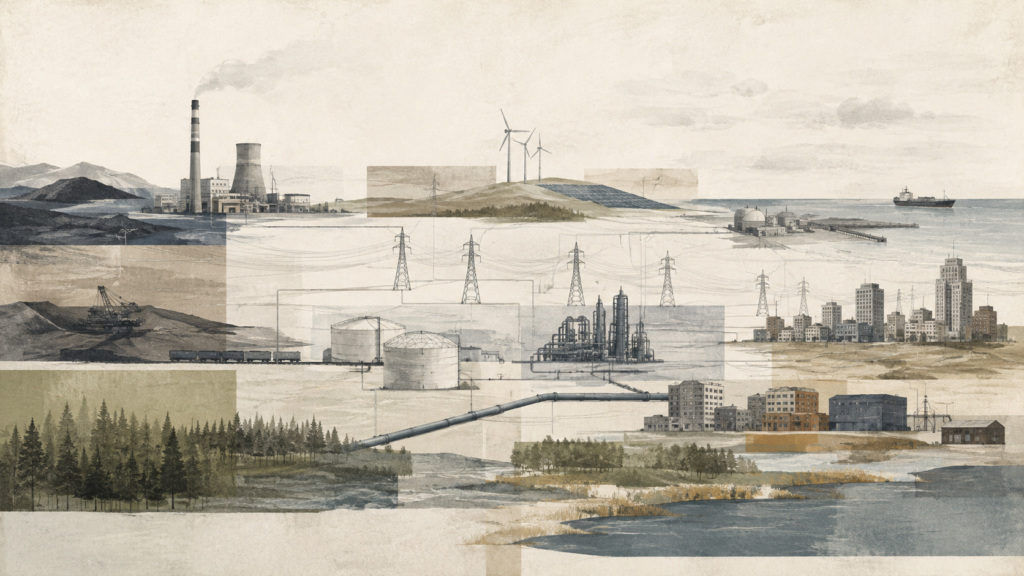
Layered editorial landscape showing power generation, transmission lines, pipelines, energy storage, industrial facilities, cities, forests, and waterways as parts of an interconnected energy system.

What Are Energy Systems? Infrastructure, Energy Flows, and Society

Energy systems connect resources, infrastructure, technologies, institutions, markets, ecosystems, and people through the production, conversion, movement, storage, and use of energy. This article introduces energy systems as more than collections of power plants, fuels, grids, and devices. It explains how physical flows interact with policy, finance, governance, public health, environmental limits, social demand, and questions of justice. Readers are introduced to system boundaries, primary and final energy, conversion losses, infrastructure networks, storage, reliability, resilience, emissions, affordability, and public value. The article also shows why energy decisions create trade-offs across time, geography, communities, and sectors. By examining technical and institutional relationships together, it provides a foundation for understanding electricity grids, fuels, storage, markets, decarbonization, energy security, and long-term transition. The goal is to help readers analyze how energy systems behave, whom they serve, where they fail, and how they can change.
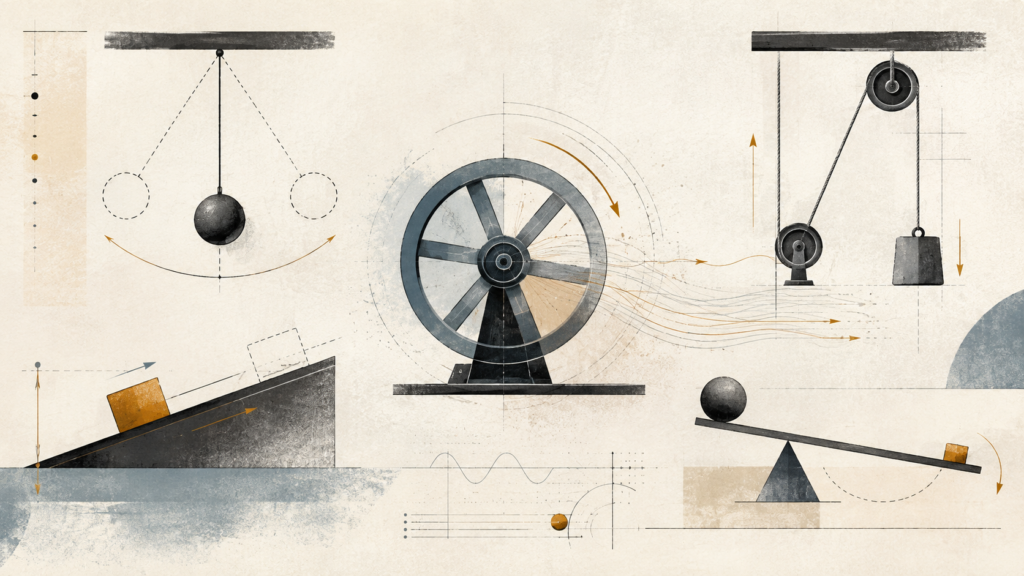
Editorial diagram showing a pendulum, wheel, pulley, inclined plane, and lever in a restrained mechanical composition representing the relationships among energy, power, and work.

Energy, Power, and Work: Foundations of Energy Systems

Energy, power, and work provide the essential foundation for understanding how modern energy systems function. This article explains how energy is stored, transferred, converted, measured, and used across physical, technological, and social systems. It clarifies the difference between energy and power, shows how work represents energy transfer, and introduces key ideas such as efficiency, capacity, demand, losses, and system boundaries. The discussion connects basic physics to electricity grids, transportation, buildings, industry, storage, and decarbonization. Rather than treating energy as an abstract quantity, the article shows how timing, scale, infrastructure, and conversion processes shape real-world outcomes. Equations, examples, and practical workflows support a rigorous but accessible introduction. Together, these concepts establish the vocabulary and analytical framework needed to evaluate energy technologies, compare system performance, understand trade-offs, and explore the wider transformation of energy systems toward greater reliability, affordability, resilience, and sustainability.

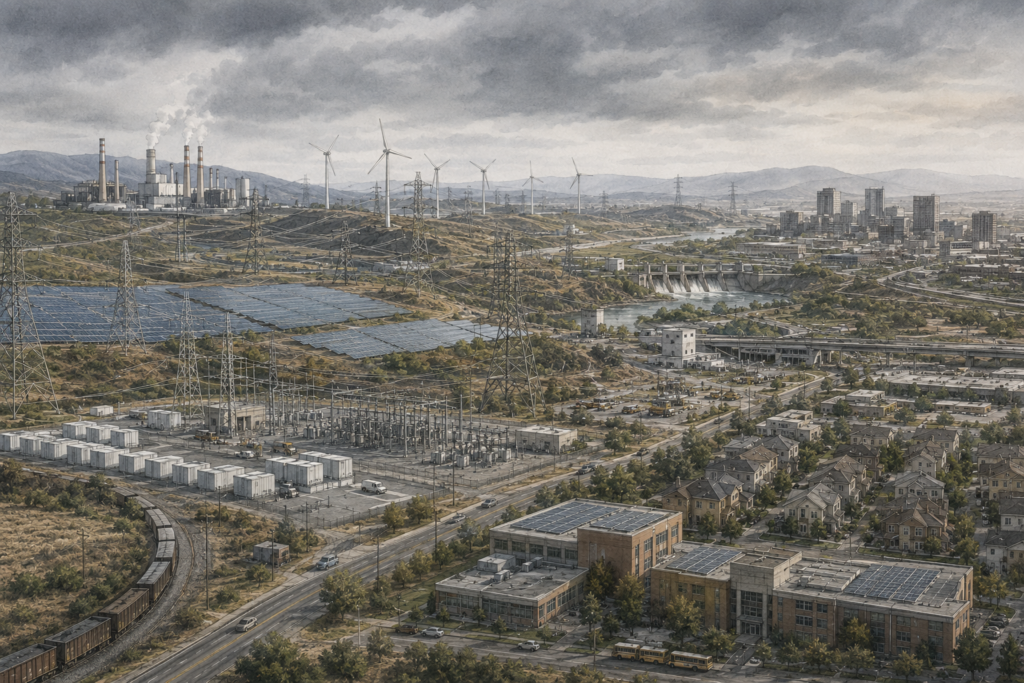
A wide institutional landscape showing interconnected energy infrastructure, including transmission lines, substations, solar fields, wind turbines, battery storage, rail corridors, industrial plants, neighborhoods, public buildings, and a modest urban core under changing skies.

Energy Systems: Infrastructure, Transition, Resilience, and Decarbonization

Energy Systems examines how societies produce, store, transmit, distribute, govern, finance, and use energy. This article map organizes the series across electricity grids, renewable power, fossil-fuel transition, nuclear energy, storage, electrification, industrial decarbonization, critical minerals, energy justice, markets, public utilities, infrastructure resilience, and long-term systems transformation. The series treats energy as more than a technical sector. Energy shapes industrial production, transportation, housing, food systems, public health, national security, climate stability, economic development, and everyday wellbeing. It also concentrates central conflicts of the twenty-first century: ecological limits, affordability, reliability, extraction, geopolitical dependency, public investment, and the transition away from high-carbon systems. This map provides the architecture for planned articles, computational models, reproducible code, datasets, and scenario-based learning across the energy transition, while linking infrastructure, justice, resilience, and decarbonization to public purpose and long-range systems stewardship for future generations everywhere sustainably.

Scroll to Top