Psychology

Psychology explores the cognitive, emotional, and social processes that shape human behavior. The discipline examines how individuals perceive information, form beliefs, make decisions, interact with others, and respond to complex environments.

Modern psychological research spans multiple domains, including cognitive psychology, behavioral economics, social psychology, and positive psychology. Together, these fields provide insights into decision-making, motivation, learning, and the social dynamics that influence collective behavior.

Understanding psychological processes is essential for designing effective institutions, policies, and communication strategies. Behavioral insights help explain why individuals and groups respond to incentives, social norms, and institutional structures in ways that often diverge from purely rational models.

Psychology therefore plays an important role in fields ranging from public policy and organizational leadership to sustainability governance and technological design.

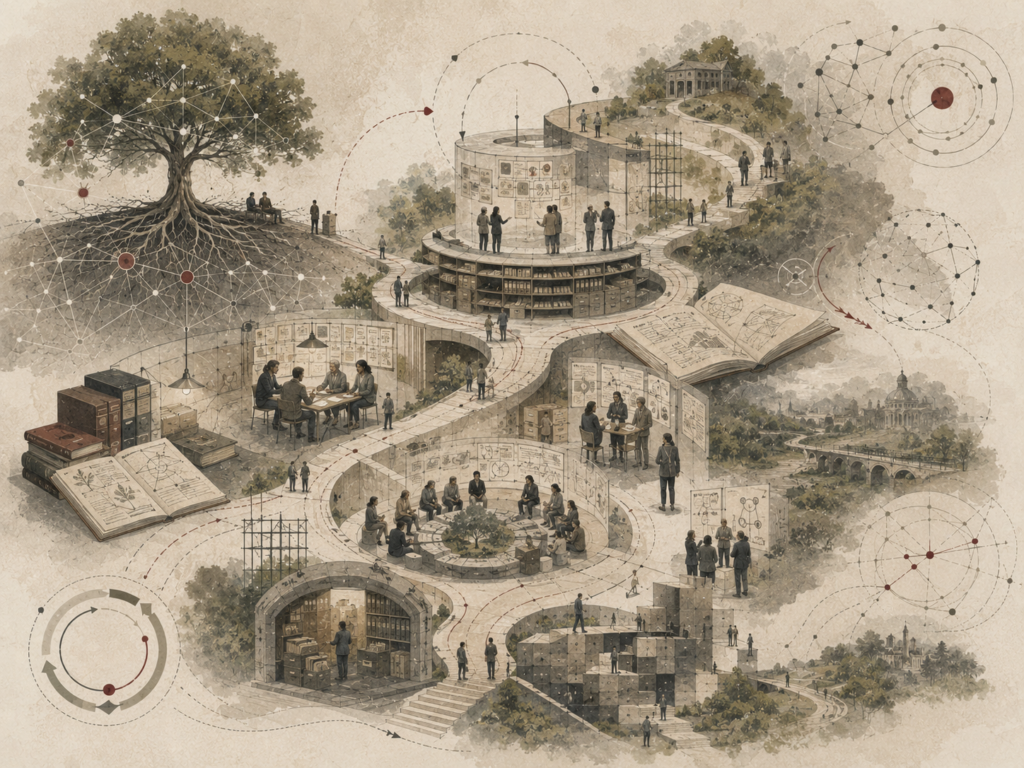
Restrained institutional illustration of people working across layered organizational spaces, restored structures, shared courtyards, pathways, scaffolding, and faint network lines representing culture change.

Culture Change in Organizations

Culture change is the institutional process through which organizations revise the shared meanings, norms, assumptions, and symbolic patterns that govern behavior across time. This article treats culture change not as a branding exercise or policy update, but as a deeper transformation of identity, authority, reinforcement, learning, and institutional legitimacy. It examines the layered nature of culture, major models of cultural transformation, the role of leadership and subcultures, the relationship between culture and resistance, and the conditions under which new values become socially credible. A semi-formal model clarifies the determinants of culture change capacity, while substantial R and Python sections provide practical starting points for analyzing cultural alignment, resistance intensity, and successful adoption across organizational units.

Restrained institutional illustration of civic buildings, archives, courtyards, public deliberation, organizational records, bridges, and network lines representing identity and legitimacy.

Organizational Identity and Institutional Legitimacy

Organizational identity is the shared understanding through which members interpret what their institution is, what it stands for, and how it distinguishes itself from other organizations. This article examines identity as a cognitive, symbolic, and institutional framework that links internal meaning with external legitimacy. It explores the classic central-enduring-distinctive model, the role of legitimacy and institutional fields, the tension between identity stability and adaptive change, the importance of leadership narrative, and the complexity of plural identities in large institutions. A semi-formal model clarifies the determinants of identity coherence and stakeholder legitimacy, while substantial R and Python sections provide practical starting points for analyzing alignment, contradiction, fragmentation, and trust across organizational units.

Restrained institutional illustration of people working, meeting, reviewing records, and collaborating across civic organizational spaces, representing values and behavioral expectations.

Institutional Values and Behavioral Expectations in Organizations

Institutional values are more than formal value statements or public-facing ethics language. They are the shared normative structures that shape how people inside organizations interpret responsibility, authority, cooperation, accountability, and legitimate conduct. In practice, values guide behavior where rules are incomplete: how leaders respond to bad news, how teams handle conflict, how dissent is treated, how mistakes are reviewed, and what forms of success remain acceptable under pressure. Values become institutionally real only when they are enacted through leadership behavior, incentives, accountability systems, psychological safety, resource allocation, governance routines, and organizational memory. When values are consistently reinforced, they help coordinate behavior across complex organizations and sustain trust. When they are symbolic or decoupled from practice, they produce cynicism, ethical drift, selective compliance, and legitimacy risk.

Restrained institutional illustration of people working, meeting, observing, and collaborating across layered organizational spaces, courtyards, bridges, archives, and shared rooms.

Organizational Culture and Shared Norms: How Institutions Shape Behavior

Organizational culture is the patterned system of shared meanings, values, assumptions, and unwritten rules through which institutions coordinate behavior, interpret uncertainty, and reproduce their distinctive ways of operating over time. This article examines culture not as a soft backdrop to structure, but as a central informal governance system shaping decision-making, communication, trust, ethics, and adaptation. It explores the classic layered model of artifacts, espoused values, and underlying assumptions; the role of norms, identity, leadership, and subcultures; and the tension between cultural stability and organizational change. A semi-formal model clarifies the determinants of cultural coherence, while substantial R and Python sections provide practical starting points for analyzing alignment, contradiction, fragmentation, and performance risk across organizational units.

Restrained institutional illustration of a collaborative team seated in an open circular workspace, surrounded by learning spaces, shared diagrams, archives, workshops, and network pathways.

Psychological Safety in High-Performing Teams: The Foundation of Learning and Innovation

Psychological safety is the shared team condition in which individuals can speak, question, admit uncertainty, report mistakes, and challenge assumptions without expecting embarrassment or punishment. This article examines psychological safety not as simple comfort, but as a relational and epistemic condition that enables team learning, error detection, innovation, and coordinated performance under uncertainty. It explores the concept’s roots in Amy Edmondson’s work, its connection to leadership, team learning, voice behavior, and organizational complexity, and the practices that make safety socially credible. A semi-formal model clarifies how safety supports learning and innovation, while substantial R and Python sections provide practical starting points for analyzing voice, blame, error reporting, and team performance across organizational settings.

Restrained institutional illustration of people gathered in a circular forum within a layered organizational courtyard, surrounded by meeting rooms, bridges, archives, and network pathways.

Conflict Resolution in Organizational Systems: Managing Disagreement in Complex Institutions

Conflict resolution is the institutional process through which organizations transform disagreement, friction, and incompatible interests into workable coordination, negotiated adaptation, and continued cooperation. This article examines conflict not as a simple disruption of harmony, but as a recurring feature of collective work in complex institutions. It explores the nature of task, relationship, and process conflict; early theory from Mary Parker Follett; conflict management strategies; negotiation and mediation systems; the relationship between conflict and performance; and the cultural conditions that determine whether disagreement becomes productive or destructive. A semi-formal model clarifies the determinants of constructive conflict capacity, while substantial R and Python sections provide practical starting points for analyzing trust, fairness, blame, power asymmetry, and collaborative resolution across teams.

Restrained institutional illustration of workplace teams collaborating across open meeting spaces, shared tables, bridges, gardens, and connected rooms.

Trust and Cooperation in Workplace Teams: The Foundations of Collaborative Performance

Trust and cooperation are foundational relational conditions through which organizations coordinate effort, integrate expertise, and sustain collaborative performance under uncertainty. This article examines trust not as a vague interpersonal virtue, but as a structured judgment about competence, integrity, benevolence, and institutional reliability. It explores how trust supports cooperation, knowledge sharing, leadership credibility, institutional legitimacy, and team performance across complex organizations. It also considers the special challenges of maintaining trust in distributed and digitally mediated teams. A semi-formal model clarifies the determinants of cooperative capacity, while substantial R and Python sections provide practical starting points for analyzing reciprocity, opportunism risk, communication reliability, and collaborative outcomes across teams and institutions.

Restrained institutional illustration of teams collaborating across a layered organizational courtyard, with circular discussion spaces, shared worktables, bridges, archives, and open meeting rooms.

Team Dynamics in Organizations: The Psychology of Collaboration and Collective Performance

Team dynamics are the patterned processes through which individuals working interdependently become capable of coordinated collective performance. This article examines team dynamics not as simple interpersonal chemistry, but as a structured organizational phenomenon shaped by communication, trust, leadership, role clarity, psychological safety, conflict management, and shared norms of accountability. It explores how teams develop over time, how diversity and difference affect collaboration, and why effective group process is essential for integrating distributed expertise in modern institutions. A semi-formal model clarifies the conditions that support team effectiveness, while substantial R and Python sections provide practical starting points for analyzing communication quality, trust, ambiguity, and collective performance across work units.

Restrained institutional illustration of employees collaborating across a warm organizational courtyard with meeting spaces, libraries, shared tables, bridges, and a central tree.

Job Satisfaction and Organizational Commitment: Psychological Foundations of Employee Retention

Job satisfaction and organizational commitment are central concepts in organizational psychology because they explain how employees evaluate their work, how they form attachments to institutions, and why they remain engaged across longer organizational horizons. This article examines job satisfaction as a structured assessment of work experience and organizational commitment as a multidimensional bond involving affective, continuance, and normative attachment. It explores how these constructs relate to leadership, culture, fairness, trust, development, retention, and long-term organizational performance. A semi-formal model clarifies the institutional conditions that strengthen durable employee attachment, while substantial R and Python sections provide practical starting points for analyzing satisfaction, commitment, and retention risk across organizational units.

Scroll to Top