
Last Updated May 23, 2026
Organizational resilience is the institutional capacity to endure disturbance without losing the ability to function, learn, coordinate, and act with purpose. In serious organizational psychology, resilience does not mean superficial toughness, motivational optimism, or the mere restoration of previous routines after disruption. It refers instead to the deeper capacity of organizations to anticipate fragility, absorb shocks, reorganize under strain, preserve legitimacy, and adapt intelligently when environments become unstable. Resilience therefore belongs not only to crisis management but to the ongoing design of institutions that must operate amid uncertainty, interdependence, volatility, and delayed consequences.
Modern organizations rarely confront isolated risks. They operate within dense systems shaped by technological dependence, financial integration, regulatory complexity, environmental stress, labor market change, public scrutiny, geopolitical instability, and shifting expectations of legitimacy. Under such conditions, disruption is rarely a singular event. It is often cascading, nonlinear, and cross-boundary. A supply-chain shock becomes a staffing problem; a staffing problem becomes a quality problem; a quality problem becomes a reputational and governance problem. Organizational resilience, then, is not reducible to continuity planning alone. It is a systemic property arising from the interaction of leadership, culture, communication, learning, redundancy, governance, and adaptive capacity.
Resilience also belongs at the center of organizational psychology because it reveals how institutions behave when normal assumptions stop working. Stable periods can conceal fragility. Strong performance metrics can coexist with hidden dependence, exhausted people, narrow decision channels, unexamined risk, and cultural silence. Disruption exposes whether an organization has merely optimized for ordinary conditions or whether it has built the deeper capacities required to remain coherent when ordinary conditions fail. The question is not only whether an organization can keep operating. The deeper question is whether it can keep interpreting reality, coordinating ethically, preserving trust, and revising itself without abandoning its purpose.
Main Library
Publications
Article Map
Organizational Psychology
Related Topic
Cognitive Psychology
Related Topic
Social Psychology
Related Topic
Institutional Psychology
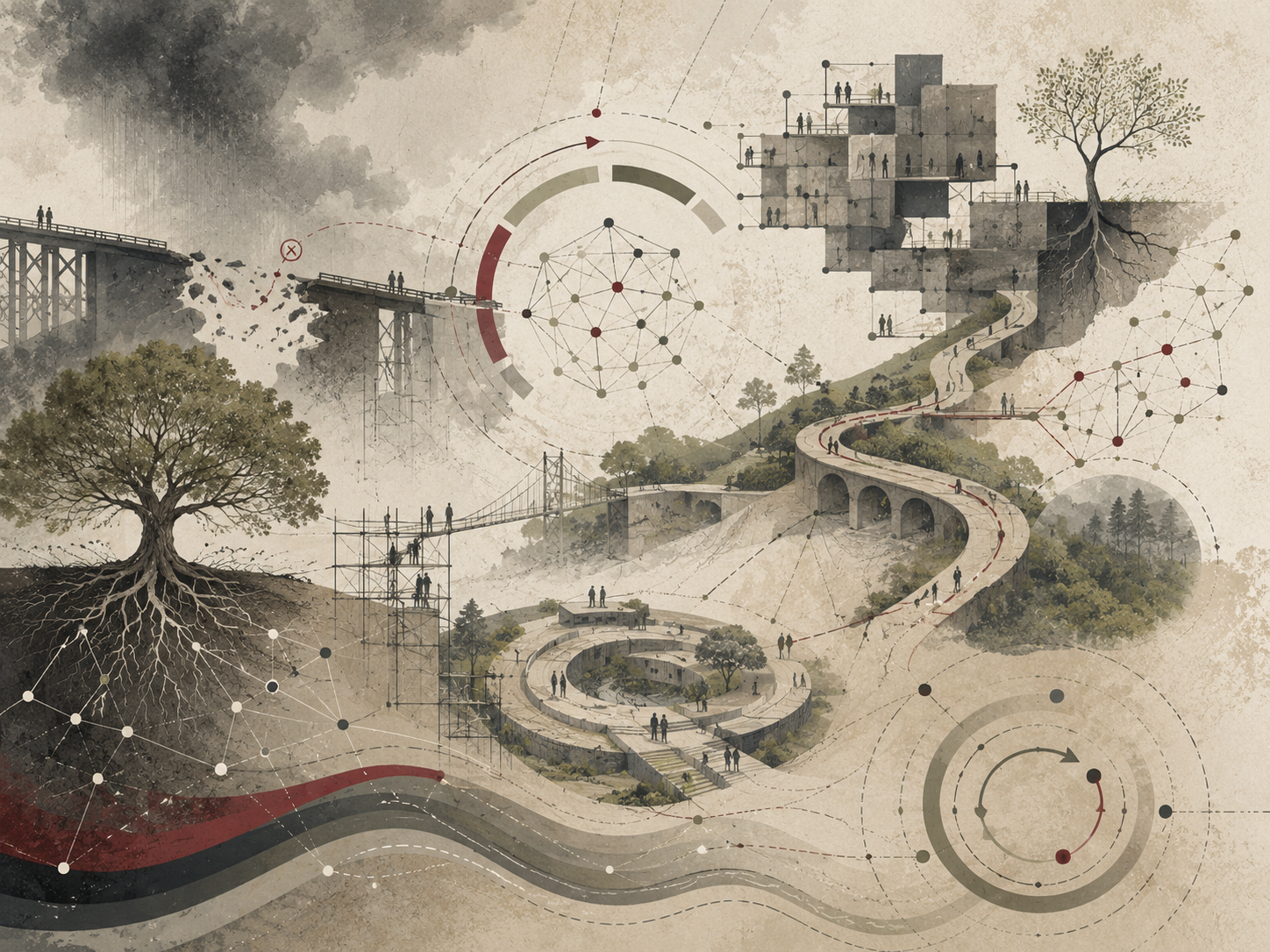
Resilient organizations sustain core functions through adaptation, learning, leadership, and flexible institutional design rather than through rigidity alone.
What Organizational Resilience Actually Means
Organizational resilience is often described too loosely, as though it were simply the ability to “bounce back” after adversity. That phrase is not entirely wrong, but it is incomplete. It implies recovery to a prior state, whereas many real disruptions do not permit simple restoration. Institutions may face structural changes in technology, regulation, finance, labor availability, public expectations, or ecological conditions that make the old equilibrium neither reachable nor desirable. In such contexts, resilience means preserving essential function while adapting form. It is as much about reorganization and learning as it is about endurance.
For this reason, resilience should be understood as a multidimensional institutional capacity. It includes the ability to anticipate threats before they fully materialize, absorb shocks without catastrophic breakdown, maintain coordination during strain, adapt structures and routines as conditions change, and learn in ways that improve future readiness. It also includes normative dimensions: whether an institution can respond without sacrificing legitimacy, ethical responsibility, or its core social purpose. An organization that survives by externalizing harm, concealing risk, or exhausting its people may remain operational in a narrow sense while becoming institutionally brittle in a deeper one.
Serious organizational psychology therefore treats resilience not as a personality-like trait of firms but as an emergent property of systems. It arises from the relationship among people, structures, routines, technologies, leadership, governance, and culture. It is shaped by how organizations distribute authority, preserve institutional memory, manage error, process dissent, and interpret signals from their environment. Resilience is not a decorative value added after strategy. It is part of the architecture that determines whether strategy can survive contact with reality.
This distinction matters because resilience is sometimes absorbed into motivational language that places the burden of endurance on individuals. Workers are asked to be adaptable, positive, flexible, and gritty while the institution preserves overload, poor communication, underinvestment, and unstable governance. That is not organizational resilience. It is the transfer of systemic fragility onto human beings. A resilient organization does not merely ask people to absorb pressure. It redesigns the conditions that generate pressure, surfaces risk earlier, distributes responsibility more intelligently, and protects the human capacity on which institutional continuity depends.
Resilience also intersects with several related themes in this series, including Learning Organizations and Knowledge Systems, Psychological Safety in High-Performing Teams, Organizational Culture and Shared Norms, Adaptive Organizations and Institutional Transformation, and Leadership Styles and Organizational Performance. Together these topics show that resilience is not a peripheral trait but a central feature of how institutions sustain performance, preserve trust, and remain viable across long horizons.
Complex Systems, Interdependence, and Organizational Vulnerability
Organizations operate within complex adaptive systems in which outcomes arise from nonlinear interaction rather than simple linear causation. Supply chains, information infrastructures, labor markets, regulatory regimes, ecological systems, public trust, and geopolitical conditions intersect in ways that make disruption difficult to predict and even harder to contain. A seemingly minor disturbance can cascade across domains. The more interconnected the system, the greater the possibility that local failure will become systemic strain.
This matters because organizational vulnerability is often produced not by the absence of resources alone but by hidden dependence. Institutions become fragile when they rely too heavily on single suppliers, narrow talent pools, concentrated decision authority, brittle technologies, unchallenged assumptions, or incentive systems that reward short-term efficiency at the expense of slack, redundancy, and learning. Efficiency can improve performance under stable conditions while undermining resilience under unstable ones. A tightly optimized organization may appear strong until variation exceeds its tolerance threshold.
Examples are easy to identify across sectors. Global production systems can be disrupted by a single logistics interruption. Financial institutions can transmit shocks through leverage and confidence effects. Public health crises can alter labor availability, service demand, and regulatory expectations simultaneously. Digital dependency can turn cyber risk into operational paralysis. In each case, resilience depends not only on the organization’s internal capacities but on its ability to monitor external signals, maintain optionality, and respond before failures compound.
Complexity also means that organizations may misunderstand their own risk. Leaders often see formal structure, budget lines, performance dashboards, and reporting hierarchies. But much of the real organization exists in informal coordination, tacit expertise, undocumented workarounds, interpersonal trust, professional judgment, and the small adaptations people make to keep systems functioning. When disruption occurs, these hidden systems can either become sources of resilience or points of failure. The more an institution misunderstands its own actual operating system, the more vulnerable it becomes.
Why complexity changes the meaning of preparedness
In linear settings, preparedness often means having a plan for known contingencies. In complex settings, preparedness also means cultivating adaptive capacity for the unknown. Institutions cannot script every scenario. They can, however, build systems that are more likely to detect weak signals, escalate uncertainty without denial, preserve decision flexibility, and reorganize under pressure. This is why resilience must be tied to learning, communication, and governance rather than treated as a mere checklist function.
Preparedness in complex environments also requires humility. Organizations cannot assume that yesterday’s risk register, vendor map, staffing model, regulatory environment, or public legitimacy will remain stable. Resilience requires the disciplined ability to revise assumptions before reality forces revision at greater cost. In this sense, resilience is not only a response capacity. It is a form of institutional attention.
Resilience, Efficiency, and the Hidden Cost of Optimization
One of the central tensions in organizational resilience is the relationship between efficiency and adaptive capacity. Modern management systems often reward lean processes, tight schedules, just-in-time logistics, narrow staffing margins, standardized workflows, and measurable productivity gains. Under stable conditions, these practices can reduce waste and improve performance. Under unstable conditions, however, extreme optimization can remove the very buffers that allow institutions to absorb variation.
This does not mean that efficiency is bad or that resilient organizations should tolerate waste. It means that organizations must distinguish between wasteful excess and protective slack. A backup supplier, a cross-trained team, a reserve inventory, a second communication channel, an experienced reviewer, or an unhurried escalation process may look inefficient in normal periods. During disruption, these forms of redundancy can become the difference between manageable strain and institutional failure.
The deeper problem is that many organizations measure efficiency more easily than resilience. Cost reductions are visible on quarterly reports. Avoided failures are less visible because they are events that did not happen. This asymmetry creates a systematic bias toward underinvesting in resilience. When institutions are rewarded for short-term optimization but not for preserving long-term adaptive capacity, they may become more fragile while appearing more disciplined.
| Organizational pattern | Short-term advantage | Resilience risk | More resilient alternative |
|---|---|---|---|
| Single-source dependency | Lower transaction costs and simplified coordination | High exposure if the supplier, platform, or partner fails | Strategic redundancy for mission-critical functions |
| Thin staffing margins | Lower labor cost and higher utilization | Rapid degradation during illness, turnover, surge demand, or crisis | Cross-training, reserve capacity, workload review, and recovery time |
| Centralized decision authority | Consistency and speed when conditions are known | Slow response when local knowledge cannot reach decision-makers | Clear escalation pathways with distributed authority under defined conditions |
| Strict procedural compliance | Predictability, auditability, and standardization | Rigidity when conditions fall outside the procedure | Rules paired with judgment, scenario training, and exception protocols |
| Performance culture focused only on targets | Clarity, accountability, and visible results | Suppression of weak signals that threaten metrics or reputation | Balanced review of outcomes, risk, learning, and ethical responsibility |
Resilience therefore requires a more mature view of performance. The strongest organizations are not those that eliminate all slack. They are those that know where slack is strategically necessary, where standardization supports reliability, where flexibility is essential, and where apparent efficiency may conceal accumulating fragility.
Core Dimensions of Organizational Resilience
Scholars of resilience have identified several recurring dimensions that help explain why some institutions degrade rapidly under strain while others remain adaptive. These dimensions are analytically distinct but operationally intertwined.
- Robustness refers to the ability to maintain essential functions during disturbance. Robust organizations can tolerate stress without immediate collapse.
- Redundancy refers to the presence of backup capacity, substitute pathways, reserve knowledge, or spare resources that allow continuity when a primary mechanism fails.
- Adaptability refers to the ability to revise structures, roles, strategies, or routines as conditions shift.
- Learning capacity refers to the ability to interpret disruption, preserve lessons, and incorporate them into future action.
- Coordination integrity refers to the capacity to maintain coherent action across units under pressure, especially when uncertainty increases and normal routines break down.
- Legitimacy preservation refers to the ability to act under strain without destroying trust among employees, stakeholders, regulators, or the public.
These dimensions show why resilience is not identical with toughness. A rigid organization may endure one type of stress while failing under another. Redundancy without learning can preserve inertia. Adaptability without coordination can produce chaos. Legitimacy without operational capability can become symbolic performance. True resilience requires a configuration of capacities that reinforce one another across time.
From an organizational psychology perspective, these capacities are inseparable from human processes. People must interpret ambiguous signals, communicate problems upward, improvise under uncertainty, manage emotional strain, coordinate across boundaries, and sustain effort without collapsing into panic, paralysis, or blame. Resilience is therefore both systemic and psychological, but never reducible to either level alone.
| Dimension | Organizational meaning | Psychological process | Typical warning sign |
|---|---|---|---|
| Robustness | Core functions remain stable under pressure | Role clarity, competence, confidence, and disciplined execution | Routine variation produces disproportionate disruption |
| Redundancy | Critical work has backup pathways | Shared knowledge, cross-training, and mutual support | One absence, vendor failure, or platform issue halts essential work |
| Adaptability | Structures and routines can change when conditions change | Cognitive flexibility, experimentation, and tolerance for uncertainty | Rules are followed even when they no longer fit reality |
| Learning capacity | Disruption becomes institutional knowledge | Reflection, evidence use, and non-defensive interpretation | Postmortems produce documents but not behavioral change |
| Coordination integrity | Units remain aligned during strain | Communication, trust, shared mental models, and prioritization | Teams optimize locally while the whole system degrades |
| Legitimacy preservation | Trust is protected during difficult decisions | Fairness perception, ethical judgment, and credible explanation | Continuity is achieved through concealment, coercion, or externalized harm |
The value of this dimensional view is practical as well as theoretical. It allows resilience to be examined through multiple lenses: operations, governance, culture, leadership, human resources, communication, ethics, and strategy. A serious resilience review asks not merely whether the organization has a continuity plan, but whether it possesses the human and institutional capacities required to make that plan meaningful under pressure.
Leadership, Governance, and Resilient Authority
Leadership plays a decisive role in shaping resilience, but not simply because leaders “inspire” others. More fundamentally, leaders influence how institutions interpret uncertainty, what kinds of information can surface, how resources are allocated under stress, and whether adaptation is permitted before crisis becomes failure. Leadership matters because it helps determine the epistemic and moral climate of the organization.
In resilient institutions, authority is used not only to issue commands but to preserve orientation under ambiguity. Leaders clarify what must be protected, what may be revised, and what evidence deserves urgent attention. They reduce denial by legitimizing uncomfortable truths. They create channels through which operational signals can reach decision-makers before harm compounds. They also resist the temptation to treat confidence displays as substitutes for diagnosis.
Governance matters just as much as leadership style. An institution may have charismatic leaders and still remain fragile if board oversight is weak, escalation channels are unclear, accountability is diffuse, or formal authority is disconnected from frontline knowledge. Resilience requires governance systems capable of balancing decisiveness with review, decentralization with coherence, and short-term action with long-horizon responsibility. This is why resilience belongs not only to crisis leadership but to the larger design of decision rights, reporting structures, and institutional accountability.
These questions intersect with Transformational Leadership and Organizational Change and Leadership Styles and Organizational Performance, but resilience adds a specific emphasis: whether leadership helps an organization remain governable under strain.
Resilient authority has several distinctive features. It does not confuse centralized control with coordination. It does not confuse speed with wisdom. It does not confuse loyalty with silence. It does not confuse optimism with preparedness. It is capable of saying, in effect: this is what must remain protected, this is what we do not yet know, this is where we need information, this is where local judgment is authorized, and this is how we will review the consequences of our decisions. Such leadership makes uncertainty discussable without making the organization directionless.
Governance also determines whether resilience is episodic or embedded. If risk review occurs only after crisis, the institution remains reactive. If resilience is built into budgeting, staffing, technology selection, vendor strategy, leadership development, succession planning, ethics review, and organizational learning, it becomes part of the institution’s operating logic. Resilience then becomes less dependent on heroic individuals and more dependent on durable systems.
Learning, Memory, and Adaptive Capacity
Organizations become resilient not merely by surviving shocks but by learning from them. Learning transforms disturbance from a recurring threat into a source of adaptive intelligence. Institutions that conduct rigorous after-action review, preserve institutional memory, and adjust routines in light of evidence are more likely to improve future response capacity. Those that suppress reflection, personalize blame, or treat each disruption as exceptional often repeat the same failure in new form.
Adaptive capacity depends on more than collecting lessons in a formal archive. It requires the ability to integrate new knowledge into actual structures, workflows, incentives, and authority patterns. Many institutions are excellent at generating reports and poor at changing behavior. Real learning is visible when crisis review alters staffing design, communication protocols, risk thresholds, scenario planning, redundancy strategy, or governance oversight. The difference between symbolic learning and operational learning is one of the great dividing lines between resilient and fragile organizations.
Institutional memory is especially important because organizations experience turnover, restructuring, and shifting priorities that can erase knowledge just when it is needed most. A resilient organization preserves not only documents but interpretive capacity: why earlier failures occurred, which signals were missed, how tradeoffs were justified, and what conditions made previous interventions succeed or fail. This is why Learning Organizations and Knowledge Systems belongs near the center of any serious account of resilience.
Adaptation is not constant change for its own sake
Adaptive capacity should not be confused with perpetual instability. Organizations need continuity as well as revision. The challenge is to distinguish what should remain durable from what must remain flexible. Resilient institutions preserve core purpose while allowing peripheral structures, routines, and pathways to change. The art of adaptation lies in protecting identity without hardening into rigidity.
This is particularly important because organizations can misuse the language of adaptability. Constant restructuring, shifting priorities, ambiguous mandates, unstable reporting lines, and perpetual urgency may be framed as agility, but they can destroy institutional memory and psychological stability. Adaptability is not organizational restlessness. It is the disciplined capacity to change what should change while protecting the conditions that make competent action possible.
A resilient learning system therefore asks several questions after disturbance. What did we notice too late? What did people know but fail to communicate? Which incentives made silence rational? Which assumptions proved false? Which dependencies were hidden? Which processes worked better than expected? Which forms of human judgment, professional expertise, or informal coordination prevented worse outcomes? The goal is not to produce a ritualized report. The goal is to improve the organization’s future ability to perceive and respond.
Culture, Psychological Safety, and Signal Detection
Resilience is deeply cultural because culture influences what people notice, what they are willing to say, and how uncertainty is interpreted. In fragile institutions, warning signals are often normalized, minimized, or filtered out because they threaten status, schedule, reputation, or existing strategic narratives. In resilient institutions, difficult information is more likely to surface because the organization treats error reporting, candid communication, and dissent as contributions to institutional intelligence rather than as acts of disloyalty.
This is where psychological safety becomes crucial. If employees fear ridicule, retaliation, or career penalty for voicing concern, the organization becomes epistemically blind. Problems remain local until they become systemic. Silence is often one of the clearest predictors of fragility. A resilient organization is not one in which no one feels stress; it is one in which relevant concern can move through the system before breakdown becomes irreversible.
Culture also shapes whether institutions learn constructively or defensively after disruption. A blame-driven culture may satisfy emotional demands for accountability while preventing analysis of structural causes. A mature culture distinguishes responsibility from scapegoating. It asks not only who acted, but what structures, incentives, assumptions, and communication failures made the event possible. This is why resilience should be linked directly to Organizational Culture and Shared Norms and Psychological Safety in High-Performing Teams.
Signal detection is not merely a technical problem. It is a social and cultural problem. Many organizations have data systems that can capture incidents, delays, errors, complaints, safety concerns, and operational anomalies. Yet the meaning of those signals depends on whether people trust the system enough to report honestly, whether managers interpret signals defensively or diagnostically, and whether leaders are willing to act before a pattern becomes publicly undeniable. Resilience therefore depends on the relationship between information systems and cultural permission.
Psychological safety is also not the same as comfort. Resilient cultures may involve high standards, difficult feedback, pressure, accountability, and intense coordination. The key issue is whether people can speak truthfully about risks, mistakes, uncertainties, and constraints without being punished for protecting the organization’s capacity to learn. In that sense, psychological safety is not softness. It is part of the infrastructure of institutional intelligence.
A Semi-Formal Model of Resilience Capacity
Resilience cannot be reduced fully to equation, but semi-formal framing can clarify how its underlying components interact. One useful conceptual model treats organizational resilience capacity as a function of robustness, redundancy, adaptive learning, coordination integrity, leadership responsiveness, and psychological safety, moderated by exposure, complexity, and accumulated fragility.
A simple expression is:
R = \frac{(B \cdot D \cdot L \cdot C \cdot G \cdot S)}{(E + K + F)}
\]
Interpretation: Resilience capacity increases when baseline robustness, redundancy, learning, coordination, governance responsiveness, and psychological safety reinforce one another. It decreases as external exposure, systemic complexity, and accumulated internal fragility grow.
where:
- R = resilience capacity
- B = baseline robustness of core operations
- D = redundancy or backup capacity
- L = learning and adaptive capability
- C = coordination integrity under strain
- G = governance and leadership responsiveness
- S = psychological safety and signal transparency
- E = external exposure to disruption
- K = systemic complexity
- F = accumulated internal fragility
This model is intentionally simplified, but it highlights a crucial point: resilience weakens not only when shocks become larger, but when institutions accumulate hidden brittleness. The organization may appear stable until the denominator overwhelms its adaptive capacity.
We can also express recovery dynamics over time:
C_{t+1} = C_t – \alpha S_t + \beta A_t + \gamma M_t
\]
Interpretation: Future functional capacity depends on current capacity, the negative effect of shock intensity, the positive contribution of adaptive response, and the degree to which institutional memory can be mobilized during recovery.
where C is functional organizational capacity, S is shock intensity, A is adaptive response effectiveness, and M is mobilized institutional memory. The parameters \( \alpha \), \( \beta \), and \( \gamma \) represent the relative effect of shock, adaptation, and memory on future capacity. This captures an important truth: disruption reduces capacity, but adaptation and memory can partially restore or even strengthen it.
Finally, one can model fragility accumulation as:
F_{t+1} = F_t + \delta O_t + \lambda X_t – \mu Q_t
\]
Interpretation: Fragility accumulates when operational overload and unresolved errors increase faster than institutional learning, corrective reform, and quality improvement can reduce them.
where O represents operational overload, X represents unresolved errors or near misses, and Q represents institutional learning and corrective reform. This illustrates why organizations that ignore weak signals may be increasing fragility long before any visible crisis appears.
The value of these expressions is not predictive precision. They are conceptual models, not universal laws. Their value lies in making relationships visible. They show that resilience is not produced by a single variable, slogan, or leadership trait. It emerges when multiple capacities interact, and it declines when accumulated fragility, environmental exposure, and systemic complexity exceed the organization’s ability to learn and coordinate.
Measurement, Diagnosis, and Resilience Review
Because resilience is multidimensional, measurement must be handled carefully. A useful resilience assessment should not pretend to reduce the whole organization to a single score. It should instead create a structured way to examine patterns of strength, exposure, dependence, and fragility across units, functions, and time. The purpose of measurement is not to label departments as resilient or weak. The purpose is to make institutional conditions visible enough for responsible action.
Potential indicators include operational continuity, incident frequency, recovery time, staffing redundancy, cross-training, psychological safety, error reporting rates, quality-control findings, employee exhaustion, vendor concentration, governance responsiveness, escalation speed, near-miss review, and the implementation rate of corrective actions. Yet each indicator requires interpretation. A low incident rate may indicate safety, or it may indicate underreporting. A high reporting rate may indicate dysfunction, or it may indicate a healthy culture of transparency. Resilience measurement is therefore inseparable from context.
| Assessment domain | Possible evidence | Interpretive caution |
|---|---|---|
| Shock absorption | Continuity during disruptions, service interruption duration, recovery time | Fast recovery may depend on unsustainable overwork if human capacity is ignored |
| Adaptive learning | After-action reviews, implemented corrective actions, revised protocols | Reports without changed routines indicate symbolic rather than operational learning |
| Signal transparency | Near-miss reporting, employee voice, escalation patterns | Low reporting may reflect silence, fear, or normalization of deviance |
| Coordination integrity | Cross-functional response quality, handoff reliability, shared situational awareness | Local performance metrics may conceal system-level coordination breakdown |
| Governance responsiveness | Decision speed, review quality, accountability structures, board attention | Decisiveness without feedback can become brittle command-and-control behavior |
| Legitimacy preservation | Trust, transparency, fairness perception, stakeholder confidence | Operational survival achieved through concealment or coercion may erode long-term viability |
A serious resilience review should combine quantitative evidence with qualitative inquiry. Surveys, incident logs, recovery metrics, and operational data can reveal patterns, but interviews, focus groups, document review, and ethnographic observation may reveal why those patterns exist. The most important information is often located at the boundary between formal systems and lived experience: the workaround everyone uses but no one documents, the staffing gap that dashboards hide, the risk everyone knows but leaders rarely hear, or the informal coordinator whose departure would expose a hidden dependency.
For that reason, resilience diagnosis should be participatory and ethically bounded. It should not become a surveillance system for identifying supposedly resilient or nonresilient individuals. The relevant unit of analysis is the institution: its conditions, routines, dependencies, incentives, and governance systems. When resilience measurement is used to blame individuals for structural strain, it becomes part of the problem it claims to solve.
Resilience, Sustainability, and Long-Horizon Institutional Design
Resilience has become increasingly important not only in organizational psychology but across sustainability science, ecological economics, risk governance, and systems theory. This broader context matters because many of the disruptions organizations now face are not temporary interruptions but long-wave structural pressures: climate instability, ecosystem degradation, geopolitical fragmentation, cyber vulnerability, infrastructural stress, demographic transition, and growing demands for ethical accountability.
In this broader frame, resilience is not simply an organizational convenience. It is part of how institutions remain socially and materially viable within stressed systems. An organization that cannot adapt to environmental regulation, chronic supply disruption, public legitimacy crises, or changing labor expectations may remain profitable for a period while becoming strategically unsustainable. Long-horizon resilience therefore requires institutions to think beyond immediate continuity and toward systemic fit.
This is one reason resilience connects to Systems Modeling, Risk and Resilience, and wider sustainability-oriented work across the site. Resilient institutions are better able to absorb disruption without externalizing cost recklessly onto workers, communities, ecosystems, or future governance systems. At its strongest, resilience is not a defensive posture. It is a design principle for responsible continuity under conditions of real interdependence.
Long-horizon institutional design also forces a moral question: what kind of resilience is being built? Some systems are resilient precisely because they are powerful enough to protect themselves while shifting harm elsewhere. A corporation may maintain continuity by transferring instability to contractors, suppliers, communities, or ecosystems. A bureaucracy may preserve its procedures while failing the people it exists to serve. A harmful institution may become highly resilient in maintaining inequitable arrangements. Resilience must therefore be evaluated with a normative lens. The goal is not resilience in the abstract, but resilience that supports legitimate, humane, ecologically aware, and socially responsible institutional life.
In this sense, organizational resilience is inseparable from institutional responsibility. An organization that survives by exhausting its workforce is not resilient in any serious human sense. An organization that protects its revenue by concealing risk is not resilient in a legitimate governance sense. An organization that externalizes environmental damage while preserving internal continuity is not resilient in a sustainable systems sense. Durable institutions must be judged not only by whether they persist, but by how they persist and what their persistence makes possible.
Design Principles for More Resilient Organizations
If resilience is institutionally produced, then it can also be institutionally designed. Better resilience does not come mainly from asking employees to be tougher or more positive. It comes from building organizations that can detect stress, preserve optionality, distribute intelligence, and revise behavior without breakdown. Several design principles recur across resilient systems.
- Preserve slack where failure would be catastrophic. Hyper-efficiency can eliminate the buffers that make continuity possible.
- Build redundancy strategically. Not every process requires duplication, but critical functions should not depend on a single fragile pathway.
- Create escalation pathways for weak signals. Institutions should make it easier, not harder, for emerging problems to become visible.
- Use after-action review to alter real structures. Learning should change routines, not merely generate documentation.
- Link authority to information. Decision-makers must remain connected to operational reality rather than insulated from it.
- Protect psychological safety. Candor is a resilience asset because silence magnifies vulnerability.
- Design for adaptation, not just compliance. Rule systems matter, but they must not prevent intelligent response when conditions shift.
- Align short-term incentives with long-term viability. Institutions become brittle when immediate metrics undermine future capacity.
These principles underscore a wider lesson: resilience is not the opposite of performance. It is one of the conditions that make durable performance possible. Organizations that optimize solely for smooth operation in stable conditions often discover too late that they have undermined their own ability to survive unstable ones.
Resilient design also requires attention to human limits. Organizations cannot build resilience on permanent overload, chronic urgency, moral injury, or the expectation that employees will compensate indefinitely for broken systems. A resilient institution protects recovery time, role clarity, realistic workload, fair decision processes, and credible communication. It treats human capacity as infrastructure, not as an infinitely elastic resource.
Finally, resilience design must be periodically tested. Tabletop exercises, scenario planning, continuity drills, cyber simulations, supply-chain stress tests, succession reviews, and cross-functional postmortems can reveal whether the organization’s assumptions hold under pressure. The goal is not to perform readiness for its own sake. The goal is to discover fragility early enough to correct it before people, stakeholders, or communities pay the price.
R: Modeling Organizational Resilience Across Units
The following R workflow models resilience capacity across organizational units by combining indicators of robustness, redundancy, learning, psychological safety, coordination quality, governance responsiveness, and exposure to disruption. It also estimates which factors best predict severe functional degradation following a shock.
library(dplyr)
library(ggplot2)
library(lme4)
library(scales)
library(broom.mixed)

set.seed(123)

n_units <- 30
n_periods <- 20

resilience_data <- expand.grid(
  unit_id = factor(paste0("Unit_", seq_len(n_units))),
  period = seq_len(n_periods)
) %>%
  arrange(unit_id, period) %>%
  mutate(
    robustness = pmin(pmax(rnorm(n(), 70, 10), 30), 95),
    redundancy = pmin(pmax(rnorm(n(), 58, 14), 10), 95),
    adaptive_learning = pmin(pmax(rnorm(n(), 65, 12), 15), 95),
    coordination_integrity = pmin(pmax(rnorm(n(), 67, 11), 20), 95),
    governance_responsiveness = pmin(pmax(rnorm(n(), 63, 13), 15), 95),
    psychological_safety = pmin(pmax(rnorm(n(), 66, 12), 20), 95),
    external_exposure = pmin(pmax(rnorm(n(), 55, 16), 5), 98),
    complexity_load = pmin(pmax(rnorm(n(), 60, 13), 10), 98),
    accumulated_fragility = pmin(pmax(rnorm(n(), 48, 15), 5), 95),
    severe_shock = rbinom(n(), 1, 0.18)
  ) %>%
  group_by(unit_id) %>%
  mutate(unit_effect = rnorm(1, 0, 4)) %>%
  ungroup() %>%
  mutate(
    resilience_capacity =
      0.20 * robustness +
      0.12 * redundancy +
      0.18 * adaptive_learning +
      0.15 * coordination_integrity +
      0.14 * governance_responsiveness +
      0.13 * psychological_safety -
      0.11 * external_exposure -
      0.10 * complexity_load -
      0.16 * accumulated_fragility -
      6.0  * severe_shock +
      unit_effect +
      rnorm(n(), 0, 4),
    resilience_capacity = pmin(pmax(resilience_capacity, 0), 100),
    functional_degradation_prob =
      plogis(
        2.4 -
        0.040 * resilience_capacity +
        0.025 * accumulated_fragility +
        0.020 * complexity_load +
        0.030 * severe_shock -
        0.018 * adaptive_learning
      ),
    major_functional_degradation = rbinom(n(), 1, functional_degradation_prob)
  )

resilience_model <- lmer(
  resilience_capacity ~
    robustness +
    redundancy +
    adaptive_learning +
    coordination_integrity +
    governance_responsiveness +
    psychological_safety +
    external_exposure +
    complexity_load +
    accumulated_fragility +
    severe_shock +
    (1 | unit_id),
  data = resilience_data
)

summary(resilience_model)

degradation_model <- glm(
  major_functional_degradation ~
    resilience_capacity +
    adaptive_learning +
    accumulated_fragility +
    complexity_load +
    severe_shock,
  family = binomial(),
  data = resilience_data
)

summary(degradation_model)
exp(coef(degradation_model))

unit_dashboard <- resilience_data %>%
  group_by(unit_id) %>%
  summarise(
    avg_resilience = mean(resilience_capacity),
    avg_learning = mean(adaptive_learning),
    avg_psych_safety = mean(psychological_safety),
    avg_fragility = mean(accumulated_fragility),
    avg_exposure = mean(external_exposure),
    degradation_rate = mean(major_functional_degradation),
    .groups = "drop"
  ) %>%
  mutate(
    resilience_risk_index = rescale(
      (100 - avg_resilience) * 0.35 +
      avg_fragility * 0.25 +
      avg_exposure * 0.15 +
      (100 - avg_psych_safety) * 0.15 +
      degradation_rate * 100 * 0.10,
      to = c(0, 100)
    )
  ) %>%
  arrange(desc(resilience_risk_index))

print(unit_dashboard)

ggplot(unit_dashboard, aes(x = reorder(unit_id, resilience_risk_index), y = resilience_risk_index)) +
  geom_col() +
  coord_flip() +
  labs(
    title = "Organizational Resilience Risk by Unit",
    x = "Unit",
    y = "Risk Index (0-100)"
  ) +
  theme_minimal()

ggplot(resilience_data, aes(x = adaptive_learning, y = resilience_capacity)) +
  geom_point(alpha = 0.45) +
  geom_smooth(method = "lm", se = TRUE) +
  labs(
    title = "Adaptive Learning and Resilience Capacity",
    x = "Adaptive Learning",
    y = "Resilience Capacity"
  ) +
  theme_minimal()

review_table <- resilience_data %>%
  mutate(
    review_priority = case_when(
      resilience_capacity < 45 | major_functional_degradation == 1 ~ "Immediate Review",
      resilience_capacity < 60 ~ "Structured Review",
      TRUE ~ "Routine Monitoring"
    )
  ) %>%
  select(
    unit_id,
    period,
    resilience_capacity,
    robustness,
    redundancy,
    adaptive_learning,
    coordination_integrity,
    governance_responsiveness,
    psychological_safety,
    accumulated_fragility,
    severe_shock,
    major_functional_degradation,
    review_priority
  ) %>%
  arrange(desc(major_functional_degradation), resilience_capacity)

head(review_table, 20)
This approach is useful because it converts resilience from a vague aspiration into a set of analyzable institutional conditions. In real organizations, these measures might be informed by employee surveys, operational incident logs, audit findings, continuity testing, governance reviews, or postmortem analysis.
The workflow also illustrates why resilience analysis should be multi-level. Units may differ in exposure, staffing, leadership, psychological safety, technical dependence, and accumulated fragility. A global average can conceal local vulnerability. Mixed-effects modeling helps separate general organizational patterns from unit-specific variation, while the dashboard translates those patterns into review priorities.
These examples are for synthetic-data research and methods demonstration. They should not be used to rank employees, screen workers, evaluate individual psychological traits, or automate employment decisions. Their appropriate use is institutional learning: identifying structural conditions that may require review, dialogue, redesign, and responsible governance.
Python: Simulating Shock Absorption and Adaptive Recovery
The following Python example simulates how organizations with different levels of robustness, redundancy, psychological safety, adaptive learning, and accumulated fragility respond to shocks over time. It then estimates which factors most strongly predict recovery versus breakdown.
import numpy as np
import pandas as pd
from sklearn.linear_model import LogisticRegression
from sklearn.model_selection import train_test_split
from sklearn.metrics import classification_report, roc_auc_score

np.random.seed(123)

n_orgs = 1800

df = pd.DataFrame({
    "robustness": np.clip(np.random.normal(0.70, 0.12, n_orgs), 0.10, 0.98),
    "redundancy": np.clip(np.random.normal(0.58, 0.16, n_orgs), 0.05, 0.98),
    "adaptive_learning": np.clip(np.random.normal(0.66, 0.14, n_orgs), 0.05, 0.98),
    "coordination_integrity": np.clip(np.random.normal(0.67, 0.13, n_orgs), 0.05, 0.98),
    "governance_responsiveness": np.clip(np.random.normal(0.61, 0.15, n_orgs), 0.05, 0.98),
    "psychological_safety": np.clip(np.random.normal(0.65, 0.15, n_orgs), 0.05, 0.98),
    "external_exposure": np.clip(np.random.normal(0.56, 0.17, n_orgs), 0.01, 0.99),
    "complexity_load": np.clip(np.random.normal(0.60, 0.15, n_orgs), 0.05, 0.99),
    "accumulated_fragility": np.clip(np.random.normal(0.47, 0.18, n_orgs), 0.01, 0.99),
    "shock_intensity": np.clip(np.random.normal(0.40, 0.24, n_orgs), 0.00, 1.00)
})

# Latent resilience capacity
df["resilience_capacity"] = (
    2.1 * df["robustness"] +
    1.4 * df["redundancy"] +
    1.7 * df["adaptive_learning"] +
    1.4 * df["coordination_integrity"] +
    1.2 * df["governance_responsiveness"] +
    1.2 * df["psychological_safety"] -
    1.3 * df["external_exposure"] -
    1.1 * df["complexity_load"] -
    1.5 * df["accumulated_fragility"] +
    np.random.normal(0, 0.28, n_orgs)
)

# Recovery score after disruption
df["recovery_score"] = (
    1.4 * df["resilience_capacity"] -
    1.7 * df["shock_intensity"] +
    0.8 * df["adaptive_learning"] +
    0.6 * df["governance_responsiveness"] +
    0.5 * df["psychological_safety"] -
    0.9 * df["accumulated_fragility"] +
    np.random.normal(0, 0.30, n_orgs)
)

df["successful_recovery"] = (df["recovery_score"] > 0.30).astype(int)
df["major_breakdown"] = (
    (df["shock_intensity"] > 0.70) &
    (df["resilience_capacity"] < 0.20)
).astype(int)

features = [
    "robustness",
    "redundancy",
    "adaptive_learning",
    "coordination_integrity",
    "governance_responsiveness",
    "psychological_safety",
    "external_exposure",
    "complexity_load",
    "accumulated_fragility",
    "shock_intensity"
]

X = df[features]
y = df["successful_recovery"]

X_train, X_test, y_train, y_test = train_test_split(
    X,
    y,
    test_size=0.25,
    random_state=123,
    stratify=y
)

model = LogisticRegression(max_iter=3000)
model.fit(X_train, y_train)

pred = model.predict(X_test)
proba = model.predict_proba(X_test)[:, 1]

print("AUC:", roc_auc_score(y_test, proba))
print(classification_report(y_test, pred))

coef_table = pd.DataFrame({
    "feature": features,
    "coefficient": model.coef_[0]
}).sort_values("coefficient", ascending=False)

print(coef_table)

# Scenario comparisons
scenarios = pd.DataFrame([
    {
        "robustness": 0.82,
        "redundancy": 0.78,
        "adaptive_learning": 0.81,
        "coordination_integrity": 0.79,
        "governance_responsiveness": 0.75,
        "psychological_safety": 0.83,
        "external_exposure": 0.45,
        "complexity_load": 0.52,
        "accumulated_fragility": 0.18,
        "shock_intensity": 0.62
    },
    {
        "robustness": 0.48,
        "redundancy": 0.30,
        "adaptive_learning": 0.42,
        "coordination_integrity": 0.39,
        "governance_responsiveness": 0.36,
        "psychological_safety": 0.33,
        "external_exposure": 0.68,
        "complexity_load": 0.73,
        "accumulated_fragility": 0.71,
        "shock_intensity": 0.62
    }
])

scenario_probs = model.predict_proba(scenarios[features])[:, 1]
scenarios["predicted_recovery_probability"] = scenario_probs
print(scenarios)

# Risk segmentation
df["resilience_risk_score"] = (
    0.20 * (1 - df["robustness"]) +
    0.12 * (1 - df["redundancy"]) +
    0.16 * (1 - df["adaptive_learning"]) +
    0.12 * (1 - df["coordination_integrity"]) +
    0.10 * (1 - df["governance_responsiveness"]) +
    0.10 * (1 - df["psychological_safety"]) +
    0.08 * df["external_exposure"] +
    0.06 * df["complexity_load"] +
    0.06 * df["accumulated_fragility"]
)

risk_summary = df.groupby(pd.qcut(df["resilience_risk_score"], 5)).agg(
    mean_recovery_rate=("successful_recovery", "mean"),
    mean_breakdown_rate=("major_breakdown", "mean"),
    avg_learning=("adaptive_learning", "mean"),
    avg_psychological_safety=("psychological_safety", "mean")
)

print(risk_summary)
This simulation is useful for scenario analysis, risk review, continuity planning, and resilience diagnostics. It also reinforces a central point: resilience is not simply a cultural slogan. It is the product of measurable structural, psychological, and governance conditions that determine whether an organization can absorb strain without institutional disintegration.
The scenario comparison is especially important. Two organizations may face the same shock intensity but experience very different outcomes because their underlying resilience profiles differ. Robustness, redundancy, adaptive learning, psychological safety, coordination integrity, and governance responsiveness influence whether a shock becomes a recoverable disruption or a major breakdown. Accumulated fragility and complexity load, by contrast, increase the likelihood that disruption will propagate across the system.
As with the R workflow, this Python example should be interpreted as a synthetic modeling exercise, not as a decision tool for evaluating individuals. The ethical use of such models is to support institutional reflection, planning, and learning. The model should prompt better questions: Where are our dependencies concentrated? Where is psychological safety weakest? Where is overload accumulating? Which units recover well, and why? Which signals are we failing to hear?
GitHub Repository
The companion repository for this article organizes the computational materials for this topic, including synthetic datasets, reproducible workflows, documentation, validation notes, and responsible-use guidance for organizational psychology research.
Complete Code Repository
Access the full companion repository for this article, including reproducible analysis materials, synthetic datasets, R and Python workflows, multi-language examples, documentation, validation notes, and responsible interpretation materials.
Interpretive Cautions and Limits
Resilience is an indispensable concept, but it is often used too indiscriminately. First, resilience is not always normatively good in itself. Institutions can become resilient in sustaining harmful practices, inequitable systems, or ecologically destructive routines. One must therefore ask: resilient for what, for whom, and at whose expense?
Second, not all resilience can or should be measured in simple quantitative terms. Some of its most important dimensions—trust, memory, legitimacy, adaptive judgment, ethical responsibility—are only partially observable. Metrics can clarify patterns, but they can also conceal the interpretive richness of institutional life if treated as exhaustive representations.
Third, resilience should not become a euphemism for asking individuals to endure structural dysfunction. It is not a serious organizational strategy to celebrate employee grit while preserving overload, opacity, underinvestment, or brittle governance. True resilience requires structural conditions that support human endurance and institutional adaptation together.
Finally, resilience is domain-specific. What works in a hospital, utility system, humanitarian agency, university, military unit, or research laboratory will differ materially. The point is not to find a universal template but to understand the capacities that allow institutions to remain functional, legitimate, and adaptive under the kinds of strain they are most likely to face.
A further caution concerns the politics of resilience language. Resilience can be used responsibly to strengthen institutions, protect people, and improve long-term viability. But it can also be used to normalize austerity, justify underinvestment, or shift responsibility downward. When leaders praise resilience while ignoring structural harm, the language becomes morally evasive. A serious organizational psychology of resilience must therefore ask whether resilience discourse is expanding institutional responsibility or narrowing it.
There is also a methodological limit. Models, dashboards, and diagnostics can assist interpretation, but they should not replace judgment. Organizations are historical, cultural, and moral systems, not merely collections of variables. The strongest resilience research combines measurement with qualitative insight, theory with practice, and institutional analysis with attention to lived experience.
Conclusion
Organizational resilience is the capacity of institutions to continue functioning, learning, and adapting under conditions of disruption without losing coherence, purpose, or legitimacy. It is not reducible to toughness, continuity planning, or managerial reassurance. It is an emergent institutional capacity grounded in robustness, redundancy, adaptive learning, coordination, governance, psychological safety, and long-horizon design.
The study of resilience reveals something central about organizational psychology itself: institutions endure not because they eliminate uncertainty, but because they build systems capable of perceiving, absorbing, interpreting, and responding to it. Resilient organizations are therefore not simply those that survive crisis. They are those that preserve enough intelligence, flexibility, and moral seriousness to remain governable while the world around them changes.
At its strongest, resilience is not a slogan about overcoming adversity. It is a disciplined institutional practice. It asks organizations to examine their dependencies, listen to weak signals, protect human capacity, preserve ethical purpose, and revise structures before fragility becomes failure. It connects leadership to governance, culture to learning, psychological safety to risk detection, and operational continuity to long-term legitimacy.
In complex systems, disruption is inevitable. Institutional breakdown is not. The difference often lies in whether organizations have built the capacity to learn before crisis, coordinate during crisis, and adapt after crisis without sacrificing the people and purposes that make continuity worth preserving.
Return to the Organizational Psychology knowledge series
Related Articles
- Learning Organizations and Knowledge Systems
- Psychological Safety in High-Performing Teams
- Organizational Culture and Shared Norms
- Adaptive Organizations and Institutional Transformation
- Leadership Styles and Organizational Performance
- Transformational Leadership and Organizational Change
- Decision-Making in Organizations
- Stress and Coping at Work
Further Reading
- Duchek, S. (2020) ‘Organizational resilience: A capability-based conceptualization’, Business Research, 13, pp. 215–246. Available at: https://doi.org/10.1007/s40685-019-0085-7.
- Hamel, G. and Välikangas, L. (2003) ‘The quest for resilience’, Harvard Business Review, 81(9), pp. 52–63. Available at: https://hbr.org/2003/09/the-quest-for-resilience.
- Lengnick-Hall, C.A., Beck, T.E. and Lengnick-Hall, M.L. (2011) ‘Developing a capacity for organizational resilience through strategic human resource management’, Human Resource Management Review, 21(3), pp. 243–255. Available at: https://doi.org/10.1016/j.hrmr.2010.07.001.
- Weick, K.E. and Sutcliffe, K.M. (2015) Managing the Unexpected: Sustained Performance in a Complex World, 3rd edn. Hoboken, NJ: Wiley. Available at: https://www.wiley.com/en-us/Managing%2Bthe%2BUnexpected%3A%2BSustained%2BPerformance%2Bin%2Ba%2BComplex%2BWorld%2C%2B3rd%2BEdition-p-9781118862414.
- Wildavsky, A. (1988) Searching for Safety. New Brunswick, NJ: Transaction Books. Available at: https://books.google.com/books/about/Searching_for_Safety.html?id=9uQWAQAAIAAJ.
- Hollnagel, E. (2017) Safety-II in Practice: Developing the Resilience Potentials. London: Routledge. Available at: https://www.taylorfrancis.com/books/mono/10.4324/9781315201023/safety-ii-practice-erik-hollnagel.
- Walker, B. and Salt, D. (2012) Resilience Practice: Building Capacity to Absorb Disturbance and Maintain Function. Washington, DC: Island Press. Available at: https://islandpress.org/books/resilience-practice.
- Vogus, T.J. and Sutcliffe, K.M. (2007) ‘Organizational resilience: Towards a theory and research agenda’, in 2007 IEEE International Conference on Systems, Man and Cybernetics, pp. 3418–3422. Available at: https://doi.org/10.1109/ICSMC.2007.4414160.
References
- Burnard, K. and Bhamra, R. (2011) ‘Organisational resilience: Development of a conceptual framework for organisational responses’, International Journal of Production Research, 49(18), pp. 5581–5599. Available at: https://doi.org/10.1080/00207543.2011.563827.
- Duchek, S. (2020) ‘Organizational resilience: A capability-based conceptualization’, Business Research, 13, pp. 215–246. Available at: https://doi.org/10.1007/s40685-019-0085-7.
- Hamel, G. and Välikangas, L. (2003) ‘The quest for resilience’, Harvard Business Review, 81(9), pp. 52–63. Available at: https://hbr.org/2003/09/the-quest-for-resilience.
- Holling, C.S. (1973) ‘Resilience and stability of ecological systems’, Annual Review of Ecology and Systematics, 4, pp. 1–23. Available at: https://www.annualreviews.org/doi/10.1146/annurev.es.04.110173.000245.
- Hollnagel, E. (2017) Safety-II in Practice: Developing the Resilience Potentials. London: Routledge. Available at: https://www.taylorfrancis.com/books/mono/10.4324/9781315201023/safety-ii-practice-erik-hollnagel.
- Lengnick-Hall, C.A., Beck, T.E. and Lengnick-Hall, M.L. (2011) ‘Developing a capacity for organizational resilience through strategic human resource management’, Human Resource Management Review, 21(3), pp. 243–255. Available at: https://doi.org/10.1016/j.hrmr.2010.07.001.
- Sutcliffe, K.M. and Vogus, T.J. (2003) ‘Organizing for resilience’, in Cameron, K.S., Dutton, J.E. and Quinn, R.E. (eds.) Positive Organizational Scholarship. San Francisco: Berrett-Koehler, pp. 94–110. Available at: https://bkconnection.com/books/title/positive-organizational-scholarship.
- Tierney, K. (2003) ‘Conceptualizing and measuring organizational and community resilience: Lessons from the emergency response following the September 11, 2001 attack on the World Trade Center’, paper presented at the National Academy of Sciences Workshop on Theoretical Problems in the Study of Human Security, Washington, DC. Available at: https://irondice.appstate.edu/sites/irondice.appstate.edu/files/tierney_2003_organizational_and_community_resilience.pdf.
- Vogus, T.J. and Sutcliffe, K.M. (2007) ‘Organizational resilience: Towards a theory and research agenda’, in 2007 IEEE International Conference on Systems, Man and Cybernetics, pp. 3418–3422. Available at: https://doi.org/10.1109/ICSMC.2007.4414160.
- Walker, B. and Salt, D. (2012) Resilience Practice: Building Capacity to Absorb Disturbance and Maintain Function. Washington, DC: Island Press. Available at: https://islandpress.org/books/resilience-practice.
- Weick, K.E. and Sutcliffe, K.M. (2015) Managing the Unexpected: Sustained Performance in a Complex World, 3rd edn. Hoboken, NJ: Wiley. Available at: https://www.wiley.com/en-us/Managing%2Bthe%2BUnexpected%3A%2BSustained%2BPerformance%2Bin%2Ba%2BComplex%2BWorld%2C%2B3rd%2BEdition-p-9781118862414.
- Wildavsky, A. (1988) Searching for Safety. New Brunswick, NJ: Transaction Books. Available at: https://books.google.com/books/about/Searching_for_Safety.html?id=9uQWAQAAIAAJ.