Moral Psychology

Moral Psychology examines the psychological traditions through which scholars have sought to understand moral judgment, moral emotion, character, responsibility, and the formation of ethical agency in human life. In the history of psychology and ethics, the field has linked conscience, moral reasoning, prosociality, identity, virtue, blame, self-regulation, and social influence in ways that illuminate how human beings become capable of care, justice, obligation, and moral failure.

This category explores the major theories, methods, and debates of moral psychology, including moral judgment, moral reasoning, moral emotion, moral identity, prosocial behavior, character, virtue, moral disengagement, responsibility, moral development, and the relation between intuition, reflection, and social context in ethical life. It considers how morality is studied empirically and conceptually, how moral agency is shaped by development and institutions, and how the field contributes to wider reflection on conscience, selfhood, ethical conduct, and the psychological conditions of responsible action.

Moral psychology plays an important role in psychological and interdisciplinary inquiry because it provides one of the most rigorous frameworks for understanding how ethical life becomes psychologically real. By engaging the field seriously, this category deepens understanding of conscience, character, judgment, prosociality, responsibility, and the fragile processes through which human beings learn to act with integrity, care, restraint, and accountability.

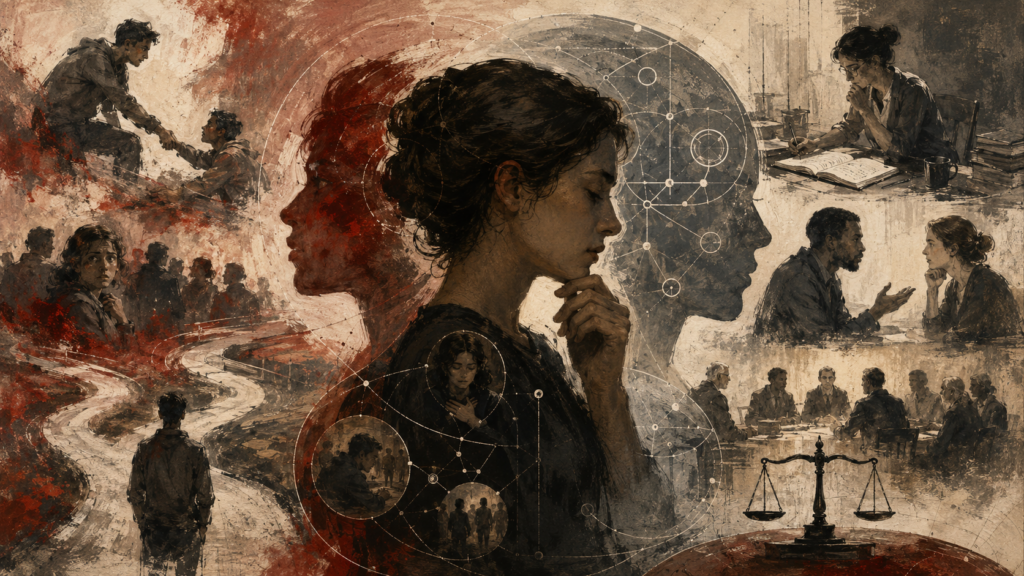
Painterly illustration of moral perception and ethical attention, showing a reflective figure surrounded by crowds, moments of suffering, helping, dialogue, branching pathways, and highlighted scenes of moral salience.

Moral Perception, Salience, and the Psychology of Ethical Attention

Moral psychology begins not only with judgment, but with attention. Before people can condemn cruelty, recognize neglect, or respond to vulnerability, something morally significant must first become visible. This article examines moral perception, moral salience, and ethical attention as the processes through which harms, duties, exclusions, and possibilities for care become psychologically focal rather than remaining background noise. Drawing on work in moral psychology, philosophy, cognitive science, and recent research on attentional moral perception, it argues that moral life depends profoundly on what people are trained to notice or ignore. The psychology of ethical attention helps explain how suffering becomes visible, why some harms remain hidden, and how institutions and media shape the moral field of perception itself.
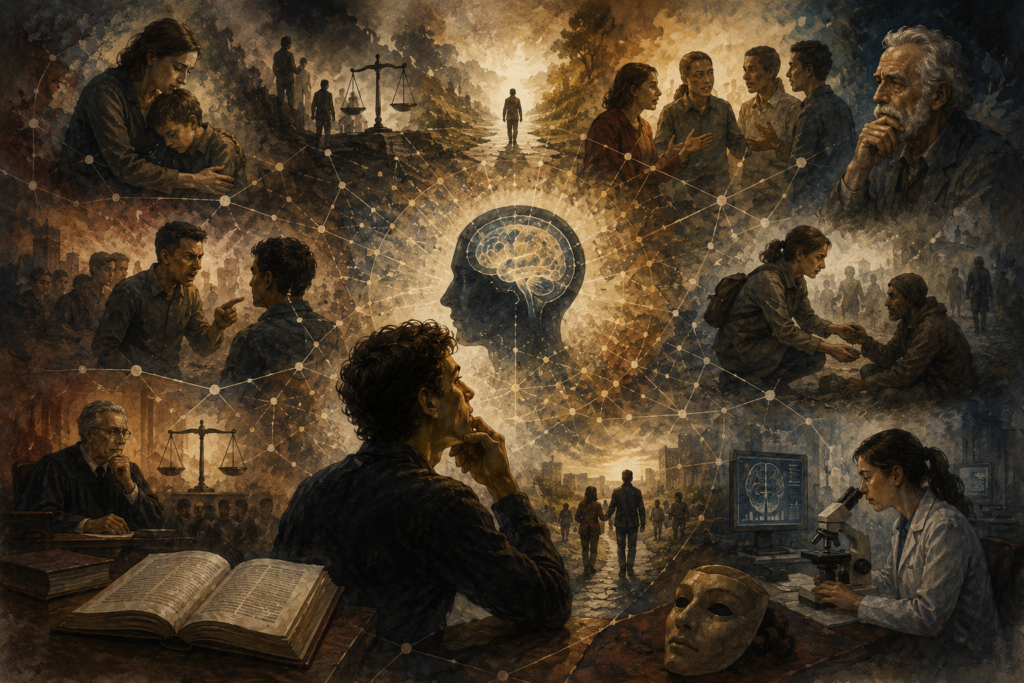
Painterly illustration of moral evaluation, showing a reflective central figure between intuitive emotion and deliberative reasoning, with branching paths, dialogue scenes, justice scales, and symbolic decision networks.

Intuition, Reflection, and the Structure of Moral Evaluation

Moral evaluation is often described through a tension between quick intuition and slower reflection, but contemporary moral psychology suggests a more complex structure. This article examines how moral judgments emerge through immediate appraisal, emotional significance, social framing, later interpretation, and reflective revision. Drawing on social intuitionism, dual-process theory, and recent work on harm, culture, and politics, it argues that moral evaluation is neither a purely rational deduction nor a mere gut response. Instead, it is a layered process in which intuition and reflection interact under conditions shaped by perception, group life, and institutional context. Understanding that structure helps explain moral disagreement, moral correction, and the uneven quality of human judgment.

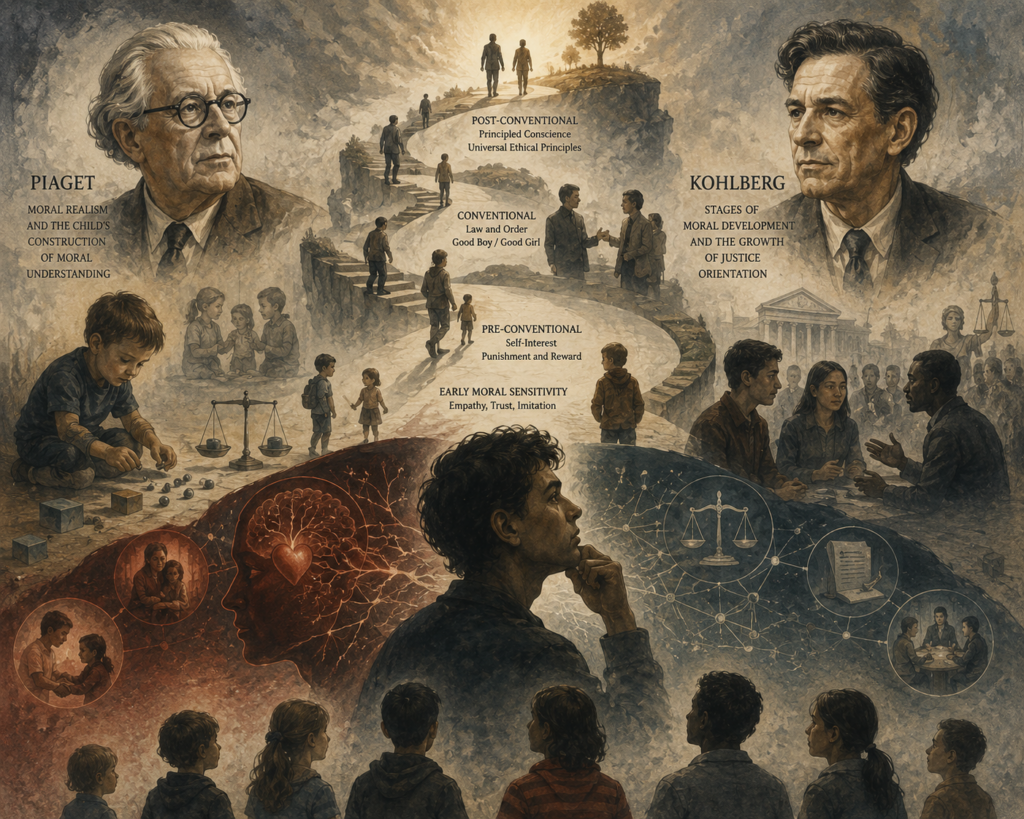
Painterly illustration of moral reasoning and developmental psychology, showing children, adolescents, staged pathways of moral development, justice scales, reflective thought, dialogue, and symbolic portraits of Piaget and Kohlberg.

Moral Reasoning: Piaget, Kohlberg, and the Developmental Tradition

Moral reasoning became a central concern of moral psychology through the developmental tradition associated with Jean Piaget and Lawrence Kohlberg. Their work asked how children and adolescents come to understand rules, intentions, fairness, duty, reciprocity, and justice over time. This article examines Piaget’s distinction between heteronomous and autonomous morality, Kohlberg’s stage theory of moral development, and the broader developmental tradition that followed. It also addresses major critiques from care ethics, social domain theory, and contemporary developmental research on norms and early moral cognition. The result is a broader account of moral reasoning as a changing, plural, and developmentally structured part of moral agency rather than a simple ladder of abstract justice alone.

Painterly illustration of moral judgment, showing a reflective figure surrounded by scenes of harm, care, responsibility, justice, dialogue, conflict, and branching ethical pathways.

Moral Judgment and the Psychology of Right and Wrong

Moral judgment examines how human beings interpret actions, intentions, harms, norms, and responsibilities as right, wrong, permissible, blameworthy, or excusable. It is one of the central domains of moral psychology because it links moral perception, emotion, deliberation, and social meaning to the evaluative ordering of ethical life. This article explores the psychology of right and wrong through intention, outcome, blame, norm violation, cultural framing, institutional context, and the gap between judgment and action. It argues that moral judgment is not a single faculty or a simple verdict, but a structured process shaped by attention, interpretation, feeling, social learning, and public moral environments.

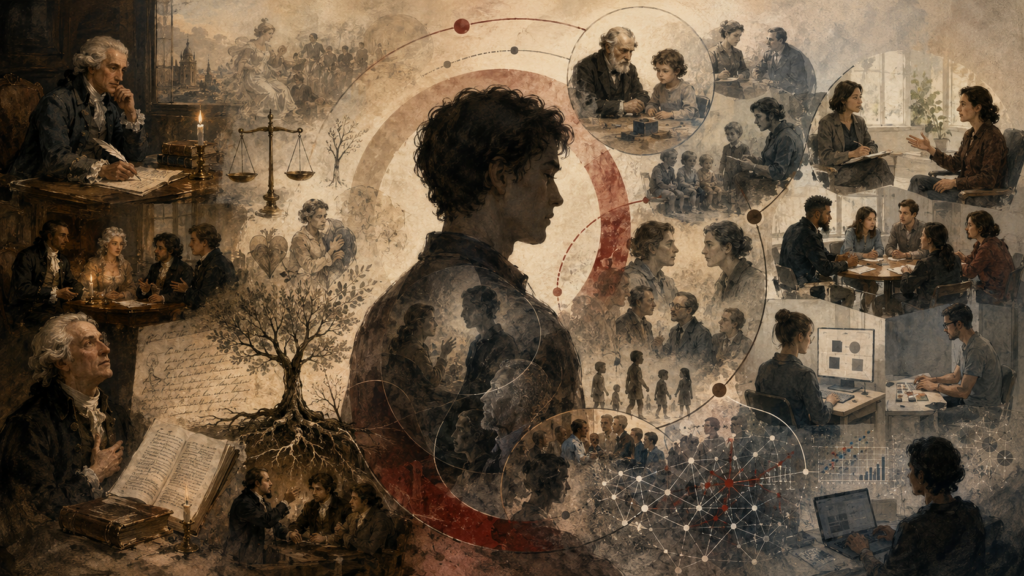
Painterly illustration of the history of moral psychology, showing early moral philosophy, developmental psychology, contemporary research, dialogue, justice scales, symbolic trees, and networked empirical study.

The History of Moral Psychology: From Moral Sense Theory to Contemporary Research

The history of moral psychology traces a long argument about the sources of moral life. From moral sense theory, sympathy, and conscience in the Scottish Enlightenment to developmental stage theories, care ethics, social domain theory, moral disengagement research, intuitionist models, dual-process accounts, and contemporary studies of culture, politics, and institutions, the field has repeatedly redefined what counts as the core engine of moral agency. This article examines that history as a sequence of expanding frameworks rather than a simple march from philosophy to science. It shows how moral psychology became a plural field concerned with judgment, emotion, identity, development, self-regulation, group life, and the moral environments in which ethical action becomes possible or breaks down.

Painterly illustration of moral psychology, showing a reflective figure surrounded by care, conflict, justice, moral judgment, scientific study, social networks, and human behavior.

What Is Moral Psychology?

Moral psychology examines how human beings perceive, judge, feel, justify, and act in morally significant contexts. It is not limited to moral reasoning alone, but investigates the full architecture of moral agency: perception, salience, emotion, conscience, identity, self-regulation, prosocial behavior, blame, repair, and the institutional settings that shape ethical conduct. As an interdisciplinary field linking psychology, ethics, development, social life, and organizational reality, moral psychology asks how moral life actually works under conditions of temptation, conflict, hierarchy, and pluralism. This article introduces the field as both an empirical and conceptual inquiry into the lived structure of moral agency, moral failure, and the conditions under which care, justice, integrity, and responsibility become possible.

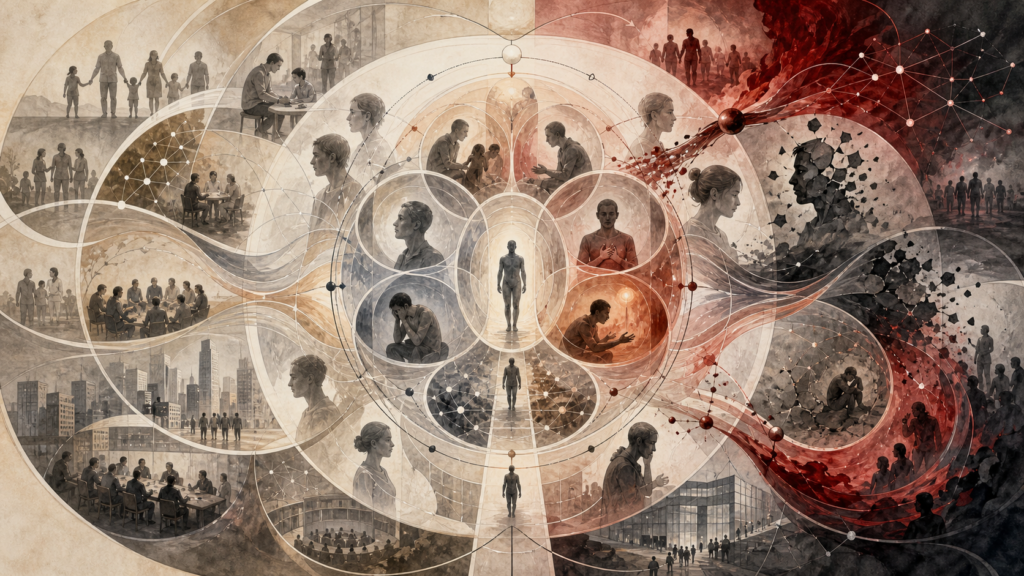
Editorial scientific illustration of moral psychology as an ethical agency systems architecture, showing moral judgment, empathy, conscience, justice, blame, forgiveness, moral repair, group identity, institutional pressure, polarization, and moral development.

Moral Psychology: Judgment, Character, Moral Emotion, and the Formation of Moral Agency

Moral psychology examines how human beings perceive, interpret, judge, feel, and act in morally significant contexts. This upgraded pillar expands the field beyond moral reasoning alone by integrating moral perception, motivation, conscience, self-regulation, relational care, blame and repair, moral failure, institutional life, cultural pluralism, and political conflict into a single map of moral agency. It also adds a mathematical lens, a semi-formal conceptual model, and substantial R and Python sections for readers interested in modeling identity, prosociality, disengagement, and ethical action over time. The result is a broader and more publication-ready account of moral psychology as a field concerned not only with what people think is right, but with how moral life becomes possible, fragile, and consequential in real human worlds.

Scroll to Top