
Last Updated May 28, 2026
Moral psychology examines how human beings perceive, interpret, judge, feel, justify, fail, repair, and act in morally significant contexts. It stands at the intersection of psychology, ethics, social theory, developmental science, organizational research, political life, and institutional analysis. Its central concern is not only what people say is right or wrong, but how moral agency actually operates under pressure: in families, schools, workplaces, bureaucracies, political communities, religious traditions, digital platforms, and social worlds where care, cruelty, loyalty, fear, conscience, identity, power, and self-justification all interact.
In that sense, moral psychology is not a narrow subfield concerned only with trolley dilemmas, moral reasoning tests, or abstract ethical puzzles. It is one of the most important domains for understanding the human person as a being capable of care, cruelty, self-restraint, hypocrisy, forgiveness, blame, repair, solidarity, dehumanization, courage, and conscience. It asks how people become morally responsive, how they fail to remain so, and how social conditions either cultivate or deform ethical agency.
Moral life is not lived in abstraction. People do not enter the world as detached judges applying universal rules to neutral cases. They notice some things and overlook others. They are shaped by guilt, shame, disgust, admiration, anger, compassion, pride, fear, resentment, love, and grief. They inherit norms, learn role expectations, seek approval, rationalize failures, imitate models, respond to authority, and act inside institutions that structure what becomes visible, sayable, punishable, forgivable, or ignored. For that reason, moral psychology asks a deeper question than “What is the right thing to do?” It asks how persons become able—or unable—to perceive, desire, sustain, and enact the good under real-world conditions.
Main Library
Publications
Article Map
Moral Psychology
Related Topic
Social Psychology
Related Topic
Personality Psychology
Related Topic
Ethics & Moral Philosophy
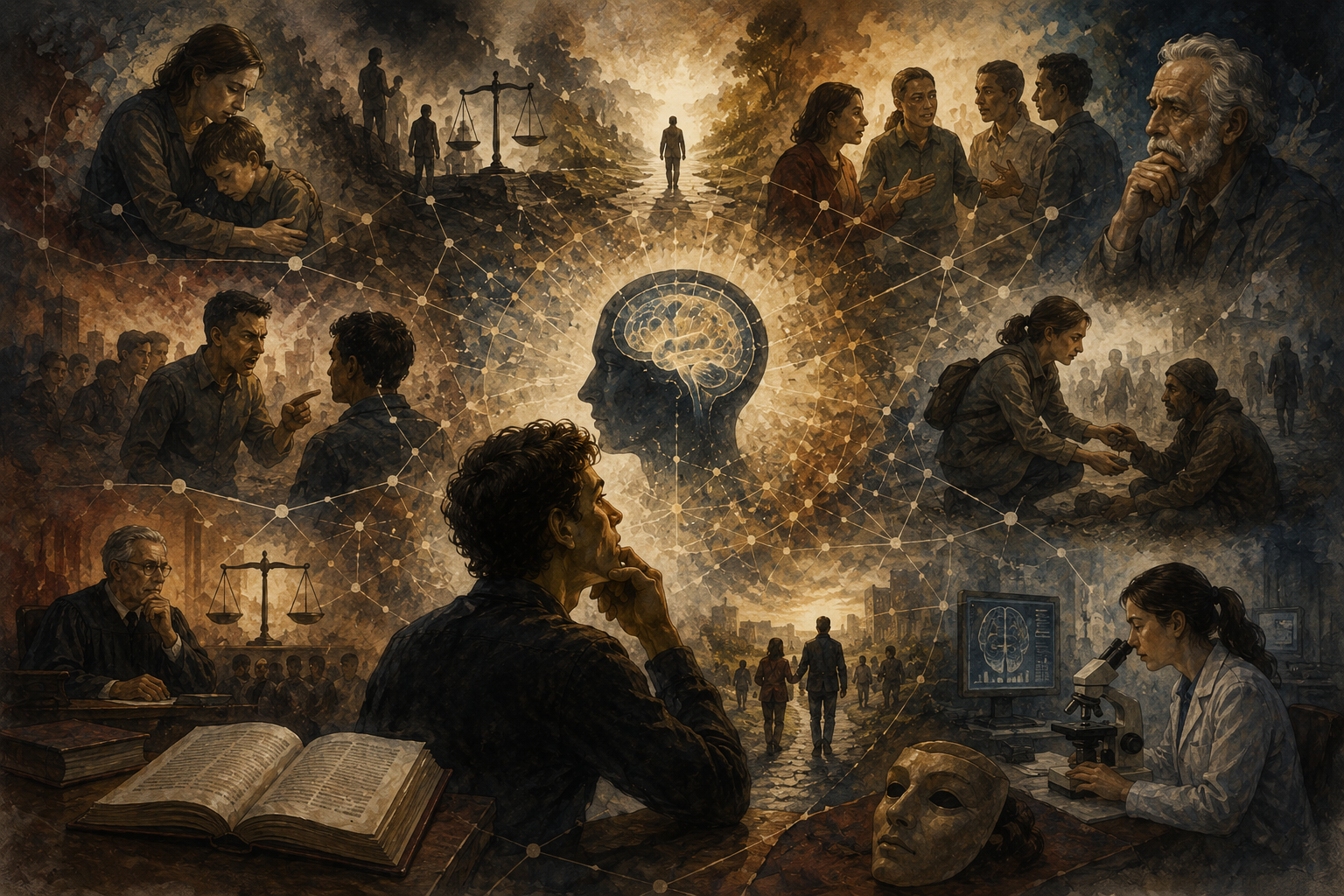
This article defines moral psychology as a field, explains why it matters, distinguishes it from moral philosophy alone, shows why it must move beyond reasoning alone, and develops a systems-oriented account of moral agency. It treats morality not as a single mental faculty but as a multi-level architecture involving attention, salience, judgment, emotion, motivation, identity, self-regulation, social learning, institutional design, and practical action. Moral psychology matters because societies do not fail ethically only when individuals lack rules. They also fail when harms become invisible, responsibility is diffused, language becomes euphemistic, institutions reward silence, groups moralize cruelty, and people learn to preserve a moral self-image while participating in harm.
Moral Psychology as a Field
Moral psychology is the study of the psychological processes, dispositions, developmental pathways, social conditions, cultural meanings, and institutional environments through which moral life takes shape. It includes research on moral judgment, moral development, conscience, moral emotion, empathy, altruism, responsibility, punishment, forgiveness, moral identity, virtue, hypocrisy, dehumanization, moral disagreement, moral disengagement, and the relationship between belief and conduct. But it is also more than a catalog of topics. It is a field organized around a central human problem: how moral agency becomes possible, how it is sustained, and why it so often breaks down.
That breadth is one reason the field matters. Moral psychology is inherently interdisciplinary. It draws from Social Psychology, Personality Psychology, Developmental Psychology, Cognitive Psychology, organizational research, affective science, political psychology, sociology, law, education, religion, and philosophy. It also intersects with ethics, public life, institutional design, democratic culture, and technology governance. A serious account of morality cannot ignore how people develop norms, interpret intentions, evaluate fairness, internalize responsibility, or disengage from obligation when systems reward compliance, silence, or tribal loyalty.
To define moral psychology well, then, is to define it broadly enough to capture the richness of moral life while preserving analytic focus. The field studies human beings as morally responsive creatures: beings who can recognize claims, experience obligation, resist or rationalize temptation, blame wrongdoing, seek repair, and orient themselves toward ideals such as justice, honesty, care, fidelity, dignity, reciprocity, mercy, and restraint. But it also studies human beings as morally fragile creatures: beings who can ignore harm, justify cruelty, obey destructive authority, perform virtue publicly while avoiding repair privately, and preserve a clean self-image while participating in systems that injure others.
| Field dimension | Core question | Examples |
|---|---|---|
| Moral perception | What becomes visible as morally relevant? | Harm, vulnerability, injustice, coercion, dignity, exclusion. |
| Moral judgment | How do people evaluate right, wrong, blame, and responsibility? | Wrongness judgments, blame judgments, punishment, forgiveness. |
| Moral emotion | How do feelings shape moral attention and response? | Guilt, shame, compassion, anger, disgust, admiration, remorse. |
| Moral development | How do moral capacities form over time? | Rule understanding, fairness, care, perspective-taking, self-control. |
| Moral identity | How does morality become part of the self? | Conscience, integrity, role responsibility, hypocrisy, character. |
| Moral action | When do people act on what they judge or value? | Courage, helping, truth-telling, repair, resistance, restraint. |
| Moral environments | How do institutions shape ethical conduct? | Workplaces, bureaucracies, platforms, law, schools, political systems. |
Why Moral Psychology Matters
Moral psychology matters because moral life is central to personal life, institutional life, and political life. Families depend on trust, fairness, care, apology, and accountability. Schools depend on norms of discipline, respect, dignity, inclusion, and growth. Workplaces depend on integrity, role responsibility, truth-telling, and the ability to speak without retaliation. Democracies depend on citizens who can distinguish disagreement from dehumanization, conviction from cruelty, and accountability from vengeance. Without some understanding of how moral agency functions, societies become vulnerable to corruption, selective empathy, moral panic, propaganda, diffusion of responsibility, bureaucratic indifference, and organized forms of ethical blindness.
The field also matters because morality is rarely exhausted by formal rules. A person may know the rule and still fail to act. Another may act generously without being able to explain why. One person may experience guilt where another experiences shame, resentment, pride, or nothing at all. Some moral failures arise from vice or selfishness; others arise from exhaustion, conformity, confusion, social dependence, institutional distortion, or the gradual normalization of harm. Moral psychology helps explain these differences by showing that moral conduct depends on attention, salience, identity, emotion regulation, self-control, social modeling, group belonging, and environmental structure—not on abstract principle alone.
In that sense, moral psychology is one of the main places where the human sciences confront the lived complexity of ethics. It refuses the reduction of moral life either to pure reason or to mere impulse. It studies persons as historically situated, socially formed, emotionally responsive, norm-bearing, self-interpreting beings. It asks why people can become better than their incentives, worse than their professed values, more courageous than their fear, or more cruel than their self-image permits them to admit.
The field is also urgent because modern institutions create moral distance. A decision-maker may never meet the people affected by a policy. A platform user may condemn a stranger from a fragment of context. A worker may follow a metric that harms customers, patients, students, or communities. A bureaucracy may distribute responsibility so widely that no one feels accountable. A political coalition may moralize loyalty and treat outsiders as threats rather than persons. Moral psychology helps explain how these conditions shape judgment and action.
| Why moral psychology matters | Personal level | Institutional and civic level |
|---|---|---|
| It explains moral judgment | How people interpret right, wrong, intention, and blame. | How courts, schools, workplaces, and publics assign responsibility. |
| It explains moral action | Why people do or do not act on values. | Why institutions need accountability systems, not only values statements. |
| It explains moral failure | How people rationalize, disengage, or preserve self-image. | How organizations normalize harm and diffuse responsibility. |
| It explains moral formation | How children develop care, fairness, conscience, and self-regulation. | How education, family, religion, and public culture shape moral agency. |
| It explains moral conflict | Why people disagree intensely over values and identity. | Why politics, platforms, and institutions can intensify moral polarization. |
| It explains moral repair | How apology, guilt, responsibility, and change become possible. | How institutions move from scandal management to accountability and reform. |
Moral Psychology and Moral Philosophy
Moral psychology and moral philosophy are closely related, but they ask different kinds of questions. Moral philosophy asks what is right, good, just, virtuous, obligatory, permissible, or blameworthy. Moral psychology asks how human beings come to perceive, judge, feel, desire, justify, enact, or fail in relation to those moral concerns. The two fields need each other. Moral psychology without philosophical clarity can become a collection of findings without conceptual discipline. Moral philosophy without psychology can become too detached from the real conditions under which people notice harm, experience duty, resist temptation, or act under pressure.
The relationship between the two fields is especially important because moral life is both normative and psychological. When people judge an action wrong, they are not merely reporting a preference. They are making a claim about what should or should not be done. At the same time, the act of judging is performed by human beings with emotions, identities, developmental histories, group loyalties, biases, habits, and institutional roles. Moral psychology studies the human capacities and conditions through which moral claims are recognized or distorted.
This distinction helps prevent two errors. The first error is psychologism: reducing moral truth to whatever people happen to feel or judge. The second is abstraction: treating moral agency as though real people were frictionless reasoners unaffected by fear, self-interest, fatigue, loyalty, shame, coercion, or social pressure. A serious account of moral life must avoid both. It must preserve the difference between what people do judge and what they ought to judge, while also studying the psychological and social conditions that make better judgment and better conduct more likely.
| Question type | Moral philosophy asks | Moral psychology asks |
|---|---|---|
| Right action | What should be done? | How do people perceive, evaluate, or fail to act on what should be done? |
| Responsibility | When is blame justified? | How do people assign blame, infer intention, and excuse wrongdoing? |
| Virtue | What is good character? | How stable are moral traits across situations and institutions? |
| Justice | What is fair or unjust? | How do people develop and apply fairness judgments? |
| Care | What do vulnerability and relationship require? | How do empathy, attachment, compassion, and role responsibility shape conduct? |
| Moral failure | What makes an act wrong or corrupt? | How do people rationalize, disengage, normalize, or hide wrongdoing? |
Beyond Moral Reasoning Alone
A common mistake is to think moral psychology is primarily the study of moral reasoning. Reasoning is important, and the field has a major developmental tradition associated with Jean Piaget and Lawrence Kohlberg. But moral psychology is broader than the ability to justify a judgment in words. Moral life begins earlier than explicit argument and extends further than declared principle.
Human beings perceive morally salient features before they fully theorize them. They respond emotionally before they give reasons. They acquire habits before they formulate moral identities. They often judge themselves by intentions and others by outcomes. They may condemn public wrongdoing while privately excusing comparable conduct in their own group. They may endorse justice in principle but fail in courage when honesty becomes costly. These are not marginal issues. They are central to what morality looks like in practice.
For that reason, moral psychology encompasses at least five broad domains: moral perception, moral evaluation, moral motivation, moral selfhood, and moral action in context. Each domain raises distinct but related questions. What do people notice? How do they interpret it? What do they feel? What do they judge? What strengthens or weakens action? How do social settings alter what counts as visible, normal, forgivable, or condemnable?
Reasoning remains crucial because moral life requires justification, criticism, reflection, and correction. But reasoning is not always the origin of judgment, and it is not always honest. Sometimes reasoning clarifies what intuition first perceived. Sometimes it corrects bias. Sometimes it rationalizes what emotion or group identity has already decided. Sometimes it becomes a public performance of virtue rather than a path toward repair. Moral psychology therefore studies reasoning as one component of moral agency, not as the whole of it.
| Moral process | What it contributes | What goes wrong when isolated |
|---|---|---|
| Perception | Makes harm, vulnerability, and obligation visible. | Can be selective, biased, or trained by power. |
| Emotion | Gives moral salience force and urgency. | Can become punitive, tribal, disgust-driven, or disproportionate. |
| Reasoning | Tests consistency, evidence, principle, and proportionality. | Can become rationalization, abstraction, or delay. |
| Identity | Makes moral commitments personally binding. | Can become self-righteousness or reputation protection. |
| Self-regulation | Supports action under temptation, fatigue, or fear. | Can fail under pressure or become rigid moral perfectionism. |
| Institutional context | Shapes what conduct is rewarded, punished, hidden, or normalized. | Can diffuse responsibility and make harm seem ordinary. |
The Architecture of Moral Agency
Moral agency is best understood as an organized structure rather than a single faculty. It includes perception, salience, evaluation, emotion, motivation, identity, self-regulation, memory, habit, social learning, and institutional embedding. A person can fail morally at any point in this architecture. They may fail to notice the vulnerable person. They may notice but misclassify the harm. They may judge correctly but lack courage. They may feel compassion but defer to authority. They may act once but lack stable habits. They may value justice but participate in a system that makes injustice invisible.
This architecture helps explain why moral psychology must be multi-level. A theory that studies only reasoning may miss emotion and attention. A theory that studies only emotion may miss principle and accountability. A theory that studies only personality may miss institutions. A theory that studies only institutions may miss conscience and responsibility. Moral agency emerges through the interaction of these levels.
- Moral perception: the ability to notice morally relevant features of a situation rather than overlooking them.
- Moral salience: the degree to which a harm, duty, claim, or vulnerability becomes psychologically prominent.
- Moral evaluation: judgments of right, wrong, fairness, blameworthiness, virtue, obligation, permissibility, or repair.
- Moral emotion: guilt, shame, disgust, indignation, compassion, admiration, elevation, remorse, resentment, and related responses.
- Moral motivation: the force that links judgment to action, especially under conditions of inconvenience or cost.
- Moral identity: the extent to which moral commitments are integrated into the self-concept.
- Moral self-regulation: capacities for restraint, honesty, consistency, repair, and resistance to temptation.
- Social and institutional embedding: the ways norms, roles, incentives, cultures, technologies, and power relations shape moral conduct.
This architecture also explains why different disciplines illuminate different parts of the same phenomenon. Social psychology clarifies conformity, identity, group judgment, and situational pressure. Personality psychology helps explain trait-level differences in empathy, honesty, self-control, humility, antagonism, and moral consistency. Developmental psychology clarifies how norms, roles, emotions, fairness concepts, and self-evaluative capacities emerge. Organizational psychology shows how systems distribute, conceal, or normalize responsibility. Ethics and philosophy ask what these patterns mean for responsibility, character, justice, dignity, and moral repair.
| Architecture component | Failure mode | Example |
|---|---|---|
| Moral perception | Harm is not noticed. | A policy’s burden on vulnerable people is treated as administrative inconvenience. |
| Moral salience | Harm is noticed but not felt as urgent. | A slow injustice becomes normalized because it lacks dramatic visibility. |
| Moral judgment | Wrongness, blame, and responsibility are misassigned. | Victims are blamed while responsible institutions are protected. |
| Moral emotion | Emotion distorts or narrows evaluation. | Disgust becomes stigma; anger becomes disproportionate punishment. |
| Moral motivation | Judgment does not become action. | A person knows retaliation is wrong but remains silent to protect status. |
| Moral identity | The self-image becomes defensive. | A person rejects criticism because it threatens their identity as good. |
| Self-regulation | Temptation, fear, fatigue, or group pressure wins. | A leader values honesty but conceals information under pressure. |
| Institutional context | Systems reward silence or diffuse responsibility. | Everyone follows procedure while no one repairs the harm. |
Moral Perception and Ethical Attention
Moral psychology begins before judgment. It begins with moral perception: the process by which certain features of a situation become ethically visible. People do not judge everything they encounter. They first notice, frame, interpret, and classify. A child crying in a classroom may appear as disruption, need, manipulation, distress, disability-related overload, trauma response, or unmet care. A workplace complaint may appear as conflict, disloyalty, courage, risk, retaliation, or whistleblowing. A public protest may appear as disorder, justice, threat, collective grief, or democratic participation. Moral judgment depends on what the observer has first been trained to see.
Moral perception is shaped by empathy, attention, social identity, culture, institutional language, prior experience, media framing, and power. Some harms are vivid; others are slow, hidden, procedural, or normalized. Some voices are believed quickly; others must overprove suffering. Some institutions make harm visible through reporting systems and records; others bury harm under categories, delays, and euphemisms. Moral psychology therefore asks not only why people judge as they do, but why some moral realities become perceptible while others remain background noise.
This matters because moral failure often begins with inattention. People may not set out to be cruel. They may simply fail to see. They may see only the rule and not the person, only the metric and not the consequence, only the procedure and not the injury, only the inconvenience and not the vulnerability. Ethical attention is therefore a core moral capacity. To perceive morally is to see persons, claims, consequences, histories, and dependencies that might otherwise remain hidden.
| Perceptual question | Why it matters | Common distortion |
|---|---|---|
| Who is vulnerable here? | Identifies persons exposed to harm, dependency, coercion, or unequal risk. | Powerful actors become the center of the moral story. |
| What harm is visible? | Determines whether wrongness is recognized at all. | Slow or structural harm disappears because it lacks spectacle. |
| Whose voice counts? | Shapes credibility and moral interpretation. | Marginalized testimony is discounted or pathologized. |
| What language is being used? | Frames harm as misconduct, error, conflict, risk, or inconvenience. | Euphemism hides moral significance. |
| What institution shapes the scene? | Reveals role, incentive, procedure, hierarchy, and accountability. | Individual blame replaces institutional analysis. |
| What history is present? | Shows whether a case is isolated or part of a pattern. | Repeated harm is treated as a one-time misunderstanding. |
Moral Judgment, Wrongness, and Blame
Moral judgment is the evaluative process through which people classify conduct, intentions, omissions, roles, institutions, and social arrangements as right, wrong, permissible, required, admirable, negligent, corrupt, cruel, generous, blameworthy, excusable, punishable, or repairable. It is central to moral psychology because it is one of the main ways human beings organize social accountability. Through judgment, conduct becomes meaningful, norms become active, and persons or institutions become objects of praise, blame, trust, suspicion, correction, punishment, forgiveness, or reform.
But moral judgment is not a single thing. It includes evaluations, norm judgments, wrongness judgments, responsibility judgments, blame judgments, sanction judgments, and repair judgments. These are related but distinct. A person may judge that harm occurred without yet knowing who is blameworthy. A rule may be violated without strong blame if the violation was coerced or accidental. An action may be wrong while punishment remains disproportionate. An institution may be responsible even when no single actor intended the harm.
This distinction is crucial because public moral life often collapses wrongness, blame, punishment, and repair into one undifferentiated response. That collapse produces overreaction and underrepair. It can turn moral life into condemnation without responsibility, apology without change, or punishment without prevention. Good moral judgment requires asking what exactly is being judged and what kind of response fits the judgment.
| Judgment type | Primary question | Typical response |
|---|---|---|
| Evaluation | Is this good, bad, admirable, troubling, or concerning? | Approval, disapproval, concern, praise, criticism. |
| Norm judgment | Was a duty, rule, expectation, or standard violated? | Clarification, correction, accountability. |
| Wrongness judgment | Was the act, omission, policy, or practice morally wrong? | Condemnation, prevention, reform, repair. |
| Responsibility judgment | Who had agency, knowledge, role duty, or control? | Assignment of accountability. |
| Blame judgment | How much moral criticism is deserved? | Rebuke, censure, apology demand, trust revision. |
| Sanction judgment | What consequence is justified? | Discipline, penalty, removal, restriction, legal response. |
| Repair judgment | What would address the harm and prevent recurrence? | Restitution, apology, redesign, protection, institutional change. |
Moral Emotion, Care, and Condemnation
Moral emotion is not merely a decoration added to judgment after the fact. It is often part of the moral process itself. Compassion can make suffering visible. Guilt can direct attention toward repair. Shame can reveal social exposure and self-evaluation. Anger can register injustice, betrayal, or violation. Disgust can mark perceived degradation or contamination. Admiration and elevation can reveal moral excellence. Fear can signal threat. Grief can hold loss in moral attention. Love can make obligation durable.
Yet moral emotions are not automatically reliable. Compassion can be selective. Anger can become vindictive. Disgust can become stigma. Shame can collapse the self rather than support repair. Pride can become moral superiority. Fear can exaggerate threat. Admiration can become uncritical hero worship. Moral psychology therefore studies emotion as both a source of moral insight and a source of moral distortion.
The field must also distinguish care from sentimentality. Care is not merely warm feeling. It is responsiveness to vulnerability, dependence, need, and dignity. It includes attention, patience, responsibility, and sometimes difficult action. A person may feel emotionally moved yet do nothing. An institution may speak the language of care while maintaining harmful incentives. Moral psychology asks when care becomes action, when condemnation becomes repair, and when emotion becomes performance.
| Moral emotion | Constructive function | Risk |
|---|---|---|
| Guilt | Supports accountability and repair for specific wrongdoing. | Can become excessive, misplaced, or performative. |
| Shame | Signals exposure and social-moral self-evaluation. | Can produce hiding, defensiveness, or global self-condemnation. |
| Compassion | Orients attention toward suffering and vulnerability. | Can be selective, vividness-driven, or limited to familiar groups. |
| Anger | Registers injustice, betrayal, domination, or violation. | Can become punitive, simplified, or disproportionate. |
| Disgust | Signals perceived degradation or violation. | Can stigmatize bodies, identities, or out-groups. |
| Admiration | Recognizes courage, generosity, restraint, or integrity. | Can become idealization without imitation or scrutiny. |
| Remorse | Connects wrongdoing to responsibility and change. | Can remain private if not translated into repair. |
Moral Identity, Character, and Self-Regulation
Moral identity concerns the extent to which moral commitments are integrated into the self-concept. A person with a strong moral identity does not merely believe that honesty, care, justice, or courage are good in the abstract. They experience those commitments as part of who they are. This can strengthen moral action because violations threaten the self, not only a rule. But moral identity can also become defensive. If being “a good person” is central to one’s self-image, criticism may feel intolerable, and self-protection may become stronger than accountability.
Character is related but not identical. Character concerns relatively stable dispositions toward action, perception, emotion, and self-regulation. It includes honesty, courage, humility, patience, generosity, reliability, fairness, and integrity. Moral psychology studies whether such traits are stable across contexts, how they develop, when they fail, and how institutions support or undermine them. The debate between virtue and situationism is important because it asks whether character can be trusted when social pressure becomes strong.
Self-regulation is the practical bridge between moral judgment and moral conduct. A person may know what is right and still fail because of fear, exhaustion, convenience, conformity, resentment, temptation, role pressure, or uncertainty. Moral action often requires restraint, courage, attention, and the ability to tolerate discomfort. It may require telling the truth when silence is rewarded, helping when indifference is easier, apologizing when pride resists, or resisting cruelty when the group demands loyalty.
| Capacity | What it supports | Failure mode |
|---|---|---|
| Moral identity | Integrates values into self-understanding. | Can become defensive self-image protection. |
| Character | Stabilizes ethical conduct across situations. | Can weaken under incentives, fatigue, fear, or group pressure. |
| Self-control | Resists temptation, impulse, and convenience. | Can collapse under stress or become rigid moralism. |
| Courage | Supports action despite social or material cost. | Can be replaced by private agreement and public silence. |
| Humility | Allows revision, apology, and learning. | Can be displaced by moral certainty or reputation defense. |
| Repair orientation | Turns judgment into responsibility and change. | Can be replaced by symbolic apology or image management. |
The Major Questions of Moral Psychology
The field is organized around a cluster of durable questions. These questions cut across development, cognition, emotion, personality, social identity, institutions, and culture. They also show why moral psychology cannot be reduced to one method or one theory.
How do people make moral judgments? Do they reason from principles, respond intuitively, rely on affective cues, follow norms, infer intentions, or use rapid social cognition? Much research suggests that moral judgment is not a single process but a family of processes, including evaluations of action, intention, norm violation, blame, and deserved response.
How does moral development unfold? Children learn norms, intentions, fairness, authority relations, empathy, role expectations, self-control, and responsibility over time. But development is not only cognitive. It is also relational, emotional, cultural, and institutional.
What explains the gap between judgment and conduct? People often know what they should do and fail to do it. This gap makes moral motivation, temptation, courage, habit, and self-regulation central to the field.
What role do emotions play? Guilt may support repair, shame may threaten the self, disgust may shape condemnation, and compassion may expand concern beyond self-interest. But emotions can also distort as much as they illuminate.
What is moral character? Are there stable moral traits, or are people mostly situation-sensitive? The debate over virtue and situationism remains one of the field’s most important fault lines.
How do institutions shape ethical life? Organizations can cultivate accountability, or they can reward silence, fragmentation, and moral disengagement. A full moral psychology must therefore move beyond the isolated individual.
How does culture matter? Some moral patterns appear widespread; others vary across traditions, communities, religions, political formations, and institutional histories. The field must therefore balance claims about human moral cognition with attention to plural moral worlds.
How does power shape moral visibility? Power affects whose pain is believed, whose anger is legitimized, whose mistakes are excused, whose conduct is punished, and whose testimony becomes evidence. Moral psychology must therefore study not only minds, but credibility, status, and institutions.
Key Debates in the Field
Moral psychology is defined as much by debate as by consensus. One major debate concerns reason and intuition. Some traditions treat moral judgment as the outcome of reflective deliberation; others emphasize rapid intuitive evaluation shaped by affect and social learning. In practice, many serious accounts now treat moral cognition as hybrid: intuitive, interpretive, reflective, and socially shaped at different moments and for different tasks.
A second debate concerns judgment and action. Knowing the right answer in a survey, classroom exercise, or laboratory scenario does not guarantee courage, sacrifice, honesty, or repair in real life. This is why moral motivation and self-regulation remain indispensable. Moral psychology cannot be reduced to declared opinion.
A third debate concerns character and situation. Are moral traits stable enough to matter, or does conduct largely depend on situational cues and pressures? The answer is not simply one or the other. Human beings show dispositional patterns, but these patterns are mediated by context, role, fatigue, incentives, and institutional norms. Character may be real without being invulnerable.
A fourth debate concerns empathy and justice. Empathy can support concern for suffering, yet it can also be partial, local, and vulnerable to in-group bias. Justice-oriented reasoning may correct those distortions, but it may also become cold, procedural, or detached from lived vulnerability. Moral life often requires the difficult coordination of care and fairness rather than the triumph of one over the other.
A fifth debate concerns individual agency and social structure. Moral psychology studies persons, but persons act in systems. Responsibility does not disappear in institutions, yet neither can it be understood apart from role design, hierarchy, propaganda, incentive systems, and networked moral climates. Bureaucracy can fragment responsibility without eliminating it; digital media can intensify moral expression while weakening durable responsibility for repair.
| Debate | One emphasis | Other emphasis | Better synthesis |
|---|---|---|---|
| Reason vs. intuition | People deliberate from principles. | People judge rapidly and justify later. | Judgment often involves intuition, emotion, reasoning, and social feedback. |
| Judgment vs. action | Knowing the right should guide conduct. | People often fail to act on what they know. | Action requires motivation, identity, self-regulation, and enabling conditions. |
| Character vs. situation | Stable traits shape moral life. | Situations strongly alter conduct. | Character is real but context-sensitive and institutionally supported or undermined. |
| Empathy vs. justice | Care for suffering motivates moral response. | Principle corrects partiality and bias. | Mature moral life requires both care and fairness. |
| Individual vs. institution | Persons choose and are responsible. | Systems shape visibility, incentives, and accountability. | Moral agency is personal but environmentally structured. |
| Universal vs. cultural | Some moral capacities are widely shared. | Moral meanings vary across social worlds. | Research must study both human commonality and moral pluralism. |
From Individual Minds to Moral Environments
One of the strongest developments in contemporary moral psychology is the recognition that moral life is environmentally structured. Individuals do not simply carry morality inside themselves like a sealed possession. They inhabit moral environments. These environments include families, schools, peer groups, religious communities, professions, workplaces, bureaucracies, states, digital platforms, political coalitions, and media systems. They shape what becomes visible, speakable, rewardable, punishable, forgivable, or ignorable.
This matters because many moral failures are not episodes of spectacular evil but patterns of ordinary accommodation. Harm becomes normalized. Responsibility is distributed. Language becomes euphemistic. Others are converted into abstractions, targets, categories, metrics, costs, threats, or complaints. A strictly individualistic account of morality cannot explain these processes well.
For this reason, moral psychology increasingly overlaps with the study of institutional ethics, political identity, polarization, platform governance, organizational culture, and public discourse. The morally relevant question is not only “What did this individual intend?” but also “What kind of moral world made this conduct easier, quieter, less visible, or more rewardable?”
That broader lens links this series naturally to adjacent work in Organizational Psychology, Social Psychology, Political Psychology, and Ethics and Moral Philosophy.
| Moral environment | What it shapes | Ethical risk |
|---|---|---|
| Family | Attachment, care, discipline, apology, loyalty, responsibility. | Silence, favoritism, shame, control, or normalized harm. |
| School | Fairness, discipline, belonging, voice, dignity, development. | Compliance mistaken for moral growth. |
| Workplace | Role responsibility, truth-telling, loyalty, retaliation, accountability. | Reputation protection over repair. |
| Bureaucracy | Procedure, categories, delay, documentation, responsibility distribution. | Human consequence hidden by administrative language. |
| Platform | Visibility, outrage, public judgment, identity signaling. | Condemnation without evidence, proportion, or repair. |
| Political community | Loyalty, threat perception, justice, legitimacy, dehumanization. | Opponents treated as enemies beyond moral concern. |
| Institutional system | Accountability, incentive, audit, reporting, sanction, reform. | Responsibility diffused until no one acts. |
Why Moral Psychology Must Also Study Failure
A serious field cannot define moral life only by ideals such as justice, care, honesty, integrity, and prosocial conduct. It must also study hypocrisy, self-excuse, selective indignation, dehumanization, weakness of will, bureaucratic compliance, cruelty, moral disengagement, and the psychological mechanisms that make wrongdoing appear normal, necessary, deserved, or someone else’s responsibility.
This is one reason the field matters now. Modern societies generate new forms of distance and abstraction. People participate in systems whose consequences they may not fully see. They consume morally charged media that rewards outrage more than responsibility. They are invited to perform virtue publicly while neglecting repair privately. They may condemn opponents for impurity while excusing domination in their own coalition. These are not side topics at the edge of moral psychology. They are central to the psychology of contemporary moral life.
To study moral failure well is not to become cynical. It is to take moral agency seriously enough to ask why it deforms. The best moral psychology does not flatter the person, but neither does it reduce human beings to mechanisms of bias and tribal reflex. It tries to understand both our vulnerability to failure and our capacity for conscience, restraint, courage, solidarity, and repair.
| Failure process | How it works | Why it matters |
|---|---|---|
| Rationalization | Reasons are used to defend what self-interest or group loyalty already wants. | People can appear reasonable while avoiding responsibility. |
| Moral disengagement | Self-sanctions are disabled through justification, euphemism, diffusion, or dehumanization. | People can participate in harm while preserving moral self-image. |
| Selective empathy | Concern is extended to some groups and withheld from others. | Care becomes tribal rather than moral. |
| Diffusion of responsibility | Responsibility is spread so widely that no one feels accountable. | Institutions can harm without clear ownership of repair. |
| Dehumanization | Others are treated as less fully minded or less morally relevant. | Cruelty becomes easier to justify. |
| Performative judgment | Public condemnation substitutes for concrete responsibility. | Outrage replaces repair. |
| Institutional blindness | Systems make harm difficult to perceive, report, or correct. | Wrongdoing becomes ordinary procedure. |
How Moral Psychology Studies Moral Life
Moral psychology uses multiple methods because moral life appears at multiple levels. Experimental designs examine judgments, intentionality, punishment, blame, fairness, disgust, cooperation, moralized attitudes, and decisions under controlled conditions. Developmental methods track norm learning, role-taking, fairness judgments, care, empathy, and the emergence of self-evaluative emotion. Survey methods measure moral identity, moral conviction, empathy, ideology, dehumanization, prosocial orientation, moral disengagement, and related constructs. Longitudinal designs examine the relation between identity, habits, institutions, and conduct across time. Qualitative and mixed methods are especially valuable when moral life is embedded in organizations, professions, institutions, and culturally specific contexts.
No single method captures the field. Laboratory research can clarify mechanisms but may miss the density of real-world moral life. Philosophical analysis can sharpen concepts but may detach them from empirical conditions. Self-report scales can detect patterns but are vulnerable to impression management and motivated self-description. Behavioral and organizational data may reveal action more clearly, but often at the cost of interpretive nuance. Historical and cultural research can reveal moral worlds that standardized measures miss, but it may not isolate mechanisms cleanly.
The field is strongest when it acknowledges that moral life is simultaneously cognitive, affective, developmental, interpersonal, political, and institutional. A mature moral psychology therefore uses methods pluralistically, matching method to question. To study blame, experiments may be useful. To study moral development, longitudinal and developmental methods matter. To study organizational silence, qualitative and institutional methods are necessary. To study moral conviction and polarization, survey and social-psychological methods help. To study repair, one must examine actual practices, not only stated attitudes.
| Method | What it reveals | Limitation |
|---|---|---|
| Experiments | Causal effects on judgment, blame, emotion, or decision-making. | May simplify real moral context. |
| Developmental studies | How norms, fairness, care, and self-regulation emerge over time. | May understate culture, family, power, and institutions. |
| Surveys and scales | Patterns in identity, conviction, empathy, disengagement, and ideology. | Vulnerable to self-presentation and measurement assumptions. |
| Longitudinal research | Change, habit formation, and developmental pathways. | Requires time, retention, and careful causal interpretation. |
| Behavioral data | Action patterns beyond self-report. | May miss meaning, motive, or context. |
| Qualitative research | Lived moral meaning in communities, professions, and institutions. | May not generalize without careful design. |
| Mixed methods | Combines mechanism, meaning, pattern, and context. | Requires careful integration across evidence types. |
Mathematical Lens: Modeling Moral Agency
A useful way to formalize moral psychology is to model moral action not as the automatic output of moral belief, but as the joint result of perception, judgment, emotion, motivation, identity, self-regulation, and situational pressure. Let:
M_t = f(P_t, J_t, E_t, I_t, R_t, S_t)
\]
Interpretation: Morally relevant action at time \(t\) is modeled as a function of moral perception or salience, explicit moral judgment, moral-emotional activation, moral identity strength, self-regulatory capacity, and situational or institutional pressure.
A simple semi-formal specification is:
M_t = \sigma\big(\alpha P_t + \beta J_t + \gamma E_t + \delta I_t + \eta R_t – \lambda S_t\big)
\]
Interpretation: The logistic transformation maps a latent moral-action score to a probability of action. Correct judgment alone does not determine conduct. Action becomes more likely when moral salience is high, identity is integrated, emotional response supports obligation, and self-regulatory resources are sufficient to resist inertia, fear, temptation, conformity, or institutional pressure.
We can also model the judgment–action gap directly:
G_t = J_t – M_t
\]
Interpretation: \(G_t\) represents the discrepancy between what a person endorses and what the person enacts. A larger gap means that the person’s explicit moral judgment is not being translated into conduct.
In institutional settings, this gap may widen as role fragmentation, diffusion of responsibility, bureaucratic distance, and accountability asymmetry increase:
G_t = \theta_0 + \theta_1 D_t + \theta_2 B_t + \theta_3 A_t – \theta_4 C_t + \varepsilon_t
\]
Interpretation: \(D_t\) represents diffusion of responsibility, \(B_t\) bureaucratic distancing, \(A_t\) accountability asymmetry, and \(C_t\) accountability climate. The model clarifies why moral failure may result from institutional conditions rather than bad intention alone.
This kind of formalization does not replace interpretation. It clarifies structure. It shows why moral agency is multi-component, why institutions matter, and why moral failure may result from weaknesses at different points in the chain.
| Term | Meaning | Moral-psychological significance |
|---|---|---|
| \(P_t\) | Moral perception or salience | Whether harm, duty, or vulnerability becomes visible. |
| \(J_t\) | Explicit moral judgment | What the person endorses as right, wrong, required, or blameworthy. |
| \(E_t\) | Moral-emotional activation | Guilt, compassion, anger, shame, admiration, disgust, or remorse. |
| \(I_t\) | Moral identity strength | Whether moral commitments are part of the self-concept. |
| \(R_t\) | Self-regulatory capacity | Capacity to act under pressure, temptation, fear, or fatigue. |
| \(S_t\) | Situational or institutional pressure | Incentives, hierarchy, conformity, retaliation risk, or role constraint. |
| \(G_t\) | Judgment–action gap | Difference between endorsed morality and enacted conduct. |
R Workflow: Modeling the Judgment–Action Gap in Moral Environments
The following R workflow simulates a moral psychology dataset and models the judgment–action gap as a function of moral identity, empathic concern, self-regulation, institutional pressure, accountability climate, and social desirability. It is designed as fully usable code rather than a fragment. The dataset is synthetic and intended for reproducible demonstration, not assessment of real persons, employees, students, organizations, or moral worth.
# What Is Moral Psychology?
# Synthetic R workflow for modeling the judgment-action gap
# in morally structured environments.
# Educational and reproducible research scaffold only.

suppressPackageStartupMessages({
  library(tidyverse)
  library(lme4)
  library(broom.mixed)
  library(scales)
})

set.seed(42)

# ------------------------------------------------------------
# 1. Set up output folders
# ------------------------------------------------------------

dir.create("outputs", showWarnings = FALSE)
dir.create("outputs/tables", recursive = TRUE, showWarnings = FALSE)
dir.create("outputs/figures", recursive = TRUE, showWarnings = FALSE)

# ------------------------------------------------------------
# 2. Simulate a multilevel moral psychology dataset
# ------------------------------------------------------------

n_people <- 600
n_orgs <- 24

people <- tibble(
  person_id = 1:n_people,
  org_id = sample(1:n_orgs, n_people, replace = TRUE),
  moral_identity = rnorm(n_people, mean = 0, sd = 1),
  empathic_concern = rnorm(n_people, mean = 0, sd = 1),
  self_regulation = rnorm(n_people, mean = 0, sd = 1),
  social_desirability = rnorm(n_people, mean = 0, sd = 1)
)

orgs <- tibble(
  org_id = 1:n_orgs,
  institutional_pressure = rnorm(n_orgs, mean = 0, sd = 0.8),
  accountability_climate = rnorm(n_orgs, mean = 0, sd = 0.8),
  repair_infrastructure = rnorm(n_orgs, mean = 0, sd = 0.8),
  retaliation_risk = rnorm(n_orgs, mean = 0, sd = 0.8)
)

df <- people %>%
  left_join(orgs, by = "org_id") %>%
  mutate(
    moral_salience =
      0.30 * empathic_concern +
      0.25 * moral_identity -
      0.15 * institutional_pressure +
      rnorm(n(), 0, 0.25),

    # Moral judgment is usually high in self-report contexts,
    # especially when moral identity and social desirability are elevated.
    moral_judgment =
      0.70 +
      0.18 * moral_identity +
      0.12 * empathic_concern +
      0.10 * moral_salience +
      0.10 * social_desirability +
      rnorm(n(), 0, 0.20),

    # Moral action depends on judgment, but also on self-regulation,
    # repair infrastructure, accountability, and institutional resistance.
    moral_action =
      0.45 +
      0.25 * moral_judgment +
      0.20 * moral_identity +
      0.18 * self_regulation +
      0.12 * repair_infrastructure +
      0.10 * accountability_climate -
      0.22 * institutional_pressure -
      0.16 * retaliation_risk +
      rnorm(n(), 0, 0.25)
  ) %>%
  mutate(
    moral_judgment = pmin(pmax(moral_judgment, 0), 1),
    moral_action = pmin(pmax(moral_action, 0), 1),
    judgment_action_gap = moral_judgment - moral_action
  )

# ------------------------------------------------------------
# 3. Fit a multilevel model of the judgment-action gap
# ------------------------------------------------------------

gap_model <- lmer(
  judgment_action_gap ~ moral_identity + empathic_concern +
    self_regulation + institutional_pressure +
    accountability_climate + repair_infrastructure +
    retaliation_risk + social_desirability +
    (1 | org_id),
  data = df
)

gap_results <- broom.mixed::tidy(gap_model, effects = "fixed")
gap_fit <- broom.mixed::glance(gap_model)

print(gap_results)

# ------------------------------------------------------------
# 4. Create an interpretable prediction grid
# ------------------------------------------------------------

pred_grid <- expand_grid(
  moral_identity = c(-1, 0, 1),
  self_regulation = c(-1, 0, 1),
  empathic_concern = 0,
  institutional_pressure = seq(-2, 2, length.out = 80),
  accountability_climate = 0,
  repair_infrastructure = 0,
  retaliation_risk = 0,
  social_desirability = 0
)

pred_grid$pred_gap <- predict(
  gap_model,
  newdata = pred_grid,
  re.form = NA
)

pred_grid <- pred_grid %>%
  mutate(
    moral_identity_label = case_when(
      moral_identity == -1 ~ "Low moral identity",
      moral_identity == 0 ~ "Average moral identity",
      TRUE ~ "High moral identity"
    ),
    self_regulation_label = case_when(
      self_regulation == -1 ~ "Low self-regulation",
      self_regulation == 0 ~ "Average self-regulation",
      TRUE ~ "High self-regulation"
    )
  )

# ------------------------------------------------------------
# 5. Visualize the judgment-action gap under pressure
# ------------------------------------------------------------

gap_plot <- ggplot(
  pred_grid,
  aes(
    x = institutional_pressure,
    y = pred_gap,
    linetype = self_regulation_label
  )
) +
  geom_line(linewidth = 1) +
  facet_wrap(~ moral_identity_label) +
  labs(
    title = "Predicted Judgment-Action Gap Under Institutional Pressure",
    subtitle = "Higher values indicate a larger gap between endorsed judgment and enacted conduct",
    x = "Institutional pressure",
    y = "Predicted judgment-action gap",
    linetype = "Self-regulation"
  ) +
  theme_minimal(base_size = 12)

print(gap_plot)

# ------------------------------------------------------------
# 6. Summarize organizations by ethical climate risk
# ------------------------------------------------------------

org_summary <- df %>%
  group_by(org_id) %>%
  summarise(
    mean_gap = mean(judgment_action_gap),
    mean_pressure = mean(institutional_pressure),
    mean_accountability = mean(accountability_climate),
    mean_repair = mean(repair_infrastructure),
    mean_retaliation_risk = mean(retaliation_risk),
    n = n(),
    .groups = "drop"
  ) %>%
  arrange(desc(mean_gap))

print(org_summary)

# ------------------------------------------------------------
# 7. Export results for reporting or dashboard use
# ------------------------------------------------------------

write_csv(df, "outputs/tables/moral_psychology_simulated_individual_data.csv")
write_csv(org_summary, "outputs/tables/moral_psychology_organizational_summary.csv")
write_csv(gap_results, "outputs/tables/moral_psychology_gap_model_coefficients.csv")
write_csv(gap_fit, "outputs/tables/moral_psychology_gap_model_fit.csv")
write_csv(pred_grid, "outputs/tables/moral_psychology_gap_prediction_grid.csv")

ggsave(
  filename = "outputs/figures/judgment_action_gap_under_pressure.png",
  plot = gap_plot,
  width = 11,
  height = 7,
  dpi = 300
)
This workflow is useful when the article’s core claim is that morality must be studied as a relation between persons and environments rather than as a simple expression of belief. It allows the knowledge series to move from theory into analyzable structure.
Python Workflow: Simulating Moral Action Under Institutional Pressure
The Python workflow below simulates moral action as a dynamic process in which salience, identity, self-regulation, accountability climate, repair infrastructure, and institutional pressure jointly shape whether a person acts on a moral judgment over repeated periods. The dataset is synthetic and should not be used to evaluate real persons, employees, students, organizations, or moral worth.
# What Is Moral Psychology?
# Python workflow for simulating moral action under institutional pressure.
# Educational and reproducible research scaffold only.

from pathlib import Path
from dataclasses import dataclass

import numpy as np
import pandas as pd

np.random.seed(42)

# ------------------------------------------------------------
# 1. Set up output folders
# ------------------------------------------------------------

output_tables = Path("outputs/tables")
output_tables.mkdir(parents=True, exist_ok=True)

# ------------------------------------------------------------
# 2. Define a simple agent-based moral action model
# ------------------------------------------------------------

@dataclass
class MoralAgent:
    agent_id: int
    moral_identity: float
    empathic_concern: float
    self_regulation: float
    baseline_salience: float


def logistic(x):
    """Map latent scores to probabilities."""
    return 1 / (1 + np.exp(-x))


# ------------------------------------------------------------
# 3. Create a population of agents
# ------------------------------------------------------------

n_agents = 800
n_periods = 30

agents = [
    MoralAgent(
        agent_id=i,
        moral_identity=np.random.normal(0, 1),
        empathic_concern=np.random.normal(0, 1),
        self_regulation=np.random.normal(0, 1),
        baseline_salience=np.random.normal(0, 1),
    )
    for i in range(n_agents)
]

# ------------------------------------------------------------
# 4. Simulate institutional conditions over time
# ------------------------------------------------------------

periods = pd.DataFrame(
    {
        "time": np.arange(n_periods),
        "institutional_pressure": np.random.normal(0, 0.7, n_periods),
        "accountability_climate": np.random.normal(0, 0.7, n_periods),
        "repair_infrastructure": np.random.normal(0, 0.7, n_periods),
        "retaliation_risk": np.random.normal(0, 0.7, n_periods),
        "moral_visibility": np.random.normal(0, 0.7, n_periods),
    }
)

# ------------------------------------------------------------
# 5. Generate repeated observations for each agent
# ------------------------------------------------------------

records = []

for agent in agents:
    for _, row in periods.iterrows():
        moral_salience = (
            0.60 * agent.baseline_salience
            + 0.45 * row["moral_visibility"]
            + np.random.normal(0, 0.4)
        )

        moral_judgment = (
            0.55
            + 0.18 * moral_salience
            + 0.16 * agent.empathic_concern
            + 0.15 * agent.moral_identity
            + np.random.normal(0, 0.20)
        )

        latent_action = (
            -0.25
            + 0.50 * moral_judgment
            + 0.25 * agent.moral_identity
            + 0.22 * agent.self_regulation
            + 0.16 * row["accountability_climate"]
            + 0.14 * row["repair_infrastructure"]
            - 0.30 * row["institutional_pressure"]
            - 0.22 * row["retaliation_risk"]
            + 0.18 * moral_salience
        )

        action_probability = logistic(latent_action)
        moral_action = np.random.binomial(1, action_probability)

        records.append(
            {
                "agent_id": agent.agent_id,
                "time": int(row["time"]),
                "moral_identity": agent.moral_identity,
                "empathic_concern": agent.empathic_concern,
                "self_regulation": agent.self_regulation,
                "baseline_salience": agent.baseline_salience,
                "institutional_pressure": row["institutional_pressure"],
                "accountability_climate": row["accountability_climate"],
                "repair_infrastructure": row["repair_infrastructure"],
                "retaliation_risk": row["retaliation_risk"],
                "moral_visibility": row["moral_visibility"],
                "moral_salience": moral_salience,
                "moral_judgment": moral_judgment,
                "action_probability": action_probability,
                "moral_action": moral_action,
            }
        )

df = pd.DataFrame(records)

# ------------------------------------------------------------
# 6. Construct judgment-action gap indicators
# ------------------------------------------------------------

df["judgment_action_gap"] = df["moral_judgment"] - df["moral_action"]

df["pressure_bin"] = pd.qcut(
    df["institutional_pressure"],
    q=4,
    labels=[
        "Low pressure",
        "Lower-middle pressure",
        "Upper-middle pressure",
        "High pressure",
    ],
)

# ------------------------------------------------------------
# 7. Summarize patterns over time and by pressure level
# ------------------------------------------------------------

summary_by_pressure = (
    df.groupby("pressure_bin", observed=False)
    .agg(
        mean_judgment=("moral_judgment", "mean"),
        mean_action=("moral_action", "mean"),
        mean_gap=("judgment_action_gap", "mean"),
        mean_salience=("moral_salience", "mean"),
        mean_repair=("repair_infrastructure", "mean"),
        mean_retaliation=("retaliation_risk", "mean"),
    )
    .reset_index()
)

summary_over_time = (
    df.groupby("time")
    .agg(
        mean_judgment=("moral_judgment", "mean"),
        mean_action=("moral_action", "mean"),
        mean_gap=("judgment_action_gap", "mean"),
        mean_pressure=("institutional_pressure", "mean"),
        mean_repair=("repair_infrastructure", "mean"),
        mean_retaliation=("retaliation_risk", "mean"),
    )
    .reset_index()
)

# ------------------------------------------------------------
# 8. Identify high-risk moral environments
# ------------------------------------------------------------

risk_report = (
    df.groupby(["time", "pressure_bin"], observed=False)
    .agg(
        action_rate=("moral_action", "mean"),
        average_gap=("judgment_action_gap", "mean"),
        salience=("moral_salience", "mean"),
        pressure=("institutional_pressure", "mean"),
        repair=("repair_infrastructure", "mean"),
        retaliation=("retaliation_risk", "mean"),
        n=("agent_id", "count"),
    )
    .reset_index()
    .sort_values(["average_gap", "action_rate"], ascending=[False, True])
)

high_gap_cases = (
    df[df["judgment_action_gap"] > df["judgment_action_gap"].quantile(0.95)]
    .sort_values(["institutional_pressure", "retaliation_risk"], ascending=False)
    .head(50)
    .reset_index(drop=True)
)

print(summary_by_pressure)
print(summary_over_time.head())
print(risk_report.head(12))

# ------------------------------------------------------------
# 9. Export files for downstream analysis or dashboard integration
# ------------------------------------------------------------

df.to_csv(output_tables / "moral_psychology_agent_simulation.csv", index=False)
summary_by_pressure.to_csv(
    output_tables / "moral_psychology_pressure_summary.csv",
    index=False,
)
summary_over_time.to_csv(
    output_tables / "moral_psychology_time_summary.csv",
    index=False,
)
risk_report.to_csv(
    output_tables / "moral_psychology_risk_report.csv",
    index=False,
)
high_gap_cases.to_csv(
    output_tables / "moral_psychology_high_gap_cases.csv",
    index=False,
)

print("Synthetic moral psychology simulation outputs written to:", output_tables)
This workflow is appropriate for a platform-oriented research environment because it translates a conceptual claim into a reproducible data-generating process: moral action is dynamic, pressured, and environmentally conditioned rather than merely declared.
GitHub Repository
The companion repository for this article provides a reproducible code scaffold for modeling moral agency, moral salience, moral judgment, moral identity, empathic concern, self-regulation, institutional pressure, accountability climate, repair infrastructure, retaliation risk, moral action, judgment-action gaps, high-risk moral environments, and the relationship between persons and moral environments.
The repository structure should support a full research workflow rather than a single script. The article folder can include language-specific examples in python, r, julia, sql, c, cpp, fortran, go, and rust, along with data, docs, notebooks, and outputs. This structure makes the article reproducible, inspectable, and extensible for readers who want to move from conceptual argument to analytical demonstration.
Conclusion
Moral psychology is the study of moral life as it is actually lived. It examines how people notice, feel, judge, justify, restrain themselves, fail, repair, and form identities within relationships and institutions. It is not reducible to philosophical ethics, but it cannot proceed without conceptual clarity. It is not reducible to experiments, but it cannot ignore empirical evidence. It is not reducible to individual character, but it cannot ignore responsibility. Its real subject is the morally situated person: a being shaped by development, emotion, selfhood, social structure, culture, and historical world.
At its best, moral psychology helps explain why moral agency is difficult, why judgment and action diverge, why institutions deform or sustain conscience, and why moral life remains one of the central problems of the human sciences. In that sense, it is not a peripheral specialty. It is one of the main disciplines through which we investigate what kind of beings we are, what kind of beings we might become, and what sorts of moral worlds make integrity, justice, care, and repair more likely.
The field’s deepest lesson is that morality is not housed in a single faculty. It is an architecture of perception, emotion, judgment, motivation, identity, habit, social learning, and institutional life. A person may reason well and fail to act. A person may feel compassion and still avoid responsibility. A person may condemn injustice publicly while benefiting from it privately. A person may become courageous because a community made courage possible. Moral psychology matters because it studies that full structure rather than flattening moral life into rules, feelings, traits, or institutions alone.
For the broader Moral Psychology series, this foundation article establishes the central frame: ethical life must be studied as a human system. Moral judgment, moral development, conscience, moral identity, moral emotion, moral failure, moral repair, institutions, and culture are not separate topics loosely grouped together. They are interlocking dimensions of moral agency. To understand morality seriously, we must study how human beings become capable of seeing, caring, judging, acting, failing, and repairing within the worlds that form them.
Related articles
- The History of Moral Psychology: From Moral Sense Theory to Contemporary Research
- Moral Judgment and the Psychology of Right and Wrong
- Moral Reasoning: Piaget, Kohlberg, and the Developmental Tradition
- Intuition, Reflection, and the Structure of Moral Evaluation
- Moral Perception, Salience, and the Psychology of Ethical Attention
- Moral Motivation and the Judgment–Action Gap
- Moral Identity and the Formation of Moral Agency
- Moral Disengagement and the Psychology of Ethical Failure
- Moral Psychology in Organizations and Institutions
Further reading
- Doris, J. (2006, rev. 2022) ‘Moral Psychology: Empirical Approaches’, in Zalta, E.N. and Nodelman, U. (eds.) The Stanford Encyclopedia of Philosophy. Available at: https://plato.stanford.edu/entries/moral-psych-emp/.
- Malle, B.F. (2021) ‘Moral Judgments’, Annual Review of Psychology, 72, pp. 293–318. Available at: https://www.annualreviews.org/content/journals/10.1146/annurev-psych-072220-104358.
- Skitka, L.J., Wisneski, D.C., Brandt, M.J. and Bauman, C.W. (2021) ‘The Psychology of Moral Conviction’, Annual Review of Psychology, 72, pp. 347–366. Available at: https://www.annualreviews.org/content/journals/10.1146/annurev-psych-063020-030612.
- Gray, K. and Pratt, S. (2025) ‘Morality in Our Mind and Across Cultures and Politics’, Annual Review of Psychology, 76, pp. 663–691. Available at: https://www.annualreviews.org/content/journals/10.1146/annurev-psych-020924-124236.
- Leach, C.W., Aarts, H. and Cyders, M.A. (2024) ‘Moral Improvement of Self, Social Relations, and Society’, Annual Review of Psychology, 75, pp. 421–447. Available at: https://www.annualreviews.org/content/journals/10.1146/annurev-psych-032420-031614.
- Ellemers, N., van der Toorn, J., Paunov, Y. and van Leeuwen, T. (2019) ‘The Psychology of Morality: A Review and Analysis of Empirical Studies Published From 1940 Through 2017’, Personality and Social Psychology Review, 23(4), pp. 332–366. Available at: https://pmc.ncbi.nlm.nih.gov/articles/PMC6791030/.
- Haidt, J. (2001) ‘The Emotional Dog and Its Rational Tail: A Social Intuitionist Approach to Moral Judgment’, Psychological Review, 108(4), pp. 814–834. Available at: https://www.its.caltech.edu/~squartz/haidt.pdf.
- Bandura, A. (2022) Manual for Constructing Moral Disengagement Scales. Available at: https://albertbandura.com/pdfs/MANUAL%20FOR%20CONSTRUCTING%20MORAL%20DISENGAGEMENT%20SCALES.pdf.
References
- Bandura, A. (2022) Manual for Constructing Moral Disengagement Scales. Available at: https://albertbandura.com/pdfs/MANUAL%20FOR%20CONSTRUCTING%20MORAL%20DISENGAGEMENT%20SCALES.pdf.
- Doris, J. (2006, rev. 2022) ‘Moral Psychology: Empirical Approaches’, in Zalta, E.N. and Nodelman, U. (eds.) The Stanford Encyclopedia of Philosophy. Available at: https://plato.stanford.edu/entries/moral-psych-emp/.
- Ellemers, N., van der Toorn, J., Paunov, Y. and van Leeuwen, T. (2019) ‘The Psychology of Morality: A Review and Analysis of Empirical Studies Published From 1940 Through 2017’, Personality and Social Psychology Review, 23(4), pp. 332–366. Available at: https://pmc.ncbi.nlm.nih.gov/articles/PMC6791030/.
- Gray, K. and Pratt, S. (2025) ‘Morality in Our Mind and Across Cultures and Politics’, Annual Review of Psychology, 76, pp. 663–691. Available at: https://www.annualreviews.org/content/journals/10.1146/annurev-psych-020924-124236.
- Haidt, J. (2001) ‘The Emotional Dog and Its Rational Tail: A Social Intuitionist Approach to Moral Judgment’, Psychological Review, 108(4), pp. 814–834. Available at: https://www.its.caltech.edu/~squartz/haidt.pdf.
- Leach, C.W., Aarts, H. and Cyders, M.A. (2024) ‘Moral Improvement of Self, Social Relations, and Society’, Annual Review of Psychology, 75, pp. 421–447. Available at: https://www.annualreviews.org/content/journals/10.1146/annurev-psych-032420-031614.
- Malle, B.F. (2021) ‘Moral Judgments’, Annual Review of Psychology, 72, pp. 293–318. Available at: https://www.annualreviews.org/content/journals/10.1146/annurev-psych-072220-104358.
- Piaget, J. (1932) The Moral Judgment of the Child. London: Routledge & Kegan Paul.
- Kohlberg, L. (1981) Essays on Moral Development, Volume I: The Philosophy of Moral Development. San Francisco: Harper & Row.
- Kohlberg, L. (1984) Essays on Moral Development, Volume II: The Psychology of Moral Development. San Francisco: Harper & Row.
- Skitka, L.J., Wisneski, D.C., Brandt, M.J. and Bauman, C.W. (2021) ‘The Psychology of Moral Conviction’, Annual Review of Psychology, 72, pp. 347–366. Available at: https://www.annualreviews.org/content/journals/10.1146/annurev-psych-063020-030612.