Strategic Ideation

Strategic ideation focuses on the structured generation of ideas, conceptual frameworks, and narratives that guide long-term strategy. Unlike informal brainstorming, strategic ideation involves disciplined methods for exploring complex problems, reframing assumptions, and developing innovative approaches to emerging challenges.

Strategic ideation is widely used in fields such as innovation management, content strategy, design research, and organizational development. Techniques often include concept mapping, scenario exploration, narrative framing, and interdisciplinary synthesis.

The goal of strategic ideation is not simply to produce more ideas, but to generate ideas that clarify problems, reveal hidden opportunities, and inform strategic decision-making. Effective ideation requires both creative thinking and analytical rigor.

In knowledge-intensive fields, strategic ideation also supports the development of intellectual architectures—frameworks that organize complex information into coherent systems of thought. These frameworks enable organizations and research communities to identify emerging trends, develop strategic insights, and communicate ideas that shape future innovation.

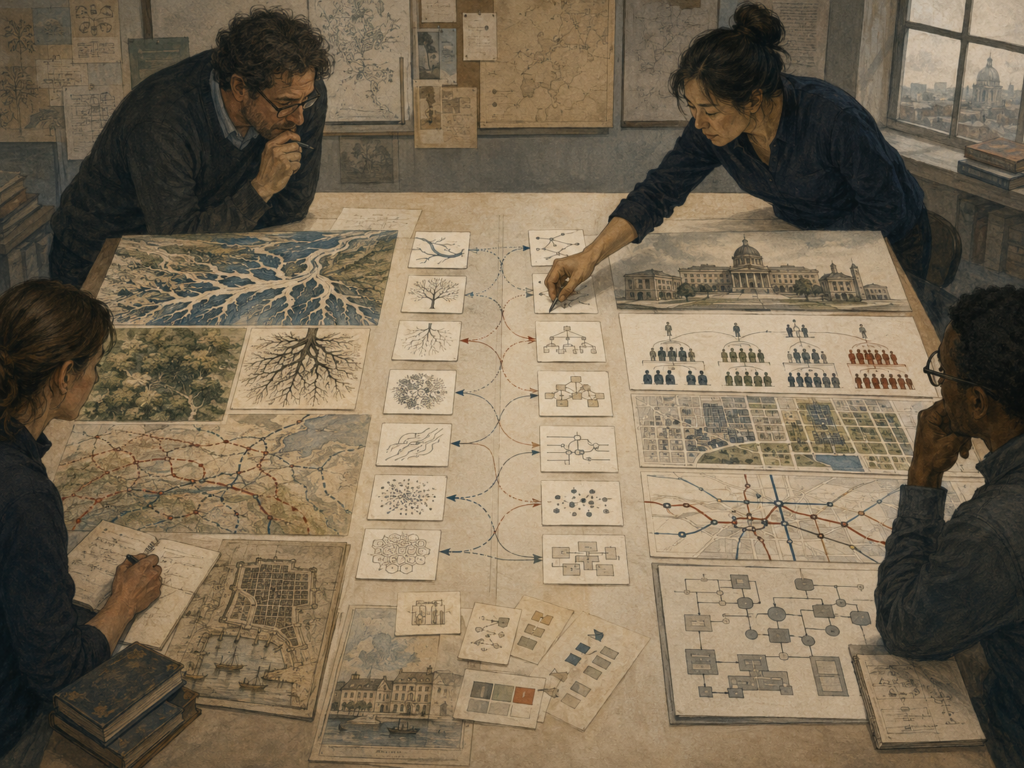
Researchers compare ecological patterns, historical maps, organizational structures, and infrastructure networks to transfer insights across different domains.

Analogical Thinking and Idea Transfer: How Strategy Learns Across Domains

Analogical Thinking and Idea Transfer examines how strategy expands beyond local expertise by transferring structures, mechanisms, and problem-solving logics from one domain into another. The article argues that analogy is not primarily about surface resemblance, but about relational correspondence: recognizing that different systems may share deeper organizing principles even when they look unrelated. It develops this through structure-mapping theory, cross-domain search, analogical transfer, biomimicry, organizational benchmarking, adaptation to constraints, common pitfalls, and the special challenge of evaluating analogies in complex systems where dynamics may diverge despite structural similarity. The article emphasizes that analogy matters strategically because it allows institutions to escape domain-bound thinking, widen the solution space, and import useful models from elsewhere—provided those transfers are critically adapted rather than copied at face value.
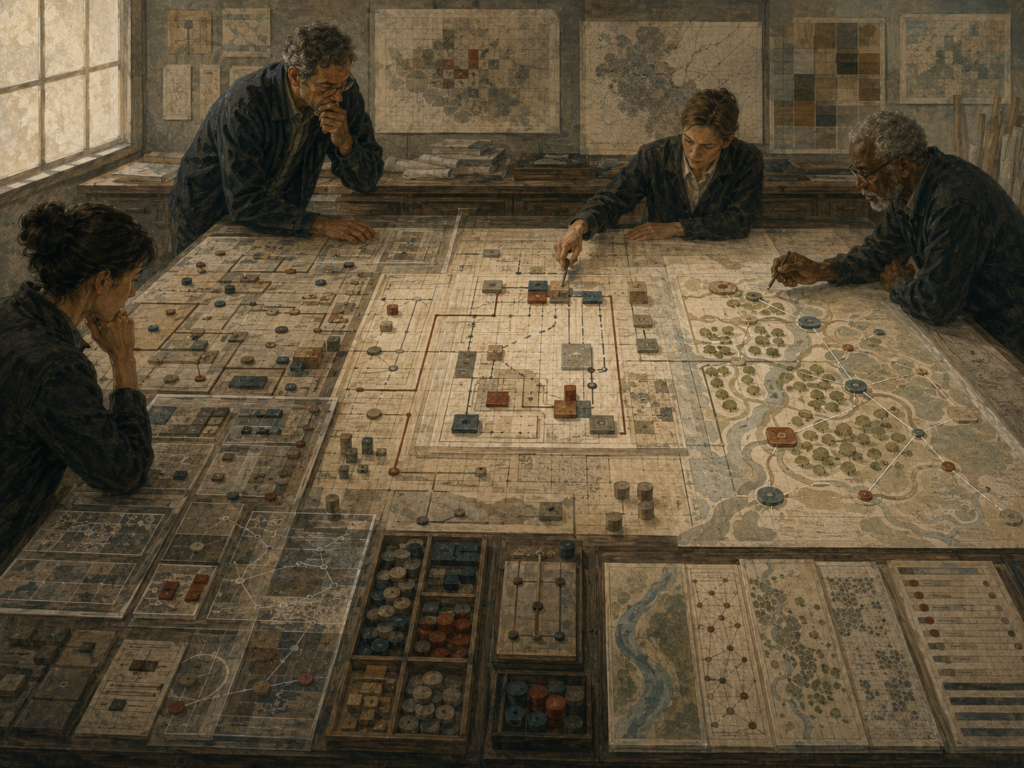
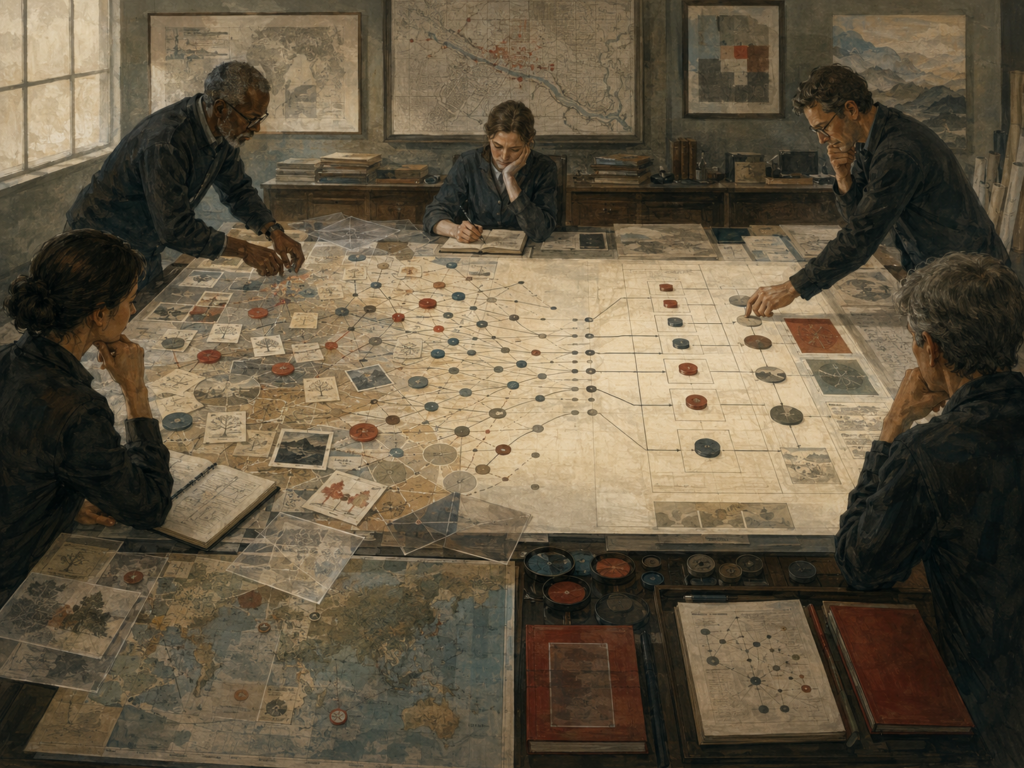
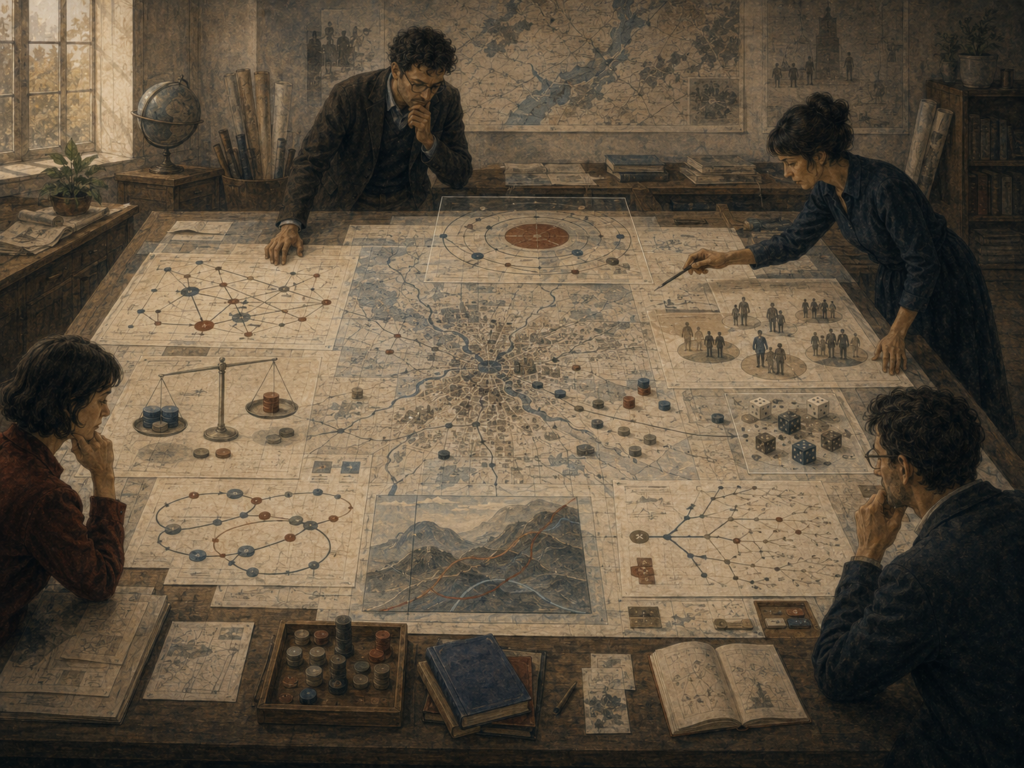
Researchers study bounded grids, maps, tokens, pathways, and modular design pieces on a large planning table, showing innovation emerging through constraints.

Creative Constraints and Innovation: How Limits Strengthen Strategic Ideas

Creative Constraints and Innovation examines how limitation functions not as the opposite of creativity, but as one of its structuring conditions. The article argues that meaningful innovation rarely emerges from boundless possibility alone; instead, it is often sharpened, directed, and made strategically useful by resource limits, technical boundaries, institutional rules, cognitive constraints, and changing environmental pressures. It develops this through the paradox of constraint and creativity, different constraint types, frugal and compliance-driven innovation, the reframing of constraints as design parameters, the calibration of divergence and convergence, organizational context, dynamic constraint management, and the link between constraint and institutional capability. The article emphasizes that stronger innovation depends less on escaping all limits than on understanding which boundaries are real, which are inherited assumptions, and how the right structure of constraints can focus search without suffocating it.

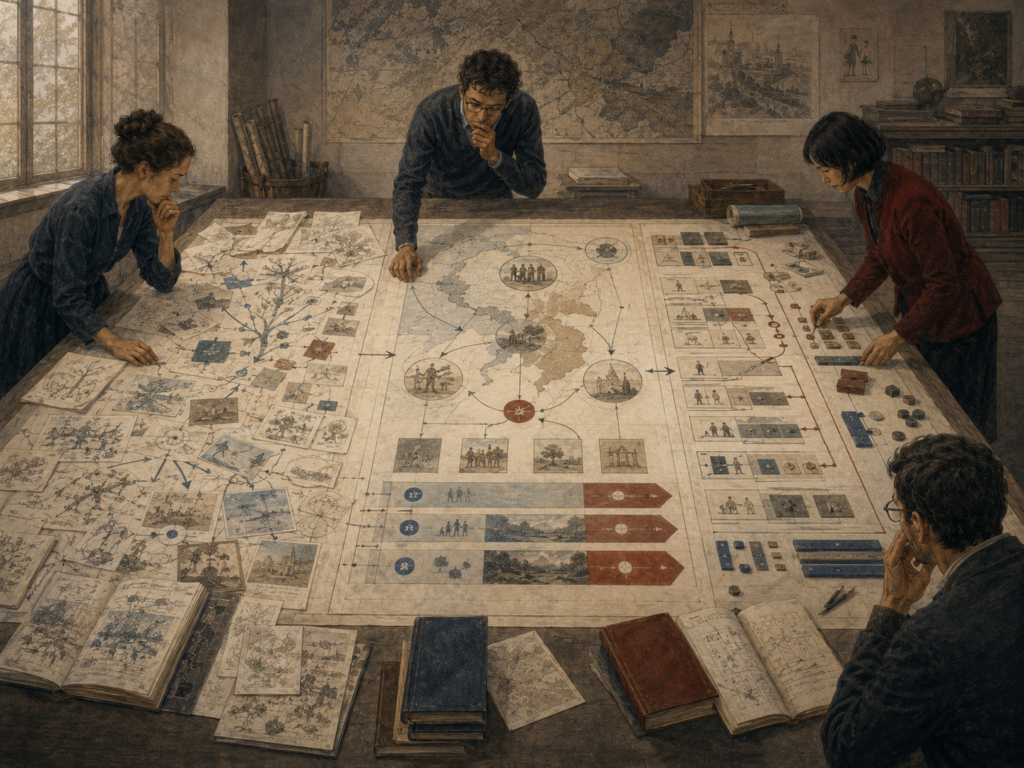
Researchers study a planning table where many exploratory ideas, maps, and branching pathways gradually narrow into structured choices and organized decision routes.

Divergent vs Convergent Thinking: How Strategy Balances Ideas and Decisions

Divergent and Convergent Thinking examines the two complementary cognitive modes that make strategic ideation workable: one expands the space of possibilities, and the other reduces that space into viable commitment. The article argues that complex problems cannot be solved through analysis alone because they require exploration before judgment, plurality before selection, and recursive movement between generative and evaluative modes. It develops this through Guilford’s account of divergent production, Cropley’s defense of convergent thinking, March’s exploration–exploitation framework, the role of constraints, iterative cycles of design and strategy, organizational conditions, and common failure modes such as premature convergence or unbounded divergence. The article emphasizes that effective strategy does not choose between creativity and discipline, but learns how to orchestrate both in sequence so that possibility can become direction without collapsing too early into habit.

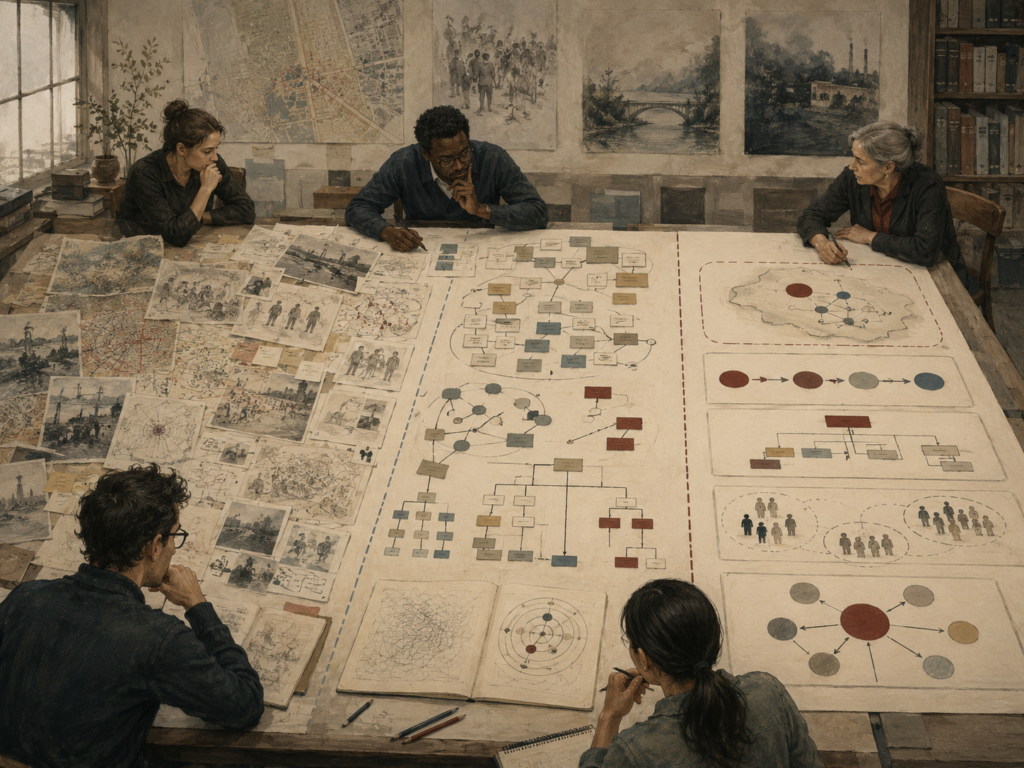
Analysts organize scattered evidence, stakeholder sketches, maps, diagrams, and structured problem maps on a large planning table.

Problem Framing and Problem Definition

Problem Framing and Problem Definition examines how strategy begins not with answers but with the construction of the problem itself. The article argues that problems are not neutral objects waiting to be discovered; they are selectively represented through frames that determine what counts as relevant information, where system boundaries are drawn, which actors matter, and what interventions become thinkable. It develops this through wicked-problem theory, framing as a search over representations, the move from framing to formal definition, stakeholder power, systems thinking, reframing techniques, organizational capability, and common failure modes such as boundary myopia and institutional lock-in. The article emphasizes that stronger strategy depends not only on better solutions, but on the ability to construct better questions and revise inherited problem representations before intelligence is spent optimizing the wrong reality.

Researchers study interconnected maps, feedback loops, stakeholder clusters, resource flows, and idea cards on a large planning table.

Systems Thinking in Ideation: Generating Ideas for Complex Systems

Systems Thinking in Ideation examines how strategic ideas become more effective when problems are understood as outputs of dynamic, interconnected systems rather than as isolated events with single causes. The article argues that traditional ideation often fails in complex environments because it generates solutions inside a fixed and overly local model of the problem, treating symptoms as if they were causes and overlooking feedback, delays, incentives, and structural interactions. It develops this through the move from idea generation to system diagnosis, the foundations of system dynamics, the principle that structure drives behavior, the distinction between solution search and structure search, leverage points, unintended consequences, organizational learning, and the importance of balancing analytical rigor with model flexibility. The article emphasizes that systems-based ideation matters strategically because it shifts creativity from surface invention to structural intervention, increasing the likelihood that ideas will remain coherent, adaptive, and causally relevant once they meet the wider system

Strategists study layered maps, root-cause diagrams, elemental building blocks, trade-off tokens, and reconstructed pathways on a large planning table.

First Principles Thinking in Strategy

First Principles Thinking in Strategy examines how organizations escape inherited assumptions by rebuilding strategic judgment from the ground up. The article argues that many institutions drift not because they lack intelligence, but because they continue solving new problems with old analogies, conventions, and institutional habits that no longer reflect present conditions. It develops this through the contrast between first-principles reasoning and conventional planning, the decomposition of systems into essential components, the separation of real constraints from assumed ones, the reconstruction of strategy from governing mechanisms, and the role of this method in innovation, institutional redesign, competitive advantage, and complex systems. The article emphasizes that first principles thinking matters not as performative disruption, but as a disciplined way of exposing hidden degrees of freedom and making inherited error harder to hide.

Analysts study layered maps, causal diagrams, stakeholder frames, trade-off models, and risk markers on a large planning table, representing mental models in strategic thinking.

Mental Models in Strategic Thinking

Mental Models in Strategic Thinking examines the internal representations through which strategists make sense of complexity, infer causality, anticipate outcomes, and decide what actions appear reasonable. The article argues that strategy is never formed from data alone, because every judgment depends on a model of how the world works, whether that model is explicit in diagrams and forecasts or implicit in habits, metrics, and institutional routines. It develops this through mental models as representations of causality, bounded rationality, model pluralism, the dangers of model monoculture, foresight, organizational embedding, and strategic failure as a problem of representation rather than effort alone. The article emphasizes that stronger strategy depends not on escaping mental models, which is impossible, but on making them richer, more plural, and more revisable so that institutions can adapt before outdated assumptions harden into avoidable failure.

Researchers study a large planning table divided into exploratory ideas, strategic pathways, and tactical implementation steps, showing the relationship between ideation, strategy, and tactics.

Strategy vs Tactics vs Ideation

Strategy vs Tactics vs Ideation distinguishes three interdependent layers of decision-making that are often blurred together in practice. The article argues that ideation generates the conceptual architecture of possibility, strategy narrows that possibility into coherent direction through tradeoffs and choice, and tactics translate that direction into real-world action that also produces feedback. It develops this through a layered model of reasoning, the role of ideation in shaping the possibility space, strategy as commitment under constraint, tactics as execution and learning, recursive feedback across layers, organizational breakdowns such as tactical overload or strategic ambiguity, and the importance of locating failure in the correct layer. The article emphasizes that stronger execution depends not only on better tactics, but on preserving the distinctions and feedback links that allow ideas to become strategy, strategy to become action, and action to become learning.

Researchers study maps, diagrams, decision cards, notebooks, and branching pathways on a large planning table, representing strategic ideation as structured creative reasoning.

What Is Strategic Ideation?

What Is Strategic Ideation? defines strategic ideation as the disciplined process through which ideas are generated, structured, evaluated, and refined so they can guide judgment and action in complex systems. The article argues that it is not equivalent to casual creativity or brainstorming, because its purpose is not merely to produce options but to build the conceptual architecture through which problems, possibilities, tradeoffs, and interventions become intelligible. It develops this through a systems-process model of framing, cognition, idea generation, conceptual structuring, evaluation, and iteration; an interdisciplinary foundation spanning bounded rationality, behavioral judgment, reflective practice, design thinking, systems theory, and foresight; the role of ideation in complex environments; and the tensions between creativity and discipline, exploration and exploitation, simplicity and fidelity, and vision and implementation. The article emphasizes that strategic ideation matters because strong strategy depends upstream on strong idea architecture: the capacity to turn uncertainty into structured understanding that can survive translation into action.

Scroll to Top