
Linear Algebra for Systems Modeling

Linear Algebra for Systems Modeling examines how vectors, matrices, linear transformations, and systems of equations make it possible to represent, analyze, and compute relationships within complex systems. Across systems modeling, linear algebra provides a foundational framework for describing structure, interaction, dependency, and scale in domains such as engineering, economics, environmental science, network analysis, physics, data science, and sustainability.

This category explores the role of vector spaces, matrix operations, eigenvalues, eigenvectors, linear mappings, decompositions, and systems of linear equations in the study of complex systems. It considers how relationships among multiple variables can be formally organized, how structure can be expressed in multidimensional form, and how mathematical representations make it possible to analyze stability, connectivity, influence, and transformation across interconnected processes. Particular attention is given to state representation, network structure, dimensionality, coupled systems, and the mathematical conditions under which systems can be solved, approximated, or interpreted.

The category also considers the relationship between formal mathematical reasoning and computational implementation. Linear algebra is not treated here as an abstract technical exercise alone, but as a practical and conceptual language for simulation, modeling, optimization, machine learning, systems analysis, and reproducible computation. Where appropriate, articles may connect classical linear algebra to Python-based workflows, matrix-based computation, and computational methods used to study high-dimensional and interdependent systems in applied settings.

By linking mathematical structure to systems thinking, this category positions linear algebra as a central method for understanding relation, form, interaction, and transformation within complex systems.

Vintage mathematical study with parchment diagrams of perpendicular vectors, projections, matrix-like arrays, network simplification, geometric planes, books, and drafting tools.

Orthogonality and Structured Simplification: How Linear Algebra Separates System Structure

Orthogonality and structured simplification explain how linear algebra separates systems into directions that do not interfere under a chosen geometry. This article introduces dot products, perpendicular directions, orthogonal vectors, orthogonal sets, orthonormal bases, orthogonal complements, orthogonal decomposition, projection residuals, least-squares geometry, Gram-Schmidt orthogonalization, QR decomposition, orthogonal matrices, numerical stability, and conditioning review. It shows how orthogonality turns overlapping structure into separated components, making approximation, residual analysis, coordinate representation, dimensional simplification, and solver workflows easier to interpret and validate. The article emphasizes that orthogonal directions are not automatically causal or institutionally independent; they depend on inner products, units, scaling, weights, tolerances, and modeling purpose. It connects orthogonality to infrastructure modes, ecological gradients, economic factors, machine learning features, scientific computing, policy indicators, reproducible audits, and accountable decision support across complex systems where structured separation must remain mathematically stable and substantively meaningful.

Vintage mathematical workspace with projection diagrams, reflected vectors, shaded planes, geometric shadows, point clouds, networks, notebooks, and drafting tools.

Projections, Reflections, and Geometric Interpretation: How Linear Algebra Makes Matrix Behavior Visible

Projections, reflections, and geometric interpretation explain how linear algebra turns matrices into visible geometric behavior. This article introduces projection operators, orthogonal projection, residual vectors, subspaces, projection matrices, least-squares geometry, reflection matrices, symmetry, distance, angle, idempotence, orthogonality, residual diagnostics, Householder reflections, and operator checks. It shows how projections retain modeled structure while separating residual structure, how reflections preserve distance while reversing perpendicular components, and how matrix actions can be interpreted as geometric transformations rather than anonymous calculations. The article connects geometry to systems modeling by showing how approximation, dimensional reduction, residual review, feature compression, infrastructure risk modes, ecological gradients, economic sector patterns, and scientific computing workflows depend on chosen subspaces, inner products, scaling, units, numerical stability, and responsible interpretation for system modeling, technical communication, policy workflows, machine learning pipelines, reproducible audits, institutional review, and accountable decision support across complex systems.

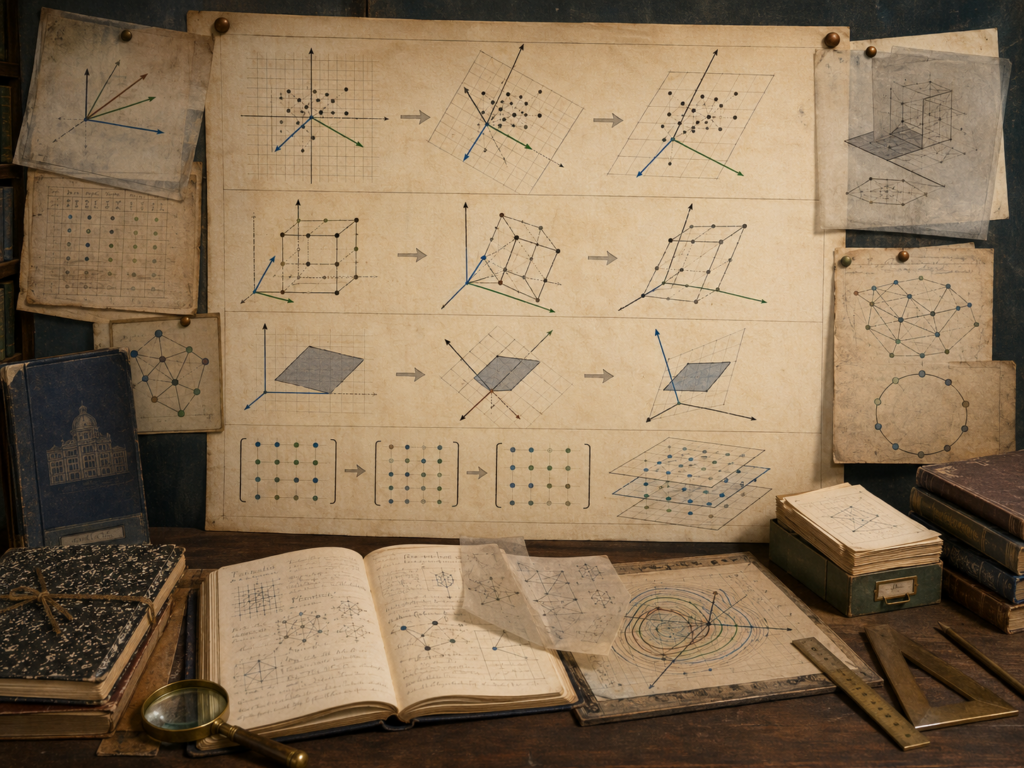
Vintage mathematical workspace with rotated coordinate grids, basis vectors, transformed point clouds, equivalent lattice diagrams, network sketches, notebooks, and drafting tools.

Change of Basis and Alternative Representations: How Linear Algebra Rewrites System Coordinates

Change of basis and alternative representations explain how the same system can look different when described in different coordinates. This article introduces basis vectors, coordinate representations, change-of-basis matrices, coordinate recovery, similarity transformations, invariant structure, orthonormal bases, nonorthogonal bases, scaling, normalization, units, condition numbers, and representation governance. It shows why vectors are not identical to coordinate lists, why matrix entries depend on basis choice, and why a better coordinate system can reveal modes, dependencies, symmetries, dominant directions, sparse structure, or hidden coupling. The article emphasizes that representation choices affect interpretation, numerical stability, visualization, compression, and decision use. It distinguishes meaningful alternative coordinates from opaque transformations under domain meaning, units, conditioning, reconstruction error, invariant checks, scientific computing, infrastructure planning, ecological modeling, economic systems, machine learning, reproducible workflows, policy analysis, state-space modeling, accountable technical communication, and governance review settings across complex systems.

Vintage systems-modeling workspace with matrix multiplication diagrams, row-column interactions, product matrices, network propagation, application panels, books, and drafting tools.

Matrix Multiplication and Interaction Effects: How Linear Algebra Reveals System Pathways

Matrix multiplication and interaction effects explain how linear transformations combine, how variables influence one another, and how multi-step systems produce indirect behavior. This article introduces matrix multiplication as row-column computation, dot-product aggregation, linear-combination structure, transformation composition, pathway tracing, and layered systems modeling. It connects dimension compatibility, intermediate indexes, order, noncommutativity, associativity, identity matrices, direct effects, indirect effects, adjacency powers, network walks, state transitions, economic interdependence, ecological coupling, infrastructure dependencies, and machine learning layers. The article shows why a product matrix is not merely a calculation but a compressed account of sequential structure: what acts first, what layer mediates interaction, how pathways accumulate, and which assumptions are hidden inside the product. It emphasizes responsible interpretation under units, indexing, scaling, transformation order, pathway validity, numerical reproducibility, scientific computing, infrastructure planning, economic systems, ecological modeling, policy workflows, documentation, and reproducible institutional review.

Vintage systems-modeling workspace with transformed grids, vector mappings, sheared cubes, altered networks, response curves, flow maps, books, and drafting tools.

Linear Transformations and Model Behavior: How Matrices Act on System States

Linear transformations and model behavior explain how matrices act on system states. This article introduces linear transformations as structure-preserving maps between vector spaces, showing how matrix action transforms inputs into outputs through scaling, rotation, shearing, projection, mixing, amplification, damping, and collapse. It connects domain, codomain, image, kernel, rank, nullity, transformed basis vectors, superposition, state transitions, sensitivity, norms, determinants, invertibility, and system response to practical modeling interpretation. The article emphasizes that a matrix is not only a coefficient table but a behavioral rule: it reveals which outputs are reachable, which input directions disappear, which differences are amplified, and which structures persist. It also distinguishes useful linear approximation from overextended linear assumptions under units, scaling, nonlinear dynamics, feedback, uncertainty, conditioning, scientific computing, infrastructure planning, ecological modeling, economic systems, policy workflows, and responsible decision use.

Vintage systems-modeling workspace with scatterplots, fitted lines, residual arrows, projection geometry, matrix blocks, monitoring maps, notebooks, and drafting tools.

Overdetermined Systems and Least Squares Thinking: How Linear Algebra Models Approximation

Overdetermined systems and least squares thinking explain how linear algebra handles models with more equations, observations, measurements, or constraints than unknowns. This article introduces overdetermined systems, inconsistency, residual vectors, residual norms, least-squares approximation, column-space projection, normal equations, full column rank, identifiability, regression, calibration, weighted least squares, constrained approximation, QR decomposition, singular value decomposition, pseudoinverses, and numerical stability. It shows why exact solutions often disappear in empirical systems, why approximation can still be principled, and why residuals should be interpreted as evidence rather than ignored leftovers. The article emphasizes responsible modeling by distinguishing best fit from truth, small residuals from validity, coefficient estimates from causal meaning, and squared-error minimization from broader judgment under measurement error, scaling choices, outliers, uncertainty, conditioning, solver method, and modeling purpose in scientific computing, infrastructure planning, ecological modeling, economic systems, policy workflows, and reproducible institutional review.

Vintage mathematical workspace with reversible grid transformations, restored vectors, inverse matrix diagrams, recovered networks, flow maps, books, and drafting tools.

Inverse Matrices and Structural Recovery: How Linear Algebra Recovers System States

Inverse matrices explain when a linear transformation can be reversed and when a system state can be recovered from observed outputs. This article examines invertibility as a structural recovery problem, connecting algebraic conditions to systems modeling questions about measurement, reconstruction, stability, and information loss. It explains identity matrices, inverse operations, determinants, rank, pivot structure, null spaces, singular matrices, ill conditioning, residuals, perturbation sensitivity, and the difference between exact recovery and unstable recovery. The article also addresses engineering and applied mathematics workflows, including direct solvers, condition numbers, pseudoinverses, least-squares fallback, sensor-state reconstruction, and validation checks. By treating the inverse matrix as a claim about recoverability rather than a mere calculation, it shows how modelers decide whether hidden states, inputs, signals, or system structures can be reconstructed reliably from transformed observations without overstating what the available data and model actually support.

Vintage mathematical workspace with transformation grids, matrices, parallelograms, cubes, flattened spaces, networks, books, and drafting tools.

Determinants and Invertibility: How Linear Algebra Reveals Reversible Structure

Determinants and invertibility explain when a square matrix preserves enough structure for a transformation to be reversed. This article introduces determinants as signed volume-scaling factors that reveal orientation, expansion, contraction, singularity, rank, pivot structure, nullity, and structural collapse. It shows why a nonzero determinant is equivalent to invertibility, full rank, a pivot in every row and column, a trivial null space, and unique solutions for every right-hand side. The article also explains why a zero determinant signals dependence, loss of dimension, and non-recoverability, while near-zero determinants require numerical caution. It emphasizes responsible interpretation by distinguishing algebraic invertibility from practical reversibility, determinant magnitude from model adequacy, singularity from model failure, and formal recovery from reliable decision-making under units, scaling, conditioning, data quality, assumptions, and modeling purpose in scientific computing, infrastructure planning, economic systems, ecological modeling, policy workflows, and institutional review.

Vintage mathematical workspace with rank and nullity diagrams, pivot patterns, dependent columns, null-space directions, subspaces, networks, and systems-modeling sketches.

Rank, Nullity, and Structural Dependence: How Linear Algebra Reveals Independent Structure and Hidden Freedom

Rank, nullity, and structural dependence explain how linear algebra measures independent structure, hidden freedom, and redundancy inside systems. This article introduces rank as the dimension of independent row or column structure, nullity as the dimension of the null space, and structural dependence as the condition in which equations, variables, or modeled relationships repeat, collapse, or fail to add new information. It connects pivot count, row rank, column rank, column-space reachability, null-space freedom, rank-nullity, rank deficiency, identifiability, underdetermination, and numerical rank to systems modeling. The article emphasizes responsible interpretation by distinguishing high rank from model adequacy, nullity from either useful flexibility or missing constraints, dependence from error or meaningful structure, and numerical rank from tolerance-sensitive computational judgment in scientific computing, policy analysis, infrastructure planning, ecological modeling, and decision workflows and institutional review, reproducible audit trails, and applied modeling governance today.

Scroll to Top