
Linear Algebra for Systems Modeling

Linear Algebra for Systems Modeling examines how vectors, matrices, linear transformations, and systems of equations make it possible to represent, analyze, and compute relationships within complex systems. Across systems modeling, linear algebra provides a foundational framework for describing structure, interaction, dependency, and scale in domains such as engineering, economics, environmental science, network analysis, physics, data science, and sustainability.

This category explores the role of vector spaces, matrix operations, eigenvalues, eigenvectors, linear mappings, decompositions, and systems of linear equations in the study of complex systems. It considers how relationships among multiple variables can be formally organized, how structure can be expressed in multidimensional form, and how mathematical representations make it possible to analyze stability, connectivity, influence, and transformation across interconnected processes. Particular attention is given to state representation, network structure, dimensionality, coupled systems, and the mathematical conditions under which systems can be solved, approximated, or interpreted.

The category also considers the relationship between formal mathematical reasoning and computational implementation. Linear algebra is not treated here as an abstract technical exercise alone, but as a practical and conceptual language for simulation, modeling, optimization, machine learning, systems analysis, and reproducible computation. Where appropriate, articles may connect classical linear algebra to Python-based workflows, matrix-based computation, and computational methods used to study high-dimensional and interdependent systems in applied settings.

By linking mathematical structure to systems thinking, this category positions linear algebra as a central method for understanding relation, form, interaction, and transformation within complex systems.

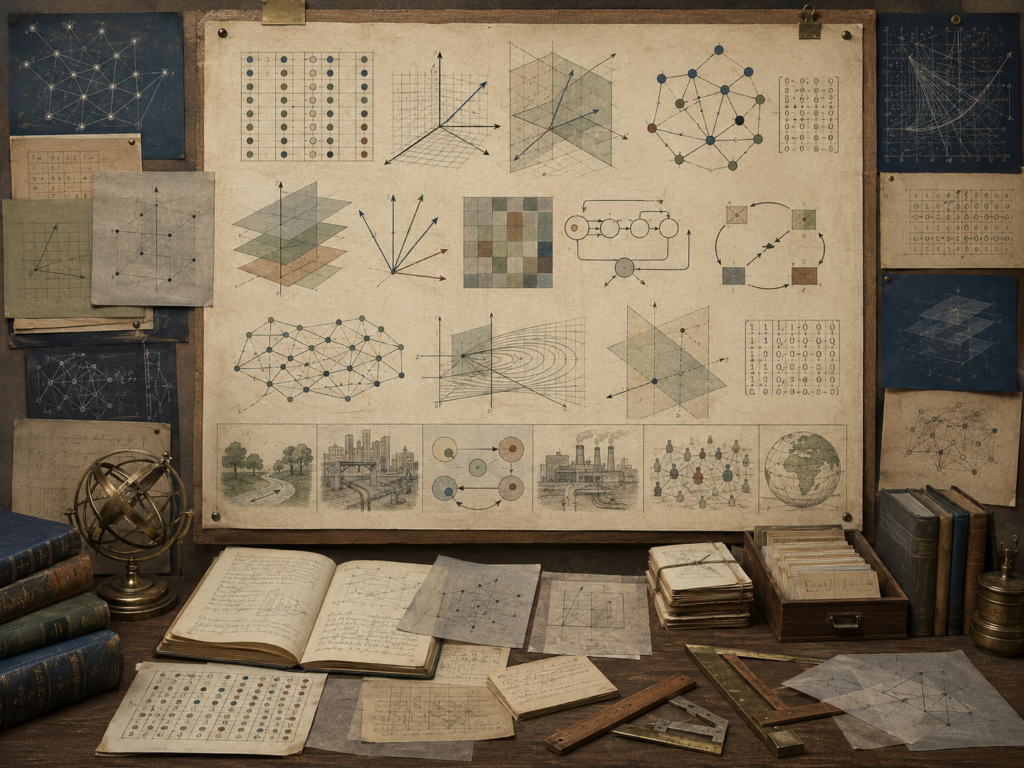
Scholarly archival workspace with matrices, vector diagrams, networks, transformation grids, and systems modeling schematics on parchment and chalkboard surfaces.

What Is Linear Algebra for Systems Modeling? Vectors, Matrices, Networks, and Structure

Linear algebra for systems modeling explains how vectors, matrices, transformations, systems of equations, eigenstructure, networks, and decompositions help represent structured relationships in complex systems. This article introduces linear algebra as more than matrix calculation: it is a modeling language for system states, constraints, interactions, flows, transitions, stability, dimensionality, and interpretation. It shows how vectors can represent multivariable states, how matrices encode relationships, how systems of equations clarify solvability, how transformations describe system behavior, how eigenvalues reveal long-run tendencies, and how decompositions simplify high-dimensional structure. The article connects formal mathematics to systems modeling, scientific computing, infrastructure, economics, ecology, machine learning, governance, and public policy. It emphasizes responsible interpretation by asking what each vector or matrix represents, what assumptions are encoded, and when linear structure clarifies or distorts real systems. It also introduces reproducible workflows for code, data, outputs, and audits.
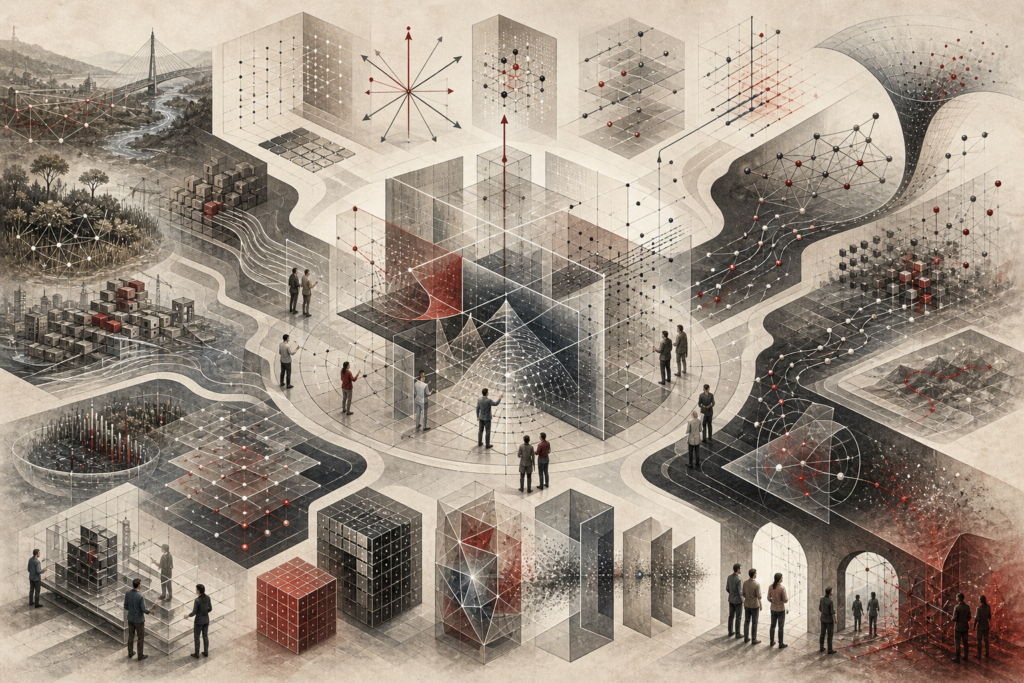
Editorial scientific illustration of linear algebra for systems modeling as a structural-systems architecture, showing vector pathways, matrix grids, coordinate spaces, transformation surfaces, eigenstructure axes, network adjacency structures, graph flows, decomposition layers, dimensionality-reduction funnels, infrastructure networks, ecological systems, economic input-output structures, machine-learning representation spaces, governance systems, and responsible structural interpretation.

Linear Algebra for Systems Modeling: Matrices, Networks, Dynamics, and Structural Reasoning

Linear Algebra for Systems Modeling introduces matrices, vectors, transformations, networks, and eigensystems as tools for understanding structure in complex systems. The map connects foundational ideas—linear equations, matrix operations, rank, span, bases, projections, determinants, eigenvalues, singular value decomposition, and least-squares reasoning—to applied questions in engineering, data analysis, infrastructure, control, optimization, and scientific modeling. Rather than treating linear algebra as isolated computation, it presents the subject as a language for describing flows, constraints, dependence, stability, approximation, feedback, and system behavior. Readers move from basic matrix representation to network models, dynamical systems, dimensional reduction, numerical reliability, and interpretive judgment. The series emphasizes both mathematical clarity and practical modeling discipline: how linear structures reveal hidden relationships, where linear assumptions fail, and how computational methods translate abstract algebra into usable insight.

Scroll to Top