Calculus for Systems Modeling

Calculus for Systems Modeling examines how mathematical concepts of change, accumulation, rate, and continuous variation make it possible to analyze dynamic systems whose behavior unfolds across time. Within systems modeling, calculus provides a foundational framework for describing growth, decline, feedback, equilibrium, instability, optimization, and transition in domains such as ecology, economics, engineering, environmental science, physics, and sustainability.

This category explores the role of derivatives, integrals, differential equations, multivariable analysis, optimization, and numerical approximation in the study of complex systems. It considers how continuous processes can be formally represented, how interacting variables shape system behavior, and how mathematical structure can clarify the mechanisms through which systems evolve, stabilize, or break down. Particular attention is given to nonlinear dynamics, threshold effects, rates of change, and the analytical conditions under which intervention may amplify, dampen, or redirect systemic behavior.

The category also considers the relationship between formal mathematical reasoning and computational implementation. Calculus is not treated here as an abstract technical exercise alone, but as a practical and conceptual language for simulation, modeling, visualization, and reproducible analysis. Where appropriate, articles may connect classical calculus to Python-based workflows, numerical methods, and computational experiments that allow continuous systems to be studied in applied settings.

By linking mathematical analysis to systems thinking, this category situates calculus as an essential instrument for understanding temporal processes, causal structure, and the evolving behavior of complex systems.

Editorial mathematical illustration of carbon accumulation and emissions pathways, showing stock-flow diagrams, emissions curves, atmospheric carbon reservoirs, land and ocean sinks, cumulative emissions, uncertainty bands, carbon budget ledgers, equations, diagnostics, and governance review materials.

Carbon Accumulation and Emissions Pathways

Carbon Accumulation and Emissions Pathways shows how calculus turns emissions, sinks, atmospheric concentration, cumulative burden, and climate response into a structured systems model. This article introduces carbon pathway modeling for calculus-based systems modeling, including stocks and flows, emissions pathways, cumulative emissions, atmospheric carbon, airborne fraction, land and ocean sinks, impulse response functions, carbon persistence, carbon budgets, net-zero pathways, overshoot, negative emissions, carbon-cycle feedback, calibration, uncertainty, sensitivity, and responsible interpretation. It shows why annual emissions are flows while atmospheric carbon is an accumulating stock with long memory. In computational workflows, carbon accumulation audits support pathway records, cumulative-emissions tables, atmospheric-burden estimates, budget records, SQL governance registries, Haskell typed pathway records, calculator scripts, Canvas artifacts, and generated reports. The article emphasizes documenting accounting boundaries, sink assumptions, removal claims, uncertainty, validation scope, and claim boundaries for transparent responsible climate pathway interpretation.


Archival climatology workspace with ice sheets, oceans, forests, storms, fire, arrows, layered maps, research diagrams, glass vessels, and drafting tools representing climate feedback models.

Climate Feedback Models

Climate Feedback Models shows how calculus turns reinforcing and balancing climate processes into a structured systems model. This article introduces climate feedback models for calculus-based systems modeling, including energy balance equations, radiative forcing, feedback parameters, Planck response, water vapor feedback, lapse-rate feedback, cloud feedback, albedo feedback, carbon-cycle feedback, ocean heat uptake, equilibrium climate sensitivity, transient response, time-scale separation, thresholds, tipping risk, calibration, uncertainty, sensitivity, and responsible interpretation. It shows why simple feedback equations are useful for clarifying structure but insufficient as complete Earth-system models. In computational workflows, climate feedback audits support forcing records, sign-convention records, feedback-component tables, one-box and two-box scenarios, SQL governance registries, Haskell typed climate records, calculator scripts, Canvas artifacts, and generated reports. The article emphasizes documenting forcing assumptions, feedback signs, parameter evidence, validation scope, uncertainty, and claim boundaries for transparent and responsible climate interpretation.

Archival ecological modeling workspace with forest habitat model, rabbits, foxes, owls, deer, population cycle curves, food-web diagrams, specimen jars, notebooks, maps, and field tools representing predator-prey systems.

Predator-Prey Systems

Predator-Prey Systems shows how calculus turns interaction, feedback, oscillation, and stability into a structured systems model. This article introduces predator-prey systems for calculus-based systems modeling, including coupled differential equations, prey growth, predator mortality, encounter rates, conversion efficiency, nullclines, phase planes, equilibria, local stability, oscillation, phase lag, logistic prey limits, functional responses, harvesting, stochasticity, spatial structure, calibration, identifiability, uncertainty, sensitivity, and responsible interpretation. It shows why classic Lotka-Volterra equations are useful as a baseline but insufficient as a complete ecological explanation. In computational workflows, predator-prey audits support parameter records, scenario tables, nullcline notes, Jacobian calculations, SQL governance registries, Haskell typed interaction records, calculator scripts, Canvas artifacts, and generated reports. The article emphasizes documenting variables, interaction assumptions, functional responses, parameter evidence, validation scope, uncertainty, and claim boundaries.

Archival ecological modeling workspace with wildlife maps, population clusters, growth curves, food-web diagrams, habitat models, specimen jars, notebooks, and drafting tools representing population dynamics without labels or text.

Modeling Population Dynamics

Modeling Population Dynamics shows how calculus turns population change into a structured, interpretable systems model. This article introduces population dynamics for calculus-based systems modeling, including state variables, exponential growth, logistic growth, per-capita growth rates, carrying capacity, density dependence, equilibrium, stability, parameter interpretation, calibration, uncertainty, sensitivity, data quality, and responsible interpretation. It shows how a simple differential equation can reveal the consequences of growth rates, constraints, feedback, and assumptions while also explaining why real populations may require migration, age structure, spatial variation, stochasticity, resource limits, predation, disease, policy, climate, or institutional context. In computational workflows, population dynamics audits support parameter records, scenario tables, SQL governance registries, Haskell typed records, calculator scripts, Canvas artifacts, and generated reports. The article emphasizes documenting population definitions, units, sources, assumptions, uncertainty, validation scope, and claim boundaries.

Archival modeling workspace with layered maps, assumptions diagrams, landscape models, curve sketches, network charts, notebooks, magnifying tools, balances, and drafting instruments representing responsible mathematical modeling.

Interpretation, Assumptions, and Responsible Mathematical Modeling

Interpretation, assumptions, and responsible mathematical modeling determine whether a model becomes a disciplined aid to understanding or a source of misplaced confidence. This article introduces responsible interpretation for calculus-based systems modeling, including model purpose, assumption records, parameter evidence, uncertainty, sensitivity, validation scope, interpretive boundaries, ethical communication, governance workflows, reproducible computation, and claim discipline. It shows why equations, parameters, rates, integrals, simulations, and visualizations do not speak for themselves: their meaning depends on assumptions, evidence, data status, parameter ranges, solver settings, and model purpose. In computational workflows, responsible modeling audits support purpose records, assumption tables, parameter evidence records, validation-scope notes, SQL governance registries, Haskell typed records, calculator scripts, Canvas artifacts, and generated reports. The article emphasizes documenting purpose, assumptions, uncertainty, sensitivity, validation scope, communication warnings, and claim boundaries.

Archival modeling desk with smooth contour overlays suspended above cracked terrain, fragmented maps, scattered data points, notebooks, samples, and drafting tools representing the limits of continuous models without labels or text.

When Continuous Models Mislead

Continuous models mislead when smooth mathematical structure is mistaken for the structure of the world. This article explains how calculus-based systems models can clarify rates, accumulation, flows, fields, differential equations, feedback, optimization, and approximation while also hiding discontinuities, thresholds, structural breaks, institutional decisions, measurement limits, solver artifacts, and model-scope failures. It examines false smoothness, hidden thresholds, equilibrium bias, aggregation risk, extrapolation, domain drift, parameter fragility, missing mechanisms, social discontinuities, and numerical confidence. In computational workflows, continuous-model risk audits support continuity assumption records, threshold checks, misleading-smoothness risk tables, solver diagnostic records, SQL governance registries, Haskell typed misuse records, calculator scripts, Canvas artifacts, and generated reports. The article emphasizes documenting smoothness assumptions, data breaks, parameter ranges, solver settings, convergence diagnostics, omitted mechanisms, validation scope, warnings, and claim boundaries.

Archival engineering workspace with gears, fluid apparatuses, network diagrams, layered model sketches, natural-system maps, notebooks, and drafting tools representing mechanistic explanation and the limits of formal models without labels or text.

Mechanistic Explanation and the Limits of Formalism

Mechanistic explanation and the limits of formalism help distinguish models that clarify causal structure from models that merely organize symbols. This article introduces mechanistic explanation for calculus-based systems modeling, including causal mechanisms, formal representation, abstraction, idealization, equation structure, parameter interpretation, model validation, explanatory scope, black-box risk, simulation limits, responsible interpretation, reproducible workflows, and model governance. It shows why formalism must be reviewed: a model may fit data, simulate trajectories, or preserve dimensional consistency while still failing to identify a meaningful mechanism. In computational workflows, mechanism audits support mechanism records, formal representation records, evidence links, explanatory claim tables, SQL governance registries, Haskell typed records, calculator scripts, Canvas artifacts, and generated reports. The article emphasizes documenting variables, parameters, units, assumptions, evidence status, validation scope, sensitivity checks, black-box warnings, and claim boundaries.

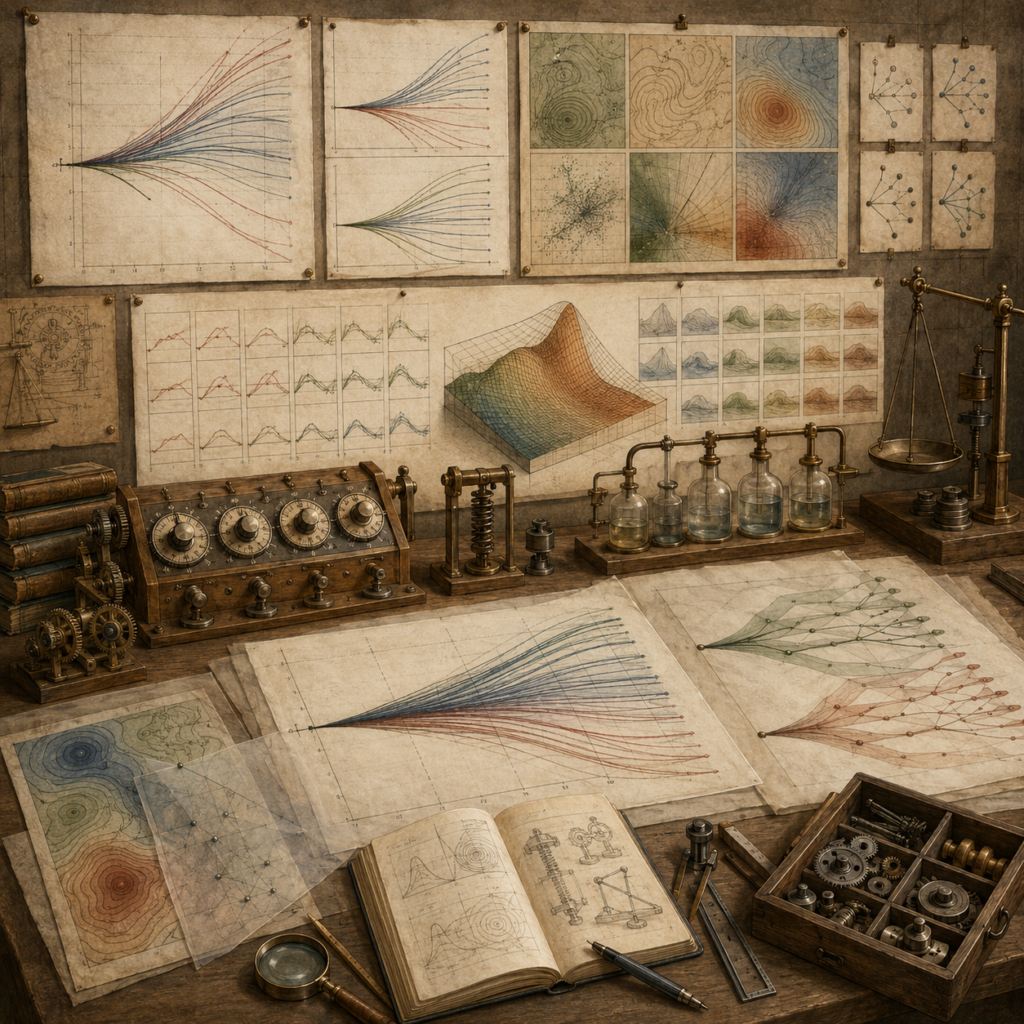
Vintage systems modeling workspace with families of sensitivity curves, response surfaces, contour maps, parameter controls, glass vessels, balances, notebooks, and drafting tools representing robustness and parameter dependence.

Sensitivity, Robustness, and Parameter Dependence

Sensitivity, robustness, and parameter dependence determine whether a mathematical model is stable under reasonable changes or fragile because of hidden assumptions. This article introduces sensitivity and robustness for calculus-based systems modeling, including local sensitivity, normalized sensitivity, elasticity, finite-difference approximations, parameter sweeps, robustness envelopes, threshold behavior, scenario ranges, interaction effects, uncertainty-aware interpretation, reproducible workflows, and model governance. It shows why sensitivity matters: model conclusions may depend strongly on growth rates, delays, capacities, exposure coefficients, initial values, boundary conditions, solver tolerances, or thresholds. In computational workflows, sensitivity audits support baseline parameter records, tested ranges, finite-difference scores, elasticity estimates, robustness classifications, SQL governance registries, Haskell typed records, calculator scripts, and generated reports. The article emphasizes documenting baselines, units, sources, ranges, perturbation methods, output metrics, solver settings, warnings, and claim boundaries.

Vintage engineering workspace with scale models, measurement tools, reservoir systems, comparative diagrams, surface plots, contour maps, notebooks, and balances representing scaling, units, and nondimensionalization.

Scaling, Units, and Nondimensionalization

Scaling, units, and nondimensionalization help mathematical models remain interpretable, comparable, and computationally reliable. This article introduces these foundations for calculus-based systems modeling, including dimensional consistency, unit records, conversion rules, reference scales, dimensionless variables, dimensionless groups, the Buckingham Pi theorem, scaling laws, similarity, numerical conditioning, parameter reduction, and responsible interpretation. It shows why scaling matters: time units can change trajectories, stock scales affect interpretation, length scales shape transport, and poor normalization can weaken numerical solvers. In computational workflows, scaling audits support unit tables, scale records, nondimensional outputs, SQL governance registries, Haskell typed unit records, calculator scripts, generated reports, and multi-language reproducibility. The article emphasizes documenting units, dimensions, reference scales, conversion assumptions, parameter ranges, solver settings, dimensionless groups, and claim boundaries so model outputs remain reviewable and responsibly interpreted.

Scroll to Top