Calculus for Systems Modeling

Calculus for Systems Modeling examines how mathematical concepts of change, accumulation, rate, and continuous variation make it possible to analyze dynamic systems whose behavior unfolds across time. Within systems modeling, calculus provides a foundational framework for describing growth, decline, feedback, equilibrium, instability, optimization, and transition in domains such as ecology, economics, engineering, environmental science, physics, and sustainability.

This category explores the role of derivatives, integrals, differential equations, multivariable analysis, optimization, and numerical approximation in the study of complex systems. It considers how continuous processes can be formally represented, how interacting variables shape system behavior, and how mathematical structure can clarify the mechanisms through which systems evolve, stabilize, or break down. Particular attention is given to nonlinear dynamics, threshold effects, rates of change, and the analytical conditions under which intervention may amplify, dampen, or redirect systemic behavior.

The category also considers the relationship between formal mathematical reasoning and computational implementation. Calculus is not treated here as an abstract technical exercise alone, but as a practical and conceptual language for simulation, modeling, visualization, and reproducible analysis. Where appropriate, articles may connect classical calculus to Python-based workflows, numerical methods, and computational experiments that allow continuous systems to be studied in applied settings.

By linking mathematical analysis to systems thinking, this category situates calculus as an essential instrument for understanding temporal processes, causal structure, and the evolving behavior of complex systems.

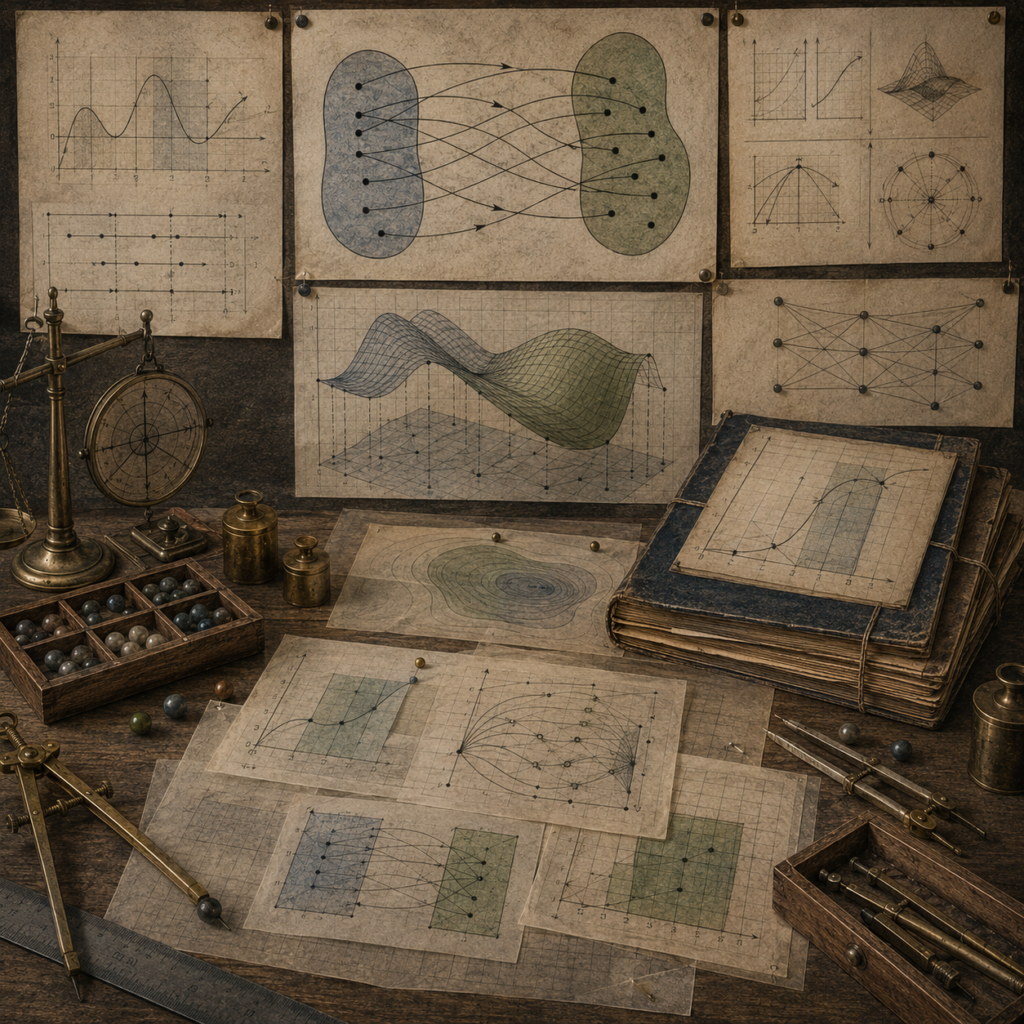
Archival-style mathematical study with mapping diagrams, plotted curves, surface graphs, network structures, and drafting tools arranged across a scholarly worktable to represent domains, ranges, and functional relationships.

Domains, Ranges, and the Structure of Functional Models: How Calculus Defines Valid System Behavior

Domains, ranges, and functional model structure determine what a systems model is allowed to say. A function does not operate on every possible input, and its outputs are not automatically meaningful in every context. In calculus for systems modeling, the domain defines valid inputs, states, parameters, scenarios, and conditions, while the range defines possible or interpretable outputs. This article explains how input spaces, output spaces, constraints, feasible regions, parameter ranges, state spaces, and boundary conditions shape model validity before derivatives, integrals, optimization, or simulation are applied. It connects domain and range reasoning to population dynamics, infrastructure modeling, epidemiology, climate systems, economics, and resource systems. It also introduces reproducible workflows in Python, R, SQL, and Haskell for validating inputs, checking outputs, documenting assumptions, and flagging scenarios that require review before drawing conclusions about model behavior, validity, or responsible use later.
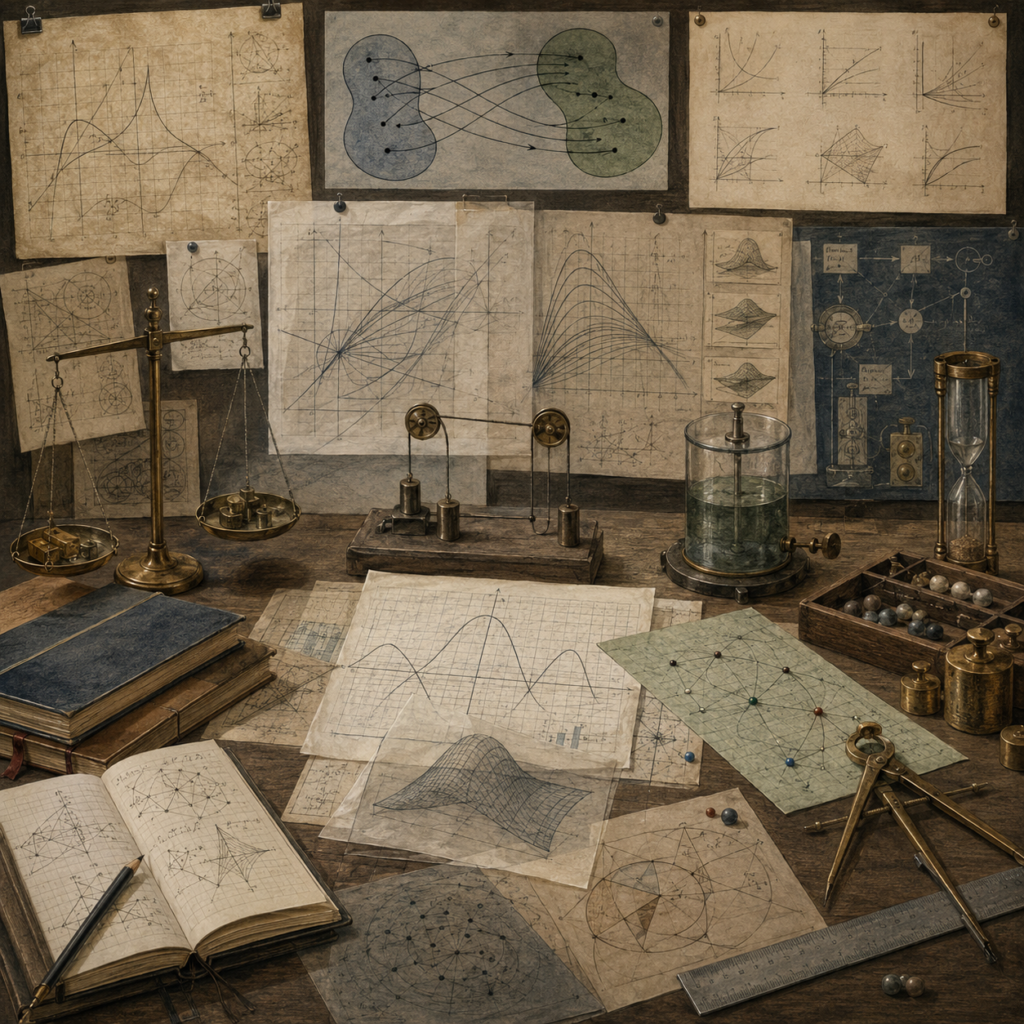
Archival-style scholarly workspace covered with graphs, plotted curves, geometric diagrams, mapping sketches, notebooks, measuring tools, weights, and model components that symbolize functions, variables, and mathematical representation.

Functions, Variables, and Mathematical Representation: How Calculus Builds Models of System Behavior

Functions, variables, and mathematical representation form the foundation of calculus for systems modeling. Before a model can describe rates of change, accumulation, feedback, optimization, or dynamic behavior, it must define what quantities matter, how those quantities are related, what inputs are valid, what outputs are meaningful, and what assumptions connect formal structure to the system being studied. This article explains functions as modeled relationships, variables as interpreted quantities, parameters as structural assumptions, and functional forms as choices that shape system behavior. It connects representation to examples from ecology, infrastructure, epidemiology, climate, economics, urban systems, and sustainability. It also introduces reproducible computational workflows in Python, R, SQL, and Haskell, showing how code can make variables, parameters, model registries, and functional assumptions inspectable, auditable, and easier to revise.

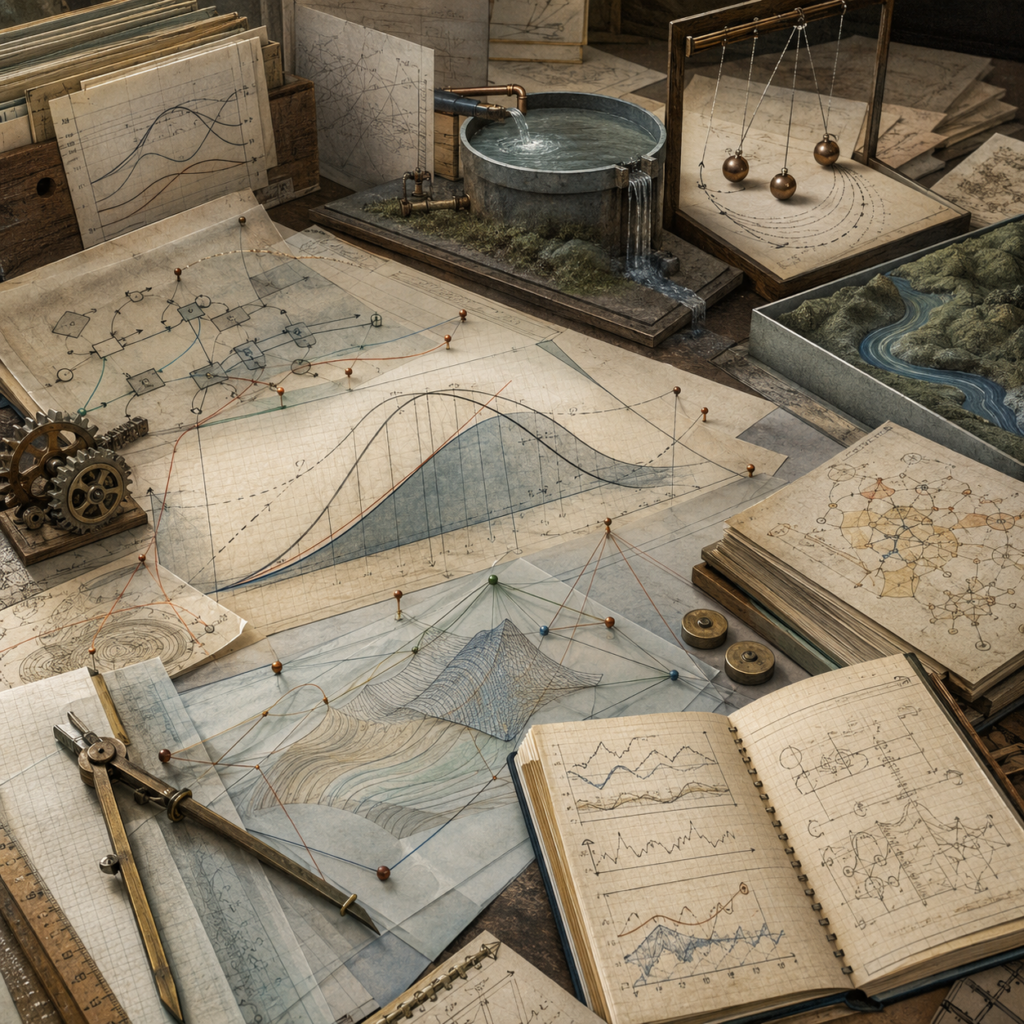
Scholarly worktable with layered diagrams, curves, flow models, gears, a water reservoir, pendulum traces, and notebooks representing calculus as a tool for understanding system change over time.

What Is Calculus for Systems Modeling? Rates, Accumulation, and Dynamic Change

Calculus for systems modeling explains how derivatives, integrals, limits, approximation, optimization, multivariable analysis, vector fields, and differential equations help represent systems that change through time and space. This article introduces calculus as a modeling language for rates, accumulation, feedback, sensitivity, spatial flow, and dynamic behavior across ecology, infrastructure, economics, epidemiology, climate, engineering, public policy, and sustainability. It shows how derivatives describe local change, how integrals describe cumulative effects, how differential equations represent evolving states, and how numerical methods make complex models executable. The article also connects calculus to reproducible computational workflows in Python, R, Julia, SQL, Haskell, C, C++, Fortran, Rust, Go, and notebooks. Throughout, it emphasizes that calculus supports interpretation and disciplined judgment; it does not replace assumptions, evidence, uncertainty analysis, validation, or responsible systems thinking in applied modeling practice.

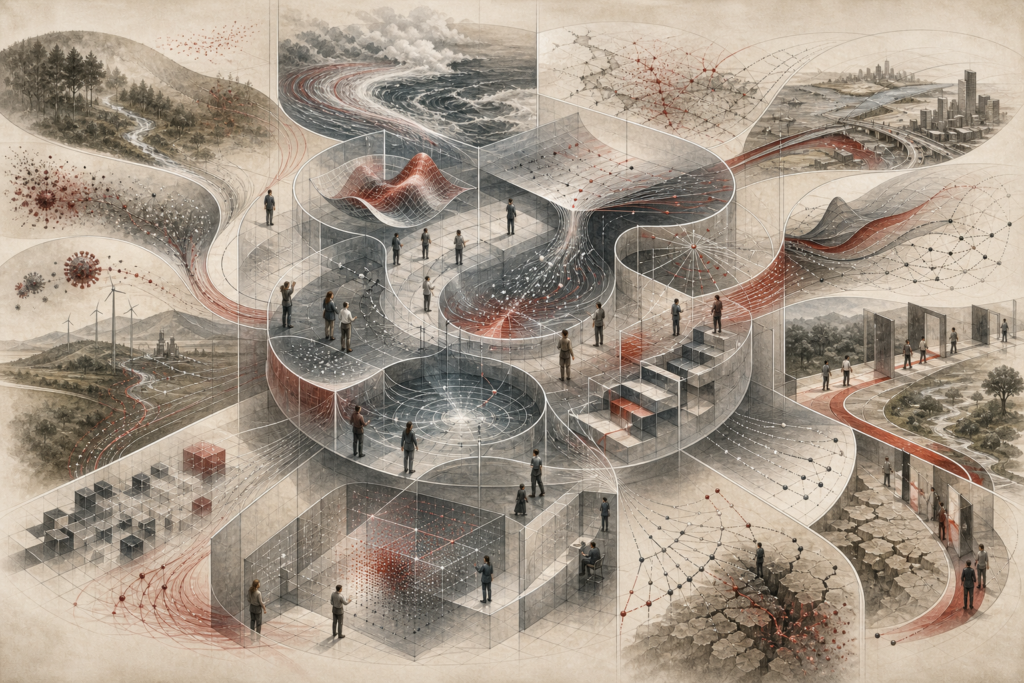
Editorial scientific illustration of calculus for systems modeling as a continuous-change architecture, showing dynamic pathways, accumulation basins, derivative-like curves, feedback loops, gradient fields, spatial flows, simulation tracks, sensitivity branches, ecological systems, climate feedback, infrastructure networks, epidemiological spread, sustainability transitions, and responsible model interpretation.

Calculus for Systems Modeling: Change, Accumulation, and Dynamics

Calculus for Systems Modeling examines how mathematical representations of continuous change make it possible to analyze dynamic systems across ecology, economics, infrastructure, climate, engineering, public policy, and sustainability. Moving from limits and derivatives to integration, multivariable analysis, vector calculus, differential equations, and numerical methods, this pillar treats calculus as both a formal mathematical language and a practical modeling framework. It also connects calculus to computational implementation in R and Python, showing how continuous models can be simulated, visualized, approximated, and interpreted in applied settings.

Scroll to Top