Calculus for Systems Modeling

Calculus for Systems Modeling examines how mathematical concepts of change, accumulation, rate, and continuous variation make it possible to analyze dynamic systems whose behavior unfolds across time. Within systems modeling, calculus provides a foundational framework for describing growth, decline, feedback, equilibrium, instability, optimization, and transition in domains such as ecology, economics, engineering, environmental science, physics, and sustainability.

This category explores the role of derivatives, integrals, differential equations, multivariable analysis, optimization, and numerical approximation in the study of complex systems. It considers how continuous processes can be formally represented, how interacting variables shape system behavior, and how mathematical structure can clarify the mechanisms through which systems evolve, stabilize, or break down. Particular attention is given to nonlinear dynamics, threshold effects, rates of change, and the analytical conditions under which intervention may amplify, dampen, or redirect systemic behavior.

The category also considers the relationship between formal mathematical reasoning and computational implementation. Calculus is not treated here as an abstract technical exercise alone, but as a practical and conceptual language for simulation, modeling, visualization, and reproducible analysis. Where appropriate, articles may connect classical calculus to Python-based workflows, numerical methods, and computational experiments that allow continuous systems to be studied in applied settings.

By linking mathematical analysis to systems thinking, this category situates calculus as an essential instrument for understanding temporal processes, causal structure, and the evolving behavior of complex systems.

Archival systems modeling workspace with linked water vessels, layered curves, network diagrams, translucent overlays, maps, notebooks, and drafting tools representing composite change without labels or text.

The Chain Rule and Composite Change in Interacting Systems: How Calculus Tracks Cascading Effects

The chain rule explains how change moves through composite pathways in interacting systems. This article develops the chain rule as a formal theorem about composite functions and as a modeling tool for mediated change, nested mechanisms, pathway sensitivity, feedback, Jacobian composition, and automatic differentiation. It shows how emissions can affect concentration, forcing, temperature, and ecological stress; how policy can affect behavior, contact, transmission, and outcomes; and how computational graphs propagate gradients through intermediate values. The article emphasizes that a composite derivative is a product or composition of local sensitivities, not a black-box response. Companion workflows in Python, R, SQL, and Haskell include chain-rule pathway audits, composite sensitivity decompositions, finite-difference checks, typed pathway records, assumption registries, Jacobian notes, implementation warnings, and advanced mathematical audit reports for responsible interpretation of mediated system change across nonlinear, feedback-rich, policy-sensitive, and computationally implemented models.
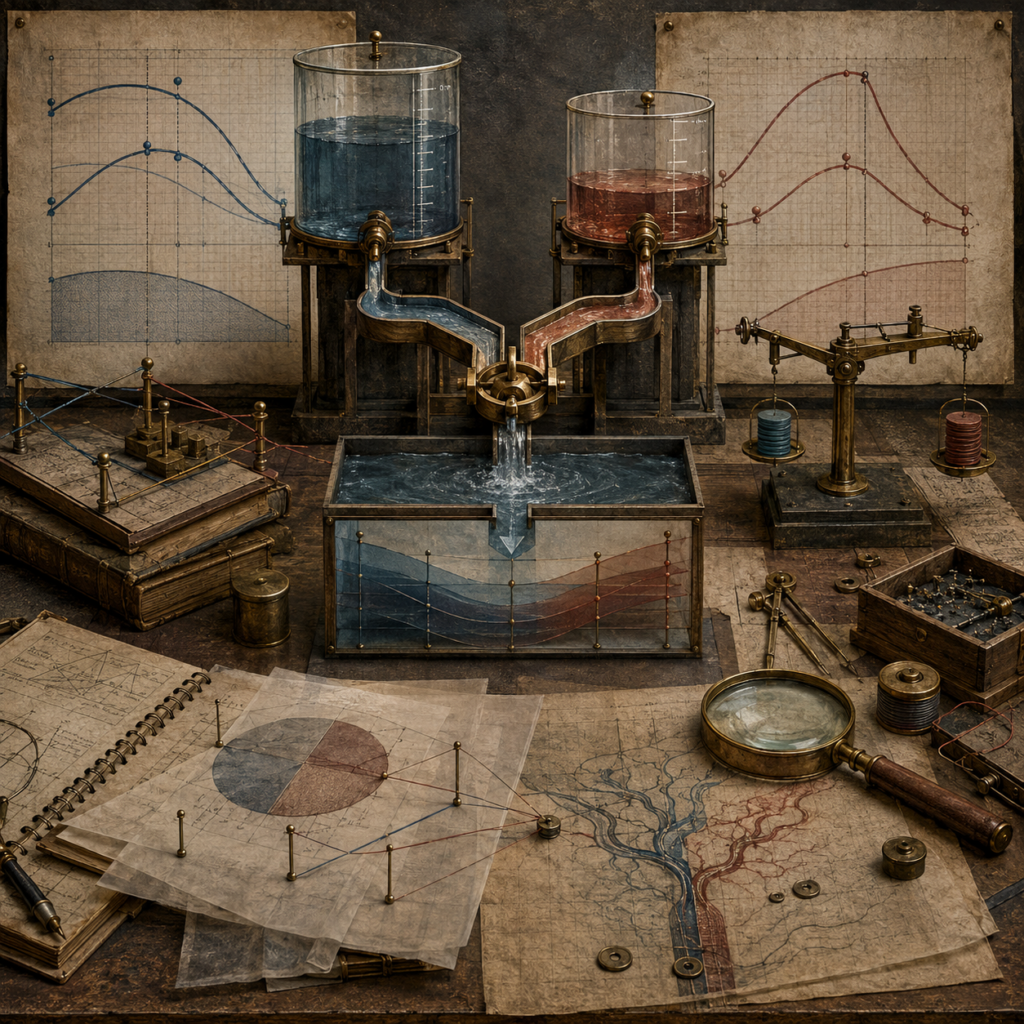
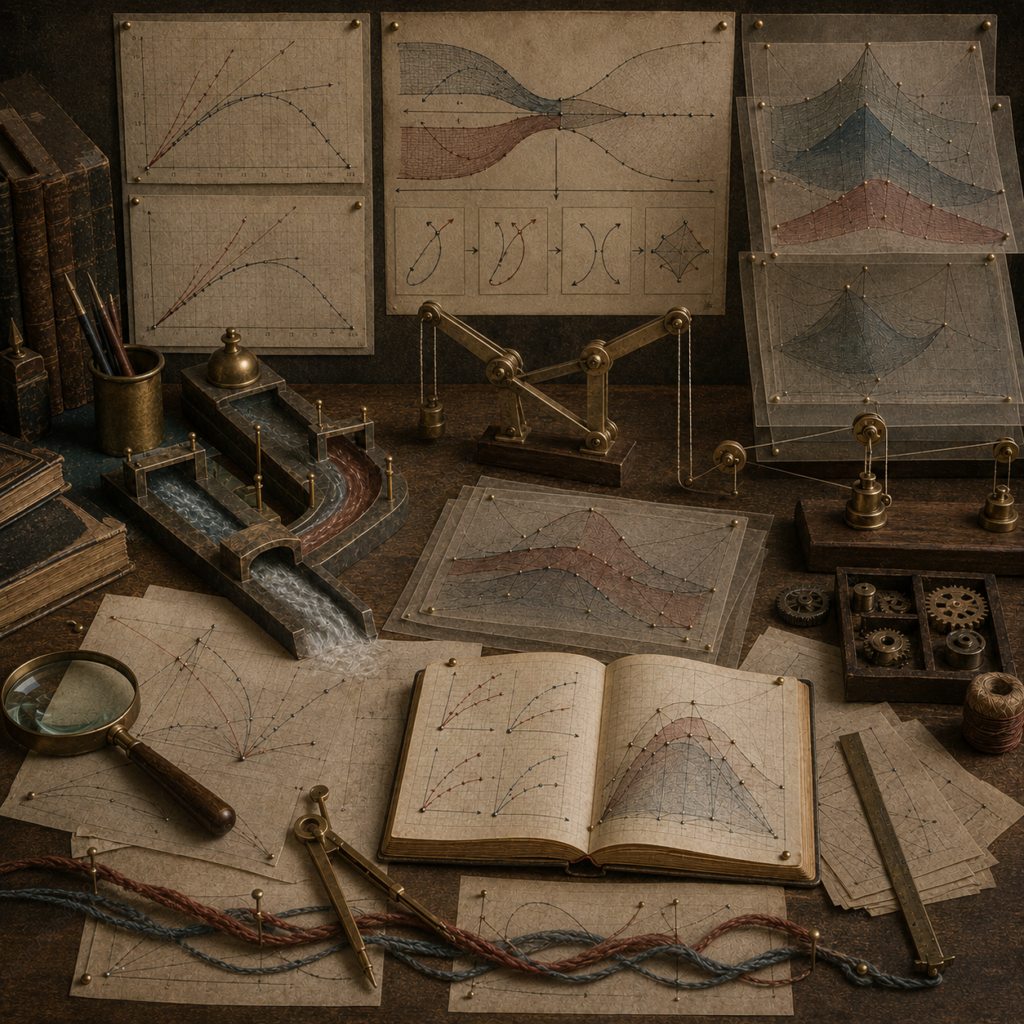
Vintage scholarly modeling studio with paired curves, layered surface diagrams, flowing channels, mechanical linkages, notebooks, transparent overlays, and drafting tools representing the quotient rule and relative change.

The Quotient Rule and Relative Change: How Calculus Measures Ratios, Rates, and System Comparison

The quotient rule explains how ratios, normalized indicators, and relative-change measures evolve when both numerator and denominator change. This article develops the formal quotient rule, numerator effects, denominator effects, relative-rate identities, logarithmic derivatives, elasticity, per-capita indicators, denominator instability, near-zero pathologies, and ratio-based model interpretation. In systems modeling, quotient structures appear in emissions per capita, resource availability per person, disease prevalence, load-to-capacity measures, productivity, debt-to-income ratios, and risk per exposure unit. The article shows why a ratio can improve while absolute conditions worsen, remain stable while both components change, or become unstable when denominators are small. Companion workflows in Python, R, SQL, and Haskell include quotient-rule decomposition, relative-change diagnostics, denominator warnings, typed ratio records, assumption registries, numerical checks, and advanced mathematical audit reports for responsible ratio interpretation across per-capita metrics, policy indicators, constrained domains, noisy observations, and finite-precision computation workflows.

Vintage mathematical modeling workspace with paired curves, layered surface diagrams, interwoven strands, flowing channels, mechanical linkages, notebooks, and drafting tools representing the product rule and interaction effects.

The Product Rule and Interaction Effects: How Calculus Models Combined System Change

Rules of differentiation reveal how model structure organizes change. This article treats constant, power, sum, scalar, product, quotient, chain, inverse, implicit, logarithmic, and exponential differentiation as structural tools rather than mechanical shortcuts. In systems modeling, the sum rule represents additive decomposition, the product rule exposes interaction effects, the quotient rule explains ratio and normalization behavior, the chain rule traces nested pathways, implicit differentiation interprets constraints, and logarithmic differentiation clarifies proportional growth and elasticity. The article connects differentiation rules to population-impact models, resource-per-capita indicators, climate response pathways, epidemiological transmission, infrastructure utilization, economic growth accounting, and constrained equilibrium systems. Companion workflows in Python, R, SQL, and Haskell include structural derivative audits, product-rule decomposition, quotient diagnostics, chain-rule pathway records, differentiation rule registries, typed rule records, numerical checks, and advanced mathematical audit reports for responsible interpretation of derivative-based model claims across complex systems.

Vintage mathematical modeling workspace with layered curve diagrams, branching rule structures, surface models, water channels, mechanical linkages, notebooks, and drafting tools representing differentiation rules and model structure.

Rules of Differentiation and Model Structure: How Calculus Reveals System Relationships

Rules of differentiation reveal how model structure organizes change. This article treats constant, power, sum, scalar, product, quotient, chain, inverse, implicit, logarithmic, and exponential differentiation as structural tools rather than mechanical shortcuts. In systems modeling, the sum rule represents additive decomposition, the product rule exposes interaction effects, the quotient rule explains ratio and normalization behavior, the chain rule traces nested pathways, implicit differentiation interprets constraints, and logarithmic differentiation clarifies proportional growth and elasticity. The article connects differentiation rules to population-impact models, resource-per-capita indicators, climate response pathways, epidemiological transmission, infrastructure utilization, economic growth accounting, and constrained equilibrium systems. Companion workflows in Python, R, SQL, and Haskell include structural derivative audits, product-rule decomposition, quotient diagnostics, chain-rule pathway records, differentiation rule registries, typed rule records, numerical checks, and advanced mathematical audit reports for responsible interpretation of derivative-based model claims across complex systems.

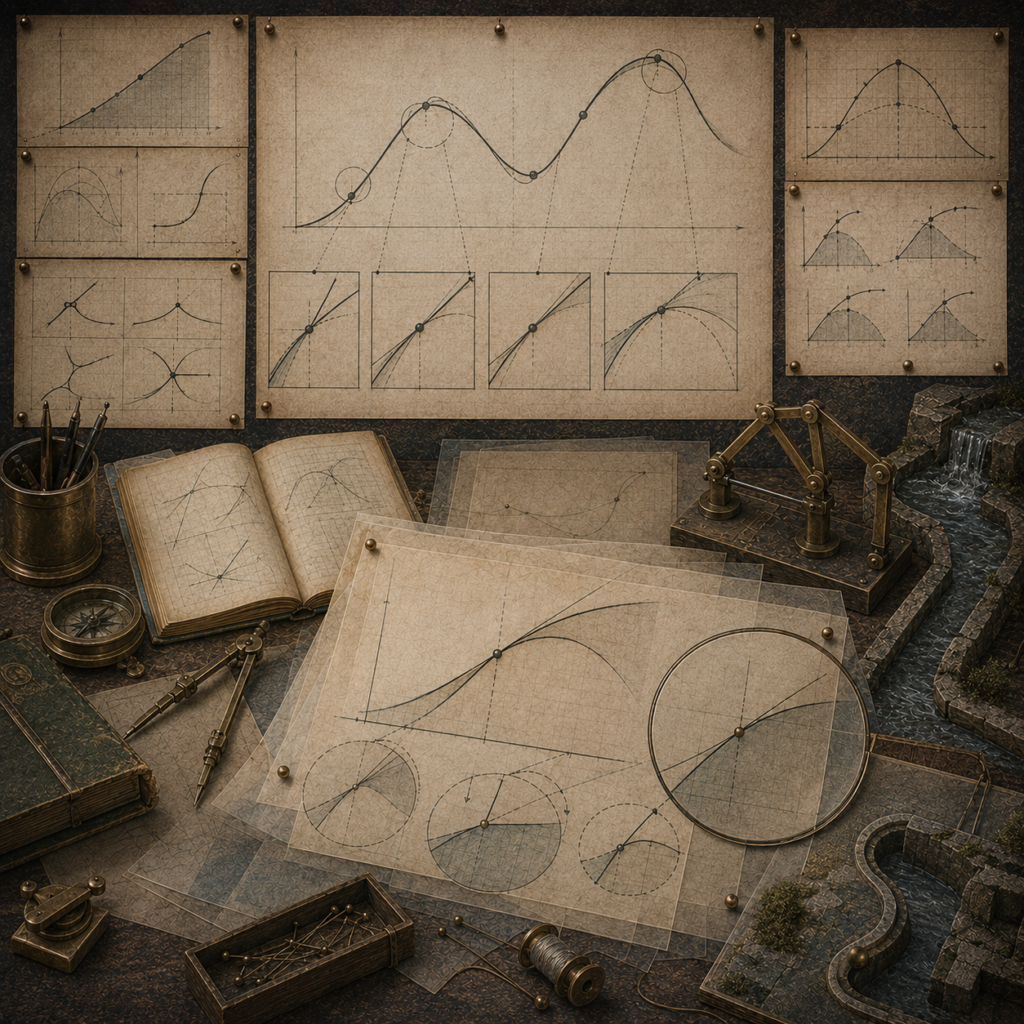
Vintage scholarly workspace with tangent-line diagrams, changing curves, flowing water, mechanical linkages, notebooks, transparent overlays, and drafting tools representing derivatives and rates of change.

Derivatives and Rates of Change: How Calculus Measures System Behavior

Derivatives and rates of change explain how systems move, respond, accelerate, and react locally to perturbations. This article develops average and instantaneous rates, derivatives as limits, derivatives as local linear maps, units and dimensional interpretation, one-sided rates, relative rates, elasticities, vector-valued rates, state-space motion, higher-order derivatives, weak derivatives, generalized derivatives, and numerical approximation. It connects derivative interpretation to population growth, resource depletion, climate forcing, infrastructure stress, epidemiological transmission, economic marginal analysis, policy thresholds, optimization, stability, and scientific computing. Companion workflows in Python, R, SQL, and Haskell include finite-difference diagnostics, average-rate comparisons, central-difference error checks, elasticity estimates, typed rate records, derivative assumption registries, vector-field notes, invariant-domain review, and advanced mathematical audit reports for responsible interpretation of rate-based claims across constrained domains, finite precision, noisy data, and idealized continuous-system models. It emphasizes units, locality, domain limits, and numerical accountability in interpretation.

Archival mathematical workspace with tangent-line diagrams, zoomed curve details, slope constructions, notebooks, drafting tools, mechanical linkages, and flowing water representing differentiability and local behavior.

Differentiability and Local Behavior: How Calculus Determines Whether System Change Is Well-Defined

Differentiability and local behavior explain when a systems model can be understood through first-order approximation. Continuity says nearby inputs produce nearby outputs, but differentiability says the function behaves locally like a linear map. This article develops the derivative as a limit, local linearization, differentiability versus continuity, one-sided derivatives, partial and directional derivatives, gradients, Jacobians, Fréchet differentiability, Gâteaux differentiability, nonsmooth behavior, counterexamples, and boundary cases. It connects these ideas to sensitivity analysis, optimization, calibration, local stability, infrastructure stress, climate response, epidemiological transmission, resource depletion, economic marginal analysis, and policy thresholds. Companion workflows in Python, R, SQL, and Haskell include finite-difference checks, local linearization error, one-sided derivative comparison, kink detection, typed derivative records, assumption registries, invariant checks, and advanced mathematical audit reports for responsible interpretation of derivative-based claims across constrained domains, thresholds, noisy observations, finite precision, and idealized continuous-system assumptions today.

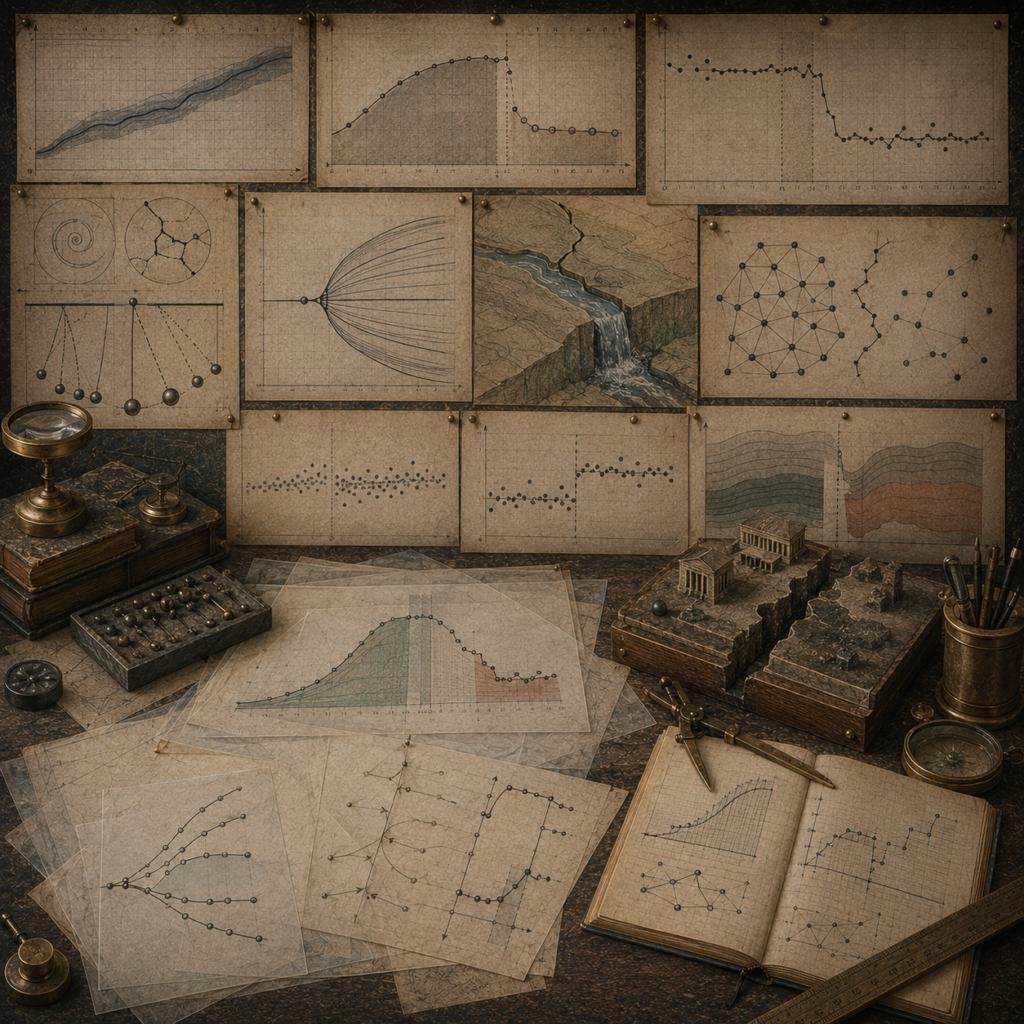
Archival mathematical workspace with continuous curves, sudden breaks, segmented graphs, cracked terrain models, network diagrams, notebooks, and drafting tools representing continuity, discontinuity, and structural breaks.

Continuity, Discontinuity, and Structural Breaks: How Calculus Tests System Stability

Continuity, discontinuity, and structural breaks determine whether a systems model can be interpreted through smooth change or must account for thresholds, jumps, rupture, and regime transition. This article explains epsilon-delta continuity, sequential and metric-space continuity, one-sided continuity, removable discontinuities, jump discontinuities, essential discontinuities, uniform continuity, Lipschitz continuity, absolute continuity, semicontinuity, and structural breaks. It is written for mathematically advanced readers as well as systems modelers, with sections on topological continuity, compactness, preservation results, counterexamples, boundary behavior, and piecewise model interpretation. The article connects these ideas to population dynamics, infrastructure failure, climate tipping points, epidemiology, resource systems, economics, policy thresholds, and scientific computing. Companion workflows in Python, R, SQL, and Haskell include jump detection, slope-break diagnostics, typed diagnostic records, concept registries, invariant checks, and advanced mathematical audit reports for careful interpretation across thresholds, finite data, and idealized continuous-system assumptions today.

Archival mathematical study with approaching curves, partitioned graphs, tangent constructions, pendulum motion, flowing water, gears, notebooks, and translucent overlays representing limits as the formal foundation of calculus.

Limits and the Formal Basis of Calculus: How Calculus Defines Change with Precision

Limits provide the formal basis of calculus by making precise the ideas of local change, accumulation, convergence, continuity, and approximation. This article explains limits through intuitive, epsilon-delta, sequential, topological, one-sided, infinite, and function-convergence formulations, then connects those ideas to derivatives, integrals, numerical methods, and systems modeling. It is written for mathematically advanced readers as well as systems modelers, with sections on limit points, metric-space definitions, uniqueness, continuity, compactness, uniform convergence, counterexamples, noncommuting limits, and boundary behavior. The article shows why models of population growth, infrastructure fatigue, climate accumulation, disease transmission, resource depletion, and scientific computing depend on limiting arguments. Companion workflows in Python, R, SQL, and Haskell include convergence-order checks, epsilon bands, Richardson extrapolation, roundoff review, typed limit experiments, assumption registries, and advanced mathematical audit reports for safer interpretation across finite data, finite machines, and idealized continuous systems representations.

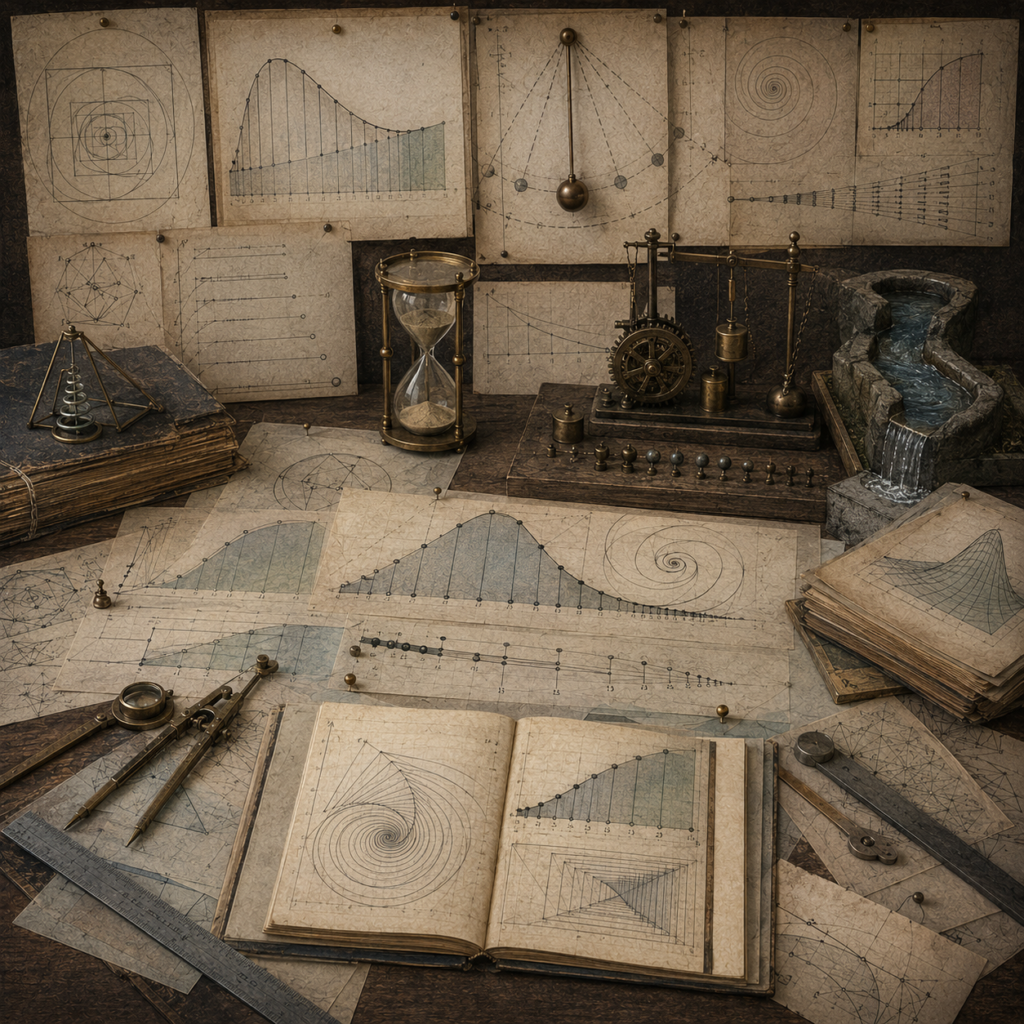
Antique scholarly workspace with spiral diagrams, infinitesimal partitions, pendulum traces, area approximations, flowing water, gears, notebooks, and drafting instruments representing infinity, infinitesimals, and the historical study of change.

Infinity, Infinitesimals, and the Historical Problem of Change: How Calculus Made Motion Mathematically Precise

Infinity, infinitesimals, and the historical problem of change explain why calculus became the central mathematical language of continuous systems. Long before modern limits, mathematicians and philosophers struggled to understand motion, accumulation, curvature, and local change across infinitely divisible intervals. This article connects ancient paradoxes, geometric exhaustion, infinitesimal reasoning, Newtonian fluxions, Leibnizian differentials, and later limit formalization to systems modeling practice. It shows why models of population growth, climate accumulation, infrastructure stress, resource depletion, epidemiological transmission, and economic change still depend on ideas of small intervals, limiting behavior, local rates, and cumulative effects. The article also introduces reproducible workflows in Python, R, SQL, and Haskell for difference quotients, approximation records, convergence checks, typed step sizes, concept registries, and responsible interpretation of continuous change in computational modeling.

Scroll to Top