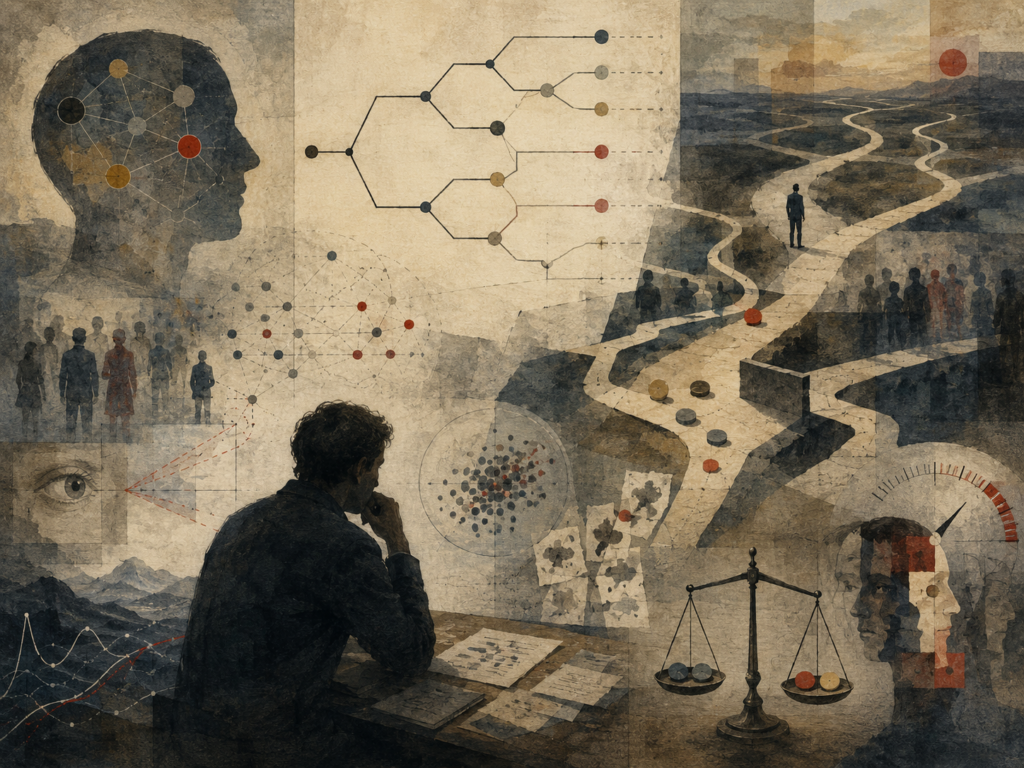
Behavioral Decision Theory: How Psychology Shapes Judgment, Risk, and Choice
Behavioral Decision Theory examines how real human choice departs from idealized rational models under uncertainty. The article argues that decisions are shaped not only by formal probabilities and stable preferences, but by heuristics, loss aversion, framing, reference points, and the cognitive limits of bounded rationality. It develops this through the origins of the field in Simon, Kahneman, and Tversky, key concepts such as bias and reference dependence, prospect theory, behavioral process design, uncertainty, ethical questions around choice architecture, and behavioral mathematical and computational workflows. The article emphasizes that stronger decision science depends on integrating formal rigor with psychological realism, so decision frameworks reflect how people actually perceive risk, interpret options, and respond to uncertainty in practice.