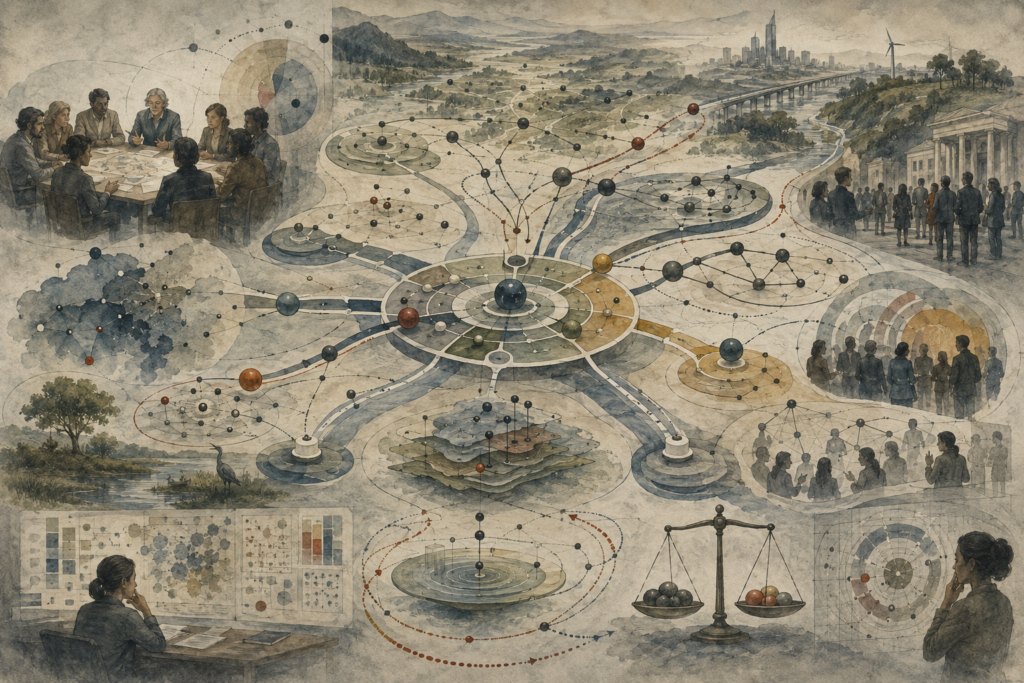
Future Directions in Decision Science: AI, Uncertainty, and Accountable Judgment
Future Directions in Decision Science examines how the field is evolving as institutions face deeper uncertainty, artificial intelligence, democratic legitimacy challenges, complex systems, climate risk, infrastructure fragility, algorithmic governance, geopolitical instability, organizational accountability, and long-term public consequences. This article explains why future decision science must move beyond narrow optimization toward accountable decision systems that integrate human judgment, AI-assisted evidence, uncertainty analysis, ethical reasoning, public legitimacy, systems thinking, adaptive governance, reproducible workflows, participatory methods, and institutional learning. It shows how decision science is shifting from individual choice models to decision architectures that preserve accountability across framing, evidence, modeling, implementation, monitoring, correction, and review. The article frames future decision quality as robust across plausible futures, transparent about uncertainty, reproducible enough to inspect, adaptive enough to revise, and accountable enough to defend in public, organizational, technological, and ecological decision environments over time.