Global Governance

Global governance refers to the institutions, norms, and cooperative arrangements through which international actors manage collective problems at the global scale. Unlike traditional government structures, global governance operates through networks of states, international organizations, private actors, and civil society institutions.

Institutions such as the United Nations, World Bank, International Monetary Fund, and World Trade Organization play central roles in coordinating economic policy, humanitarian assistance, environmental protection, and conflict resolution. Informal networks and multilateral agreements also contribute to global governance structures.

The effectiveness of global governance systems depends on institutional legitimacy, coordination capacity, and the ability of actors to negotiate shared solutions to transnational challenges. As issues such as climate change, financial stability, and technological regulation increasingly require global cooperation, the study of global governance has become central to international relations and sustainable development.

Abstract legal-studies illustration of the United Nations collective security system, showing Security Council authority, peaceful settlement, enforcement powers, self-defense, peacekeeping, veto paralysis, General Assembly workarounds, and unequal enforcement.

The United Nations and Collective Security

The United Nations collective security system is the central legal framework through which the contemporary international order seeks to prevent conflict, respond to threats to peace, and authorize collective action under international law. Created in the aftermath of the Second World War, the Charter established a system in which the Security Council bears primary responsibility for maintaining international peace and security through peaceful settlement, sanctions, enforcement powers, and evolving peacekeeping practice. This article examines the structure of that system through Chapters VI and VII of the UN Charter, Article 51 self-defense, Security Council practice, the veto, Palestine, Gaza, South Africa’s legal activism, and the unequal political conditions that often determine whether collective security operates as a universal legal mechanism or a selectively enforced instrument of power.

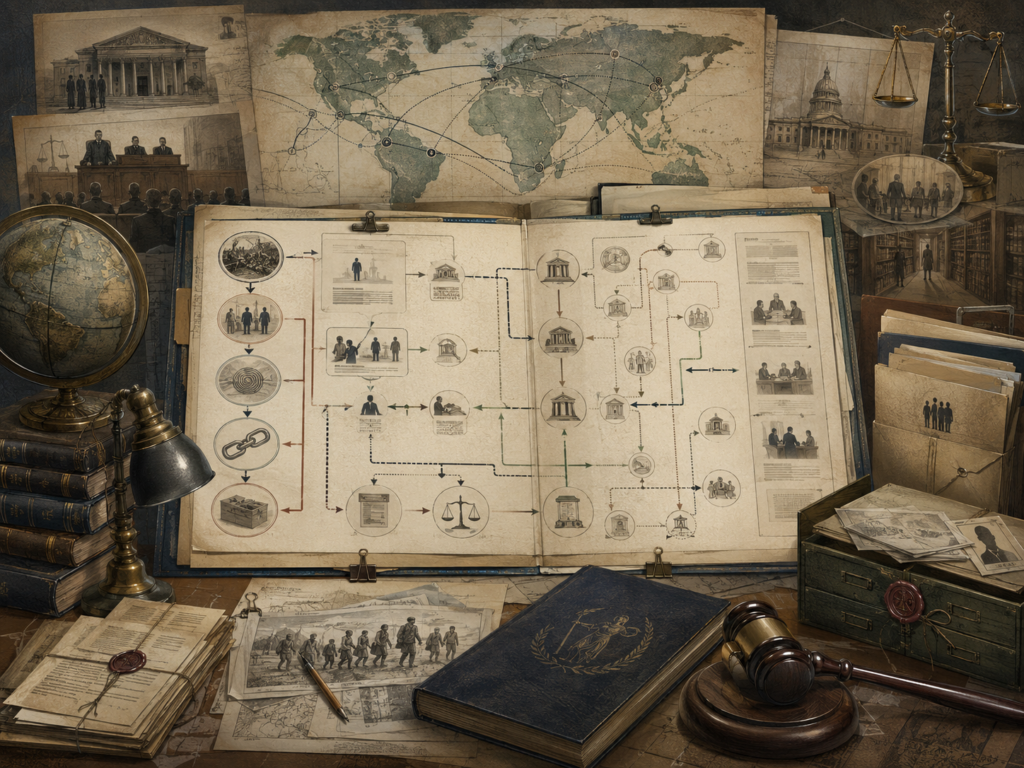
Abstract legal-studies illustration of international courts and tribunals, showing plural judicial forums, consent-based jurisdiction, advisory opinions, criminal accountability, human-rights review, arbitration, unequal access, and selective enforcement.

International Courts and Tribunals in the Global Legal System

International courts and tribunals play a central role in interpreting, applying, and contesting international law. Although the international legal system lacks a single global judiciary, a complex network of courts, tribunals, and quasi-judicial bodies has developed to resolve disputes, clarify legal obligations, and promote accountability across interstate conflict, human rights, maritime law, trade, and international criminal law. This article examines the International Court of Justice, the International Criminal Court, ITLOS, regional human-rights courts, arbitration, and hybrid tribunals, while also exploring Palestine, South Africa’s legal activism, Black internationalism, Malcolm X, and the unequal political conditions that often determine who can actually access international justice.

Abstract legal-studies illustration of state responsibility in international law, showing attribution, breach, aid or assistance, reparation, countermeasures, serious breaches, non-recognition, and uneven enforcement.

State Responsibility in International Law

State responsibility in international law determines the legal consequences that arise when a state violates an international obligation. As one of the core doctrines of the international legal system, it provides the framework for identifying internationally wrongful acts, attributing conduct to the state, determining whether a breach has occurred, and specifying the legal consequences that follow, including cessation, assurances of non-repetition, restitution, compensation, and satisfaction. This article examines the doctrine through the structure of the International Law Commission’s Articles on Responsibility of States for Internationally Wrongful Acts (ARSIWA), while also exploring complicity, aid or assistance, serious breaches of peremptory norms, Palestine, South Africa’s legal activism, and the unequal way responsibility is often invoked and enforced in practice.

Abstract legal-studies illustration of customary international law forming through repeated state practice, legal belief, evidence, institutional interpretation, protest, and contested recognition.

Customary International Law: State Practice and Opinio Juris

Customary international law examines how binding legal norms emerge through the general practice of states accompanied by acceptance of that practice as law. Unlike treaty law, which is grounded in formal written agreement, customary law develops through repeated conduct, legal justification, institutional recognition, and the gradual consolidation of normative expectation within the international community. This article explores the classical framework set out in Article 38 of the Statute of the International Court of Justice and deepens it through the International Law Commission’s contemporary guidance on identifying custom. It analyzes the two-element structure of state practice and opinio juris, the role of courts and tribunals in recognizing customary rules, the persistent objector doctrine, the problem of specially affected states, and the complex relationship between treaties and custom.

Abstract legal-studies illustration of treaty law as a layered international legal architecture connecting treaties, state consent, interpretation, reservations, institutional authority, coercion, and unequal participation in global legal order.

Treaty Law and the Vienna Convention: How International Agreements Work

Treaty law examines the formal legal framework through which states create, interpret, modify, and terminate binding international agreements. In the absence of a centralized global legislature, treaties remain one of the principal mechanisms through which international legal obligation is expressed, structured, and stabilized across areas such as peace and security, trade, human rights, maritime governance, environmental protection, and institutional cooperation. This article explores the Vienna Convention on the Law of Treaties as the cornerstone of modern treaty law, while also analyzing the full lifecycle of treaties, including negotiation, adoption, ratification, interpretation, reservations, invalidity, amendment, suspension, and termination.

Abstract legal-studies illustration of the Westphalian system and state sovereignty, showing territorial authority, sovereign equality, non-intervention, treaty settlements, statehood, the UN Charter order, empire, decolonization, and contemporary international legal transformation.

Westphalian Law and State Sovereignty

The Westphalian system remains one of the most important historical frameworks for understanding modern international law. Associated with the Peace of Westphalia of 1648, it names a state-centered legal order built around territorial sovereignty, sovereign equality, jurisdiction, non-intervention, treaty relations, and diplomatic recognition. Yet the Westphalian model is also a legal myth that must be handled carefully. The 1648 settlements did not instantly create modern sovereignty, nor did they produce a fully formed international legal system. Instead, Westphalia became a later shorthand for the gradual emergence of territorially organized states as the central actors in international order. This article examines the historical settlement, the development of sovereignty, the influence of empire and decolonization, the Montevideo criteria for statehood, the UN Charter framework, and the hybrid character of contemporary international law, where state authority remains foundational but increasingly qualified by human rights, international institutions, collective security, and global governance.

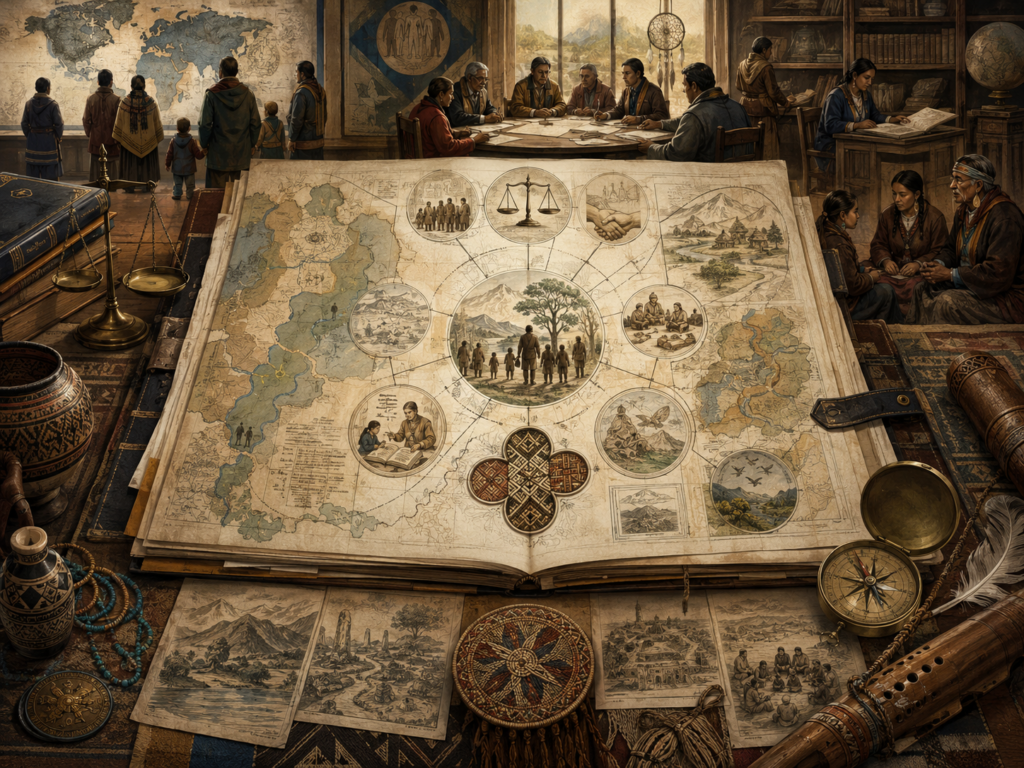
Editorial illustration of the sources of international law shown as a circular layered legal architecture with treaty-like documents, institutional chambers, archives, legal pathways, human figures, and outer rings representing sovereignty, custom, hierarchy, unequal power, and contested global authority.

Sources of International Law: Treaties, Custom, and Legal Principles

International law examines the recognized legal sources through which rules arise, acquire authority, and are interpreted within the international system. Because there is no single global legislature, international law develops through treaties, customary international law, general principles of law, judicial decisions, scholarly writings, and the evolving practice of states and international institutions. This article explores how Article 38 of the Statute of the International Court of Justice became the classical framework for identifying those sources, while also examining the dynamic interaction between treaty law, custom, legal principles, soft law, and peremptory norms in the development of international legal order. By clarifying how international law is made, argued, and applied, the article provides a foundation for understanding sovereignty, human rights, armed conflict, maritime governance, dispute settlement, and the wider structure of global legal authority.

Abstract legal-studies illustration comparing public international law and private international law, showing state-centered legal order, international institutions, treaties, cross-border private disputes, jurisdiction, applicable law, recognition of judgments, arbitration, and global commerce.

Public vs Private International Law: Understanding the Distinction

Public international law and private international law are closely related but distinct fields. Public international law governs relations among states, international organizations, peoples, and other international legal subjects, including treaties, custom, human rights, state responsibility, diplomatic relations, the law of the sea, and the use of force. Private international law, often called conflict of laws, governs cross-border disputes between private actors by determining which court has jurisdiction, which legal system applies, and whether foreign judgments can be recognized or enforced. This article explains the doctrinal distinction while showing where the fields increasingly overlap through investment arbitration, commercial disputes, global supply chains, digital platforms, cross-border family law, and access-to-justice questions in an interconnected world.

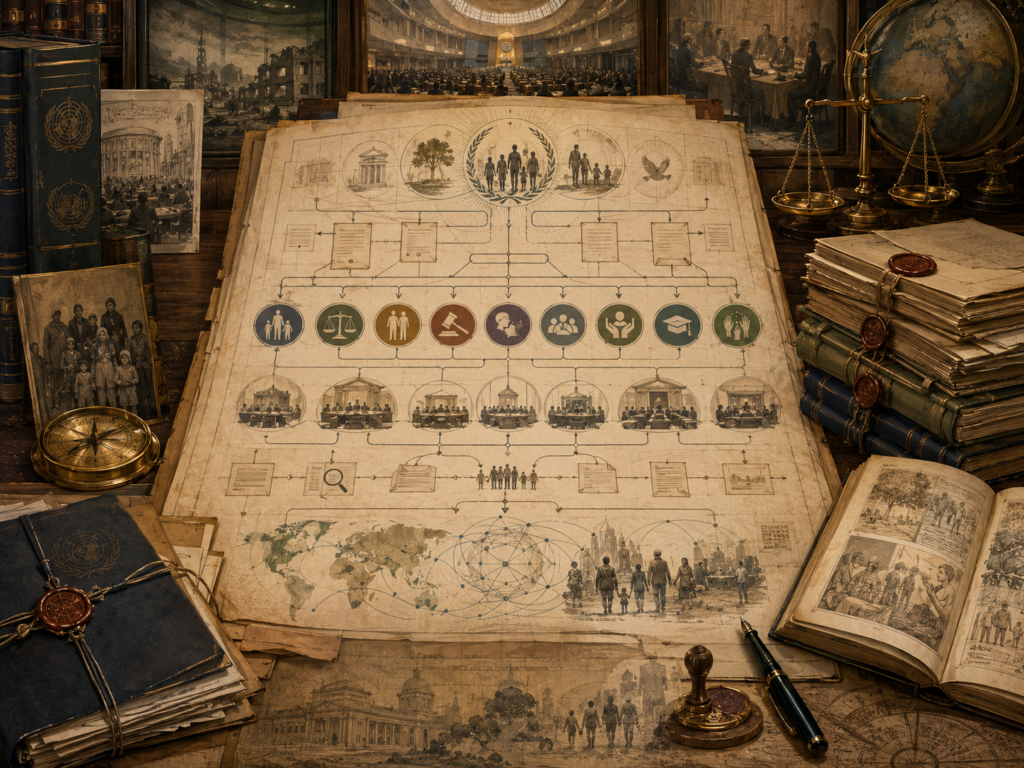
Abstract legal-studies illustration of international law as a global legal architecture, showing states, treaties, custom, general principles, institutions, courts, human rights, diplomacy, maritime routes, environmental cooperation, and selective enforcement.

What Is International Law? Foundations of Global Governance

International law provides the legal framework for relations among states, international organizations, peoples, individuals, courts, and other global actors. This introductory article explains how international law structures diplomacy, treaties, trade, environmental protection, human rights, armed conflict, maritime navigation, public health cooperation, and international institutions. It distinguishes public international law from domestic law and private international law, introduces core sources such as treaties, custom, general principles, judicial decisions, and scholarly writings, and explains why international law operates as a decentralized legal order rather than a domestic-style hierarchy. It also examines everyday examples of international law, the role of the United Nations and International Court of Justice, the question of whether international law is “really law,” and the field’s unresolved tensions around empire, decolonization, unequal power, selective enforcement, and global governance.

Scroll to Top