
Last Updated June 24, 2026
The International Criminal Court is both a legal institution and a political object. It was created to make atrocity accountability less dependent on victorious armies, temporary tribunals, diplomatic bargains, or national courts controlled by the very officials accused of mass crimes. Yet the ICC operates in a world of sovereignty, unequal power, selective cooperation, contested legitimacy, and incomplete enforcement.
The politics of global justice do not make the Court irrelevant. They make the Court intelligible. The ICC is a permanent treaty-based criminal court, not a world government, human rights commission, police force, or substitute for national prosecution. It depends on the Rome Statute, state cooperation, judicial independence, prosecutorial judgment, arrest capacity, evidentiary access, victim participation, diplomatic support, and public legitimacy. Its promise is accountability for genocide, crimes against humanity, war crimes, and aggression. Its central tension is that the gravest crimes often arise where political power is strongest, institutions are weakest, or enforcement is most contested.
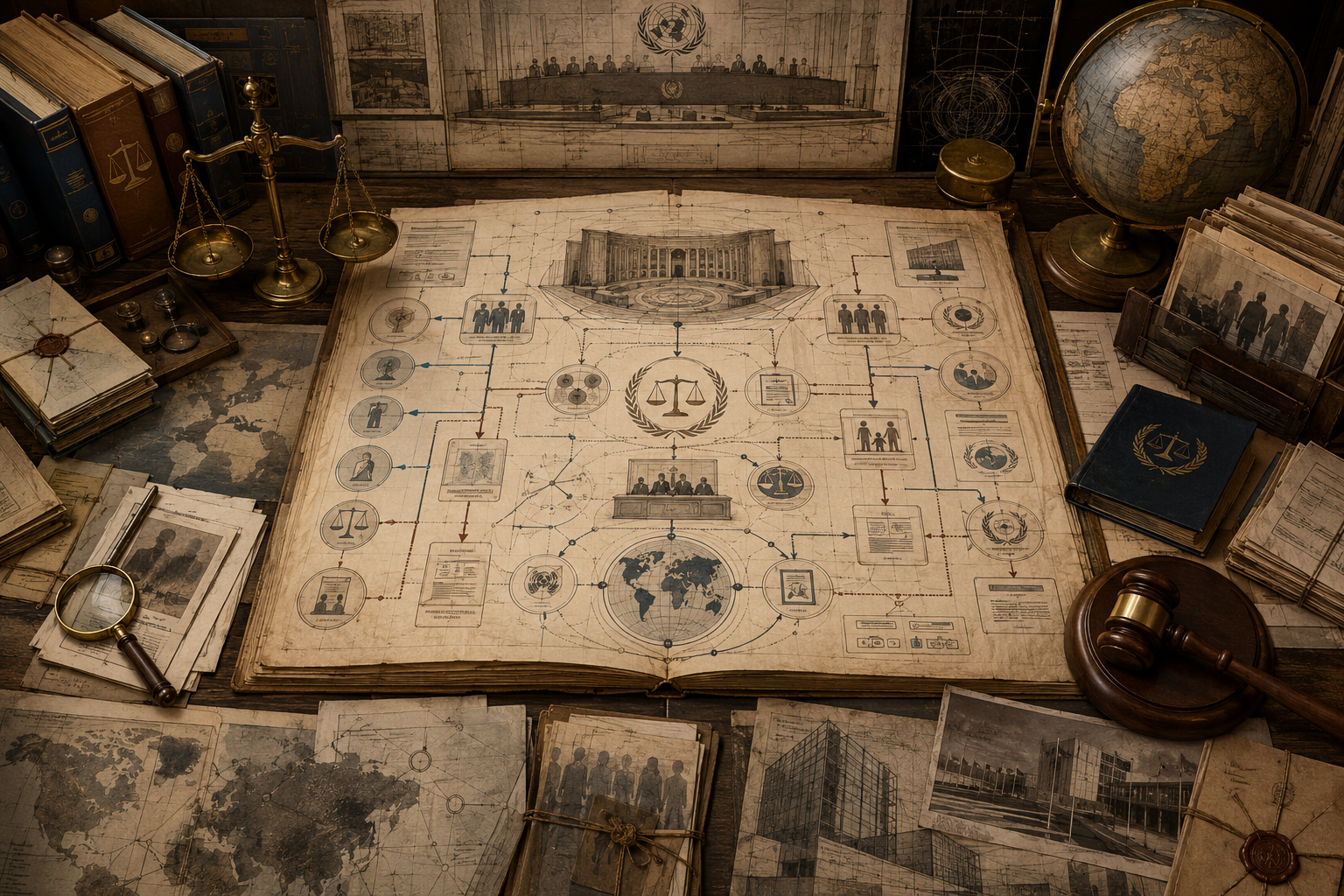
The Court’s institutional design reflects a difficult compromise. International criminal law rejects impunity for the most serious crimes of concern to the international community. But the Rome Statute does not abolish sovereignty. It makes the ICC complementary to national criminal jurisdictions, gives states the first responsibility to prosecute, and permits the Court to act only when jurisdiction and admissibility requirements are satisfied. The result is neither pure global justice nor ordinary diplomacy. It is a hybrid legal architecture: judicial enough to issue warrants, receive evidence, protect defendants’ rights, and hear victims; political enough to depend on states for arrests, evidence access, enforcement, funding, and long-term legitimacy.
Why the ICC Matters
The ICC matters because it gives permanent institutional form to an idea that developed unevenly across the twentieth century: some crimes are not merely domestic offenses or violations between states. They are crimes of concern to the international community, and individuals can be held criminally responsible for them.
That idea did not begin with the ICC. It emerged through the post-Second World War tribunals, the Genocide Convention, the Geneva Conventions, human rights law, the ad hoc tribunals for the former Yugoslavia and Rwanda, hybrid courts, national universal-jurisdiction cases, and long debates about impunity. The Rome Statute consolidated that trajectory into a standing court. Instead of creating a new tribunal after each atrocity, states created a permanent institution with ongoing jurisdictional rules, judges, prosecutors, procedures, and an Assembly of States Parties.
The Court’s value is not measured only by convictions. It also shapes the accountability environment. ICC investigations can preserve evidence, influence national proceedings, alter diplomatic costs, provide victims with a procedural forum, clarify legal categories, and signal that atrocity crimes are not beyond legal judgment. But those effects depend on cooperation. A warrant is not an arrest. A preliminary investigation is not a conviction. A legal finding is not a political settlement. The ICC’s power is therefore real but incomplete.
Core idea: the ICC is best understood as a permanent accountability institution operating inside a decentralized international system. It is strongest when law, evidence, domestic courts, state cooperation, civil society documentation, and diplomatic pressure align.
What the ICC Is—and Is Not
The ICC is a permanent international criminal court established by treaty. It prosecutes individuals, not states. It does not decide interstate disputes in the way the International Court of Justice does. It does not function as a general human rights court. It does not have its own police force. It does not automatically acquire jurisdiction over every atrocity in the world. It does not replace national courts when those courts are genuinely investigating or prosecuting relevant cases.
The Court’s jurisdiction is limited by the Rome Statute. The core crimes are genocide, crimes against humanity, war crimes, and aggression. Even when one of those crimes is alleged, the Court must still address jurisdiction, admissibility, gravity, prosecutorial discretion, evidentiary sufficiency, fair trial rights, and state cooperation. The ICC’s institutional role is therefore narrower than public debate often suggests.
That narrowness is not a defect by itself. Criminal adjudication must be specific. It must prove individual responsibility. It must test evidence. It must distinguish legal categories. It must protect accused persons from punishment based on politics, emotion, or collective blame. The ICC’s legitimacy depends not only on condemning atrocity but also on applying criminal procedure fairly.
| Institutional Feature | What It Means | Common Misunderstanding |
|---|---|---|
| Permanent court | The ICC exists before crises arise and can operate across situations. | It is not created for a single conflict like an ad hoc tribunal. |
| Treaty-based authority | The Rome Statute supplies jurisdictional and procedural rules. | The ICC is not a general world criminal court with unlimited reach. |
| Individual criminal responsibility | The Court prosecutes persons for crimes. | It does not decide state responsibility in the way an interstate court does. |
| Complementarity | National courts have the first responsibility to prosecute. | The ICC is not meant to replace domestic justice systems. |
| State cooperation | Arrests, evidence access, witness protection, and sentence enforcement depend heavily on states. | The Court does not possess a global police force. |
The Rome Statute Architecture
The Rome Statute is the ICC’s constitutional instrument. It establishes the Court, defines crimes, sets out general principles of criminal law, creates jurisdictional rules, regulates investigation and prosecution, protects accused persons, recognizes victims’ procedural roles, governs cooperation, and organizes institutional administration.
The Statute’s structure matters because ICC debates often collapse into general moral claims. Legal analysis requires a more disciplined sequence. The lawyer must identify the crime, the conduct, the contextual element, the mental element, the person accused, the mode of liability, the jurisdictional basis, the admissibility posture, and the procedural stage. Each part matters.
Example: a mass attack on civilians may generate human rights claims, state responsibility, humanitarian-law violations, sanctions, diplomatic condemnation, and domestic prosecutions. For ICC purposes, however, the analysis must ask whether specific persons can be charged with specific Rome Statute crimes based on admissible evidence and a legally recognized mode of liability.
Core Rome Statute Components
-
- Institutional establishment: the Court is established as a permanent institution.
- Subject-matter jurisdiction: genocide, crimes against humanity, war crimes, and aggression.
- Trigger mechanisms: state party referral, Security Council referral, or proprio motu prosecutorial action with judicial authorization where required.
- Admissibility: complementarity, gravity, and genuine national proceedings.
- General principles: legality, non-retroactivity, individual criminal responsibility, command responsibility, mental elements, defenses, and fair trial guarantees.
- Cooperation regime: requests for arrest, surrender, evidence, assistance, and enforcement.
- Victim participation: victims may participate under conditions determined by the Court.
Jurisdiction, Admissibility, and Complementarity
ICC jurisdiction is not a single question. It involves several layers. Subject-matter jurisdiction asks whether the alleged conduct falls within a Rome Statute crime. Temporal jurisdiction asks whether the relevant conduct occurred after the Court’s jurisdiction attached. Territorial and nationality jurisdiction ask whether the conduct or accused is connected to a state that has accepted ICC jurisdiction, unless the Security Council has referred the situation. Admissibility then asks whether the case should proceed before the ICC in light of national proceedings, gravity, and other admissibility rules.
Complementarity is the ICC’s central structural compromise. The Rome Statute system assumes that states retain the first responsibility to investigate and prosecute international crimes. The Court may step in when national systems are unwilling or unable genuinely to carry out proceedings. This means complementarity is not merely a technical rule. It is the bridge between sovereignty and global accountability.
| Analytical Layer | Question | Why It Matters |
|---|---|---|
| Subject matter | Is the alleged conduct genocide, a crime against humanity, a war crime, or aggression? | Ordinary crimes and human rights violations do not automatically fall within ICC jurisdiction. |
| Temporal jurisdiction | Did the conduct occur after jurisdiction attached? | The Court cannot exercise unlimited retroactive jurisdiction. |
| Territorial or nationality link | Is there a state-party, accepting-state, or Security Council basis? | The ICC’s reach depends on consent, referral, or specific statutory mechanisms. |
| Admissibility | Are national proceedings genuine, and is the case sufficiently grave? | The ICC is a court of last resort, not a routine replacement for domestic courts. |
| Evidence and suspect focus | Can criminal liability be proven against identifiable persons? | International criminal law requires individual responsibility, not generalized condemnation. |
The Politics of Global Justice
The phrase “global justice” can suggest universality, neutrality, and equal application. The ICC aspires to those values, but it operates in a system where states differ dramatically in power, wealth, military reach, legal capacity, and willingness to cooperate. That gap creates recurring political tensions.
Some critiques focus on selectivity. Why are some situations investigated while others are not? Why do some suspects face arrest while others travel freely? Why do some states support accountability for rivals while resisting scrutiny of allies or themselves? These questions do not necessarily refute the ICC project, but they reveal the conditions under which international criminal justice operates.
Other critiques focus on sovereignty. Governments may argue that ICC scrutiny interferes with domestic legal processes, peace negotiations, military operations, or democratic decision-making. Civil society groups and victims may respond that sovereignty should not shield atrocity. The Court must navigate between those claims without becoming either an instrument of powerful states or a purely symbolic institution detached from enforcement reality.
Political paradox: the ICC’s legitimacy depends on independence from states, but its effectiveness depends on state cooperation. The Court must be judicially independent while practically reliant on the very political system it is meant to discipline.
State Cooperation, Arrest, and Enforcement
The ICC cannot try most suspects unless they are arrested and transferred. It does not control national police, militaries, borders, or detention systems. The Rome Statute cooperation regime requires states parties to cooperate with the Court, but compliance can be uneven, contested, delayed, or politically costly.
This creates a distinctive enforcement gap. The Court can authorize investigations, issue warrants, confirm charges, conduct trials, and impose sentences. But when suspects remain protected by state power, armed groups, diplomatic networks, or territorial control, judicial decisions may not immediately produce custody. That gap is one reason ICC justice can appear slow, uneven, or symbolic.
Yet warrants can still matter before arrest. They can restrict travel, shape diplomacy, stigmatize suspects, preserve records, strengthen domestic accountability efforts, and signal that impunity is not complete. In international criminal law, legal effects often unfold across long time horizons. Arrests may occur years after warrants. Political conditions may shift. Domestic systems may reopen cases. Evidence may be preserved for later proceedings.
Cooperation Pressure Points
- Arrest and surrender: the Court depends on states to execute warrants.
- Evidence access: documents, witnesses, crime scenes, and digital evidence often require state or organizational cooperation.
- Witness protection: trials can endanger witnesses, victims, intermediaries, and investigators.
- Sentence enforcement: imprisonment after conviction depends on states willing to enforce sentences.
- Political shielding: suspects may be protected by governments, armed actors, alliances, or diplomatic considerations.
The Security Council, Great Power Politics, and Referral Authority
The Rome Statute permits the UN Security Council to refer situations to the ICC. That mechanism reflects the connection between atrocity accountability and international peace and security. It also imports Security Council politics into the ICC system. Council referrals can extend the Court’s reach beyond ordinary state-party jurisdiction, but Council dynamics can also create asymmetry, veto politics, and selective attention.
The Security Council relationship reveals a broader institutional tension. The ICC is independent from the United Nations, yet the UN system helped create the diplomatic conditions for the Rome Statute, and Security Council referrals can be central to some situations. The Court’s independence therefore coexists with political referral mechanisms, cooperation agreements, and international diplomacy.
For legal analysis, the key is to separate three questions: whether the Court has jurisdiction, whether a case is admissible, and whether political conditions allow cooperation. A Security Council referral may address jurisdiction, but it does not guarantee arrests, evidence access, funding, witness protection, or long-term compliance.
Selectivity, Legitimacy, and Critique
Selectivity is one of the most persistent critiques of international criminal justice. No court can prosecute every crime. Domestic prosecutors also select cases. But ICC selectivity raises sharper legitimacy concerns because the crimes are grave, the institution claims global significance, and state power shapes cooperation.
Legitimacy depends on more than formal legality. It requires reasoned case selection, transparent prosecutorial policy, procedural fairness, independence from political direction, responsiveness to victims, and credible engagement with affected communities. It also requires sensitivity to regional and historical context. Communities affected by atrocity may support accountability while questioning whether international institutions listen, understand, or distribute attention fairly.
Critique can strengthen the ICC when it demands fairness, consistency, transparency, resources, and universality. Critique weakens accountability when it becomes a shield for impunity. The distinction matters. A serious politics of global justice asks how to make international criminal law more equal, not how to exempt powerful actors from legal scrutiny.
| Critique | Legal Significance | Constructive Response |
|---|---|---|
| Selective enforcement | Uneven cases may weaken perceived neutrality. | Develop transparent priorities and broaden cooperation without abandoning existing cases. |
| Dependence on states | Arrests and evidence require political cooperation. | Strengthen cooperation regimes, domestic capacity, and diplomatic support for warrants. |
| Distance from affected communities | Victims may experience proceedings as remote or slow. | Improve outreach, participation, reparations, and accessible communication. |
| Peace-versus-justice tension | Accountability may interact with negotiations and transitions. | Analyze context carefully without treating impunity as the price of peace by default. |
| Great-power asymmetry | Powerful non-cooperating states can limit enforcement. | Promote universality, domestic prosecutions, and complementary accountability routes. |
Victims, Evidence, and Trial Process
The ICC is not only a prosecutor’s institution. Victims may participate in proceedings under the Rome Statute framework, and reparations can be part of the Court’s work after conviction. This distinguishes the Court from older models of international criminal adjudication in which victims were primarily witnesses. Victim participation can help connect legal process to affected communities, though it also creates procedural complexity.
Evidence is equally central. Atrocity crimes are often committed in chaotic environments: active war zones, collapsed institutions, mass displacement, destroyed records, propaganda environments, and widespread trauma. Prosecutors must connect incidents to suspects, contextual elements, command structures, intent, knowledge, and modes of liability. Defense counsel must test that evidence. Judges must protect fair trial rights while recognizing the difficulty of investigating mass violence.
Modern accountability increasingly relies on digital evidence: satellite imagery, videos, photographs, intercepted communications, social media posts, metadata, open-source investigations, and geolocation analysis. These tools can strengthen accountability, but they also raise questions of authentication, chain of custody, manipulation, bias, privacy, and witness safety.
Trial-Process Considerations
- Presumption of innocence: public outrage cannot substitute for proof beyond the relevant criminal standard.
- Disclosure: evidence must be disclosed and tested under procedural rules.
- Witness protection: survivor testimony and insider evidence require careful security planning.
- Victim participation: participation can make justice more responsive but must be managed consistently with fair trial rights.
- Reparations: reparations connect conviction to harm, but they cannot repair every injury caused by mass atrocity.
The ICC and Domestic Courts
The Rome Statute system is not only about The Hague. It is also about national courts. Complementarity makes domestic prosecution central to the project. The ICC should encourage states to investigate and prosecute international crimes themselves, while preserving an international forum when domestic systems fail genuinely to act.
This has practical consequences. A strong accountability strategy may involve national war-crimes units, universal jurisdiction cases, domestic legislation implementing Rome Statute crimes, mutual legal assistance, evidence-sharing, sanctions, immigration consequences, truth commissions, reparations programs, and civil litigation. The ICC is one node in a broader accountability ecosystem.
Domestic proceedings can sometimes be faster, closer to evidence, more accessible to victims, and better integrated into local legal systems. But they can also be compromised by political interference, lack of capacity, fear, conflict, amnesties, or unwillingness to prosecute high-level actors. Complementarity analysis therefore requires careful attention to what national authorities are actually doing, not merely what they claim to be doing.
Case Selection and Prosecutorial Judgment
International criminal courts cannot prosecute every suspect or incident. Prosecutorial judgment is unavoidable. The question is how that judgment is disciplined. Relevant considerations may include gravity, representativeness, evidentiary sufficiency, suspect responsibility level, victim impact, feasibility, complementarity, and the interests of justice.
Case selection is politically sensitive because it communicates institutional priorities. Charging only low-level perpetrators may appear inadequate. Charging only one side of a conflict may raise legitimacy concerns if evidence exists of crimes by multiple actors. Charging too broadly may overextend resources and weaken trial quality. Charging too narrowly may miss structural criminality.
The best ICC analysis therefore distinguishes selectivity from strategy. Selectivity is inevitable. Strategy is the reasoned explanation for why particular cases, suspects, incidents, and crime patterns are prioritized within limited institutional capacity. Legitimacy depends on whether that strategy is legally grounded, transparent enough, evidence-driven, and resistant to improper political pressure.
Global South, Sovereignty, and Universality
The politics of the ICC cannot be separated from histories of colonialism, intervention, unequal legal development, and selective international enforcement. Many states and civil society actors support accountability for atrocity crimes while criticizing the unequal application of international law. These positions are not contradictory. A legal order can be necessary and unequal at the same time.
Debates about the ICC and Africa, Palestine, Afghanistan, Ukraine, Sudan, and other situations often combine legal, historical, and geopolitical claims. Some critiques accuse the Court of bias. Others accuse states of invoking bias to protect perpetrators. Still others argue that the real problem is not the existence of the Court but the incomplete universality of the Rome Statute system and the uneven willingness of powerful states to accept scrutiny.
Universality matters because global justice cannot depend only on weaker states accepting legal exposure while stronger states resist it. But universality is not achieved by abandoning existing accountability. It is achieved by expanding jurisdictional acceptance, strengthening domestic courts, improving cooperation, protecting judicial independence, and applying legal standards consistently across political alignments.
Peace Versus Justice
The peace-versus-justice debate asks whether criminal accountability can interfere with negotiations, transitions, ceasefires, or political settlements. The concern is real, but it is often overstated or framed too simply. Impunity can also prolong conflict, reward violence, delegitimize institutions, and leave victims without recognition.
The more precise question is not whether peace or justice should always prevail. It is how accountability interacts with timing, sequencing, political incentives, victim rights, amnesty design, security conditions, and institutional capacity. International criminal law does not by itself produce peace. But peace without accountability may entrench impunity and prepare future violence.
The ICC’s role is especially difficult because the Court is designed as a judicial institution, not a peace negotiator. Its decisions must be based on law and evidence. Yet those decisions occur in political environments where negotiators, states, armed groups, victims, and civil society actors may evaluate justice through different lenses.
Practical framing: the strongest peace-and-justice analysis avoids slogans. It asks who benefits from delay, who bears the cost of impunity, whether domestic proceedings are genuine, whether victims are consulted, and whether accountability mechanisms can be sequenced without abandoning legal responsibility.
Digital Evidence and Contemporary Accountability
The ICC operates in an era of dense documentation. Atrocity allegations may be accompanied by livestreams, social media videos, drone footage, satellite imagery, phone records, intercepted communications, and open-source intelligence. This can change the evidentiary landscape, making some crimes harder to deny and enabling investigators to reconstruct events remotely.
But digital evidence does not eliminate legal difficulty. Videos may lack context. Metadata may be missing or altered. Translation may be contested. Footage may show harm without identifying perpetrators or command structures. Open-source investigations may be powerful but must still satisfy authentication, relevance, reliability, disclosure, and fair-trial requirements.
The politics of digital evidence also matter. Some conflicts receive enormous documentation and global attention, while others remain underdocumented. Platforms remove content, preserve content unevenly, or restrict access. Survivors and local investigators may face retaliation. Legal teams must therefore treat digital evidence as part of a broader evidentiary strategy, not as a shortcut to conviction.
The Future of the ICC
The future of the ICC depends on whether the Rome Statute system can become more universal, more cooperative, more credible, and more connected to domestic accountability. The Court’s legal mandate is ambitious, but its resources are limited. Its legitimacy is fragile but not exhausted. Its politics are difficult but not unique. Every system of criminal justice operates amid power; the ICC simply does so on a global stage.
Several institutional priorities follow. The Court needs stronger state cooperation, better arrest strategies, improved field outreach, sustainable evidence systems, protection for witnesses and intermediaries, more consistent engagement with affected communities, and clearer communication about what it can and cannot do. States need stronger domestic implementing legislation, war-crimes units, mutual legal assistance capacity, and willingness to prosecute allies as well as adversaries.
The ICC will not end atrocity. It will not depoliticize global justice. But it can help make impunity more costly, preserve records, support victims’ claims, catalyze domestic proceedings, and remind states that sovereignty does not include a right to commit mass crimes without legal consequence.
Lawyer-Facing ICC Toolkit
Lawyer’s ICC Analysis Checklist
- Identify the alleged crime: genocide, crime against humanity, war crime, or aggression.
- Map the contextual element: armed conflict, widespread or systematic attack, protected group, or aggression framework.
- Define the suspect theory: direct perpetration, co-perpetration, ordering, aiding and abetting, contribution, command responsibility, or other Rome Statute mode.
- Test jurisdiction: subject matter, territory, nationality, temporal jurisdiction, and any Security Council or accepting-state basis.
- Assess admissibility: genuine national proceedings, unwillingness or inability, gravity, and case specificity.
- Evaluate cooperation: arrest prospects, evidence access, witness security, state assistance, and enforcement risks.
- Separate law from politics: identify political constraints without allowing them to replace statutory analysis.
- Protect fair trial rights: ensure disclosure, defense access, presumption of innocence, and reliable evidence.
- Account for victims: participation, reparations, outreach, trauma, security, and community expectations.
- Consider complementary routes: domestic prosecution, universal jurisdiction, sanctions, civil claims, truth processes, and documentation mechanisms.
ICC Practice Table
| Problem | ICC Lens | Practical Legal Question |
|---|---|---|
| Mass civilian deaths | War crimes or crimes against humanity | Can incidents be linked to prohibited conduct, contextual elements, mental state, and identifiable suspects? |
| Domestic investigation announced | Complementarity | Is the national proceeding genuine, case-specific, and directed at substantially the same conduct and persons? |
| Unexecuted arrest warrant | Cooperation | Which states have legal obligations and practical capacity to arrest and surrender the suspect? |
| Security Council referral debate | Jurisdiction and politics | Would referral expand jurisdiction, and what political limits may affect cooperation? |
| Victim participation request | Procedure and reparations | How can victim views be heard while preserving fair-trial guarantees? |
| Digital evidence file | Authentication and admissibility | Can the file be verified, contextualized, preserved, and connected to a legal element? |
Leading Authorities for ICC Analysis
- Rome Statute: the foundational treaty establishing the Court, defining jurisdiction, admissibility, crimes, procedure, and cooperation.
- Elements of Crimes: interpretive framework for proving Rome Statute crimes.
- Rules of Procedure and Evidence: procedural architecture governing investigations, trials, victims, evidence, and rights of the accused.
- ICC case law: decisions on jurisdiction, admissibility, evidence, modes of liability, victim participation, reparations, and sentencing.
- UN materials: diplomatic history, Security Council referrals, accountability debates, and rule-of-law context.
- National implementing legislation: domestic statutes enabling prosecution, cooperation, arrest, surrender, and sentence enforcement.
Applied ICC Examples
Complementarity example: if a state opens a domestic investigation after ICC scrutiny begins, the admissibility question is not whether a press release exists. It is whether the state is genuinely investigating substantially the same persons for substantially the same conduct.
Cooperation example: an ICC arrest warrant may create legal obligations for states parties, but the practical likelihood of arrest depends on travel, territorial control, diplomatic relations, domestic law, and political will.
Global justice example: when states support ICC accountability for rivals but reject scrutiny of allies, the legal system may remain formally valid while its legitimacy is politically strained. The lawyer should identify both the law and the asymmetry.
Memo, Brief, and Advisory Workflow
- Open with posture: identify whether the matter involves a situation, case, warrant, admissibility challenge, cooperation request, or policy analysis.
- State the Rome Statute basis: identify relevant provisions on jurisdiction, crimes, admissibility, and cooperation.
- Separate legal issues: do not merge crime classification, suspect liability, jurisdiction, admissibility, and politics into one claim.
- Build the evidence map: organize incidents, witnesses, documents, open-source material, command links, and mental-element evidence.
- Address complementarity: evaluate domestic proceedings factually, not rhetorically.
- Assess enforcement reality: arrests, access, cooperation, sanctions, and diplomatic constraints.
- Preserve fairness: include rights of the accused, evidentiary limits, and procedural safeguards.
- Conclude with options: ICC litigation, domestic prosecution, universal jurisdiction, documentation, diplomatic advocacy, or hybrid mechanisms.
Common Pitfalls in ICC Analysis
- Treating the ICC as a world police force: it depends on states for arrest and enforcement.
- Confusing jurisdiction with admissibility: a court may have jurisdiction but still find a case inadmissible.
- Ignoring complementarity: national proceedings are central to the Rome Statute system.
- Equating atrocity with conviction: moral clarity does not replace proof, procedure, and individual criminal responsibility.
- Overlooking political economy: resources, cooperation, diplomacy, and enforcement shape outcomes.
- Reducing critique to anti-accountability: some critiques identify genuine legitimacy problems that should be addressed.
- Reducing accountability to ICC action alone: domestic courts, universal jurisdiction, truth mechanisms, sanctions, and reparations also matter.
- Ignoring victims’ expectations: justice must be communicated honestly, especially when proceedings are slow or partial.
Complete Code Repository
Code, datasets, and reproducible research materials for this article are available in the International Law research repository.
Related Articles
- War Crimes, Crimes Against Humanity, Genocide, and the Architecture of International Criminal Law
- Universal Jurisdiction and Accountability for Atrocity Crimes
- Command Responsibility, Individual Criminal Liability, and Modes of Participation
- International Courts and Tribunals
- International Humanitarian Law: The Geneva Conventions and the Regulation of Armed Conflict
Primary Authorities
- Assembly of States Parties (2022) Rules of Procedure and Evidence of the International Criminal Court. The Hague: International Criminal Court. Available at: https://www.icc-cpi.int/sites/default/files/2023-02/Rules-of-Procedure-and-Evidence-Dec-2022.pdf (Accessed: 24 June 2026).
- International Criminal Court (2011) Elements of Crimes. The Hague: International Criminal Court. Available at: https://www.icc-cpi.int/sites/default/files/Publications/Elements-of-Crimes.pdf (Accessed: 24 June 2026).
- International Criminal Court (2011) Regulations of the Court. The Hague: International Criminal Court. Available at: https://www.icc-cpi.int/sites/default/files/NR/rdonlyres/50A6CD53-3E8A-4034-B5A9-8903CD9CDC79/0/RegulationsOfTheCourtEng.pdf (Accessed: 24 June 2026).
- International Criminal Court (2024) Rome Statute of the International Criminal Court. The Hague: International Criminal Court. Available at: https://www.icc-cpi.int/sites/default/files/2024-05/Rome-Statute-eng.pdf (Accessed: 24 June 2026).
- International Criminal Court (2026) How the Court Works. The Hague: International Criminal Court. Available at: https://www.icc-cpi.int/about/how-the-court-works (Accessed: 24 June 2026).
- International Criminal Court (2026) About the Court. The Hague: International Criminal Court. Available at: https://www.icc-cpi.int/about/the-court (Accessed: 24 June 2026).
- International Criminal Court (2026) Situations and Cases. The Hague: International Criminal Court. Available at: https://www.icc-cpi.int/cases (Accessed: 24 June 2026).
- Office of the Prosecutor, International Criminal Court (2016) Policy Paper on Case Selection and Prioritisation. The Hague: International Criminal Court. Available at: https://www.icc-cpi.int/sites/default/files/itemsDocuments/20160915_OTP-Policy_Case-Selection_Eng.pdf (Accessed: 24 June 2026).
- Office of the Prosecutor, International Criminal Court (2023) Policy on Gender-Based Crimes. The Hague: International Criminal Court. Available at: https://www.icc-cpi.int/sites/default/files/2023-12/2023-policy-gender-en-web.pdf (Accessed: 24 June 2026).
- Office of the Prosecutor, International Criminal Court (2023) Policy on Children. The Hague: International Criminal Court. Available at: https://www.icc-cpi.int/sites/default/files/2023-12/2023-policy-children-en-web.pdf (Accessed: 24 June 2026).
- Office of the Prosecutor, International Criminal Court (2024) Policy on Complementarity and Cooperation. The Hague: International Criminal Court. Available at: https://www.icc-cpi.int/sites/default/files/2024-04/2024-comp-policy-eng.pdf (Accessed: 24 June 2026).
- Trust Fund for Victims (2026) Trust Fund for Victims. The Hague: International Criminal Court. Available at: https://www.icc-cpi.int/tfv (Accessed: 24 June 2026).
- United Nations (1948) Convention on the Prevention and Punishment of the Crime of Genocide. New York: United Nations Audiovisual Library of International Law. Available at: https://legal.un.org/avl/ha/cppcg/cppcg.html (Accessed: 24 June 2026).
- United Nations (1998) Rome Statute of the International Criminal Court. New York: United Nations Office of Legal Affairs. Available at: https://legal.un.org/icc/statute/99_corr/cstatute.htm (Accessed: 24 June 2026).
- United Nations (2005) Security Council Resolution 1593 (2005). New York: United Nations Digital Library. Available at: https://digitallibrary.un.org/record/544817?ln=en (Accessed: 24 June 2026).
- United Nations (2011) Security Council Resolution 1970 (2011). New York: United Nations Digital Library. Available at: https://digitallibrary.un.org/record/698927?ln=en (Accessed: 24 June 2026).
- United Nations International Law Commission (2019) Draft Articles on Prevention and Punishment of Crimes against Humanity, with Commentaries. New York: United Nations. Available at: https://legal.un.org/ilc/texts/instruments/english/commentaries/7_7_2019.pdf (Accessed: 24 June 2026).
- United Nations International Criminal Tribunal for Rwanda (2010) Statute of the International Criminal Tribunal for Rwanda. Arusha: ICTR/IRMCT. Available at: https://unictr.irmct.org/en/documents/statute-and-creation (Accessed: 24 June 2026).
- United Nations International Criminal Tribunal for the former Yugoslavia (2009) Updated Statute of the International Criminal Tribunal for the former Yugoslavia. The Hague: ICTY. Available at: https://www.icty.org/en/documents/statute-tribunal (Accessed: 24 June 2026).
- United Nations International Criminal Tribunal for the former Yugoslavia (2015) Rules of Procedure and Evidence. The Hague: ICTY. Available at: https://www.icty.org/en/documents/rules-procedure-evidence (Accessed: 24 June 2026).
Further Reading
- Ba, O. (2020) States of Justice: The Politics of the International Criminal Court. Cambridge: Cambridge University Press.
- Bassiouni, M.C. (2011) Crimes against Humanity: Historical Evolution and Contemporary Application. Cambridge: Cambridge University Press.
- Cassese, A. (2008) International Criminal Law. 2nd edn. Oxford: Oxford University Press.
- Clark, K.M. (2019) Affective Justice: The International Criminal Court and the Pan-Africanist Pushback. Durham, NC: Duke University Press.
- Clark, P. (2018) Distant Justice: The Impact of the International Criminal Court on African Politics. Cambridge: Cambridge University Press.
- Cryer, R., Friman, H., Robinson, D. and Wilmshurst, E. (2019) An Introduction to International Criminal Law and Procedure. 4th edn. Cambridge: Cambridge University Press.
- deGuzman, M.M. (2020) Shocking the Conscience of Humanity: Gravity and the Legitimacy of International Criminal Law. Oxford: Oxford University Press.
- Eltringham, N. (2019) Genocide Never Sleeps: Living Law at the International Criminal Tribunal for Rwanda. Cambridge: Cambridge University Press.
- Kersten, M. (2016) Justice in Conflict: The Effects of the International Criminal Court’s Interventions on Ending Wars and Building Peace. Oxford: Oxford University Press.
- Nouwen, S.M.H. (2013) Complementarity in the Line of Fire: The Catalysing Effect of the International Criminal Court in Uganda and Sudan. Cambridge: Cambridge University Press. Available at: https://www.cambridge.org/core/books/complementarity-in-the-line-of-fire/9AD8A8B07D7728C1296132DAB3B04314 (Accessed: 24 June 2026).
- Schabas, W.A. (2020) An Introduction to the International Criminal Court. 6th edn. Cambridge: Cambridge University Press. Available at: https://www.cambridge.org/core/books/an-introduction-to-the-international-criminal-court/49ECD7C86898655A241F37ED10A7090A (Accessed: 24 June 2026).
- Sikkink, K. (2011) The Justice Cascade: How Human Rights Prosecutions Are Changing World Politics. New York: W.W. Norton.
- Stahn, C. (2019) A Critical Introduction to International Criminal Law. Cambridge: Cambridge University Press. Available at: https://www.cambridge.org/highereducation/books/a-critical-introduction-to-international-criminal-law/EFEDBED0B84359DFA281A9079047846F (Accessed: 24 June 2026).
- Stahn, C. (ed.) (2015) The Law and Practice of the International Criminal Court. Oxford: Oxford University Press.
- Tallgren, I. and Skouteris, T. (eds) (2019) The New Histories of International Criminal Law: Retrials. Oxford: Oxford University Press.
- Werle, G. and Jessberger, F. (2020) Principles of International Criminal Law. 4th edn. Oxford: Oxford University Press.
References
- Assembly of States Parties (2022) Rules of Procedure and Evidence of the International Criminal Court. The Hague: International Criminal Court. Available at: https://www.icc-cpi.int/sites/default/files/2023-02/Rules-of-Procedure-and-Evidence-Dec-2022.pdf (Accessed: 24 June 2026).
- International Criminal Court (2011) Elements of Crimes. The Hague: International Criminal Court. Available at: https://www.icc-cpi.int/sites/default/files/Publications/Elements-of-Crimes.pdf (Accessed: 24 June 2026).
- International Criminal Court (2011) Regulations of the Court. The Hague: International Criminal Court. Available at: https://www.icc-cpi.int/sites/default/files/NR/rdonlyres/50A6CD53-3E8A-4034-B5A9-8903CD9CDC79/0/RegulationsOfTheCourtEng.pdf (Accessed: 24 June 2026).
- International Criminal Court (2016) Representing Victims before the International Criminal Court: A Manual for Legal Representatives. 5th edn. The Hague: International Criminal Court. Available at: https://www.icc-cpi.int/sites/default/files/manual-victims-legal-representatives-fifth-edition-rev1.pdf (Accessed: 24 June 2026).
- International Criminal Court (2024) Rome Statute of the International Criminal Court. The Hague: International Criminal Court. Available at: https://www.icc-cpi.int/sites/default/files/2024-05/Rome-Statute-eng.pdf (Accessed: 24 June 2026).
- International Criminal Court (2026) About the Court. The Hague: International Criminal Court. Available at: https://www.icc-cpi.int/about/the-court (Accessed: 24 June 2026).
- International Criminal Court (2026) How the Court Works. The Hague: International Criminal Court. Available at: https://www.icc-cpi.int/about/how-the-court-works (Accessed: 24 June 2026).
- International Criminal Court (2026) Situations and Cases. The Hague: International Criminal Court. Available at: https://www.icc-cpi.int/cases (Accessed: 24 June 2026).
- Office of the Prosecutor, International Criminal Court (2013) Policy Paper on Preliminary Examinations. The Hague: International Criminal Court. Available at: https://www.icc-cpi.int/sites/default/files/iccdocs/otp/OTP-Policy_Paper_Preliminary_Examinations_2013-ENG.pdf (Accessed: 24 June 2026).
- Office of the Prosecutor, International Criminal Court (2016) Policy Paper on Case Selection and Prioritisation. The Hague: International Criminal Court. Available at: https://www.icc-cpi.int/sites/default/files/itemsDocuments/20160915_OTP-Policy_Case-Selection_Eng.pdf (Accessed: 24 June 2026).
- Office of the Prosecutor, International Criminal Court (2021) Policy on Situation Completion. The Hague: International Criminal Court. Available at: https://www.icc-cpi.int/sites/default/files/itemsDocuments/20210615-Situation-Completion-Policy-eng.pdf (Accessed: 24 June 2026).
- Office of the Prosecutor, International Criminal Court (2023) Policy on Gender-Based Crimes. The Hague: International Criminal Court. Available at: https://www.icc-cpi.int/sites/default/files/2023-12/2023-policy-gender-en-web.pdf (Accessed: 24 June 2026).
- Office of the Prosecutor, International Criminal Court (2023) Policy on Children. The Hague: International Criminal Court. Available at: https://www.icc-cpi.int/sites/default/files/2023-12/2023-policy-children-en-web.pdf (Accessed: 24 June 2026).
- Office of the Prosecutor, International Criminal Court (2024) Policy on Complementarity and Cooperation. The Hague: International Criminal Court. Available at: https://www.icc-cpi.int/sites/default/files/2024-04/2024-comp-policy-eng.pdf (Accessed: 24 June 2026).
- Trust Fund for Victims (2026) Trust Fund for Victims. The Hague: International Criminal Court. Available at: https://www.icc-cpi.int/tfv (Accessed: 24 June 2026).
- United Nations (1948) Convention on the Prevention and Punishment of the Crime of Genocide. New York: United Nations Audiovisual Library of International Law. Available at: https://legal.un.org/avl/ha/cppcg/cppcg.html (Accessed: 24 June 2026).
- United Nations (1998) Rome Statute of the International Criminal Court. New York: United Nations Office of Legal Affairs. Available at: https://legal.un.org/icc/statute/99_corr/cstatute.htm (Accessed: 24 June 2026).
- United Nations (2005) Security Council Resolution 1593 (2005). New York: United Nations Digital Library. Available at: https://digitallibrary.un.org/record/544817?ln=en (Accessed: 24 June 2026).
- United Nations (2011) Security Council Resolution 1970 (2011). New York: United Nations Digital Library. Available at: https://digitallibrary.un.org/record/698927?ln=en (Accessed: 24 June 2026).
- United Nations International Criminal Tribunal for Rwanda (1998) Historic Judgement Finds Akayesu Guilty of Genocide. Arusha: ICTR. Available at: https://unictr.irmct.org/en/news/historic-judgement-finds-akayesu-guilty-genocide (Accessed: 24 June 2026).
- United Nations International Criminal Tribunal for Rwanda (2010) Statute of the International Criminal Tribunal for Rwanda. Arusha: ICTR/IRMCT. Available at: https://unictr.irmct.org/en/documents/statute-and-creation (Accessed: 24 June 2026).
- United Nations International Criminal Tribunal for the former Yugoslavia (2009) Updated Statute of the International Criminal Tribunal for the former Yugoslavia. The Hague: ICTY. Available at: https://www.icty.org/en/documents/statute-tribunal (Accessed: 24 June 2026).
- United Nations International Criminal Tribunal for the former Yugoslavia (2015) Rules of Procedure and Evidence. The Hague: ICTY. Available at: https://www.icty.org/en/documents/rules-procedure-evidence (Accessed: 24 June 2026).
- United Nations International Law Commission (2019) Draft Articles on Prevention and Punishment of Crimes against Humanity, with Commentaries. New York: United Nations. Available at: https://legal.un.org/ilc/texts/instruments/english/commentaries/7_7_2019.pdf (Accessed: 24 June 2026).